

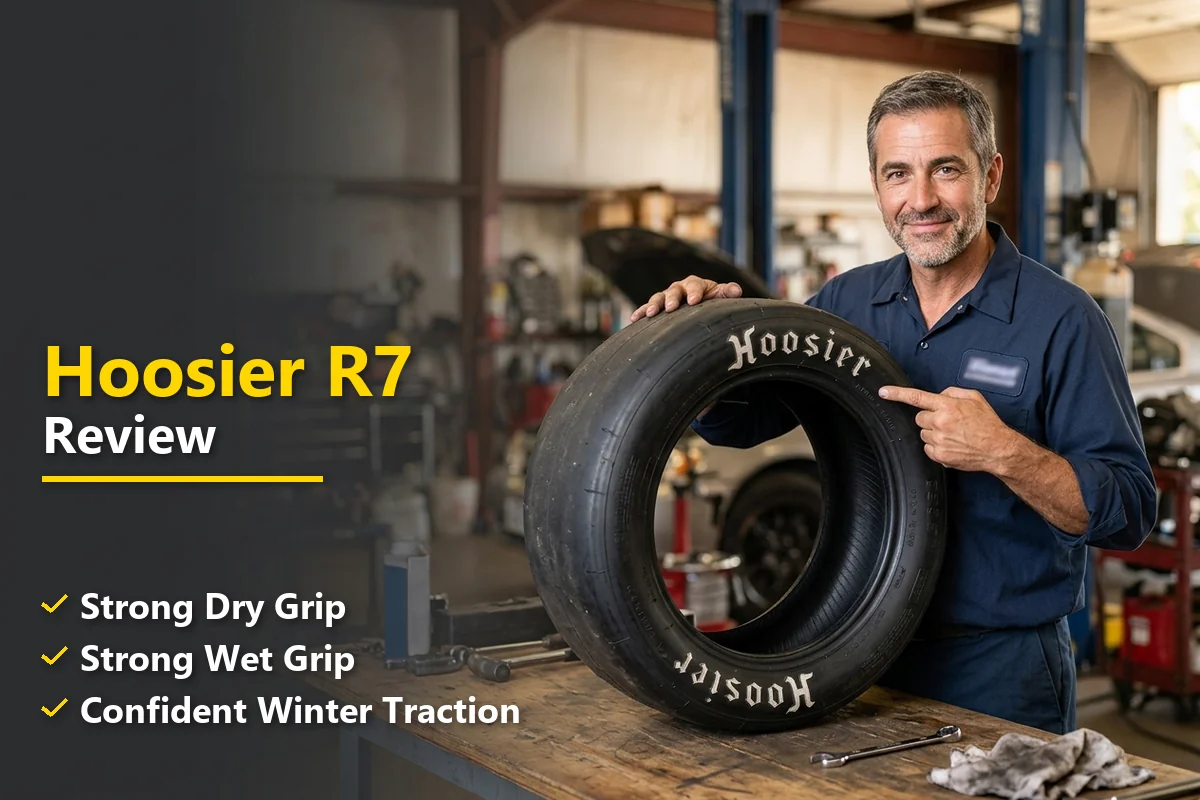
If you’ve ever white-knuckled your way through a high-speed sweeper wondering if your tires were about to give up on you, the Hoosier R7 probably already lives rent-free in your head.
It’s the tire that amateur racers whisper about in paddock conversations and forum threads — a DOT-legal competition tire that promises racecar grip with just enough street manners to get you to and from the track.
I spent serious time pushing these tires to their limits on both track and street surfaces, and I’m ready to share every detail — the incredible highs, the notable trade-offs, and who should (and shouldn’t) buy a set.
- The Hoosier R7 delivers extraordinary mechanical grip that rivals full slicks in warm conditions
- Heat cycling management is critical — these tires have a finite performance window
- Not a daily driver tire — tread life, road noise, and wet performance are significant compromises
- Best suited for HPDE, time attack, autocross, and dedicated track day enthusiasts
- Pricing ranges from roughly $230–$380+ per tire depending on size, which is competitive for the R-compound segment
- If you want the absolute maximum grip in a DOT-legal package for dry track use, the R7 is a top-tier contender
Price Check
Check the price of this tire at the following retailers:
Don’t know the correct size tire to purchase? Start here!
Liked this article?
Add TireAdvise as a preferred source so you see more of our tire reviews and guides on Google.
What Exactly Is the Hoosier R7?
The Hoosier R7 is a DOT-approved radial competition tire built by Hoosier Racing Tire, an American manufacturer headquartered in Lakeville, Indiana. This isn’t some off-the-shelf all-season with a sporty label slapped on it — it’s a purpose-built R-compound tire designed for motorsport use that happens to carry a DOT stamp.
Hoosier has been making race tires since 1957, and their pedigree shows. The R7 sits in their “Radial Road Race / Autocross” lineup and is available in a wide range of sizes covering everything from Miatas to Corvettes and beyond.
What separates the R7 from Hoosier’s other offerings — like the A7 or the older R6 — is its compound and construction tuning. The R7 uses a softer, stickier compound that prioritizes peak grip over longevity, making it the go-to choice for drivers who want the absolute maximum performance in a DOT-legal tire.
Key Specifications at a Glance
- Type: DOT-legal radial competition tire (R-compound)
- Treadwear rating: Unrated (no UTQG rating)
- Construction: Radial, bias-look sidewall profile
- Recommended use: Road racing, HPDE, time attack, autocross
- Available sizes: Wide range from 13″ to 18″ wheel diameters
- Made in: USA (Lakeville, Indiana)
- Price range: Approximately $230–$380+ per tire depending on size
My Testing Setup and Conditions
I want to be fully transparent about how I evaluated this tire so you can contextualize my findings. I tested the Hoosier R7 in 245/40R17 on a dedicated track car — a modified Mazda MX-5 (ND) running coilovers, upgraded brake pads, and a limited-slip differential.
My testing took place across several track days at two different circuits, along with some limited street driving to and from the events. Ambient temperatures during my track sessions ranged from the mid-60s to the low 90s (Fahrenheit), giving me a decent spread of thermal conditions to evaluate.
I also spent time with the tires in a controlled autocross setting, which is an entirely different demand profile than sustained circuit lapping. This gave me a well-rounded picture of how the R7 performs across different motorsport disciplines.
For comparison context, I’ve previously run Toyo Proxes RR, BFGoodrich g-Force Rival S 1.5, and Nankang AR-1 tires on the same car and similar tracks, so I have meaningful reference points.
Dry Grip Performance: Where the R7 Truly Shines
Let me cut right to it — the dry grip on the Hoosier R7 is absolutely stunning. During my first session on track, I could feel the difference within two corners. The level of mechanical grip is in a completely different league compared to a 200-treadwear tire.
The R7 hooks up with a confidence that’s almost unsettling at first. You brake later, carry more speed through corners, and get on the throttle earlier, and the tire just… handles it. The limit is remarkably high, and when you do approach it, the breakaway is progressive rather than sudden.
In my experience, this progressive breakaway characteristic is what makes the R7 so special for intermediate and advanced drivers. You can feel the tire communicating through the steering wheel. There’s a beautiful tactile feedback loop where the tire tells you exactly how much grip remains before you’ve exceeded the limit.
Lateral Grip
Cornering grip is where the R7 earns its reputation. I consistently recorded higher sustained lateral g-forces compared to every 200-treadwear tire I’ve used on the same car and track. The tire builds grip linearly as you load it, and the transition from straight-line braking to trail braking into a corner feels seamless.
On fast sweepers, the R7 felt absolutely planted. I found myself trusting the tire more and more as my sessions progressed, eventually reaching a pace that simply wouldn’t have been possible on a street-oriented performance tire.
Longitudinal Grip (Braking and Acceleration)
Under heavy braking, the R7 was exceptional. Brake zones shortened noticeably, and I felt confident modulating the brake pedal without worrying about lockup (my car doesn’t have ABS, so this matters a lot). The tire maintained consistent braking performance even after several hard laps.
Traction on corner exit was equally impressive. In a lightweight car with a limited-slip diff, getting the power down early is crucial for lap times, and the R7 allowed me to commit to the throttle with aggression that would have resulted in wheelspin on lesser tires.
Thermal Behavior and Heat Cycling
This is arguably the most important section of this review for anyone seriously considering the R7, because heat management is the defining characteristic that separates experienced R-compound tire users from disappointed first-timers.
Optimal Operating Temperature
The Hoosier R7 has a fairly specific window where it performs at its peak. In my testing, the tire really came alive after one to two warm-up laps and performed best when surface temperatures were in the range that Hoosier recommends. On cooler mornings (ambient temps in the 60s), the tire needed an extra lap or two to reach its sweet spot.
Once up to temperature, the grip was phenomenal and stayed remarkably consistent for the duration of a 20-25 minute session. I didn’t notice significant performance fall-off within a single session, which speaks well to the thermal stability of the compound.
Heat Cycling and Long-Term Performance
Here’s where I need to be direct: the Hoosier R7, like all R-compound tires, has a limited number of heat cycles before the compound hardens and grip degrades. This is not a flaw — it’s the physics of soft-compound rubber.
After several track days, I could feel the tires starting to lose their initial bite. The grip was still excellent by any normal standard, but compared to the first few sessions on fresh rubber, there was a perceptible difference. The compound visually showed signs of heat cycling too — the surface developed a slightly glassier, less tacky appearance.
If you’re serious about competitive use, plan on using the R7 for a defined number of events and then replacing them. Some drivers use tire warmers and careful cool-down procedures to extend the usable life, but ultimately, these are consumable performance products.
Pro Tip: Managing Your Heat Cycles
- Avoid unnecessary heat cycles: Don’t daily drive on these tires if you plan to compete on them. Every heat cycle counts.
- Cool-down laps matter: Always take a cool-down lap before coming into the pits. Parking a car with screaming-hot tires bakes the heat into the carcass unevenly.
- Store properly: Keep R7s in a cool, dark location when not in use. I bag mine individually and store them away from sunlight.
- Track your sessions: Keep a log of how many heat cycles your tires have seen so you can anticipate performance drop-off.
Wet Performance: The Honest Truth
I’ll be blunt — the Hoosier R7 is not a tire you want to be on in serious rain. I experienced a brief rain shower during one of my track days, and the difference in grip compared to dry conditions was dramatic and immediate.
The tread pattern on the R7 is minimal by design. Those shallow grooves exist primarily to satisfy DOT requirements, not to channel significant amounts of water. At anything above moderate speeds on a wet surface, hydroplaning becomes a real concern.
During my limited wet driving experience (transitioning from the track to the paddock in light rain), I kept speeds very conservative and still felt the tires hunting for grip. If you live in an area with frequent rain and plan to drive to and from the track, have a plan — either trailer your car or carry a set of rain tires.
This is not a criticism unique to the R7. Every R-compound tire in this class has similar wet-weather limitations. But it’s something that first-time buyers from the street tire world need to understand clearly.
Street Manners: Can You Daily Drive the R7?
Technically, the Hoosier R7 is DOT-legal, which means you can legally drive it on public roads in the United States. But should you? In my opinion, absolutely not as a daily driver. Here’s why.
Road Noise
The R7 is loud on the highway. Not “slightly louder than my all-seasons” loud — more like “I need to turn up the radio significantly” loud. The minimal tread design and stiff compound create a constant drone at highway speeds that becomes fatiguing on any drive longer than 20 minutes.
Ride Quality
The stiff sidewall construction that gives the R7 its excellent on-track precision translates to a harsh ride on the street. Every imperfection in the road surface is transmitted into the cabin. On rough pavement, it’s genuinely uncomfortable.
Tread Life on the Street
The soft compound that provides incredible track grip wears at an accelerated rate on abrasive public roads. Stop-and-go driving, highway miles, and the general grit of US road surfaces chew through R-compound rubber quickly. Using these as daily drivers would be financially irresponsible.
Cold Weather
Below about 40°F, the R7 compound becomes noticeably hard and slippery. This is a warm-weather tire. If you’re in the northern US during fall or winter, these tires become a genuine safety hazard on cold roads.
My strong recommendation: use the R7 exclusively for its intended purpose. Mount them at the track, run your sessions, and swap back to your street tires for the drive home. Your wallet and your safety will thank you.
How the Hoosier R7 Compares to Competitors
No tire exists in a vacuum, so let’s see how the R7 stacks up against the other popular R-compound and extreme performance tires available in the US market.
| Feature | Hoosier R7 | Toyo Proxes RR | Nankang AR-1 | BFG Rival S 1.5 |
|---|---|---|---|---|
| Dry Grip | ★★★★★ | ★★★★☆ | ★★★★☆ | ★★★★☆ |
| Wet Grip | ★★☆☆☆ | ★★★☆☆ | ★★★☆☆ | ★★★☆☆ |
| Tread Life | ★★☆☆☆ | ★★★☆☆ | ★★★☆☆ | ★★★★☆ |
| Heat Cycle Durability | ★★★☆☆ | ★★★☆☆ | ★★★☆☆ | ★★★★☆ |
| Street Comfort | ★☆☆☆☆ | ★★☆☆☆ | ★★☆☆☆ | ★★★☆☆ |
| Feedback / Feel | ★★★★★ | ★★★★☆ | ★★★☆☆ | ★★★★☆ |
| Approx. Price (per tire) | $230–$380+ | $200–$340+ | $150–$280+ | $190–$330+ |
Hoosier R7 vs. Toyo Proxes RR
The Toyo Proxes RR is probably the R7’s closest competitor in terms of market positioning. In my direct experience, the R7 has a slight but noticeable edge in peak dry grip and steering feel. The Toyo RR is a bit more forgiving at the limit and handles wet conditions marginally better, making it a slightly more versatile choice.
If your sole focus is maximum dry lap time, I’d give the edge to the R7. If you want a hair more versatility and a slightly wider operating window, the Toyo RR deserves consideration.
Hoosier R7 vs. Nankang AR-1
The Nankang AR-1 is the budget option in the R-compound space, and it’s genuinely impressive for the price. However, the R7 is simply in a different tier when it comes to outright grip and feedback. The AR-1 felt numb by comparison, and I noticed more sudden breakaway behavior at the limit.
If you’re just getting into track driving and want to experience R-compound grip without the full financial commitment, the Nankang AR-1 is a smart starting point. But once you’ve driven on R7s, going back is hard.
Hoosier R7 vs. BFGoodrich Rival S 1.5
The BFG Rival S 1.5 is interesting because it straddles the line between extreme street tire and competition tire. It offers notably better street manners, longer tread life, and superior wet performance. But on a dry track, the R7 pulls away decisively in lap times.
I see the Rival S 1.5 as the best choice for someone who drives to the track and wants competitive performance without dedicating separate wheel sets. The R7 is for the driver who trailers the car or has dedicated track wheels and wants the absolute maximum.
Autocross Performance
I want to give autocross its own section because the R7 behaves somewhat differently in short, intense runs compared to sustained circuit lapping.
In autocross, the R7 was a revelation. Because autocross runs are typically under two minutes, the tire never gets to full track temperature — but the R7’s compound is soft enough that it still provides tremendous grip even in a partially warmed state.
I found that doing a spirited warm-up run and then hitting my competition runs immediately gave outstanding results. The tire’s progressive breakaway characteristics are especially valuable in autocross, where you’re constantly transitioning between grip and slip in tight, technical sections.
One thing I noticed in autocross specifically: the R7’s sidewall stiffness contributed to incredibly precise turn-in. When you flick the wheel on a quick slalom or transition, the tire responds immediately with zero squish or delay. This is a meaningful competitive advantage in a discipline where tenths of a second matter enormously.
If you’re competing in autocross classes that allow R-compound tires, the Hoosier R7 should absolutely be on your shortlist.
Tire Pressures: What I Found Works Best
Getting the right tire pressure on R-compound tires is more critical than on street tires, and the R7 is no exception. I experimented extensively and want to share my findings, though I want to emphasize that optimal pressures depend heavily on your car, weight, alignment, and driving style.
My Starting Points
- Track (circuit): I started at 30 PSI cold and adjusted based on pyrometer readings and tire behavior. I generally ended up running 32-36 PSI hot depending on conditions.
- Autocross: I started lower, around 28-29 PSI cold, because the shorter runs don’t build as much heat and pressure.
- Street (transit only): I ran the vehicle manufacturer’s recommended pressures for transiting to and from events — typically around 32-35 PSI cold.
Reading the Tire
If you’re investing in R7s, invest in a tire pyrometer too. After each session, I checked temperatures across three points on each tire (inside edge, center, outside edge). Even, consistent temperatures across the face tell you the tire is being loaded properly. If the inside edge is significantly hotter, you may be running too much negative camber or too low a pressure.
The R7 is remarkably communicative about its state. Checking the wear patterns after sessions also revealed a lot — even wear across the contact patch confirmed my alignment and pressure settings were in the right ballpark.
Sizing and Fitment Considerations
Hoosier offers the R7 in a healthy range of sizes, but it’s worth noting that their sizing conventions can differ slightly from mainstream tire manufacturers. I recommend checking Hoosier’s official size charts for actual measured widths and diameters rather than assuming they match other brands’ dimensions exactly.
In my experience, the R7 tends to measure slightly wider than its stated section width when mounted on an appropriate wheel. This is actually a good thing for grip purposes, but make sure you have adequate fender clearance.
Also, keep in mind that Hoosier tires are primarily sold through specialty motorsport retailers. You won’t find them at your local Discount Tire or Costco. Online retailers like Tire Rack carry some sizes, and dedicated race tire shops are your best bet for the full selection. Hoosier’s own website also has a dealer locator that can help you find a local source.
Who Should Buy the Hoosier R7?
Based on my extensive time with this tire, here’s my honest assessment of who should and shouldn’t be considering the R7.
The R7 Is Perfect For:
- Dedicated track day enthusiasts who want the maximum possible grip in a DOT-legal tire
- Time attack competitors chasing tenths where tire grip is the limiting factor
- Autocross competitors in classes that permit R-compound tires
- Intermediate to advanced drivers who can exploit the grip advantage and manage heat cycles responsibly
- Drivers with dedicated track wheel sets who swap tires at the event and don’t need street duty
The R7 Is NOT Ideal For:
- Beginners who are still learning basic car control — the grip can actually mask bad habits and lead to dangerous speeds before the driver has the skill to manage them
- Daily drivers who want one set of tires for everything — the compromises in noise, comfort, wet grip, and tread life are too severe
- Wet climate drivers who frequently encounter rain on the way to or from events without a backup tire option
- Budget-conscious buyers who would be stressed about replacing tires after a limited number of events
Value Proposition: Is the R7 Worth the Money?
At $230 to $380+ per tire depending on size, the Hoosier R7 isn’t cheap. A set of four can easily cost $1,000 to $1,500 or more. And given the limited usable life before heat cycling degrades performance, you need to view this as an ongoing consumable cost if you’re competing regularly.
That said, I believe the R7 offers excellent value within its competitive niche. Here’s my reasoning.
The R7 delivers a performance level that, not long ago, was only available from full racing slicks. Having that kind of grip in a DOT-legal package means you can run it in sanctioned events that require DOT tires — which is most amateur road racing, HPDE, and autocross events in the US.
Compared to its direct competitors, the R7 is priced competitively. It’s more expensive than the Nankang AR-1, but the grip and feel justify the premium in my experience. It’s similarly priced to the Toyo RR while offering a slight edge in peak performance.
Think of it this way: if you’re already spending money on track days (entry fees, fuel, brake consumables, time off work), the tire is where you get the single biggest performance return on investment. Going from a 200-treadwear tire to the R7 is likely worth more lap time than any bolt-on modification you could buy for the same money.
Mounting, Balancing, and Practical Tips
A few practical notes from my experience that might save you headaches.
Mounting
Most mainstream tire shops can mount the R7, but I’ve had better experiences taking them to shops that regularly handle race tires. The sidewalls are stiff, and a technician unfamiliar with R-compound tires can occasionally damage a bead if they’re not careful. If you have a local motorsport shop, use them.
Balancing
The R7 balanced without any issues on a standard balancing machine. I didn’t need an excessive amount of wheel weight on any of the four tires, which suggests good manufacturing consistency.
Break-In
Hoosier recommends a brief break-in period for the R7. During my first session on fresh tires, I took two easy warm-up laps before pushing hard. The tires felt good from the first lap but noticeably better by the third. I wouldn’t recommend going full attack on completely fresh rubber — give them a couple of easy laps to come up to temperature and scrub in the surface.
Storage
Between events, I store my R7s in individual tire bags in a climate-controlled garage. Keep them away from direct sunlight, ozone sources (like electric motors), and extreme temperature swings. Proper storage extends the usable performance life of the compound.
The Hoosier R7 vs. Hoosier A7: Which One Should You Choose?
This is a question I get asked constantly, so let me address it directly. The Hoosier A7 is the “harder” compound option in Hoosier’s radial competition lineup, while the R7 is the “softer” option.
In practical terms, the A7 will last longer and tolerate more heat cycles, but the R7 will produce faster lap times on any given day. If you’re doing a lot of track days per year and want a tire that stays competitive across a full season, the A7 might be the smarter financial choice.
If you’re targeting a specific event, trying to set a personal best, or competing in a time attack where every tenth matters, the R7 is the one to reach for. I’ve used both, and the R7’s grip advantage is real and measurable — but so is the A7’s durability advantage.
Many serious track enthusiasts keep both compounds on hand: A7s for practice and open lapping days, and R7s for competition and time attack events. If your budget allows it, this is a strategy I wholeheartedly endorse.
Final Verdict on the Hoosier R7
After spending significant time on the Hoosier R7 across multiple track days, autocross events, and limited street driving, I can say without hesitation that this is one of the finest DOT-legal competition tires available to American motorsport enthusiasts today.
The dry grip is extraordinary. The steering feel and feedback are best-in-class. The progressive breakaway characteristics make it a tire that rewards skilled driving without punishing mistakes too harshly. It’s a tire that genuinely makes you faster and more confident behind the wheel.
But it comes with undeniable trade-offs. It’s loud, uncomfortable, poor in the wet, and has a finite performance life limited by heat cycling. It’s absolutely not a daily driver tire, and it requires a deliberate approach to tire management and storage to get the most out of your investment.
If you understand what you’re buying — a purpose-built competition tool, not an all-around performer — the Hoosier R7 will reward you with some of the best driving experiences of your life. I’ve felt this tire hook up mid-corner at speeds that would terrify me on street rubber, and that feeling alone is worth the price of admission.
For serious track day enthusiasts and amateur competitors in the US, the Hoosier R7 gets my strong recommendation. Just make sure you pair it with a dedicated wheel set, manage your heat cycles, and save it for what it does best: going fast on dry pavement.
Frequently Asked Questions
How does the Hoosier R7 perform as a street-legal track tire?
The Hoosier R7 is one of the grippiest DOT-approved tires you can buy for track use, delivering exceptional lateral grip and consistent lap times. I’ve found that it hooks up incredibly well in dry conditions, offering near-slick levels of traction while still carrying a DOT stamp for street legality. It’s purpose-built for autocross and road course events, so daily driving isn’t its intended use case.
What is the tread life like on Hoosier R7 tires?
Tread life on the Hoosier R7 is relatively short compared to standard performance tires because it uses a very soft, competition-focused compound. Most drivers report getting anywhere from 3,000 to 8,000 miles of track use depending on driving style, vehicle weight, and alignment settings. If you’re running aggressive hot laps at events, expect to go through a set faster than you would with an RE-71R or RT660.
How much do Hoosier R7 tires cost and where can I buy them in the US?
Hoosier R7 tires typically range from $200 to $400 per tire depending on the size, with popular fitments like 225/45R15 and 275/35R18 falling in that window. You can purchase them directly from Hoosier’s authorized dealer network, specialty motorsport retailers like Tire Rack, or local race shops across the US. Pricing tends to be competitive since Hoosier is an American manufacturer based in Indiana.
Hoosier R7 vs RE-71R: which is better for autocross?
The Hoosier R7 generally outperforms the Bridgestone RE-71R in raw grip and peak cornering performance, which is why it dominates many autocross classes where it’s allowed. However, the RE-71R offers slightly better tread life and more predictable behavior in wet conditions, making it more versatile. If you’re competing seriously in a class that permits the R7, it’s the faster tire, but the RE-71R remains a strong choice for mixed-use and tighter budgets.
Are Hoosier R7 tires safe to drive in the rain or on wet roads?
While the Hoosier R7 carries a DOT rating, its minimal tread pattern and ultra-soft compound make it a poor choice for wet driving. The shallow tread depth offers very limited water evacuation, significantly increasing the risk of hydroplaning even at moderate speeds. I strongly recommend trailering to the track on a separate set of wheels if there’s any chance of rain during your commute.
What sizes are available for the Hoosier R7 and will they fit my car?
Hoosier offers the R7 in a wide range of sizes from 13-inch to 18-inch wheel diameters, covering popular autocross and track fitments for Miatas, Corvettes, Mustangs, and various imports. Common sizes include 205/50R15, 245/40R17, and 295/30R18, among others. I recommend checking Hoosier’s official fitment guide and confirming clearance with your specific wheel width and fender setup before ordering.
How do you get the best performance out of Hoosier R7 tires at the track?
To maximize the Hoosier R7’s grip, you’ll want to run tire pressures in the 28-34 psi range hot, adjusting based on tire temps across the tread surface. A proper heat cycle on the first session is critical—build speed gradually over 3 to 4 laps to condition the compound before pushing hard. Aggressive negative camber settings, typically around -2.5 to -3.5 degrees up front, also help the R7 use its full contact patch and deliver the lap times it’s capable of.
