

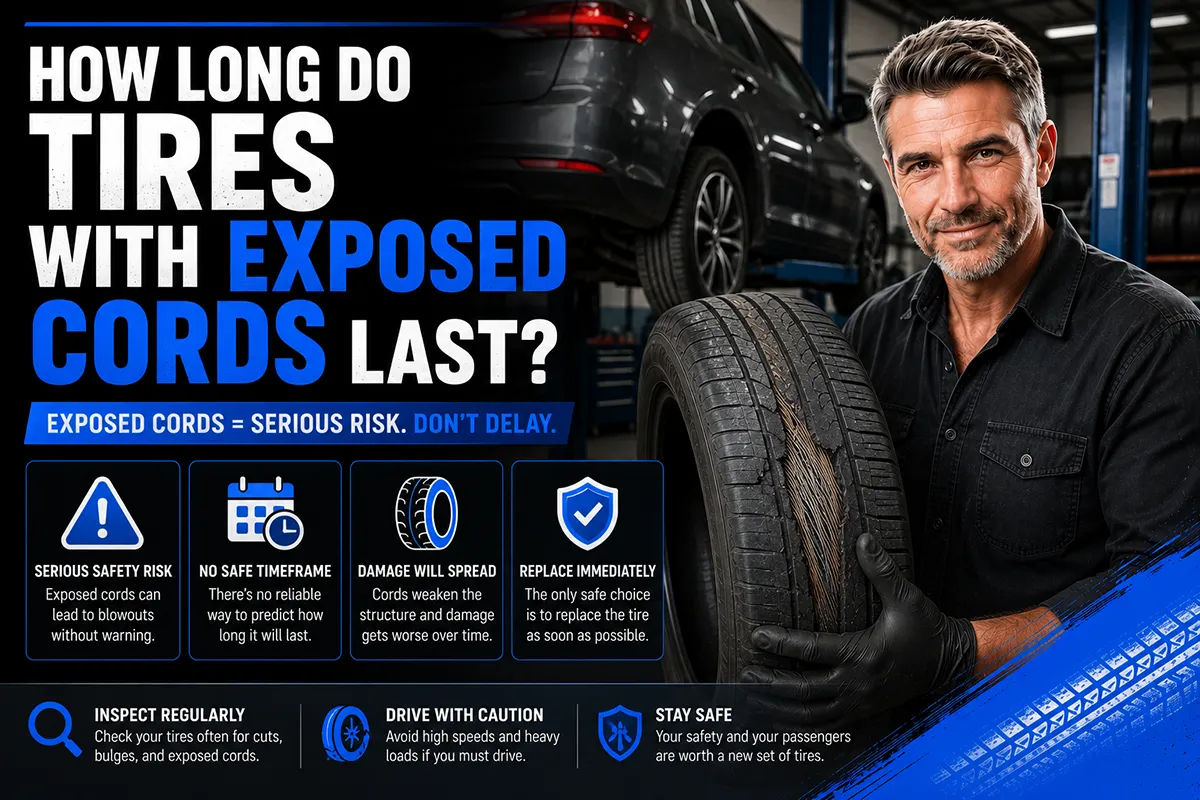
- Tires with exposed cords should be replaced immediately — they can blow out without warning at any speed.
- There is no safe timeframe for driving on them, not even “just to the tire shop.”
- Exposed cords mean the tire’s structural integrity is compromised beyond repair — no patch, plug, or sealant will fix this.
- If you absolutely must move the car, drive under 25 mph on surface streets for the shortest possible distance.
- Budget replacement tires in the US start around $50–$70 per tire installed — far cheaper than a blowout-related accident.
Liked this article?
Add TireAdvise as a preferred source so you see more of our tire reviews and guides on Google.
What Are Tire Cords and Why Do They Matter?
To understand how serious this problem is, you need to know what’s actually inside your tire. Most people think a tire is just a thick ring of rubber, but that’s far from the truth. Inside every modern passenger tire, there are layers of reinforcing materials — typically polyester body plies and steel belt packages — that give the tire its shape and strength. These internal fabrics and wires are what I’m referring to when I say “cords.” The rubber tread on the outside is essentially the sacrificial layer. It’s designed to wear down over time while protecting those internal cords. Once the rubber wears through and those cords become visible, you’ve lost the tire’s primary structural protection. I’ve cut open dozens of worn-out tires over the years to show people what’s inside, and every single time, people are shocked at how thin the remaining rubber is even on a tire that “looks fine” from a distance. When cords are actually showing, there’s essentially zero rubber left between the road and the tire’s skeleton.How Long Do Tires With Exposed Cords Actually Last?
Here’s the blunt truth from someone who has been reviewing and testing tires for years: tires with exposed cords have zero safe life remaining. I know that’s not what you want to hear. You’re probably reading this because you noticed cords on your tire and you’re hoping I’ll tell you it’s safe to drive for another week or two until you can budget for replacements. I can’t do that in good conscience. In my experience inspecting failed tires — both on my own test vehicles and on cars that friends and readers have brought to me — a tire with exposed cords can fail at literally any moment. I’ve seen blowouts happen within hours of the first cord becoming visible. I’ve also seen people (like my cousin) somehow limp along for several days. But that survival is pure luck, not an indication that the tire is safe.The Variables That Affect How Quickly a Cord-Exposed Tire Fails
While I will never tell you it’s “safe” to drive on exposed cords, I can tell you what factors make a blowout more or less imminent:- Speed: Higher speeds generate more heat, and heat is the number-one enemy of a compromised tire. Highway driving at 60+ mph can cause a blowout within minutes.
- Temperature: Summer heat in states like Texas, Arizona, or Florida dramatically accelerates tire failure. Hot asphalt can reach 150°F+, which softens and further weakens the exposed area.
- Load: A fully loaded vehicle — passengers, cargo, a trailer — puts more stress on the tire. Exposed cords under heavy load are a recipe for disaster.
- Tire position: A front tire blowout is generally more dangerous because it directly affects steering. A rear blowout is still serious but slightly more manageable.
- Road conditions: Potholes, debris, gravel, and even rain can instantly trigger failure in a cord-exposed tire. The exposed steel wires are vulnerable to moisture, which causes rapid corrosion.
- Extent of cord exposure: A small patch of visible cords on one edge is marginally less immediately dangerous than a full band of exposed steel across the tread face — but both are emergencies.
What Causes Cords to Become Exposed?
In all my years of testing and reviewing tires, I’ve seen cords become exposed for several different reasons. Understanding the cause can help you prevent it from happening on your next set.1. Normal Wear Past the Safe Limit
This is the most common cause. Every tire has tread wear indicators — those small raised bars sitting in the grooves at 2/32″ depth. Once the tread wears flush with those bars, the tire is legally bald in most US states. If you keep driving past that point, you’ll eventually reach the cords. I’ve tested tires all the way down to their wear indicators and measured what’s left. At 2/32″, there’s still a thin buffer of rubber over the cords. At 0/32″, you’re basically there. People who ignore wear indicators for weeks or months after they first become visible are the ones who end up with cord exposure.2. Misalignment and Uneven Wear
This one drives me crazy because it’s so preventable. I reviewed a set of mid-range all-season tires a while back that should have lasted well beyond their warranty period, but the owner had never gotten an alignment after hitting a curb. The inside edges of both front tires wore down to the cords while the outer edges still had plenty of tread left. If you’re only checking the outer visible edge of your tires, you could be missing dangerous wear on the inside. I always recommend running your hand across the full width of the tread (when the tire is cool) to feel for uneven wear.3. Under-Inflation
Running tires below their recommended pressure causes the outer shoulders to bear more load, leading to accelerated wear on both edges. I’ve seen under-inflated tires wear to the cords in a fraction of the time a properly inflated tire would. In my testing, even being 8–10 psi below the recommended pressure (found on the driver’s door jamb sticker, not the tire sidewall) caused noticeable uneven wear patterns within just a few weeks of daily driving.4. Over-Inflation
The opposite problem. Over-inflated tires ride on the center of the tread, causing the middle to wear down faster than the edges. I’ve seen center-worn tires with cords showing in a strip right down the middle while the shoulders looked practically new.5. Defective or Low-Quality Tires
I’ll be honest — in my reviews, I’ve occasionally come across budget tires from no-name brands that wore through to the cords suspiciously fast. While most tires from reputable manufacturers (even budget-friendly ones like Westlake, Hankook, or Cooper) are well-constructed, some ultra-cheap imports cut corners on rubber compound quality and belt placement.6. Mechanical Damage
Hitting a pothole, curb, or road debris can damage the internal structure and cause localized rapid wear or a bulge that eventually exposes cords. I’ve seen this happen suddenly — a tire that looked fine one day had a worn-through spot just days later because of hidden internal damage from an impact.Why You Cannot Repair a Tire With Exposed Cords
Let me be crystal clear about this: no tire repair method can fix a tire with exposed cords. I’ve had readers ask me about patches, plugs, rubber cement, tire sealant sprays, and even old-school methods like vulcanization. None of these are appropriate for a tire with visible cords, and no reputable tire shop in the US will attempt such a repair. Here’s why:- Patches and plugs are designed to seal punctures in the tread area where sufficient rubber surrounds the repair. When cords are exposed, there’s no rubber left to bond with.
- Sealant sprays (like Fix-a-Flat) address small punctures by filling the air cavity. They do nothing to restore structural integrity to a worn-through tire.
- Re-treading is a process used commercially on truck tires but is not available or safe for passenger tires, and even commercial re-treaders reject casings with cord damage.
The Real Dangers of Driving on Exposed Cords
I want to walk you through what can actually happen, because I think some people underestimate the risk.Blowout at Highway Speed
This is the nightmare scenario, and it’s the most common outcome if you continue driving on exposed cords at speed. The weakened area gives way suddenly, and the tire loses all air pressure in an instant. I’ve experienced a rear tire blowout during a test (on a tire I was intentionally running to failure in a controlled environment), and even at moderate speed on a straight road, it took everything I had to keep the car stable. At highway speed with traffic around you, this can be fatal. According to the National Highway Traffic Safety Administration (NHTSA), tire-related crashes cause hundreds of fatalities and thousands of injuries every year in the United States.Loss of Traction in Rain
A tire with exposed cords has zero tread depth, which means zero ability to channel water. Even a thin film of rain on the road will cause hydroplaning at speeds as low as 35 mph. I’ve tested bald tires on wet surfaces, and the loss of grip is immediate and terrifying.Inability to Brake Effectively
In my braking tests, the difference between a tire at 4/32″ tread depth and a bald tire is staggering. Stopping distances can increase by 40–80% on wet roads with a bald tire. With exposed cords, the surface is partially steel against asphalt — there’s almost no predictable friction.Slow Air Leak Leading to Rim Damage
Even if the tire doesn’t blow out dramatically, exposed cords allow air to seep through the compromised tread. You might notice your tire losing pressure daily. If you drive on it long enough while it’s losing air, you risk damaging the wheel rim, which turns a $60 tire replacement into a $200+ rim-and-tire job.What to Do Right Now If Your Tires Have Exposed Cords
Okay, let’s get practical. If you’re reading this article because you’re staring at cords on your tire right now, here’s my step-by-step advice:Step 1: Stop Driving on It
If you’re at home, leave the car parked. If you’re somewhere else, get to the nearest safe stopping point. Do not take the highway home. Do not “just run one more errand.”Step 2: Use Your Spare Tire
Most cars sold in the US come with either a compact spare (donut) or a full-size spare in the trunk. Pull it out and put it on. A compact spare is rated for temporary use at up to 50 mph — that’s far safer than driving on exposed cords. If you’ve never changed a tire before, your owner’s manual has step-by-step instructions, and there are excellent video guides available. It takes about 15–20 minutes.Step 3: If No Spare Is Available, Call for Help
Many newer vehicles (especially EVs and some compact cars) come with a tire inflator kit instead of a spare. That kit will not help you here. Call roadside assistance — most auto insurance policies, AAA memberships, and even some credit cards include free towing.Step 4: Get a Replacement Tire ASAP
Drive (on your spare) to the nearest tire shop. You don’t need to buy the most expensive tire — you just need a safe one. I’ll cover affordable options below.Affordable Replacement Tire Options in the US
One of the biggest reasons people keep driving on dangerous tires is cost. I understand that — tires aren’t cheap, and unexpected expenses hit hard. But let me show you that replacement doesn’t have to break the bank.Budget-Friendly Tire Brands I’ve Tested and Recommend
| Brand/Model | Type | Approx. Price (per tire, common sizes) | My Take |
|---|---|---|---|
| Westlake RP18 | All-Season | $50–$70 | Solid budget pick. Quiet, decent grip, won’t win any performance awards but perfectly safe for daily driving. |
| Cooper CS5 Grand Touring | All-Season Touring | $80–$110 | American-designed, excellent ride comfort. One of my go-to recommendations for budget-conscious buyers. |
| Hankook Kinergy PT (H737) | All-Season | $75–$100 | Good treadwear, impressive wet traction for the price. A favorite in my budget tire reviews. |
| General AltiMAX RT45 | All-Season | $70–$95 | Backed by Continental’s engineering. Impressive longevity for the price point in my wear testing. |
| Firestone All Season | All-Season | $65–$90 | A classic American brand. Nothing fancy, but reliably safe and widely available at Firestone Complete Auto Care shops. |
If you can only afford to replace one tire right now, do it — and put the new tire on the same axle as the other tire in better condition. But ideally, replace at least two tires at a time (both on the same axle) for balanced handling.
Where to Buy Affordable Tires
- Walmart Auto Care Centers: Often the lowest installed prices I’ve found. They carry budget brands and offer free lifetime balancing and rotation with purchase.
- Discount Tire / America’s Tire: The largest independent tire retailer in the US. They price-match and frequently run promotions. Their road hazard warranty is excellent.
- Costco Tire Center: If you have a membership, their tire packages (which include installation, balancing, rotations, and road hazard) are hard to beat.
- TireRack.com: Great for comparison shopping. You can order online and have tires shipped free to a local installer.
- Used tire shops: I’m cautious here. While a quality used tire with plenty of tread left is infinitely better than a tire with exposed cords, inspect it carefully (or have a pro inspect it) for age, patches, and uneven wear. Check the DOT date code — I don’t recommend used tires older than 5–6 years.
Can You Pass a State Inspection With Exposed Cords?
Absolutely not. In every US state that requires periodic vehicle safety inspections — including Texas, New York, Virginia, Pennsylvania, Missouri, and others — a tire with exposed cords is an automatic failure. Most state inspection standards require a minimum of 2/32″ tread depth across the full width of the tread, with no exposed cords, belts, or fabric visible anywhere on the tire. Some states set the bar at 1/32″, but even that is far above the zero rubber remaining that characterizes exposed cords. In my experience, even in states without mandatory inspections, law enforcement can and do issue citations for unsafe tires during traffic stops. In some jurisdictions, driving on tires with exposed cords can be classified as operating an unsafe vehicle, which carries fines and can affect your insurance.How to Check Your Tires Before It Gets This Bad
Prevention is everything. In my years of testing and reviewing tires, I’ve developed a quick monthly inspection routine that takes less than five minutes. Here’s what I do, and what I recommend you do too:The Penny and Quarter Test
You’ve probably heard of the penny test: insert a penny head-first into the tread groove. If you can see all of Lincoln’s head, you’re at or below 2/32″ — legally bald. Time to replace. But I actually prefer the quarter test for earlier warning. Insert a quarter head-first. If you can see all of Washington’s head, you’re at or below 4/32″ — still legal, but your wet weather performance is already significantly degraded. This is my personal replacement threshold, especially for drivers in rainy areas like the Pacific Northwest or Southeast.Monthly Visual and Tactile Inspection
- Walk around the car and look at each tire from the front and side.
- Check for uneven wear by running your palm across the full tread width. Feel for smooth patches, feathering, or any rough metal poking through.
- Look at the sidewalls for bulges, cracks, or cuts. These can indicate internal damage that could lead to sudden failure even with adequate tread.
- Check tire pressures with a digital gauge (they’re about $8 at any auto parts store). Do this when the tires are cold — before driving or at least three hours after driving.
- Note the DOT date code on the sidewall. It’s a four-digit number — the first two digits are the week, the last two are the year. For example, “2319” means the 23rd week of 2019. I recommend replacing tires older than 6 years regardless of tread depth, and absolutely by 10 years (which is the maximum age recommended by most tire manufacturers).
Get Regular Alignments and Rotations
In my experience, the single most effective thing you can do to maximize tire life and prevent uneven wear is to stay on top of alignments and rotations. I rotate my test tires every time I have them in for an oil change — roughly every few months. Most tire shops will do rotations for free if you purchased the tires there. Alignments should be done at least once a year, or any time you hit a significant pothole or curb.Understanding When “Worn” Becomes “Dangerous”
There’s a progression that I want to make clear, because I think a lot of drivers don’t realize how quickly “getting worn” turns into “dangerously bald” turns into “cords are showing.”| Tread Depth | Status | What I Recommend |
|---|---|---|
| 10/32″–7/32″ | Good tread life remaining | Keep driving. Monitor monthly. |
| 6/32″–5/32″ | Moderate wear — still safe | Start budgeting for replacements. Wet traction beginning to decline. |
| 4/32″ | Approaching end of useful life | Replace soon, especially if you drive in rain or snow. This is my personal threshold. |
| 2/32″ | Legally bald in most states | Replace immediately. You’re on borrowed time. |
| 0/32″ — Cords visible | Structurally compromised — DANGEROUS | Stop driving. Replace now. Use your spare. |
Liability and Insurance Implications
This is something most people don’t think about, and I want to bring it up because it has real financial consequences. If you’re involved in an accident while driving on tires with exposed cords, your insurance company may deny or reduce your claim. Driving on a known unsafe vehicle component can be considered negligence. I’ve spoken with insurance adjusters who’ve told me that tire condition is one of the first things they check after an accident. Beyond insurance, if your tire fails and causes an accident that injures someone else, you could face personal liability. In a worst-case scenario, driving on visibly unsafe tires could be used against you in a civil lawsuit to establish negligence. This isn’t theoretical — it happens in courtrooms across the US.Real-World Scenarios I’ve Encountered
Let me share a few real situations that illustrate why I take this so seriously.The “Just Getting to Work” Driver
A reader emailed me after finding my tire reviews online. He had a front tire showing cords and asked if he could drive about 15 minutes to work and back for a couple of days until he got paid. I told him to use his spare, but he admitted he’d never checked if he had one. Turned out he had a full-size spare in perfect condition that had been sitting in his trunk for years. He mounted it that evening and drove safely until he could buy a replacement. The lesson: check for your spare tire today, even if you don’t need it yet.The Highway Blowout
A friend of a friend was driving on I-35 in Texas during a summer afternoon. Rear left tire had cords showing — she knew about it but was waiting until the weekend. The tire blew out at highway speed. She lost control briefly, crossed a lane, and hit the median barrier. No one was seriously hurt, but the car needed several thousand dollars in body work and her insurance premiums went up. The tire would have cost $75 to replace.The Seasonal Discovery
I was helping my neighbor swap his summer tires back on after winter, and when I pulled the summer set out of his garage, two of the four had cords showing on the inside edges. He had no idea — he’d stored them at the end of the previous season without inspecting them. Those tires had been slowly wearing unevenly all of the prior summer due to a bad alignment. He was about to mount dangerously compromised tires without realizing it. The lesson: always inspect tires before mounting, after removing from storage, and regularly throughout their use.Final Thoughts: Don’t Gamble With Your Safety
I’ve tested hundreds of tires across every category — budget all-seasons, premium touring tires, ultra-high-performance summer tires, all-terrain truck tires. I’ve driven them in rain, snow, desert heat, and everything in between. Through all of that testing, the single most important thing I’ve learned about tires is this: a tire’s ability to keep you safe depends entirely on its structural integrity. When cords are exposed, that integrity is gone. There is no amount of careful driving, reduced speed, or shorter trips that makes it safe. The tire is done. It’s served its purpose, and continuing to drive on it is a gamble where the potential cost — your life, someone else’s life, or at minimum a very expensive accident — vastly outweighs the cost of a replacement tire. I understand that money is tight for a lot of people. I’ve been there myself. But a basic, safe replacement tire from a budget brand can be had for around $50–$70 installed at Walmart or Discount Tire. Many shops offer payment plans or accept credit cards. Some even offer interest-free financing. If you’ve read this entire article, you now know more about tire safety than most drivers on the road. Use that knowledge. Check your tires this weekend. Run the quarter test. Feel for uneven wear. Look at those inner edges you normally can’t see without crouching down. And if you see cords — any cords, anywhere — it’s time to stop driving and start shopping. Your tires are the only thing between your car and the road. Don’t let them fail you when it matters most.Frequently Asked Questions
How long can you drive on tires with exposed cords?
You should not drive on tires with exposed cords at all. Once the steel or fabric cords are visible through the rubber, the tire has zero remaining safe tread life and can blow out at any moment, especially at highway speeds. I recommend replacing cord-exposed tires immediately before driving anywhere, even to a nearby tire shop — use a spare or call for a tow instead.
Is it illegal to drive on tires with cords showing in the US?
Yes, in most US states it is illegal to drive on tires with exposed cords because they fail minimum tread depth requirements, which is typically 2/32 of an inch. If a police officer spots cord-exposed tires during a traffic stop or inspection, you could face a citation, fines ranging from $50 to $200 or more depending on the state, and your vehicle may be deemed unsafe to operate. Driving on them also voids any tire warranty and can create serious liability issues if you cause an accident.
What causes tire cords to become exposed?
Tire cords become exposed when the tread rubber wears down completely, which is usually caused by driving well past the tire’s usable lifespan, improper wheel alignment, or underinflation that creates uneven wear patterns. Aggressive driving habits like hard braking and fast cornering accelerate tread wear significantly. I’ve also seen cords exposed from hitting potholes or curbs that damage the sidewall, which is especially common on rough US roads during winter and spring.
Can a tire with exposed cords be repaired or retreaded?
No, a tire with exposed cords cannot be safely repaired or retreaded. Once the structural cords are visible, the tire’s integrity is permanently compromised, and no patch, plug, or retread process can restore it to a safe condition. The only option is full replacement, and I’d strongly recommend replacing tires in pairs on the same axle for balanced handling and safety.
How much does it cost to replace tires with exposed cords?
Replacement tire costs in the US typically range from $60 to $150 per tire for budget brands like Westlake or Cooper, $100 to $200 for mid-range options like General or Falken, and $150 to $300+ for premium brands like Michelin, Bridgestone, or Goodyear. Add $15 to $25 per tire for mounting and balancing at most shops. Since tires with exposed cords need immediate replacement, check retailers like Tire Rack, Discount Tire, or Costco for competitive pricing and fast availability.
What are the dangers of driving on tires with cords showing?
Driving on tires with exposed cords puts you at serious risk of a sudden blowout, which can cause loss of vehicle control at any speed and is especially deadly on highways. The tire has virtually no traction in wet conditions, dramatically increasing your stopping distance and hydroplaning risk. You also risk damaging your wheel rims, suspension components, and brakes if the tire fails completely, which can turn a $100 tire replacement into a $1,000+ repair bill.
How can I prevent my tires from wearing down to the cords?
The best way to prevent tires from reaching cord exposure is to check your tread depth monthly using a penny test — insert a penny head-first into the tread, and if you can see all of Lincoln’s head, you’re at or below 2/32 and need new tires. I also recommend rotating your tires every 5,000 to 7,500 miles, keeping them inflated to the manufacturer’s recommended PSI found on your door jamb sticker, and getting a wheel alignment at least once a year or after hitting a significant pothole. Most tires last 40,000 to 70,000 miles depending on the brand, so plan your replacement budget before they reach a dangerous wear level.
