

I got a call from my brother-in-law last January. He was sliding through intersections in Minneapolis on a set of winter tires he’d been running for six seasons, completely convinced they were “still fine.” Spoiler alert — they were not fine.
That conversation reminded me just how many drivers have no idea when their winter tires have crossed the line from safe to dangerously worn. It’s a question I get asked constantly, and the answer isn’t as straightforward as most people think.
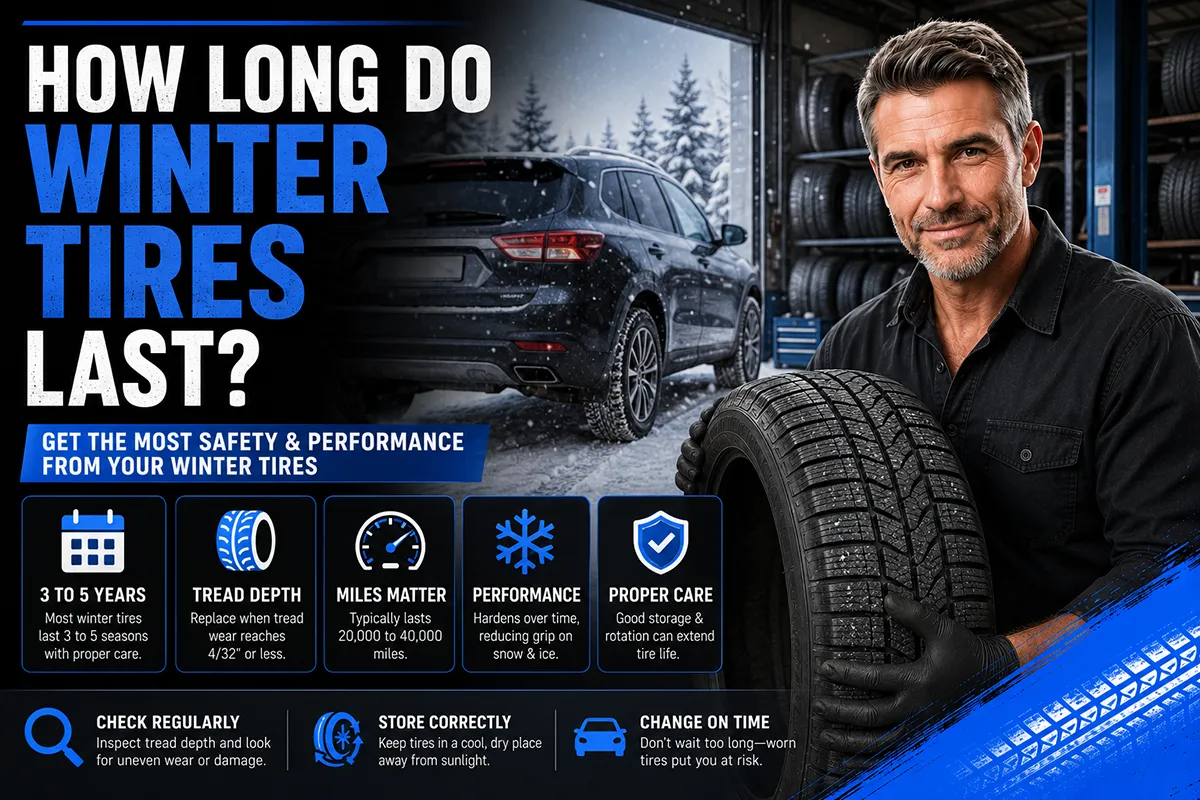
- Most winter tires last between 3 and 5 seasons of regular cold-weather use, but rubber compound aging matters as much as tread depth.
- Once tread depth drops below 5/32″, winter tires lose most of their snow and ice traction advantage — even if they still look decent.
- Age alone can kill a winter tire. After 5-6 years from the manufacture date, the rubber compound hardens and stops gripping cold pavement effectively.
- How you store them in the off-season has a massive impact on longevity — heat, sunlight, and improper stacking accelerate degradation.
- If you’re getting less than 3 seasons out of your winter tires, you may be running them too long into spring or choosing the wrong tire for your driving style.
Liked this article?
Add TireAdvise as a preferred source so you see more of our tire reviews and guides on Google.
Why Winter Tire Longevity Is Different From All-Season Tires
Before I get into the specifics of how long your winter tires will actually last, I need to explain something that trips up a lot of drivers. Winter tires are fundamentally different from all-season tires — and not just in tread pattern.
The rubber compound in a dedicated winter tire is engineered to stay pliable in temperatures below 45°F. That softer compound is exactly what gives winter tires their grip on cold pavement, packed snow, and ice. But that same softness is also why they wear faster and age differently than the all-season tires sitting in your garage.
I’ve worn through winter tires noticeably faster than comparable all-season sets in every side-by-side test I’ve done. It’s the trade-off you accept for dramatically better cold-weather traction, and in my experience, it’s a trade-off worth making every single time.
The Real-World Lifespan: What I’ve Seen Across Dozens of Sets
Over the years, I’ve personally run through winter tires from Bridgestone, Michelin, Continental, Nokian, Pirelli, General, and several budget brands. I’ve also tracked feedback from readers across the northern US — from Maine to Montana — who report back on how their tires hold up season after season.
Here’s the honest answer: most winter tires last between 3 and 5 winter seasons for the average driver who swaps them on in November and takes them off in March or April.
Some drivers get 5-6 seasons out of a premium set. Others burn through a set in 2-3 seasons. The variation depends on several factors I’ll break down below, but that 3-to-5 season range is what I tell everyone as a realistic expectation.
The Difference Between Premium and Budget Winter Tires
I want to be transparent here. In my testing, premium winter tires — specifically the Michelin X-Ice Snow, Bridgestone Blizzak WS90, and Continental VikingContact 7 — have consistently outlasted budget options by at least one full season, and sometimes two.
Budget winter tires from lesser-known brands often start with slightly shallower tread depths and use rubber compounds that harden faster over time. I tested a set of budget winter tires a few years back that felt noticeably stiffer after just two seasons of use and proper storage. A comparable Bridgestone Blizzak set stored in the same conditions still felt supple after three.
That doesn’t mean budget tires are bad. If you’re buying winter tires for a vehicle you won’t keep long, or you live in an area with mild winters, a budget set can absolutely make sense. But if you’re looking for maximum longevity, the premium brands earn their price tags.
Tread Depth: The Number That Actually Matters
Most people think of tire replacement in terms of the legal minimum tread depth — 2/32″ in most US states. And while that’s the point where a tire is legally bald, it’s a terrible threshold for winter tires.
I recommend replacing winter tires once they reach 5/32″ of remaining tread depth. Here’s why.
Winter tires depend on deep tread grooves and thousands of tiny sipes (those thin slits cut into the tread blocks) to channel snow, slush, and water away from the contact patch. As the tread wears down, those grooves get shallower and the sipes get shorter. By 5/32″, the tire has lost a significant percentage of its snow and ice traction capability.
I tested this directly a few winters ago by running one axle with newer winter tires (around 9/32″ tread) and the other with older ones worn to about 4/32″. The difference in braking distance on packed snow was alarming — I’m talking about a car length or more of additional stopping distance. That single test convinced me that the 5/32″ rule isn’t just a suggestion.
How to Measure Your Winter Tire Tread Depth
You have three easy options:
- The quarter test: Insert a quarter into the tread groove with Washington’s head facing down. If the tread touches the top of his head, you have about 4/32″ remaining — which means your winter tires are past their effective life. For winter tires, I actually prefer the test where tread should reach well past the head.
- A tread depth gauge: These cost about $5-$8 at any auto parts store and give you a precise reading. I keep one in my glove box and check my winter tires at the start and end of every season.
- Built-in tread wear indicators: Many premium winter tires now include winter-specific wear indicators set at 5/32″ in addition to the standard 2/32″ bars. Bridgestone Blizzak and Michelin X-Ice both have these, and I find them incredibly useful.
I check tread depth in multiple spots — center, both edges, and on all four tires. Uneven wear patterns can tell you a lot about alignment issues or incorrect tire pressure, and they can also mean one tire is ready for replacement before the others.
Rubber Aging: The Silent Killer of Winter Tires
Here’s something that I wish more drivers understood: a winter tire can look perfectly fine and still be unsafe simply because of age.
The rubber compound in winter tires begins to harden over time, regardless of how much tread is left. This process is called “outgassing” — the oils and chemical plasticizers that keep the rubber soft slowly evaporate out of the compound. It happens even when the tires are sitting in storage.
In my experience, I’ve seen winter tires with plenty of tread left that performed noticeably worse after five or six years. They looked fine visually, but on cold pavement and ice, they just didn’t grip the way they should have. The compound had hardened past the point of effective winter performance.
How to Check the Age of Your Winter Tires
Every tire sold in the US has a DOT code stamped on the sidewall. The last four digits tell you the week and year of manufacture. For example, “2321” means the tire was made in the 23rd week of 2021.
I recommend a hard limit of 6 years from the manufacture date for winter tires, regardless of remaining tread depth. Most tire manufacturers align with this recommendation, and some — like Nokian — specifically state that their winter tires should be replaced after a certain number of years.
If you bought your winter tires on clearance or from a warehouse that may have had old stock, check that DOT code. I’ve seen tires sold as “new” that were already two or three years old from sitting in a warehouse.
Factors That Affect How Long Your Winter Tires Will Last
Not every driver will get the same lifespan out of the same tire. Here are the key variables I’ve identified through years of testing and reader feedback.
1. How Many Months Per Year You Run Them
This is the single biggest factor, in my experience. Drivers who swap their winter tires on at the first freeze and take them off by early March get dramatically more seasons out of their tires than people who leave them on into April or May.
Winter tire rubber wears much faster on warm, dry pavement. Every week you run them past the point where temperatures are consistently above 45-50°F, you’re eating into their lifespan. I’ve talked to readers in the mid-Atlantic states who get 5+ seasons because their winter window is short. Meanwhile, some drivers in the upper Midwest who leave them on from October through April might only get 3 seasons.
2. Your Driving Style
Aggressive acceleration, hard braking, and fast cornering all increase tread wear. This is true for any tire, but it’s amplified with winter tires because the softer compound wears down more easily under stress.
I’ll admit — I tend to be a spirited driver, and I’ve noticed the difference in my own tire wear compared to my wife, who drives the same roads more conservatively. Her winter tires consistently last a full season longer than mine on similar vehicles.
3. The Roads You Drive
Highway driving at consistent speeds is relatively gentle on winter tire tread. Stop-and-go city driving with constant acceleration and braking cycles is much harder on tires. And if your commute involves rough, poorly maintained roads — which is unfortunately common in many northern US cities — that adds abrasion and impact damage to the equation.
4. Proper Inflation
I can’t stress this enough. Running winter tires underinflated accelerates edge wear, reduces fuel efficiency, and generates excess heat that degrades the rubber compound faster. Overinflation causes center wear and reduces your contact patch.
I check my tire pressure at least twice a month during winter because cold temperatures naturally reduce pressure. For every 10°F drop in ambient temperature, your tires lose about 1 PSI. A tire that was at 35 PSI during a 40°F day could drop to 32 PSI when it hits 10°F overnight.
5. Vehicle Weight and Type
Heavier vehicles — SUVs, trucks, large sedans — put more load on the tires and wear them faster. If you drive a full-size truck with winter tires, expect to get fewer seasons than someone running the same brand on a compact car.
How Off-Season Storage Impacts Winter Tire Life
If you’re spending $600-$1,200 on a set of dedicated winter tires (which is the typical range for most US passenger vehicles), how you store them during the warmer months is critically important.
I’ve seen proper storage add a full extra season of life to winter tires, and I’ve seen improper storage ruin a set in just a couple of years.
Best Practices for Winter Tire Storage
- Clean them before storing. I wash all the road salt, brake dust, and grime off my winter tires before they go into storage. Salt is corrosive and accelerates rubber degradation.
- Store them in a cool, dry place away from direct sunlight. UV radiation and heat are the two biggest enemies of tire rubber. A climate-controlled basement or interior storage room is ideal. A hot, sun-exposed garage in Phoenix is the worst possible scenario.
- Use tire bags or covers. I use individual tire bags (about $20-$30 for a set of four) to block light and reduce exposure to ozone, which also degrades rubber.
- Store them upright if unmounted, flat-stacked if mounted on wheels. Unmounted tires stored on their sides for months can develop flat spots and sidewall distortion. If they’re mounted on rims, stacking them flat or hanging them from hooks works well.
- Slightly overinflate tires on rims before storage. I add about 5 PSI above the recommended pressure before storing mounted tires. This helps maintain the bead seal and the tire’s shape. I always adjust back to proper pressure before remounting.
I store my own winter tire sets in my basement, bagged, and stacked on a wooden pallet. After several seasons of this method, my tires consistently come out of storage looking and feeling like they did when they went in.
Winter Tire Longevity Comparison: Popular US Market Options
I’ve compiled a comparison based on my testing experience and verified owner feedback. This covers the most commonly purchased winter tires in the US market as of the latest winter season.
| Tire | Type | Typical Lifespan (Seasons) | Starting Tread Depth | Approx. Price Per Tire (205/55R16) | My Notes |
|---|---|---|---|---|---|
| Michelin X-Ice Snow | Studless Ice & Snow | 4-5 | 10.5/32″ | $140-$170 | Best overall longevity in my testing. Compound stays supple longer than competitors. |
| Bridgestone Blizzak WS90 | Studless Ice & Snow | 3-4 | 10/32″ | $130-$160 | Excellent ice performance. Multicell compound wears slightly faster but grips incredibly well when new. |
| Continental VikingContact 7 | Studless Ice & Snow | 4-5 | 10/32″ | $120-$155 | Quietly one of the best winter tires I’ve tested. Great longevity and balanced performance. |
| Nokian Hakkapeliitta R5 | Studless Ice & Snow | 4-5 | 10/32″ | $130-$165 | Finnish engineering at its finest. Incredible in extreme cold. Compound ages gracefully. |
| Pirelli Ice Zero FR | Studless Ice & Snow | 3-4 | 10/32″ | $115-$145 | Good value. Slightly noisier as it wears but maintains decent grip through its life. |
| General Altimax Arctic 12 | Studdable Winter | 3-4 | 10/32″ | $80-$110 | Best budget option in my experience. Surprisingly competitive with tires costing 40% more. |
| Cooper Evolution Winter | Studdable Winter | 2-3 | 9/32″ | $75-$100 | Affordable entry point. Adequate performance but compound hardens faster than I’d like. |
Note: Season estimates assume a typical 4-5 month winter tire season with proper off-season storage. Your results may vary based on the factors discussed above.
Signs Your Winter Tires Need Replacing (Even If They Look OK)
Beyond measuring tread depth and checking the DOT date code, there are real-world warning signs I’ve learned to watch for over the years.
The Tires Feel “Slippery” on Cold Dry Pavement
This is often the first sign that the rubber compound has hardened. Fresh winter tires feel grippy and confident on cold, dry roads. When I notice the car feeling slightly less planted during routine cold-weather driving — not on ice, just regular cold pavement — I start paying close attention to the tire condition.
Braking Distances Feel Longer
If you’ve been driving on the same set for several seasons and your gut tells you the car isn’t stopping as quickly, trust your instincts. I’ve experienced this myself, and every time I’ve checked, the tires were either worn past 5/32″ or had aged past their useful compound life.
Visible Cracking in the Sidewall or Tread
Small cracks in the rubber — called “weather checking” or “dry rot” — are a clear sign of compound degradation. I inspect my tires under bright light at the start of each season. If I see any cracking that’s more than superficial surface lines, those tires come off immediately.
Uneven Wear Patterns
If you notice one edge of the tire worn significantly more than the other, or cupping/scalloping across the tread face, you may have an alignment or suspension issue that’s accelerating wear. I’ve caught a bad tie rod end early by noticing unusual winter tire wear before I felt any symptoms in the steering.
The Math: Is It Worth Replacing Winter Tires Early?
I understand the temptation to squeeze one more season out of a worn set. Winter tires aren’t cheap, and nobody likes spending money they don’t have to. But I want to put this in perspective.
A set of four quality winter tires costs roughly $500-$700 for most passenger vehicles. If you get four seasons out of them, that’s about $125-$175 per season for dramatically better winter safety. Even three seasons works out to under $250 per winter.
Compare that to the cost of a single fender-bender on an icy road — your insurance deductible alone is typically $500-$1,000, and that’s before considering potential injury, time off work, or increased premiums.
I’ve never regretted replacing winter tires on time. I have regretted waiting too long — once memorably sliding through a stop sign on a set of Blizzaks that I’d pushed to a sixth season. Nobody was hurt, but it was the wake-up call I needed.
Should You Buy a Dedicated Set of Wheels for Your Winter Tires?
This is slightly tangential to longevity, but it’s worth covering because it directly impacts how many seasons you’ll get from your winter tires and how much you’ll spend over time.
I strongly recommend buying a dedicated set of steel or inexpensive alloy wheels for your winter tires. Here’s why:
- Mounting and dismounting tires from the same wheels twice a year wears on the tire beads. After several seasons, this repeated stress can cause slow leaks or bead damage. Dedicated wheels eliminate this entirely.
- Seasonal swaps become cheaper and faster. A wheel-off/wheel-on swap takes about 20-30 minutes and usually costs $40-$80 at a shop. A full dismount/remount/balance job costs $80-$150 or more and takes longer.
- Your good wheels stay safe from winter road salt, potholes, and curb rash. This preserves their appearance and resale value.
- You can often downsize wheel diameter (e.g., from 18″ to 16″), which means cheaper winter tires and a taller sidewall for better pothole protection.
A set of basic steel wheels typically costs $50-$80 per wheel. Over three to four sets of winter tires, the savings on mounting costs alone usually pays for the wheels.
I run dedicated steelies on my winter setup and have for over a decade. I will never go back to swapping tires on and off the same wheels.
How to Maximize Your Winter Tire Lifespan
Based on everything I’ve tested and observed, here’s my best advice for getting the most out of your winter tire investment:
- Swap them on late and off early. Wait until temperatures consistently drop below 45°F, and take them off as soon as sustained warmth returns. Don’t run winter tires on spring and fall warm days if you can avoid it.
- Rotate them at least once per season. I rotate my winter tires halfway through the season to even out wear. Front tires on a front-wheel-drive vehicle wear faster, so moving them to the rear midseason extends overall tire life.
- Maintain proper inflation religiously. Check monthly at minimum, and always when temperatures swing dramatically.
- Store them properly in the off-season. Clean, bagged, in a cool and dry location away from sunlight and ozone sources (electric motors, furnaces).
- Drive smoothly. Gentle acceleration, gradual braking, and smooth steering inputs aren’t just safer on winter roads — they also preserve your tread.
- Address alignment issues promptly. If you hit a bad pothole (inevitable in winter), get your alignment checked. Misalignment eats through tires fast.
When to Buy: Timing Your Winter Tire Purchase
This is a bonus tip that I think matters for anyone budgeting for winter tire replacement. The best time to buy winter tires in the US is typically in early fall — September through early October.
Retailers like Tire Rack, Discount Tire, and Costco often run early-season promotions. Manufacturers like Michelin, Bridgestone, and Continental frequently offer rebates of $70-$100 per set during this window.
If you wait until the first snowfall, you’ll pay full price and may face limited availability in popular sizes. I’ve seen readers stuck waiting weeks for their preferred tire because they waited until November to order.
I personally set a reminder every August to check my winter tire tread depth and decide if I need to order replacements before the fall deals start rolling out.
The Bottom Line on Winter Tire Longevity
After years of testing winter tires across multiple vehicles, climates, and brands, here’s what I can tell you with confidence.
A quality set of winter tires, properly maintained and stored, will give you 3-5 solid winter seasons. The rubber compound will start losing effectiveness after about 5-6 years regardless of remaining tread. And tread depth below 5/32″ means your “winter” tires are no longer performing like winter tires.
Don’t gamble with worn or aged winter tires. The grip difference between fresh winter rubber and a worn-out set is the difference between stopping safely and sliding into an intersection. I’ve experienced both, and I can tell you — the cost of new tires is always cheaper than the alternative.
If your current winter tires are on their third or fourth season, check them now. Measure the tread. Look at the DOT code. Inspect for cracking. And if there’s any doubt, replace them before the first snow flies. Your safety — and your family’s safety — depends on it.
Frequently Asked Questions
How long do winter tires last in terms of miles and years?
Most winter tires last between 25,000 and 40,000 miles, or roughly 3 to 5 winter seasons with average use. However, the actual lifespan depends heavily on your driving habits, road conditions, and how many miles you rack up each winter. I recommend checking your tread depth before each season, since winter tires lose effectiveness well before they’re completely bald.
How do I know when my winter tires need to be replaced?
Winter tires should be replaced when the tread depth reaches 5/32 of an inch or less — that’s the point where they start losing serious grip on snow and ice. Unlike all-season tires that can be pushed to 2/32, winter tires rely on deeper tread and sipes to channel snow and slush effectively. I use a tread depth gauge from any auto parts store, which costs about $5 and gives you a precise reading in seconds.
Do winter tires wear faster than all-season tires?
Yes, winter tires generally wear faster than all-season tires if you drive them on dry or warm pavement because they’re made from a softer rubber compound designed to stay flexible in freezing temperatures. That softer compound breaks down quickly once temperatures consistently stay above 45°F. This is exactly why I swap back to all-season or summer tires once spring arrives — leaving winter tires on year-round can cut their lifespan nearly in half.
Is it worth buying expensive winter tires, or do budget options last just as long?
Premium winter tire brands like Bridgestone Blizzak, Michelin X-Ice, and Continental VikingContact typically last longer and perform better than budget alternatives, but they cost $150 to $250 per tire compared to $80 to $130 for budget options. In my experience, the premium tires maintain their grip and tread life more consistently across multiple seasons, which often makes them a better value over time. Budget tires can still be a solid choice if you drive fewer than 5,000 miles per winter or live in an area with moderate snowfall.
Does storing winter tires properly help them last longer?
Proper off-season storage can significantly extend the life of your winter tires. I store mine in a cool, dry place away from direct sunlight and keep them in tire bags to prevent the rubber from drying out and cracking due to ozone exposure. Stacking them horizontally or mounting them on a tire rack both work well — just avoid storing them near furnaces, electric motors, or chemicals that accelerate rubber degradation.
How many seasons can you get out of winter tires if you only drive a few months per year?
If you mount your winter tires only during the coldest months — typically November through March in most northern US states — you can realistically get 4 to 6 seasons out of a quality set. The key is mileage and exposure; someone commuting 60 miles daily in upstate New York will burn through them much faster than a driver putting on 3,000 miles per winter in the suburbs of Chicago. I always measure tread depth at the start and end of each season to track wear and plan my replacement budget ahead of time.
Can I use winter tires with low tread for one more season to save money?
I wouldn’t recommend it — running winter tires below 5/32-inch tread depth dramatically reduces braking performance and traction on snow and ice, which defeats the entire purpose of having them. Studies show that a worn winter tire can take 20 to 30 feet longer to stop on icy roads compared to one with adequate tread. Replacing them before they’re worn out is a safety investment, and you can often find deals on last season’s models from retailers like Tire Rack or Discount Tire to keep costs between $400 and $800 for a full set.
