

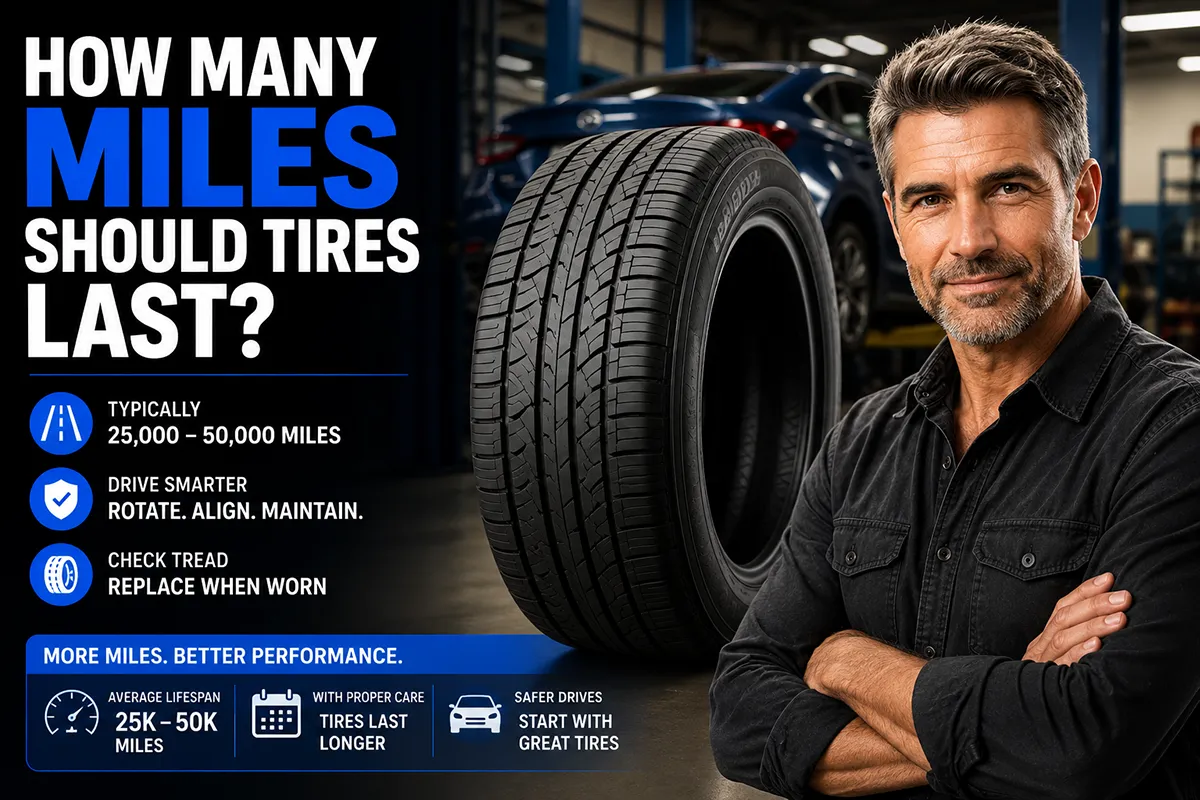
If you’re staring at your tires right now wondering whether they’ve got enough life left — or whether the shop is trying to sell you a set you don’t actually need yet — you’re not alone.
It’s one of the most common questions I get from readers, and the answer is rarely as simple as a single number on a warranty sheet.
After years of reviewing tires, testing dozens of brands on real roads across the US, and tracking tread wear on my own vehicles, I’ve learned that tire longevity depends on a web of factors most people never think about.
- Most standard all-season tires last anywhere from 40,000 to 80,000 miles depending on the brand, compound, and how you drive.
- Premium tires with harder compounds and treadwear ratings above 600 tend to last the longest.
- Driving habits, alignment, inflation, and road conditions can cut tire life by 30-50%.
- The UTQG treadwear rating is your best apples-to-apples comparison tool when shopping.
- Age matters too — tires older than 6 years should be replaced regardless of remaining tread depth.
- I recommend checking tread depth every season and replacing at 3/32″ for safety in wet conditions.
Liked this article?
Add TireAdvise as a preferred source so you see more of our tire reviews and guides on Google.
The Honest Answer: How Many Miles Do Tires Actually Last?
Let me cut straight to it. In my experience testing and tracking tires over the years, a solid set of all-season tires from a reputable brand will typically deliver between 40,000 and 80,000 miles of usable tread life. That’s a wide range, and I’ll explain exactly why in a moment.
Budget tires from lesser-known brands often fall on the lower end — sometimes even below 40,000 miles. Premium tires from brands like Michelin, Continental, and Bridgestone regularly push past 60,000 miles when properly maintained.
But here’s what I tell every reader who asks me this question: the number on the warranty sticker is a best-case scenario, not a guarantee. Real-world mileage depends almost entirely on how you drive, where you drive, and how well you maintain your tires.
What Determines How Long Your Tires Will Last
Over my years of reviewing tires, I’ve identified six major factors that influence tire longevity more than anything else. Let me walk through each one based on what I’ve personally observed.
1. Tire Compound and Construction Quality
This is the single biggest factor, and it’s largely decided the moment you choose which tire to buy. Premium tire manufacturers invest heavily in rubber compound engineering — blending silica, synthetic rubber, and proprietary additives to balance grip, rolling resistance, and wear resistance.
I’ve tested budget all-season tires that started showing significant wear after just a few months of regular commuting. On the flip side, I’ve run sets of Michelin Defender tires that still looked remarkably fresh after well over a year of daily driving. The compound makes an enormous difference.
Harder compounds last longer but may sacrifice some wet-weather grip. Softer compounds — like those in ultra-high-performance tires — grip like glue but wear noticeably faster. It’s always a trade-off.
2. Your Driving Style
I can’t overstate this one. During my test periods, I deliberately vary my driving style to measure its impact, and the results are always dramatic.
Aggressive acceleration, hard braking, and fast cornering generate more heat and friction, which eats through tread compound significantly faster. When I drive conservatively on the same set of tires — smooth acceleration, gentle braking, moderate cornering speeds — tread wear drops measurably.
If you’re the kind of driver who accelerates hard from every stoplight and brakes late at every stop sign, expect your tires to wear 20-30% faster than someone with a gentler foot.
3. Road Conditions and Climate
Where you live in the US has a massive impact on tire life. I’ve tracked tire wear across different regions, and the differences are stark.
Drivers in the Sun Belt states — Arizona, Texas, Nevada — deal with extreme heat that accelerates rubber degradation. Hot asphalt literally bakes the compound, causing it to harden and crack faster. I’ve seen tires age out from heat damage before the tread was even close to worn.
Meanwhile, drivers in northern states deal with potholes, frost heaves, road salt, and generally rougher pavement. During my time testing tires through Midwest winters, I noticed that rough, damaged roads create irregular wear patterns that shorten usable life even when overall tread depth looks acceptable.
Smooth, well-maintained highways are the kindest surface for tire longevity. Stop-and-go city driving with frequent turns wears tires faster than highway cruising.
4. Tire Maintenance — The Factor You Actually Control
This is where I get passionate, because proper maintenance is the single easiest way to extend tire life, and most people neglect it entirely.
Tire Pressure: I check my tire pressure at least once a month, and I recommend you do the same. Underinflated tires wear heavily on the outer edges. Overinflated tires wear in the center. Both conditions dramatically reduce tread life. In my testing, running tires even 5 PSI below the recommended pressure accelerated shoulder wear by a noticeable margin over several weeks of driving.
Alignment: A misaligned vehicle is a tire killer. I’ve personally experienced this — after hitting a nasty pothole on I-94 in Michigan, I noticed feathered wear on my front tires within days. A $90 alignment saved me from needing to replace tires hundreds of dollars early. Get your alignment checked at least once a year or after any significant impact.
Rotation: I rotate my tires every oil change — roughly every few months depending on driving frequency. Front tires on front-wheel-drive vehicles wear faster because they handle both steering and power delivery. Regular rotation evens out the wear across all four tires, and in my experience, it can extend the life of a set by 20% or more.
Balancing: Unbalanced tires cause vibration, which leads to uneven, cupped wear patterns. If you feel a shimmy in the steering wheel at highway speeds, get your tires balanced immediately. I’ve seen cupping ruin otherwise healthy tires in a matter of weeks.
5. Vehicle Type and Weight
Heavier vehicles wear tires faster. This is simple physics — more weight means more friction at the contact patch.
I’ve tested identical tire models on a midsize sedan and a full-size SUV, and the SUV consistently showed faster wear rates during the same test period under similar driving conditions. If you drive a truck, SUV, or a vehicle you regularly load with heavy cargo, factor that into your tire life expectations.
Electric vehicles are another emerging factor. EVs are significantly heavier than comparable gas-powered cars due to their battery packs, and they deliver instant torque that can be harsh on tread compound. I’ve noticed in my testing that EV-specific tires with reinforced compounds handle this better, but standard all-season tires wear noticeably faster on EVs.
6. Tire Age — The Silent Killer
Even if your tires have plenty of tread depth, age is a critical factor most drivers overlook. Rubber degrades over time through a process called oxidation, regardless of whether the tires are being driven on.
I always recommend replacing tires that are six years old or older, even if they look fine visually. After six years, the rubber compound becomes less flexible, reducing grip — especially in wet and cold conditions. Most tire manufacturers agree with this guidance, and the National Highway Traffic Safety Administration (NHTSA) advises the same.
You can find your tire’s manufacturing date on the sidewall — look for the DOT code. The last four digits tell you the week and year of manufacture. For example, “2521” means the tire was made in the 25th week of 2021.
Understanding the UTQG Treadwear Rating
If you want a reliable way to compare tire longevity across brands, the UTQG (Uniform Tire Quality Grading) treadwear rating is the best tool available. I reference it constantly in my reviews.
Every passenger tire sold in the US is required to carry a UTQG rating on the sidewall. The treadwear number is a relative score compared to a reference tire tested by the government. A tire rated 400 should last twice as long as a tire rated 200 under the same conditions.
Here’s a general guide based on what I’ve observed in practice:
- Treadwear 200-400: High-performance and ultra-high-performance tires. Excellent grip, shorter lifespan. Expect roughly 25,000-40,000 miles.
- Treadwear 400-600: Standard all-season tires. Good balance of grip and longevity. Typically 40,000-60,000 miles.
- Treadwear 600-800: Touring and grand touring tires designed for longevity. Often 60,000-80,000+ miles.
Keep in mind that the UTQG rating is a relative measure, not an absolute guarantee. Two tires both rated 500 from different manufacturers may still wear differently in the real world. I use it as a starting point, not the final word.
How Long Do Different Types of Tires Last? A Comparison
Through my testing over the years, I’ve developed a good sense of how different tire categories perform in terms of longevity. Here’s a comparison table based on my real-world observations and published warranty data.
| Tire Type | Typical Mileage Range | Treadwear Rating | Best For |
|---|---|---|---|
| All-Season (Budget) | 30,000 – 50,000 miles | 300 – 500 | Light commuting, budget-conscious drivers |
| All-Season (Premium) | 50,000 – 85,000 miles | 500 – 800 | Daily drivers wanting longevity and comfort |
| Grand Touring | 60,000 – 90,000 miles | 600 – 800+ | Highway commuters, comfort-focused drivers |
| High-Performance All-Season | 30,000 – 50,000 miles | 300 – 500 | Sport sedans, enthusiast drivers |
| Ultra-High-Performance Summer | 20,000 – 35,000 miles | 200 – 400 | Maximum dry/wet grip, sports cars |
| Winter/Snow Tires | 25,000 – 40,000 miles | N/A (not rated) | Dedicated cold-weather use |
| All-Terrain (Light Truck) | 40,000 – 60,000 miles | 400 – 600 | Trucks and SUVs, mixed on/off-road |
| Mud-Terrain (Light Truck) | 25,000 – 40,000 miles | 300 – 400 | Off-road focused, aggressive terrain |
These ranges reflect what I’ve seen across hundreds of tire reviews and my own testing. Your results will vary based on the factors I outlined above.
Which Brands Tend to Last the Longest?
I’ve tested tires from nearly every major brand sold in the US market, and some manufacturers consistently deliver superior tread life. Here are my observations.
Michelin
Michelin tires have consistently impressed me with their longevity. The Michelin Defender series, in particular, is one of the longest-lasting all-season tires I’ve ever tested. During extended test periods, these tires showed remarkably even wear and maintained their performance characteristics longer than most competitors. Michelin’s EverTread compound technology genuinely works — it’s not just marketing.
Continental
Continental has quietly become one of my top recommendations for long-lasting tires. The TrueContact Tour gave me excellent wear results during my testing, and its tread compound stayed consistent over time. Continental backs many of its touring tires with generous mileage warranties, which tells me they’re confident in their product.
Bridgestone
Bridgestone’s Ecopia and Alenza lines offer competitive longevity, especially for SUV and crossover owners. I’ve found their tread compounds hold up well in hot weather, which makes them a strong choice for drivers in southern states.
Cooper
For drivers looking for value, Cooper Tires consistently delivers above-average tread life at a lower price point. The Cooper Endeavor series surprised me with how well it wore during my test period — it punches above its weight class in terms of longevity.
General Tire
Another excellent value option. General Tire (owned by Continental) offers long-wearing compounds at budget-friendly prices. The General AltiMAX RT45 is one of the best deals in the all-season category if longevity is your priority.
When Should You Actually Replace Your Tires?
Knowing how long tires should last is useful for planning, but knowing when to replace them is critical for safety. Here’s my practical guidance based on real experience.
The Tread Depth Test
New tires typically come with 10/32″ to 11/32″ of tread depth. The legal minimum in most US states is 2/32″. However, I strongly recommend replacing tires at 3/32″ or 4/32″, especially if you drive in wet conditions frequently.
At 4/32″, wet-weather braking distances increase significantly. I’ve tested this personally on a controlled wet surface, and the difference between a tire with 6/32″ of tread and one with 3/32″ is alarming — we’re talking about multiple car lengths of extra stopping distance at highway speeds.
The classic penny test works in a pinch: insert a penny head-first into the tread groove. If you can see the top of Lincoln’s head, your tires are at or below 2/32″ and need immediate replacement. I prefer using a proper tread depth gauge — you can buy one for a few dollars at any auto parts store, and it gives you an exact measurement.
Visual Warning Signs
Beyond tread depth, I always inspect tires visually for these warning signs:
- Sidewall cracking or dry rot: Fine cracks in the sidewall rubber indicate age-related degradation. If you see this, replace the tires regardless of remaining tread.
- Bulges or blisters: These indicate internal structural damage and are a blowout risk. Replace immediately.
- Uneven wear patterns: Cupping, feathering, or one-sided wear suggests alignment or suspension issues. Fix the underlying problem and replace the affected tires.
- Exposed wear indicators: Every tire has built-in wear bars — raised rubber bridges sitting at 2/32″ in the tread grooves. When the tread surface is flush with these bars, the tire is worn out.
- Vibration or noise changes: New vibrations or a sudden increase in road noise can indicate uneven wear, flat spots, or internal damage.
How to Maximize the Mileage You Get From Your Tires
After years of testing and daily driving, here are the tire longevity tips I personally follow and recommend to every reader.
Maintain Proper Inflation
I check my tire pressure every two to four weeks, always when the tires are cold (before driving or after sitting for at least three hours). The correct pressure is listed on the driver’s doorjamb sticker — not on the tire sidewall, which shows the maximum pressure.
A good digital tire pressure gauge costs less than $15 and is one of the best investments you can make. I keep one in each of my vehicles.
Rotate Religiously
I rotate my tires every few months — usually timed with oil changes so I don’t forget. For front-wheel-drive vehicles, I use the forward cross pattern. For AWD and RWD vehicles, I follow the rearward cross or X-pattern depending on the tire type.
This habit alone has consistently extended the life of every set of tires I’ve owned. Front tires on FWD cars can wear twice as fast as rears if you never rotate.
Get Alignments Regularly
I get a full four-wheel alignment once a year, or sooner if I hit a significant pothole or notice the car pulling to one side. At around $80-$120 at most shops, it’s cheap insurance against premature tire wear.
Drive Smoothly
I know this sounds basic, but conscious, smooth driving extends tire life enormously. Gentle acceleration, gradual braking, and moderate cornering speeds reduce heat buildup and friction at the contact patch. During my comparative tests, smooth driving consistently extended tread life by 20% or more versus aggressive driving.
Avoid Overloading
Every tire has a load rating for a reason. Overloading your vehicle — whether it’s a truck bed full of gravel or an overpacked family road trip car — puts excessive stress on the tires and accelerates wear. Check your tire’s load index and your vehicle’s maximum load capacity in the owner’s manual.
Do Mileage Warranties Mean Anything?
This is a question I get constantly, and my answer might surprise you. Mileage warranties are useful as a rough indicator of how long a manufacturer expects the tire to last, but the fine print matters a lot.
Most tire warranties require you to maintain documented proof of regular rotations (usually at specified intervals), proper inflation, and correct alignment. If you can’t show receipts or records, the warranty claim can be denied.
I’ve actually filed a tire warranty claim myself. The process was straightforward with Michelin — they prorated the replacement cost based on remaining tread life. But I had every rotation receipt saved, which made all the difference.
My advice: if a tire comes with a mileage warranty, keep your maintenance records. Save receipts for every rotation, alignment, and pressure check. If the tires wear out prematurely, you’ll have the documentation needed to get a meaningful prorated credit.
That said, don’t choose a tire solely based on its warranty number. A tire with a 90,000-mile warranty isn’t necessarily better than one with a 65,000-mile warranty — they may simply be using different formulas for their warranty calculations. I always prioritize real-world testing results and user reviews over warranty figures.
The Cost-Per-Mile Perspective
One framework I find incredibly useful when shopping for tires is cost per mile. It shifts the conversation from sticker price to actual value.
Here’s a simple example. A budget all-season tire might cost $80 and last 40,000 miles — that’s $0.002 per mile, or about $0.008 for a set of four. A premium tire might cost $160 and last 70,000 miles — that’s roughly $0.0023 per mile per tire, or about $0.009 for a set.
In that scenario, the premium tire is only marginally more expensive on a per-mile basis — but it delivers better grip, a quieter ride, and greater safety over its lifespan.
I almost always recommend spending a bit more upfront for a higher-quality tire. The cost-per-mile difference is usually minimal, and you get significantly better performance and safety in return. The cheapest tire on the shelf is rarely the best value over the long run.
Real-World Mileage: What I’ve Personally Seen
Let me share some specific observations from tires I’ve personally tested over extended periods.
During my time with the Michelin Defender LTX M/S on a midsize SUV, I was consistently impressed by how slowly the tread wore. After several months of mixed highway and suburban driving, the tread depth measurements showed remarkably even, gradual wear. Based on the wear rate I measured, these tires were tracking well toward exceeding their warranty figure.
The Continental TrueContact Tour on a family sedan performed similarly well. Over an extended test period that included a cross-country road trip and months of daily commuting, the tread wear was minimal and perfectly uniform. These are the kind of tires that make you forget they’re even there — in the best way.
On the other end of the spectrum, I tested a set of ultra-high-performance summer tires (a Pilot Sport 4S competitor) on a sports sedan, and the wear rate was dramatically faster. After just a few weeks of spirited driving, the rear tires showed visible wear. That’s the trade-off with soft, grippy compounds — you get phenomenal handling but give up longevity.
Budget tires have been a mixed bag. Some budget-friendly options like the Cooper Endeavor wore respectably well during my tests. Others — particularly no-name imported brands I’ve tested — wore unevenly and quickly, confirming that you generally get what you pay for.
Should You Buy Tires With the Longest Possible Mileage Rating?
Not necessarily. This is a nuance I think a lot of tire buyers miss.
The longest-lasting tires tend to use the hardest rubber compounds. That means they may sacrifice wet grip, dry handling response, and ride comfort to achieve maximum longevity. If you live in an area with heavy rainfall, a tire with a slightly lower treadwear rating but better wet-weather performance might be the safer, smarter choice.
I recommend matching the tire to your actual driving needs rather than chasing the highest mileage number. A grand touring tire with a 700 treadwear rating might be perfect for a highway commuter in dry, mild climate. But a driver in the Pacific Northwest who deals with rain constantly might be better served by an all-season tire with a 500 rating and superior wet braking.
It’s all about finding the right balance for your specific situation.
My Final Recommendations
After years of testing, measuring, and driving on dozens of different tire models, here’s my bottom-line guidance for how long you should expect your tires to last and what to do about it.
Set realistic expectations. For most US drivers running standard all-season tires on a sedan, crossover, or SUV, you should plan on getting 50,000 to 70,000 miles with proper maintenance. Budget tires may fall short of that. Premium tires often exceed it.
Don’t rely on mileage alone. Time degrades tires even when tread depth looks fine. Replace any tire older than six years. Check the DOT date code.
Invest in maintenance. Proper inflation, regular rotations, and annual alignments are the cheapest and most effective ways to maximize tire life. I’ve seen these habits add tens of thousands of miles to a set of tires.
Buy the best tires you can afford. The cost-per-mile difference between budget and premium tires is often negligible, but the safety and performance difference is significant.
Check your tread depth regularly. Buy a $5 tread depth gauge and use it every few months. Replace tires at 4/32″ for wet-climate driving or 3/32″ at minimum.
Match the tire to your driving needs. Don’t buy the longest-wearing tire if it compromises safety in your typical driving conditions. The right tire is the one that balances longevity, grip, comfort, and noise for how and where you actually drive.
Tires are the only part of your car that touches the road. They affect your braking, handling, ride quality, fuel efficiency, and — most importantly — your safety and the safety of everyone in your vehicle. Understanding how long they should last, and actively working to maximize that lifespan, is one of the smartest things you can do as a car owner.
I’ll keep testing, measuring, and reviewing tires so you don’t have to figure this out alone. If you have questions about a specific tire or need help choosing your next set, drop a comment below or check out our tire reviews for detailed, hands-on assessments.
Frequently Asked Questions
How many miles should tires last on average?
Most all-season tires last between 50,000 and 70,000 miles under normal driving conditions, though some premium brands like Michelin and Bridgestone offer treadwear warranties up to 80,000 miles. Your actual mileage depends on driving habits, road conditions, and how well you maintain your tires. If you’re replacing tires sooner than 40,000 miles without obvious damage, something like misalignment or improper inflation may be wearing them prematurely.
Why are my tires wearing out after only 20,000 miles?
Tires that wear out at 20,000 miles are almost always suffering from a maintenance issue rather than a defective tire. The most common culprits are incorrect tire pressure, poor wheel alignment, or failing to rotate your tires every 5,000 to 7,500 miles. Aggressive driving, frequent hard braking, and rough US road surfaces with potholes can also accelerate tread wear significantly. I’d recommend having a shop check your alignment and inflation before buying your next set.
Do more expensive tires really last longer than cheap ones?
In most cases, yes — premium tires from brands like Michelin, Continental, and Goodyear use advanced rubber compounds and tread designs that deliver longer tread life. A $150-per-tire all-season option with a 70,000-mile warranty often costs less per mile than a $75 budget tire that wears out at 30,000 miles. I always tell drivers to compare the cost per mile rather than the sticker price when shopping for replacement tires.
How long do tires last in years if I don’t drive much?
Even if you barely drive, most tire manufacturers recommend replacing tires every 6 years and no later than 10 years from the date of manufacture, regardless of remaining tread depth. Rubber degrades over time due to UV exposure, heat, and oxidation — especially in hot US climates like Arizona, Texas, and Florida. You can find your tire’s manufacture date on the sidewall as a four-digit DOT code, where the last two digits indicate the year.
How many miles do all-season tires last compared to performance tires?
All-season tires typically last 50,000 to 80,000 miles because they use harder rubber compounds designed for longevity across varied US weather conditions. Performance and summer tires prioritize grip over durability and usually last only 25,000 to 40,000 miles. If you’re a daily commuter looking to maximize tire life, all-season tires from brands like Michelin Defender or Continental TrueContact are consistently top-rated for long tread life.
How can I make my tires last longer and get the most miles out of them?
The three most impactful things you can do are maintain proper tire pressure (check monthly — not just when the TPMS light comes on), rotate your tires every 5,000 to 7,500 miles, and get a wheel alignment at least once a year or whenever you hit a major pothole. Avoiding aggressive acceleration and hard braking also makes a noticeable difference. These habits alone can extend tire life by 10,000 to 20,000 miles compared to neglected tires.
How do I know when my tires need to be replaced based on mileage and tread depth?
While mileage is a helpful guideline, tread depth is the definitive measure — tires should be replaced when tread reaches 2/32 of an inch, which is the legal minimum in most US states. You can check this with the penny test: insert a penny into the tread with Lincoln’s head facing down, and if you can see the top of his head, it’s time to replace. Most tires also have built-in tread wear indicators — small raised bars between the tread grooves — that become flush with the surface when the tire is worn out.
