

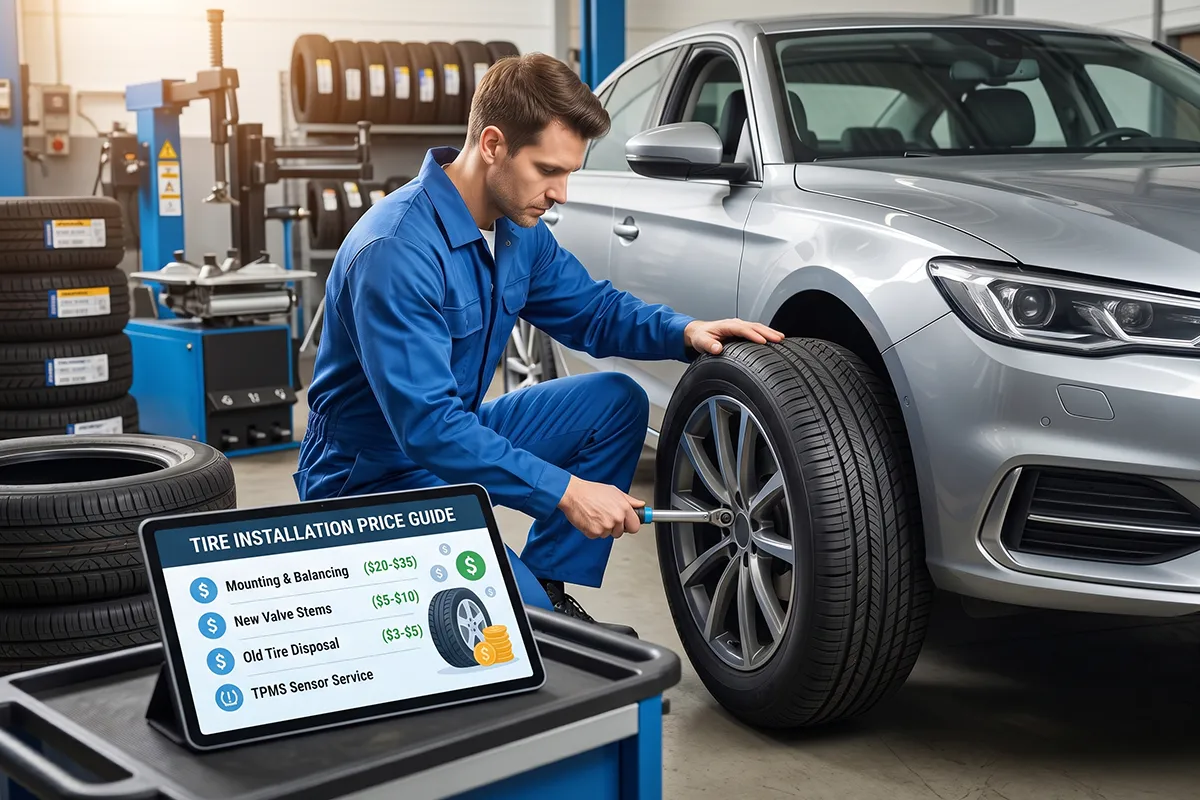
I’ve bought and had installed well over 50 sets of tires over the years — and I can tell you from experience that the sticker price on the tire is rarely what you actually pay at the counter. The installation fees are where tire shops quietly pad the bill, and most people have no idea what’s fair until after they’ve already handed over their credit card.
- Tire installation typically costs $15–$45 per tire, but the real total after mounting, balancing, valve stems, and disposal fees is usually $50–$80 per tire.
- Big-box retailers (Costco, Walmart, Sam’s Club) often offer the best all-in value — especially if you’re buying tires from them.
- Dealer service centers consistently charge the most for installation labor.
- Ask for an itemized quote before you say yes — fees like nitrogen inflation and road hazard warranties add up fast.
- If you’re buying tires online and having them shipped to a local installer, budget an extra $20–$30 per tire for the install.
Liked this article?
Add TireAdvise as a preferred source so you see more of our tire reviews and guides on Google.
What You’re Actually Paying For When You Get Tires Installed
When a tire shop quotes you an installation price, that number almost never means the same thing from one shop to the next. At one shop, “installation” might mean mounting only.
At another, it includes mounting, balancing, new valve stems, tire disposal, and TPMS sensor service. This inconsistency is the single biggest reason people feel confused or ripped off when they get tires put on.
Here’s what a full tire installation actually involves, broken down service by service:
Mounting
This is the labor cost to remove your old tires from the rims and press the new ones on using a mounting machine. It’s the core of any installation job.
Expect to pay $3–$15 per tire for mounting alone at most shops. Some shops bundle mounting and balancing together into a single line item, which is fine — just make sure balancing is included.
Balancing
After a new tire is mounted, it needs to be dynamically balanced so it doesn’t cause steering wheel vibration at highway speeds. A tire balancer spins the wheel and tire assembly at speed, then the technician adds small weights to compensate for any uneven weight distribution.
Balancing runs $6–$20 per tire. Never skip this — unbalanced tires wear unevenly and make your car uncomfortable to drive.
Valve Stems
Rubber valve stems are considered a wear item and should be replaced every time you put on new tires. Standard rubber stems cost around $3–$5 per tire installed.
If your car has a direct TPMS (tire pressure monitoring system), your sensors are integrated into the valve stem assembly. These are more expensive — typically $15–$50 per sensor to service or replace, though most shops will re-use yours if they’re in good shape.
TPMS Service
If your vehicle is a 2008 model year or newer, it has a federal mandate TPMS system. Any time the tire is dismounted from the wheel, the sensor should be inspected and the service kit (valve core, cap, nut, and grommet) replaced.
This runs $5–$15 per tire. Skipping TPMS service is one of those “penny wise, pound foolish” moves — a failed sensor means a warning light on your dash and a return trip to the shop.
Tire Disposal
Your old tires need to go somewhere, and shops pass along the disposal cost to you. Regulations vary by state, but most shops charge $2–$5 per tire for eco-disposal. A few shops (particularly Costco) include this in their flat per-tire installation rate.
Road Hazard Warranty (Optional)
Many shops will try to upsell you on a road hazard protection plan — typically $10–$25 per tire — which covers flat repairs and sometimes prorated tire replacement if you get a sidewall puncture.
Whether this is worth it depends on where you drive. If you commute daily in a pothole-heavy city, it might pay for itself. If you’re mostly highway driving, it’s usually not worth it.
Tire Installation Cost by Retailer: A Real-World Comparison
I’ve personally used most of these retailers over the years. Here’s an honest look at what you can expect to pay at each one — and more importantly, what’s included for that price.
| Retailer | Install Price (per tire) | What’s Included | My Take |
| Costco Tire Center | $19.99 | Mount, balance, rotation, flat repair, nitrogen, disposal | Best all-in value if buying tires from them |
| Sam’s Club | $20.00 | Mount, balance, valve stems, rotation, flat repair, disposal | Very competitive; underrated option |
| Walmart Auto Care | $15–$20 | Mount, balance, valve stems, disposal | Budget-friendly; quality varies by location |
| Discount Tire | $18–$30 | Mount, balance, valve stems (rotation sometimes free) | Consistent quality nationwide; free rotation is a big plus |
| Firestone | $15–$30 | Mount, balance, valve stems (TPMS extra) | Solid but watch for upsells |
| Pep Boys | $20–$35 | Mount, balance, valve stems | Fine, but rarely the best price in town |
| Local / Independent Shop | $15–$45 | Varies widely | Ask for itemized quote; often competitive on labor |
| Dealership Service Center | $35–$60+ | Mount, balance (everything else extra) | Most expensive option; rarely worth it for install only |
A few important notes on this table: Costco’s $19.99 rate is only available when you purchase tires through Costco. They won’t install tires you bring in from elsewhere.
The same applies to Sam’s Club. Discount Tire, on the other hand, will install tires you purchased elsewhere — they call it their “bring your own tire” service — though the price may be slightly higher than if you bought through them.
What Does a Full Set of 4 Tires Actually Cost to Install?
Let me run through a realistic, real-world scenario so you can see exactly how the final number gets built up. I’ll use a set of four standard passenger car tires on a 2022 Toyota Camry with a direct TPMS system.
| Service | Budget Estimate | Mid-Range Estimate | Premium/Dealer |
| Mounting (per tire × 4) | $12–$20 total | $40–$60 total | $80–$120 total |
| Balancing (per tire × 4) | $24–$40 total | $40–$60 total | $80–$100 total |
| Valve Stem Replacement (×4) | $12–$16 total | $16–$20 total | $20–$30 total |
| TPMS Service Kit (×4) | $20–$40 total | $40–$60 total | $60–$100 total |
| Tire Disposal (×4) | $8–$16 total | $12–$20 total | $16–$24 total |
| Road Hazard Warranty (×4) | $0 (declined) | $40–$80 total | $80–$120 total |
| TOTAL | $76–$132 | $188–$300 | $336–$494 |
That’s a wide range, I know. The honest truth is that most people landing at a mid-range shop like Discount Tire or Firestone for a standard passenger car will spend somewhere between $60–$80 all-in per tire for a complete installation including all the line items above — but not a road hazard warranty.
For four tires, you’re looking at $240–$320 just in installation labor and fees, on top of whatever the tires themselves cost.
That said, if you go to Costco or Sam’s Club, they’ve built most of those fees into that flat $19.99–$20.00 per tire rate, making their effective all-in installation cost significantly lower.
Factors That Affect Tire Installation Cost
1. Tire Size
Larger tires — particularly low-profile performance tires, truck tires, and SUV all-terrain tires — take more time and skill to mount and balance.
Some shops charge a premium of $5–$15 per tire for oversized fitments or low-profile tires (anything 40-series or lower). If you’re running 20″ or larger wheels with a 35-series tire, ask specifically whether there’s an upcharge.
2. Staggered Fitment
Performance cars with staggered setups (wider tires in the rear than the front) can’t have tires rotated in the traditional front-to-back pattern. Some shops charge extra for the additional time involved in a staggered installation.
3. TPMS Sensor Type
If your sensors are aftermarket, older than 7 years, or damaged, you may need full sensor replacement rather than just a service kit.
Individual TPMS sensors run $25–$60 each, with programming fees of $5–$15 per sensor on top. If all four need replacement, that’s potentially an extra $120–$300 in addition to your base installation cost.
4. Wheel Weight Removal
Some shops charge a small fee (usually $2–$5 per wheel) to remove old wheel weights before balancing. This is typically included in a standard balance job, but some bare-bones shops itemize it separately.
5. Geographic Location
Labor rates in major metropolitan areas — Los Angeles, New York, Chicago — run 20–40% higher than rural markets. A tire installation that costs $25 per tire in rural Tennessee might run $38–$45 per tire in San Francisco. It’s just the reality of regional labor markets.
6. Tire Brand and Type Complexity
Run-flat tires are harder to mount and require a specialized machine in some cases. A few shops charge an extra $10–$15 per tire for run-flat mounting. Similarly, foam-lined noise-cancellation tires (like those found on some BMW and Kia models) require careful handling.
Hidden Fees to Watch Out For
Over the years, I’ve noticed a consistent set of upsells and hidden fees that tire shops use to pad the final bill. Here are the ones I see most often — and my honest take on each:
- Nitrogen inflation: Shops charge $5–$8 per tire to fill with nitrogen instead of regular air. The real-world difference in tire pressure retention is minimal for most passenger car drivers. Save your money.
- Wheel weights: Some shops advertise “balancing” in their base price but only include lead weights. If you have alloy wheels that require stick-on weights (which are less visible), they may charge extra. Ask upfront.
- Re-torque fees: A few shops charge you to return for a re-torque of your lug nuts after 50 miles (which is actually a legitimate safety step, but should be free).
- Road hazard warranty auto-add: Some shops add this to your invoice by default. Check your receipt before paying.
- Alignment inspection fee: There’s a difference between an alignment check (should be free) and an alignment service ($80–$150). Don’t let a “check” turn into a full alignment without a specific quote first.
- Online order fee: If you ship tires to a shop from Tire Rack or another online retailer, some shops charge an “online tire” surcharge of $5–$10 per tire. Some shops refuse to install tires they didn’t sell. Always call ahead.
Buying Tires Online and Having Them Installed Locally
One of the most common questions I get from readers is whether it makes sense to buy tires online — from retailers like Tire Rack, Discount Tire Direct, or SimpleTire — and then pay a local shop to install them.
The short answer is: it often does, especially for premium tire brands that are cheaper online than at local shops.
Tire Rack, for example, has a “Ship to Installer” program that lets you order tires and have them shipped directly to a participating shop near you. The participating shops agree to install at a set price, which takes the negotiation out of it. You can find their installer network right on their website.
Here’s how I’d think about the math: If you can find a tire you want for $40–$60 less per tire online compared to your local shop’s price, and local installation runs $25–$35 per tire, you’re still ahead — sometimes significantly.
But if the price difference is only $10–$15 per tire, the convenience of a one-stop shop experience at a local retailer often wins.
One thing to be aware of: some brick-and-mortar shops are reluctant to install “customer supplied” tires and may charge a premium or decline altogether. Always call ahead. Discount Tire locations are generally more welcoming of this, as are many independent shops.
Should You Get an Alignment When You Install New Tires?
Here’s my honest take: not every tire installation requires a wheel alignment, but if it’s been more than a year since your last one — or if your old tires showed uneven wear patterns across the tread — you should get it done when you install new tires.
Installing new tires on a misaligned car is like buying a new pair of sneakers and then running laps on gravel. You’ll chew through the new rubber faster than necessary.
A standard two-wheel alignment (front wheels only) runs $60–$100, while a four-wheel alignment costs $100–$150 at most shops. Dealers charge more — sometimes $150–$200+. If you’re already paying for installation, ask if the shop will bundle the alignment at a discount. Many will.
Situations where I’d always recommend pairing an alignment with new tires: you’ve recently hit a major pothole or curb, your car pulls to one side, your old tires wore unevenly (more on one edge than the other), or you’ve done any suspension or steering work recently.
Can You Install Tires Yourself? The Honest Answer
Technically, yes. Practically, for most people — no, and it’s not worth it.
Home tire changing involves two specialized pieces of equipment: a tire mounting machine (to break the bead and press the tire onto the rim) and a wheel balancing machine. Professional-grade versions of these run $3,000–$10,000+.
There are manual tire changing kits available for around $100–$200, but using them on modern low-profile tires risks damaging the tire bead or scratching your wheels. And without a balancer, you’re driving on unbalanced tires, which will cause vibration and premature wear.
The one DIY scenario that genuinely makes sense: if you have a dedicated set of winter tires already mounted on their own dedicated steel wheels (a very common setup in the northern US), you can swap the entire wheel-and-tire assembly yourself using your car’s jack and a torque wrench.
This avoids mounting and balancing costs entirely — you’re just doing a glorified tire rotation. That saves you $60–$120 per season changeover.
7 Ways to Reduce Your Tire Installation Cost
- Get quotes from at least three shops before committing. Prices vary more than you’d expect, even within the same metro area.
- Ask for an itemized quote, not a single “installation fee.” You should be able to see mounting, balancing, valve stems, and disposal listed separately.
- Consider Costco or Sam’s Club if you’re a member — their flat-rate all-in pricing is genuinely one of the best deals available, and their lifetime benefits (free flat repair, free rotation, free nitrogen top-offs) add real value over the life of the tire.
- Look for installation rebates. Some tire manufacturers offer mail-in or instant rebates that include free installation — Michelin and Bridgestone run these fairly regularly.
- Skip the road hazard warranty if you’re buying a premium tire with a strong mileage warranty. You’re already getting protection through the manufacturer.
- Decline nitrogen inflation — regular compressed air works fine for passenger vehicles and is free at most gas stations.
- Book appointments mid-week. Many shops are less busy Tuesday through Thursday and may be more willing to negotiate or throw in extras like a free rotation.
What to Know Before You Shop for New Tires
Tire installation cost is just one piece of the puzzle. Before you walk into a shop, I’d recommend reading through my tire buying and maintenance guide — it covers everything from how to read a tire sidewall to what questions to ask a shop before committing. It’ll help you go in informed, which means you’re less likely to get upsold on something you don’t need.
If you’re also shopping for a specific tire performance category, understanding speed ratings will help you match the right tire to your vehicle.
My tire speed rating chart explains what each rating means in plain English — and why buying a tire with a lower speed rating than your car’s requirement is a safety issue, not just a performance one.
Frequently Asked Questions
How much does it cost to install one tire?
For a single tire, expect to pay $40–$70 all-in including mounting, balancing, a new valve stem, and disposal. Keep in mind that most shops don’t offer a break on single-tire installations — you’ll pay the same per-tire rate as a full set.
Does Costco install tires you buy elsewhere?
No. Costco’s tire installation service — including their $19.99 per-tire rate and lifetime benefits — is only available when you purchase tires through Costco’s tire center. They do not install customer-supplied tires.
How long does tire installation take?
A standard four-tire installation (mount and balance) typically takes 45 minutes to 1.5 hours, depending on shop traffic. If you’re also getting an alignment, add another 30–60 minutes. Some shops offer appointment-based service that can reduce wait time significantly.
Is it cheaper to install tires at Walmart?
Walmart’s $15–$20 per-tire installation rate is one of the cheapest available at a national chain. However, “cheap” and “best value” aren’t always the same thing. Walmart’s installation includes mounting, balancing, valve stems, and disposal — which is a reasonable package. Quality of service can vary significantly by location, so read local reviews before booking.
Do I tip the person who installs my tires?
Tipping tire technicians is not a standard practice in the US, unlike restaurants or salons. You’re paying a shop fee that includes labor. That said, if a tech goes above and beyond — especially on a difficult job or a weekend when they’re slammed — a cash tip of $5–$20 is always appreciated and not expected.
Can I drive immediately after getting new tires installed?
Yes. New tires are ready to drive on immediately. There’s no break-in limitation in the traditional sense, though I always recommend being a bit gentle for the first 50–100 miles — avoiding hard acceleration, hard braking, and sharp cornering — to let the tires seat properly and any mold release lubricants from manufacturing to wear off.
What if my TPMS light comes on after installation?
This is common if the sensors weren’t re-programmed to the new wheel positions or if a service kit wasn’t replaced. Return to the shop — this should be fixed at no additional charge as it’s part of a complete installation job. Don’t ignore a TPMS warning after new tires; a false reading can mask a genuinely low tire.
Bottom Line: Know What You’re Paying For
The installation cost you’ll see advertised is almost never the full story. By the time you add mounting, balancing, valve stems, TPMS service, and disposal fees, a “$15 installation” can easily become $55 or more per tire.
That’s not a scam — those services are real and necessary — but you should know what you’re agreeing to before you sign anything.
My recommendation: before you commit to any shop, ask for a full written breakdown of installation charges for your specific vehicle and tire size. A shop that can’t or won’t give you an itemized quote isn’t one I’d trust with my wheels.
For most people replacing a standard set of four passenger car tires, budgeting $60–$80 per tire in installation costs (on top of the tire purchase price) is a realistic planning number.
If you’re a Costco or Sam’s Club member, that number drops meaningfully — and you’ll get lifetime service benefits that have real ongoing value.
Go in informed, ask the right questions, and you won’t leave feeling like you were taken advantage of. That’s the whole point.
Related Reading
→ Complete Tire Buying and Maintenance Guide
→ Tire Speed Rating Chart: What Every Letter Means
