

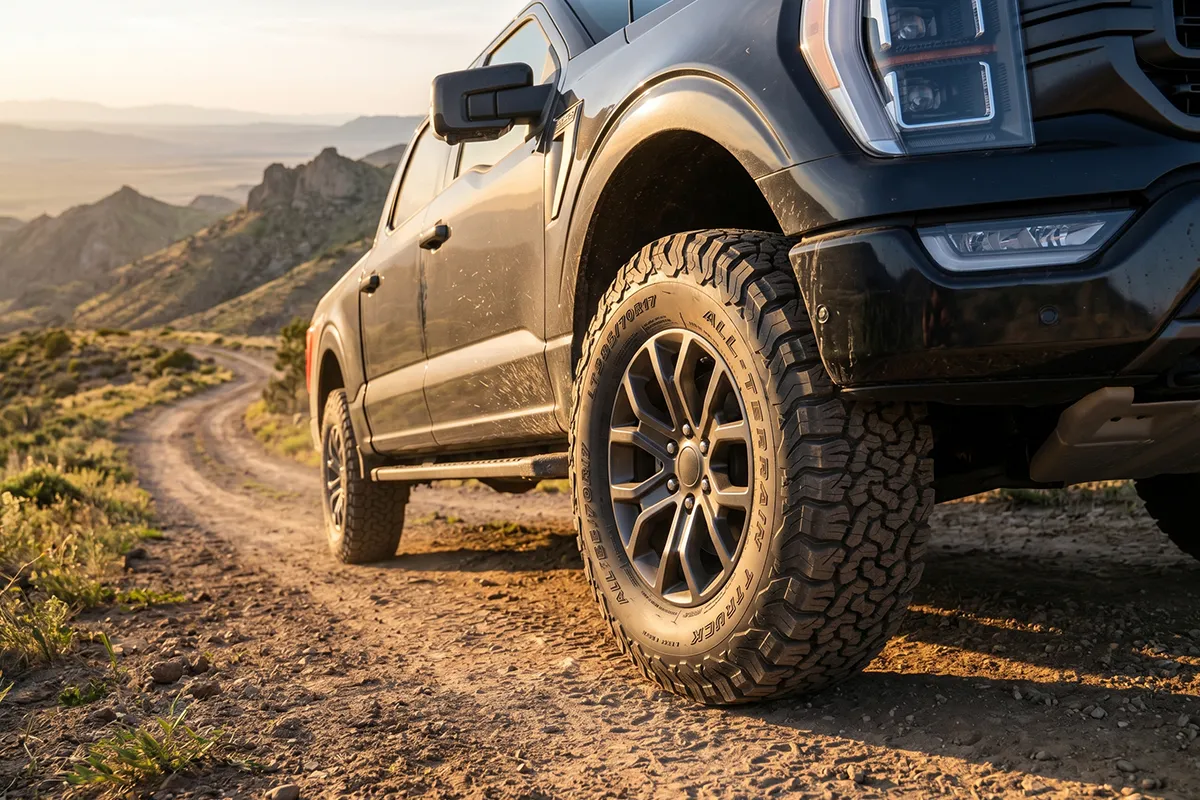
If you tow a trailer on weekends, haul equipment for work, or just want a tougher tire under your truck, the “LT” designation on a tire sidewall is one of the most important letters you’ll ever read — and most people gloss right over it.
Light truck (LT) tires are built with stiffer, multi-ply construction designed for higher load capacity, towing, and harsher conditions. They differ significantly from passenger (P-metric) tires in construction, load rating, inflation requirements, and ride feel. If you drive a half-ton or heavier truck, tow regularly, or carry heavy payloads, LT tires are almost always the right call — but they come with trade-offs you should know about before buying.
Liked this article?
Add TireAdvise as a preferred source so you see more of our tire reviews and guides on Google.
What Are Light Truck Tires?
Light truck tires — marked with an “LT” prefix on the sidewall (e.g., LT265/70R17) — are engineered specifically for trucks, SUVs, and vans that carry heavy payloads, tow trailers, or operate in demanding conditions.
They’re built with a heavier internal structure than standard passenger tires, using additional plies of steel or polyester to handle greater stress.
I’ve been running a rotation of both LT and P-metric tires across two trucks and an SUV for the past few years, logging well over 40,000 miles between them. The difference in real-world feel — especially when loaded — is immediately apparent the moment you pull onto a highway with a full bed or a trailer hitched up.
The “LT” designation traces back to a joint TRA/ETRTO tire sizing standard used primarily in North America.
When you see LT on a tire, you’re looking at a product engineered to a completely different set of load and inflation standards than a passenger car tire, and that engineering decision touches everything from how the tire handles on the highway to how much air pressure you need to pump into it.
LT Tire Sizing — How to Read the Sidewall
Before we get into performance differences, let’s decode what you’re actually looking at on a light truck tire sidewall. Take LT265/70R17 121/118S Load Range E as an example:
| Code | What It Means |
|---|---|
| LT | Light Truck construction standard |
| 265 | Section width in millimeters (265mm wide) |
| 70 | Aspect ratio — sidewall height is 70% of 265mm |
| R | Radial construction |
| 17 | Rim diameter in inches |
| 121/118 | Load index — single/dual wheel capacity |
| S | Speed rating (112 mph max) |
| Load Range E | 10-ply rated; max inflation typically 80 PSI |
That load index and load range are where LT tires really diverge from passenger tires. A Load Range E tire at 80 PSI can carry significantly more weight per tire than a P-metric equivalent — which is why your truck’s door jamb sticker and owner’s manual will specify what load range you need based on your GVWR.
Passenger Tire vs. Light Truck Tire: What’s Actually Different
This is the section I wish I’d found before I made my first truck tire purchase. The differences between passenger (P-metric) and LT tires run deeper than most buying guides acknowledge.
Construction and Ply Rating
LT tires use a higher ply count — ranging from 6-ply (Load Range C) up to 10-ply or 12-ply (Load Range E or F) — compared to the typical 4-ply construction of passenger tires. More plies mean a stiffer sidewall, which is critical when you’re carrying 1,500 lbs of lumber in the bed or towing a loaded trailer.
Passenger tires, by design, use softer, more flexible sidewall construction to maximize ride comfort and fuel economy for everyday commuting. That flexibility is a liability when load stresses start increasing — sidewalls can flex excessively under load, generating heat and potentially leading to failure over time.
Load Capacity
This is the big one. An LT265/70R17 Load Range E can carry roughly 3,195 lbs per tire at max inflation (single application). A comparable P265/70R17 passenger tire might carry closer to 2,000–2,200 lbs. For a pickup truck carrying 1,200 lbs in the bed with two people in the cab, those numbers matter.
Inflation Pressure
LT tires run at higher pressures — Load Range E tires typically require 65–80 PSI compared to the 32–36 PSI typical for passenger tires. This is a point of confusion for a lot of truck owners.
If you put LT Load Range E tires on your truck and inflate them to the P-metric pressure listed on your door jamb, you’re significantly under-inflating them and negating the load-carrying benefit entirely.
Always inflate to the LT tire manufacturer’s recommended pressure, cross-referenced against your truck’s payload needs. Your owner’s manual should have a table — use it.
Ride Quality
Here’s the honest trade-off: LT tires ride rougher. Full stop. The stiffer construction that makes them capable of carrying heavy loads also transmits more road vibration into the cabin.
When I switched from P-metric to Load Range E LT tires on my daily driver (which I don’t tow with), the first week felt noticeably harsher — especially on chip-seal roads.
If you rarely haul anything and primarily use your truck for commuting, P-metric tires are genuinely more comfortable. If you haul or tow regularly, the trade-off is absolutely worth it.
Tread Patterns and Compound
LT tires often come in all-terrain (AT) or mud-terrain (MT) tread patterns optimized for load-bearing durability and off-road traction, in addition to standard highway (HT) patterns. P-metric tires lean heavily toward highway performance and all-season touring, with fewer options for serious off-road use.
Load Range Explained: C, D, E, and F
One of the most confusing things about shopping for LT tires is the Load Range designation. Here’s a quick breakdown:
| Load Range | Ply Rating | Typical Max PSI | Best For |
|---|---|---|---|
| C | 6-ply | 50 PSI | Light-duty trucks, SUVs, vans with moderate loads |
| D | 8-ply | 65 PSI | Medium-duty trucks, moderate towing |
| E | 10-ply | 80 PSI | Half-ton and 3/4-ton trucks, regular towing |
| F | 12-ply | 95 PSI | Heavy-duty trucks, maximum payload |
For the vast majority of half-ton truck owners (F-150, Silverado 1500, Ram 1500, Tundra), Load Range E is the sweet spot. It handles typical towing and payload scenarios comfortably without the harshness penalty of a Load Range F.
If you’re on a lighter truck — a Toyota Tacoma, Chevy Colorado, or similar mid-size — Load Range C or D is often more than adequate for normal use, and will ride noticeably better.
Who Should Buy Light Truck Tires?
In my experience, the answer is clearer than most tire sites make it sound.
Get LT tires if you:
- Regularly tow a trailer (boat, camper, equipment)
- Carry heavy payloads in your truck bed consistently
- Drive a 3/4-ton or 1-ton truck (these vehicles often require LT tires per the manufacturer)
- Off-road with any frequency on rough or rocky terrain
- Work-use your vehicle (contractor trucks, farm trucks)
P-metric or Euro-metric tires may be fine if you:
- Drive a half-ton truck or truck-based SUV primarily as a daily commuter
- Rarely or never tow or haul heavy loads
- Prioritize ride comfort and fuel efficiency over load capacity
- Drive mostly on paved roads in suburban or urban environments
One thing I always tell readers: check your vehicle’s door jamb sticker and owner’s manual. Some trucks — especially heavy half-tons and most 3/4-ton and 1-ton trucks — specify LT tires as the baseline OE requirement.
Putting P-metric tires on these vehicles isn’t just a performance downgrade; it can be a safety issue if you’re using the truck anywhere near its rated payload or tow capacity.
Before you make any tire decision for your specific setup, I’d recommend running through the fundamentals in my tire buying and maintenance guide — it covers everything from reading your door jamb sticker to matching tires to your driving profile.
Popular Light Truck Tire Categories
Highway Terrain (HT) — Best for Daily Driving
LT highway terrain tires offer load-carrying capability with a tread pattern optimized for pavement. They’re quiet, fuel-efficient, and handle wet roads well. Think of them as the “all-season sedan tire” of the LT world.
Good picks in this category: Michelin Defender LTX M/S, Bridgestone Dueler H/L Alenza, Continental TerrainContact H/T.
All-Terrain (AT) — Best All-Around for Truck Owners
If I had to pick one category that represents the best balance for the typical American truck owner, it’s all-terrain. AT tires deliver solid on-road manners, decent wet traction, and meaningful capability off the pavement.
Good picks: BFGoodrich All-Terrain T/A KO2, Falken Wildpeak A/T3W, Toyo Open Country A/T III, Cooper Discoverer AT3 4S.
Mud-Terrain (MT) — Best for Serious Off-Road Use
MT tires have large, widely spaced lugs designed to dig into mud, rock, and loose terrain. The trade-off is substantial: road noise is significantly louder, on-road handling is compromised, tread wear accelerates on pavement, and fuel economy drops noticeably.
Unless you’re doing actual rock crawling or serious mudding on a regular basis, I’d steer most readers toward a quality AT tire instead.
Good picks: BFGoodrich Mud-Terrain T/A KM3, Mickey Thompson Baja Boss M/T, Nitto Ridge Grappler.
Real-World Testing: What I Noticed
I ran a set of LT265/70R17 Load Range E all-terrain tires on my half-ton for just over 18,000 miles across a mix of highway commuting, occasional towing (a small utility trailer, typically loaded to about 2,000 lbs), and light gravel road use.
Highway: Noticeably louder than the P-metric tires I replaced, particularly at 65–75 mph. The tread noise was consistent but present — definitely something to account for if you spend a lot of time on the highway. Handling felt planted and predictable in both dry and wet conditions.
Towing: This is where LT tires earn their money. With the trailer hitched and a full load, the rear of the truck sat noticeably more level than it did on the old P-metric tires, and cornering felt more controlled. The difference in feel under load is real and reassuring.
Fuel economy: I saw about a 1.5–2 MPG drop compared to my previous passenger tires. Not catastrophic, but worth factoring into the cost calculation, especially at current fuel prices.
Tread wear: Wear was even across the tread face throughout the test period, with no shoulder scrubbing or heel-toe wear developing.
LT Tire Price: What to Expect
LT tires cost more than comparable passenger tires — sometimes significantly more — and that’s a fair expectation to set going in.
| Tier | Approximate Price Per Tire (LT265/70R17) |
|---|---|
| Budget | $120–$160 |
| Mid-range | $160–$230 |
| Premium | $230–$320+ |
Installation, balancing, and disposal fees typically add $60–$100 per set at most shops. Some warehouse clubs (Costco, Sam’s Club) include installation in the tire price, which can represent meaningful savings on a set of four.
Don’t cheap out entirely on LT tires if you’re using the vehicle for work or towing. The budget tier typically compromises on tread compound durability and wet-weather performance — areas where you don’t want to discover shortcomings at 65 mph with a trailer behind you.
How Long Do Light Truck Tires Last?
Most quality LT tires are warranted for 50,000–65,000 miles. Highway-terrain LT tires with conservative driving habits can reach or exceed this range.
Mud-terrain tires driven predominantly on pavement will wear faster — sometimes significantly so, with heavy pavement use burning through an MT tire in 30,000–40,000 miles.
Rotation is critical. I rotate every 5,000–7,500 miles and have consistently seen more even wear and longer overall tread life as a result.
With trucks, the weight distribution is uneven between front and rear axles, which accelerates wear on whichever end is heavier — regular rotation is non-negotiable if you want to reach the full mileage rating.
Common Mistakes When Buying LT Tires
1. Under-inflating LT tires to passenger pressures. I see this all the time. LT tires at 35 PSI are severely under-inflated. Check the sidewall max pressure and cross-reference with your vehicle’s load requirements.
2. Upsizing without recalculating load ratings. A bigger tire isn’t necessarily a better tire for your specific payload needs. Going up in size can actually reduce your effective load-carrying capacity if the new size comes in a lower load range.
3. Buying mud-terrain tires for on-road use. MT tires are genuinely miserable daily drivers — loud, harsh, and fast-wearing on pavement. Most people are much better served by a good AT tire.
4. Ignoring OE fitment specs. Your truck was engineered around a specific tire category. Deviating significantly — especially downgrading from LT to P-metric on a heavy truck — can affect handling, stability, and towing safety.
5. Mixing LT and P-metric tires. This creates mismatched load ratings, different inflation requirements, and potentially different handling characteristics front-to-rear. Run matching tires across all four positions.
Frequently Asked Questions
Q: Can I put passenger tires on a light truck?
Technically yes, but it depends heavily on the truck. For lighter half-tons used primarily as commuters without towing or hauling, P-metric tires are sometimes acceptable. For any truck used near its payload or tow rating, or any 3/4-ton or 1-ton vehicle, P-metric tires are inappropriate and potentially unsafe. Always check your door jamb sticker and owner’s manual for OE tire category requirements.
Q: Do LT tires need more air pressure than regular tires?
Yes. Load Range E LT tires typically require 65–80 PSI, compared to 32–36 PSI for most passenger tires. Always inflate LT tires to the recommended pressure for your load — never to the passenger tire pressure listed on your door jamb sticker if it doesn’t match the LT tire’s requirements.
Q: What does Load Range E mean on LT tires?
Load Range E indicates a 10-ply rated construction with a maximum inflation pressure of around 80 PSI. It’s one of the most common load ranges for half-ton and 3/4-ton trucks and represents a high load-carrying capacity suitable for towing and payload applications.
Q: Are LT tires louder than passenger tires?
Generally yes, especially all-terrain and mud-terrain LT tires. The stiffer construction and more aggressive tread patterns produce more road noise, particularly at highway speeds. Highway-terrain LT tires are the quietest LT option and are often competitive with passenger tires in terms of cabin noise.
Q: How do I know if my truck needs LT tires?
Check the tire information placard on your driver’s side door jamb. If it lists an LT tire size (beginning with “LT”), that’s your answer — your truck was designed and tested with LT tires and you should stay with that designation. If it lists a P-metric size, LT tires are often still a worthwhile upgrade for towing and hauling, but aren’t mandatory for light-duty use.
Q: What is the difference between LT and ST tires?
ST (Special Trailer) tires are designed exclusively for trailer axles — they’re never meant to be driven on a tow vehicle. LT tires are for trucks and SUVs. Never put ST tires on a vehicle axle.
Q: Are more expensive LT tires worth it?
In my experience, yes — particularly the jump from budget to mid-range. Premium LT tires typically deliver better tread compound durability, improved wet-weather performance, less road noise, and longer tread warranties. For work trucks and towing applications where reliability matters, I wouldn’t skimp on tires.
Final Verdict
Light truck tires are a purpose-built solution for a real engineering challenge: giving trucks the capability to actually do truck things safely.
If your vehicle is a genuine work truck, a regular tower, or a heavy hauler, the construction differences that define LT tires aren’t marketing — they’re the reason your truck handles predictably under load.
The trade-offs are real: higher cost, rougher ride, more road noise, and lower fuel economy. But for the drivers who need what LT tires offer, those trade-offs are well worth making. Just make sure you’re inflating them properly, rotating them regularly, and matching the load range to how you actually use your truck.
Have a question about light truck tires or want to share your experience with a specific brand or load range? Drop a comment below — I read every one.
