

I’ll never forget the first time a reader emailed me about mysterious transmission problems after installing bigger tires. He’d put aggressive 33-inch all-terrains on his stock Chevy Silverado 1500, and within a few months, his transmission was slipping, running hot, and shifting erratically.
He thought it was a coincidence. It wasn’t.
After more than a decade of testing tires across every category — and fielding hundreds of similar questions — I can tell you this is one of the most common and costly mistakes everyday drivers make. Going bigger on your tires feels like a simple upgrade, but the ripple effects on your drivetrain are real, measurable, and sometimes expensive.
- Oversized tires increase the effective gear ratio your transmission has to work against, forcing it to work harder at every speed.
- Larger tires cause delayed, harsh, or erratic shifting because they confuse your vehicle’s speed sensors and computer.
- Transmission fluid temperatures rise significantly with oversized tires, accelerating wear and risking failure.
- A recalibration or regear can solve most problems, but adds $200–$1,500+ to your total cost.
- Going 1–2 sizes up is usually safe on most trucks and SUVs; beyond that, you need supporting modifications.
- Always factor in drivetrain costs when budgeting for larger tires — the tires themselves are only part of the equation.
Liked this article?
Add TireAdvise as a preferred source so you see more of our tire reviews and guides on Google.
Why I Started Paying Attention to This Issue
Early in my career reviewing tires, I focused almost exclusively on tread performance — grip, wear, noise, wet braking. But I kept noticing something when I’d swap to significantly larger test tires on press vehicles and personal trucks: the transmission behaved differently.
Shift points felt off. The truck seemed to “hunt” for gears on the highway. Acceleration felt sluggish in ways that couldn’t be explained by the added weight alone. Over time, I started monitoring transmission temperatures, shift patterns, and fuel economy alongside my standard tire metrics.
What I found confirmed what transmission specialists had been warning about for years — and what most tire shoppers never hear about until it’s too late.
The Basic Physics: Why Bigger Tires Stress Your Transmission
Here’s the simplest way I explain it to people: your transmission was engineered to work with a specific tire size. Every gear ratio, shift point, and torque calculation your vehicle’s computer makes is based on the assumption that your tires are the factory-specified diameter.
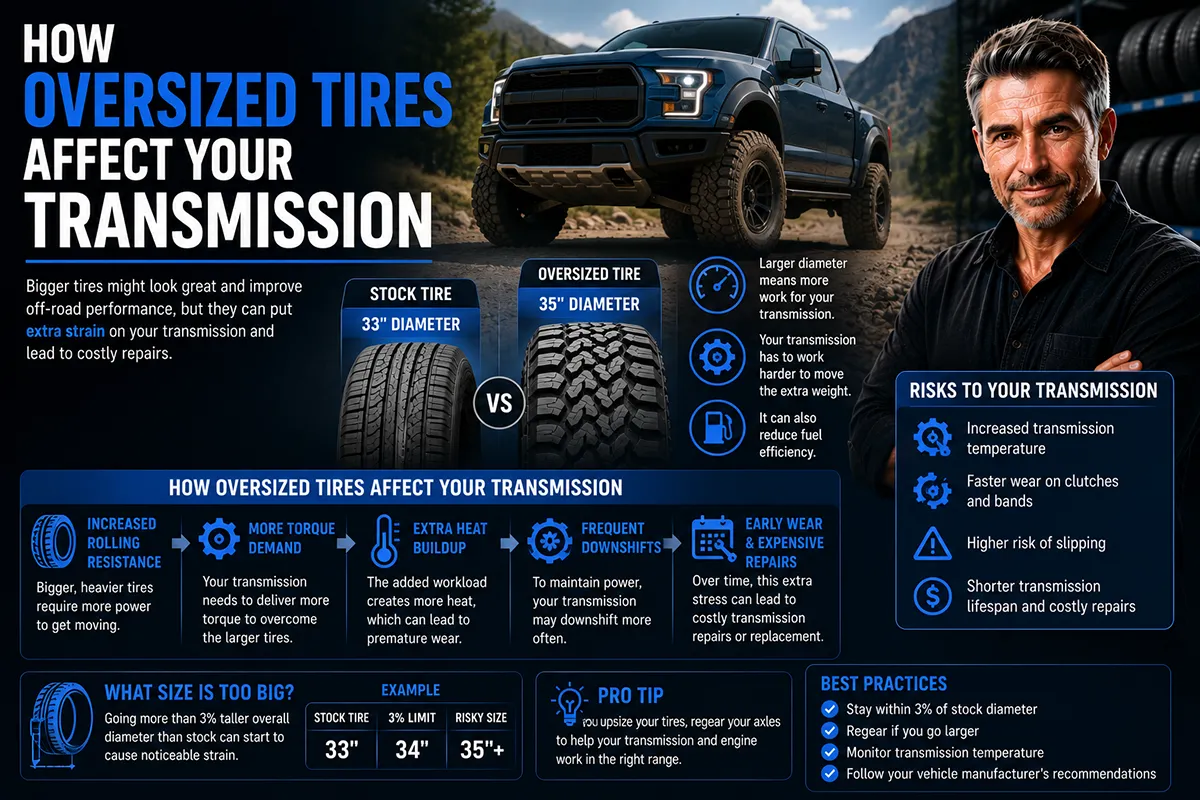
When you install a taller tire, you’re effectively changing the final drive ratio. A larger circumference means your tire covers more ground per revolution. That sounds great for highway cruising, but it also means your engine has to produce more torque to turn that larger wheel — especially from a stop or when climbing a grade.
The Gear Ratio Effect
Think of it like riding a bicycle in too high a gear. You can do it, but you have to push much harder on the pedals, especially starting from a standstill or going uphill. Your transmission is doing the same thing when it’s paired with oversized tires — it’s constantly working in a gear that’s effectively “too tall” for the situation.
For example, if your truck came with 31-inch tires and a 3.73 rear axle ratio, your effective gear ratio is well-matched for that combination. Swap to 35-inch tires without changing anything else, and your effective ratio drops to approximately 3.42. That’s a significant reduction — about 8% — and your transmission feels every bit of it.
Here’s a quick reference for how common tire upsizes affect your effective gear ratio on a vehicle with a factory 3.73 axle ratio:
| Stock Tire Size | Oversized Tire | Diameter Increase | Effective Gear Ratio (from 3.73) | Impact on Transmission |
|---|---|---|---|---|
| 265/70R17 (~31.6″) | 275/70R17 (~32.2″) | ~2% | ~3.66 | Minimal — generally safe |
| 265/70R17 (~31.6″) | 285/70R17 (~32.7″) | ~3.5% | ~3.60 | Mild — noticeable shift changes |
| 265/70R17 (~31.6″) | 295/70R17 (~33.3″) | ~5.4% | ~3.53 | Moderate — harder shifts, higher temps |
| 265/70R17 (~31.6″) | 315/70R17 (~34.4″) | ~8.9% | ~3.40 | Significant — regear recommended |
| 265/70R17 (~31.6″) | 35×12.50R17 (~35″) | ~10.8% | ~3.33 | High — regear strongly recommended |
As you can see, even a seemingly modest increase in tire diameter creates a measurable change in what your transmission experiences. And it compounds — the bigger you go, the more dramatic the effect.
What I’ve Actually Observed: Real Symptoms on Real Vehicles
I’ve installed oversized tires on several of my personal vehicles and test trucks over the years, and I’ve documented the transmission-related symptoms carefully. Here’s what I consistently see.
Delayed and Harsh Shifting
This is usually the first thing I notice. After installing tires that are significantly larger than stock — typically 3 inches or more in diameter — the transmission takes noticeably longer to upshift. When it does shift, it often feels harder and more abrupt than usual.
The reason is straightforward: your vehicle’s transmission control module (TCM) uses data from the vehicle speed sensor (VSS) to determine when to shift. With larger tires, the VSS reads a slower speed than the vehicle is actually traveling, because the driveshaft is rotating fewer times per mile. The TCM thinks you’re going slower than you are, so it holds gears longer and shifts at inappropriate times.
Gear Hunting on Hills and Highways
During one of my test periods with 35-inch tires on a stock-geared Ram 1500, I drove through the Appalachian Mountains on I-68 and I-79 in West Virginia. The transmission was constantly searching for the right gear — downshifting on moderate grades, upshifting on slight declines, then downshifting again almost immediately.
This “gear hunting” behavior is exhausting for the transmission. Every shift cycle generates heat and adds wear to clutch packs and bands inside the transmission. On stock tires, the same truck handled those grades without breaking a sweat.
Higher Transmission Fluid Temperatures
I started using an OBD-II scanner to monitor transmission fluid temperatures during my oversized tire tests, and the data was eye-opening. On a hot summer day in Texas, a stock-tired truck might see trans temps of 180–190°F during normal highway driving. The same truck with 35-inch tires consistently ran 10–20°F hotter under identical conditions.
That might not sound like much, but transmission fluid degrades rapidly above 200°F. Every 20°F increase above normal operating temperature cuts fluid life roughly in half. I’ve seen trucks with big tires routinely hitting 210–220°F when towing or driving in hilly terrain — that’s the danger zone.
Sluggish Acceleration and Engine Lugging
This one is less about the transmission and more about how the engine and transmission interact. With oversized tires, the engine has to work harder to accelerate the vehicle, especially from a stop. I’ve noticed the engine “lugging” at low RPM — that labored, low-frequency vibration you feel through the seat — because the transmission shifts up too early (based on its incorrect speed reading).
Over time, this constant lugging puts additional stress on the torque converter, which is the fluid coupling between your engine and transmission. A worn or damaged torque converter is a repair that easily costs $800–$2,000 at most shops.
It’s Not Just Manual vs. Automatic — Both Are Affected
I want to clear up a misconception I see in forums constantly: that manual transmissions are “immune” to oversized tire problems. They’re not.
Yes, with a manual, you control when to shift, so you can compensate somewhat for the taller effective gearing. But the clutch still has to handle the increased torque load every time you launch from a stop. I’ve worn through clutches noticeably faster on vehicles running significantly oversized tires.
Automatic transmissions are more sensitive because they rely on computer-controlled shift logic that assumes stock tire sizes. But both types share the same fundamental problem: the drivetrain was designed for a specific tire diameter, and deviating from that design puts added strain on components.
How Your Vehicle’s Computer Gets Confused
Modern vehicles are rolling computers. Your engine control module (ECM), transmission control module (TCM), and anti-lock braking system (ABS) all rely on accurate speed data to function properly. Here’s what goes wrong with oversized tires.
Speedometer Error
Your speedometer will read slower than your actual speed. With 35-inch tires on a truck calibrated for 31-inch tires, you might be going 73 mph when your dash reads 65. I’ve verified this with GPS during my tests, and the discrepancy is consistent and predictable.
This isn’t just a speedometer issue — it means every system that uses speed data is working with wrong information. Your cruise control, your stability control, your ABS, and yes, your transmission shifting strategy.
Shift Point Miscalibration
Because the TCM thinks you’re going slower than you actually are, it may delay upshifts, engage torque converter lockup at the wrong time, or fail to downshift when you need power. I’ve experienced all three of these issues during my testing.
The most dangerous scenario I’ve personally encountered was a failed downshift during a highway merge. I was in the right lane, needed to accelerate to merge with faster traffic, floored the throttle, and the transmission hesitated for a full two seconds before kicking down. That hesitation wouldn’t have happened with correctly calibrated tires.
Traction and Stability Control Interference
While not directly a transmission issue, it’s worth noting that oversized tires can confuse your vehicle’s traction control system. I’ve had traction control lights illuminate on dry pavement because the system detected a mismatch between what the wheel speed sensors reported and what the vehicle was actually doing.
On some vehicles, traction control intervention can limit throttle input and affect transmission behavior — creating a cascading effect of strange drivability symptoms that are hard to diagnose if you don’t know oversized tires are the root cause.
Towing Makes Everything Worse
If you tow anything — a boat, a camper, a utility trailer — the transmission stress from oversized tires multiplies dramatically. I cannot stress this enough.
I tested this directly by towing a 5,000-pound enclosed trailer with a half-ton truck, first on stock 31-inch tires and then on 35-inch tires with no other modifications. The difference in transmission temperature alone was alarming: the oversized tires pushed trans temps over 230°F on a sustained 4% grade in summer heat. With stock tires, the same scenario maxed out around 205°F.
At 230°F, you’re actively damaging the transmission fluid, and by extension, every internal component that fluid protects. If you tow regularly and want to run oversized tires, you absolutely need an auxiliary transmission cooler. I consider that a non-negotiable modification — and a good one costs $150–$400 installed.
What You Can Do About It: Real Solutions That Work
The good news is that running oversized tires doesn’t have to destroy your transmission. There are well-proven solutions, and I’ve personally used or tested all of them.
1. Speedometer Recalibration
This is the minimum I recommend for anyone going more than one size up. A recalibration corrects the speed signal so your TCM, ECM, and ABS all receive accurate data.
For most modern trucks and SUVs, this can be done with a handheld programmer like a Superchips Flashcal (around $100–$150) or through a dealer reflash ($75–$200 depending on the dealership). I’ve used the Flashcal on both Ford and Ram trucks and found it corrects the speedometer within 1 mph of GPS-verified speed.
However, recalibrating the speedometer alone doesn’t change the mechanical disadvantage of the taller gearing. It fixes the computer’s confusion, but your transmission is still working harder than it was designed to. For tires that are 3+ inches taller than stock, you need more.
2. Regearing Your Axles
This is the gold-standard solution, and the one I recommend most often for trucks running 33-inch tires or larger on a vehicle that originally came with 31s. Regearing means swapping the ring and pinion gears in your axle(s) to a numerically higher ratio that compensates for the taller tires.
For example, if your truck has 3.73 gears and you’ve installed 35-inch tires, going to 4.56 gears restores nearly the same effective ratio you had with stock tires. The result is dramatic — the transmission shifts when it should, the engine operates in its happy RPM range, and that sluggish, labored feeling disappears completely.
I’ve had regearing done on two personal vehicles, and both times, it transformed the driving experience. The cost ranges from $800–$1,500 per axle for parts and labor at a reputable shop. For a 4WD truck, you’re looking at both axles, so $1,600–$3,000 total. It’s not cheap, but it’s far less expensive than a transmission rebuild ($3,000–$6,000+).
3. Transmission Tuning
Several aftermarket tuners — like HP Tuners, SCT, and DiabloSport — allow you to adjust shift points, shift firmness, torque converter lockup strategy, and line pressure. A good custom tune from a reputable tuner can make a meaningful difference in how your transmission handles oversized tires.
I’ve run custom transmission tunes on test trucks and found they’re most effective when combined with a speedometer recalibration. The tune adjusts the shift strategy to account for the added load, while the recalibration ensures the computer has accurate speed data. Together, they address both the mechanical and electronic sides of the problem.
Expect to pay $300–$600 for a quality custom tune from a reputable shop, or $400–$700 for a handheld tuner with pre-loaded tunes.
4. Auxiliary Transmission Cooler
If you’re keeping your oversized tires and haven’t addressed the gearing, an auxiliary transmission cooler is the single best investment you can make to protect your transmission. It won’t fix the shift issues or the sluggish acceleration, but it will keep fluid temperatures in check — and that’s what prevents the catastrophic failures.
I’ve installed Derale and Hayden coolers on several vehicles. A quality cooler with a built-in fan costs $150–$350 and can be installed in an afternoon with basic tools. I’ve seen trans temps drop 20–30°F with a good auxiliary cooler, which brings most oversized-tire setups back into the safe operating range.
5. Staying Within a Reasonable Size Increase
The simplest solution, honestly, is to not go too crazy. In my experience, most trucks and SUVs can handle a tire that’s 1–2 inches larger in diameter without any modifications beyond a speedometer recalibration. The transmission will work slightly harder, but it’s within the design margin that engineers build into these systems.
The trouble starts when people jump 3, 4, or 5+ inches in diameter without any supporting modifications. That’s where I see the transmission problems, the premature wear, and the expensive repairs.
How Much Is This Really Going to Cost You?
One of the biggest frustrations I have as a reviewer is that tire shoppers rarely budget for the full cost of upsizing. They see the price of four tires and think that’s the number. Here’s what the real budget looks like for common scenarios.
| Scenario | Tire Cost (Set of 4) | Supporting Mods | Total Estimated Cost |
|---|---|---|---|
| 1 size up (e.g., 31″ to 32″) | $600–$1,200 | Speedometer recal: $100–$200 | $700–$1,400 |
| 2 sizes up (e.g., 31″ to 33″) | $800–$1,600 | Recal + trans cooler: $250–$550 | $1,050–$2,150 |
| 3+ sizes up (e.g., 31″ to 35″) | $1,200–$2,400 | Recal + regear + cooler + possible lift: $2,000–$5,000+ | $3,200–$7,400+ |
When you lay it out like this, you can see why I always tell people: the tires are often the cheapest part of the equation. The drivetrain modifications to properly support them can cost as much as — or more than — the tires themselves.
Vehicles I’ve Seen Most Affected
Not all vehicles react the same way to oversized tires. In my experience, here are the ones where I see the most transmission-related problems.
Half-Ton Trucks (Silverado 1500, Ram 1500, F-150)
These are the most common culprits because they’re the most popular trucks in America and the ones owners most frequently upsize. Half-tons typically come with lighter-duty transmissions compared to their 3/4-ton and 1-ton siblings, so they have less margin for error. I’ve seen more transmission complaints on oversized-tire half-tons than any other category.
Jeep Wranglers
Wrangler owners love big tires — it’s basically part of the ownership experience. But the JK and JL Wranglers come with relatively modest axle gearing from the factory (often 3.21 or 3.45), and many owners jump straight to 35-inch or even 37-inch tires. Without regearing, these Jeeps are sluggish, the automatic transmissions shift poorly, and the manuals require excessive clutch slipping to get moving.
Midsize Trucks (Tacoma, Colorado, Ranger)
Midsize trucks have smaller engines and lighter transmissions than full-size trucks, which means they’re even more sensitive to oversized tires. I’ve tested oversized tires on both a Toyota Tacoma and a Chevy Colorado, and even a 2-inch diameter increase was noticeable in how the transmission behaved. These trucks have very little margin.
SUVs and Crossovers (4Runner, Bronco Sport, RAV4)
The overlanding trend has pushed a lot of SUV and crossover owners toward larger, more aggressive tires. Some of these vehicles — like the 4Runner — handle modest increases well. Others — like smaller crossovers with CVT transmissions — are a terrible match for oversized tires. CVTs are particularly sensitive because they rely on precise belt/pulley ratios that don’t adapt well to significant changes in rolling resistance and effective gearing.
Signs Your Transmission Is Already Struggling
If you’ve already installed oversized tires and you’re reading this article with a sinking feeling, here are the warning signs I look for that suggest your transmission needs attention.
- Delayed engagement: You shift into Drive or Reverse and there’s a pause before the vehicle moves. This is often caused by low line pressure or worn clutch packs — both accelerated by operating with oversized tires.
- Slipping: The engine revs climb but the vehicle doesn’t accelerate proportionally. This means the clutch packs inside the transmission aren’t holding under the increased load.
- Hard or erratic shifting: Shifts feel like the transmission is slamming into the next gear, or the shift pattern is inconsistent — sometimes shifting smoothly, sometimes not.
- Burning smell: Overheated transmission fluid has a distinct burnt, acrid smell. If you catch this, check your fluid immediately. Dark brown or black fluid with a burnt odor means damage has already occurred.
- Check engine light or transmission warning: Modern vehicles will set diagnostic trouble codes when the transmission isn’t performing within expected parameters. Common codes related to this issue include P0700, P0730, P0740, and various solenoid performance codes.
- Fluid temperature warnings: If your vehicle has a trans temp gauge or warning light and it’s activating during normal driving, that’s a clear sign the transmission is being overtaxed.
If you’re experiencing any of these symptoms, I’d recommend getting your transmission inspected by a reputable shop before the problem escalates. A $200 diagnostic and fluid change now could save you from a $4,000+ rebuild later.
My Honest Recommendation as a Tire Reviewer
I love big tires. I genuinely do. There’s something deeply satisfying about a truck or Jeep sitting on meaty, aggressive rubber. And there are legitimate performance reasons to go bigger — more ground clearance, better off-road capability, improved traction in certain conditions.
But I’ve seen too many people spend $1,500 on a set of 35-inch tires and then spend $5,000 on a transmission rebuild a year later because they didn’t do the supporting modifications. That’s not a smart tire purchase — it’s a $6,500 lesson.
Here’s my personal rule of thumb that I’ve developed over years of testing:
- Up to 1 inch larger in diameter: You’re almost certainly fine with just a speedometer recalibration. Enjoy your tires.
- 1–2 inches larger: Recalibrate your speedometer, add a transmission cooler if you tow, and monitor your trans temps for the first few weeks. Most modern trucks handle this well.
- 2–3 inches larger: You should seriously consider regearing, especially if you tow or drive in hilly terrain. A transmission tune is also a smart addition at this level.
- 3+ inches larger: Regearing is essentially mandatory. Budget for a full supporting modification package: regear, recalibration, transmission cooler, possible transmission tune, and likely a lift kit. If you can’t budget for these, I’d recommend choosing a smaller tire.
I know that last point might sound harsh, but it comes from a place of experience. I’ve watched too many enthusiasts destroy good trucks by jumping straight to the biggest tires they can fit without thinking about the drivetrain consequences.
A Note About Warranties
One more thing I want to mention: installing significantly oversized tires can jeopardize your vehicle’s powertrain warranty. If your transmission fails and the dealership sees 35-inch tires on a truck that came with 31s, they may deny the warranty claim under the Magnuson-Moss Warranty Act argument that the modification caused the failure.
I’ve heard from readers who’ve been in this exact situation. Some won their cases, some didn’t. But it’s a risk you should be aware of, especially on newer vehicles still under factory warranty coverage. If you’re within your warranty period, I’d recommend staying within the manufacturer’s approved tire size range or being prepared to document that your modifications were properly installed and maintained.
The Bottom Line
Oversized tires are one of the most popular modifications in America, and for good reason — they look great and offer real functional benefits. But they’re not a bolt-on-and-forget modification. Your transmission is directly affected by the size of tire you put on your vehicle, and ignoring that relationship can lead to costly repairs.
In my years of testing, the drivers who are happiest with their oversized tire setups are the ones who planned ahead, budgeted for the full package of supporting modifications, and treated the project as a system upgrade rather than just a tire swap. The ones who end up frustrated — and broke — are the ones who only thought about how the tires looked in the wheel well.
Take care of your transmission, and it’ll take care of you. Budget smart, modify right, and enjoy the ride on whatever size rubber makes you happy — as long as your drivetrain can handle it.
Frequently Asked Questions
How do oversized tires affect your transmission lifespan?
Oversized tires force your transmission to work harder because the increased rotational mass and rolling resistance demand more torque to get the vehicle moving and keep it at speed. Over time, this added stress can lead to premature wear on transmission components like clutch packs, bands, and the torque converter. I’ve seen drivers who jump two or three sizes up from stock experience transmission overheating and even complete failure within 50,000–80,000 miles if no other modifications are made.
Do bigger tires mess up your transmission shift points?
Yes, installing bigger tires than your vehicle’s factory spec throws off the calibrated shift points because the transmission computer relies on speed sensor data that no longer matches actual wheel speed. This means your transmission may shift too early or too late, causing rough shifting, gear hunting on the highway, and reduced fuel economy. A transmission recalibration or a programmer like a Superchips or SCT tuner, typically costing $300–$600, can correct these shift points for your new tire size.
What size tire is too big for a stock transmission?
As a general rule, going more than 3% larger in overall tire diameter than the factory size starts putting noticeable extra strain on a stock transmission. For example, jumping from a 265/70R17 to a 285/75R17 increases the diameter by roughly 5%, which is enough to cause shift timing issues and added heat buildup. If you’re planning to run 33-inch or 35-inch tires on a truck that came with 30- or 31-inch tires, I’d strongly recommend budgeting for a gear ratio change and transmission tune.
Can oversized tires cause transmission overheating?
Absolutely. Larger, heavier tires increase the load on your transmission, especially during city driving, towing, or climbing grades in states like Colorado or Tennessee where elevation changes are significant. The added resistance generates more heat inside the transmission, and if your stock transmission cooler can’t dissipate it fast enough, fluid temperatures can exceed safe levels. Adding an aftermarket transmission cooler, which runs $100–$250 installed, is one of the most cost-effective upgrades you can make when running oversized tires.
Do I need to regear my truck after installing bigger tires to protect the transmission?
Regearing is one of the best ways to protect your transmission after upsizing tires because it restores the mechanical advantage your drivetrain lost when you increased tire diameter. For most trucks and Jeeps, going from stock 3.21 or 3.55 gears to 4.10 or 4.56 gears compensates for 33-inch to 35-inch tires and brings RPMs back to normal operating range. Expect to pay $1,200–$2,000 for a professional regear at a US shop, but it can save you thousands in transmission repairs down the road.
Will oversized tires void my vehicle’s transmission warranty?
Most dealerships in the US can deny a transmission warranty claim if they determine that oversized tires contributed to the failure, thanks to the Magnuson-Moss Warranty Act’s provision that allows denial when aftermarket modifications cause the damage. If your truck is still under powertrain warranty, I’d recommend keeping documentation that you’ve added supporting mods like a tuner recalibration or regear to show the transmission wasn’t being abused. Some drivers stick with a modest 1-inch increase in tire diameter to stay under the radar while still getting a more aggressive look.
Does putting bigger tires on an automatic vs manual transmission make a difference?
Oversized tires tend to stress automatic transmissions more than manuals because automatics rely on a torque converter and complex hydraulic shifting that generates more heat under increased load. With a manual transmission, you have direct control over shift points, so you can downshift proactively on hills or when towing to keep RPMs in a healthy range. That said, both transmission types will experience accelerated clutch and gear wear with significantly oversized tires if you don’t address the gear ratio mismatch, so the upgrade considerations are similar regardless of what you drive.
