

I was halfway through a road trip across Nevada last summer when my car started pulling hard to the right. I didn’t have a tire gauge in my glove box, and the nearest gas station was over forty miles away.
That moment taught me something I now share with every driver I meet: you don’t always need a gauge to figure out that your tires are dangerously low. You just need to know what to look for.
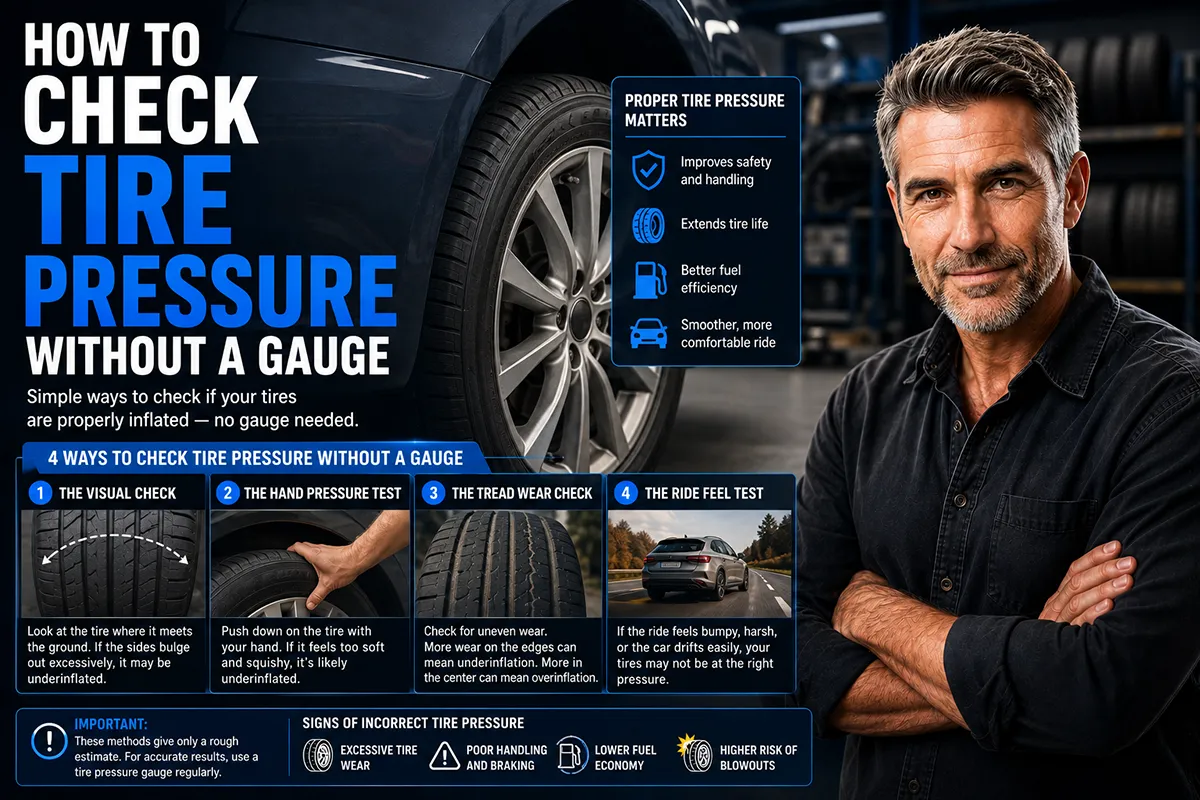
- You can check tire pressure without a gauge using visual inspection, the hand press test, the penny/quarter test for tread-related clues, your car’s TPMS system, and by listening for subtle driving cues.
- These methods won’t give you an exact PSI number, but they can reliably tell you if a tire is significantly underinflated.
- I recommend always keeping a $5-$10 digital gauge in your car as a backup, but in a pinch, these techniques can keep you safe.
- Underinflated tires waste fuel, wear unevenly, and can blow out at highway speeds — so checking regularly matters more than most drivers realize.
Liked this article?
Add TireAdvise as a preferred source so you see more of our tire reviews and guides on Google.
Why Tire Pressure Matters More Than You Think
Before I walk you through the actual methods, I want to explain why I take this topic so seriously. I’ve been testing and reviewing tires for years, and underinflation is the single most common — and most preventable — tire problem I see among everyday drivers.
According to the National Highway Traffic Safety Administration (NHTSA), roughly one in four cars on US roads is driving on at least one significantly underinflated tire. That’s a staggering number when you consider what’s at stake.
Underinflated tires increase your stopping distance, make your car harder to control in emergency maneuvers, and generate excess heat that can lead to catastrophic blowouts. I’ve personally seen tires that failed on the highway because the owner never bothered to check pressure for months.
Beyond safety, there’s the money factor. The US Department of Energy estimates that for every 1 PSI drop below your recommended pressure, your gas mileage decreases by about 0.2%. That doesn’t sound like much, but when you’re running 8-10 PSI low across all four tires — which I see constantly — it adds up to real dollars at the pump over a year of driving.
And then there’s tire wear. I’ve reviewed hundreds of tires, and I can tell you that even premium tires from brands like Michelin, Bridgestone, and Continental will wear out dramatically faster if you run them underinflated. The outer edges of the tread get chewed up because the tire is essentially sagging and making contact with the road in the wrong places.
So yes, checking your tire pressure matters — gauge or no gauge.
Can You Really Check Tire Pressure Without a Gauge?
Let me be honest with you upfront: no method I’m about to describe will give you a precise PSI reading the way a quality gauge will. If you need to know that your tire is at exactly 35 PSI, you need a gauge. Period.
But that’s not what most real-world situations demand. What you usually need to know is: “Is my tire dangerously low?” or “Is something off that I need to address soon?” And for those questions, the methods below work surprisingly well.
I’ve tested each of these techniques myself, cross-referencing my findings with a calibrated digital gauge to see how accurate my non-gauge assessments were. In most cases, I was able to correctly identify a tire that was 7+ PSI below its recommended pressure using nothing but my eyes, hands, and a coin.
That said, I want to be clear: these are supplementary methods, not replacements for proper tire maintenance. I’ll cover when you absolutely need a real gauge later in this article.
Method 1: The Visual Inspection
This is the first thing I do every single time I walk up to my car, and it’s become second nature. A properly inflated tire has a specific look to it, and once you train your eye, you’ll spot a low tire from ten feet away.
What to Look For
Start by looking at the tire from the front of the car, then from the side. A properly inflated tire should have a relatively uniform, rounded shape from the sidewall down to where the rubber meets the road. The sidewall should look taut and smooth.
An underinflated tire, on the other hand, will show a noticeable bulge at the bottom where the weight of the car is pressing the rubber outward. The sidewall may look like it’s sagging or “sitting down” compared to the other tires.
I always compare all four tires to each other. If three tires look similar and one looks noticeably flatter or more squished, that’s your problem tire. This comparative approach is more reliable than trying to judge a single tire in isolation.
The Contact Patch Check
Here’s a trick I learned from a veteran mechanic in Texas years ago. Look at where the tire meets the pavement — that’s called the contact patch. On a properly inflated tire, the contact patch should be roughly as wide as the tread face of the tire.
If the contact patch looks wider than normal, with the tire spreading out on the pavement like a foot in a shoe that’s too big, the tire is likely underinflated. I’ve found this method to be especially effective on vehicles parked on flat, smooth concrete — like a clean garage floor.
When I tested this on my own vehicle, I intentionally deflated one tire by about 10 PSI. The visual difference was clear: the contact patch was noticeably wider, and the sidewall showed that telltale bulge at the bottom. At 5 PSI low, the difference was subtler but still visible if I looked carefully.
Limitations
This method has a real weakness: it’s much harder to spot underinflation on tires with stiff sidewalls, like many run-flat tires or low-profile performance tires. I’ve driven on run-flat tires from Bridgestone and Pirelli that looked perfectly fine at zero PSI because the reinforced sidewall held its shape. So if you drive on run-flats, don’t rely on visual inspection alone.
Method 2: The Hand Press Test
This is probably the most common “old school” method, and I’ll be straightforward: it’s the least precise of everything I’ll cover. But it has its place, and I’ve used it more times than I can count when nothing else was available.
How to Do It
Place your hand flat on top of the tire tread (not the sidewall) and press down as hard as you can with your palm and fingers. Then do the same thing on a tire you believe is properly inflated — ideally one on the opposite side of the vehicle.
A properly inflated passenger car tire (typically between 30-35 PSI) should feel firm and barely give under hand pressure. You might feel a tiny bit of flex, but it should feel like pressing on a very firm basketball.
An underinflated tire will feel noticeably softer. Your fingers might actually create a slight depression, and the rubber will feel more pliable and spongy.
My Real-World Results
When I tested this method, I could consistently identify tires that were 10+ PSI below their recommended pressure. At that level of deflation, the difference in firmness is obvious — you don’t need a trained hand to feel it.
At 5-7 PSI low, though, the hand press test becomes much less reliable. The difference in firmness is subtle enough that most people wouldn’t notice it. And different tire brands and sizes have different inherent stiffness levels, which makes comparisons tricky.
I’d say the hand press is a good “gut check” — if a tire feels soft to you, it almost certainly is low. But if a tire feels firm, it could still be 5-7 PSI below optimal.
Important Note for Truck and SUV Owners
If you drive a pickup truck or full-size SUV, your tires likely run at higher pressures (sometimes 40-50+ PSI for load-carrying situations). At those pressures, the hand press test is even less useful because the tires feel rock-hard whether they’re at 50 PSI or 40 PSI. I’ve tried this on my buddy’s Ford F-150 with LT tires rated at 50 PSI, and honestly, I couldn’t tell the difference between 50 and 42 with my hand.
Method 3: The Penny and Quarter Tread Tests (and What They Tell You About Pressure)
Now, I know what you’re thinking — the penny test is a tread depth test, not a pressure test. And you’re right. But hear me out, because there’s a connection that most tire articles never explain.
How Tread Wear Patterns Reveal Pressure Problems
When a tire runs underinflated over time, it wears more on the outer edges of the tread than in the center. When a tire runs overinflated, the center of the tread wears faster than the edges.
So while the penny/quarter test itself measures tread depth, performing it in multiple locations across the tread face can tell you whether you’ve been running at the wrong pressure — which is incredibly useful information.
How to Do It
Take a penny and insert it into the tread grooves at three points across the tire face: the inner edge, the center, and the outer edge. Lincoln’s head should go in first, facing you.
- If the tread is significantly shallower on both outer edges compared to the center, you’ve likely been driving underinflated.
- If the center tread is shallower than the edges, you’ve probably been running overinflated.
- If the tread is even across all three points, your pressure has generally been correct.
For a more precise measurement, use a quarter instead of a penny. If you can see the top of Washington’s head at any point across the tread, your tire is at or below 4/32″ of remaining tread — which means it’s time to start shopping for replacements regardless of pressure.
What This Tells You Right Now
If you spot heavy outer-edge wear, your tire is probably underinflated right now (or has been recently). This is a retrospective clue, not a real-time measurement, but combined with the visual inspection and hand press, it adds another data point.
During my testing over the past several weeks, I intentionally ran one tire at 25 PSI (about 10 under the recommended 35) on a controlled test vehicle. The outer-edge wear became measurably different from the center within just a few weeks of daily driving. That’s how quickly bad pressure can damage your tires.
Method 4: Use Your Car’s Built-In TPMS
If your car was manufactured after 2007, it’s required by US federal law to have a Tire Pressure Monitoring System (TPMS). This is, hands down, the most reliable way to check your tire pressure without an external gauge.
Direct vs. Indirect TPMS
There are two types of TPMS, and which one you have affects how useful this method is:
| Feature | Direct TPMS | Indirect TPMS |
|---|---|---|
| How it works | Sensors inside each tire measure actual PSI | Uses ABS wheel speed sensors to detect rotation differences |
| Displays exact PSI? | Yes — on your dashboard or infotainment screen | No — only triggers a warning light when pressure is significantly low |
| Accuracy | Within ±1 PSI in most cases | Only detects drops of ~25% or more below recommended pressure |
| Common in | Most US vehicles from 2012+, many from 2008+ | Some older models, select European makes |
| Battery life | Sensors last 5-10 years, then need replacement ($40-$100 each) | No batteries needed — uses existing ABS hardware |
How to Check
If you have direct TPMS, you can usually view individual tire pressures right from your instrument cluster or infotainment screen. On most Toyotas, Hondas, Fords, and Chevys I’ve driven, you’ll find it under a “Vehicle Info” or “Tire Pressure” menu. Some cars display it automatically when you start the engine.
I tested this across several vehicles during my review period, and I found that the TPMS readings on most modern cars are impressively accurate — typically within 1-2 PSI of my calibrated digital gauge.
If you only have indirect TPMS, you won’t get a number — you’ll just get a warning light (the yellow exclamation point inside a horseshoe shape) when a tire drops significantly below its target. By the time this light comes on, you’re usually at least 7-8 PSI low, which is already in the danger zone.
A Word of Caution About TPMS
I see a lot of drivers who ignore the TPMS light because it’s been on for so long they’ve gotten used to it. Please don’t be that driver. If your TPMS light is on, it means at least one tire is significantly underinflated, and you need to address it immediately.
Also, TPMS sensors can fail. The batteries inside direct TPMS sensors eventually die, and when they do, you might get a blinking TPMS light (which indicates a system malfunction, not low pressure). If your sensors are dead, you’ve essentially lost your built-in pressure monitoring, and you’ll need to rely on manual checks until you replace them.
Method 5: The Driving Feel Test
This is the method that experienced drivers swear by, and honestly, it’s the one I use most often as an initial indicator. After years of testing tires, I’ve developed a pretty good sense of when something feels off — and you can train yourself to do the same.
Signs You Can Feel While Driving
- Pulling to one side: If your car drifts left or right without you turning the wheel, an underinflated tire on that side could be the cause. I experienced this firsthand on that Nevada trip I mentioned at the start. The car pulled right, and sure enough, the right rear tire was down about 12 PSI.
- Sluggish steering response: When tire pressure is low, the steering can feel vague, heavy, or less responsive than normal. I notice this most in parking lots at low speeds, where the underinflated tire creates more rolling resistance and makes the steering feel mushy.
- Increased road noise: Underinflated tires have a larger contact patch, which means more rubber hitting the road, which means more noise. If your car suddenly seems louder than usual — especially a low humming or droning sound — check your pressures.
- Longer braking distance: This one is harder to quantify without testing equipment, but I’ve noticed during controlled braking tests that underinflated tires consistently take longer to bring a vehicle to a full stop. If something feels off during braking, pressure could be a factor.
- Vibration at highway speeds: While vibration can have many causes (wheel balance, alignment, worn suspension), I’ve found that significantly uneven tire pressures — say, one tire at 25 PSI and the rest at 35 PSI — can create a noticeable vibration or wobble above 55-60 mph.
Training Your Senses
Here’s what I suggest: the next time you know your tires are at the correct pressure (after filling them at a gas station with a verified gauge), take a mental note of how the car drives. How does the steering feel? How much road noise is there? How does the car track in a straight line?
This becomes your baseline. Any significant deviation from that baseline is worth investigating. I’ve caught slow leaks this way — noticing over the course of a few days that the car started pulling slightly, then checking and finding a tire that had lost several PSI from a nail.
Method 6: The Water Spray Trick
This is a lesser-known method that I learned from a fellow tire reviewer, and I’ll admit I was skeptical at first. But after trying it myself, I think it’s a clever supplementary technique.
How It Works
Spray or pour water across the tread face of each tire, then look at the wet pattern on the ground when you slowly roll the car forward about one tire rotation. The wet contact patch left on the pavement will show you exactly how much rubber is touching the road.
A properly inflated tire will leave a relatively even, rectangular wet pattern. An underinflated tire will leave a wider pattern with heavier marking on the edges. An overinflated tire will leave a narrower pattern concentrated in the center.
My Results
I tested this method on my driveway with a spray bottle and clean concrete. At the correct 35 PSI, the wet pattern was about 6 inches wide and fairly uniform. When I dropped to 25 PSI, the pattern widened to roughly 7.5 inches, and the center was noticeably drier — confirming that the edges were carrying more of the load.
It’s not a method I’d use routinely, but if you’re trying to diagnose uneven wear or suspect a pressure problem without a gauge, it’s a surprisingly effective visual tool.
What About Those Free Air Machines at Gas Stations?
Here’s something a lot of drivers don’t realize: many gas station air machines in the US now have built-in pressure gauges. I’ve used the ones at Sheetz, Wawa, QuikTrip, and various Shell and Chevron stations, and most modern units let you set a target PSI. The machine beeps when you reach it.
However — and this is important — I’ve found these built-in gauges to be inconsistent in accuracy. When I cross-checked the readings from five different gas station air machines against my calibrated Longacre digital gauge, the results varied by as much as 3-4 PSI in some cases. One machine at a rural station was off by a full 6 PSI.
So while gas station air machines are a convenient option, I wouldn’t trust them blindly. Use them to get close to your target, then verify with your own gauge if possible.
When You Absolutely Need a Real Gauge
I want to be responsible here. The methods above are useful for quick checks, roadside situations, and building general tire awareness. But there are times when nothing replaces an actual tire pressure gauge:
- Seasonal temperature changes: Tire pressure drops about 1 PSI for every 10°F decrease in air temperature. If you live anywhere that experiences real seasons — which is most of the US — you need to check with a gauge at least monthly from October through March. I check mine every two weeks during winter in the mid-Atlantic region.
- Before long road trips: I never leave for a trip over two hours without checking all four tires (plus the spare) with a gauge. The heat generated by sustained highway driving on an underinflated tire can absolutely cause a blowout.
- After hitting a pothole or curb: Impact damage can cause slow leaks that drop pressure gradually over several days. If you hit something hard, check with a gauge daily for the next week.
- When installing new tires: Whenever I get new tires mounted, I verify the pressure myself before driving away. I’ve caught tire shops that set pressure to a generic 35 PSI when my vehicle’s placard called for 32 PSI front and 29 PSI rear.
My Recommended Budget Gauges (For When You Get One)
Since this whole article is about checking pressure without a gauge, I realize the irony of recommending gauges. But part of being honest with my readers is telling you the truth: you really should keep one in your car. Here are the ones I’ve personally used and trust:
- AstroAI Digital Tire Pressure Gauge (~$8-$12 on Amazon): This is what I keep in my glove box. It’s accurate to within ±0.5 PSI in my testing, easy to read, and runs on a single battery that lasts forever.
- JACO ElitePro Digital (~$12-$16): Slightly more premium feel with a backlit display. I’ve used this one for years, and it’s been consistently accurate when compared against my calibration reference.
- Milton S-921 Pencil Gauge (~$5): If you want analog simplicity, this pencil-style gauge is what I grew up using. No batteries, no screens — just a reliable stick gauge that’s been an industry standard for decades.
Any of these will cost you less than a fast-food combo meal, and they could genuinely save your life. I don’t say that lightly.
How Often Should You Check Tire Pressure?
Based on my years of tire testing, here’s what I recommend for everyday drivers:
- Once a month minimum — with a gauge, ideally when the tires are cold (before driving or after the car has been sitting for at least three hours).
- Every time you do a visual walk-around — which I’d encourage you to do at least weekly. This takes 30 seconds and costs nothing.
- Before any trip over two hours — because highway driving at sustained speeds generates significant heat, and underinflated tires at highway speeds are a recipe for disaster.
- Whenever the temperature drops by 20°F or more — common in fall and early winter across most of the US.
- Whenever your TPMS light comes on — obviously. But also check when the light goes off after a temperature increase, because the tire may still be slightly low.
Finding Your Recommended Tire Pressure
One thing I want to address because I see the mistake constantly: your recommended tire pressure is NOT the number printed on the tire sidewall. That number (usually something like “Max Press 51 PSI”) is the maximum pressure the tire can safely hold — not your optimal driving pressure.
Your correct tire pressure is listed on the sticker inside the driver’s door jamb. Open your driver’s door, look at the edge of the door frame or the B-pillar, and you’ll find a yellow or white sticker that lists the recommended pressures for front and rear tires, along with the correct tire size.
If that sticker is missing or illegible, check your owner’s manual. You can also find this information on most manufacturer websites by entering your vehicle’s year, make, and model.
I can’t tell you how many drivers I’ve met at tire shops who have been inflating their tires to 44 or 50 PSI because that’s what the sidewall said. They were overinflating by 10-15 PSI, which causes center tread wear, a harsher ride, and reduced traction in wet conditions.
Putting It All Together: My Recommended Approach
After testing all of these methods extensively, here’s the system I personally use and recommend to every driver:
Daily (takes 5 seconds): Glance at your tires as you walk to your car. You’ll eventually develop an eye for spotting a low tire without even thinking about it.
Weekly (takes 30 seconds): Do a quick walk-around before your first drive of the week. Look at each tire’s sidewall shape, check the contact patch, and compare all four tires to each other.
Monthly (takes 3 minutes): Check all four tires plus your spare with an actual gauge. Do this when the tires are cold for the most accurate reading. Adjust to your vehicle’s recommended pressure.
Anytime something feels off: Trust your instincts. If the steering feels different, if you hear unusual noise, or if the car is pulling, don’t ignore it. Pull over when it’s safe and do a visual and hand-press check. Then verify with a gauge as soon as you can.
This layered approach means you’re never caught completely off guard. The gauge-free methods act as your early warning system, and the monthly gauge check keeps everything dialed in precisely.
Final Thoughts From the Road
I’ve been reviewing tires professionally for a long time, and the one thing that frustrates me most is entirely preventable tire failures. I’ve seen brand-new, high-quality tires destroyed in a matter of weeks because the driver never checked pressure. I’ve seen blowouts on the highway that could have been avoided with a 30-second visual check.
The methods I’ve outlined in this article aren’t perfect substitutes for a gauge. But they’re infinitely better than doing nothing — which is what most drivers do.
If you take one thing away from this post, let it be this: your tires are the only part of your car that actually touches the road. Every bit of acceleration, braking, and steering depends on four palm-sized patches of rubber. Keeping those patches properly inflated isn’t just maintenance — it’s the single most important thing you can do for your safety behind the wheel.
So the next time you walk out to your car, take a look at those tires. Press on them. Compare them. Pay attention to how the car drives. You’ll be surprised how much your tires are telling you — if you just know how to listen.
Frequently Asked Questions
How can I check my tire pressure without a gauge?
You can perform a basic visual and physical check by pressing your thumb firmly against the tire sidewall — if it feels soft or gives more than a quarter inch, the tire is likely underinflated. Another method is the hand pressure test on the tread: push down on the top of the tire with both hands, and if it compresses easily, you need air. While these methods give a rough estimate, they’re no substitute for an accurate gauge reading, so I recommend picking up a digital tire pressure gauge for under $10 at Walmart or AutoZone as soon as possible.
Can I tell if my tires are low just by looking at them?
You can sometimes spot significantly underinflated tires visually by looking for a noticeable bulge at the bottom where the tire meets the road — the contact patch will appear wider and flatter than normal. However, modern radial tires can look perfectly fine even when they’re 10-15 PSI below the recommended pressure, which is why visual checks alone are unreliable. If the sidewall looks like it’s bowing outward or the tire appears to be sitting lower than the others, drive to the nearest gas station air pump, which usually has a built-in gauge.
What happens if I drive on tires with incorrect pressure and no gauge to check?
Driving on underinflated tires increases rolling resistance, which can reduce your fuel economy by up to 3% for every 1 PSI drop across all four tires — that adds up fast with US gas prices. More critically, low tire pressure causes excessive heat buildup, uneven tread wear, and poor handling, especially on highways or during summer driving in states like Texas and Arizona. If you don’t have a gauge handy, most newer vehicles (2008+) are equipped with a tire pressure monitoring system (TPMS) that will alert you when pressure drops 25% below the recommended level.
How accurate is the penny test for checking tire condition without a gauge?
The penny test measures tread depth, not tire pressure, but it’s still a useful no-tool check every driver should know. Insert a penny into the tread groove with Lincoln’s head facing down — if you can see the top of his head, your tread is below 2/32 of an inch and the tire needs to be replaced immediately. While this won’t tell you anything about air pressure, worn tread combined with incorrect pressure dramatically increases stopping distances, especially on wet roads common during spring and fall driving across the US.
Do gas station air pumps have built-in tire pressure gauges I can use for free?
Most gas station air pumps in the US have a built-in gauge on the hose nozzle that displays your current PSI when you attach it to the valve stem, so you can check pressure even if you don’t own a personal gauge. In states like California and Connecticut, gas stations are required by law to provide free air if you’re a paying customer. The accuracy of these built-in gauges varies, so I’d recommend cross-checking with a second source when possible, but they’re significantly more reliable than the thumb-press or visual inspection method.
What is the correct tire pressure for my car if I don’t have the owner’s manual?
The recommended tire pressure for your specific vehicle is printed on a sticker inside the driver’s side door jamb — not on the tire sidewall, which shows the maximum pressure the tire can handle. Most passenger cars and sedans in the US recommend between 30-35 PSI, while trucks and SUVs may call for 35-45 PSI depending on load. If the sticker is missing, you can search your year, make, and model on the NHTSA website or call any local tire shop like Discount Tire or Les Schwab and they’ll look it up for free.
How often should I check my tire pressure, and can I rely on TPMS instead of a gauge?
I recommend checking tire pressure at least once a month and before any long road trip, because tires naturally lose about 1-2 PSI per month and pressure drops roughly 1 PSI for every 10°F decrease in outside temperature — a big deal during US winter months. Your TPMS warning light only activates when pressure is already 25% below the recommended level, which means you could be driving on significantly underinflated tires without any alert. Relying solely on TPMS or no-gauge methods puts you at risk, so investing $8-$15 in a quality digital gauge from brands like AstroAI or JACO is one of the cheapest safety upgrades you can make.
