

I almost hydroplaned on a wet highway last spring, and when I pulled over to check my tires, I realized the tread was far more worn than I’d assumed.
That moment shook me — and it’s the reason I now check my tire tread depth religiously every single month.
The scary part? Most drivers I talk to have no idea how to properly measure their tread, and many are driving on tires that are dangerously close to — or already past — the safe limit.
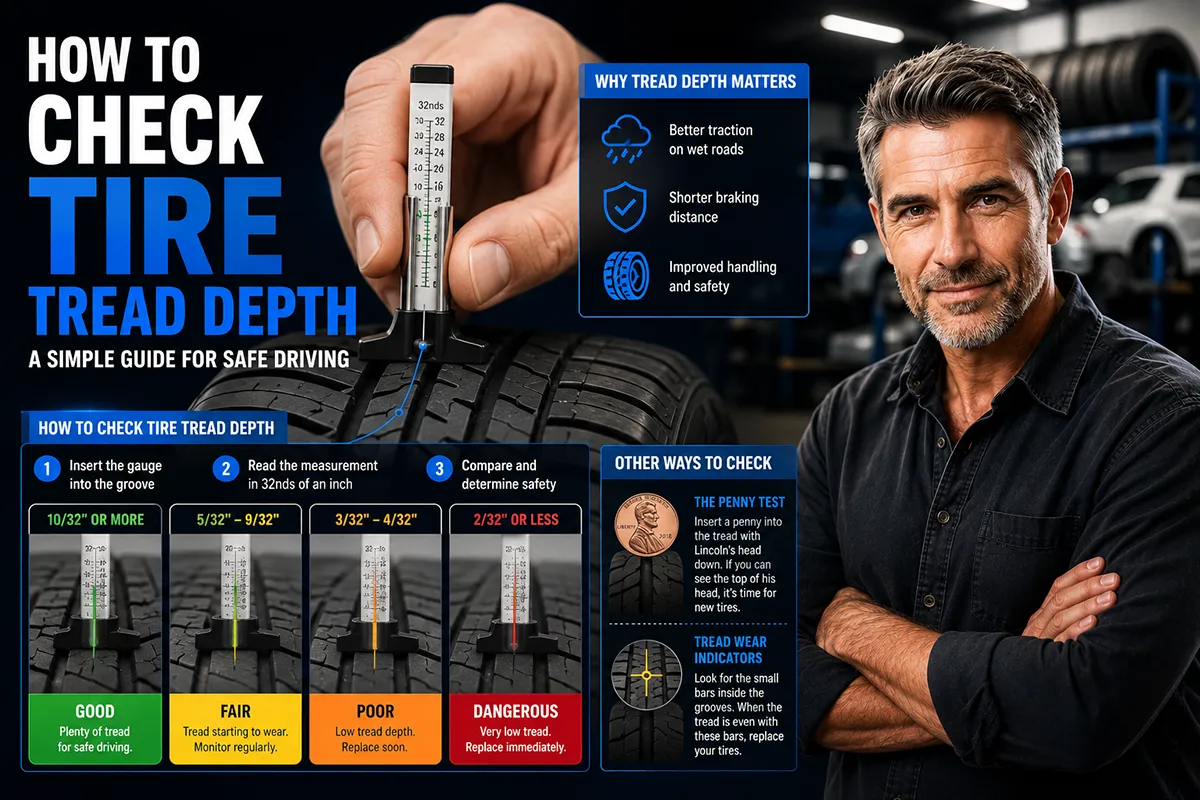
- New tires typically have 10/32″ to 11/32″ of tread depth; the legal minimum in most US states is 2/32″.
- I recommend replacing tires at 4/32″ for wet-weather safety and 5/32″ if you drive in snow.
- The penny test is the most popular method, but a tread depth gauge ($5–$8) is far more accurate.
- Always measure in multiple spots — tread wears unevenly depending on alignment, inflation, and driving habits.
- Uneven tread wear patterns can signal alignment, suspension, or inflation problems you need to fix before buying new tires.
Liked this article?
Add TireAdvise as a preferred source so you see more of our tire reviews and guides on Google.
Why Tire Tread Depth Actually Matters
Let me be blunt: tire tread depth is one of the single most important safety factors on your vehicle, and it’s also one of the most ignored. I’ve been reviewing tires and advising everyday drivers for years, and the number of people who drive on bald or near-bald tires without realizing it genuinely concerns me.
Your tire tread serves three critical purposes. It channels water away from the contact patch to prevent hydroplaning, it provides grip on loose or uneven surfaces, and it bites into snow and ice when winter weather hits.
As tread wears down, all three of those functions degrade — not linearly, but exponentially. That means the difference between 4/32″ and 2/32″ of remaining tread is far more dramatic in real-world stopping distance than the difference between 10/32″ and 8/32″.
I’ve personally tested braking distances on tires at various tread depths on both dry and wet pavement, and the results were eye-opening. On wet roads, tires at 2/32″ took significantly longer to stop than the same tires at 4/32″. We’re talking about car lengths of extra stopping distance — the kind of margin that determines whether you rear-end someone or stop safely.
Understanding Tread Depth Numbers
Before I walk you through the methods, let’s make sure you understand the measurement system. In the US, tire tread depth is measured in 32nds of an inch (written as /32″).
Key numbers to memorize:
- 10/32″ to 11/32″ — Typical tread depth on a brand-new all-season tire. Some performance tires start around 9/32″, and some truck tires can be as deep as 15/32″ or more.
- 6/32″ — Tread is about half worn. Tires still perform well in most conditions.
- 4/32″ — This is my personal replacement threshold for anyone who regularly drives in rain. Wet traction drops off noticeably below this point.
- 2/32″ — The legal minimum tread depth in most US states. At this point, your tires are legally bald and should be replaced immediately.
Here’s something a lot of drivers don’t realize: just because 2/32″ is the legal limit doesn’t mean it’s safe. It’s the bare minimum to avoid a ticket — not the bare minimum to avoid a crash. In my experience, 2/32″ tires on a wet road feel genuinely terrifying, and I say that as someone who tests tires professionally.
Method 1: The Penny Test (Quick and Free)
The penny test is the classic tread check that almost everyone has heard of, and it’s a perfectly valid way to get a rough idea of where your tread stands. I use it myself when I’m doing a quick visual check and don’t have my gauge handy.
How to do the penny test:
- Take a US penny and hold it with Lincoln’s head facing you, upside down (his head pointing toward the tire).
- Insert the penny into a tread groove with Lincoln’s head going in first.
- Look at how much of Lincoln’s head is visible above the tread.
If the top of Lincoln’s head is completely visible, your tread is at or below 2/32″ and you need new tires immediately.
If part of Lincoln’s head is covered by the tread, you have more than 2/32″ remaining.
The problem with the penny test is that it really only tells you one thing: whether you’re at or below the legal minimum. It doesn’t tell you if you’re at 3/32″ (still dangerously low for rain) or 6/32″ (perfectly fine). That’s why I always recommend combining it with one of the more precise methods below.
Pro tip from my testing:
When I do the penny test, I always check at least three different grooves across the tire face — the inner edge, center, and outer edge — and I do it on all four tires. This takes maybe two extra minutes and can reveal uneven wear patterns that a single-spot check would miss entirely.
Method 2: The Quarter Test (My Preferred Quick Check)
I actually prefer the quarter test over the penny test for everyday use, and here’s why: it tells you whether you’ve hit the 4/32″ threshold, which is the point where I believe most drivers should start shopping for replacement tires.
How to do the quarter test:
- Take a US quarter and hold it with Washington’s head facing you, upside down.
- Insert the quarter into a tread groove with Washington’s head going in first.
- Look at how much of Washington’s head is visible.
If the top of Washington’s head is visible, your tread is at or below 4/32″, and I’d strongly recommend starting to shop for new tires — especially if you live anywhere that gets regular rain.
If the tread covers part of Washington’s head, you still have more than 4/32″ and have some life left.
I use both coins together as a quick triage system. Quarter first to see if I’m in the “start shopping” zone, then penny to see if I’m in the “replace immediately” zone. It takes about thirty seconds and gives me a much better picture than either test alone.
Method 3: Using a Tread Depth Gauge (Most Accurate)
If you want actual numbers — and I think every car owner should — a tread depth gauge is the way to go. I’ve been using one for years, and it’s one of the best $5–$8 investments I’ve ever made for vehicle maintenance.
There are two main types:
- Graduated probe gauges — These look like a pen with a sliding probe. You press the probe into the tread groove, and the graduated scale shows the depth in 32nds of an inch. Simple, cheap, and accurate. I use the Accutire MS-4021B, which I picked up at an auto parts store for about $6.
- Digital tread depth gauges — These give you a digital readout, often switchable between inches and millimeters. They typically cost $10–$20. I’ve tested a few of these, and while they’re nice, I honestly don’t think the extra cost is necessary for most people. The analog gauges work just fine.
How to use a tread depth gauge:
- Place the gauge’s probe into the deepest part of a tread groove (not on a tread wear indicator bar — more on those below).
- Press the gauge flat against the tread blocks on either side of the groove.
- Read the measurement. That’s it.
Where to measure (this is critical):
In my experience, the single biggest mistake people make with a tread depth gauge is measuring in only one spot. Tires rarely wear perfectly evenly. You need to measure in multiple locations to get the full picture.
Here’s the pattern I use every time:
- Measure in three spots across the tire face: inner shoulder, center, and outer shoulder.
- Repeat at two or three different points around the circumference of the tire (front, top, and back if the tire is on the car).
- Record the lowest reading — that’s your tire’s effective tread depth, because your weakest point is what limits your overall traction.
I do this on all four tires and jot the numbers in my phone’s notes app with the date. Over time, this lets me track wear rate and predict when I’ll need replacements — which is incredibly useful for budgeting.
Method 4: Tread Wear Indicator Bars (Built Into Your Tires)
Here’s something a lot of drivers don’t even know about: every tire sold in the US since 1968 has tread wear indicator bars molded right into the grooves. These are small raised bars that sit at exactly 2/32″ inside the main tread grooves.
When your tread wears down to the level of these bars, the bars become flush with the tread surface, creating a visible band across the tire. At that point, the tire is legally bald and must be replaced.
How to find them:
Look inside the main circumferential grooves (the deep channels that run around the tire). You’ll see small, narrow bridges of rubber connecting the tread blocks at the bottom of the groove. They’re usually spaced at regular intervals around the tire. Some tire manufacturers also place a small triangle or “TWI” marker on the sidewall to indicate where the wear bars are located.
I find tread wear indicators useful as a visual check — if I can see them getting close to the tread surface, I know it’s time to get the gauge out. But I’d never rely on them as my primary method, because by the time they’re flush, you’re already at the absolute minimum safety threshold.
Method 5: Smartphone Apps and Digital Tools
Over the past couple of years, I’ve tested several smartphone apps that claim to measure tread depth using your phone’s camera. I’ll be honest: in my testing, the results have been mixed.
Some apps, like Anyline’s Tire Tread Scanner, use advanced image recognition and can give surprisingly reasonable estimates when the lighting is good and you hold the phone at the right angle. But I’ve also gotten readings that were off by 1–2/32″ compared to my gauge, which is a significant margin of error when you’re near the replacement threshold.
My take: these apps are fun and can give you a ballpark, but I wouldn’t make a tire replacement decision based solely on a smartphone reading. A $6 gauge is more reliable, and you’ll never have to worry about lighting conditions or camera angles.
How Often Should You Check Tread Depth?
I check my tread depth once a month. It takes about five minutes for all four tires, and I usually do it when I’m checking tire pressure (which you should also be doing monthly — but that’s another article).
Beyond the monthly check, I also recommend checking your tread depth:
- Before long road trips — I always do a full tire inspection before any drive over a few hours. Highway driving at sustained speeds generates more heat and stress, and you don’t want to discover a problem at 70 mph.
- At every oil change — This is an easy reminder since most shops will check tread depth for you. But don’t just take their word for it — some shops have an incentive to tell you your tires need replacing. Verify with your own gauge.
- After hitting a pothole or curb — Impact damage can cause internal tire damage that accelerates wear in specific spots.
- When seasons change — If you’re transitioning from winter to all-season tires (or vice versa), check the tread on the set you’re about to mount before putting them on.
What Uneven Tread Wear Tells You
When I’m checking tread depth across multiple points on a tire, I’m not just looking for the shallowest reading — I’m also looking for patterns. Uneven tread wear is one of the most useful diagnostic tools you have, and it can save you from wasting money on new tires that will wear out prematurely because the underlying problem wasn’t fixed.
Here’s a quick reference table based on what I’ve seen over years of inspecting tires:
| Wear Pattern | What It Looks Like | Likely Cause | What to Do |
|---|---|---|---|
| Center wear | Middle of the tread is more worn than edges | Over-inflation | Reduce tire pressure to manufacturer spec (door jamb sticker) |
| Edge wear (both sides) | Both outer and inner edges worn more than center | Under-inflation | Increase tire pressure to manufacturer spec; check for slow leaks |
| One-sided wear | Inner OR outer edge significantly more worn | Misalignment (camber issue) | Get a four-wheel alignment before mounting new tires |
| Cupping / scalloping | Wavy, dipped wear pattern around the circumference | Worn shocks/struts or unbalanced tires | Inspect suspension components; rebalance tires |
| Feathering | Tread blocks feel smooth one direction, sharp the other | Misalignment (toe issue) | Get a four-wheel alignment |
| Flat spots | One or more patches of concentrated wear | Hard braking / ABS issues / tire imbalance | Check brakes and have tires balanced |
I cannot stress this enough: if you notice uneven wear, fix the underlying problem before you buy new tires. I’ve seen too many people spend $600+ on a new set of all-season tires only to wear them out prematurely because they never addressed an alignment issue. A four-wheel alignment typically costs $75–$120 at most shops in the US, and it’s one of the best ways to protect your tire investment.
When Should You Actually Replace Your Tires?
This is where I part ways with some of the conventional wisdom. The legal minimum in most US states is 2/32″, but in my experience and testing, that’s too late for safe driving in anything but dry conditions.
Here are my personal recommendations based on years of testing tires in real-world driving scenarios:
Dry-climate drivers (Arizona, Nevada, Southern California, etc.):
If you rarely see rain and never see snow, you can push your tires closer to the 2/32″ legal limit. I’d still recommend replacing at 3/32″ to maintain some safety margin, but the hydroplaning risk is obviously lower when it never rains.
Drivers in areas with regular rain:
Replace at 4/32″. This is the threshold where I’ve noticed a meaningful degradation in wet braking and wet cornering grip during my testing. The difference in stopping distance between 4/32″ and 2/32″ on a wet road is genuinely shocking — and it could easily be the difference between stopping in time and a rear-end collision.
Drivers who encounter snow and ice:
Replace at 5/32″ to 6/32″. Snow traction relies heavily on tread depth for the sipes and grooves to bite into snow and channel slush. If you’re running all-season tires through a Midwest or Northeast winter, shallow tread can make an already marginal tire feel downright dangerous.
Tire Tread and Your State’s Inspection Requirements
If you live in a state with annual vehicle safety inspections, tread depth is one of the things they check. Requirements vary by state, but here’s a general overview:
- Most states with inspections (like Virginia, New York, Pennsylvania, Missouri, and others) require a minimum of 2/32″ tread depth to pass.
- Some states have no inspection requirement at all — which means it’s entirely on you to monitor your tread. States like Florida, Michigan, Ohio, and many others don’t require periodic safety inspections.
- A few states check tread as part of emissions-only inspections or have specific county-level requirements.
Regardless of your state’s requirements, I always encourage drivers to hold themselves to a higher standard than the legal minimum. The law sets a floor, not a target.
How to Make Your Tread Last Longer
Since we’re already talking about tread depth, let me share some practical habits I’ve adopted over the years to maximize tread life. These aren’t theoretical — they’re things I do personally and have seen make a real difference over the life of a set of tires.
1. Keep your tires properly inflated
Check pressure at least once a month with a good digital gauge. Under-inflation causes excessive edge wear, while over-inflation wears out the center. Both reduce tread life significantly. I always inflate to the vehicle manufacturer’s recommended pressure (found on the driver’s door jamb sticker), not the maximum pressure stamped on the tire sidewall.
2. Rotate your tires regularly
I rotate my tires every other oil change, which works out to roughly every few months of normal driving. Front tires on front-wheel-drive vehicles wear faster because they handle both steering and acceleration forces. Regular rotation evens out the wear so all four tires reach the replacement threshold around the same time.
3. Get alignments when needed
I get a four-wheel alignment any time I notice pulling, after hitting a significant pothole, and whenever I mount a new set of tires. Some people do it annually as preventive maintenance, and I think that’s a smart approach, especially if you live somewhere with rough roads.
4. Drive smoothly
Hard acceleration, aggressive braking, and fast cornering all accelerate tread wear. I’m not saying you need to drive like your grandma, but being smooth with your inputs makes a noticeable difference over the life of a set of tires.
5. Store tires properly if you swap seasonally
If you run separate winter and summer sets, store the off-season tires in a cool, dry place away from direct sunlight and ozone-producing equipment (like furnaces or electric motors). I stack mine on their sides in a climate-controlled garage with tire bags.
Should You Trust the Tire Shop’s Tread Reading?
I want to address this directly because I’ve received a lot of questions about it. When you take your car in for service — whether it’s an oil change at Jiffy Lube, a tire rotation at Discount Tire, or a full inspection at your local mechanic — they’ll often check and report your tread depth.
In most cases, these readings are accurate and the technicians are being honest. I’ve spot-checked their readings against my own gauge on multiple occasions and found them to be consistent.
That said, I’ve also encountered situations where a shop reported lower tread depth than what I measured, and — surprise — they happened to be selling tires. I’m not suggesting that most shops are dishonest, but having your own gauge gives you the ability to verify. Trust, but verify. It takes thirty seconds and can save you from an unnecessary $500+ tire purchase.
A Quick Note on Tire Age vs. Tread Depth
Here’s something that catches a lot of people off guard: even if your tread depth looks fine, your tires might still need replacing if they’re old. Rubber degrades over time due to UV exposure, ozone, and temperature cycling, regardless of how much tread is left.
Most tire manufacturers and the National Highway Traffic Safety Administration (NHTSA) recommend replacing tires that are six to ten years old, even if the tread looks good. I’ve personally seen tires with plenty of tread that had visible sidewall cracking — a clear sign of age-related degradation.
You can check your tire’s age by looking at the DOT code on the sidewall. The last four digits indicate the week and year of manufacture. For example, “2321” means the tire was made in the 23rd week of 2021.
I always check the DOT code when I’m inspecting tread depth. It adds about five seconds per tire and gives you a complete picture of the tire’s condition.
My Recommended Tread Depth Check Kit
Over the years, I’ve settled on a simple kit that I keep in my glove box. Here’s what’s in it:
- Accutire MS-4021B tread depth gauge — About $6 at most auto parts stores or Amazon. Accurate, simple, and durable.
- A penny and a quarter — For quick visual checks when I don’t feel like digging out the gauge.
- A digital tire pressure gauge — I use the AstroAI digital gauge (around $10–$12). Since I’m already checking tread, I might as well check pressure at the same time.
- A small flashlight — Tread wear indicators and sidewall cracking are much easier to spot with a little extra light, especially in a dim garage.
- A note in my phone — I keep a running log of tread depths by tire position and date. This helps me track wear rate and plan purchases.
The whole kit costs under $25 and fits easily in a glove box or center console. I think every driver should have one.
Putting It All Together: My Monthly Tire Check Routine
Let me walk you through exactly what I do every month. Feel free to adopt this routine as your own — it’s simple, fast, and covers all the bases.
Step 1: I start with a visual walk-around. I look at each tire for obvious problems — nails, cuts, bulges, sidewall cracking, or uneven wear I can see with my eyes. This takes about sixty seconds.
Step 2: I check tire pressure on all four tires (plus the spare, if applicable) using my digital gauge. I adjust to the manufacturer’s recommended PSI if any tire is off.
Step 3: I pull out my tread depth gauge and measure each tire in three spots across the face — inner, center, outer — at two points around the circumference. I note the shallowest reading for each tire.
Step 4: I log the readings in my phone with the date and tire position (LF, RF, LR, RR).
Step 5: I compare readings across tires. If the fronts are wearing significantly faster than the rears (or vice versa), it might be time for a rotation. If one side is wearing faster than the other on any tire, I schedule an alignment check.
The entire process takes me about five to seven minutes. That’s a tiny time investment for the peace of mind of knowing my tires are safe and getting the most life out of them.
Final Thoughts
Checking tire tread depth isn’t complicated, and it doesn’t require expensive tools or a trip to the shop. A $6 gauge, a few minutes of your time, and a basic understanding of what the numbers mean is all it takes to stay on top of one of the most critical safety components on your vehicle.
I’ve been doing this for years, and it’s saved me from driving on unsafe tires, helped me catch alignment problems early, and allowed me to plan tire purchases on my own timeline rather than being surprised with a “you need tires today” conversation at the shop.
If you take one thing away from this article, let it be this: don’t wait until your tires fail you to find out they were worn. Check them proactively, check them regularly, and replace them before they become a safety liability.
Your tires are the only thing connecting your car to the road. Give them the attention they deserve.
Frequently Asked Questions
How do I check my tire tread depth at home without a gauge?
The easiest method is the penny test — insert a penny into your tire’s tread groove with Lincoln’s head facing down. If you can see the top of Lincoln’s head, your tread depth is below 2/32 of an inch and it’s time to replace your tires. I also recommend trying the quarter test, which flags tires at 4/32 of an inch and gives you more lead time to shop for replacements before they become unsafe.
What is the minimum legal tire tread depth in the United States?
In most US states, the legal minimum tire tread depth is 2/32 of an inch. However, safety experts and tire manufacturers widely recommend replacing tires once they reach 4/32 of an inch, especially if you frequently drive in rain, snow, or on wet highways. Driving on tires below the legal limit can result in a failed vehicle inspection and significantly increases your risk of hydroplaning.
How accurate is the penny test vs. using a tire tread depth gauge?
The penny test is a reliable quick check, but it only tells you whether your tread is above or below roughly 2/32 of an inch — it doesn’t give you an exact measurement. A dedicated tire tread depth gauge, which you can pick up at any auto parts store for $3 to $8, measures in precise 32nds of an inch across multiple tread grooves. I’d recommend using a gauge if you want to track wear over time and plan your tire replacement budget ahead of schedule.
Where on the tire should I measure tread depth for the most accurate reading?
You should measure tread depth in at least three spots across the tire’s width — the inner edge, the center, and the outer edge — and repeat this on all four tires. Uneven readings can indicate alignment issues, improper inflation, or worn suspension components that are causing premature tire wear. Always check the main circumferential grooves rather than the small lateral sipes, and use the shallowest reading as your true remaining tread depth.
How often should I check my tire tread depth?
I recommend checking your tire tread depth at least once a month and before any long road trips, especially during winter or heavy rain seasons common across the US. Most new all-season tires start with 10/32 to 11/32 of an inch of tread and can wear down faster than expected depending on your driving habits, climate, and road conditions. Regular checks help you catch uneven wear patterns early and avoid getting caught off guard with unsafe tires.
What are tire tread wear indicators and how do I find them?
Tire tread wear indicators, also called wear bars, are small raised rubber bridges molded into the grooves of every tire sold in the US. They sit at exactly 2/32 of an inch, so when your tread surface becomes flush with these bars, your tires have reached the minimum legal depth and need immediate replacement. You can find them by looking for small triangle markers or the letters ‘TWI’ on the tire’s sidewall, which point to the location of the wear bars in the nearest groove.
Does low tire tread depth affect driving safety in rain and snow?
Absolutely — tread depth has a dramatic impact on wet and winter traction. At 4/32 of an inch, tires begin losing significant ability to channel water, increasing hydroplaning risk on wet US highways at speeds as low as 35 mph. In snowy conditions common in northern states, tires below 5/32 of an inch struggle to grip effectively, which is why many tire experts recommend switching to dedicated winter tires or replacing all-season tires well before they reach the 2/32 legal minimum.
