

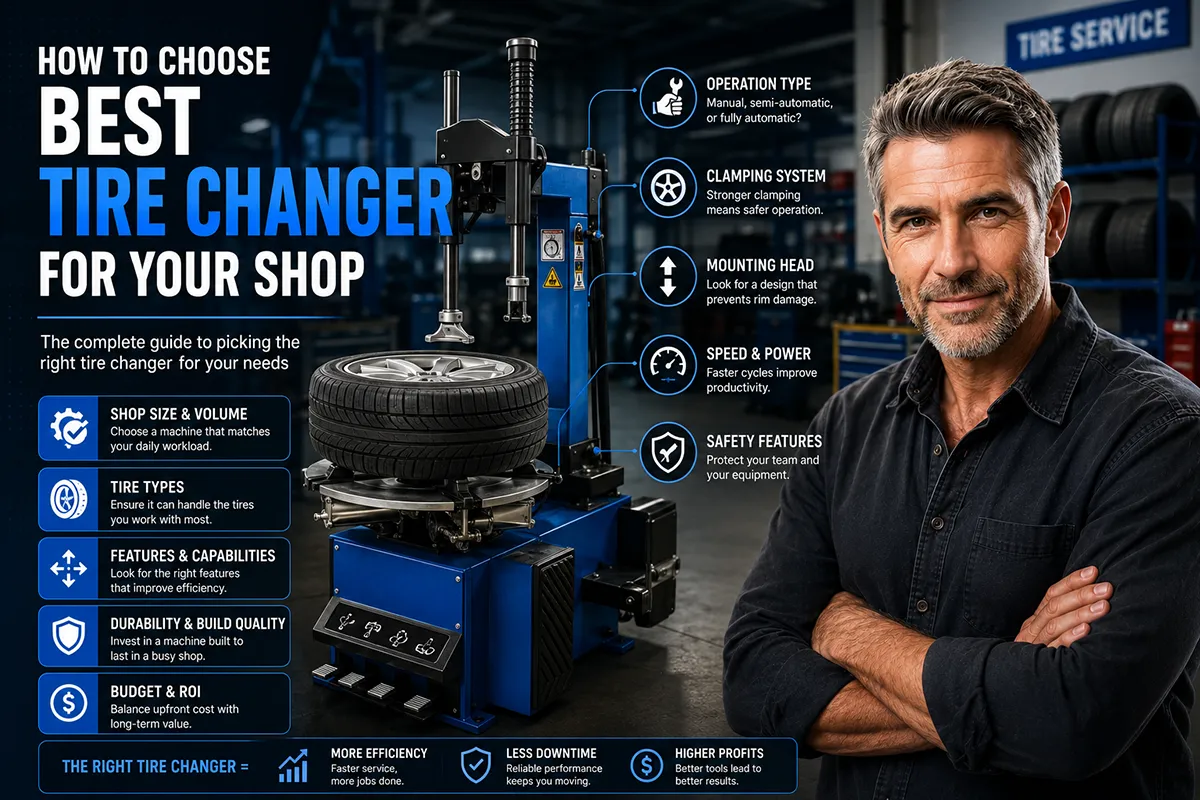
If you’ve ever watched a technician wrestle with a cheap tire changer for twenty minutes on a single low-profile tire, you know exactly how much the wrong machine can cost you — not just in money, but in time, frustration, and damaged rims.
I’ve been working in and around tire shops for over fifteen years, and I’ve personally operated everything from bare-bones manual changers to fully automatic machines that cost more than my first car. The difference between the right tire changer and the wrong one isn’t subtle — it’s the difference between a shop that runs smoothly and one that bleeds profit on every job.
Whether you’re opening your first shop, upgrading aging equipment, or adding a second bay, this guide covers everything I’ve learned from real-world use about choosing a tire changer that fits your operation.
- Match the tire changer type (manual, semi-automatic, or fully automatic) to your daily volume and tire complexity.
- Budget between $1,500 and $12,000+ depending on features — leverless systems cost more but prevent rim damage.
- Prioritize clamping range, bead breaker power, and helper arm availability for modern low-profile tires.
- Top US-market brands I trust: Coats, Ranger, Atlas, Hunter, and Corghi.
- Don’t skip air supply requirements, floor space, and warranty when comparing models.
- A good tire changer pays for itself within months if it cuts your per-tire service time even by a few minutes.
Liked this article?
Add TireAdvise as a preferred source so you see more of our tire reviews and guides on Google.
Why Your Tire Changer Choice Matters More Than You Think
I used to believe a tire changer was just a tire changer. Clamp the wheel, break the bead, swap the rubber, done. Then I spent a full afternoon trying to mount a set of 22-inch low-profile tires on a basic swing-arm machine that had no helper device. I scratched two rims and nearly threw my back out.
That experience taught me something every shop owner needs to hear: the tire changer is the heartbeat of your tire service operation. If it’s too slow, you lose throughput. If it lacks features, you damage customer wheels. If it breaks down, your entire bay goes dark.
The tire industry has changed dramatically. Wheels are bigger, sidewalls are shorter, run-flat tires are more common, and customers expect zero damage. Your tire changer needs to keep up with all of that.
The Three Main Types of Tire Changers
Before I get into specific features and brands, let me break down the three broad categories. Understanding these is the single most important step in making the right choice.
1. Manual (Economy) Tire Changers
These are the bare-bones machines you’ll see priced between $800 and $2,000. They typically require more physical effort from the operator. You’ll manually guide the mount/demount head, and there’s usually no helper arm.
I’ve used these in small hobby shops and mobile tire service setups. They work fine for standard passenger tires with decent sidewall height. But the moment you encounter a stiff low-profile tire or a run-flat, you’re in for a fight.
Best for: Farm shops, hobbyists, very low-volume operations, or as a backup machine.
2. Semi-Automatic Tire Changers
This is the sweet spot for most independent tire shops in the US. Semi-automatic changers handle bead breaking and table rotation with pneumatic or hydraulic power, but the operator still manually positions the mount/demount tools.
I’ve spent the most time on semi-automatic machines over the years. Priced between $2,500 and $6,000, they offer a great balance of speed, capability, and affordability. Many models in this range now come with optional helper arms, which I consider essential.
Best for: Independent shops doing 10–30 tire jobs per day, general automotive repair shops adding tire service.
3. Fully Automatic (Leverless) Tire Changers
These are the machines I dream about. Fully automatic changers use leverless mount/demount systems that virtually eliminate rim damage. The operator positions the wheel, and the machine does the heavy lifting with powered tool heads that precisely control force and angle.
Prices range from $6,000 to $15,000+, but in my experience, they pay for themselves quickly in high-volume shops because they dramatically reduce per-tire service time. They also virtually eliminate rim damage claims, which can easily cost you $300–$1,000 per incident.
Best for: High-volume tire shops, dealerships, shops handling luxury vehicles and high-end wheels.
Key Features I Always Evaluate
After testing and working with dozens of machines, here are the specific features I examine before recommending any tire changer. I’m listing them in order of importance based on real-world impact.
Clamping System and Range
The clamping system holds the wheel in place during the tire change. There are two main types: external (rim clamp from the outside) and internal (jaws expand inside the center bore).
Most modern changers offer both. What I look for is the clamping range. If your shop handles anything from compact car wheels to light truck wheels, you need a machine that clamps from roughly 10 inches to at least 24 inches. Some premium machines go up to 30 inches.
I once had a shop that skipped the extra clamping range to save money. Within the first week, we had to turn away a customer with 26-inch aftermarket wheels. That’s lost revenue you don’t get back.
Bead Breaker Power and Design
The bead breaker is what separates the tire bead from the rim. This is where cheap machines fail the hardest. A weak bead breaker will struggle with corroded beads, run-flat tires, and stiff low-profile sidewalls.
I always recommend looking for a machine with at least 3,500 to 5,000 pounds of bead-breaking force. Some heavy-duty models push past 8,000 pounds. Also pay attention to the bead breaker design — shovel-style breakers work well for most applications, but some machines offer dual-position or traveling breakers that give you more versatility.
In my experience, the bead breaker is the component most likely to determine whether a job takes two minutes or twenty.
Helper Arms and Assist Devices
If you’re buying a tire changer in 2025 and it doesn’t have a helper arm (or at least an option for one), keep shopping. I can’t stress this enough.
Helper arms — also called press arms, roller arms, or third-hand devices — hold down the top bead during mounting. Without one, low-profile tires will pop off the opposite side of the rim while you’re trying to lever them on. It’s maddening, time-consuming, and increases the chance of damage.
I’ve retrofitted helper arms onto older machines, and while it works, it’s always better to buy a machine with an integrated helper system. The leverless helper devices on high-end machines are worth every penny.
Turntable Speed and Motor Power
The turntable spins the wheel during mounting and demounting. Look for a motor with at least 1 to 1.5 HP for passenger vehicles. If you’ll be handling light truck tires regularly, aim for 1.5 to 2 HP.
Variable speed control is a feature I’ve grown to appreciate over the years. Being able to slow the table down during tricky mount situations gives you much more control and reduces the chance of scratching rims. Some budget machines only have one speed, and it’s almost always too fast for delicate work.
Mount/Demount Head Material and Design
This is where rim protection starts. The mount/demount head is the tool that physically levers the tire bead over the rim edge. Plastic or nylon-coated heads are gentler on wheels. Metal heads with replaceable plastic inserts are a good middle ground.
I’ve seen too many aluminum rims get gouged by bare metal mount heads. If you’re servicing any aftermarket or OEM alloy wheels — and in 2025, that’s nearly every car — make sure the tool head is designed to protect finishes.
Wheel Lift (Optional but Valuable)
A built-in wheel lift may sound like a luxury, but after you’ve muscled a heavy 35-inch truck tire onto a turntable a few hundred times, your back will disagree. Wheel lifts are especially valuable in shops where technicians handle larger assemblies all day.
I consider a wheel lift essential for any shop regularly servicing trucks, SUVs, or any wheel/tire combo over 60 pounds.
Tire Changer Comparison: What I’d Buy at Three Budget Levels
Based on my hands-on experience, here’s how I’d break down the decision at three common budget levels. I’m using representative price ranges and the types of machines available from trusted US-market brands.
| Feature | Budget ($1,500–$2,500) | Mid-Range ($3,000–$6,000) | Premium ($7,000–$15,000+) |
|---|---|---|---|
| Type | Manual / Economy Semi-Auto | Semi-Automatic | Fully Automatic / Leverless |
| Clamp Range | 10″–21″ | 10″–24″ | 12″–30″ |
| Bead Breaker Force | ~3,000 lbs | 3,500–5,000 lbs | 5,000–10,000 lbs |
| Helper Arm | None / Optional add-on | Usually included or optional | Integrated leverless system |
| Wheel Lift | No | Optional | Usually included |
| Best For | Hobbyists, low volume | Independent shops | High-volume, dealerships |
| Rim Damage Risk | Moderate–High | Low–Moderate | Very Low |
| Per-Tire Time (est.) | 8–15 minutes | 4–8 minutes | 2–5 minutes |
Brands I Trust (and Why)
I’m not going to recommend brands I haven’t personally used or seen perform over extended periods in real shops. Here are the names I keep coming back to, all widely available in the US market.
Coats
Coats is arguably the most established tire changer brand in American shops. I’ve used their machines in multiple shops over the years, and they consistently deliver reliability. Their mid-range models (like the Coats 5060 series) hit a great balance of features and price. Parts availability is excellent in the US, and their customer support has always been responsive when I’ve needed it.
Ranger (by BendPak)
Ranger has become a go-to for independent shops looking for solid performance without the premium price tag. I’ve been particularly impressed with their R980 series. The build quality feels substantial, and several shops I consult with have run Ranger machines for years with minimal maintenance issues. BendPak’s US-based support is a major plus.
Hunter Engineering
Hunter is the premium choice, and their machines reflect that. I’ve used their Revolution series, and the leverless technology is genuinely impressive — it’s the closest thing to “set it and forget it” I’ve experienced in tire changing. The price is steep, often north of $10,000, but for high-volume operations handling expensive wheels daily, it’s justified.
Atlas (by Titan Lifts)
Atlas offers some of the best value in the mid-range segment. Their machines are imported but come with US-based support and warranty service. I’ve recommended Atlas to several startup shops that needed capable equipment without breaking the bank. The TC289 and similar models handle most passenger and light truck tires without issue.
Corghi
Corghi is an Italian brand with a strong US presence, especially in the premium and dealership segment. Their Artiglio series is outstanding for shops that handle a lot of European vehicles and large-diameter wheels. I’ve found their build quality to be among the best, though parts can occasionally take longer to source compared to domestic brands.
How to Size a Tire Changer to Your Shop
One mistake I see repeatedly is shops buying based on price alone without considering their actual workflow. Here’s the framework I use when helping shop owners make this decision.
Calculate Your Daily Tire Volume
Be honest about how many tires you’re changing per day. If you’re doing fewer than 10, a budget or entry-level semi-automatic machine will handle the load. Between 10 and 30, invest in a solid mid-range semi-automatic with a helper arm. Over 30 tires daily, you need either a premium machine or multiple machines.
I’ve seen shops buy one high-end machine thinking it’ll handle 50+ tires a day. It physically can, but you’re creating a bottleneck. Two mid-range machines often outperform one premium machine in raw throughput.
Consider Your Tire Mix
What kinds of tires are you mounting most often? If 90% of your work is standard passenger tires with 55-series or taller sidewalls, you can get by with less machine. But if you’re handling run-flats, low-profile performance tires (35-series, 30-series), or large truck tires, you need the extra bead breaker force and helper arm capability.
In my experience, the trend is clearly moving toward bigger wheels and lower profiles. Even economy cars are coming with 18-inch wheels now. I’d buy for where the market is heading, not where it was five years ago.
Measure Your Floor Space
Tire changers need more room than you might expect. The machine itself typically occupies a 5′ x 5′ footprint, but you need swing clearance for the mount/demount arm, space for the bead breaker to fully extend, and room for the operator to move around freely with a tire.
I recommend a minimum of 8′ x 8′ of dedicated floor space per machine. If you’re adding a wheel balancer next to it (which you should), plan for at least a 10′ x 16′ bay for the pair.
Check Your Air Supply
Every pneumatic tire changer needs compressed air, typically between 8 and 12 CFM at 110–175 PSI, depending on the model. I’ve visited shops where the tire changer was fighting with impact wrenches and paint guns for air pressure. The machine worked sluggishly, and the owner blamed the tire changer when the real problem was an undersized compressor.
Make sure your compressor can handle the tire changer’s requirements on top of everything else running in your shop. A dedicated air line to the tire changer is ideal.
Avoiding Common Buying Mistakes
I’ve made some of these mistakes myself, and I’ve watched other shop owners make them too. Learn from our collective pain.
Mistake #1: Ignoring the Total Cost of Ownership
That $1,800 tire changer looks great on paper until you factor in replacement clamp jaws every few months, a new bead breaker cylinder after a year, and the rim damage claims that eat into your profit. I’ve seen budget machines cost more over three years than a mid-range machine would have cost upfront.
Always ask about replacement part prices and availability before buying. A machine is only as good as the support behind it.
Mistake #2: Skipping the Helper Arm
I’ve already mentioned this, but it bears repeating because I see it happen constantly. Shop owners look at the $500–$1,200 add-on cost for a helper arm and decide to save the money. Then they spend an extra five minutes on every low-profile tire, scratching rims and wearing out their technicians.
A helper arm pays for itself within the first few weeks of use. Don’t skip it.
Mistake #3: Buying More Machine Than You Need
This cuts the other direction. If you’re running a general repair shop that does occasional tire work — maybe five to eight tires a day — you don’t need a $12,000 leverless machine. A solid semi-automatic in the $3,000–$5,000 range will serve you beautifully and free up capital for other equipment.
Mistake #4: Not Training Your Technicians
The best tire changer in the world will damage rims and destroy tires in untrained hands. I’ve personally seen a technician break a TPMS sensor because he didn’t know how to properly position the mount head relative to the valve stem.
Budget for training time. Most reputable brands offer setup assistance and basic operation training. Take advantage of it, and make sure every tech who touches the machine knows the proper procedures.
New vs. Used: Is a Used Tire Changer Worth It?
I get this question constantly, and my answer has evolved over the years.
A quality used tire changer from a reputable brand can be an excellent value — if you know what to look for. I’ve bought used Coats machines that ran flawlessly for years after purchase. The key is inspecting the clamping jaws for wear, checking the bead breaker cylinder for leaks, verifying the turntable motor runs smoothly, and testing all pneumatic functions.
However, I’d only buy used from a dealer who offers at least a short warranty, or from a shop you personally trust. Buying a used tire changer sight-unseen from an online auction is a gamble I’ve lost before. The machine I received had a cracked turntable bearing and a non-functional bead breaker. The “deal” ended up costing me more than a new entry-level machine after repairs.
If you’re buying used, budget an additional 15–20% for potential repairs and replacement parts. And always verify that parts are still available for the model you’re considering. Some older imported machines have been orphaned by manufacturers that left the US market.
Must-Have Accessories and Add-Ons
Beyond the machine itself, there are accessories that I consider essential for a complete tire changing setup.
- Rim protector clamp covers: Snap-on plastic covers for the clamping jaws. They cost $20–$50 for a set and save you from countless rim scratches. I keep extras on hand at all times.
- Bead sealer and lubricant: Proper tire mounting paste makes a huge difference in ease of mounting and initial bead seating. I use it on every single tire. Skipping it is a false economy.
- TPMS tool kit: Nearly every passenger car on the road today has TPMS. You need a tool kit for safely removing and reinstalling sensors, plus a TPMS reset/relearn tool.
- Wheel weight pliers and hammer: For removing old adhesive and clip-on weights before balancing.
- Bead seating inflator (cheetah/blast tool): Essential for seating beads on tires that won’t inflate with standard shop air alone, especially common with larger tires or tires that have been sitting.
- Valve stem installation tool: A simple, inexpensive tool that saves you from fighting with rubber valve stems using pliers.
I’d estimate $200–$500 for a complete accessory kit. It’s a minor investment compared to the machine itself, but it makes the entire workflow smoother and more professional.
What About Motorcycle and ATV Tire Changers?
If your shop handles motorcycles, ATVs, or UTVs, be aware that most standard automotive tire changers can handle these with the right adapters. However, some motorcycle wheels (especially spoke wheels) require specific clamping setups.
I’ve used motorcycle adapters on a standard Ranger machine and it worked well for cast wheels. For spoke wheels, I prefer a dedicated motorcycle tire changer — they’re much cheaper than automotive units, typically $500–$1,500, and they’re designed for the unique challenges of thin, flexible rims.
If motorcycle or powersport tire work is a meaningful part of your revenue, a dedicated machine is worth having alongside your automotive changer.
The ROI Calculation: How Fast Will It Pay for Itself?
Let me walk through the math I use when consulting with shop owners.
The average tire mounting and balancing fee in the US market is $20–$40 per tire, depending on your region and whether it’s a package deal. Let’s use $25 per tire as a conservative average for just the mounting portion.
If you’re mounting 20 tires per day, that’s $500 in daily mounting revenue. Over a 25-day work month, that’s $12,500 per month. Even a premium $10,000 tire changer pays for itself in under a month of revenue — and that’s before you factor in the value of preventing rim damage claims and the labor savings from faster service.
The real question isn’t “can I afford a good tire changer?” It’s “can I afford to NOT have one?”
I’ve watched shops increase their daily tire capacity by 30–40% just by upgrading from a worn-out budget machine to a quality mid-range unit. The time savings compound in a way that’s hard to appreciate until you experience it.
My Personal Recommendation for Most Shops
If you’re a typical independent tire or auto repair shop in the US doing a moderate volume of tire work, here’s exactly what I’d buy today:
A semi-automatic tire changer in the $3,500–$5,500 range from Coats, Ranger, or Atlas, equipped with an integrated helper arm and rim-clamping range up to at least 24 inches. I’d pair it with a matching wheel balancer from the same brand (for consistency in support and parts), set up in a dedicated bay with proper air supply and lighting.
This setup gives you the capability to handle 95% of the passenger cars and light trucks that’ll roll into your shop, with enough speed and rim protection to keep customers happy and profit margins healthy.
If your budget allows, add a wheel lift. Your technicians’ backs will thank you, and the reduced fatigue translates to faster, more careful work throughout the day.
Final Thoughts: Buy for the Shop You’re Building
The tire changer you choose today will likely serve your shop for five to ten years, maybe longer. Don’t just buy for the work you’re doing this month. Think about where your shop is headed.
Are you planning to add more bays? Will you be targeting performance or luxury vehicles? Is fleet work on your radar? These considerations should influence your decision.
In my fifteen-plus years of working with tire equipment, the shops that invest thoughtfully in their tire changers consistently outperform those that cut corners. It’s not about spending the most money — it’s about spending it wisely on a machine that matches your real-world needs.
Take the time to demo machines if possible. Many equipment distributors offer in-shop demonstrations, and I always recommend seeing a machine work with your own tires and wheels before committing. There’s no substitute for hands-on evaluation.
Your tire changer is the foundation of your tire service operation. Choose well, and it’ll reward you every single day.
Frequently Asked Questions
What type of tire changer is best for a small independent tire shop?
For most small to mid-size tire shops in the US, a swing-arm or tilt-back tire changer in the $2,500–$5,000 range offers the best balance of performance and value. Brands like Coats, Ranger, and Atlas are popular choices that handle standard passenger and light truck tires with ease. I’d recommend a model with a bead breaker that can handle at least 24-inch rims, since SUVs and trucks with larger wheels are extremely common on American roads.
How much does a good tire changer machine cost for a professional shop?
Entry-level professional tire changers start around $1,500–$3,000, while mid-range models with leverless or touchless technology typically run $4,000–$8,000. High-end machines from brands like Hunter Engineering or Corghi can exceed $12,000 but offer features like automatic bead pressing and rim protection that pay for themselves in shops handling luxury or low-profile tires. Factor in installation, training, and a compressed air system if you don’t already have one, which can add $500–$2,000 to your startup costs.
What is the difference between a leverless tire changer and a traditional tire changer?
A traditional tire changer uses a metal mount/demount head that physically contacts the rim during tire installation, which can risk scratching alloy wheels if not handled carefully. A leverless or touchless tire changer uses hydraulic or pneumatic pressing arms that grip the tire bead without touching the rim, making it ideal for shops that service high-end vehicles with expensive custom wheels. Leverless machines cost more upfront but reduce damage claims and speed up the process on low-profile and run-flat tires, which are increasingly common in the US market.
Can I use a motorcycle or ATV tire changer for car tires in my shop?
No, motorcycle and ATV tire changers are designed for smaller rim diameters and narrower tire widths, so they lack the clamping force and bead-breaking power needed for standard passenger car and truck tires. If you service a mix of vehicles, invest in a full-size automotive tire changer that handles rims from 10 to 30 inches and look for adapter kits if you also want to do motorcycle work on the side. Trying to force a car tire onto an undersized machine is a safety hazard and will likely damage the equipment.
Do I need a tire balancer if I already buy a tire changer for my shop?
Yes, a tire changer and a wheel balancer are two separate machines that work together to complete a proper tire installation. The changer mounts and demounts the tire from the rim, while the balancer ensures even weight distribution to prevent vibrations at highway speeds. Most shops in the US purchase both as a combo package, which can save you $500–$1,500 compared to buying them individually from brands like Ranger, Triumph, or Atlas.
What features should I look for in a tire changer to handle low-profile and run-flat tires?
Low-profile and run-flat tires have stiff sidewalls that require significantly more force to mount and demount, so look for a tire changer with a powerful bead breaker, a helper arm or pressing device, and ideally leverless operation. A top-side bead assist roller is almost essential for run-flat tires, which are factory-equipped on many BMW, Mercedes, and Lexus models popular in the US. I’d avoid budget machines under $2,000 if run-flats and low-profiles make up a significant portion of your workload, as they’ll struggle and slow you down.
What are the most reliable tire changer brands available in the US market?
The most trusted tire changer brands in the US include Coats, Hunter Engineering, Ranger Products, Corghi, and Hofmann, all of which offer strong dealer support and readily available replacement parts. Coats and Hunter are especially popular in high-volume shops because of their durability and extensive US-based service networks. For budget-conscious shop owners, brands like Atlas and Triumph offer solid mid-range machines backed by US-based customer support, making them a practical choice for startup or low-volume operations.
