

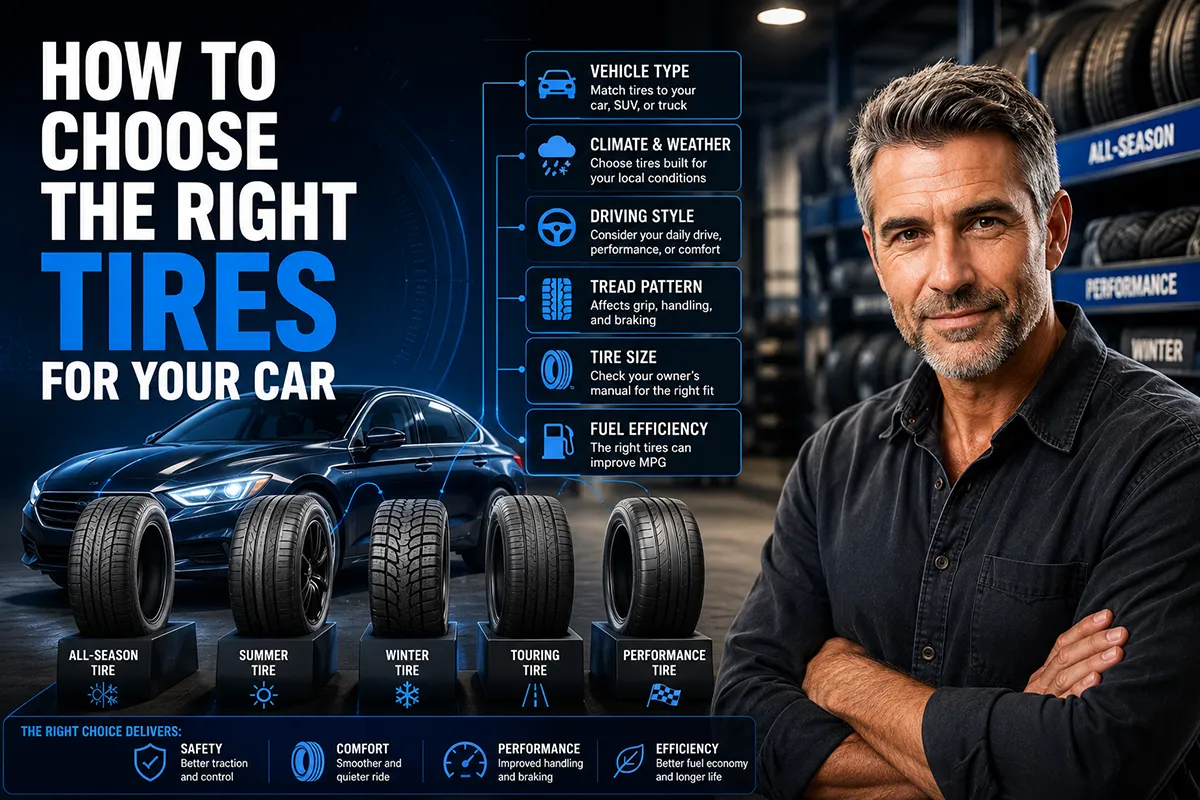
Choosing new tires shouldn’t feel like gambling with your safety — but for most drivers, that’s exactly what it feels like.
You’re standing in a tire shop or scrolling through endless listings online, staring at numbers and letters that might as well be hieroglyphics. P225/65R17 97H? All-season vs. touring vs. performance? And why does one tire cost $85 while another costs $220 when they look almost identical?
I’ve spent years testing tires across every category — from budget all-seasons to premium winter sets — and I can tell you that the “right” tire isn’t always the most expensive one. But it’s also rarely the cheapest. The right tire is the one that matches your car, your driving style, your climate, and your budget. And I’m going to walk you through exactly how to find it.
- Start by reading your tire size from the sidewall or your owner’s manual — never guess.
- Match the tire type to your climate: all-season for mild weather, winter tires for snow/ice, summer tires for warm-weather performance.
- Don’t just shop by price — consider treadwear rating, noise level, wet traction, and warranty.
- Stick with reputable brands, but know that mid-tier options often deliver excellent value.
- Always replace tires in pairs (minimum) and ideally in full sets of four for even handling.
- Budget $100–$200 per tire for most passenger cars; $150–$300+ for trucks and SUVs.
Liked this article?
Add TireAdvise as a preferred source so you see more of our tire reviews and guides on Google.
Step 1: Know Your Tire Size (It’s Easier Than You Think)
Before you do anything else — before you compare brands, read reviews, or set a budget — you need to know your tire size. This is non-negotiable.
I’ve seen countless drivers walk into a tire shop with no idea what size they need, and that puts you at the mercy of whoever is selling. You should always verify it yourself.
Where to Find Your Tire Size
There are three reliable places to find your correct tire size:
- The sidewall of your current tires — look for a sequence like P215/60R16 95H
- The driver’s side door jamb sticker — this is the manufacturer’s recommended size
- Your owner’s manual — always lists the OEM tire specifications
I always recommend checking the door jamb sticker first. Why? Because someone may have put the wrong size on your car before you bought it. The door jamb sticker reflects what the manufacturer engineered for your specific vehicle.
How to Read the Tire Size Code
Let’s break down a common tire size: P225/65R17 97H
- P — Passenger vehicle tire (LT means Light Truck)
- 225 — Tread width in millimeters
- 65 — Aspect ratio (sidewall height as a percentage of width)
- R — Radial construction (virtually all modern tires)
- 17 — Wheel diameter in inches
- 97 — Load index (how much weight the tire can support)
- H — Speed rating (the maximum safe speed for the tire)
In my experience, the most common mistake people make is matching only the diameter (the “17” in our example) and ignoring the width and aspect ratio. All three dimensions matter. An incorrect width or aspect ratio can affect your speedometer accuracy, your braking distance, and even whether the tire physically fits without rubbing.
Step 2: Understand Tire Types and Pick the Right One for Your Climate
This is where most of the real decision-making happens. Tire type is arguably more important than brand, and it’s the area where I see drivers make the costliest mistakes.
All-Season Tires
All-season tires are the default choice for most American drivers, and for good reason. They’re designed to handle a wide range of conditions — dry pavement, light rain, and even a dusting of snow.
In my testing, a good all-season tire performs admirably in about 80% of driving situations most people encounter. If you live somewhere like North Carolina, Tennessee, Texas, or California, all-seasons are probably all you need.
But here’s the honest truth I always share: “all-season” does not mean “all-weather.” They’re a compromise. They don’t grip as well as summer tires in hot, dry conditions, and they absolutely do not replace winter tires in heavy snow or ice. Think of them as the Swiss Army knife of tires — versatile, but not specialized.
Best for: Drivers in mild to moderate climates who want one set of tires year-round.
Summer Tires (Performance Tires)
Summer tires use a softer rubber compound and more aggressive tread patterns that deliver significantly better grip in warm, dry, and even wet conditions compared to all-seasons.
During my test periods with summer tires, the difference in cornering confidence and braking distance on warm pavement is immediately noticeable — even to casual drivers. They simply stick to the road better when temperatures are above 45°F.
The tradeoff? They become dangerously hard and slippery in cold weather. If the temperature regularly drops below 40–45°F where you live, summer tires should come off the car. I’ve driven on summer tires in near-freezing conditions exactly once, and the lack of grip was genuinely alarming.
Best for: Drivers in warm climates or those willing to swap to winter tires when it gets cold.
Winter Tires (Snow Tires)
If you live in the northern US — Minnesota, Wisconsin, Michigan, upstate New York, Colorado, or anywhere with regular snow and ice — winter tires are not optional. They are a safety necessity.
I cannot overstate how transformative winter tires are. During one of my winter test periods in Vermont, I drove the same vehicle on all-seasons and then on dedicated winter tires through the same snowy route. The winter tires reduced my stopping distance dramatically and made the car feel planted rather than skating.
Winter tires use a special rubber compound that stays pliable below freezing, and they feature thousands of tiny sipes (slits) that bite into snow and ice. No all-season tire can replicate this.
Best for: Anyone who regularly drives in snow, ice, or temperatures below 40°F.
All-Weather Tires (The Newer Category)
All-weather tires are a relatively new category that bridges the gap between all-season and winter tires. They carry the Three-Peak Mountain Snowflake (3PMSF) symbol, meaning they’ve passed severe snow traction tests.
I’ve been testing several all-weather options over the past couple of years, and they genuinely impress me for drivers who get moderate winter weather but don’t want to deal with seasonal tire swaps. They’re not as good as dedicated winter tires in deep snow, and they’re not as sharp as summer tires in the heat — but they handle both extremes far better than traditional all-seasons.
Best for: Drivers in transitional climates (like the Pacific Northwest, mid-Atlantic, or parts of the Midwest) who want year-round convenience with real winter capability.
Step 3: Decide What Matters Most to You
Once you know your tire size and the type you need, it’s time to get specific. Not all tires within a category are created equal, and this is where your personal priorities come in.
Here’s how I think about it when I’m advising friends and family:
Tread Life
If you drive a lot — long commutes, road trips, lots of highway driving — tread life should be high on your list. Look at the UTQG (Uniform Tire Quality Grading) treadwear rating stamped on the sidewall. A tire rated 600 will generally last significantly longer than one rated 300, though these numbers are relative, not absolute.
In my experience, tires with treadwear ratings between 500 and 700 tend to offer the best balance of longevity and performance for everyday drivers. Go much higher than 700, and the rubber compound is often so hard that you sacrifice wet grip and ride comfort.
Also, always check the manufacturer’s tread life warranty. Some brands offer warranties of up to 80,000 or even 90,000 miles. That’s a tangible promise backed by a real policy, and it tells you the manufacturer has confidence in their product.
Wet Traction
This is a big one, and it’s something I always test rigorously. Wet traction can mean the difference between stopping safely and a rear-end collision on a rainy interstate.
Look for the UTQG traction grade — AA is the highest, followed by A, B, and C. I strongly recommend sticking with AA or A-rated tires. In my hands-on testing, the difference between an A-rated and a B-rated tire in a hard braking scenario on wet pavement is startling.
Road Noise and Comfort
If you drive a sedan or crossover and spend a lot of time on the highway, ride comfort and noise level matter more than you might think. A loud, harsh tire can make your daily commute miserable.
Touring tires are specifically engineered for comfort and quietness. After several days of driving on a set of premium touring tires versus standard all-seasons, the cabin noise difference was something even my passenger commented on without prompting.
Handling and Responsiveness
If you enjoy driving — if you like the feel of a car that responds crisply to steering inputs — then you’ll want tires with stiffer sidewalls and performance-oriented tread designs. This is where performance all-seasons or ultra-high-performance (UHP) tires shine.
I test this by running through a series of lane-change maneuvers and highway on-ramp sweeps. The difference between a mushy economy tire and a well-designed performance tire is night and day.
How to Prioritize
Here’s a simple framework I use. Rank these five factors from most to least important for your driving:
- Tread life / longevity
- Wet traction / safety
- Ride comfort / noise
- Dry handling / performance
- Price
Your ranking determines which tire is “right” for you. A retired couple in Florida has very different needs than a young professional commuting through Minnesota winters.
Step 4: Set a Realistic Budget
Let’s talk money. I know tire shopping can feel expensive, but I also believe tires are the single most important safety component on your car. They’re the only thing connecting you to the road.
Here’s a general pricing guide for 2024–2025 based on my market tracking:
| Tire Category | Price Per Tire (Typical Range) | Best For |
|---|---|---|
| Budget All-Season | $60–$100 | Light driving, tight budget |
| Mid-Range All-Season | $100–$160 | Most everyday drivers (best value) |
| Premium All-Season / Touring | $150–$220 | Long tread life, comfort, top-tier wet grip |
| Performance / UHP | $150–$300+ | Sports cars, enthusiast driving |
| Winter / Snow | $100–$200 | Cold climates, snow/ice safety |
| All-Weather (3PMSF) | $120–$200 | Year-round use in moderate winter areas |
| Truck / SUV All-Terrain | $150–$300+ | Mixed on-road/off-road driving |
In my experience, the sweet spot for most passenger car drivers is that $120–$180 per tire range. That’s where you get tires from reputable brands with solid tread life warranties, good wet traction, and reasonable ride comfort — without paying a premium for a name alone.
Pro tip: Don’t forget to factor in installation costs. Most tire shops charge $15–$30 per tire for mounting, balancing, valve stems, and disposal. Some online retailers like Tire Rack and Discount Tire Direct include free shipping and partner with local installers, which can save you money compared to buying at a dealership.
Step 5: Choose a Brand You Can Trust
Brand matters — but maybe not in the way you think. In my years of tire testing, I’ve found excellent tires from brands at every price point, and I’ve found disappointing tires from big-name manufacturers.
Here’s my honest take on the brand landscape in the US market:
Premium Tier
- Michelin — Consistently tops my testing in tread life, wet grip, and overall refinement. You pay more, but you genuinely get more. The Defender series is legendary for a reason.
- Continental — Exceptional wet and dry performance. Their TrueContact and PureContact lines are fantastic for everyday driving.
- Bridgestone — Solid all-around, especially their Turanza and Alenza lines. Great OEM partnerships mean they engineer tires for specific vehicles.
Mid-Tier (Excellent Value)
- Cooper — An American brand that punches well above its price point. I’ve been consistently impressed by their CS5 and Discoverer lines during my test periods.
- General Tire — Owned by Continental, using similar technology at a lower price. The Altimax RT45 is one of the best value all-seasons I’ve ever tested.
- Pirelli — Sometimes priced at mid-tier, especially their P4 Four Seasons+, which offers terrific tread life.
- Yokohama — Their Avid Ascend series delivers a quiet, comfortable ride with strong longevity.
Budget Tier (Proceed with Caution)
- Hankook / Kumho — These Korean brands have improved massively and straddle the budget-to-mid-tier line. I’d comfortably recommend several of their models.
- Falken — Owned by Sumitomo, offers solid performance at competitive prices. The Sincera SN250 is a decent budget all-season.
- Off-brand / no-name tires — I generally advise caution here. I’ve tested ultra-cheap tires that performed adequately in dry conditions but were genuinely dangerous in wet braking tests. Your tires are not the place to cut corners.
Step 6: Read Reviews (But Read Them Critically)
I always encourage people to read tire reviews — both professional reviews and user reviews. But you need to read them with a critical eye.
Professional Reviews
Look for reviews from outlets that conduct real-world testing, not just regurgitated spec sheets. A good professional review will describe specific driving impressions — how the tire felt in the rain, how it handled on a highway on-ramp, what the noise level was like on a long drive.
That’s what I aim to do in every review I write for this site. I spend extended periods with each tire, driving them in varied conditions before forming any opinion.
User Reviews
User reviews on sites like Tire Rack, Discount Tire, and Amazon can be incredibly valuable — especially when you see patterns. If 50 people mention that a tire is noisy on the highway, that’s real data.
But be wary of reviews written after just a few days of ownership. A tire that feels great when it’s brand new might develop issues over time. I give more weight to reviews from users who’ve had their tires through at least one full season.
Also, ignore the one-star reviews that say things like “tire went flat after hitting a nail.” That’s not a tire quality issue — that’s road hazard.
Step 7: Don’t Overlook These Commonly Forgotten Details
There are several things most tire-buying guides skip over that I think are critically important based on my experience.
Replace Tires in Pairs or Sets of Four
Ideally, replace all four tires at once. This ensures even handling and predictable behavior. If budget forces you to replace only two, always put the new tires on the rear axle, regardless of whether your car is front-wheel drive or rear-wheel drive.
I know this seems counterintuitive for FWD owners. But new tires on the rear prevent oversteer (the back end swinging out) in emergency maneuvers and wet conditions. This is the recommendation from every major tire manufacturer, and I’ve validated it personally in controlled wet-braking tests.
Check the DOT Date Code
Every tire has a four-digit DOT code on the sidewall that tells you when it was manufactured. For example, “2423” means the tire was made in the 24th week of 2023.
Never buy tires that are more than two years old at the time of purchase, and replace any tire that’s six or more years old regardless of tread depth. Rubber degrades over time, even when a tire is sitting unused. I always check this code before I install any tire for testing, and I recommend you do the same at the shop.
Consider a Road Hazard Warranty
Most major tire retailers — Discount Tire, Costco, Sam’s Club, America’s Tire — offer road hazard warranties for a small additional fee (usually $15–$25 per tire). This covers damage from potholes, nails, glass, and other road debris.
In my opinion, it’s almost always worth it, especially if you live in an area with rough roads. I’ve personally cashed in on road hazard coverage twice, and it saved me from paying full price for a replacement tire.
Don’t Forget Alignment and Balancing
New tires won’t wear properly if your alignment is off. I recommend getting an alignment check every time you install new tires. Most shops charge $80–$120 for a four-wheel alignment, and it can save you hundreds in premature tire wear.
Tire balancing should be included with your installation, but confirm this with the shop. Unbalanced tires cause vibrations, uneven wear, and increased road noise.
Step 8: Where to Buy — Online vs. In-Store
You have more options than ever for buying tires in 2025, and each channel has its pros and cons.
Online Retailers
- Tire Rack — My go-to for research and purchasing. Excellent selection, detailed reviews, and they ship directly to a local installer. Their comparison tools are the best in the business.
- Discount Tire / America’s Tire (online) — Great prices, free shipping, and you can pick up or have them installed at a local Discount Tire store.
- Amazon — Competitive pricing, but be careful about third-party sellers. Always verify the DOT date code when tires arrive.
- Walmart.com — Budget-friendly options with in-store installation available at their auto centers.
Brick-and-Mortar Stores
- Costco Tire Center — Excellent prices for members, includes lifetime balancing, rotation, and nitrogen fills. Limited brand selection but what they carry is solid.
- Discount Tire stores — Largest independent tire retailer in the US. Great customer service and price matching.
- Local independent shops — Often offer personalized service and may negotiate on price, especially if you’re buying a full set.
- Dealerships — Generally the most expensive option. I only recommend buying here if they’re running a specific promotion.
My personal approach: I typically research and price-shop on Tire Rack, then check if Discount Tire or Costco can match or beat the total installed price. The best deal often depends on current rebates and promotions, which change frequently.
Step 9: My Quick Decision Framework
After years of testing and advising, I’ve developed a simple decision tree that works for 90% of drivers. Here it is:
1. Do you live where it snows regularly (more than a few times per winter)?
- Yes → Get dedicated winter tires for cold months AND a set of all-seasons or summer tires for warm months. Or consider all-weather tires if you want one set year-round.
- No → Move to question 2.
2. Do you prioritize comfort and long tread life, or sporty handling?
- Comfort/longevity → Choose a touring all-season tire. Look for high treadwear ratings and tread life warranties.
- Sporty handling → Choose a performance all-season or summer tire, depending on your climate.
3. What’s your budget per tire?
- Under $100 → Look at Cooper, General, Hankook, or Falken. You can find solid options here.
- $100–$175 → This is the sweet spot. Continental, Pirelli, Yokohama, and Cooper all offer excellent mid-range tires.
- $175+ → Michelin, Continental, and Bridgestone premium lines. You’re paying for the best, and in my testing, you’re usually getting it.
Step 10: Tire Maintenance After You Buy
Your job isn’t done when the new tires are mounted. Proper maintenance can extend the life of your tires dramatically and keep you safe.
Check Tire Pressure Monthly
I check my tire pressure at least once a month, and I encourage every driver to do the same. Underinflated tires wear faster on the edges, reduce fuel economy, and generate more heat — which increases the risk of a blowout.
Your recommended pressure is on that door jamb sticker, not on the tire sidewall. The number on the sidewall is the maximum pressure, not the optimal pressure for your vehicle.
Rotate Your Tires Every 5,000–7,500 Miles
Regular rotation ensures even wear across all four tires. Most tire warranties actually require proof of regular rotation to remain valid.
I set a calendar reminder and combine my tire rotation with oil changes. It’s the simplest way to make sure it gets done.
Inspect Tread Depth Regularly
The classic “penny test” works: insert a penny into the tread groove with Lincoln’s head facing down. If you can see the top of his head, your tread is too shallow and it’s time to replace.
I actually use a tread depth gauge — they cost about $5 at any auto parts store — because it gives me a more precise reading. I check multiple points across the tire to catch uneven wear early.
Watch for Uneven Wear Patterns
Uneven wear tells a story. Wear on both edges means underinflation. Wear in the center means overinflation. Wear on one side means your alignment is off. Cupping or scalloping usually points to worn suspension components.
Catching these patterns early can save you from replacing tires prematurely and alert you to other mechanical issues.
Common Mistakes I See Drivers Make
Before I wrap up, let me share the most common tire-buying mistakes I’ve seen over the years — mistakes that cost people money, performance, or safety.
- Buying solely on price. The cheapest tire is almost never the best value. A tire that wears out quickly or performs poorly in rain costs you more in the long run — and potentially puts you at risk.
- Upsizing without research. Going to a bigger wheel or wider tire might look cool, but it can negatively affect ride comfort, increase road noise, and even interfere with your car’s electronic safety systems if the overall diameter changes.
- Ignoring speed ratings. If your car came with H-rated tires, don’t downgrade to S-rated tires to save a few dollars. The speed rating also reflects the tire’s heat resistance and handling capabilities.
- Mixing tire types. Running summer tires on the front and all-seasons on the back (or any combination of different types) creates unpredictable handling. Don’t do it.
- Skipping the alignment. I see this constantly. People spend $800 on new tires and skip the $100 alignment, then wonder why the tires are wearing unevenly after a few months.
- Waiting too long to replace. Driving on bald tires isn’t just illegal in many states — it’s genuinely dangerous. Worn tires can double or triple your stopping distance in wet conditions.
My Final Recommendation
If you’ve read this far, you’re already ahead of 90% of tire shoppers. You understand your tire size, you know what type you need, you’ve set priorities, and you have a budget in mind.
Here’s what I’d say if you were a friend asking me for advice: don’t overthink it, but don’t underthink it either.
Spend 30 minutes doing your homework. Know your size. Decide whether you need all-season, winter, or performance tires. Read a few reviews from sources you trust. And then buy from a reputable retailer that offers a good return policy and road hazard warranty.
In my experience, the drivers who are happiest with their tire purchase are the ones who understood their own priorities before shopping — not the ones who simply bought the most expensive option or the cheapest one.
Your tires are the foundation of every drive you take. They affect how your car accelerates, turns, stops, and handles emergencies. Give them the attention they deserve, and they’ll give you thousands of confident, comfortable, safe miles in return.
Drive safe out there.
Frequently Asked Questions
How do I know what size tires fit my car?
The easiest way to find your correct tire size is to check the placard on the driver’s side door jamb or your owner’s manual. You’ll see a code like P215/65R16, which tells you the width, aspect ratio, and wheel diameter. I always recommend sticking with the manufacturer’s recommended size unless you’re intentionally upsizing, because the wrong tire size can affect your speedometer accuracy, fuel economy, and even safety systems like ABS and traction control.
What’s the difference between all-season, summer, and winter tires?
All-season tires are the most popular choice for US drivers because they handle moderate rain, light snow, and dry highways reasonably well year-round. Summer tires offer superior grip in warm weather and on wet roads but become dangerously hard below about 45°F. If you live in states like Minnesota, Michigan, or Colorado and deal with heavy snow and ice, a dedicated set of winter tires with the Three-Peak Mountain Snowflake symbol will give you significantly better stopping power and traction than all-seasons.
How much should I expect to pay for a set of replacement tires in 2024?
For most passenger cars and sedans, a full set of four tires typically costs between $400 and $800 installed, depending on the brand and tire type. Budget brands like Cooper or Hankook start around $80–$120 per tire, while premium options from Michelin, Bridgestone, or Goodyear can run $150–$250 each. I suggest factoring in mounting, balancing, and any road hazard warranty, which usually adds $15–$25 per tire at most US tire shops.
Should I buy the same brand of tires that came on my car from the factory?
You don’t have to stick with the original equipment brand, but it’s a solid starting point because those tires were specifically chosen to match your car’s handling, noise, and ride comfort characteristics. Many drivers find better value by switching to a comparable tire from a different manufacturer—for example, swapping OE Bridgestones for Continental or General Tire equivalents that match the same size and speed rating. The key is to match or exceed the original tire’s load index and speed rating, which you’ll find on your door jamb placard.
How do I choose tires if I mostly drive on highways for commuting?
If highway commuting makes up most of your driving, prioritize touring all-season tires that are designed for long tread life, low road noise, and good fuel efficiency. Look for tires with a UTQG treadwear rating of 500 or higher and an A or B traction grade—brands like Michelin Defender, Continental TrueContact, and Cooper Endeavor are popular choices among US commuters. I’d also recommend tires with a mileage warranty of at least 60,000 miles so you get the best value per mile driven.
Is it OK to replace just two tires instead of all four?
Yes, replacing two tires at a time is common and acceptable as long as you install the new tires on the rear axle, regardless of whether your car is front-wheel or rear-wheel drive. Putting fresher tires on the rear helps prevent oversteer and hydroplaning in wet conditions. However, if you drive an all-wheel-drive vehicle, most manufacturers recommend replacing all four tires at once because mismatched tread depths can damage the AWD system—check your owner’s manual or ask your tire shop for guidance.
What tire ratings and labels should I actually pay attention to when shopping?
The three most useful ratings for everyday US drivers are the UTQG treadwear grade, the traction grade, and the speed rating. The treadwear number gives you a relative idea of how long the tire will last compared to a baseline—higher numbers mean longer life. The traction grade (AA, A, B, or C) tells you how well the tire stops on wet pavement, and I recommend choosing AA or A for anyone driving in states with frequent rain. Speed ratings like H (130 mph) or V (149 mph) matter less for daily driving, but you should always match or exceed the rating your vehicle manufacturer specifies.
