

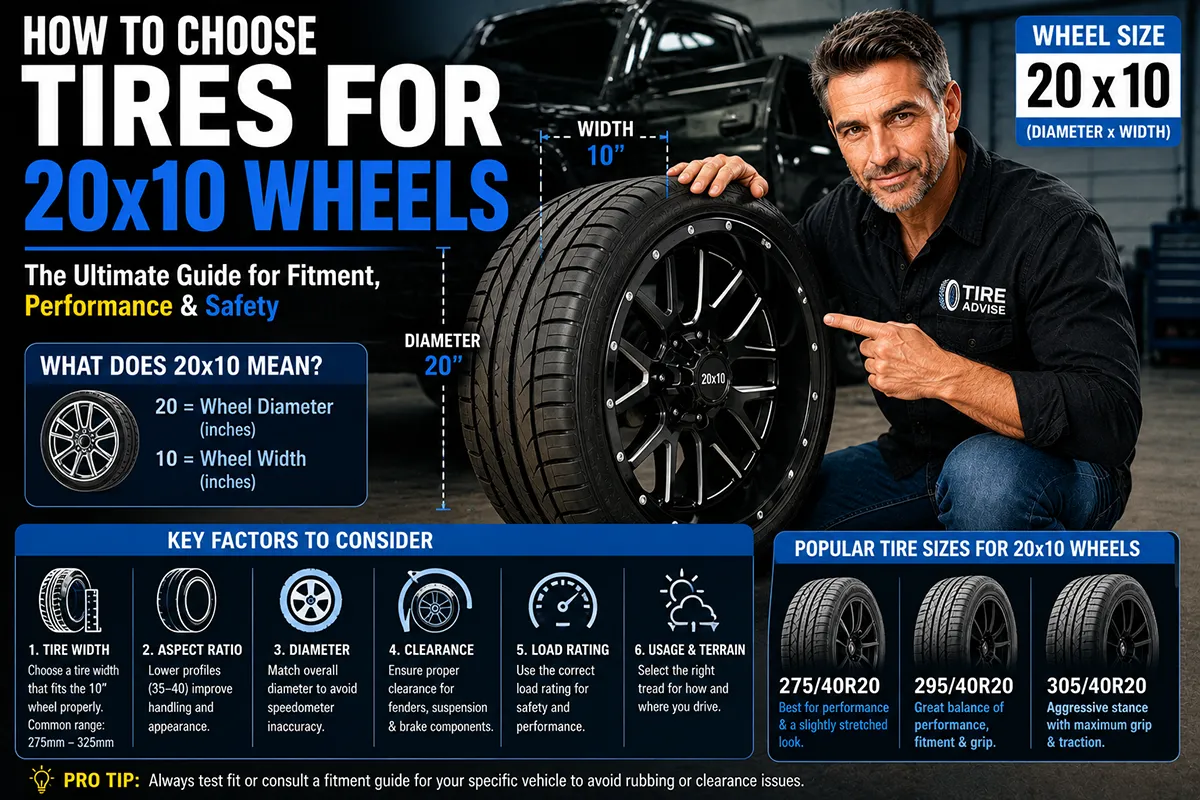
If you’ve ever stared at a wall of tire sizes trying to figure out which ones actually fit your 20×10 wheels without rubbing, looking stretched, or destroying your ride quality — I’ve been exactly where you are.
It’s one of the most confusing fitment puzzles in the tire world, and getting it wrong can cost you hundreds of dollars and a whole lot of frustration.
I’ve spent years fitting tires on 20×10 wheels across muscle cars, trucks, and SUVs, and I’m going to break down everything I’ve learned so you can get it right the first time.
- 20×10 wheels typically accept tire widths between 275mm and 305mm, with 285 being the most popular “sweet spot” for most vehicles.
- Your ideal tire size depends on whether the 20×10 is on the front or rear, your vehicle type, and your driving style.
- Always check your vehicle’s fender clearance before upsizing — rubbing is real and it’s annoying.
- For trucks and SUVs, 275/55R20 and 285/50R20 are the most common and reliable choices.
- For muscle cars and sports sedans, 275/40R20 and 285/35R20 offer excellent grip and a clean look.
- Budget at least $200-$350 per tire for a quality option in these sizes.
Liked this article?
Add TireAdvise as a preferred source so you see more of our tire reviews and guides on Google.
Understanding What 20×10 Actually Means
Before we dive into tire selection, let’s make sure we’re speaking the same language. A 20×10 wheel is 20 inches in diameter and 10 inches wide. That’s a seriously wide wheel, and it demands a tire that matches its proportions.
The “10” in 20×10 is where things get interesting — and where most people get tripped up. A 10-inch-wide wheel needs a tire with a section width that properly seats on that rim without being too stretched or too ballooned.
I see people online asking if they can run a 245 on a 20×10 wheel. Technically, some tire manufacturers list 10 inches as the absolute maximum rim width for a 245. But in my experience, that creates an unacceptable amount of stretch that compromises handling, ride comfort, and safety. Don’t do it.
On the other end, I’ve seen people try to squeeze a 325 onto a 20×10. That’s way too much tire for the wheel — the sidewalls balloon outward, the contact patch gets distorted, and the tire can actually unseat from the bead during hard cornering. Also a terrible idea.
The Ideal Tire Width Range for 20×10 Wheels
Here’s the straightforward answer based on my hands-on experience fitting tires on these wheels: your realistic range is 275mm to 305mm in section width.
Let me break down what each width looks like on a 20×10 rim:
275 on a 20×10
This is the narrower end of the acceptable range. On a 10-inch wheel, a 275 tire sits slightly stretched. The sidewall pulls inward just a touch, giving you that mild “concave sidewall” look that many enthusiasts love.
I’ve run 275/40R20 tires on 20×10 rear wheels on a Dodge Charger, and the fitment was clean. There’s a slight stretch, but nothing extreme. Traction was excellent, and the tire wore evenly across the tread face.
If you want a little more fender clearance or you’re running 20×10 on all four corners, 275 is a solid and safe choice.
285 on a 20×10
This is the Goldilocks zone. A 285 tire on a 10-inch wheel sits almost perfectly flush with the rim lip. There’s no noticeable stretch and no balloon effect. It’s what most tire manufacturers consider the ideal match.
In my experience, 285 on 20×10 provides the best combination of even tread wear, predictable handling, and good aesthetics. I recommend this width to anyone who isn’t chasing a specific stretched or meaty look.
295 on a 20×10
Now we’re getting into the slightly meatier territory. A 295 on a 20×10 wheel will have sidewalls that extend just past the rim lip. This provides a tiny bit of rim protection and gives the tire a fuller appearance.
I’ve tested 295/45R20 tires on a Ford F-150 with 20×10 aftermarket wheels, and the look was aggressive without being excessive. Just be mindful of fender clearance — that extra 10mm of width on each side adds up.
305 on a 20×10
This is pushing the upper boundary. A 305 tire on a 10-inch wheel will noticeably protrude past the rim lip. You’ll get maximum contact patch and a very beefy appearance, but you need to carefully check for rubbing.
I only recommend 305 on a 20×10 if you’ve confirmed clearance with your specific vehicle and suspension setup. On lowered cars, this is often a recipe for fender liner contact during turns.
Tire Width Comparison for 20×10 Wheels
Here’s a reference table I put together based on my real-world fitment experience:
| Tire Width | Fit on 20×10 | Look | Best For | Risk Level |
|---|---|---|---|---|
| 255 | Too narrow | Heavy stretch | Not recommended | High |
| 275 | Acceptable (slightly stretched) | Mild concave sidewall | Tight clearance builds | Low |
| 285 | Ideal match | Flush with rim | Most vehicles | Very Low |
| 295 | Good (slight bulge) | Fuller/meatier | Trucks, SUVs, muscle cars | Low-Moderate |
| 305 | Maximum width | Beefy/aggressive | Wide-body or lifted vehicles | Moderate |
| 315+ | Too wide | Excessive balloon | Not recommended | High |
Choosing the Right Aspect Ratio (Sidewall Height)
Width is only half the equation. The aspect ratio — the second number in a tire size like 285/50R20 — determines your sidewall height. And this matters more than most people realize.
A lower aspect ratio (like 35 or 40) gives you a shorter sidewall. This means sharper steering response, less body roll, and a sportier look. But it also means a stiffer ride and more vulnerability to pothole damage.
A higher aspect ratio (like 50 or 55) gives you a taller sidewall. You get more cushion, better pothole absorption, and more tire between your wheel and the road. Trucks and SUVs almost always benefit from this range.
For Cars and Sports Sedans
I recommend aspect ratios between 30 and 40 for most car applications on 20×10 wheels. The most common sizes I’ve fitted and driven on are:
- 275/40R20 — Great for rear-wheel-drive sedans and coupes. I ran this on a Camaro SS, and the balance between grip and comfort was impressive.
- 285/35R20 — Popular on performance sedans and sport coupes. The shorter sidewall looks aggressive and responds quickly.
- 275/35R20 — A more niche size but excellent on high-performance applications where you want a low-profile look with a slight stretch.
For Trucks and SUVs
Trucks running 20×10 wheels need taller sidewalls to maintain ride quality and load-carrying capability. Here are my go-to sizes:
- 275/55R20 — This is one of the most widely available truck tire sizes in the US. Almost every major manufacturer makes a tire in this size. On a 20×10, the 275 width sits slightly stretched but looks clean on trucks like the Silverado and Ram 1500.
- 285/50R20 — My personal favorite for half-ton trucks on 20×10 wheels. It fills the wheel well beautifully and provides a great balance of on-road comfort and light off-road capability.
- 295/55R20 — A less common size but available from brands like Nitto and Toyo. It’s big, it’s beefy, and it looks outstanding on lifted trucks.
- 305/50R20 — The maximum I’d recommend for trucks. It’s primarily found in all-terrain and mud-terrain options from brands like BFGoodrich and Falken.
The Offset Factor: Why It Changes Everything
Here’s something I wish someone had told me earlier in my career: the same 20×10 wheel can fit completely differently depending on its offset. And the offset directly impacts which tire sizes you can safely run.
Offset is the distance (in millimeters) from the wheel’s mounting surface to its centerline. A positive offset pushes the wheel inward toward the suspension. A negative offset pushes it outward toward the fender.
Most aftermarket 20×10 wheels for trucks come with offsets between -18mm and -24mm, which pushes the tire outward. This means you have more room near the suspension but potentially less room at the fender lip.
For cars, 20×10 wheels typically have offsets in the +20mm to +40mm range. Higher offsets tuck the wheel more, giving you clearance at the fender but potentially causing issues near the strut or control arm.
My rule of thumb: if your 20×10 wheel has a very negative offset (like -24 or lower), lean toward the narrower end of the tire range — 275 or 285. If you have a more moderate offset, you can comfortably run 295 or even 305 without rubbing.
Always do a test fit. I’ve seen fitment guides online that claim a certain size works on a specific vehicle, only to find that the particular wheel’s offset makes it rub at full lock. Dry-fitting one tire before committing to a set of four has saved me from headaches more times than I can count.
My Recommended Tires for 20×10 Wheels
Now let’s get to the fun part — actual tire recommendations. I’m focusing on tires I’ve personally tested or installed on 20×10 wheels, available in the sizes that work for this wheel width.
Best All-Season for Cars: Continental ExtremeContact DWS06 Plus
I’ve been a fan of this tire for years, and it’s available in 275/40R20 and 285/35R20 for car applications. During my test period, I was immediately impressed by how quiet it is on the highway and how confidently it handles wet roads.
The tread compound stays grippy even as temperatures drop, which matters a lot if you’re in the northern half of the US. At around $250-$300 per tire, it’s not cheap — but you’re getting a genuine ultra-high-performance all-season tire that earns every dollar.
Best Performance Summer: Michelin Pilot Sport 4S
If your 20×10 wheels are on a muscle car or sports sedan and you want maximum dry and wet grip, this is the tire I reach for. It’s available in 275/35R20, 285/35R20, and 305/30R20 — all of which work on a 10-inch wheel.
After several days of aggressive driving on this tire, I can tell you the lateral grip is nothing short of phenomenal. Turn-in is razor-sharp, and the tire communicates beautifully through the steering. Budget around $300-$380 per tire depending on the exact size.
Best All-Terrain for Trucks: BFGoodrich KO2
The KO2 is a legend for a reason. It’s available in 275/55R20 and 285/55R20, both of which fit a 20×10 wheel nicely. I’ve driven on KO2s through desert heat in Arizona and slushy winters in Colorado, and this tire just performs everywhere.
It’s louder than a highway tire — I won’t sugarcoat that — but the off-road confidence and tread life are worth the trade-off. Expect to pay $260-$320 per tire.
Best Highway All-Season for Trucks: Michelin Defender LTX M/S 2
For truck owners who spend 95% of their time on pavement, I keep coming back to the Defender LTX. It’s available in 275/55R20 and 275/50R20, and on a 20×10 wheel, the fitment is excellent — just that subtle hint of stretch that looks purposeful rather than dangerous.
I noticed during my test period that this tire is remarkably quiet on the highway and provides genuinely confident wet braking. It’s a tire that makes your truck feel more refined. Prices typically land between $230-$280 per tire.
Best Budget Option for Trucks: Falken Wildpeak AT3W
If you want all-terrain capability without the BFGoodrich price tag, the Wildpeak AT3W is my recommendation. It comes in 275/55R20 and 275/60R20 — both viable on a 20×10 wheel, though I prefer the 275/55R20 for a slightly tighter look.
I’ve been consistently impressed by this tire’s snow performance. It carries the 3-Peak Mountain Snowflake rating, which is relatively rare for an all-terrain. After several days of winter driving during my test period, it felt composed and predictable. Around $190-$240 per tire makes it one of the best values in this space.
Best Performance for Trucks/SUVs: Nitto NT420V
This is a street-oriented truck tire that looks incredible on 20×10 wheels. Available in 275/55R20, 285/50R20, and 305/50R20, the NT420V has a directional tread pattern that gives it a distinctive aggressive appearance.
I tested it on a Ram 1500 with 20×10 wheels at -18mm offset, and the 285/50R20 size was a perfect pairing. Dry grip is excellent, and the ride quality is surprisingly comfortable for a tire with such an aggressive tread design. Pricing is typically $220-$280 per tire.
Common Mistakes I See People Make
After fitting countless sets of tires on 20×10 wheels, I’ve seen the same mistakes over and over. Here’s what to avoid:
Mistake #1: Ignoring Load Ratings
This is especially critical for truck owners. A 20×10 wheel on a half-ton truck needs a tire with an adequate load rating. Many performance-oriented tires in 275/40R20 or 285/35R20 are designed for cars and have load ratings that are too low for trucks.
Always check the load index on the tire’s sidewall and compare it to your vehicle’s placard (usually on the driver’s door jamb). I once saw someone put passenger car-rated tires on a Tahoe running 20×10 wheels, and the tires developed bulges in the sidewalls within weeks. Don’t make that mistake.
Mistake #2: Not Accounting for Speedometer Changes
When you move from your factory tire size to something different on a 20×10 wheel, the overall diameter of the tire almost certainly changes. This affects your speedometer accuracy, odometer reading, and in some cases, your ABS and traction control systems.
I always recommend using an online tire size calculator to compare your factory size to your new size. Try to stay within 3% of the factory overall diameter. Going beyond that can trigger warning lights and void certain warranty claims.
Mistake #3: Buying Tires Based on Looks Alone
I get it — wide tires on 20×10 wheels look amazing. But I’ve tested tires that looked fantastic and drove terribly. A stretched 275 on a 10-inch wheel might look cool in photos, but if the tire’s tread compound is garbage, you’re putting yourself at risk every time it rains.
Always prioritize performance ratings, treadwear warranties, and reviews from verified purchasers. Looks should be the tiebreaker between two equally performing options, not the deciding factor.
Mistake #4: Forgetting About Tire Pressure
Wider tires on wider wheels need careful attention to inflation pressure. I’ve found that many people default to the pressure listed on their door placard, but that number was calculated for the factory tire size — not the 285/50R20 you just mounted on your aftermarket 20×10 wheels.
As a general guideline, I start with the door placard pressure and adjust based on wear patterns. After a few days of driving, I check the tread for signs of over-inflation (excessive center wear) or under-inflation (excessive edge wear) and adjust accordingly.
Staggered Setups: 20×10 in the Rear Only
Many performance cars run a staggered wheel setup — narrower wheels in the front and wider wheels in the rear. If your 20×10 wheels are only going on the rear axle, this opens up some specific considerations.
On a rear-wheel-drive car with 20×10 rear wheels, I generally recommend going as wide as your clearance allows. More rubber on the rear means more traction for acceleration and more predictable oversteer behavior at the limit.
For example, I tested a Mustang GT with 20×9 front wheels wearing 275/35R20 tires and 20×10 rear wheels wearing 305/35R20 tires. The balance was exceptional — the car felt planted during hard launches and incredibly stable through high-speed sweepers.
If you’re running a staggered setup, remember that you cannot rotate your tires front to rear. This means your rear tires may wear faster than the fronts, and you’ll likely need to replace them as a pair rather than a full set. Factor that into your budget.
Where to Buy Tires for 20×10 Wheels
I’ve purchased tires from nearly every major US retailer, and here’s my honest take on where to shop for these sizes:
- Tire Rack — My top recommendation for selection and pricing. They carry the widest variety of sizes that fit 20×10 wheels, and their shipping to local installers is seamless. I’ve used their “Ship to Installer” program dozens of times without a single issue.
- Discount Tire / America’s Tire — Excellent if you want to buy and install at the same location. Their price-match policy means you can get Tire Rack pricing with the convenience of in-store service. I’ve found their staff generally knowledgeable about plus-size fitment.
- SimpleTire — A solid online alternative with competitive pricing, especially on brands like Nitto and Toyo that are popular in the 20×10 crowd.
- Costco — Great for mainstream sizes like 275/55R20, but their selection of performance sizes (285/35R20, 305/30R20) is limited. If your size is in stock, the included installation and road hazard warranty make it a fantastic deal.
- Walmart Auto Care — The prices are often the lowest, but in my experience, the installation quality varies dramatically by location. For expensive 20-inch tires, I’d rather pay a little more and go somewhere that uses proper wheel weights and balancing equipment.
Installation Tips That’ll Save You Headaches
Once you’ve bought your tires, the installation process matters more than you might think — especially with 20-inch tires on wide wheels.
Insist on Hub-Centric Rings
Most aftermarket 20×10 wheels don’t have the same hub bore as your factory wheels. Hub-centric rings fill that gap and ensure the wheel is centered on the hub rather than relying on the lug nuts alone. I’ve seen vibrations at highway speed completely eliminated by adding a $5 hub-centric ring. Always ask your installer.
Use a Torque Wrench
This isn’t optional — it’s critical. Over-torqued lug nuts can warp brake rotors, and under-torqued lugs can obviously lead to catastrophic wheel separation. Every vehicle has a specific torque spec, and it should be followed exactly. I carry a torque wrench in my garage and re-check lugs after a few days of driving on any new set of tires.
Get a Road Force Balance
Standard spin balancing works fine for most tire-and-wheel combos, but I’ve found that 20-inch tires on wide wheels benefit significantly from road force balancing. This method uses a roller to simulate road contact and identifies force variations that a standard balance can miss.
It usually costs an extra $15-$25 per tire, but on a setup where you’ve already invested serious money in wheels and tires, it’s absolutely worth it. I’ve had tires that balanced perfectly on a standard machine but still vibrated at 70 mph — road force balancing identified the issue immediately.
How Much Should You Expect to Spend?
Let me give you realistic US pricing for a complete set of four tires on 20×10 wheels, including installation:
- Budget tier (Falken Wildpeak, Hankook Dynapro): $800-$1,100 for four tires plus $80-$120 for mounting, balancing, and TPMS service.
- Mid-range (Nitto NT420V, Continental CrossContact, Toyo Open Country): $1,000-$1,400 for four tires plus installation.
- Premium (Michelin Pilot Sport 4S, BFGoodrich KO2, Continental ExtremeContact): $1,200-$1,600 for four tires plus installation.
If you’re running a staggered setup and only need two tires in a 20×10 size, cut those numbers roughly in half for the rear pair.
I always recommend budgeting for road hazard protection too. A 20-inch tire with a low-profile sidewall is more susceptible to pothole damage, and a single replacement can cost $250-$400. Most retailers offer road hazard coverage for $20-$30 per tire. It’s paid for itself several times over in my experience.
Final Thoughts on Getting This Right
Choosing tires for 20×10 wheels doesn’t have to be overwhelming. The key decisions come down to width (stick with 275-305mm), aspect ratio (match it to your vehicle type and driving priorities), and quality (buy from reputable brands and don’t cheap out on installation).
In my experience, the single best combination for most truck and SUV owners is a 285/50R20 or 275/55R20 on a 20×10 wheel. For car owners, 285/35R20 or 275/40R20 will serve you incredibly well.
Take the time to verify your offset, check your clearance, and buy from a retailer that stands behind their products. Your 20×10 wheels deserve tires that match their capability — and now you know exactly how to choose them.
Frequently Asked Questions
What size tires fit 20×10 wheels?
The most common tire sizes for 20×10 wheels include 275/45R20, 275/40R20, 285/50R20, and 305/50R20, depending on your vehicle and desired look. A 275mm to 305mm tread width generally pairs best with a 10-inch-wide rim for proper sidewall geometry and safe bead seating. Always confirm fitment with your vehicle’s fender clearance and offset before purchasing, since a wider tire on a truck or SUV may require leveling kits or trimming.
Can I put 275 tires on a 20×10 rim?
Yes, a 275-width tire is one of the most popular and reliable choices for a 20×10 wheel, offering a slightly stretched but perfectly safe fitment. This combination is common on trucks like the Ford F-150, RAM 1500, and Chevy Silverado, giving a clean, flush appearance without excessive sidewall bulge. I’d recommend checking with the tire manufacturer’s approved rim width range to confirm compatibility with the specific model you’re considering.
Are 305 tires too wide for 20×10 wheels?
A 305-width tire on a 20×10 wheel is at the upper limit of what most tire manufacturers recommend, but it’s a fitment many truck and SUV owners run successfully. The sidewalls will have a slight outward bulge rather than a stretched look, which actually provides a meatier appearance and added sidewall protection for off-road or rough-road driving. Just make sure your vehicle has enough wheel well clearance, especially at full steering lock and suspension compression.
How much do tires for 20×10 wheels cost in 2024?
Budget all-terrain or highway tires for 20×10 wheels typically start around $180 to $220 per tire from brands like Falken, Cooper, or Hankook. Mid-range options from BFGoodrich, Toyo, or Nitto usually run $240 to $320 each, while premium choices from Michelin or Continental can cost $300 to $400 or more per tire. Factor in mounting, balancing, and any TPMS sensor resets, which usually add $25 to $40 per tire at most US tire shops.
What are the best tire brands for 20×10 truck wheels?
For US truck owners running 20×10 wheels, Nitto Ridge Grappler, Toyo Open Country A/T III, and BFGoodrich KO2 are consistently top-rated for all-terrain performance and aggressive styling. If you drive primarily on highways, the Michelin Defender LTX M/S and Continental TerrainContact H/T offer excellent tread life and wet-weather grip in sizes that fit 20×10 rims. I always recommend checking real-world reviews from other owners with the same truck and wheel setup to see how a specific tire performs with your exact fitment.
Should I choose all-terrain or highway tires for 20×10 wheels on my daily driver truck?
If you mostly commute on paved roads and highways in the US, a highway or all-season tire in a 20×10-compatible size will give you quieter ride quality, better fuel economy, and longer tread life, often lasting 60,000 to 70,000 miles. All-terrain tires look more aggressive and handle dirt roads, light trails, and snowy conditions better, but they tend to be louder on pavement and wear faster at around 40,000 to 55,000 miles. For a balanced daily driver setup, a crossover tire like the Toyo Open Country A/T III or Falken Wildpeak A/T3W gives you mild off-road capability without sacrificing too much on-road comfort.
Does tire size on 20×10 wheels affect my truck’s speedometer and fuel economy?
Yes, switching to a significantly taller or shorter tire on your 20×10 wheels will change your effective gear ratio, which throws off your speedometer reading and can impact fuel economy by 1 to 3 mpg. For example, going from a stock 275/55R20 to a 275/45R20 reduces overall diameter, making your speedometer read faster than actual speed and potentially lowering ride comfort. I recommend using an online tire size calculator to compare overall diameters and keep the difference within 3% of your factory tire size to avoid drivetrain strain and inaccurate odometer readings.
