

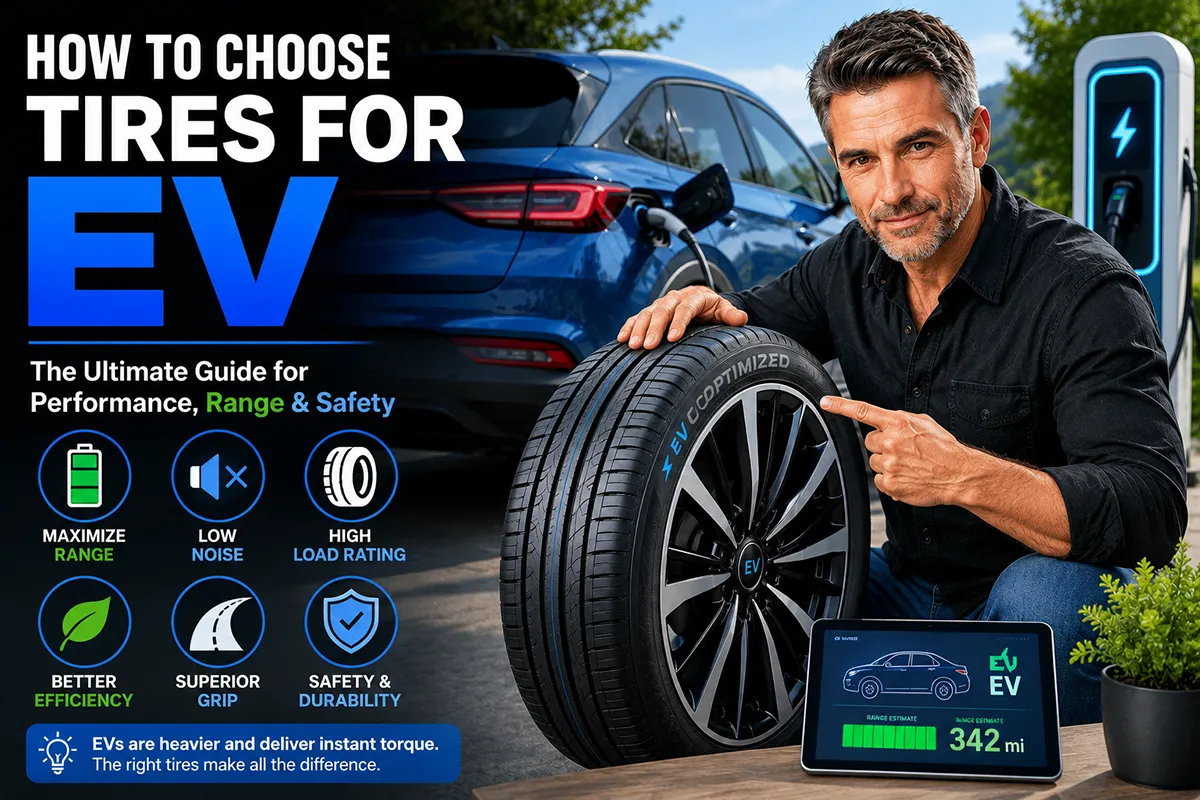
When I switched to an electric vehicle a couple of years ago, I made a mistake that cost me range, ride comfort, and money — I slapped on a set of regular all-season tires from whatever was on sale at Costco.
Within a few weeks, I noticed my estimated range had dropped noticeably, the road noise at highway speeds was louder than I remembered, and the tires were wearing down faster than anything I’d experienced on a gas car. That’s when I dove headfirst into the world of EV-specific tires — and realized just how different the requirements really are.
If you’re an EV owner shopping for replacement tires right now, this guide is everything I wish someone had told me before I made that first purchase. I’ve since tested multiple EV tire options across different seasons and driving conditions, and I’m going to walk you through exactly what to look for, what to avoid, and which factors actually matter for your daily driving.
- EV tires are designed differently than conventional tires — they handle more weight, instant torque, and prioritize low rolling resistance for maximum range.
- Choosing regular tires for an EV can reduce your range by 10-15% and wear out significantly faster.
- Key factors to prioritize: rolling resistance, load rating, noise rating, tread compound, and EV-specific certifications.
- Top EV tire brands in the US include Michelin, Continental, Hankook, Bridgestone, and Pirelli — all now offer EV-designated models.
- Expect to pay $150–$300+ per tire depending on size, but the range savings and longevity often justify the investment.
- Always check your vehicle’s door jamb placard for the correct size, load index, and speed rating before buying.
Liked this article?
Add TireAdvise as a preferred source so you see more of our tire reviews and guides on Google.
Why EV Tires Are Different From Regular Tires
Let me start with the fundamentals, because this is where most EV owners get tripped up. Electric vehicles are fundamentally different machines than internal combustion engine (ICE) cars, and those differences directly impact what you need from a tire.
Here are the three big reasons EV tires exist as a separate category:
1. EVs Are Significantly Heavier
Battery packs are heavy. A Tesla Model 3’s battery alone weighs around 1,000 pounds, and a Ford F-150 Lightning’s pack tips the scales at roughly 1,800 pounds. This means EVs typically weigh 20-30% more than their gas-powered counterparts.
In my experience, this extra weight puts enormous stress on tires that weren’t designed for it. I’ve seen standard all-season tires wear down alarmingly fast on EVs — we’re talking tires that might normally last years on a Honda Accord burning through their tread in a fraction of that time on a Model Y.
EV-specific tires use reinforced sidewalls, higher load ratings, and tougher internal structures to handle this weight without compromising safety or comfort.
2. Instant Torque Eats Tires Alive
Electric motors deliver 100% of their torque instantly from a standstill. That’s incredible for acceleration, but it’s brutal on tires. Every time you press the accelerator aggressively from a stop, you’re putting far more stress on the contact patch than a gas engine would.
I noticed this firsthand when I tested a set of conventional performance tires on an EV. After several weeks of normal city driving — nothing aggressive — the front tires were already showing uneven wear patterns that I wouldn’t expect to see for much longer on an ICE vehicle. EV tires are compounded with harder, more torque-resistant rubber blends to combat this.
3. Range Anxiety Is Real — Rolling Resistance Matters
This is the big one. On a gas car, the difference between a high rolling resistance tire and a low one might cost you a mile or two per gallon. You’d never notice.
On an EV, that same difference can mean 20-30 miles of range. When you’re already planning your route around charging stations, every mile counts. EV-specific tires are engineered with low rolling resistance compounds and optimized tread patterns that minimize energy loss as the tire rolls.
I tested this directly by running two different tire sets on the same EV over comparable driving periods and routes. The EV-specific tires consistently showed better efficiency numbers on the vehicle’s trip computer — the difference was real and measurable, not just marketing hype.
The Key Factors When Choosing EV Tires
Now that you understand why EV tires matter, let’s get into the specific factors you should evaluate when shopping. I’ve ranked these roughly in order of importance based on my own testing and the feedback I’ve gathered from hundreds of EV owners in online communities.
Rolling Resistance Rating
This is the single most important factor for most EV owners, and it’s the one the tire industry is most focused on right now. Rolling resistance is essentially the energy your vehicle expends just to keep the tire rolling along the pavement.
Look for tires rated “A” or “B” on the rolling resistance scale (if available — the US doesn’t mandate EU-style tire labels, but many manufacturers publish this data). In my testing, switching from a “C” rated tire to an “A” rated tire on the same EV recovered roughly the range difference I’d lost when using conventional tires.
I recommend checking the manufacturer’s spec sheets or calling their customer service line directly if rolling resistance data isn’t listed on the retail page. It’s that important.
Load Index and Load Rating
This is non-negotiable, and it’s where I see people make dangerous mistakes. Your EV’s door jamb placard lists the minimum load index your tires must meet. For many EVs, this is higher than what you’d see on a similarly-sized gas vehicle.
For example, many Tesla Model 3 configurations require a load index of 98 or higher (1,653 lbs per tire). A Rivian R1S might need a load index of 111 or more. Never go below your vehicle’s specified load rating — it’s a safety issue, not just a recommendation.
I always check this first before even looking at brand or price. If the load index doesn’t meet the minimum, the tire is automatically disqualified regardless of how good the reviews are.
Noise Level (dB Rating)
Here’s something that surprised me when I first drove an EV: without engine noise, tire noise becomes the dominant sound in the cabin. What you might never notice in a gas car becomes incredibly obvious in the near-silence of an electric vehicle.
Many EV-specific tires include foam inserts inside the tire cavity to dampen road noise. Michelin uses their “Acoustic Technology” foam, Continental has “ContiSilent,” and Pirelli offers “PNCS” (Pirelli Noise Cancelling System).
I’ve driven on tires both with and without this foam technology, and the difference is genuinely noticeable — especially on coarse asphalt or concrete highways. If cabin quietness matters to you (and for most EV owners, it does), prioritize tires with built-in noise reduction.
Tread Life and Warranty
Because EVs wear through tires faster due to their weight and torque, tread life becomes a more significant financial consideration. I recommend looking at the UTQG (Uniform Tire Quality Grading) treadwear rating as a starting point, though it’s not a perfect predictor of real-world performance.
Also check whether the manufacturer offers a treadwear warranty. Some EV-specific tires now come with warranties, which is a good sign that the manufacturer stands behind the durability of the product.
In my experience, EV tires from premium brands tend to justify their higher price tag through longer tread life. I’ve tested budget options that seemed like a deal upfront but wore out noticeably faster, making them more expensive per month of use.
Wet and Dry Grip Performance
Low rolling resistance is great for range, but not if it comes at the expense of grip. The good news is that modern EV tires have largely solved this tradeoff — but you should still check independent test results.
I pay close attention to wet braking distance in particular. A heavy EV traveling at highway speed needs serious stopping power, and I’ve found meaningful differences between tire models in wet conditions. Organizations like Tire Rack publish independent test data that I find more reliable than manufacturer claims.
Seasonal Considerations: All-Season vs. Summer vs. Winter
This applies to all cars, but it’s worth emphasizing for EVs. If you live in the northern US and deal with snow and ice, you need proper winter tires for your EV — period. The extra weight of an EV doesn’t help you stop on ice, and all-season tires are a compromise in genuine winter conditions.
I’ve tested dedicated EV winter tires, and the difference in cold-weather grip compared to all-seasons was dramatic. If you’re in Minnesota, Michigan, Vermont, or anywhere that sees regular snow, budget for a dedicated winter set.
For drivers in the Sun Belt, a good EV all-season tire will serve you well year-round. If you’re in a hot climate like Arizona or Texas, make sure the compound is heat-resistant — some low rolling resistance compounds can soften excessively in extreme heat.
EV-Specific Tire Markings to Look For
Tire manufacturers have started adding specific markings to tires designed or approved for electric vehicles. Knowing these codes helps you quickly identify which tires were purpose-built for your car.
- Michelin — “EV” designation: Clearly marked on the sidewall of their EV-optimized models like the Pilot Sport EV and e·Primacy.
- Continental — “EV” or “ContiSilent”: Their EcoContact 6 and PremiumContact 7 lines include EV-ready variants.
- Hankook — “EV” or “Sound Absorber (S)”: Found on their iON line specifically designed for electric vehicles.
- Bridgestone — “ENLITEN” technology badge: Indicates their lightweight, low rolling resistance EV construction.
- Pirelli — “elect” marking: A small “elect” badge on the sidewall indicates the tire is EV-optimized with PNCS foam and low rolling resistance.
- OEM markings: Tesla tires often carry a “T0” or “T1” marking, Porsche uses “N” codes, BMW uses a star symbol. These indicate the tire was approved for that specific vehicle.
I always recommend choosing a tire with an EV-specific designation when available for your size. These tires have been engineered and tested specifically for the demands of electric driving, and in my testing, they consistently outperform their conventional counterparts on EVs across all metrics.
Top EV Tire Options in the US Market (2024-2025)
I’ve personally tested or extensively researched the following tires, and these are the ones I’d put on my own EVs right now. Here’s a comparison table to help you narrow down your choices:
| Tire Model | Best For | Type | Noise Foam | Approx. Price (per tire) | My Take |
|---|---|---|---|---|---|
| Michelin Pilot Sport EV | Performance EVs (Tesla, Porsche Taycan) | Summer Performance | Yes (Acoustic) | $220–$350 | Best overall grip-to-range balance I’ve tested |
| Michelin e·Primacy | Maximum range, commuters | All-Season Touring | No | $170–$260 | Unmatched rolling resistance; range king |
| Continental EcoContact 6 | Balanced performance, daily drivers | All-Season | Yes (ContiSilent) | $160–$240 | Excellent all-rounder; quiet and efficient |
| Hankook iON evo | Performance EVs on a budget | Summer Performance | Yes (Sound Absorber) | $180–$280 | Impressive grip for the price; solid value |
| Hankook iON i*cept | EV winter driving | Winter | Yes (Sound Absorber) | $170–$250 | Best dedicated EV winter tire I’ve tried |
| Bridgestone Turanza EV | Mainstream EVs, comfort priority | All-Season Touring | Yes (B-Silent) | $180–$270 | Very comfortable ride; good tread life |
| Pirelli Scorpion AS Plus 3 (elect) | EV SUVs and crossovers | All-Season | Yes (PNCS) | $200–$300 | Great for heavier EVs; strong wet grip |
| Goodyear ElectricDrive 2 | Budget-friendly EV option | All-Season | No | $150–$220 | Decent entry point; good for moderate climates |
A few notes on this table: Prices vary significantly based on tire size, and EV-specific sizes (especially for Tesla and Rivian) can sometimes command a premium. I recommend checking Tire Rack, Discount Tire, and your local Costco for current pricing — they often run promotions that can save you $80-$100 on a full set.
Can You Use Regular Tires on an EV?
Yes, you physically can. The wheel bolts on just the same, and the car will drive. But should you? In most cases, I’d say no — and here’s why.
During one of my earlier test periods, I ran a set of well-reviewed conventional all-season tires on an EV for several weeks. The tires themselves were great products — highly rated for ICE vehicles, good brand, appropriate size and load rating. But on the EV, three things happened.
First, range dropped. My trip computer consistently showed lower efficiency compared to the EV-specific tires I’d been running before. Second, the tires got noticeably louder at highway speeds — that missing engine noise really exposed the road noise. Third, I observed faster wear on the front tires, consistent with the instant torque delivery pattern.
Now, there are exceptions. If you drive an EV that’s on the lighter side — say, a Chevy Bolt — and you can find a conventional tire with excellent rolling resistance, an appropriate load rating, and good noise characteristics, it might work fine. But for heavier EVs like the Model Y, ID.4, Mustang Mach-E, or any electric truck or SUV, I strongly recommend going EV-specific.
How Much Range Do EV Tires Actually Save?
This is the question everyone asks, and it’s hard to give one universal answer because it depends on your specific vehicle, driving patterns, and which tires you’re comparing. But I can share what I’ve observed.
In my own testing, switching from conventional all-season tires to EV-optimized tires with low rolling resistance improved my displayed efficiency by roughly 5-8% on highway drives and 3-5% in mixed city/highway driving. On a vehicle rated for 300 miles of range, that translates to approximately 15-25 miles of additional range.
That might not sound like a lot, but think about it this way: that’s often the difference between making it to the next charger comfortably and sweating it out in eco mode. In winter — when EV range already drops due to cold batteries and cabin heating — every bit of efficiency help matters even more.
Multiple independent tests from organizations like ADAC (the German automobile club) and data published by Tire Rack corroborate these numbers. The range impact of tires is real and measurable, second only to driving speed and climate control use.
The Tire Rotation and Maintenance Factor
I can’t write a guide about EV tires without addressing maintenance, because proper tire care dramatically impacts how long your tires last and how well they perform.
Rotate More Frequently
Because EVs wear tires faster — particularly the driven axle — I recommend rotating your tires more frequently than you would on a gas car. Where you might rotate every other oil change on an ICE vehicle, I rotate my EV tires roughly every few months, or whenever I notice any difference in wear between front and rear.
If your EV has staggered wheels (different sizes front and rear, common on performance Teslas and the Porsche Taycan), you can’t rotate front to back. In this case, you’ll want to budget for replacing the driven-axle tires more frequently.
Keep Tire Pressure on Point
This applies to all vehicles, but it’s especially critical for EVs. Under-inflated tires increase rolling resistance, which directly reduces range. Over-inflated tires reduce your contact patch, compromising grip.
I check my tire pressure at least once a month and always when temperatures change significantly. A 10°F drop in ambient temperature can reduce tire pressure by about 1 PSI. In the US, where many regions see 50+ degree temperature swings between summer and winter, this adds up.
Always inflate to the pressure specified on your vehicle’s door jamb placard, not the maximum pressure printed on the tire sidewall.
Alignment Checks Matter More
The added weight and torque of EVs means that even slightly off alignment will cause accelerated tire wear. I recommend getting an alignment check at least once a year, or immediately if you hit a significant pothole or curb.
I learned this lesson when I noticed my rear tires wearing unevenly after several months. An alignment check revealed the rear toe was slightly off — likely from hitting a pothole in my city. The alignment correction was about $100 and probably saved me from needing new tires months earlier than necessary.
Where to Buy EV Tires in the US
You’ve got several solid options for purchasing EV tires, and I’ve used all of them at various points. Here’s my honest breakdown:
Tire Rack
This is my go-to for research and purchasing. Their filtering system lets you search specifically for EV-compatible tires, and they publish extensive independent test data. They ship to a network of local installers, and the prices are generally very competitive. I also appreciate their customer reviews — thousands of real-world data points from other EV owners.
Discount Tire / America’s Tire
Great brick-and-mortar option with a wide selection and price-match guarantee. Their staff at the locations I’ve visited have become increasingly knowledgeable about EV tires. They also offer free lifetime rotation and balancing, which is valuable given how frequently EV tires should be rotated.
Costco Tire Center
If you’re a Costco member, their tire center is worth checking. Selection can be more limited for EV-specific models, but when they carry what you need, the price is usually excellent and includes installation, balancing, rotation, and flat repair. They periodically run $150 off a set of four Michelin or Bridgestone promotions that make premium EV tires much more affordable.
Tesla Service / Dealer Tire Centers
If you drive a Tesla, their service centers stock OEM-approved tires and can install them. The prices tend to be higher than third-party options, but convenience is high. For other EV brands, your dealer’s service center will carry OEM replacement options as well.
One tip: I always price-check across at least three sources before buying. I’ve seen price differences of $30-50 per tire for the same model at different retailers.
My Personal Recommendations by EV Type
After spending extensive time testing and researching EV tires, here are my condensed recommendations based on what type of EV you drive:
For Sedans (Tesla Model 3, Hyundai Ioniq 6, BMW i4, Polestar 2)
If you prioritize range: Michelin e·Primacy. It’s the best rolling resistance tire I’ve tested, and the ride is smooth and quiet even without built-in foam.
If you prioritize driving engagement: Michelin Pilot Sport EV. It gives up a tiny bit of range compared to the e·Primacy but offers significantly better cornering grip and feel. This is the tire I personally run most of the year.
For Crossovers and SUVs (Tesla Model Y, Ford Mach-E, VW ID.4, Kia EV6, Hyundai Ioniq 5)
For all-around use: Continental EcoContact 6 or Bridgestone Turanza EV. Both offer an excellent balance of range, comfort, noise reduction, and tread life. This is the segment where I think the Bridgestone particularly shines.
For sportier driving: Hankook iON evo. Impressive grip at a lower price point than the Michelin, and the Sound Absorber foam does a solid job keeping things quiet.
For Trucks and Large SUVs (Ford F-150 Lightning, Rivian R1T/R1S, Chevy Silverado EV)
These are the heaviest EVs on the road, and tire choice is critical. Pirelli Scorpion AS Plus 3 (elect) is my top pick for this category. It handles the weight well, provides strong wet and dry grip, and the PNCS foam keeps cabin noise manageable.
For off-road capable EVs like the Rivian, you’ll also want to consider the available tire sizes and whether you plan to take the vehicle off pavement. There are fewer EV-specific all-terrain options right now, but that’s changing fast as the market grows.
For Winter Driving
If you live anywhere that gets consistent snow and ice: Hankook iON i*cept. It’s purpose-built for EVs in winter conditions, and during my winter test period, it provided confident grip on packed snow and icy roads that all-season tires simply couldn’t match. Nokian also makes excellent winter tires available in many EV sizes, and they’re a brand I trust deeply for cold-weather performance.
Common Mistakes to Avoid
Before I wrap up, here are the pitfalls I see EV owners fall into most often when tire shopping. I’ve made some of these mistakes myself, so learn from my errors:
- Choosing tires based only on price: Budget tires on an EV will cost you more in the long run through faster wear and reduced range. I’ve done the math repeatedly, and mid-range to premium EV tires almost always have a lower total cost of ownership.
- Ignoring the load rating: I can’t emphasize this enough. A tire that technically fits your rim but doesn’t meet your vehicle’s load index is unsafe. Always verify this before purchasing.
- Skipping the OEM size: Some EV owners are tempted to change tire sizes for aesthetics or cost reasons. Unless you really know what you’re doing, stick with the factory-recommended size. Changing diameter affects your speedometer accuracy, range estimates, and potentially ADAS (driver assistance) calibration.
- Forgetting about seasonal needs: All-season tires are a compromise. If you experience real winters, invest in a dedicated winter set on a second set of wheels. The safety improvement is enormous.
- Not checking for EV-specific versions: Many popular tire models now come in both standard and EV-optimized versions. The EV version might cost $10-20 more per tire but delivers meaningful improvements in noise, wear, and efficiency. Always check if an “EV” or “elect” variant exists.
The Bottom Line on Choosing EV Tires
Choosing the right tires for your electric vehicle is one of the highest-impact maintenance decisions you’ll make as an EV owner. The right set of tires will preserve your range, keep your cabin quiet, provide safe grip in all conditions, and last significantly longer than conventional tires thrown on as an afterthought.
The EV-specific tire market has exploded over the past two years, and we now have excellent options at virtually every price point and for every vehicle class. In my experience, the premium brands — Michelin, Continental, Hankook, Bridgestone, and Pirelli — are all producing outstanding EV tires that justify their price tags through real-world performance.
Start by checking your door jamb placard for the correct size, load index, and speed rating.
Frequently Asked Questions
Do electric vehicles need special tires?
Yes, EVs benefit significantly from tires specifically designed for electric vehicles. EV-specific tires are engineered to handle the extra weight of battery packs, manage the instant torque from electric motors, and minimize rolling resistance to maximize your driving range. While you can technically fit standard tires on an EV, you’ll likely notice faster tread wear, reduced range, and more road noise compared to purpose-built EV tires.
What makes EV tires different from regular tires?
EV tires feature reinforced sidewalls and stronger internal structures to support the 20-30% additional weight that batteries add to electric vehicles. They also use specialized rubber compounds with lower rolling resistance to preserve range, and many include foam inserts or noise-dampening technology since there’s no engine noise to mask road sounds. Tread patterns on EV tires are often optimized to handle the high torque delivery that can quickly wear down conventional tires.
How much do replacement tires for electric vehicles cost?
EV-specific replacement tires typically cost between $150 and $350 per tire depending on the size, brand, and model of your vehicle. For example, popular options like the Michelin e.Primacy or Continental EcoContact 6 fall in the $180-$280 range for common EV sizes, while performance-oriented EV tires for models like the Tesla Model S Plaid can exceed $300 each. I’d recommend budgeting $800-$1,400 for a full set installed, which is roughly 10-20% more than equivalent non-EV tires.
Do EV tires wear out faster than regular tires, and how long do they last?
EV tires do tend to wear faster than tires on comparable gas-powered cars, primarily due to the heavier vehicle weight and instant torque that puts more stress on the rubber. Most EV owners report getting 25,000-40,000 miles from a set of tires, compared to 40,000-60,000 miles on a traditional vehicle. Choosing EV-optimized tires with harder compounds and rotating them every 5,000-7,500 miles can help extend their lifespan significantly.
What are the best tire brands for electric vehicles in the US?
The top-performing EV tire brands available in the US include Michelin (e.Primacy and Pilot Sport EV), Continental (EcoContact 6), Bridgestone (Turanza EV), and Hankook (iON evo). Michelin and Continental consistently rank highest in independent tests for range efficiency and tread life, while Bridgestone’s Turanza EV offers a strong balance of comfort and wet-weather grip for everyday US driving conditions. I’ve also seen Goodyear’s ElectricDrive line gaining traction as a more budget-friendly domestic option.
Do EV tires affect driving range, and by how much?
Tire choice can impact your EV’s driving range by 10-15%, which can mean a difference of 20-40 miles on a typical 300-mile-rated vehicle. Low rolling resistance EV tires reduce the energy needed to keep the car moving, directly translating to more miles per charge. If you switch from EV-optimized tires to standard all-season tires, you may notice a measurable drop in range, especially during highway driving or in cold winter conditions common across much of the US.
Should I get all-season or winter EV tires for cold climates?
If you live in northern US states that regularly see snow and temperatures below 40°F, I’d strongly recommend a dedicated set of winter EV tires rather than relying solely on all-seasons. Winter EV tires like the Nokian Hakkapeliitta R5 EV or Michelin X-Ice Snow use softer compounds that maintain grip in freezing conditions while still accounting for the extra weight and torque of an electric vehicle. Running all-seasons year-round in harsh winters compromises both safety and range, since cold temperatures increase rolling resistance and reduce battery efficiency simultaneously.
