

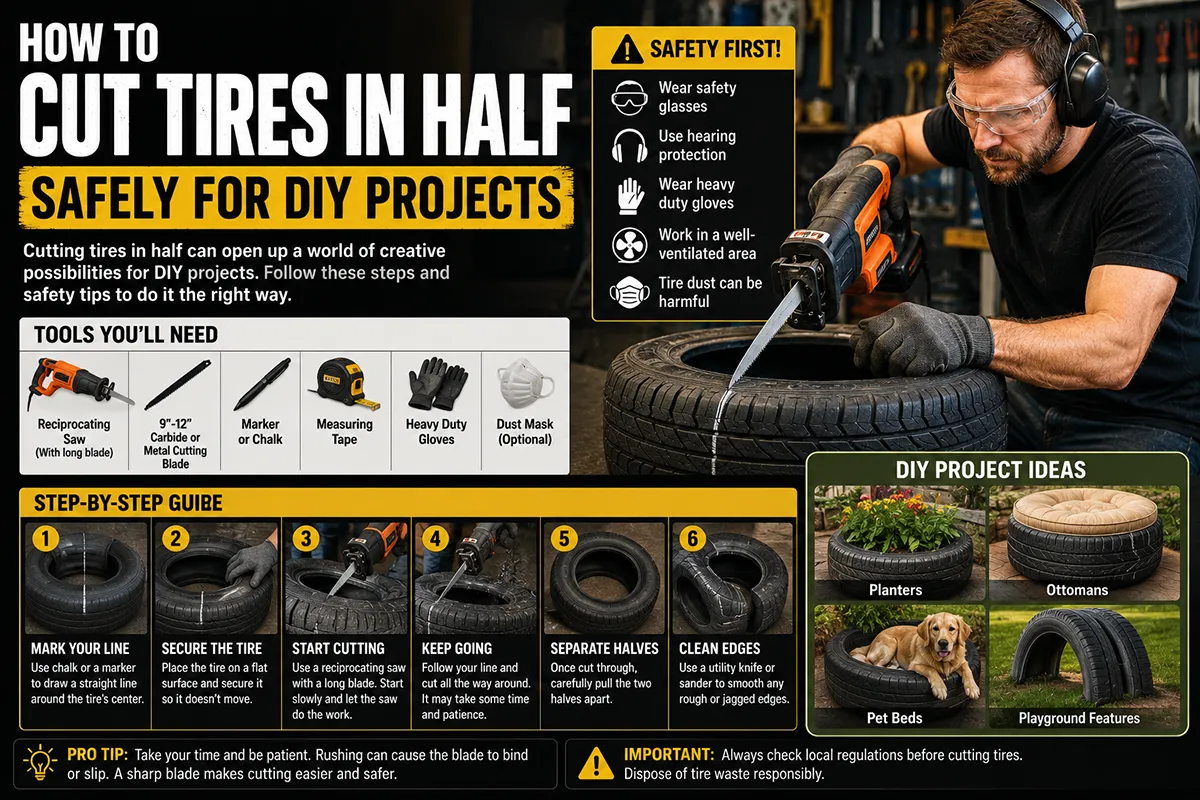
Ever stared at a pile of old tires in your garage and wondered what on earth you’re supposed to do with them? Maybe you’ve got a landscaping project in mind, or you just want to see what’s actually inside that rubber-and-steel beast hugging your wheels.
I’ve cut more tires in half than I can count — for garden planters, playground barriers, DIY obstacle courses, and honestly, just plain curiosity. And I’ll tell you right now: it’s not as simple as grabbing a kitchen knife and going to town.
- Cutting a tire in half requires a reciprocating saw, jigsaw, or heavy-duty utility knife — never use a chainsaw.
- Steel belts inside most passenger tires make cutting difficult and require bi-metal or carbide-tipped blades.
- Always deflate the tire completely and remove it from the rim before cutting.
- Wear heavy-duty gloves, safety goggles, and a respirator to protect against rubber dust and steel fragments.
- Common reasons for cutting tires include DIY projects, disposal prep, recycling, and tire education.
- If you’re cutting a tire just to inspect it, consider visiting a tire shop — many will show you cross-sections for free.
Liked this article?
Add TireAdvise as a preferred source so you see more of our tire reviews and guides on Google.
Why Would You Want to Cut a Tire in Half?
Before we get into the how, let’s talk about the why. I get this question a lot, and the answer isn’t always obvious to people outside the tire world.
In my experience, there are several legitimate and practical reasons everyday drivers and DIYers end up wanting to halve a tire.
DIY and Upcycling Projects
Old tires make incredible raw material for creative projects. I’ve personally turned halved tires into raised garden beds, dog water bowls, tree swings with better grip surfaces, and even rustic outdoor seating.
The upcycling community has embraced tires in a big way. Pinterest and YouTube are loaded with ideas that start with “first, cut your tire in half.”
Tire Disposal and Recycling Prep
Some municipal waste facilities in the US require tires to be cut before they’ll accept them. Whole tires can trap methane gas in landfills and become breeding grounds for mosquitoes, so many recycling centers prefer them quartered or halved.
I’ve had to cut tires down to size for exactly this reason when my local transfer station in the Midwest wouldn’t take whole tires without charging a hefty fee.
Educational Purposes and Tire Inspection
If you’ve ever wanted to truly understand what’s inside a tire — the steel belts, the polyester body plies, the inner liner, the bead wire — there’s no better way than cutting one open. I’ve done this during informal demonstrations for friends who were curious about tire construction.
It’s genuinely fascinating. When you see the layers inside a Michelin Defender or a Continental TrueContact, you start to understand why quality tires cost what they cost.
Livestock Feeders and Farm Use
This one’s big in rural America. Halved tractor or truck tires make excellent livestock water troughs and feed bunks. If you’ve ever driven through farm country in Texas, Oklahoma, or Iowa, you’ve seen these everywhere.
I helped a buddy on his ranch cut several old truck tires in half for exactly this purpose. They’re durable, weatherproof, and essentially free.
What’s Actually Inside a Tire? (And Why It Matters for Cutting)
Understanding tire construction isn’t just academic — it directly affects which tools and techniques you’ll need. Let me walk you through what you’re dealing with.
The Anatomy of a Modern Car Tire
A standard passenger tire sold in the US today — whether it’s a Goodyear Assurance, a Bridgestone Ecopia, or a Pirelli Cinturato — contains multiple layers of different materials.
Here’s what you’ll encounter from the outside in:
- Tread compound: The thick outer rubber layer that contacts the road. This is the easiest part to cut through.
- Steel belts: Usually two layers of steel cord embedded in rubber, running circumferentially under the tread. This is the hardest part to cut and will destroy regular saw blades.
- Body plies: One or two layers of polyester, rayon, or nylon cords that give the tire its shape and strength.
- Inner liner: A thin layer of butyl rubber that acts as the tire’s air barrier (essentially a built-in tube).
- Bead wire: A bundle of high-tensile steel wire at each edge of the tire that locks it onto the rim. This is incredibly strong and difficult to cut.
- Sidewall rubber: The flexible rubber covering the side of the tire, thinner than the tread area.
Why Steel Belts Are Your Biggest Challenge
The steel belts under the tread are the single biggest obstacle you’ll face. In my experience, they will eat through a standard wood-cutting reciprocating saw blade in seconds.
These belts are made from braided steel cords coated in brass (for rubber adhesion) and then embedded in a rubber compound. They’re designed to resist puncture and maintain tire shape at highway speeds. They do not want to be cut.
The bead wire is equally stubborn. It’s essentially a cable of drawn steel wire wound into a hoop, and it’s strong enough to hold the tire on a rim under thousands of pounds of pressure.
Tools You’ll Need to Cut a Tire in Half
I’ve experimented with many different tools over the years. Some worked great, some were dangerous, and some were a complete waste of time. Here’s my honest breakdown.
Recommended Tools
| Tool | Best For | Handles Steel Belts? | Approx. Cost | My Rating |
|---|---|---|---|---|
| Reciprocating saw (Sawzall) | Full cuts through tread and bead | Yes (with bi-metal blade) | $60–$150 (tool) + $10–$20 (blades) | ⭐⭐⭐⭐⭐ |
| Jigsaw | Sidewall cuts, detailed shaping | Poorly — struggles with belts | $40–$120 (tool) + $8–$15 (blades) | ⭐⭐⭐ |
| Heavy-duty utility knife | Sidewall-only cuts | No | $10–$25 | ⭐⭐⭐ |
| Angle grinder (with cut-off wheel) | Bead wire and steel belt areas | Yes | $30–$80 (tool) + $5–$10 (wheels) | ⭐⭐⭐⭐ |
| Oscillating multi-tool | Precision cuts in sidewall | Barely | $40–$100 | ⭐⭐ |
My Top Recommendation: The Reciprocating Saw
If you’re going to cut a tire in half — truly in half, through the tread, belts, and all — a reciprocating saw (commonly known by the Milwaukee brand name “Sawzall”) is your best friend.
I use a corded DeWalt reciprocating saw that I picked up at Home Depot for around $80. Corded models deliver consistent power, which matters when you’re grinding through steel belts.
The key is the blade. You absolutely need a bi-metal or carbide-tipped blade rated for metal cutting. I recommend blades that are at least 8 inches long with 14–18 teeth per inch (TPI). Diablo and Lenox both make excellent options available at most US hardware stores for $10–$20 per pack.
Tools to AVOID
- Chainsaw: Never, ever use a chainsaw on a tire. The steel belts will destroy the chain, and a broken chain at high RPM is a life-threatening hazard. I’ve seen people suggest this online, and it’s genuinely dangerous advice.
- Circular saw: The tire’s flexible, curved surface makes a circular saw extremely unstable and prone to kickback. Don’t do it.
- Standard wood saw blades: They’ll dull in seconds on the steel belts and overheat. You’ll waste money and time.
- Household scissors or regular knives: You’ll hurt yourself before you make any meaningful progress.
Safety Gear: Don’t Skip This Section
I want to be completely straightforward here: cutting a tire is more hazardous than most people expect. The combination of flying rubber particles, steel fragments, and carbon black dust creates real health and safety risks.
Essential Safety Equipment
- Cut-resistant gloves (Level A4 or higher): The exposed steel belts will slice through regular work gloves. I use Mechanix Wear cut-resistant gloves. Budget $15–$30.
- ANSI Z87.1 rated safety goggles: Not glasses — goggles that seal around your eyes. Steel wire fragments and rubber chunks will fly. Budget $8–$15.
- N95 respirator or half-face respirator with P100 filters: Tire rubber dust contains carbon black, which is classified as a possible carcinogen by IARC. Protect your lungs. Budget $5–$30.
- Hearing protection: A reciprocating saw cutting through steel generates significant noise. Foam earplugs or over-ear muffs work fine. Budget $5–$15.
- Long sleeves and pants: Exposed skin will catch rubber debris and small steel splinters.
- Steel-toed boots: A tire half is heavier than you’d expect, and a dropped reciprocating saw is no joke.
Work Area Safety
Always work outdoors or in a very well-ventilated area. The rubber dust and fumes generated during cutting are not something you want to breathe in an enclosed garage.
Keep a fire extinguisher nearby. Friction from power tools can heat rubber to its ignition point, especially if you’re cutting aggressively without pausing.
Clear the area of bystanders, pets, and especially children. I usually set up a 15-foot perimeter when I’m cutting.
Step-by-Step: How to Cut a Tire in Half
Alright, let’s get into the actual process. I’m going to walk you through exactly how I do it, based on having done this many times over the years.
Step 1: Prepare the Tire
Remove the tire from the rim. Never attempt to cut a tire while it’s still mounted. Even if the tire is flat, there can be residual pressure, and cutting into a rim will damage your tools and create sparks.
If the tire is still inflated, deflate it completely by removing the valve core (not just pressing the valve stem). You can pick up a valve core removal tool at any auto parts store for about $3.
Clean the tire with a hose and let it dry. Mud, rocks, and road grime will dull your blades faster and can hide nails or other embedded metal objects.
Step 2: Mark Your Cut Line
Use chalk, a paint marker, or white crayon to draw your cut line around the tire. For a true half cut (splitting the tire into two equal halves across the tread), you’ll need to mark a line around the circumference of the tread, perpendicular to the sidewalls.
I find that wrapping a piece of painter’s tape around the tire as a guide helps keep my line straight. It doesn’t have to be perfect, but a visual guide makes a huge difference.
Step 3: Secure the Tire
This is a step a lot of people skip, and it’s a mistake. An unsecured tire will spin, shift, and bounce as you cut, making the process dangerous and frustrating.
I either clamp the tire to a sturdy workbench using C-clamps, or I place it flat on the ground and stand on one side while cutting the other (only for sidewall cuts with a utility knife — never with a power saw while standing on it).
For tread cuts with a reciprocating saw, the best setup I’ve found is clamping the tire in a large bench vise or between two saw horses with ratchet straps holding it firm.
Step 4: Start with the Sidewall
Here’s my biggest tip: don’t start cutting through the tread. Start with the sidewall.
The sidewall is the thinnest, most flexible part of the tire and contains no steel belts (only body plies and rubber). You can often start the cut with a sharp utility knife and then switch to your reciprocating saw.
Plunge the utility knife into the sidewall about an inch away from the tread area (to avoid the steel belt edges). Once you have a starter hole, insert your reciprocating saw blade.
Cut around the entire sidewall circumference on one side. Then flip the tire and do the same on the other side. You’ll now have the tread band separated from the two sidewall rings — essentially giving you three pieces instead of trying to force one brutal cut through the steel-belted tread.
Step 5: Cut Through the Tread (The Hard Part)
Now comes the real challenge. The tread section contains those steel belts I’ve been warning you about.
With your reciprocating saw loaded with a fresh bi-metal blade (I always start this step with a new blade), begin cutting across the tread. Go slowly. Let the blade do the work — don’t force it.
I typically cut across the tread width in one spot first, then work my way around. You’ll hear the blade’s pitch change as it hits the steel belts. That’s normal. If you smell burning rubber, you’re pushing too hard or going too fast. Back off, let things cool for 30 seconds, and continue.
Expect to go through two to four blades for a single passenger tire. Larger truck or SUV tires may require even more.
Step 6: Handle the Bead Area
If your cut line goes through the bead area (where the tire would meet the rim), you’ll encounter the bead wire. This is essentially a thick cable of steel wire, and it’s one of the toughest parts of the tire.
An angle grinder with a metal cut-off wheel makes quicker work of the bead wire than a reciprocating saw. Just be extra cautious of sparks — make sure there’s nothing flammable nearby.
I usually use the reciprocating saw for the rubber portions and switch to the angle grinder specifically for the bead wire. It takes a bit of tool-switching but saves time overall.
Step 7: Clean Up and Deburr
Once the tire is cut, you’ll likely have exposed steel wire ends poking out of the cut edges. These are sharp and will absolutely cut you if you handle the tire pieces carelessly.
I use pliers to bend the wire ends inward and/or an angle grinder to smooth them down. If the halved tire is going to be used for a planter or any project where people (or animals) might touch it, this step is critical.
Sweep up all rubber debris and steel fragments. Use a shop magnet to pick up small steel pieces from the ground — they’re nearly invisible but will find their way into bare feet or pet paws.
How Long Does It Actually Take?
In my experience, cutting a standard passenger car tire (something like a 205/55R16) in half takes about 30 to 45 minutes if you’re using a reciprocating saw and following the sidewall-first method I described.
The first time I did it, it took me well over an hour because I tried to go straight through the tread and burned through three blades before I figured out a better approach.
Larger tires — like those from a pickup truck (265/70R17 or bigger) — can take an hour or more. The rubber is thicker, the steel belts are wider and heavier gauge, and the bead wire is more substantial.
Creative Uses for Halved Tires
Once you’ve got your tire halves, the possibilities are surprisingly broad. Here are projects I’ve personally done or seen done well.
Raised Garden Beds and Planters
A halved tire laid flat makes an excellent raised garden bed. The rubber retains heat, which can extend growing seasons in cooler US climates. Just fill with soil and plant.
One word of caution: there’s ongoing debate about whether chemicals leaching from tires can contaminate soil and edible plants. The research is mixed, but I personally use tire planters only for ornamental flowers, not vegetables. If you’re concerned, line the inside with landscape fabric.
Livestock Feeders and Water Troughs
As I mentioned earlier, this is huge in agricultural areas. A halved truck tire is practically indestructible and holds a significant volume of water or feed.
Playground and Obstacle Course Features
Half tires embedded vertically in the ground create classic playground obstacles. I helped install several of these at a community park in Indiana, and the kids love them.
Erosion Control and Retaining Walls
Stacked tire halves filled with earth can serve as low-cost retaining walls for slopes. This is a technique used in “earthship” sustainable building and can be genuinely effective for small-scale landscaping.
Understanding Tire Construction
If you’re a tire nerd like me, there’s nothing quite like holding a cross-section of a tire in your hands. You can see how the tread depth varies, examine the steel belt coverage, and appreciate the engineering that goes into something we usually take for granted.
I’ve used cut tire sections when explaining to friends why they should invest in quality tires for their daily drivers. When you see the difference between a premium tire’s construction and a budget tire’s, the price gap starts to make sense.
Alternative Approach: Cutting Just the Sidewall Off
For many DIY projects — especially planters — you don’t actually need to cut the tire perfectly in half across the tread. Instead, you just need to cut one sidewall off to create an open-topped container.
This is significantly easier because you’re avoiding the steel belts entirely. A sharp utility knife or a jigsaw with a fine-toothed blade can handle sidewall-only cuts without much trouble.
I’ve done sidewall-only cuts in as little as 10 to 15 minutes per tire using a sharp box cutter with a fresh blade. Apply dish soap or WD-40 to the blade as a lubricant — it makes a remarkable difference in how easily the blade glides through the rubber.
Cost Breakdown: What This Project Will Run You
If you already own a reciprocating saw, this is an extremely affordable project. Here’s a realistic cost breakdown based on US retail prices as of 2024:
- Bi-metal reciprocating saw blades (pack of 5): $12–$20 at Home Depot, Lowe’s, or Harbor Freight
- Cut-resistant gloves: $15–$30 at Amazon or hardware stores
- Safety goggles: $8–$15
- N95 respirators (pack of 10): $15–$25
- Chalk or paint marker: $3–$5
- Valve core removal tool: $3–$5 at AutoZone, O’Reilly, or Advance Auto Parts
Total cost (assuming you own the saw): $56–$100
If you need to buy a reciprocating saw, budget an additional $60–$150 for a reliable corded model. I’d recommend the DeWalt DWE305 or Milwaukee 6519-31, both of which are widely available at US retailers and frequently go on sale.
When NOT to Cut a Tire Yourself
There are situations where I’d advise against taking on this project:
- Run-flat tires: These have reinforced sidewalls with extra-stiff rubber and sometimes Kevlar inserts. They’re significantly harder to cut and will burn through blades fast.
- Very large tires (commercial truck, heavy equipment): Tires from semis, tractors, or heavy machinery have much heavier steel components and require industrial tools. This is not a home DIY project.
- Tires still mounted on rims: Never cut a tire on a rim. Period. Even “flat” mounted tires can have residual pressure.
- If you lack appropriate tools or safety gear: Improvising with the wrong tools is how people get hurt. If you don’t have the right reciprocating saw and blades, invest in them before starting.
Environmental Considerations
I want to address this because it matters. Tires are classified as non-biodegradable waste, and improper tire disposal is actually illegal in many US states.
If you’re cutting tires for disposal purposes, check your state and county regulations first. Many states — including California, Texas, Florida, and New York — have specific tire disposal laws and designated recycling facilities.
The EPA estimates that about 290 million scrap tires are generated annually in the US. The good news is that recycling rates have improved dramatically, with over 80% of scrap tires now being recycled or repurposed into products like rubberized asphalt, playground surfaces, and fuel.
If your goal is just to get rid of old tires, you might not need to cut them at all. Many tire retailers — including Discount Tire, Tire Rack (for shipped tires), and Costco — will accept old tires for recycling, often for a small fee of $2–$5 per tire. Some will even take them for free when you purchase new tires.
Pro Tips From Someone Who’s Done This Many Times
Let me close the instructional portion with some hard-won tips that I’ve picked up over the years:
Lubricate your blade. A spray of WD-40 or even dish soap on the blade reduces friction, extends blade life, and makes cleaner cuts. I re-apply every few minutes.
Use a new blade for the tread section. Don’t start the hardest part of the cut with a blade that’s already been dulled by sidewall cutting. Swap in a fresh one when you reach the steel belts.
Let the tool rest. Reciprocating saws can overheat during prolonged cutting through tough materials. I take a one-to-two-minute break every five to seven minutes of continuous cutting.
Work in daylight. Good visibility is essential for staying on your cut line and spotting hazards. I always do this work in natural light.
Have a first aid kit nearby. Even with proper safety gear, nicks and cuts happen. Be prepared.
Don’t rush. Every time I’ve gotten impatient with this process, something has gone wrong — a slipped blade, a dulled edge, or a small cut on my hand. Slow and steady genuinely wins here.
Final Thoughts
Cutting a tire in half isn’t glamorous work, but it’s a genuinely useful skill for anyone who does DIY projects, lives in a rural area, or simply wants to understand what’s inside the rubber donuts keeping their car on the road.
The process is straightforward if you have the right tools and respect the materials you’re cutting through. A quality reciprocating saw with bi-metal blades, proper safety gear, and a patient approach will get you through any passenger tire in under an hour.
I’ve cut tires from brands ranging from Goodyear and Firestone to Hankook and Kumho, and the process is fundamentally the same for all of them. The thickness of the tread and gauge of the steel belts vary, but the technique doesn’t change.
If you’re thinking about taking this on for the first time, start with an old standard passenger tire — not a truck tire or run-flat. Get comfortable with the process, learn how your saw behaves in the material, and build your confidence before tackling anything bigger.
And if all of this sounds like more effort than it’s worth? That’s completely valid too. Drop your old tires off at a recycling center and save your Saturday for something more fun. But if you’re the hands-on type — and if you’re reading TireAdvise.com, I suspect you might be — there’s something deeply satisfying about taking apart a tire and seeing the engineering that goes into every single one.
Stay safe out there, and as always, don’t cheap out on the things that connect your car to the road.
Frequently Asked Questions
What is the best tool to cut a tire in half?
The best tool for cutting a tire in half is a reciprocating saw (such as a DeWalt or Milwaukee) fitted with a bi-metal or carbide-tipped blade designed for cutting through rubber and steel belts. A standard utility knife can handle the sidewalls, but you’ll need the power saw to get through the steel-belted tread section. Always wear heavy-duty gloves and safety goggles, as steel wires inside the tire can be extremely sharp.
Can you cut a tire in half with a utility knife?
You can use a sharp utility knife to cut through the rubber sidewalls of a tire, but it won’t get through the steel belts embedded in the tread area. For a complete cut in half, you’ll need to start with the utility knife on the softer sidewall sections and then switch to a reciprocating saw or angle grinder with a cut-off wheel to handle the reinforced tread. Applying dish soap or WD-40 to the blade helps reduce friction and makes cutting the rubber significantly easier.
Is it safe to cut old tires in half at home?
Cutting old tires in half at home is safe as long as you take proper precautions, including wearing cut-resistant gloves, safety glasses, and a dust mask to avoid inhaling rubber particles. Never attempt to cut a tire that is still mounted on a rim or inflated, as the sudden release of pressure can cause serious injury. Work in a well-ventilated outdoor area, secure the tire with clamps or a vise, and keep bystanders away from flying debris.
How much does it cost to cut tires in half compared to paying for tire disposal?
Cutting tires in half yourself costs virtually nothing beyond the price of a saw blade ($8–$15 at Home Depot or Lowe’s), while professional tire disposal fees typically range from $2 to $10 per tire at most US tire shops and recycling centers. Some retailers like Discount Tire and Tire Rack offer free disposal when you purchase new replacement tires. If you have multiple old tires to get rid of, cutting them in half can make them easier to fit in your curbside trash where local regulations allow it.
Why would you cut a tire in half instead of recycling it?
Most people cut tires in half for DIY projects like garden planters, livestock feeders, obstacle course equipment, or tire swings rather than simply for disposal. Halved tires are also easier to transport and store if you’re waiting to drop them off at a recycling facility. In the US, many municipalities won’t accept whole tires in regular trash pickup, but some will accept cut-up tire pieces in heavy-duty bags—check your local waste management guidelines before disposing of them this way.
Can you cut steel-belted radial tires in half?
Yes, you can cut steel-belted radial tires in half, but the internal steel wires make it significantly harder than cutting bias-ply tires. You’ll need a reciprocating saw with a carbide-grit or heavy-duty bi-metal blade rated for metal cutting, as standard wood blades will dull almost immediately. Expect to go through one to two blades per tire depending on the size—larger truck tires from brands like Goodyear or BFGoodrich have thicker steel belts and will require more effort and blade changes.
How do you cut a tire off a rim without damaging the wheel?
To cut a tire off a rim without damaging the wheel, first fully deflate the tire by removing the valve core with a valve stem tool. Use a utility knife to cut both sidewalls close to the bead area, then carefully use a reciprocating saw on the remaining tread section while angling the blade away from the rim’s surface. If you plan to reuse the wheel for new replacement tires, consider having a tire shop use a professional tire changer instead—most US shops charge only $15–$25 per tire for dismounting, which protects your rims from accidental scratches or gouges.
