

I’ll never forget the morning I hit a patch of black ice on a quiet suburban road in Ohio and felt my steering wheel become completely useless. My car drifted sideways for what felt like an eternity — probably only two seconds — and in that moment, I realized that everything I thought I knew about winter driving was wrong.
That experience changed how I approach cold-weather driving forever, and it’s exactly why I’m writing this guide today.
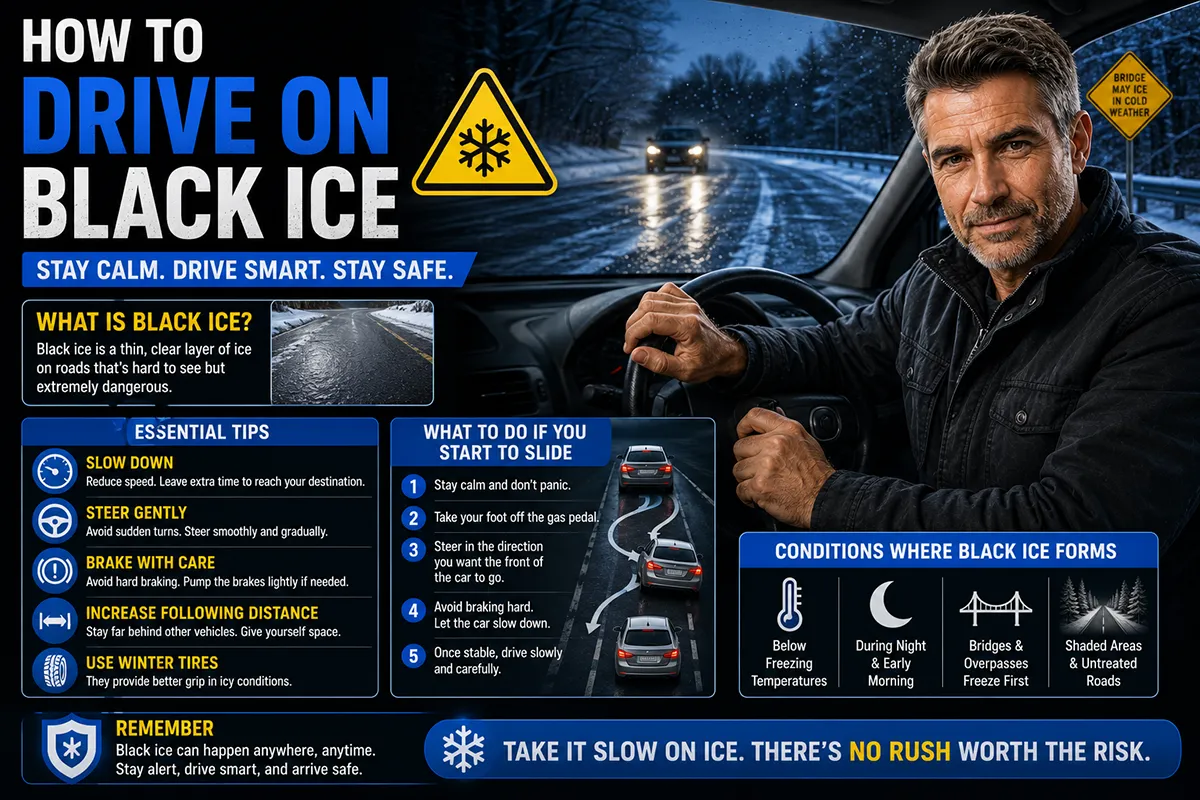
- Black ice is a nearly invisible thin layer of ice on the road that forms when temperatures hover around 32°F, especially on bridges, overpasses, and shaded areas.
- If you hit black ice, do NOT slam the brakes — ease off the gas, keep the steering wheel straight, and let your car coast through.
- Reduce your speed well below the posted limit in conditions where black ice is likely.
- Winter tires or all-weather tires with the 3PMSF (Three-Peak Mountain Snowflake) symbol dramatically improve your grip on icy surfaces.
- Proper tire tread depth (at least 5/32″) is critical — worn tires are exponentially more dangerous on ice.
- Increase your following distance to at least 8-10 seconds behind the vehicle in front of you.
Liked this article?
Add TireAdvise as a preferred source so you see more of our tire reviews and guides on Google.
What Exactly Is Black Ice?
Black ice is a thin, transparent layer of ice that forms on road surfaces, making it nearly impossible to see. It gets its name not because it’s actually black, but because it’s so clear that the dark pavement shows through, blending in perfectly with the road.
I’ve driven in winter conditions across multiple states — from Michigan to Pennsylvania to Colorado — and I can tell you that black ice is the single most dangerous road hazard I’ve encountered. It’s worse than snow, worse than slush, and worse than visible ice, because you simply don’t see it coming.
How Does Black Ice Form?
Black ice typically forms when the air temperature is at or just below 32°F (0°C), and there’s moisture on the road from rain, melting snow, fog, or even dew. The moisture freezes into a smooth, thin sheet that bonds directly to the pavement.
In my experience, the most dangerous time for black ice is during the late evening, overnight, and early morning hours when temperatures drop rapidly. I’ve also encountered it during the day on roads that are shaded by trees, buildings, or hillsides — places where the sun never gets a chance to warm the pavement.
Here are the conditions and locations where black ice is most likely to form:
- Bridges and overpasses — These freeze first because cold air circulates above and below the road surface.
- Shaded areas — Under trees, alongside buildings, and on north-facing slopes.
- Early morning hours — Even if daytime temperatures were above freezing, the overnight drop can create ice by dawn.
- Intersections — Vehicle exhaust and tire friction can melt snow, which refreezes into ice.
- Rural and less-traveled roads — These are often the last to be salted or plowed.
- Near bodies of water — Lakes, rivers, and streams add moisture to the air, increasing the risk.
How to Recognize Black Ice Before You Hit It
One of the hardest things about black ice is that it’s almost invisible. But after years of winter driving and testing tires in cold conditions, I’ve learned a few tricks to spot it — or at least anticipate where it’s hiding.
Visual Clues to Watch For
Look for sections of road that appear slightly darker, glossier, or wetter than the surrounding pavement. If the road ahead looks like it’s been freshly wet but there’s been no recent rain, that’s a red flag.
I also watch the spray coming off the tires of vehicles ahead of me. If the road looks wet but there’s no spray being kicked up, the moisture has likely frozen, and you’re looking at ice.
Use Your Dashboard
Most modern vehicles have an exterior temperature display. I make it a habit to glance at that number constantly during winter months. When it reads between 28°F and 36°F, I go into high-alert mode.
Many newer cars will even flash a snowflake or ice warning symbol on the dash when the temperature drops near freezing. Don’t ignore that warning — it’s there for a reason, and I’ve been grateful for it on more than one occasion.
Feel Your Steering
Sometimes, you’ll feel the difference before you see it. If your steering suddenly feels lighter or less responsive, or if you notice a subtle change in the road noise (it gets quieter), you may already be on ice.
In my experience, this “quiet” feeling is one of the most reliable indicators. Tires on dry or wet pavement produce a consistent hum. On ice, that sound drops dramatically because the tires have lost their grip.
What to Do When You Hit Black Ice
This is the most critical section of this entire article, and I want you to read it carefully. Your instincts when you hit black ice will be wrong — every single one of them. Your brain will scream at you to slam the brakes, jerk the wheel, or overcorrect. You need to override those instincts.
Step 1: Stay Calm and Lift Off the Gas
The moment you feel your tires lose traction, take your foot off the accelerator. Don’t stomp on the brakes. Don’t even touch the brakes if you can help it. Simply ease off the gas and let the car decelerate naturally.
I know this feels counterintuitive. Every fiber of your being wants to stop the car immediately. But braking on ice — especially hard braking — will lock up your wheels (or cause your ABS to pulse rapidly) and send you into an uncontrolled skid.
Step 2: Keep the Steering Wheel Straight
Resist the urge to turn. If you’re traveling in a straight line when you hit the ice, keep the wheel pointed straight ahead. The ice patch may only be a few car lengths long, and your tires will regain traction on the other side if you stay calm.
If you try to steer while you have zero traction, you’ll set up a situation where the tires suddenly grip when they reach dry pavement again, and that sudden grip with the wheels turned can whip you into a violent spin.
Step 3: If You Start to Skid, Steer Into It
If the rear of your car starts sliding to the right, gently turn your steering wheel to the right. If it slides left, steer left. This is what driving instructors mean when they say “steer into the skid.”
I’ve practiced this technique in empty parking lots (with permission!) after fresh ice events, and I can tell you that the key word is “gently.” You’re not making dramatic corrections — you’re making small, smooth adjustments.
Step 4: If You Have ABS, Apply Steady Brake Pressure
If you absolutely must brake and your car has anti-lock brakes (almost all cars manufactured after 2012 in the US do), press the brake pedal firmly and steadily. Don’t pump it. Let the ABS system do its job — you’ll feel the pedal pulsing under your foot, and that’s completely normal.
If your vehicle doesn’t have ABS, gently pump the brakes to prevent lockup. But honestly, if you can avoid braking altogether and simply coast through the icy section, that’s always the better option.
Step 5: Aim for Areas with More Traction
If you have some control and can make gentle steering adjustments, aim for areas of the road that are likely to have more grip. Textured pavement, patches of snow (snow actually offers more grip than ice), gravel shoulders, or salted/sanded sections are all better than glare ice.
During one particularly harrowing drive through western Pennsylvania, I deliberately steered toward a patch of accumulated snow on the shoulder to slow my car when I realized I was on a long stretch of ice heading toward a curve. It worked — the snow provided just enough friction to slow me down safely.
How to Drive Proactively to Avoid Black Ice Incidents
The best strategy for dealing with black ice is to never lose control in the first place. Here’s how I approach winter driving to minimize my risk.
Slow Down — Seriously
I can’t emphasize this enough. When conditions suggest black ice is possible, I routinely drive 10-15 mph below the posted speed limit. On particularly dangerous mornings, I’ve driven as slowly as 25-30 mph on highways where the limit is 55.
Speed is the number one factor that determines whether a black ice encounter is a minor scare or a catastrophic crash. At lower speeds, you have more time to react, your car is easier to control, and any impact will be less severe.
Increase Your Following Distance
Under normal dry conditions, the recommended following distance is about 3-4 seconds. On icy roads, I increase that to a minimum of 8-10 seconds.
I measure this by watching the car ahead pass a fixed object (like a sign or bridge pillar) and then counting the seconds until I reach the same point. If I can’t count to at least eight, I’m too close.
Avoid Cruise Control
Never use cruise control when there’s any possibility of ice. Cruise control can cause your wheels to spin if they hit an icy patch, because the system will try to maintain speed by applying more throttle — exactly the opposite of what you want.
I learned this the hard way during a drive through Indiana when my cruise control engaged the throttle on a frost-covered interstate ramp. The rear end started to slide before I could react and disengage the system. Lesson permanently learned.
Be Extra Cautious on Bridges and Overpasses
You’ve seen the signs: “BRIDGE FREEZES BEFORE ROAD.” Take them seriously. Bridges and overpasses lose heat from both the top and bottom surfaces, which means they can be icy even when the surrounding roads are perfectly dry.
I make it a habit to reduce my speed before I reach a bridge and avoid braking, accelerating, or changing lanes while I’m on it.
Use Your Headlights
Keeping your headlights on during winter driving helps you spot the subtle sheen of black ice. It also makes you more visible to other drivers who may be struggling with traction themselves.
Why Your Tires Are Your Most Important Safety Tool on Ice
Here’s where my expertise as a tire reviewer really comes into play. I’ve tested dozens of tires in winter conditions over the years, and I can tell you without hesitation: your tires are the single most important factor in whether you maintain control on ice.
No amount of driving skill will save you if your tires can’t grip. And conversely, a good set of winter or all-weather tires can make an average driver significantly safer in icy conditions.
Winter Tires vs. All-Season Tires on Ice
I’ve done back-to-back tests on icy roads with all-season tires and dedicated winter tires, and the difference is staggering. Winter tires offer dramatically shorter stopping distances, better cornering grip, and more predictable handling on ice and snow.
Here’s why: winter tires use a softer rubber compound that stays flexible in cold temperatures (below ~45°F). They also feature thousands of tiny slits in the tread blocks called “sipes” that create additional biting edges to grip ice and packed snow.
All-season tires, by contrast, use a harder compound that stiffens in the cold, reducing grip when you need it most.
Tire Comparison: Winter Conditions Performance
| Feature | Summer Tires | All-Season Tires | All-Weather Tires (3PMSF) | Dedicated Winter Tires |
|---|---|---|---|---|
| Ice Braking Performance | Very Poor | Poor to Fair | Good | Excellent |
| Snow Traction | Very Poor | Fair | Good | Excellent |
| Cold Weather Rubber Flexibility | Very Stiff | Moderate | Good | Excellent |
| Siping Density | Minimal | Low to Moderate | High | Very High |
| Year-Round Usability | Warm months only | Yes | Yes | Winter months only |
| 3PMSF Certified | No | Rarely | Yes | Yes |
| Best For | Southern/warm climates | Mild winters | Moderate winters, don’t want to swap | Severe winters, frequent ice/snow |
Tires I Recommend for Icy Conditions
Based on my testing over multiple winter seasons, here are the tires I trust most on icy roads:
- Bridgestone Blizzak WS90 — This is my top pick for dedicated winter tires. During my test period on roads with mixed ice and snow, the Blizzak provided grip that genuinely surprised me. The NanoPro-Tech multicell compound bites into ice at a microscopic level.
- Michelin X-Ice Snow — Another outstanding winter tire. I found it to be slightly quieter and longer-lasting than the Blizzak, with nearly identical ice performance. Great for daily commuters who rack up a lot of winter highway driving.
- Continental VikingContact 7 — This one has impressed me for several seasons. It delivers excellent ice braking and feels stable and confident in slushy conditions too.
- Toyo Observe GSi-6 — A more budget-friendly option that still performs well. I tested it over several days of mixed winter conditions and was pleased with its ice traction for the price point.
- Nokian Hakkapeliitta R5 — If you live in the upper Midwest or anywhere that regularly sees severe winter weather, this Finnish-designed tire is built for exactly your conditions. In my testing, it felt planted and secure on ice.
For drivers who don’t want the hassle of swapping tires seasonally, I recommend all-weather tires with the Three-Peak Mountain Snowflake (3PMSF) certification. The Michelin CrossClimate 2 and Nokian WR G4 are two excellent choices I’ve tested that provide year-round versatility with genuine winter capability.
Check Your Tread Depth — It Matters More Than You Think
Even the best winter tire becomes dangerous when it’s worn. For winter driving, I recommend a minimum tread depth of 5/32″ — more than the legal minimum of 2/32″ in most US states.
I use a simple tread depth gauge (you can buy one for about $5 at any auto parts store) to check my tires regularly during the winter season. The old “penny test” works in a pinch too — insert a penny into the tread groove with Lincoln’s head facing down. If you can see the top of his head, your tread is too shallow for safe winter driving.
After testing multiple tires over extended periods, I’ve seen firsthand how quickly ice performance drops off as tread wears down. A tire with 4/32″ of remaining tread might need double the stopping distance on ice compared to the same tire when new. It’s a scary difference.
Vehicle Features That Help on Black Ice
Modern vehicles come with several electronic safety features that can help you maintain control on ice. Understanding how these systems work — and what they can’t do — is important.
ABS (Anti-Lock Braking System)
ABS prevents your wheels from locking up during hard braking. On ice, this means you can steer while braking, which is crucial for avoiding obstacles. Remember: press and hold the brake pedal firmly, don’t pump it.
ESC (Electronic Stability Control)
ESC detects when your car starts to slide and automatically applies brakes to individual wheels to help you maintain control. Required on all US vehicles since 2012, ESC is a literal lifesaver on ice.
In my experience, ESC has intervened on my behalf several times during icy drives, and I felt the system correct subtle slides before they became full skids. It’s impressive technology, but it’s not magic — it can’t overcome the laws of physics if you’re going too fast.
Traction Control
Traction control prevents wheel spin during acceleration. On ice, this helps you get moving from a stop without your drive wheels spinning uselessly. It’s especially helpful on front-wheel-drive vehicles.
AWD and 4WD
All-wheel drive and four-wheel drive help with acceleration on slippery surfaces, but here’s the critical thing: they do NOT help you stop or turn on ice. I’ve seen plenty of SUV and truck drivers overestimate their AWD system’s capabilities and end up in a ditch.
AWD plus winter tires is an excellent combination. AWD plus worn all-season tires is a recipe for overconfidence and disaster.
Common Myths About Driving on Black Ice
Over the years, I’ve heard plenty of bad advice about ice driving. Let me set the record straight on a few myths.
Myth: “AWD Makes You Invincible in Winter”
As I just mentioned, AWD helps you accelerate. It does nothing for braking or cornering grip. Your tires are what determine whether you stop or slide. I’ve tested identical vehicles — one with AWD and all-season tires, another with front-wheel drive and winter tires — and the FWD car with winter tires stopped shorter and cornered better on ice every single time.
Myth: “Pumping the Brakes Is Always the Right Move”
This was true decades ago, before ABS was standard. If your vehicle has ABS (check your owner’s manual, but it almost certainly does), pumping the brakes actually interferes with the system’s ability to optimize braking. Press firmly and hold.
Myth: “If the Road Looks Wet, It’s Fine”
This is exactly how black ice fools people. A road that looks wet in freezing temperatures isn’t wet — it’s icy. Always check the temperature and trust the conditions, not your eyes.
Myth: “Deflating Your Tires Gives You More Grip on Ice”
I’ve heard this one more times than I can count, and it’s flat-out wrong. Under-inflated tires reduce your control and can cause uneven wear, overheating, and even blowouts. Always keep your tires inflated to the vehicle manufacturer’s recommended pressure, which you’ll find on the placard inside your driver’s door jamb.
What to Keep in Your Car During Winter
Being prepared for a black ice incident means having the right supplies in your vehicle. Here’s my personal winter car kit:
- Blankets or sleeping bag — If you slide off the road and are waiting for help, staying warm is critical.
- Phone charger / portable battery pack — Your phone is your lifeline.
- Flashlight with extra batteries
- Ice scraper and snow brush
- Small bag of kitty litter or sand — Spreading it under your tires can help you gain traction if you’re stuck on ice.
- Jumper cables or a portable jump starter — Cold weather kills batteries.
- First aid kit
- Non-perishable snacks and water
- Reflective triangles or flares — Visibility on an icy road is crucial if you’re stopped.
When to Just Stay Home
I want to end with something that might sound surprising coming from a guy who loves testing tires in challenging conditions: sometimes the safest driving decision is not to drive at all.
If your local weather service has issued a winter storm warning, if freezing rain is falling, or if the roads are reported to be sheets of ice, strongly consider staying home. No meeting, no errand, and no appointment is worth your life.
During the worst ice events I’ve seen, even professional drivers with the best winter tires struggled. Black ice isn’t something you “beat” — it’s something you respect and navigate as carefully as possible.
Final Thoughts from the Driver’s Seat
Black ice is one of the most humbling forces you’ll ever encounter on the road. It doesn’t care how experienced you are, what kind of vehicle you drive, or how good your reflexes are. What it does respond to is preparation, caution, and the right rubber between your car and the pavement.
If you take away just three things from this article, let them be these: slow down when temperatures are near freezing, invest in quality winter or all-weather tires with the 3PMSF rating, and if you hit ice, resist every urge to slam the brakes or jerk the wheel.
I’ve been reviewing and testing tires for years, and I genuinely believe that tire choice is the most important safety decision you can make as a driver — especially in winter. A $600-$800 investment in a good set of winter tires can be the difference between arriving safely at your destination and ending up in a hospital or a junkyard.
Stay safe out there, keep your tread deep, and drive like the road might be ice — because sometimes, it is.
Frequently Asked Questions
What should you do if you hit black ice while driving?
Generating…
What tires are best for driving on black ice in the US?
Winter tires with a soft rubber compound and siping patterns, like the Bridgestone Blizzak WS90 or Michelin X-Ice Snow, offer the best grip on black ice compared to all-season tires. These tires typically range from $120 to $220 per tire depending on your vehicle size and are widely available at US retailers like Tire Rack, Discount Tire, and Costco. I always recommend a full set of four winter tires rather than just two, since mismatched traction between axles can make handling on icy roads even more dangerous.
Can all-season tires handle black ice safely?
All-season tires provide significantly less grip on black ice than dedicated winter tires because their rubber compound hardens in freezing temperatures and their tread design isn’t optimized for ice. If you live in a region with occasional icy conditions, a quality all-weather tire like the Toyo Celsius II can be a reasonable year-round compromise, though it still won’t match true winter tire performance. For drivers in northern US states who regularly encounter black ice, investing in a separate set of winter tires is the safest and most cost-effective choice long-term.
Where does black ice form most often on US roads?
Black ice forms most frequently on bridges, overpasses, shaded road sections, and areas near bodies of water because these surfaces lose heat faster than regular pavement. In the US, it’s especially common during early morning hours from November through March in the Midwest, Northeast, and Pacific Northwest. I’ve found that highway on-ramps and off-ramps are also high-risk spots because they’re often elevated and exposed to wind, so slowing down before these transitions is critical during freezing conditions.
How do you know if there is black ice on the road?
Black ice is nearly invisible because it forms as a thin, transparent layer that takes on the color of the pavement beneath it. Look for sections of road that appear slightly glossier or darker than the surrounding surface, especially when temperatures are near or below 32°F. Your car’s outside temperature gauge is one of the best early warning tools — if it reads between 26°F and 36°F and the road looks wet but you don’t see active rain, there’s a strong chance black ice is present.
Does tire pressure affect traction on black ice?
Yes, maintaining proper tire pressure is critical for maximizing your contact patch with icy road surfaces. Under-inflated tires can cause uneven tread contact and reduce your already limited grip, while over-inflated tires shrink the contact patch and make sliding more likely. I check my tire pressure at least twice a month during winter because cold air causes pressure to drop roughly 1 PSI for every 10°F decrease in temperature. Always inflate to the manufacturer’s recommended PSI listed on your driver’s side door jamb, not the maximum printed on the tire sidewall.
Is it worth buying winter tires just for black ice if I only deal with it a few times a year?
Even if you only encounter black ice a handful of times per season, winter tires can be a worthwhile investment because they also perform significantly better in all cold-weather conditions below 45°F, including cold rain and light snow. A set of four budget-friendly winter tires like the General Altimax Arctic 12 starts around $400-$500 for most sedans and can last three to four winters if stored properly during warmer months. I recommend mounting them on a separate set of steel wheels ($50-$80 each) so you can swap them yourself and save on seasonal mounting costs, which adds up to real savings while dramatically improving your safety.
