

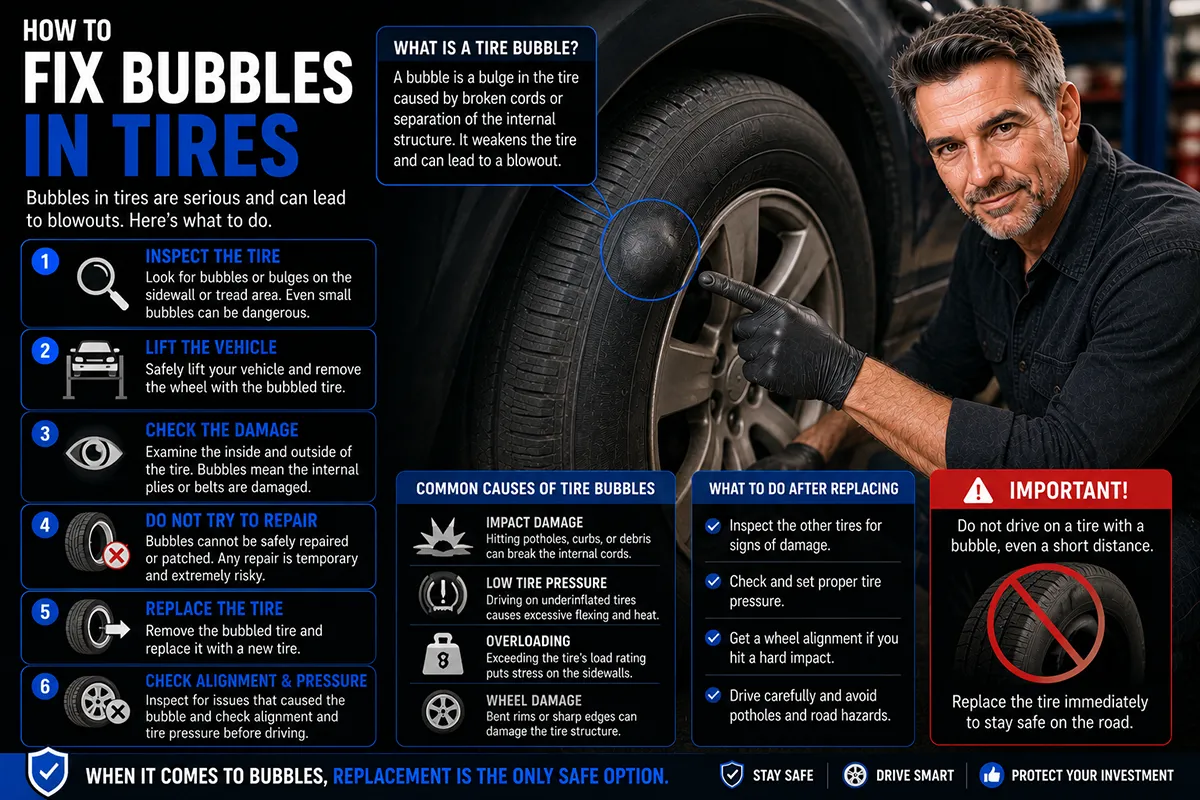
I was doing a routine walk-around on my daily driver a few years back when I noticed something that made my stomach drop — a golf-ball-sized bulge pushing out from the sidewall of my front passenger tire.
It looked almost alive, like the tire was swelling from the inside. And honestly, it terrified me because I’d been driving on that tire at highway speeds for days without realizing it was there.
If you’ve spotted a bubble on your tire and you’re frantically Googling whether you can fix it, I need to be upfront with you before we go any further: **you almost certainly cannot safely repair a tire bubble.** But don’t close this tab yet — I’m going to walk you through everything I’ve learned about why bubbles form, what your options really are, how to stay safe in the short term, and how to pick the right replacement tire without overspending.
- Tire bubbles (sidewall bulges) are caused by internal structural damage — the inner liner separates from the carcass plies.
- There is no safe, permanent fix for a tire bubble. The tire must be replaced.
- Driving on a bubbled tire is extremely dangerous — it can blow out without warning at any speed.
- If you spot a bubble, reduce speed immediately, avoid highways, and get to a tire shop as soon as possible.
- Prevention is your best tool: avoid potholes, maintain proper inflation, and inspect your tires regularly.
- Budget-friendly replacement tires from brands like General, Cooper, and Falken start around $80–$120 per tire for most passenger vehicles.
Liked this article?
Add TireAdvise as a preferred source so you see more of our tire reviews and guides on Google.
What Exactly Is a Tire Bubble?
A tire bubble — sometimes called a sidewall bulge or tire blister — is a raised, balloon-like protrusion that appears on the surface of a tire, almost always on the sidewall. It can be as small as a marble or as large as a fist.
What you’re actually seeing is air that has escaped from the tire’s interior chamber and become trapped between the inner liner and the outer rubber layers. The structural cords that give the tire its shape have broken or separated in that spot, and there’s nothing holding the rubber in place anymore except the thin outer layer.
I’ve personally encountered tire bubbles on three separate occasions — twice on my own vehicles and once on a friend’s car I happened to be inspecting. In every case, the tire had to be replaced. There was no shortcut, no patch, and no magic fix.
Why Tire Bubbles Can’t Be Fixed (The Honest Truth)
I know this isn’t what you want to hear, especially if you’re on a tight budget. But I’d rather be honest with you than give you dangerous advice.
Here’s why a tire bubble is unrepairable:
The Damage Is Structural, Not Surface-Level
A nail puncture in the tread can often be patched because the tread area is thick, reinforced, and designed to handle repairs. A sidewall bubble is completely different. The internal belts and polyester or nylon cords that form the tire’s skeleton have been compromised.
Think of it like a broken bone inside a cast. You can put plaster on the outside, but the structural integrity is gone. No amount of rubber cement, plug kits, or sealant can re-bond those internal cords once they’ve separated.
The Sidewall Is the Weakest Part of the Tire
The sidewall is intentionally thinner and more flexible than the tread area. It’s designed to flex as you drive, absorb bumps, and support the vehicle’s weight. But that flexibility also means it has less material to work with when something goes wrong.
I’ve spoken with tire technicians at Discount Tire and Tire Rack over the years, and every single one has told me the same thing: **they will not attempt to repair a sidewall bulge, period.** It’s an industry-wide safety standard, not a sales tactic to get you to buy a new tire.
The Bubble Will Only Get Worse
Once the internal structure has failed, the bubble will expand over time. Every rotation of the tire, every bump in the road, and every degree of temperature change puts more stress on that weakened area. I’ve seen bubbles that were barely noticeable one day become alarmingly large after just a few more days of driving.
What Causes Tire Bubbles in the First Place?
Understanding what causes bubbles can help you prevent them in the future. In my experience, the causes fall into a handful of common categories.
1. Pothole Impact
This is the number one cause I’ve seen, and it’s the reason my own tire developed a bubble. Hitting a deep pothole at speed compresses the tire violently between the rim and the road surface. That impact can sever the internal cords instantly, even if you don’t notice damage right away.
US roads are notoriously rough — the American Society of Civil Engineers gave our roads a “D” grade in their most recent infrastructure report card. If you live in states like Michigan, Pennsylvania, Illinois, or anywhere in the Northeast, potholes are practically a season unto themselves.
2. Hitting a Curb
Parallel parking gone wrong? We’ve all been there. But even a moderate curb strike can pinch the sidewall hard enough to damage the internal structure. I once helped a friend figure out why her tire had a bubble, and she remembered bumping a curb in a parking garage the previous week. That was all it took.
3. Speed Bumps Taken Too Fast
Speed bumps are designed to slow you down, and they will punish you if you don’t. Hitting a speed bump at full speed creates a similar compression effect as a pothole. The faster you go, the more violent the impact on your sidewall.
4. Underinflation
Running your tires underinflated is one of the most common — and most preventable — causes of sidewall damage. When a tire is low on air, the sidewall flexes excessively with every rotation. This generates heat, weakens the internal bonds, and can eventually cause the plies to separate.
I check my tire pressure every two weeks using a simple digital gauge I bought for $8 at AutoZone. It takes less than five minutes, and it’s one of the best habits I’ve developed as a car owner.
5. Overloading the Vehicle
Every tire has a load rating stamped on its sidewall. Exceeding that rating — by packing your car too heavy for a road trip, for example — puts enormous stress on the sidewall. I’ve seen this happen more than once with SUV owners who load up for camping trips without checking their tire specs.
6. Manufacturing Defects
It’s rare, but it happens. Sometimes a tire leaves the factory with a weak spot in the internal construction. If you notice a bubble on a brand-new tire or one that’s only been on your vehicle for a few days, it may be a defect covered under the manufacturer’s warranty.
How Dangerous Is Driving on a Tire with a Bubble?
Let me be blunt: **driving on a tire with a bubble is one of the most dangerous things you can do in a car.**
The bubble represents a point of catastrophic failure waiting to happen. That thin layer of rubber is the only thing between you and a blowout. And unlike a slow leak, a blowout from a sidewall bubble is sudden, violent, and nearly impossible to anticipate.
What Happens During a Blowout
When a bubbled tire finally fails, it doesn’t gently deflate. It explodes. I’ve seen the aftermath of sidewall blowouts on the highway — shredded rubber everywhere, damaged wheel wells, and in some cases, total loss of vehicle control.
At highway speeds (65–75 mph on most US interstates), a front-tire blowout can cause the vehicle to pull sharply to one side. A rear-tire blowout can cause the back end to fishtail. Either scenario is extremely dangerous in traffic.
The Risk Increases with Speed and Heat
Summer driving in the US — particularly in the South and Southwest — makes bubbled tires even more dangerous. Hot pavement heats up the air inside the tire, increasing pressure and stress on the already-weakened sidewall. I’ve heard from technicians in Texas and Arizona that they see a spike in blowout-related incidents every summer.
What to Do When You Find a Bubble on Your Tire
Here’s the step-by-step process I follow whenever I discover a tire bubble, based on real experience:
Step 1: Don’t Panic, but Don’t Ignore It
The bubble isn’t going to explode the instant you look at it. You have some time — but not much. Do not plan a road trip, do not hop on the highway, and do not assume it’ll be fine for another few weeks.
Step 2: Check Your Spare Tire
If you have a full-size spare or a compact spare (donut) in your trunk, now is the time to use it. Swap the bubbled tire out in your driveway or a safe location. If you’re not comfortable changing a tire yourself, call roadside assistance — most insurance policies and AAA memberships include this service.
In my experience, using the spare right away gives you the most peace of mind and the most time to shop for a proper replacement without feeling rushed.
Step 3: If You Must Drive on It, Stay Under 30 MPH
If you absolutely cannot swap the tire — maybe your spare is flat or you don’t have one — drive directly to the nearest tire shop at low speed. Avoid highways entirely. Stay on surface streets, keep it under 30 mph, and put your hazard lights on if needed. This is a “get me to the shop and nowhere else” situation.
Step 4: Get to a Tire Shop ASAP
Take the tire to a reputable shop and have them inspect it. They’ll confirm the bubble and recommend replacement. If you’re lucky, your other three tires are still in good shape and you’ll only need to replace one.
Step 5: Check for Wheel Damage
Whatever caused the bubble — a pothole, curb strike, etc. — may have also damaged the wheel itself. Ask the technician to inspect the rim for bends, cracks, or deformation. A bent rim can cause vibration, uneven wear, and even new tire damage down the road.
I had a bent rim once that I didn’t catch during a tire replacement. It caused my new tire to wear unevenly, and I ended up needing to replace it far sooner than expected. Don’t make my mistake — get the wheel checked.
Can Any Type of Tire Bubble Be Repaired?
I want to address this directly because I’ve seen some questionable advice floating around online.
Sidewall Bubbles: Absolutely Not
As I’ve explained, sidewall bubbles are structural failures. No legitimate tire shop will repair them, and no DIY method is safe. If someone online tells you to use tire sealant, super glue, or a patch kit on a sidewall bubble, please ignore that advice. It could cost you your life.
Tread Bulges: Still No
Occasionally, a bulge will appear on the tread surface rather than the sidewall. This is rarer but equally dangerous — it means the belt package under the tread has separated. Same verdict: replace the tire.
Small Bumps on New Tires: Maybe Not a Bubble
Here’s an important distinction. Some new tires have small, uniform bumps or ridges on the sidewall that look concerning but are actually normal. These are often splice points from the manufacturing process or markings from the tire mold.
If you just bought new tires and notice small, consistent bumps, ask the installer to inspect them. In most cases, these are cosmetic and not structural. A true bubble will be asymmetrical, squishy to the touch, and clearly different from the surrounding rubber.
How to Replace a Bubbled Tire Without Breaking the Bank
Now for the practical part — what to actually buy. I’ve tested and reviewed dozens of tire brands over the years, and I can tell you that you don’t need to spend a fortune to get a safe, reliable replacement.
Replacing One Tire vs. Two or Four
If only one tire has a bubble and the other three are in good condition with plenty of tread left, you can usually get away with replacing just the one. However, there are some rules of thumb I follow:
- Same axle rule: The two tires on the same axle (front pair or rear pair) should match in brand, model, and tread depth as closely as possible. If the opposite tire on the same axle is significantly worn, replace both.
- AWD vehicles: If you drive an all-wheel-drive vehicle, mismatched tread depths can damage the drivetrain. Many AWD manufacturers recommend replacing all four tires at once, or at minimum having the new tire shaved down to match the existing tread depth.
- Budget consideration: If you’re replacing one tire, try to find the exact same brand and model. If that’s discontinued, ask the tire shop for the closest equivalent.
Budget-Friendly Replacement Tires I Recommend
Here are some tires I’ve personally tested or have extensive knowledge of that offer excellent value in the US market:
| Tire | Type | Approx. Price (per tire) | Best For | My Take |
|---|---|---|---|---|
| General AltiMAX RT45 | All-Season | $85–$130 | Sedans, daily commuters | Excellent ride comfort and long tread life at a great price point |
| Cooper CS5 Ultra Touring | All-Season | $100–$150 | SUVs, highway driving | Quiet, stable, and handles wet roads confidently |
| Falken Sincera SN201 A/S | All-Season | $80–$115 | Compact cars, budget shoppers | One of the best values I’ve tested — surprisingly good grip for the price |
| Hankook Kinergy PT H737 | All-Season | $90–$140 | Mixed driving conditions | Strong all-around performer with a generous treadwear warranty |
| Michelin Defender 2 | All-Season | $140–$200 | Those wanting premium quality | My top pick if your budget allows — exceptional longevity and ride quality |
I typically purchase my tires through Tire Rack or Discount Tire, both of which offer competitive pricing, free shipping (Tire Rack to an installer), and solid return policies. Costco is another great option if you have a membership — their tire center pricing includes installation, balancing, lifetime rotation, and flat repair.
How to Prevent Tire Bubbles in the Future
Prevention is always cheaper and safer than replacement. Here’s what I do — and what I recommend to every driver I talk to.
1. Check Your Tire Pressure Regularly
I can’t stress this enough. Underinflated tires are dramatically more susceptible to sidewall damage. I check mine every two weeks and always before long trips. The correct pressure for your vehicle is printed on a sticker inside the driver’s door jamb — use that number, not the maximum pressure printed on the tire itself.
A decent digital tire pressure gauge costs between $5 and $15 and is one of the most important tools you can keep in your glovebox.
2. Avoid Potholes and Road Hazards
I know this sounds obvious, but it’s worth saying: slow down and pay attention to the road surface. Many pothole strikes happen because the driver was distracted or following too closely to see the hazard in time.
When I’m driving on roads I know are rough — especially during late winter and early spring when potholes are at their worst — I increase my following distance and reduce speed. It’s a simple habit that has saved me from countless impacts.
3. Slow Down for Speed Bumps and Railroad Crossings
Take speed bumps at 5 mph or less. Same for railroad crossings and those steep parking lot entrances that scrape low-clearance vehicles. Your tires will thank you.
4. Don’t Overload Your Vehicle
Check your vehicle’s maximum payload capacity (usually found in the owner’s manual or on the same door jamb sticker as the tire pressure) and respect it. If you’re loading up for a move or a camping trip, weigh the load or at least be conservative.
5. Inspect Your Tires Visually Every Week or Two
This takes about two minutes. Walk around your car and look at each tire. Check for bulges, cracks, cuts, nails, uneven wear, or anything that looks abnormal. I do this every time I wash my car, which is roughly every couple of weeks.
Catching a bubble early — before it grows or fails — could be the difference between a controlled tire replacement and a highway blowout.
6. Replace Aging Tires
Even if a tire has plenty of tread left, the rubber compound degrades over time. Most tire manufacturers and safety organizations recommend replacing tires that are six to ten years old, regardless of tread depth. The manufacture date is stamped on the sidewall as a four-digit DOT code — for example, “2321” means the tire was made in the 23rd week of 2021.
I’ve seen old tires with full tread develop bubbles and cracks simply because the rubber had hardened and lost its flexibility. Age matters.
Will Insurance or a Warranty Cover a Bubbled Tire?
This depends on the cause and your coverage.
Tire Manufacturer Warranty
Most major tire brands offer a workmanship and materials warranty that covers defects for a certain period or number of years. If your tire develops a bubble due to a manufacturing defect — not road hazard damage — the manufacturer may replace it at no cost or at a prorated price.
I’ve successfully filed a warranty claim once with Continental for a tire that developed a bubble within the first few weeks of use with no impact damage. They replaced it at no charge through the dealer. Keep your receipt and register your tires with the manufacturer to protect this option.
Road Hazard Protection
Many tire retailers — including Discount Tire, Tire Rack, and Costco — offer road hazard protection plans. These typically cover damage from potholes, nails, glass, and other road debris. Prices range from $15 to $30 per tire, and in my experience, they’re absolutely worth it.
I’ve used Discount Tire’s road hazard warranty twice and been reimbursed both times. If you buy a road hazard plan and then hit a pothole that causes a bubble, you’ll likely get a free or heavily discounted replacement.
Auto Insurance
Standard auto insurance policies generally do not cover tire damage from potholes or normal road hazards. However, if the pothole was on a government-maintained road, you may be able to file a claim with the responsible city or county. Success rates vary, and the process can be slow, but it’s worth looking into if the damage is significant.
What About Tire Sealants and Emergency Inflators?
Products like Fix-a-Flat, Slime, and other tire sealants are designed for tread punctures — small holes where air is leaking from the tread area. They are absolutely not designed for sidewall bubbles, and using them on a bubbled tire will not fix the problem.
I want to be crystal clear on this because I’ve seen people try it. Spraying sealant into a tire with a sidewall bubble does nothing to repair the broken internal cords. The bubble will remain, the structural weakness will remain, and you’ll have a false sense of security that could end very badly.
Save those sealant cans for what they’re designed for — getting you to the nearest tire shop after a small tread puncture. That’s it.
Real Scenarios I’ve Encountered
Let me share a few real-world situations to drive these points home.
Scenario 1: The Parking Lot Curb
A friend called me after noticing a small bubble on the sidewall of her rear tire. She hadn’t hit any potholes recently, but she admitted to scraping a curb while parking a few days earlier. The bubble was small — maybe the size of a quarter — but it was clearly there. I told her to swap the spare on immediately.
She replaced the tire at Discount Tire for about $110, including mounting and balancing. The technician also inspected the wheel and found it was fine. Total cost: about an hour of time and $110. The alternative — a blowout on her commute — would have been infinitely worse.
Scenario 2: The Interstate Pothole
During a drive through Pennsylvania a couple of years ago, I hit a pothole on I-76 that I simply couldn’t avoid — it was hidden behind a curve and I was boxed in by traffic. I felt the impact immediately and pulled over at the next exit. Sure enough, a large bubble was already forming on the front passenger sidewall.
I put the spare on in a gas station parking lot and drove to a nearby Walmart Auto Center, where I bought a replacement tire for about $95. It wasn’t the same brand as the other three, but it was the same size and speed rating, and it got me home safely. I replaced the mismatched pair at my next opportunity.
Scenario 3: The Warranty Win
I once installed a set of tires that came highly recommended, and within the first couple of weeks, I noticed a small bulge forming on one of the rears. There had been no impact event — no potholes, no curbs, nothing unusual. I took it back to the tire shop, and they agreed it was likely a manufacturing defect.
They filed a warranty claim with the manufacturer, and I received a brand-new replacement tire at zero cost. The lesson: always keep your documentation, and don’t hesitate to pursue a warranty claim if the damage seems defect-related.
Key Takeaways: Your Action Plan
If you’ve found a bubble on your tire, here’s exactly what I want you to do:
- Stop driving on it as much as possible. Swap to your spare tire immediately if you can.
- Get to a tire shop within the next day or two. Don’t wait a week, and definitely don’t wait a month.
- Have the wheel inspected for bends or cracks while you’re there.
- Replace the tire with a quality all-season option that matches your existing tires as closely as possible.
- Buy road hazard protection on the new tire — it typically costs less than $25 and can save you the full replacement cost next time.
- Start a prevention routine: check your tire pressure every two weeks, visually inspect your tires regularly, and slow down for road hazards.
I know discovering a tire bubble is stressful, especially when money is tight. But this is one of those situations where cutting corners isn’t an option. A $100 tire replacement is a small price to pay compared to the potential consequences of a high-speed blowout.
Stay safe out there, keep your tires properly inflated, and keep your eyes on the road — both for traffic and for potholes.
Frequently Asked Questions
Can you fix a bubble in a tire or does it need to be replaced?
Unfortunately, a bubble in a tire sidewall cannot be safely repaired and the tire must be replaced immediately. Tire bubbles indicate internal structural damage where the inner liner has separated from the outer casing, and no patch or plug can restore that integrity. Driving on a tire with a bubble puts you at serious risk of a blowout, especially at highway speeds common on US interstates. I always recommend pulling over and switching to your spare as soon as you notice a sidewall bulge.
What causes bubbles to form on tire sidewalls?
Tire bubbles are most commonly caused by impact damage from hitting potholes, curbs, speed bumps, or road debris at speed — a frequent problem on poorly maintained US roads, especially after winter. The impact breaks the internal structural cords that hold the tire’s shape, allowing air to push through to the outer rubber and form a visible bulge. Manufacturing defects can also cause bubbles, though this is less common with reputable brands like Goodyear, Michelin, or Cooper. Low tire pressure makes sidewalls more vulnerable to impact damage, so maintaining proper PSI is critical.
How much does it cost to replace a tire with a bubble?
Replacing a single tire with a sidewall bubble typically costs between $100 and $250 for most passenger cars and sedans in the US, depending on the tire brand and size. SUV and truck tires can run $150 to $350 or more per tire. Many tire shops like Discount Tire, Tire Rack, or Costco offer competitive pricing and may include free mounting and balancing. If the bubble was caused by a manufacturing defect and the tire is still under warranty, you may be able to get a prorated replacement at reduced cost.
Is it safe to drive on a tire with a small bubble?
No, it is never safe to drive on a tire with a bubble, regardless of how small it appears. Even a small bulge means the tire’s internal structure is compromised and could fail without warning, leading to a dangerous blowout at any speed. The risk increases significantly on highways where most US drivers regularly travel at 60-75 mph. I recommend driving slowly to the nearest tire shop or using your spare tire to get there safely.
Can hitting a pothole cause a bubble in your tire?
Yes, hitting a pothole is one of the most common causes of tire bubbles in the US, especially in states with harsh winters like Michigan, Pennsylvania, and New York where road conditions deteriorate significantly. The sudden impact compresses the tire against the wheel rim, which can sever the internal reinforcement cords and cause air to leak into the sidewall layers. Driving at lower speeds through rough road sections and maintaining the recommended tire pressure can help reduce your risk of pothole-related tire damage.
Will tire warranty cover a bubble in the sidewall?
Most major tire manufacturers like Michelin, Bridgestone, and Goodyear offer limited warranties that cover defects in materials and workmanship, which can include bubbles caused by manufacturing flaws. However, bubbles caused by road hazard damage like potholes or curb strikes are typically not covered under standard warranties unless you purchased a separate road hazard protection plan. Many US retailers like Discount Tire and America’s Tire offer affordable road hazard warranties at the time of purchase, usually $15-$30 per tire, which I strongly recommend for drivers in areas with rough roads.
How can I prevent tire bubbles from forming in the first place?
The best way to prevent tire bubbles is to maintain proper tire pressure by checking your PSI at least once a month and before long road trips, since underinflated tires are far more susceptible to impact damage. Avoid potholes, sharp curbs, and road debris whenever you can safely do so, and slow down on rough or poorly maintained roads. Investing in quality tires from trusted US-market brands with strong sidewall construction — such as Michelin Defender or Continental TrueContact — also provides better resistance to impact damage. Regularly inspecting your tires for early signs of sidewall damage can help you catch problems before they become dangerous.
