

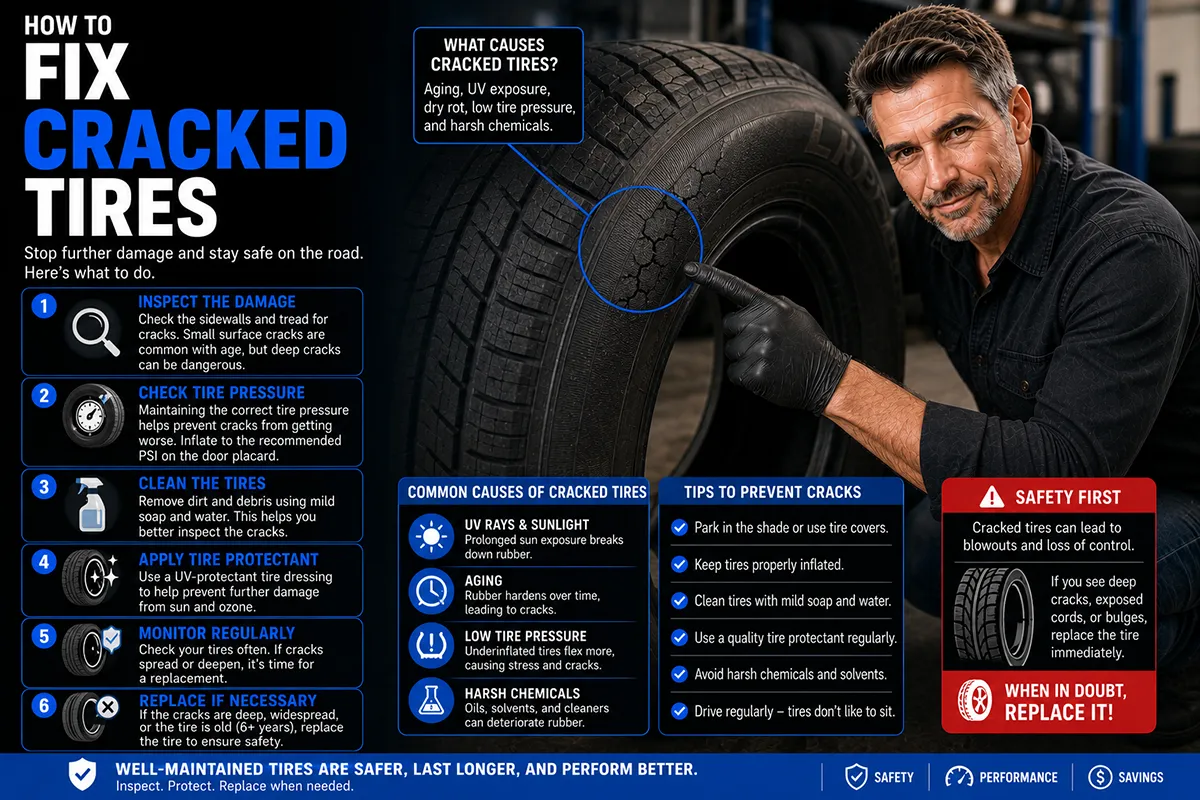
I was doing my usual weekend walk-around inspection on my SUV when I noticed something that made my stomach drop — a web of tiny cracks spreading across the sidewall of my rear tire.
The tire still had plenty of tread left, and I’d only had the set for a couple of years. My first thought was, “Can I fix this, or am I about to drop $600 on new tires?”
If you’ve ever spotted cracks on your tires and felt that same mix of confusion and dread, you’re not alone. I’ve spent years reviewing tires, inspecting sidewalls, and talking to tire technicians across the country, and tire cracking is one of the most common — and most misunderstood — issues drivers face.
- Small surface cracks (dry rot) can sometimes be managed with tire protectant and proper maintenance, but they cannot truly be “repaired” like a puncture can.
- Deep cracks on the sidewall or between tread blocks are a safety hazard and mean it’s time to replace the tire.
- UV exposure, underinflation, age, and harsh chemicals are the top causes of tire cracking in the US.
- Most tires should be replaced after 6 years regardless of tread depth — cracking accelerates this timeline.
- Prevention is your best tool: park in shade, maintain proper PSI, and use a quality UV protectant.
Liked this article?
Add TireAdvise as a preferred source so you see more of our tire reviews and guides on Google.
What Are Cracked Tires, Exactly?
Before I walk you through fixes, let’s make sure we’re talking about the same thing. Tire cracking — often called “dry rot,” “weather cracking,” or “ozone cracking” — refers to small fissures that form on the rubber surface of your tires.
These cracks can appear on the sidewall, in the grooves between tread blocks, or even on the tire’s shoulder area. They range from barely visible hairline fractures to deep, pronounced splits that expose the internal structure of the tire.
In my experience inspecting dozens of cracked tires over the years, I’ve learned that not all cracks are created equal. Some are purely cosmetic and surface-level. Others are ticking time bombs that could lead to a blowout on the highway.
The key is knowing which is which — and I’m going to help you figure that out right now.
What Causes Tires to Crack?
Understanding why your tires cracked in the first place is essential, because the cause directly impacts whether you can manage the issue or need to replace the tire immediately. Here are the main culprits I’ve encountered again and again.
1. UV Exposure and Sun Damage
This is the number one cause of tire cracking I see, especially in Sun Belt states like Arizona, Texas, Florida, and California. Ultraviolet radiation breaks down the chemical bonds in rubber over time.
Tire manufacturers add anti-ozonants and UV inhibitors to the rubber compound, but these protectants gradually migrate to the surface and deplete — especially when the tire sits in direct sunlight for extended periods. If you park your car outside every day without shade, you’re dramatically accelerating this process.
2. Ozone Exposure
Ozone is a naturally occurring gas that’s particularly aggressive toward rubber. It attacks the polymer chains in the tire compound, causing surface-level cracking that often appears as a fine web of lines.
This is more common in urban areas with higher pollution levels. I’ve noticed that tires on vehicles parked near industrial areas or in cities with heavy traffic tend to show ozone cracking sooner than those in rural settings.
3. Underinflation
Running your tires below the recommended PSI is one of the fastest ways to develop sidewall cracks. When a tire is underinflated, the sidewall flexes more than it’s designed to, generating excess heat and stress.
Over time, this repeated over-flexing breaks down the rubber from the inside out. I’ve personally seen tires develop visible cracking after just a few months of being consistently underinflated by 10-15 PSI.
4. Age
Even if your tires have been sitting in a climate-controlled garage and have never touched a road, the rubber compound degrades over time. The oils and chemicals that keep rubber flexible slowly evaporate.
The tire industry and the National Highway Traffic Safety Administration (NHTSA) generally recommend replacing tires that are 6-10 years old, regardless of tread depth. In my experience, I start seeing noticeable cracking on most tires somewhere around the 4-5 year mark, especially in hotter climates.
5. Harsh Chemicals and Improper Cleaning Products
This one surprises a lot of people. That tire shine spray you’ve been using every weekend at the car wash? If it’s petroleum-based or contains harsh solvents, it could actually be stripping away the tire’s built-in UV protectants.
I learned this the hard way years ago when I was religiously applying a cheap tire dressing from an auto parts store. My tires looked great for a few weeks, then developed surface cracks faster than any set I’d owned before. Now I only use water-based, non-petroleum tire protectants.
6. Low Mileage and Infrequent Use
This seems counterintuitive, but tires that don’t get driven regularly actually crack faster. When a tire rolls, it flexes the rubber and helps distribute the anti-ozonant chemicals evenly across the surface.
If your car sits for weeks or months at a time — like a seasonal vehicle, RV, or trailer — the tires are especially vulnerable to cracking. I see this constantly on boat trailers and classic cars that only come out a few times a year.
How to Assess the Severity of Your Tire Cracks
Before you do anything, you need to determine how bad the cracking actually is. I use a simple three-level system that I’ve developed over years of tire inspections.
| Severity Level | What It Looks Like | Location | Action Needed |
|---|---|---|---|
| Level 1 — Surface/Cosmetic | Faint hairline cracks, barely visible unless you look closely | Sidewall surface, between tread blocks | Monitor closely, apply protectant, maintain proper inflation |
| Level 2 — Moderate | Clearly visible cracks, some connecting into a web pattern, slight depth | Sidewall, shoulder, tread grooves | Start shopping for replacements, reduce highway speeds, avoid long trips |
| Level 3 — Severe | Deep cracks that expose underlying cords or layers, chunks of rubber separating, bulging | Anywhere on the tire | Replace immediately — do not drive on these tires |
I want to be completely honest with you here: **there is no true “fix” for cracked tires in the way you can patch a puncture.** Once the rubber compound has begun to degrade, you cannot reverse the chemical process. What you *can* do is slow down further deterioration at the early stages and take preventive steps to protect your next set.
That said, let me walk you through every option available to you depending on your situation.
How to Manage Level 1 (Surface) Tire Cracks
If your cracks fall into the Level 1 category — shallow, cosmetic, hairline fractures — you have some time, but you need to act now to slow the progression. Here’s exactly what I do when I spot early-stage cracking on my own tires.
Step 1: Clean the Tires Properly
Start by washing the tire with warm water and a mild, pH-balanced soap. I use a dedicated tire brush with medium-stiff bristles to get into the grooves and remove all road grime, brake dust, and old tire dressing residue.
Do NOT use dish soap, degreaser, or any petroleum-based cleaner. These strip the tire’s natural oils and make cracking worse. I’ve seen people recommend bleach-based cleaners online — please don’t do that. It’s one of the worst things you can put on rubber.
Step 2: Apply a Water-Based Tire Protectant
After cleaning and drying the tire completely, apply a high-quality, water-based tire protectant that contains UV blockers. I’ve had the best results with products like 303 Aerospace Protectant and Chemical Guys VRP (Vinyl, Rubber, Plastic) protectant.
Apply a thin, even coat to the entire sidewall and let it absorb for 10-15 minutes before wiping away any excess. I typically reapply every two weeks, or after any rain or car wash.
Step 3: Check and Correct Tire Pressure
Pull out your tire pressure gauge — or better yet, invest in a quality digital gauge like the Jaco ElitePro, which I’ve been using for years — and check all four tires plus the spare.
The correct PSI is listed on the driver’s side door jamb sticker, NOT on the tire sidewall. The number on the sidewall is the *maximum* pressure, not the recommended pressure. I check mine every two weeks and always before any road trip.
Step 4: Inspect Regularly
Once you’ve spotted Level 1 cracking, you need to make tire inspections part of your routine. I do a visual check every time I wash the car and a more thorough hands-on inspection once a month.
What I’m looking for is progression — are the cracks getting deeper, longer, or more numerous? If the answer is yes, even with proper maintenance, it’s time to start shopping for new tires.
Step 5: Reduce UV Exposure
Park in a garage or covered area whenever possible. If that’s not an option, try to park in shade. When I lived in an apartment without covered parking, I used tire covers on my vehicle during the weekdays while it sat in the lot.
Tire covers might look a bit odd, but they’re cheap (around $20-$40 for a set of four on Amazon) and incredibly effective at blocking UV rays. They’re especially important for RVs, trailers, and vehicles that sit for extended periods.
What About Tire Sealants and Rubber Conditioners?
I get this question constantly, so let me address it directly. You’ll find products marketed as “tire crack repair” or “rubber rejuvenator” at auto parts stores and online. Here’s my honest take after testing several of them.
Rubber Conditioners/Rejuvenators
Products like Tire-Tek Tire Conditioner and various rubber rejuvenators claim to restore flexibility to dried-out rubber. In my experience, these can make the tire *look* better temporarily and may slightly improve surface flexibility, but they do not restore the structural integrity of degraded rubber.
I tested a popular rubber rejuvenator on a set of cracked tires a couple of years ago. The appearance improved noticeably after a few days — the cracks looked less pronounced and the rubber felt more supple. But within a few weeks, the cracks returned to their previous state and continued progressing.
Think of it like putting moisturizer on deeply wrinkled skin. It might look a bit better temporarily, but it doesn’t reverse the underlying aging process.
Tire Sealants (Like Slime or Fix-a-Flat)
These are designed for puncture repair, not for cracking. Tire sealants work by filling a hole from the inside. They cannot address surface or structural cracking, and they should never be used as a solution for dry rot.
I’ve seen people inject sealant into tires with sidewall cracks hoping it would help. It doesn’t. It just makes a mess inside the tire and can actually cause balance issues and TPMS sensor damage.
When Cracked Tires MUST Be Replaced
This is the most important section of this entire article. While Level 1 cracking can be monitored, there are clear situations where replacement isn’t optional — it’s a safety requirement.
Replace Immediately If:
- You can see cords or internal structure through any crack. This means the rubber has degraded to the point where the tire’s structural layers are exposed, and a blowout is imminent.
- Cracks are deep enough to fit a fingernail into. If you run your fingernail across a crack and it catches or sinks in, the cracking has gone beyond the surface layer.
- There’s any bulging or bubbling on the sidewall near cracked areas. This indicates internal damage, often a separated belt or damaged inner liner.
- Cracks are accompanied by vibration or handling changes. If you notice shaking, pulling, or a change in ride quality along with visible cracking, the tire’s internal structure may already be compromised.
- The tire is more than 6 years old with visible cracking. Check the DOT date code on the sidewall — the last four digits tell you the week and year of manufacture (e.g., “2419” means the 24th week of 2019).
- Cracking appears on the tread face itself. This is less common but very serious, as it directly affects the tire’s grip on the road.
I want to share something that really drove this home for me. Several years ago, a friend of mine decided to keep driving on a set of moderately cracked tires because they still had good tread. During a road trip through Nevada in July, one of those tires had a catastrophic sidewall failure at highway speed. Thankfully, he kept control and no one was hurt, but the car was damaged, and the experience was terrifying.
No tire is worth risking your life or your family’s safety. When in doubt, replace.
How to Choose Replacement Tires If Yours Are Cracked
If your cracked tires need replacing, here are the factors I prioritize based on years of testing and reviewing tires for the US market.
Prioritize Crack Resistance
Not all tire compounds are equal when it comes to resisting dry rot. In my experience, premium tire brands tend to use higher-quality rubber compounds with better UV and ozone resistance. I’ve consistently seen longer crack-free life from brands like Michelin, Continental, and Bridgestone compared to budget options.
That said, I understand budget constraints. If you’re looking for solid crack resistance without the premium price tag, I’ve had good experiences with General Tire (AltiMAX RT45) and Falken (Sincera SN201 A/S). Both offer good compound quality at mid-range prices.
Consider Your Climate
If you live in the Southwest, Southeast, or any area with intense sun and heat, crack resistance should be near the top of your priority list. I’ve noticed that tires with higher silica content in the compound tend to resist heat-related cracking better than older carbon-black-heavy compounds.
Don’t Buy Old “New” Tires
This is a tip that most people don’t know about. A “brand new” tire that’s been sitting in a warehouse for three years has already lost some of its crack resistance before you even mount it. Always check the DOT date code and try to buy tires manufactured within the last 12 months.
I’ve walked away from deals at discount tire shops because the tires were already two or three years old. Those tires may be cheaper, but they’ll start cracking sooner.
Prevention: How to Keep Your Next Set of Tires Crack-Free
Prevention is always cheaper than replacement. Here’s the maintenance routine I follow to maximize the life of every set of tires I install.
Monthly Tire Pressure Checks
I cannot overstate how important this is. Underinflation is the silent killer of tires. Buy a decent digital gauge (they’re $10-$20) and check your tires at least once a month, always when they’re cold (before driving or after the car has sat for 3+ hours).
I keep my gauge in the glove box so I never have to hunt for it. It takes less than two minutes to check all four tires plus the spare.
Bi-Weekly Protectant Application
During warmer months, I apply a water-based UV protectant to all four tires every two weeks. During winter, I extend that to once a month. This single habit has noticeably extended the crack-free life of my tires.
My go-to product is 303 Aerospace Protectant — it’s about $15-$20 for a bottle that lasts months. For the protection it offers, it’s one of the cheapest forms of tire insurance you can buy.
Avoid Petroleum-Based Tire Shine
I know those ultra-glossy, wet-look tire dressings look incredible. But most of the cheap ones at your local car wash or auto parts store are solvent-based and will accelerate rubber degradation over time.
If you want the glossy look, invest in a quality water-based tire gel. It might cost a few dollars more, but your tires will last significantly longer. Chemical Guys VRP and Meguiar’s Endurance Tire Gel (which is actually a hybrid formula) are both solid options I’ve used extensively.
Proper Storage for Seasonal Tires
If you swap between summer and winter tires, how you store the off-season set matters enormously. Store them in a cool, dry, dark place — away from direct sunlight, electric motors (which generate ozone), and any chemicals.
I store mine in black tire tote bags in my basement. Some people use thick garbage bags, which works fine in a pinch. The key is blocking UV light and limiting air exposure.
Drive Regularly
If you have a vehicle that sits for extended periods, try to drive it at least once every couple of weeks. The flexing action of driving helps distribute anti-degradation chemicals throughout the rubber compound.
For vehicles in long-term storage, I recommend overinflating by 5-10 PSI above the recommended level (but below the maximum) to reduce sidewall flex from the weight of the vehicle sitting on them. Some people also jack up the vehicle to take weight off the tires entirely, which is ideal.
Common Myths About Fixing Cracked Tires
Over the years, I’ve heard a lot of bad advice floating around forums, Facebook groups, and even from a few mechanics. Let me debunk the most common myths.
Myth 1: “You Can Super Glue Tire Cracks”
Please don’t do this. Super glue, rubber cement, and other adhesives are not designed for the dynamic, heat-generating environment of a tire. They’ll crack and peel almost immediately, and they do absolutely nothing to restore the rubber’s integrity.
Myth 2: “Heat Guns Can Seal Cracks”
I’ve seen YouTube videos suggesting you can use a heat gun to “melt” surface cracks closed. This is dangerous and counterproductive. Excessive heat further degrades the rubber compound and can damage the internal structure of the tire.
Myth 3: “Tire Cracking Is Only Cosmetic”
While Level 1 surface cracking may be primarily cosmetic, it’s always a warning sign that the rubber is degrading. Ignoring it entirely is risky. Even “cosmetic” cracking will eventually progress to structural cracking if left unaddressed.
Myth 4: “New Tires Can’t Crack”
Wrong. New tires that are improperly stored, consistently underinflated, or exposed to harsh chemicals can develop cracking well before their expected lifespan. I’ve seen cracking develop on relatively new tires that were parked in direct Arizona sun with low pressure.
Myth 5: “Tire Dressing Prevents Cracking”
Only the right type of tire dressing helps. As I mentioned earlier, petroleum-based dressings actually accelerate cracking. Only water-based protectants with UV inhibitors provide genuine protection.
How Much Does It Cost to Replace Cracked Tires?
Since you can’t truly repair cracked tires, replacement costs are worth understanding. Here’s what you can expect in the US market as of 2024-2025.
- Budget tires (Westlake, Sentury, Lexani): $60-$100 per tire for most passenger car sizes. These are fine for short-term use, but in my experience, they tend to crack earlier due to less refined rubber compounds.
- Mid-range tires (General, Falken, Cooper, Hankook): $100-$160 per tire. This is the sweet spot for most drivers. You get significantly better compound quality and crack resistance without breaking the bank.
- Premium tires (Michelin, Continental, Bridgestone, Goodyear): $150-$250+ per tire. You’re paying for better rubber science, longer crack-free life, superior ride quality, and generally better warranties.
- Mounting, balancing, and disposal: Typically $20-$30 per tire at most US shops. Some retailers like Costco, Discount Tire, and Tire Rack include this in the purchase price or offer package deals.
For a complete set of four mid-range all-season tires including installation, most US drivers are looking at roughly $500-$800 total. Premium sets run $750-$1,200+.
I know that’s not cheap, but consider this: a single tire blowout from cracking can cause thousands of dollars in vehicle damage, not to mention the safety risk. The replacement cost is always worth it.
My Recommended Tire Care Kit for Preventing Cracks
Here’s the exact kit I keep in my garage for tire maintenance. Every item has been personally tested and used by me over multiple tire sets.
- 303 Aerospace Protectant (~$18) — Best UV protectant I’ve found for tires
- Jaco ElitePro Digital Tire Pressure Gauge (~$12) — Accurate, easy to read, reliable
- Chemical Guys Sticky Citrus Wheel & Tire Gel (~$10) — Safe, effective tire cleaner
- Medium-bristle tire brush (~$8) — Essential for proper cleaning
- Foam applicator pads (~$6 for a pack) — For even protectant application
- Tire covers (~$30 for a set of 4) — If you park outdoors regularly
Total cost: roughly $85 for everything. That’s less than the price of a single budget tire, and this kit will help protect a set that costs 10-20 times more.
Final Thoughts: Be Honest With Yourself About Your Tires
After years of reviewing tires and helping friends and family with tire decisions, the biggest mistake I see people make is bargaining with cracked tires. They’ll tell themselves, “It’s probably fine,” or “I’ll replace them next month,” and next month turns into next season.
I get it — tires are expensive, and no one enjoys spending money on them. But tires are the only thing connecting your 3,000-4,000 pound vehicle to the road. They’re your braking, your steering, your stability in rain, and your lifeline in an emergency maneuver.
If your tires have Level 1 surface cracking, take action now with proper cleaning, protectant, and pressure maintenance. Monitor them closely and start budgeting for replacements.
If your tires have Level 2 or Level 3 cracking, please replace them. Don’t wait for a blowout to make the decision for you. Check out our tire reviews and buying guides here on TireAdvise.com to find the best replacement options for your vehicle and budget.
Stay safe out there, and take care of your rubber — it’s the most underappreciated safety equipment on your car.
Frequently Asked Questions
Can you fix cracked tires, or do they need to be replaced?
It depends on the severity. Minor surface cracks in the sidewall (known as weather checking) can be monitored, but deep cracks that expose the internal cords or appear on the tread area mean the tire’s structural integrity is compromised and replacement is the only safe option. As a rule, if you can fit a penny into the crack, it’s time to shop for new tires.
What causes tires to crack on the sidewall?
Sidewall cracking is most commonly caused by UV exposure, extreme heat, and the natural aging of rubber compounds — all accelerated in hot US climates like Arizona, Texas, and Florida. Underinflation, infrequent driving that lets tires sit in one position, and exposure to harsh chemicals like certain tire dressings can also break down the rubber over time. Even tires with plenty of tread depth can develop dangerous cracks if they’re more than 5-6 years old.
How much does it cost to replace cracked tires in the US?
Replacement costs vary based on tire size and brand, but most US drivers can expect to pay between $100 and $250 per tire for a quality all-season option from brands like Goodyear, Cooper, or Michelin. Budget-friendly options from brands like General Tire or Hankook can run $75-$150 per tire. I recommend factoring in $15-$25 per tire for mounting, balancing, and disposal fees at most tire shops.
Is it safe to drive on tires with small cracks?
Small, shallow surface cracks — often called dry rot or weather cracking — don’t immediately make a tire unsafe, but they are a warning sign that the rubber is deteriorating. I wouldn’t drive at highway speeds or in heavy rain on visibly cracked tires because the weakened rubber is far more prone to a sudden blowout. If you notice any cracking, have a tire professional inspect the depth and schedule replacement sooner rather than later.
Does tire sealant or rubber filler fix cracked tires?
Tire sealants and rubber fillers marketed as crack repair products are not recommended by any major tire manufacturer, including Goodyear, Bridgestone, or Michelin. These products may temporarily mask the appearance of cracks, but they do nothing to restore the structural strength of degraded rubber. Using them can actually trap moisture inside the cracks and accelerate further deterioration, so I always advise putting that money toward replacement tires instead.
How can I prevent my tires from cracking in the first place?
The best prevention is keeping your tires properly inflated to the PSI listed on your driver’s door placard, parking in a garage or shaded area to limit UV and heat exposure, and driving regularly so the rubber stays flexible. Avoid cheap petroleum-based tire shine products, which can dry out the sidewall over time — use a water-based tire protectant with UV blockers instead. I also recommend replacing tires every 6 years regardless of tread depth, especially if you drive in extreme US climates.
How do I know if my cracked tires are too old to be safe?
Every tire sold in the US has a DOT code on the sidewall where the last four digits indicate the week and year of manufacture — for example, 2219 means the tire was made in the 22nd week of 2019. Most tire manufacturers and the NHTSA recommend replacing tires that are 6-10 years old, even if the tread looks fine. If your tires show visible cracking and are older than 5 years, I’d strongly recommend replacing them before your next road trip or winter season.
