

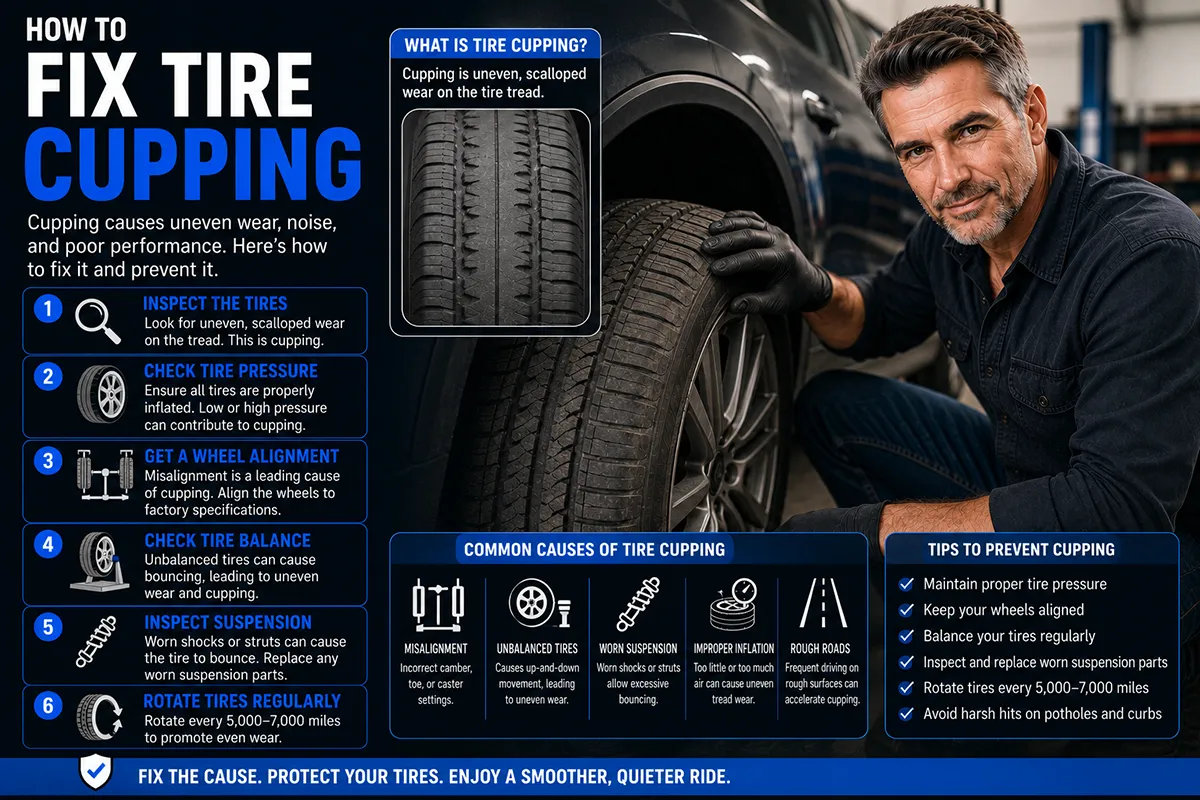
Ever notice a strange rumbling noise coming from your tires that gets louder the faster you drive? You check your tread and find a pattern of scalloped, uneven dips worn into the rubber — almost like someone took an ice cream scoop to your tire.
That’s tire cupping, and it’s one of the most frustrating and misunderstood tire problems I encounter. If you don’t fix both the cupping *and* its root cause, you’ll chew through a brand-new set of tires in a fraction of their expected lifespan.
I’ve personally dealt with cupped tires on three different vehicles over the years, and I’ve helped dozens of readers at TireAdvise.com troubleshoot the same issue. In this guide, I’m going to walk you through exactly what causes tire cupping, how to fix it step by step, and — most importantly — how to make sure it never happens again.
- Tire cupping (also called scalloping) creates uneven, wavy dips in your tread and causes a loud humming or rumbling noise.
- The most common causes are worn shocks/struts, unbalanced tires, misalignment, and infrequent tire rotations.
- Fixing cupping requires addressing the root cause first (suspension, balance, alignment), then deciding whether to replace the tires or try to salvage them.
- Mildly cupped tires can sometimes be corrected with rotation and rebalancing, but severely cupped tires should be replaced.
- Prevention is straightforward: rotate every 5,000–7,500 miles, maintain proper inflation, and replace worn suspension components promptly.
Liked this article?
Add TireAdvise as a preferred source so you see more of our tire reviews and guides on Google.
What Exactly Is Tire Cupping?
Tire cupping — sometimes called tire scalloping — is a specific type of irregular tire wear. Instead of your tread wearing down evenly across the surface, you get a pattern of alternating high and low spots, almost like a series of shallow cups or divots scooped out of the rubber.
I’ve seen it described as a “wavy” or “choppy” pattern, and that’s pretty accurate. If you run your hand across a cupped tire, you’ll feel the bumps and valleys immediately — it’s unmistakable once you know what you’re looking for.
The dips are typically about three to four inches in diameter and are most commonly found along the edges of the tread. In my experience, cupping tends to show up more frequently on the front tires, but I’ve definitely seen it on rear tires as well, especially on rear-wheel-drive trucks and SUVs.
Cupping vs. Other Types of Irregular Wear
It’s important to distinguish cupping from other common wear patterns because the fix is different for each one. Here’s a quick comparison I’ve put together based on what I’ve seen across many tire inspections:
| Wear Pattern | What It Looks Like | Primary Cause | Most Likely Fix |
|---|---|---|---|
| Cupping / Scalloping | Wavy, dipped pattern across the tread | Worn shocks/struts, imbalance | Suspension repair + rebalance |
| Feathering | Tread ribs smooth on one side, sharp on the other | Toe misalignment | Alignment adjustment |
| One-Side Wear | Inside or outside edge worn significantly more | Camber misalignment | Alignment adjustment |
| Center Wear | Middle of tread worn more than edges | Over-inflation | Correct tire pressure |
| Edge Wear (Both Sides) | Both outer edges worn more than center | Under-inflation | Correct tire pressure |
As you can see, cupping has a very distinctive look and cause. If you’re not sure which pattern you’re seeing, I’d recommend running your hand slowly across the tread surface — cupping feels like a washboard road under your fingertips.
What Causes Tire Cupping? (The Real Reasons)
This is where most articles oversimplify things. Tire cupping is almost never caused by just one factor. In my experience, it’s usually a combination of issues that compound on each other. Let me break down each cause in order of how frequently I’ve seen them.
1. Worn Shocks or Struts (The #1 Culprit)
If I had to pick the single most common cause of cupped tires, it’s worn-out shocks or struts — and it’s not even close. I’d estimate that at least 60-70% of the cupping cases I’ve investigated trace back to tired suspension dampers.
Here’s why: your shocks and struts control how your tire interacts with the road surface. When they’re working properly, they keep the tire in consistent contact with the pavement, absorbing bumps and preventing the tire from bouncing.
When they’re worn out, the tire literally bounces as you drive — micro-bounces you might not even feel from inside the cabin. Each time the tire bounces and re-contacts the road, it scrubs away a tiny bit of rubber in a localized spot. Over weeks and months of driving, those tiny scrub marks compound into the scalloped cupping pattern.
I replaced the rear shocks on my Tacoma after noticing cupping on both rear tires. The shocks looked fine visually — no leaking fluid, no obvious damage. But when I pushed down on the rear bumper, the truck bounced more than once before settling. That’s the classic bounce test, and it told me everything I needed to know.
2. Out-of-Balance Tires
Tire imbalance is the second most common cause I see. When a tire and wheel assembly isn’t properly balanced, it creates a vibration at speed. That vibration causes the tire to contact the road unevenly, and over time, you get cupping.
I’ve had this happen after a tire shop mounted new tires but did a sloppy balancing job. Within a few weeks of driving, I noticed the telltale rumble starting on my front passenger tire. A rebalance on a quality road-force balancer fixed the vibration immediately.
The tricky thing about balance is that it changes over time. Wheel weights can fall off, and the tire itself wears in ways that shift the balance point. That’s why I always recommend rebalancing whenever you rotate your tires.
3. Wheel Misalignment
While alignment issues more commonly cause feathering or one-sided wear, I’ve definitely seen cases where a bad alignment contributed to cupping — especially when combined with other factors like marginal shocks.
Toe and camber misalignment force the tire to meet the road at an angle it wasn’t designed for. This creates uneven contact pressures across the tread, and when you add any kind of suspension softness into the equation, cupping develops faster.
4. Infrequent Tire Rotations
Not rotating your tires regularly won’t directly cause cupping on its own, but it absolutely makes the problem worse and allows it to develop faster. Regular rotation redistributes the wear pattern before it can become deeply established.
I think of tire rotation as your first line of defense against all types of irregular wear. In my experience, drivers who rotate on schedule (every 5,000–7,500 miles or roughly every other oil change) rarely develop severe cupping, even with slightly worn suspension components.
5. Low-Quality or Worn Tires
I’ve noticed that certain tire constructions are more susceptible to cupping than others. Cheaper tires with softer tread compounds or less rigid internal structures tend to cup more easily because they’re more “compliant” — meaning they flex and deform more under load.
That doesn’t mean you need to buy the most expensive tires on the market. But in my testing experience, mid-range tires from reputable brands like Continental, Michelin, Bridgestone, and Cooper consistently resist cupping better than no-name budget options.
6. Worn or Damaged Suspension Components Beyond Shocks
Sometimes the culprit isn’t the shocks or struts themselves but other suspension components: worn ball joints, tired bushings, bent control arms, or damaged wheel bearings. Any component that allows unwanted movement in the wheel assembly can contribute to cupping.
I once chased a cupping issue on a Honda CR-V for weeks. New shocks didn’t solve it. New balance didn’t solve it. Turned out it was a worn lower ball joint that allowed just enough play in the front wheel to create the cupping pattern. Once the ball joint was replaced and the tires rotated, the problem resolved.
How to Diagnose Tire Cupping (Step by Step)
Before you start spending money on fixes, you need to confirm that what you’re seeing is actually cupping and identify the root cause. Here’s the diagnostic process I follow every time.
Step 1: Perform a Visual and Tactile Inspection
Get down next to each tire and look at the tread surface at eye level. Cupping is often easier to feel than see, so run your hand across the tread in both directions. If it feels smooth one way and rough the other — like running your hand against sandpaper — that could be feathering. If it feels wavy and bumpy in both directions, that’s cupping.
Take note of which tires are affected and where on the tread the cupping is located (inner edge, outer edge, or center). This information will help pinpoint the cause.
Step 2: Do the Bounce Test on Your Suspension
Walk to each corner of your vehicle and push down firmly on the bumper or fender, then release. A healthy shock or strut will allow the vehicle to bounce up once and settle immediately. If it bounces two or more times, your dampers are worn and likely contributing to the cupping.
This isn’t a definitive test — some worn shocks will pass the bounce test but still underperform at highway speeds. But in my experience, it catches the majority of cases.
Step 3: Check for Vibration While Driving
Take your car for a drive on a smooth highway. Do you feel vibration in the steering wheel (front tire issue) or through the seat (rear tire issue)? Vibration that increases with speed and isn’t related to braking usually points to a balance problem or, if the cupping is already established, the cupped tires themselves vibrating.
Step 4: Inspect Other Suspension Components
If your shocks pass the bounce test, start looking at other suspension parts. Jack up each corner and try to wiggle the tire by grabbing it at the 12 o’clock and 6 o’clock positions (checks ball joints) and then at the 3 o’clock and 9 o’clock positions (checks tie rod ends and wheel bearings). Any noticeable play or clunking indicates a worn component.
Step 5: Get a Professional Alignment Check
Most tire shops and alignment centers will check your alignment for free or for a minimal fee ($20–$30). Ask for a printout of your current alignment readings so you can see exactly which angles are out of spec.
How to Fix Tire Cupping: The Complete Repair Plan
Here’s the critical thing most people get wrong: they replace the cupped tires without fixing the underlying cause. Then, a few months later, their brand-new tires start cupping too. I’ve seen this happen more times than I can count.
You must fix the root cause first, then address the tires. Here’s my recommended order of operations.
Fix #1: Replace Worn Shocks or Struts
If your bounce test or a mechanic’s inspection reveals worn dampers, this is job number one. You cannot fix cupping without addressing this — everything else is a Band-Aid.
For most US drivers, I recommend replacing shocks and struts in pairs (both fronts or both rears). Expect to pay between $150 and $400 per pair for parts, plus $150–$300 for labor at a typical shop. If you’re handy, rear shocks on trucks and SUVs are often a straightforward DIY job — I’ve done them in my driveway with basic tools.
Quality brands I’ve had good experiences with include Bilstein, KYB, Monroe (their OESpectrum line, not the cheapest option), and Gabriel. In my experience, KYB Excel-G struts offer the best balance of price and performance for daily drivers. I’ve installed them on two vehicles and have been happy with the results.
Fix #2: Rebalance All Four Tires
Once your suspension is sorted, get all four tires rebalanced. I specifically recommend asking for road-force balancing if the shop has the equipment — it’s a more precise method that can detect balance and uniformity issues that a standard spin balancer will miss.
Road-force balancing typically costs $20–$30 per tire at most US tire shops. Standard balancing runs $10–$15 per tire. The extra cost for road-force is worth it, especially when you’re trying to solve a cupping problem.
Fix #3: Get a Four-Wheel Alignment
After the suspension work, a fresh alignment is essential. New shocks or struts can slightly change your alignment angles, and any pre-existing misalignment needs to be corrected to prevent future cupping.
A standard four-wheel alignment costs $75–$120 at most US shops. Some places like Firestone offer lifetime alignment packages for $200–$250, which can be a good value if you plan to check alignment regularly.
Fix #4: Address Any Other Worn Components
If your inspection revealed worn ball joints, bushings, tie rod ends, or wheel bearings, get those replaced before or at the same time as the alignment. There’s no point in aligning a car with worn components — the alignment will drift as soon as you start driving.
Can You Save Cupped Tires, or Do They Need to Be Replaced?
This is the question everyone wants answered, and the honest truth is: it depends on the severity.
Mild Cupping: Salvageable
If the cupping is shallow — meaning you can feel it but the dips aren’t dramatically deep — there’s a decent chance the tires can recover. After fixing the root cause, rotate the tires to a different position on the vehicle. The new position changes the forces acting on the tire, and over several weeks of driving, the wear pattern tends to even out as the high spots wear down.
I’ve personally salvaged mildly cupped tires this way. On my Tacoma, after replacing the rear shocks and rotating the cupped rear tires to the front, the rumbling noise diminished noticeably within the first week and was essentially gone after a few weeks of regular driving.
Severe Cupping: Replace the Tires
If the cupping is deep — you can see the dips clearly without even touching the tire, or the noise is so loud it sounds like a wheel bearing is failing — the tires are beyond saving. Deep cupping compromises the structural integrity of the tread and can even affect grip in wet conditions because water channels aren’t functioning as designed.
In these cases, I recommend replacing the tires after all underlying issues have been resolved. Do not put new tires on a vehicle with worn shocks or bad alignment — you’ll just destroy the new rubber.
The “Shave” Option
Some specialty tire shops can shave cupped tires on a tire truing machine, which essentially resurfaces the tread to remove the high spots. This isn’t widely available — you’ll typically need to find a performance or racing-oriented shop. It costs $25–$50 per tire and can be effective, but it also removes tread depth, so it only makes sense on relatively new tires with plenty of remaining life.
I’ve used tire shaving once, on a nearly new set of tires that developed mild cupping due to a balance issue. It worked well and gave me a smooth ride immediately, versus waiting weeks for the wear to even out naturally. But it’s not a practical option for everyone.
How to Prevent Tire Cupping From Coming Back
Once you’ve fixed the problem, prevention is straightforward. These are the habits I follow on every vehicle I drive, and I haven’t had a cupping issue recur since I started being disciplined about them.
Rotate Your Tires Religiously
I can’t stress this enough: rotate your tires every 5,000–7,500 miles. I tie my rotation schedule to every other oil change, which makes it easy to remember. Most tire shops offer free rotations for the life of your tires if you purchased them there — take advantage of this.
Regular rotation is the single most effective preventive measure against all types of irregular wear, not just cupping.
Maintain Proper Tire Pressure
Check your tire pressure at least once a month and before long trips. The correct pressure is listed on the driver’s door jamb sticker, not on the tire sidewall. Under-inflated tires are more susceptible to cupping because the softer sidewall allows more flexion and bouncing.
I keep a quality digital tire gauge in my glove box. The Accutire MS-4021B (around $8 on Amazon) is the one I’ve used for years — it’s accurate and durable.
Replace Shocks/Struts Proactively
Don’t wait until your tires start cupping to replace worn suspension components. Most shock and strut manufacturers recommend replacement every 50,000–75,000 miles, but this varies by driving conditions. If you frequently drive on rough roads, potholes, or unpaved surfaces — common in rural parts of the US — your suspension wears faster.
I do the bounce test on my vehicles every few months and pay attention to how the car handles over bumps. Any change in ride quality gets investigated promptly.
Get Annual Alignment Checks
Even if your car drives straight and the steering wheel is centered, subtle alignment drift can contribute to uneven wear over time. I get my alignment checked once a year, usually in the spring after winter pothole season has done its damage.
Many shops will check it for free, so there’s really no excuse not to.
Invest in Quality Tires
As I mentioned earlier, higher-quality tires with stiffer constructions resist cupping better. When it’s time to buy replacement tires, consider mid-range to premium options from established brands. The Michelin Defender series, Continental TrueContact, and Cooper Discoverer line have all performed well in my long-term testing when it comes to resisting irregular wear.
The price difference between a budget tire and a mid-range tire is often only $20–$40 per tire. Over the life of the tire, that’s a small investment for significantly better wear characteristics, ride quality, and safety.
How Much Does It Cost to Fix Tire Cupping? (Real-World Breakdown)
I know cost is a major concern for most drivers, so here’s a realistic breakdown of what you’re looking at, based on current US shop rates:
| Service | Estimated Cost (US) | Notes |
|---|---|---|
| Shock/Strut Replacement (pair) | $300–$700 installed | Varies significantly by vehicle type |
| Tire Rebalancing (all 4) | $40–$120 | Road-force balancing costs more but is worth it |
| Four-Wheel Alignment | $75–$120 | Lifetime packages available at some chains |
| Ball Joint Replacement (each) | $150–$350 installed | Only if worn; usually lower ball joint |
| Tire Shaving (per tire) | $25–$50 | Not widely available; specialty shops only |
| New Tires (set of 4, mid-range) | $400–$800 | Only if cupping is severe and tires are unsalvageable |
In a best-case scenario — where you just need rebalancing and an alignment — you’re looking at around $120–$240 total. In a worst-case scenario involving new shocks, alignment, rebalancing, and new tires, you could be looking at $900–$1,600.
I know that’s a wide range, but the key takeaway is that catching cupping early saves you real money. If you address it when it’s mild, you can often avoid the cost of new tires entirely.
Is It Safe to Drive on Cupped Tires?
This is a question I get frequently, and I want to give a responsible answer. Mildly cupped tires are not immediately dangerous. You can drive on them while you schedule repairs and arrange for the underlying cause to be fixed.
However, I wouldn’t ignore it for long. Cupped tires have reduced grip, especially in wet conditions, because the irregular tread surface disrupts the tire’s ability to channel water. The vibration from cupping also adds stress to other suspension and steering components, potentially accelerating their wear.
I also find that cupped tires make the vehicle less predictable in emergency maneuvers. During my testing, I’ve noticed that cupped tires tend to break traction less smoothly than evenly worn tires — instead of a gradual slide, you get a more abrupt loss of grip.
If the cupping is severe enough that you feel significant vibration or hear loud humming at highway speeds, I’d recommend limiting your driving to necessary trips until you can get it fixed. And absolutely avoid driving on cupped tires in heavy rain or on snowy/icy roads.
Tire Cupping on Trucks and SUVs: Special Considerations
I want to address trucks and SUVs specifically because cupping is disproportionately common on these vehicles. There are a few reasons for this.
First, trucks and SUVs tend to have longer-travel suspension systems with softer damping characteristics, which makes them more susceptible to the bouncing motion that causes cupping. Second, many truck and SUV owners use aggressive all-terrain tires with large, open tread blocks — these blocks are more prone to scalloping because each block acts somewhat independently.
Third, trucks often carry varying loads. Driving an empty pickup truck puts very different forces on the rear tires compared to driving with a bed full of gravel. This inconsistency in loading can accelerate irregular wear if the suspension isn’t tuned for it.
If you drive a truck or SUV and are experiencing cupping, pay extra attention to your rear shocks. In my experience, rear shocks on trucks wear out faster than fronts because they deal with more dynamic loading. I’ve also found that upgrading to monotube shocks (like Bilstein 5100s) makes a noticeable difference in damping control and cupping resistance compared to standard twin-tube designs.
The Tire Rotation Pattern That Works Best Against Cupping
Not all rotation patterns are equal when it comes to combating cupping. For most front-wheel-drive and all-wheel-drive vehicles in the US market, I recommend the standard forward-cross pattern: rear tires move straight to the front, and front tires cross to the opposite rear position.
For rear-wheel-drive trucks, the rearward-cross pattern works best: front tires move straight to the rear, and rear tires cross to the opposite front position.
The key is that the tires change both position and direction of travel. This disrupts any developing wear pattern and gives the tread a chance to even out. If you’re using the same rotation pattern your shop defaults to, double-check that it matches the recommendation for your drivetrain.
One important note: if your vehicle has different-sized tires front and rear (common on some performance vehicles), you can only rotate side to side, not front to back. In this case, cupping prevention relies even more heavily on maintaining your suspension and balance.
When to See a Professional
While I encourage hands-on tire inspections and basic troubleshooting, there are times when you need a professional. If you’ve replaced shocks, rebalanced, and aligned and the cupping persists, there may be a subtler issue at play — a bent wheel, an internal tire defect, or a suspension geometry problem that requires specialized diagnostic equipment.
I also recommend professional inspection if you notice cupping developing on new tires within the first few weeks of ownership. This could indicate a defective tire (which may be warrantied) or a pre-existing vehicle issue that wasn’t caught during installation.
Good independent tire shops and suspension specialists — not just the chain stores — are your best resource for tricky cupping cases. In my experience, the mechanics at independent shops tend to have more diagnostic freedom and are more willing to dig into unusual problems.
Final Thoughts: Don’t Ignore the Warning Signs
Tire cupping is your vehicle trying to tell you something. That humming noise isn’t just annoying — it’s a signal that your suspension, tire balance, or alignment needs attention. The longer you ignore it, the more expensive the fix becomes.
I’ve seen too many drivers replace a perfectly good set of tires only to have the new ones start cupping because the root cause was never addressed. Don’t be that driver. Diagnose the cause, fix it first, then decide whether your tires can be saved.
The good news is that cupping is both fixable and preventable. With proper maintenance — regular rotations, pressure checks, alignment monitoring, and timely suspension service — you can expect your tires to wear evenly and last their full intended life. That’s money in your pocket and a safer ride for you and your family.
If you have questions about tire cupping on your specific vehicle, drop a comment below or check out our tire reviews for recommendations on tires that resist irregular wear. I read every comment and am always happy to help troubleshoot.
Frequently Asked Questions
What causes tire cupping and how do I know if my tires have it?
Tire cupping, also called scalloping, is caused by worn or damaged suspension components like shocks, struts, or bushings that allow the tire to bounce unevenly against the road surface. You’ll notice a distinct rumbling or growling noise that gets louder at higher speeds, and if you run your hand along the tread, you’ll feel alternating high and low spots every 3-4 inches. Unbalanced tires, misalignment, and infrequent tire rotations can also contribute to cupping over time.
Can I fix cupped tires or do I need to replace them?
If the cupping is mild and caught early, you may be able to extend the tire’s life by fixing the underlying cause and then rotating the affected tires to a non-drive axle, which can allow the tread to gradually even out. However, if the scalloped wear is deep—typically more than 2/32″ of uneven tread depth—the tire is compromised and should be replaced for safety. I always recommend having a mechanic inspect the severity before deciding, since driving on badly cupped tires affects braking distance and wet traction.
How much does it cost to fix tire cupping and the suspension problems causing it?
The total cost depends on whether you need new shocks, struts, or a wheel alignment. Replacing shocks or struts typically runs $200-$600 per axle at most US shops, while a four-wheel alignment costs $75-$150. If the cupped tires need replacing, budget $100-$200 per tire for a quality all-season like a Cooper CS5 or General AltiMAX RT45, plus mounting and balancing fees of around $20-$30 per tire.
Will a wheel alignment fix tire cupping on its own?
A wheel alignment alone won’t fix tire cupping if worn shocks or struts are the root cause, because the tire will continue bouncing irregularly regardless of alignment angles. However, misalignment can worsen or even initiate cupping, so I recommend getting an alignment done after any suspension repair. Addressing both the alignment and suspension together is the only reliable way to stop cupping from recurring on your new or existing tires.
How often should I rotate my tires to prevent cupping?
Most tire manufacturers and the Tire Industry Association recommend rotating your tires every 5,000 to 7,500 miles to promote even tread wear and reduce the chance of cupping. If you drive frequently on rough US highways or pothole-heavy city roads—common in states like Michigan, Pennsylvania, and New York—rotating closer to every 5,000 miles is a smart move. I pair my rotations with oil changes so I never forget, and I ask the shop to check tire balance at the same time.
Are certain tire brands or types more prone to cupping than others?
Softer-compound tires and some budget all-season tires tend to cup more easily because the tread is less resistant to uneven forces from worn suspension parts. Premium brands like Michelin, Bridgestone, and Continental use stiffer tread compounds and more reinforced internal structures that resist scalloping better under the same conditions. That said, even the best tire will cup if your shocks are blown or your wheels are out of balance, so the vehicle’s maintenance matters more than the tire brand alone.
Can tire cupping cause vibration at highway speeds and is it dangerous to keep driving?
Yes, cupped tires create noticeable vibration and a rhythmic humming noise that typically worsens between 40-60 mph on the highway. Driving on severely cupped tires is risky because the uneven contact patch reduces grip during braking and cornering, especially on wet roads common during US spring and fall seasons. I’d recommend getting your suspension and tires inspected as soon as you notice the vibration, since the cupping will only accelerate and could lead to premature tire failure if ignored.
