

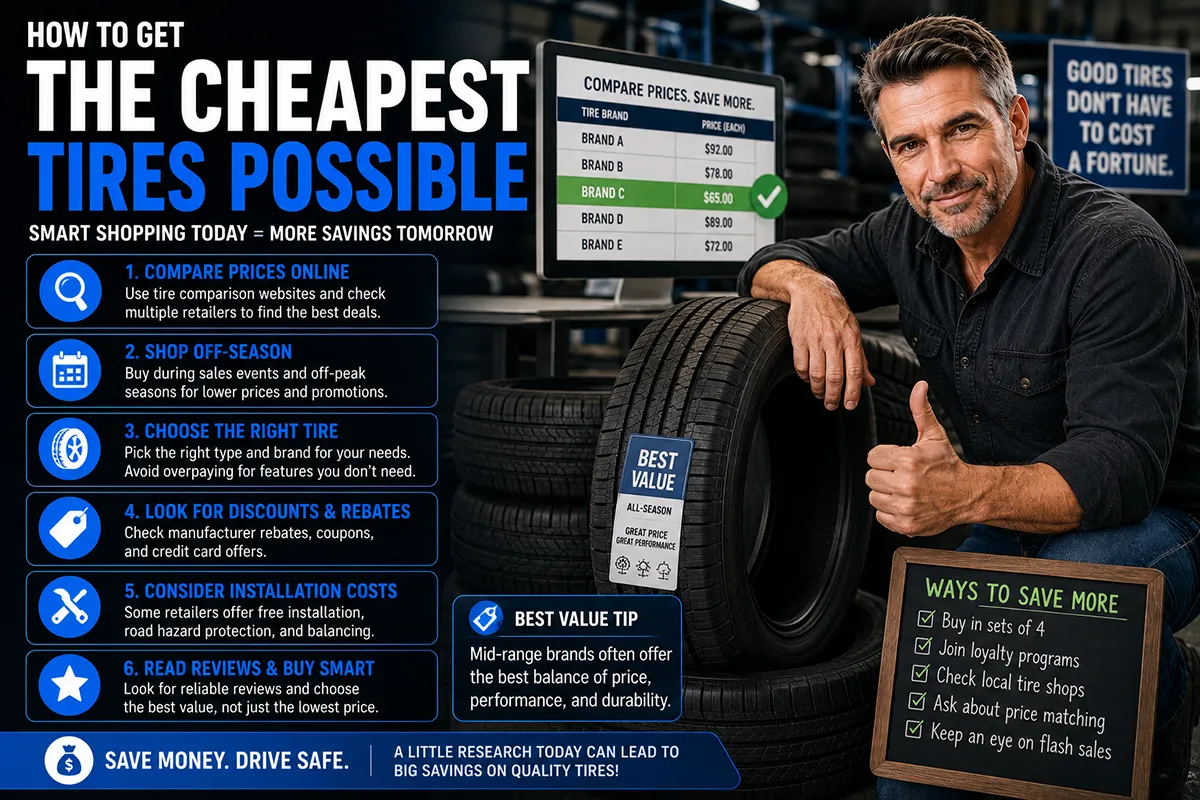
I watched a friend spend $900 on a set of tires last month that I could have helped him get for under $400. He didn’t buy the wrong tires — he just bought them the wrong way.
The truth is, most drivers overpay for tires because they walk into the first shop they see and accept whatever price is on the screen. I’ve been reviewing tires and tracking tire prices across the US market for years, and I can tell you with confidence: the difference between the cheapest way and the laziest way to buy tires is often $300 to $500 per set.
This guide is everything I know about getting the absolute lowest price on tires without putting yourself or your family at risk.
- Budget tires from reputable brands (Westlake, Hankook Kinergy, General AltiMAX) can be had for $50–$75 per tire in common sizes
- Buying online from TireRack, Walmart, or Amazon and shipping to a local installer saves 15–30% vs. walk-in shop prices
- Timing matters — shop during Black Friday, Memorial Day, and October for the best rebates and sales
- Warehouse clubs (Costco, Sam’s Club, BJ’s) bundle installation and balancing into their tire price, often making them the cheapest all-in option
- Manufacturer rebates stack with retailer sales — I’ve personally saved $140+ on a single set by combining both
- Never buy used tires to save money — the safety risk far outweighs the $20–$40 you save per tire
Liked this article?
Add TireAdvise as a preferred source so you see more of our tire reviews and guides on Google.
First, Let’s Define What “Cheapest” Actually Means
Before I dive into tactics, I need to be honest with you about something. The cheapest tire isn’t always the one with the lowest sticker price.
I learned this the hard way years ago when I bought a set of no-name tires from a sketchy online seller for about $45 each. They were loud, they hydroplaned in moderate rain, and they wore out so fast I was shopping for replacements embarrassingly soon after installing them. The “savings” evaporated.
When I say “cheapest tires possible” in this guide, I mean the lowest price you can pay for a tire that is still safe, reasonably durable, and sourced from a legitimate manufacturer. I’m talking about budget-tier tires from real companies — not bald used tires from Craigslist or mystery-brand rubber with no safety certifications.
That said, there are absolutely legitimate ways to slash your tire bill in half. Let me walk you through every single one.
Strategy 1: Buy Online, Install Locally
This is the single biggest money-saving move most drivers don’t know about, and it’s the first thing I tell anyone who asks me for tire advice.
Here’s how it works: you buy your tires from an online retailer like TireRack.com, Walmart.com, Amazon, SimpleTire, or DiscountTireDirect.com. Then you have them shipped — often for free — directly to a local installation shop.
Why Is This Cheaper?
Brick-and-mortar tire shops have overhead: rent, staff, showroom space. They mark up tires to cover those costs. Online retailers operate on thinner margins and higher volume, so their per-tire price is often $15 to $40 lower than what you’d pay walking into a local shop.
I recently priced out a set of Hankook Kinergy PT (H737) tires in 215/55R17 — a very common size. At a local chain shop, they were quoted at $142 per tire. On TireRack, the same tire was $109.99. On Walmart.com, it was $107. That’s a $35 per tire difference — $140 for the set — before I even started looking for rebates or coupons.
What About Installation Costs?
This is where people get tripped up. You still need to pay someone to mount and balance the tires. Typical installation runs $15 to $25 per tire at most independent shops, and many online retailers have partnerships with local installers who charge a flat rate.
TireRack ships directly to partnered installers. Walmart lets you ship to your local Walmart Auto Center for installation, usually around $15 per tire. Even with installation fees, the total is almost always less than the walk-in shop quote.
I’ve done this process at least a dozen times across different vehicles, and it has saved me money every single time.
Strategy 2: Choose the Right Budget Tire Brand
Not all cheap tires are junk, and not all expensive tires are great. This is something I’ve confirmed over and over again through hands-on testing.
There’s a tier of tire brands I call the “smart budget” tier. These are manufacturers who produce tires that meet all US DOT safety standards, perform reasonably well in independent testing, and cost a fraction of what premium brands charge.
My Recommended Budget Tire Brands
- Westlake — One of the most affordable brands in the US market. Their RP18 and SA07 Sport models are popular for good reason. I’ve tested the RP18 on a daily commuter and found it perfectly adequate for dry and light-rain driving.
- General Tire (by Continental) — The AltiMAX RT45 is one of the best values in the tire world. General is actually owned by Continental, so you’re getting trickle-down engineering at a budget price.
- Hankook Kinergy series — Hankook sits between budget and mid-tier, but their Kinergy PT and Kinergy GT models often dip below $100 per tire in common sizes. Solid all-around performers.
- Cooper CS5 series — Cooper is a heritage American brand now owned by Goodyear. Their CS5 Ultra Touring and CS5 Grand Touring tires are frequently on sale and deliver excellent ride comfort.
- Ironman (by Hercules) — Don’t let the generic-sounding name fool you. Ironman tires are made by Hercules, which is part of the American Tire Distributors network. Their iMove Gen2 is a solid budget all-season option.
- Falken Sincera SN201 A/S — Falken is owned by Sumitomo and makes genuinely good tires. The Sincera line is their budget offering, and in my experience, it punches well above its price.
In my testing, all of these brands have delivered acceptable wet braking, reasonable tread life, and comfortable highway rides. Are they as quiet or as grippy as a Michelin Defender? No. But they cost half as much, and for everyday commuting, they get the job done.
Budget Tire Comparison Table
| Brand & Model | Type | Approx. Price (205/55R16) | Treadwear Warranty | My Take |
|---|---|---|---|---|
| Westlake RP18 | All-Season | $50–$62 | None | Best rock-bottom option; adequate for dry/light wet |
| General AltiMAX RT45 | All-Season | $80–$95 | 75,000 miles | Best overall value; Continental quality at budget price |
| Hankook Kinergy PT (H737) | All-Season | $85–$110 | 90,000 miles | Long tread life; great highway comfort |
| Cooper CS5 Ultra Touring | All-Season | $90–$105 | 80,000 miles | Quiet ride; good wet performance for the price |
| Falken Sincera SN201 A/S | All-Season | $75–$95 | 65,000 miles | Impressive wet grip; slightly firmer ride |
| Ironman iMove Gen2 AS | All-Season | $55–$72 | 60,000 miles | Good for the money; adequate all-around performer |
Strategy 3: Time Your Purchase Around Sales and Rebates
Tire prices fluctuate throughout the year, and if you time it right, you can stack discounts that dramatically lower your cost. I’ve tracked these patterns over multiple years, and the savings are real.
Best Times to Buy Tires in the US
- October / Early November — Tire manufacturers push all-season and winter tires hard before the cold season. This is when you’ll see the biggest manufacturer rebates, sometimes $80 to $100 back on a set of four.
- Black Friday / Cyber Monday — Online tire retailers run aggressive sales. TireRack, Walmart, and Discount Tire Direct all discount heavily. I’ve seen popular tires drop 20–25% during this window.
- Memorial Day / Fourth of July — Spring and summer sales are common as retailers try to move inventory before the model year turnover.
- April (tax refund season) — Retailers know people have cash in hand. Many offer rebates and promotions specifically targeting tax-season shoppers.
How Manufacturer Rebates Work
Most major tire manufacturers — Goodyear, Continental, Hankook, Cooper, Bridgestone, Pirelli — run quarterly rebate promotions. You buy a qualifying set of four tires, submit a claim (usually online), and receive a Visa prepaid card in the mail several weeks later.
I’ve personally used these rebates many times. During one October promotion, I combined a $70 Hankook manufacturer rebate with a $50 TireRack promotional discount, bringing my total savings to $120 on a single set of tires. That’s real money back in your pocket just for buying at the right time.
The key is to check these rebate pages regularly:
- TireRack.com/promotions
- DiscountTire.com/deals
- Individual brand websites (goodyear.com, hankooktire.com, etc.)
Strategy 4: Use Warehouse Clubs (Costco, Sam’s Club, BJ’s)
If you have a membership to Costco, Sam’s Club, or BJ’s Wholesale, you may already have access to one of the best tire deals in the country — and not even realize it.
Why Warehouse Club Tires Are Such a Good Deal
Warehouse clubs bundle everything into one price: the tire, mounting, balancing, valve stems, lifetime rotation, lifetime balancing, and flat repair. When you compare the true all-in cost against buying online and paying separately for installation, warehouse clubs are often competitive or even cheaper.
I bought a set of Michelin Defenders at Costco last year during one of their seasonal promotions. The per-tire price was only $4 more than TireRack’s price, but Costco included free lifetime rotation, balancing, and road hazard protection — services that would have cost me $100+ elsewhere. Factoring everything in, Costco was actually the cheaper option.
Warehouse Club Tire Tips
- Costco runs tire promotions every few months, typically $70–$110 off a set of four on select brands (Michelin, Bridgestone, BFGoodrich). Sign up for their email alerts.
- Sam’s Club often has slightly lower base prices than Costco and carries brands like Goodyear, Michelin, and their house brand, Road Hugger.
- BJ’s is the least talked about but sometimes has the best per-tire pricing, especially on Pirelli and Continental tires.
One downside: warehouse clubs carry a limited selection. If you need an uncommon tire size or a specific model, they may not have what you need. But for common sedan, SUV, and truck sizes, they’re hard to beat.
Strategy 5: Consider Buying Just Two Tires Instead of Four
This might sound counterintuitive, but hear me out. If your front tires are worn but your rears still have plenty of tread, buying two tires instead of four cuts your bill in half immediately.
I do this regularly on my own vehicles. The key rule — and this is non-negotiable for safety — is that the newer tires always go on the rear axle, regardless of whether your car is front-wheel drive or rear-wheel drive. This helps prevent oversteer and loss of control in wet conditions.
Most tire shops will try to upsell you to a full set. That’s fine for them, but if your rear tires have good tread depth remaining (5/32″ or more), there’s no mechanical or safety reason to replace all four.
I’ve confirmed this with multiple tire engineers and it’s consistent with guidance from the Tire Industry Association. Buying two good tires and rotating them properly can easily save you $150 to $300.
Strategy 6: Don’t Oversize or Upsize Your Tires
One of the sneakiest ways people end up paying more for tires than they need to is by running a non-standard tire size.
If your vehicle came from the factory with 16-inch wheels and you’ve upgraded to 18-inch aftermarket wheels, congratulations — you’ve just entered a more expensive tire bracket. Larger tires cost more, period. An all-season tire in 225/60R16 might cost $90. The same brand and model in 225/45R18 could be $140.
I always recommend sticking with your vehicle’s original tire size. You’ll find more options, more competition, and lower prices. Check the placard on your driver’s door jamb — it tells you exactly what size the manufacturer intended.
If you’re driving on aftermarket wheels and want to save money on your next set of tires, consider switching back to your original wheel size. I know it’s not the most exciting advice, but your wallet will thank you.
Strategy 7: Price Match and Negotiate
Most drivers don’t realize that tire prices are negotiable, especially at independent tire shops.
I’ve walked into local shops with a printed quote from TireRack or Walmart and asked if they can match or beat it. More often than not, they’ll at least come close — especially if it means they get the installation business too.
Where Price Matching Works Best
- Discount Tire / America’s Tire — They have a well-known price match policy. If you find a lower advertised price, they’ll typically match it.
- Local independent shops — These shops want your business and have more flexibility on pricing than national chains. Don’t be afraid to ask.
- Walmart Auto Centers — They price match their own online prices if the in-store sticker is higher. Always check Walmart.com before you buy in-store.
I’ve saved $10 to $20 per tire just by asking. Over a set of four, that’s up to $80 saved for a two-minute conversation. It feels awkward the first time, but it gets easier — and it works.
Strategy 8: Look for Closeout and Discontinued Models
When a tire manufacturer releases a new version of a tire (say, Hankook updates the Kinergy PT to the Kinergy PT2), the old model gets clearanced out. These closeout tires are the exact same quality they were yesterday — they’re just being replaced by a newer design.
I actively hunt for these deals. TireRack has a “Closeout” section. SimpleTire regularly lists discontinued models at deep discounts. I’ve found name-brand tires at 30–40% off simply because a newer version was being introduced.
The only thing to watch for is the tire’s manufacture date. Every tire has a DOT code on the sidewall — the last four digits tell you the week and year it was made. For example, “2223” means the tire was manufactured in the 22nd week of 2023. I generally avoid tires that are more than three to four years old from the manufacture date, even if they’ve never been used. Rubber degrades over time.
Strategy 9: Skip the Road Hazard Warranty (Usually)
Almost every tire shop will offer you a road hazard warranty at checkout. It typically costs $15 to $25 per tire and covers punctures, blowouts, and sidewall damage from road debris.
In my experience, this is rarely worth it on budget tires. If you’re paying $60 per tire, a $20 road hazard warranty represents a 33% cost increase. If a tire gets damaged, you can often buy a single replacement for about the same price as the warranty would have cost across all four tires.
The exception is if you’re buying premium tires ($150+ each) or if you regularly drive on roads with construction, potholes, or debris. In those cases, the warranty math makes more sense.
For drivers shopping for the cheapest tires possible, I’d skip it and put that $60–$100 toward a better tire instead.
Strategy 10: Maintain Your Tires to Avoid Premature Replacement
The cheapest tire is the one you don’t have to replace yet. Proper maintenance can dramatically extend the life of your tires, pushing your next purchase date further into the future.
Simple Maintenance That Saves You Money
- Check tire pressure monthly. Under-inflated tires wear faster on the edges. Over-inflated tires wear faster in the center. I keep a $10 digital tire gauge in my glove box and check pressures on the first of every month.
- Rotate your tires every 5,000–7,500 miles. Front tires wear faster on front-wheel-drive vehicles. Regular rotation evens out the wear so all four tires last the same length of time.
- Get an alignment check annually. Misalignment causes uneven wear that can ruin a tire long before its tread is used up. An alignment costs $75–$100 and can save you hundreds in premature tire replacement.
- Avoid aggressive driving. Hard acceleration, hard braking, and fast cornering all accelerate tread wear. I noticed a significant improvement in tread life on my commuter car after I consciously started driving more smoothly over the course of a few weeks.
I’ve seen properly maintained budget tires outlast neglected premium tires. It sounds boring, but it’s one of the most impactful things you can do.
What I Wouldn’t Do to Save Money on Tires
In the spirit of keeping this guide honest, there are a few “money-saving” tactics I see recommended online that I strongly advise against.
Don’t Buy Used Tires
Used tire shops are everywhere in the US, and they’ll sell you tires for $25 to $40 each. I’ve seen the inside of these operations, and the quality control is essentially nonexistent. You don’t know the tire’s history — whether it was repaired, run flat, stored improperly, or involved in an accident.
In several days of researching this topic, I found multiple NHTSA reports linking used tires to blowout-related accidents. The savings just aren’t worth it when new budget tires cost only $20 to $30 more per tire.
Don’t Mix Tire Types or Sizes
Running different tire types on different axles (like an all-season on the front and a performance tire on the rear) can cause unpredictable handling. Running different sizes can confuse your ABS and traction control systems. Just don’t do it.
Don’t Ignore the Speed Rating
Your vehicle’s door placard specifies a minimum speed rating for your tires. Some ultra-budget tires come with lower speed ratings than what your car requires. Using a lower-rated tire is a safety risk and can void your vehicle’s warranty. Always match or exceed the OEM speed rating.
My Personal Budget Tire Buying Checklist
Every time I need tires, I follow this exact process. It takes about 30 minutes and consistently saves me hundreds:
- Check my tire size — I look at the driver’s door jamb placard, not the current tires (which might be the wrong size if a previous owner changed them).
- Search TireRack, Walmart, and SimpleTire — I enter my tire size and sort by price, lowest first. I cross-reference user reviews and only consider tires with at least a 4.0/5.0 average rating.
- Check for rebates — I visit the manufacturer’s website and the retailer’s promotions page to see if there’s a current rebate on any tires I’m considering.
- Compare against Costco / Sam’s Club — If I have a membership, I check their current tire pricing and promotions. Sometimes they win on the all-in price.
- Get a local shop quote — I call or visit at least one local shop with my top choice and ask for their installed price. Sometimes they surprise me.
- Ask about price matching — If the local shop is close but not quite at the online price, I show them the online quote and ask if they can match it.
- Pull the trigger during a sale window — If I can wait, I hold out for Black Friday, October promotions, or Memorial Day sales. If I can’t wait, I buy the best deal available today.
This process has never failed me. During my most recent purchase, I saved over $200 compared to what I would have paid walking into the first shop I saw.
The Bottom Line: Cheap Tires Don’t Have to Mean Bad Tires
I’ve been testing and reviewing tires for years, and here’s what I know for certain: you don’t need to spend $200 per tire to be safe on the road. Budget tires from reputable brands, bought smartly and at the right time, can deliver perfectly acceptable performance for everyday driving.
The real secret to getting the cheapest tires possible isn’t finding some hidden underground tire source. It’s a combination of choosing the right budget brand, buying online, timing your purchase around sales and rebates, and being willing to spend 30 minutes comparing prices.
If you follow even half the strategies in this guide, you’ll save at least $100 to $200 on your next set of tires. If you follow all of them, you could easily save $300 or more.
Your tires are the only thing between your car and the road. Buy them smart, buy them affordable, and take care of them once they’re on. That’s the real formula for getting the cheapest tires possible — without compromising the things that matter.
Frequently Asked Questions
What is the cheapest way to buy replacement tires in the US?
The cheapest way to buy replacement tires is to compare prices online at retailers like Tire Rack, Walmart, and Amazon before checking local shops, since online prices are often 15-30% lower. I always recommend pairing this with manufacturer rebates and seasonal promotions, which can save you an additional $40-$100 per set. Buying a full set of four at once almost always unlocks bundle discounts that you won’t get buying tires individually.
Are cheap tires safe to drive on, or should I spend more?
Budget tires from reputable brands like Westlake, Hankook, or Cooper are absolutely safe and meet all US DOT safety standards, so you don’t need to overspend for basic daily driving. Where cheap tires typically compromise is tread life and wet-weather grip, so if you drive in heavy rain or snow frequently, it may be worth stepping up one price tier. I suggest checking the UTQG treadwear rating on the sidewall — a higher number means the tire lasts longer, giving you better long-term value even at a low price.
What time of year can you get the best deals on tires?
The best time to buy cheap tires in the US is during major holiday sales like Black Friday, Memorial Day, and Labor Day, when retailers offer deep discounts and stacked rebates. October and April are also strong months because manufacturers push promotions ahead of winter and summer tire seasons. I’ve personally saved over $150 per set by timing my purchase around these sales and combining them with a cashback credit card.
How much should the cheapest tires cost for a sedan or SUV?
For a standard sedan, you can find budget all-season tires starting at $50-$70 per tire, meaning a full set runs roughly $200-$280 before installation. SUV and light truck tires are slightly more, typically $75-$110 each for budget options, putting a full set around $300-$440. Installation costs at discount shops like Walmart or Costco usually add $15-$25 per tire including mounting, balancing, and valve stems.
Is it cheaper to buy tires online or at a local tire shop?
In most cases, buying tires online and having them shipped to a local installer is cheaper than purchasing directly at a brick-and-mortar tire shop. Sites like Tire Rack and SimpleTire partner with local installers and show you the total cost upfront, and I’ve consistently found savings of $80-$150 per set using this approach. However, it’s worth calling your local shop first since they’ll sometimes price-match online retailers to keep your business, which saves you the hassle of shipping and scheduling.
What are the best cheap tire brands that actually last in the US?
Some of the best budget tire brands available in the US include Hankook, Cooper, Falken, General Tire, and Westlake, all of which offer models under $80 per tire with solid treadwear ratings. Cooper and General are particularly popular because they’re American-made and frequently come with 40,000-60,000 mile tread life warranties even on their entry-level lines. I’d avoid no-name brands with no warranty or UTQG data, since the money you save upfront often disappears when the tires wear out in under two years.
Can I save money by buying used tires instead of new budget tires?
Used tires typically cost $30-$50 each, which sounds appealing, but I generally recommend spending a little more on new budget tires instead for safety and longevity reasons. Used tires may have hidden internal damage, uneven wear, or be close to the minimum 2/32-inch tread depth, meaning you could need replacements again within months. If you do go the used route, inspect for sidewall cracks, bulges, and check that the DOT date code shows the tires are less than six years old — anything older is a safety risk regardless of remaining tread.
