

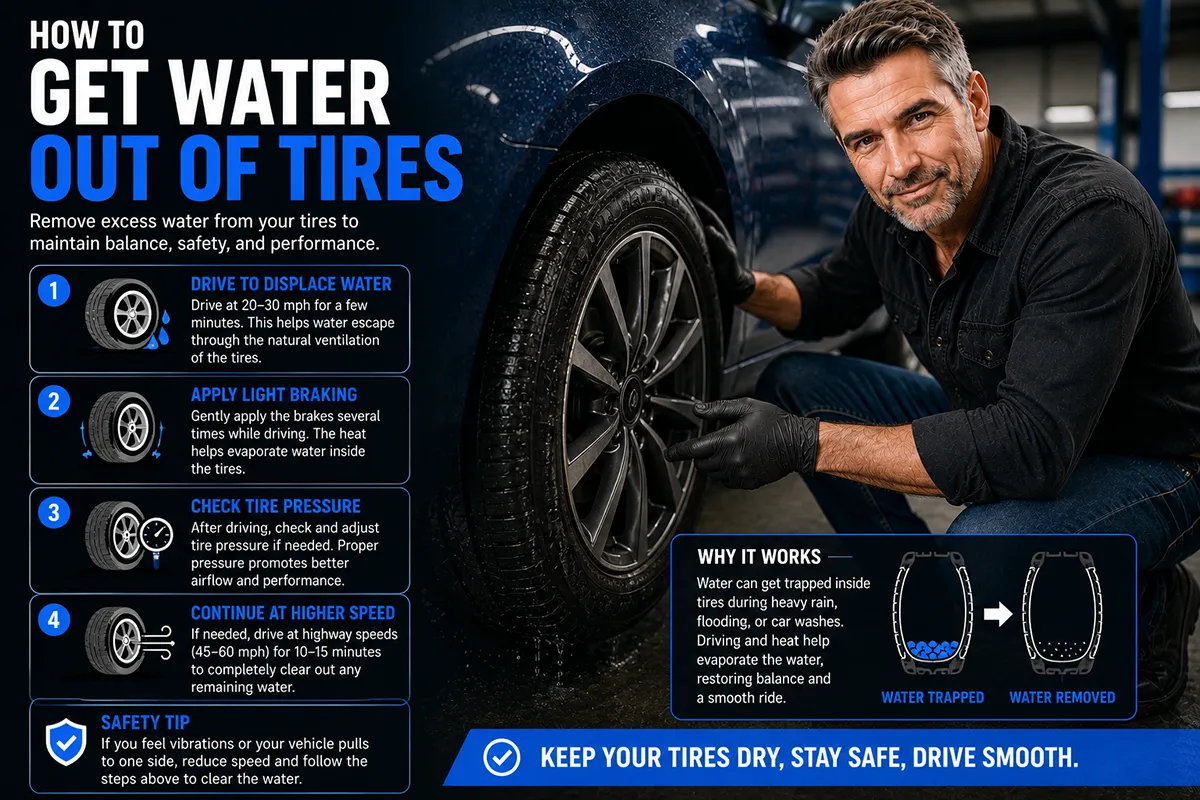
If you’ve ever felt a strange wobble or shimmy at highway speeds and couldn’t figure out what was wrong, water trapped inside your tires might be the culprit you never suspected.
I’ve seen this problem more times than you’d think — from tires mounted during rainy weather to rims that sat outside uncovered. It’s one of those sneaky issues that most drivers don’t even know exists until it starts ruining their ride quality.
In this guide, I’ll walk you through exactly how water gets inside tires, how to confirm it’s there, and multiple proven methods I’ve personally used to get it out for good.
- Water inside tires causes vibrations, imbalance, and potential corrosion — especially at highway speeds.
- It usually enters during mounting, through leaky valve stems, or from compromised bead seals.
- The most reliable fix is to break the bead, drain the water, dry the interior, and remount the tire.
- You can also remove water through the valve stem using gravity and compressed air, though it’s less thorough.
- Prevention is key: store wheels indoors, inspect valve stems regularly, and use a reputable tire shop for mounting.
Liked this article?
Add TireAdvise as a preferred source so you see more of our tire reviews and guides on Google.
How Does Water Get Inside a Tire in the First Place?
This is the question I get asked most often, and honestly, it surprised me the first time I encountered it too. You’d think a sealed, inflated tire would be completely watertight, but there are several ways moisture sneaks in.
During the Mounting Process
The most common cause I’ve encountered is water entering during the tire mounting process itself. Many tire shops use a lubricant solution (often soap and water) to help slide the tire bead onto the rim. If they’re generous with the solution or if conditions are humid, a surprising amount of liquid can get trapped between the tire’s inner liner and the rim.
I’ve personally witnessed this at budget tire shops where speed is prioritized over thoroughness. The technician sprays the bead, mounts the tire, inflates it, and moves on — never bothering to check if excess liquid pooled at the bottom.
Leaky or Damaged Valve Stems
Rubber valve stems degrade over time, especially in extreme heat and cold — something we deal with constantly across most of the US. Cracked rubber or a loose valve core can allow moisture to seep in gradually.
I once helped a friend diagnose a persistent vibration on his Honda Accord. After ruling out balance weights and alignment, we pulled the tire and found about two ounces of water inside. The culprit was a hairline crack in his rubber valve stem that had been slowly wicking in moisture during rainstorms.
Compromised Bead Seals
If your rim has curb rash, corrosion (common on aluminum alloy wheels), or any damage along the bead seat, the seal between the tire bead and rim can be imperfect. This doesn’t always cause a noticeable air leak, but it can absolutely let water in — especially when you drive through standing water or during heavy rain.
Tire Repair Entry Points
If you’ve had a puncture repaired with a plug or patch, that repair site is another potential entry point for moisture. I’m not saying every repaired tire will take on water, but a poorly executed plug — especially one that wasn’t sealed internally — can be a gateway.
Condensation Buildup
This one is more subtle. In regions with large temperature swings — I’m thinking the Midwest, Northeast, or anywhere that goes from freezing nights to warm days — condensation can form inside the tire. The air inside contains some moisture, and as temperatures cycle, that moisture condenses on the inner surfaces.
Over weeks and months, this can add up to a measurable amount of water. It’s not dramatic, but it’s enough to cause balance issues on sensitive vehicles.
How to Tell If There’s Water Inside Your Tires
Before you go through the effort of removing water, you need to confirm it’s actually there. Here are the signs I look for based on my experience.
Unexplained Vibration at Speed
This is the number one symptom. Water sloshes around inside the tire as you drive, and because it’s a liquid, it constantly shifts position. This creates a dynamic imbalance that no amount of wheel balancing can fix.
The vibration typically gets worse at highway speeds (55-75 mph) and may seem to come and go randomly. That randomness is actually the water moving to different positions inside the tire.
Tire Balance That Won’t Stay Right
If you’ve had your tires balanced, and they were perfect on the machine, but you still feel a vibration on the road — water is a strong suspect. I’ve seen technicians add more and more balance weights trying to chase the problem, and it never resolves because the water keeps shifting.
In my experience, if a tire needs an unusual amount of weight (say, more than 2-3 ounces) to balance, or if it was balanced recently and already feels off, it’s worth investigating for trapped water.
The Shake Test
This is crude but effective. Remove the tire and wheel assembly from the vehicle. Hold it upright and rock it side to side. If there’s water inside, you may hear a faint sloshing sound or feel the weight shift in a liquid, delayed manner.
I’ll be honest — this doesn’t always work, especially with small amounts of water. But when it does, it’s unmistakable. I once found what turned out to be nearly a cup of water in a tire just by doing this test in my garage.
The Deflate-and-Listen Method
Remove the valve core and listen as the air escapes. With the tire positioned so the valve stem is at the lowest point, you might hear gurgling or see moisture spray out with the air. I’ve used this method multiple times, and when water is present in any significant quantity, you’ll know.
Method 1: Draining Water Through the Valve Stem
This is the simplest approach, and it’s the one I try first when I suspect a small amount of water. You don’t need any special tools beyond a valve core removal tool and access to an air compressor.
What You’ll Need
- Valve core removal tool (costs about $2-5 at any auto parts store)
- Air compressor or portable inflator
- A clean rag or towel
- Patience
Step-by-Step Process
Step 1: Remove the tire and wheel assembly from the vehicle. You can do this with the water inside, but you’ll need the wheel off the car to position it correctly.
Step 2: Position the wheel so the valve stem is at the very bottom — the 6 o’clock position. I usually lean it against a wall at a slight angle to keep the valve stem at the lowest point. The goal is to let gravity pull the water toward the valve.
Step 3: Remove the valve core using your removal tool. Air will rush out — that’s fine. Keep the valve at the bottom and let the tire deflate completely.
Step 4: Once deflated, gently press on the tire sidewall to push remaining air and water toward the valve opening. You should see water dripping or dribbling out of the valve hole. Be patient here — I’ve spent 10-15 minutes working water out of a single tire.
Step 5: Rotate the tire slowly while keeping the valve at the bottom to coax water from different areas of the inner cavity.
Step 6: Once you’re satisfied the water has drained, reinstall the valve core and reinflate the tire to the manufacturer’s recommended PSI (check your door jamb sticker).
Limitations of This Method
I want to be upfront: this method works well for small amounts of water, but it has real limitations. The valve hole is tiny, and water doesn’t always flow freely through it. Surface tension can trap small amounts of water inside, and if there’s any residue or debris, it can clog the opening.
For anything more than a tablespoon or two of water, I recommend the more thorough method below.
Method 2: Breaking the Bead for Complete Drainage (The Best Method)
This is the method I trust the most, and it’s what I recommend when you know there’s a significant amount of water inside or when the valve stem method didn’t fully resolve the vibration. It’s more involved, but it’s thorough.
What You’ll Need
- A bead breaker tool, large C-clamp, or access to a tire machine
- Tire lubricant (bead sealer/soap solution)
- Clean rags or towels
- Air compressor capable of reseating the bead
- Valve core removal tool
Step-by-Step Process
Step 1: Remove the tire and wheel assembly from the vehicle.
Step 2: Fully deflate the tire by removing the valve core.
Step 3: Break the bead on one side of the tire. If you have a manual bead breaker (available for $30-80 at stores like Harbor Freight), this is straightforward. Position the tool and press the tire bead away from the rim flange. You only need to break it in one spot to create a gap.
If you don’t have a bead breaker, I’ve had success using a large C-clamp and a block of wood, though I’ll admit this takes more effort and finesse. Press the wood block against the sidewall near the rim edge and tighten the clamp until the bead pops free.
Step 4: Once the bead is broken, tilt the assembly and let the water pour out. I tip it over a bucket so I can actually see how much water was inside — it’s often more than you’d expect.
Step 5: Use clean rags to wipe down the inside of the tire and the interior of the rim. You want to remove as much moisture as possible. If it’s a warm, sunny day, I’ll leave the assembly with the bead broken for an hour or so to let it air dry.
Step 6: Inspect the rim’s bead seat while you’re in there. Look for corrosion, pitting, or debris. If you see corrosion on an alloy wheel, lightly sand it with fine-grit sandpaper (220 grit works well) and wipe clean. This is also a good time to inspect the valve stem.
Step 7: Apply tire bead lubricant to both the rim flange and the tire bead. Reseat the bead using your air compressor. You may need to use a ratchet strap around the tire’s circumference to help the bead make initial contact with the rim — a trick I’ve used many times in my garage.
Step 8: Reinstall the valve core and inflate to the correct PSI. Check for leaks using soapy water around the bead and valve stem.
Step 9: Get the tire rebalanced. This is important — removing the water changes the balance, so your old weights are no longer accurate.
Method 3: Using Compressed Air to Purge Water
This is a middle-ground approach that I sometimes use when I can’t break the bead easily. It’s not as thorough as Method 2, but it’s more effective than the basic valve stem drain.
How It Works
The idea is to repeatedly pressurize and depressurize the tire with the valve stem positioned at the bottom, using the force of the compressed air to push water out each time you release the valve core.
Step 1: Position the wheel with the valve stem at the bottom.
Step 2: Inflate the tire to its maximum sidewall pressure (not your vehicle’s recommended pressure — the max pressure molded into the sidewall, typically 44-51 PSI for most passenger tires).
Step 3: Quickly remove the valve core. The pressurized air rushing out will carry water with it. Aim the valve away from your face — this gets messy.
Step 4: Reinstall the valve core, reinflate, and repeat. I’ve done this 5-8 times on a single tire before the water stopped coming out.
This method is especially useful when you’re at a gas station or don’t have a full workshop setup. I once used this technique in a parking lot with a portable 12V compressor, and while it took a while, it got the job done.
Comparison of Water Removal Methods
| Method | Effectiveness | Difficulty | Tools Needed | Best For | Estimated Cost |
|---|---|---|---|---|---|
| Valve Stem Drain | Moderate | Easy | Valve core tool only | Small amounts of water | $2-5 |
| Break the Bead | Excellent | Moderate-Hard | Bead breaker, compressor, lubricant | Large amounts or persistent issues | $30-80 (DIY) or $15-25 per tire (shop) |
| Compressed Air Purge | Good | Easy-Moderate | Valve core tool, compressor | Moderate amounts, no shop access | $2-5 (plus compressor) |
| Professional Service | Excellent | None (they do it) | None | Anyone not comfortable DIYing | $20-40 per tire |
When to Just Take It to a Tire Shop
I’m a big believer in doing things yourself when it makes sense, but I also know when to hand a job to a professional. If any of the following apply to you, I’d recommend taking your tires to a reputable shop like Discount Tire, Tire Rack’s installation partners, Costco Tire Center, or your local independent tire dealer.
- You don’t own an air compressor — reseating a bead without one is nearly impossible at home.
- You suspect rim damage or corrosion — a shop can properly clean, sand, and seal the bead seat.
- The tire has been repaired before — a technician can inspect the repair while the tire is off the rim.
- You’re dealing with run-flat tires — these have stiffer sidewalls and require specialized equipment to handle safely.
- TPMS sensors are involved — breaking a bead carelessly can damage a $30-80 TPMS sensor.
Most tire shops will charge $15-25 per tire for a dismount, drain, and remount. Some will do it for free if you originally purchased the tires there. I’ve had Discount Tire handle this for me at no charge on a set I bought from them, which is one of the reasons I keep going back.
What Happens If You Don’t Remove the Water?
You might be wondering: is this really a big deal? Can’t I just leave a little water in there? In my experience, here’s what happens when you ignore it.
Persistent Vibration and Poor Ride Quality
Even a few ounces of water creates enough dynamic imbalance to feel a vibration through the steering wheel or seat. It’s the kind of thing that starts as mildly annoying and becomes infuriating over several days of driving. And since the water moves, the vibration is inconsistent — sometimes it’s bad, sometimes it seems fine — which makes it maddening to diagnose.
Internal Corrosion of the Wheel
Water sitting inside a steel wheel will cause rust. Water sitting inside an aluminum alloy wheel will cause oxidation and pitting. Over time, this corrosion compromises the bead seal, leading to slow air leaks. I’ve seen wheels that were perfectly functional develop chronic slow leaks because trapped water ate away at the bead seat over a period of months.
Tire Pressure Monitoring System (TPMS) Damage
Most modern vehicles sold in the US have TPMS sensors mounted inside the tire. These sensors have batteries and electronic components that don’t appreciate being submerged in water. While they’re somewhat sealed, prolonged water exposure can shorten their lifespan or cause erratic readings.
Potential Freezing in Winter
If you live anywhere in the northern US — and I’m talking about a huge portion of the country — water inside your tires can freeze in winter. Frozen water creates a hard, uneven mass inside the tire that throws the balance off dramatically. I experienced this myself during a particularly cold stretch in the Midwest, and the vibration was severe enough that I thought I had a broken belt in the tire. Turns out, it was ice.
Once the ice thaws, the vibration changes character again, which only adds to the confusion. Trust me, you don’t want to deal with this.
How to Prevent Water From Getting Inside Your Tires
Prevention is always better than cure, and after dealing with this issue multiple times, I’ve developed some habits that have served me well.
Choose a Quality Tire Shop
I cannot overstate how much the mounting process matters. A careful technician who uses the right amount of bead lubricant, ensures the tire is properly seated, and doesn’t rush the job will save you from this problem almost entirely.
I look for shops that take the time to clean the rim’s bead seat before mounting a new tire. Places like Discount Tire and Costco Tire Center generally do a good job of this. Avoid the cheapest quote from an unknown shop — the $10 you save per tire isn’t worth the headaches.
Replace Rubber Valve Stems During Tire Changes
Every time I get new tires mounted, I ask for new valve stems. Rubber snap-in valve stems cost about $2-3 each, and metal clamp-in stems run $8-12 each. It’s cheap insurance against a cracked or deteriorated valve letting moisture in.
If your vehicle has TPMS, the sensor rebuild kits (new seal, core, cap) run about $5-10 per sensor and are well worth doing during a tire swap.
Inspect Your Wheels for Damage
Before having new tires mounted, take a close look at each wheel. Check the bead seat area for curb rash, corrosion, or dents. If you see any issues, have them addressed before the tire goes on. A rim with a compromised bead seat is a recipe for both air leaks and water intrusion.
Store Spare Wheels Properly
If you have a set of winter wheels or keep spare tire and wheel assemblies, store them indoors or at least covered. I’ve seen cases where wheels stored outside — even with tires mounted — took on water through valve stems or bead seals during heavy rain. A simple tire tote bag ($15-25 for a set of four) keeps them clean and dry.
Consider Nitrogen Inflation
This is a somewhat debated topic, but I’ll share my perspective. Nitrogen is a dry gas — when tires are filled with nitrogen instead of regular compressed air, there’s virtually no moisture inside the tire. This eliminates the condensation issue entirely.
Many tire shops offer nitrogen fills for $5-10 per tire or free with a tire purchase. Costco, for example, fills all tires with nitrogen. Whether the other purported benefits of nitrogen (slower pressure loss, etc.) are worth it is debatable, but the moisture-free aspect is real and relevant to this discussion.
Water in Tires vs. Tire Sealant: Know the Difference
I want to address something that comes up frequently. Some drivers confuse the symptoms of trapped water with issues caused by tire sealant products like Fix-a-Flat or Slime.
These are different situations, though they can produce similar symptoms (vibration, balance problems). If you’ve used an aerosol tire sealant as an emergency fix and never had the tire properly repaired afterward, the sealant residue inside the tire can cause balance issues just like water.
The removal process is similar — break the bead, clean the inside thoroughly, and remount. However, sealant is much messier and stickier than water. I once spent over an hour cleaning dried Fix-a-Flat out of a tire’s inner liner, and I’ll tell you now, it’s not fun. The lesson: use emergency sealants only as a true last resort, and get the tire properly serviced as soon as possible afterward.
Can Water Inside a Tire Cause a Blowout?
I get asked this occasionally, and I want to give an honest answer. In normal driving conditions, water inside a tire is extremely unlikely to cause a blowout. The tire’s structure — belts, plies, inner liner — is designed to contain air at pressure, and a small amount of water doesn’t change that.
However, there’s an indirect risk. If water causes corrosion on the wheel’s bead seat, and that corrosion leads to a gradual loss of tire pressure, you could end up driving on an underinflated tire without realizing it. Underinflation is one of the leading causes of tire failure in the US. So while the water itself won’t blow your tire, the chain of events it sets in motion could lead to a dangerous situation.
This is why I take water in tires seriously even when the amount seems trivial. It’s about preventing downstream problems.
My Final Thoughts on Getting Water Out of Tires
After dealing with this issue across multiple vehicles and tire setups over the years, here’s what I’ve learned: it’s a more common problem than most drivers realize, it’s almost always fixable, and it’s best caught early.
If you’re experiencing an unexplained vibration — especially one that changes character or seems to come and go — and you’ve already checked your tire balance and alignment, consider the possibility of trapped water. The diagnostic process is simple, and the fix ranges from a free 15-minute DIY job to a $25 shop visit.
For most everyday drivers, I recommend the break-the-bead method (Method 2) for a thorough job, or simply having your local tire shop handle it. It’s quick, it’s cheap, and it completely resolves the issue.
And going forward, focus on prevention. Use a reputable shop for mounting, replace valve stems with every new set of tires, inspect your wheels for damage, and store spare wheels properly. These simple habits will keep water out of your tires and keep your ride smooth and safe on every road you drive.
If you have any questions or want to share your own experience with water in tires, drop a comment below. I read every one and do my best to help.
Frequently Asked Questions
How do you get water out of a tire after driving through a flood?
To get water out of a tire, you’ll need to remove the tire from the rim, drain all standing water, and let both the tire and wheel dry completely before remounting and rebalancing. If you drove through deep floodwater, I’d recommend taking the wheels to a tire shop since trapped water can cause internal corrosion on steel and alloy wheels. Most US tire shops charge between $20 and $40 per tire for a dismount, inspection, and remount service.
Can water inside a tire cause vibration while driving?
Yes, even a small amount of water trapped inside a tire can cause noticeable vibration and balance issues, especially at highway speeds of 55-70 mph. Water sloshes around unpredictably inside the tire cavity, throwing off the careful balance set by your wheel weights. If you notice a new vibration after driving through standing water or after a rainy season, water intrusion could be the culprit and you should have your tires inspected promptly.
How does water get inside a sealed tire in the first place?
Water most commonly enters a tire through a compromised bead seal, a damaged or corroded valve stem, or during a tire mounting process where moisture isn’t properly managed. In humid US climates like the Southeast and Gulf Coast, condensation can also build up inside tires over time from moisture in the air used to inflate them. This is one reason many tire shops now offer nitrogen inflation, which contains virtually no moisture.
Will water inside my tire cause rust on the rim or damage the TPMS sensor?
Absolutely — water sitting inside a tire can corrode steel wheels, pit alloy wheels, and damage your TPMS (tire pressure monitoring system) sensor, which typically costs $50 to $150 per sensor to replace. The corrosion can also break the bead seal between the tire and rim, leading to slow air leaks that are frustrating to diagnose. I always recommend addressing water intrusion quickly to avoid turning a simple drain job into an expensive wheel or sensor replacement.
Should I replace my tires if they’ve been submerged in floodwater?
If your tires were fully submerged in floodwater, you should have them professionally inspected even if they look fine on the outside. Floodwater often contains chemicals, oils, and debris that can degrade rubber compounds and compromise tire integrity over time. While a brief encounter with standing water usually isn’t a reason to buy new tires, prolonged submersion — especially in contaminated water — may warrant replacement, particularly if you notice sidewall discoloration, unusual cracking, or persistent slow leaks afterward.
Can I use a shop vac or compressed air to remove water from inside a tire?
You can use compressed air to help blow moisture out of a tire, but the most effective method is to break the tire off the rim entirely so you can drain and wipe the interior dry. A shop vac through the valve stem opening won’t remove water efficiently because the opening is too small. If you’re doing it at home, deflate the tire completely, break the bead on both sides, separate the tire from the wheel, towel-dry everything, and let both components air-dry before reassembly.
Does filling tires with nitrogen instead of air prevent water buildup inside?
Yes, nitrogen inflation significantly reduces moisture inside your tires because nitrogen is a dry gas, whereas regular compressed air from shop compressors contains water vapor. Over time, that moisture can condense inside the tire cavity, especially in regions with extreme temperature swings like the Midwest and Northeast US. Many Costco, Discount Tire, and America’s Tire locations offer free or low-cost nitrogen fills, and it’s a worthwhile upgrade if you want to minimize corrosion and maintain more consistent tire pressure.
