

I got a call from my neighbor last winter asking why her “all season” tires were slipping on wet roads after just a few months of use. When I walked over and checked her sidewalls, I realized she’d actually purchased highway touring tires marketed with misleading language — they weren’t true all season tires at all.
It’s a mistake I see more often than you’d think. The tire industry doesn’t make it easy for everyday drivers to tell what they’re actually buying.
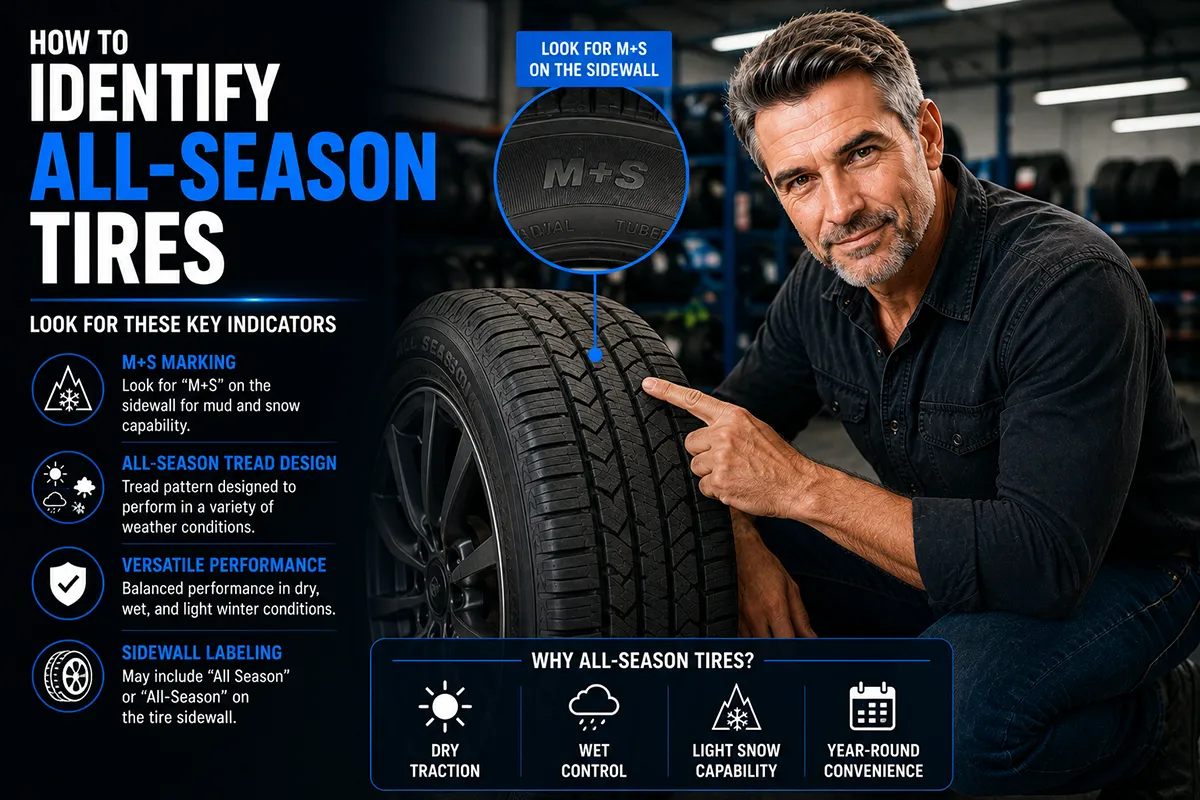
- Look for the M+S (Mud and Snow) marking on the sidewall — it’s the baseline identifier for all season tires.
- The 3PMSF (Three-Peak Mountain Snowflake) symbol means the tire meets a higher winter traction standard, but it doesn’t automatically make it a winter tire.
- All season tires have moderate tread depth (typically 10/32″ to 11/32″), symmetrical or asymmetrical tread patterns, and circumferential grooves for water evacuation.
- Don’t rely on marketing names alone — always check the sidewall codes and the tire’s UTQG ratings.
- True all season tires balance dry grip, wet traction, light snow handling, and tread life — they’re the jack-of-all-trades of the tire world.
Liked this article?
Add TireAdvise as a preferred source so you see more of our tire reviews and guides on Google.
Why Identifying All Season Tires Actually Matters
Buying the wrong tire category isn’t just a minor inconvenience — it can genuinely compromise your safety. I’ve personally tested tires across every major category over the years, and the performance gap between a true all season tire and a summer tire in cold, wet conditions is dramatic.
If you live in a region that experiences all four seasons — which describes a huge swath of the US from the Mid-Atlantic through the Midwest — you need a tire that can handle hot summer pavement, fall rain, light winter snow, and spring storms. That’s exactly what all season tires are designed to do.
But here’s the problem: tire manufacturers use terms like “all weather,” “all terrain,” “all season,” and “four season” somewhat loosely. Without knowing how to read the actual tire, you’re relying on marketing copy and a salesperson’s pitch.
The Sidewall Is Your Best Friend: Key Markings to Look For
Every tire tells you exactly what it is — if you know where to look. The sidewall of a tire is essentially its birth certificate, ingredient list, and performance resume all rolled into one. Let me walk you through every marking that matters.
The M+S Symbol
The most fundamental identifier of an all season tire is the M+S marking (sometimes written as M/S, M&S, or spelled out as “Mud and Snow”). You’ll find this stamped into the rubber on the sidewall, usually near the bead area or close to the size designation.
In my experience inspecting hundreds of tires, this marking appears on virtually every all season tire sold in the US market. It tells you the tire meets the Rubber Manufacturers Association (RMA) definition for mud and snow traction based on its tread design geometry.
However — and this is important — the M+S rating is a design-based standard, not a performance-based one. It means the tread pattern has sufficient void area and groove geometry to theoretically provide traction in light mud and snow. It does not mean the tire was actually tested in snow.
The Three-Peak Mountain Snowflake (3PMSF) Symbol
This is where things get interesting. The 3PMSF symbol — a snowflake inside a mountain outline — indicates the tire has passed an actual traction test on packed snow. It must demonstrate at least 10% better traction than a standard reference test tire.
Here’s what surprises most people: a growing number of all season tires now carry both the M+S and 3PMSF symbols. Tires like the Michelin CrossClimate2 and Continental TrueContact Tour fall into this category. I’ve tested both extensively, and they genuinely do offer better cold-weather grip than traditional all season tires.
So if you see the 3PMSF symbol, don’t automatically assume it’s a dedicated winter tire. Check the other markings and the manufacturer’s category designation too.
The UTQG Rating
The Uniform Tire Quality Grading (UTQG) system is a US Department of Transportation requirement that rates every passenger tire sold in the US on three metrics: treadwear, traction, and temperature resistance.
Here’s how to use UTQG ratings to help identify an all season tire:
- Treadwear: All season tires typically score between 400 and 800. Summer performance tires often score 200-400, while budget touring tires may score 700+. A very high treadwear number (800+) suggests a highway touring tire rather than a true all season.
- Traction: Look for A or AA. All season tires almost always score at least A for wet traction. A score of B might indicate a budget tire that won’t perform well in rain.
- Temperature: Most all season tires score A or B. This measures the tire’s ability to dissipate heat at speed.
In my testing, I’ve found that UTQG ratings are a helpful screening tool but shouldn’t be your only data point. They’re standardized but self-reported by manufacturers, so there’s some variability in how different brands test.
The Tire Size and Speed Rating
The tire size code itself can offer clues. For example, a tire labeled 225/60R16 98H breaks down into width, aspect ratio, construction type, wheel diameter, load index, and speed rating.
All season tires for everyday passenger vehicles typically carry speed ratings of H (130 mph), T (118 mph), or V (149 mph). If you see a W or Y speed rating, you’re likely looking at a summer performance or ultra-high-performance all season tire designed for sports cars and performance sedans.
The speed rating alone doesn’t confirm a tire’s category, but it helps narrow things down. In my experience, the most common all season tires for sedans, SUVs, and crossovers fall in the T to V speed rating range.
Tread Pattern: What All Season Tires Look Like
Beyond sidewall markings, the tread pattern itself is one of the most reliable visual ways to identify an all season tire. After spending years comparing tread designs across categories, I can usually tell the tire type just by glancing at the tread face.
Circumferential Grooves
All season tires almost always feature three or four deep circumferential grooves — the long channels that run around the entire tire in the direction of travel. These grooves are critical for channeling water away from the contact patch to resist hydroplaning.
Summer performance tires may have fewer or shallower circumferential grooves because they prioritize maximum rubber-to-road contact. Winter tires also have circumferential grooves, but theirs are accompanied by far more aggressive lateral channels and siping.
Siping
Sipes are the tiny slits cut into the tread blocks. All season tires have moderate siping — more than a summer tire, but significantly less than a dedicated winter tire.
When I compare an all season tire like the Goodyear Assurance WeatherReady to a winter tire like the Bridgestone Blizzak WS90, the difference in sipe density is immediately obvious. The winter tire looks almost feathery with sipes, while the all season tire has a cleaner, more structured appearance.
Tread Block Design
All season tires typically use symmetrical or asymmetrical tread patterns. Symmetrical patterns (where the inner and outer halves mirror each other) are common on touring all season tires. Asymmetrical patterns (different designs on the inner and outer portions) show up on performance-oriented all season tires.
Directional (V-shaped) tread patterns are less common on all season tires but do exist. They’re more typical of winter tires and some performance summer tires. If you see a strongly directional V-pattern, investigate further before assuming it’s all season.
Tread Depth
New all season tires typically ship with a tread depth between 10/32″ and 11/32″ of an inch. Some premium models go up to 12/32″.
For comparison, summer performance tires often start around 8/32″ to 10/32″, while winter tires range from 11/32″ to 13/32″. If you have a tread depth gauge (I keep one in my glove box — they cost about $5 at any auto parts store), measuring the tread can help confirm what type of tire you’re dealing with.
All Season vs. Other Tire Types: A Visual Comparison
I find that the best way to understand all season tires is to compare them directly against the other major categories. Here’s a comparison table I put together based on my hands-on testing experience across all four categories:
| Feature | Summer Tire | All Season Tire | All Weather Tire | Winter Tire |
|---|---|---|---|---|
| M+S Marking | No | Yes | Yes | Yes |
| 3PMSF Symbol | No | Sometimes | Yes | Yes |
| Sipe Density | Minimal | Moderate | Moderate-High | Very High |
| Circumferential Grooves | 2-3, shallow | 3-4, deep | 3-4, deep | 3-4, very deep |
| Typical Tread Depth (New) | 8/32″ – 10/32″ | 10/32″ – 11/32″ | 10/32″ – 12/32″ | 11/32″ – 13/32″ |
| Rubber Compound | Hard, heat-resistant | Medium flexibility | Medium-soft | Very soft, cold-optimized |
| Optimal Temp Range | Above 45°F | 20°F to 100°F+ | Below freezing to 90°F | Below 45°F |
| UTQG Treadwear | 200-400 | 400-800 | 400-700 | Not rated / low |
| Speed Rating (Typical) | W, Y, Z | T, H, V | T, H, V | Q, S, T |
This table covers the broadest generalizations. There are always exceptions, but in my experience these patterns hold true about 90% of the time across the major brands I encounter.
The Rubber Compound: What You Can’t See But Can Feel
One thing that won’t show up on any sidewall marking is the rubber compound, and it’s arguably the most important difference between tire categories.
All season tires use a medium-flexibility compound designed to remain pliable across a wide temperature range — roughly from the low 20s Fahrenheit up past 100°F. This is a carefully engineered compromise.
Summer tires use harder compounds that grip best when hot but turn nearly rigid in cold weather. I’ve personally felt the difference during early morning drives in November — a summer tire feels almost like driving on hockey pucks when temps drop below 40°F.
Winter tires go the opposite direction with very soft, silica-rich compounds that stay flexible well below freezing but wear rapidly in warm weather. During a summer test period, I watched a set of winter tires develop visible wear patterns in just a few days of normal driving — they’re simply not designed for heat.
You can sometimes get a rough sense of compound softness by pressing your thumbnail into the tread. A summer tire feels firm and resistant. An all season tire gives slightly. A winter tire feels noticeably softer. It’s not scientific, but it’s a useful trick I use when I’m at a tire shop and want a quick comparison.
Common All Season Tire Sub-Categories
Here’s where identification gets a bit more nuanced. Not all “all season” tires are created equal. The category has several sub-types, and understanding them will help you choose the right tire for your specific needs.
Standard Touring All Season
This is the most common all season tire on American roads. It prioritizes comfort, low road noise, and long tread life over aggressive performance. Examples include the Michelin Defender2, Cooper Endeavor, and Firestone WeatherGrip.
I’ve driven on the Defender2 for an extended period, and it’s the kind of tire that you forget about — in the best way. It’s quiet, smooth, and handles rain confidently. It won’t thrill you on a mountain switchback, but that’s not what it’s designed for.
These tires typically have symmetrical tread patterns, UTQG treadwear ratings above 600, and speed ratings of T or H.
Grand Touring All Season
A step up in performance from standard touring. Grand touring all season tires offer better handling response and cornering grip while still maintaining good ride comfort. The Continental PureContact LS and Michelin Primacy MXM4 are classic examples.
These often carry V speed ratings and have asymmetric tread patterns. I notice the difference most on highway on-ramps and sweeping curves — there’s more confidence and feedback through the steering wheel compared to standard touring tires.
High Performance All Season
These are designed for sportier vehicles — think Mustangs, Camaros, 3-Series BMWs, and similar cars. They sacrifice some tread life and cold-weather capability for sharper dry handling and higher speed capability.
The Continental ExtremeContact DWS 06 Plus and Michelin Pilot Sport All Season 4 fall in this category. I’ve tested both, and they genuinely feel like a different class of tire. The steering response is more immediate, the lateral grip in corners is noticeably higher, and they’re rated for much higher speeds.
The tradeoff? They’ll wear faster and won’t perform as well when temperatures drop below freezing. If you live in Minnesota, these probably aren’t your best choice.
All Weather (The Newer Sub-Category)
I want to specifically address all weather tires because they cause a lot of confusion. All weather tires are essentially all season tires with enhanced winter capability. They carry both the M+S marking and the 3PMSF symbol.
The Michelin CrossClimate2 and Nokian WR G4 are the most popular examples in the US market. I’ve driven extensively on the CrossClimate2, and it’s the closest thing to a do-everything tire I’ve ever tested. It handles summer heat well, provides solid wet traction, and offers genuinely usable grip in moderate snow.
These tires sit in a fascinating middle ground. They’re not as good as dedicated winter tires in heavy snow, and they’re not as sharp as performance all season tires on dry pavement. But for drivers who want a single set of tires year-round and encounter occasional winter weather, they’re a compelling option.
How to Verify a Tire’s Category Before You Buy
Now let me give you a practical, step-by-step approach that I personally use when helping friends and family shop for tires.
Step 1: Check the Manufacturer’s Website
Go directly to the tire manufacturer’s product page. Every major brand — Michelin, Goodyear, Bridgestone, Continental, Pirelli, Hankook, Kumho, Cooper — clearly labels each tire model by category. Look for the words “All Season,” “Grand Touring All Season,” or “All Season Passenger.”
Don’t rely on retailer websites alone. I’ve seen tires miscategorized on third-party retail sites more times than I can count.
Step 2: Read the Sidewall
If you’re looking at a tire in person — whether at a tire shop, in a warehouse, or already mounted on a used car you’re buying — go straight to the sidewall. Look for:
- The M+S marking (confirms all season design)
- The 3PMSF symbol (indicates enhanced winter capability)
- The UTQG ratings (treadwear, traction, temperature)
- The speed rating (embedded in the size code)
Step 3: Look at the Tread
Visually inspect the tread pattern. You’re looking for:
- Three or four circumferential grooves
- Moderate siping in the tread blocks
- A relatively uniform, structured tread block layout
- No extreme directional V-patterns (which suggest winter or performance summer)
Step 4: Cross-Reference the DOT Code
The DOT code on the sidewall tells you where and when the tire was manufactured. While it doesn’t directly tell you the tire category, it’s useful for verifying that the tire matches the manufacturer’s listed specs. The last four digits indicate the week and year of manufacture (e.g., “2324” means the 23rd week of 2024).
I always check this when buying tires to make sure I’m not getting old stock. A tire manufactured more than five years ago deserves scrutiny, even if it’s never been mounted.
Step 5: Check Online Reviews and Tests
Finally, read independent reviews — not just the manufacturer’s claims. Sites like ours at TireAdvise.com, along with resources like Tire Rack’s user reviews and Consumer Reports testing, can confirm whether a tire truly performs as an all season model should.
Red Flags: Signs a Tire Might NOT Be All Season
Let me share some warning signs I’ve learned to watch for over the years.
No M+S Marking
If there’s no M+S stamp on the sidewall, it’s not an all season tire. Period. It’s likely a summer tire, even if the name doesn’t include the word “summer.” Many summer tires have innocuous names that don’t tip you off — the Bridgestone Potenza line, for example, includes both summer and all season models.
Very Aggressive Siping
If the tread blocks are covered in dense, wavy sipes and the tread looks almost “shredded,” you’re probably looking at a winter tire. All season tires have sipes, but they’re more restrained and organized.
Extremely Soft Rubber
As I mentioned earlier, if the rubber feels very soft to the touch, it’s likely a winter compound. All season rubber should feel firm but have slight give.
Low UTQG Treadwear Rating
A treadwear rating below 300 is a strong indicator of either a summer performance tire or a winter tire. All season tires engineered for the US market rarely score that low.
Missing UTQG Rating Entirely
Winter tires are exempt from UTQG testing requirements. If a tire has no UTQG rating on the sidewall, it’s almost certainly a dedicated winter/snow tire.
Real-World Identification: My Personal Approach
Let me tell you how this all comes together in practice. A few weeks ago, a friend asked me to look at a set of used tires he was considering buying from a private seller. The seller described them as “all season performance tires.”
I drove over and inspected the sidewalls. Here’s what I found:
- No M+S marking anywhere on the sidewall
- UTQG rating of 300 treadwear, AA traction, A temperature
- Speed rating of W (168 mph)
- Minimal siping, large tread blocks, two circumferential grooves
These were clearly summer performance tires — specifically, a set of Continental ExtremeContact Sport tires. Great tires for dry and wet summer driving, but they’d be dangerous in cold temperatures and virtually useless on snow.
My friend would have been driving these through a Pennsylvania winter if he’d taken the seller’s word for it. A two-minute sidewall inspection saved him from a potentially dangerous mistake.
Where to Find This Information Without Inspecting the Physical Tire
Not everyone has the tire in front of them when making a buying decision. If you’re shopping online — which most Americans now do for tires — here’s how to verify the category:
- Tire Rack (tirerack.com): Every listing clearly states the tire category and includes sidewall images. I use this as my go-to reference.
- Manufacturer product pages: Always list the official category and provide detailed spec sheets.
- Discount Tire (discounttire.com): Another reliable US retailer with clear category labeling.
- Walmart Auto (walmart.com): Categories are listed, though I’ve occasionally noticed inconsistencies in their tire filtering system. Double-check against the manufacturer’s site.
When shopping online, I recommend searching for the exact tire model name plus “datasheet” or “spec sheet.” Most manufacturers publish detailed PDFs that include every sidewall marking, UTQG rating, available sizes, and the official tire category.
A Quick Note on All Season Tires for Trucks and SUVs
If you drive a pickup truck or SUV — which, let’s be honest, describes a huge percentage of American drivers — the all season identification rules still apply, but there’s an additional category to be aware of: all terrain (A/T) tires.
All terrain tires often carry the M+S marking and sometimes even the 3PMSF symbol, but they’re designed for a very different purpose than standard all season tires. They feature more aggressive tread blocks with larger gaps, designed for off-road traction on dirt, gravel, and rocky surfaces.
I’ve tested tires like the BFGoodrich All-Terrain T/A KO2 and the Falken Wildpeak A/T3W. Both are exceptional for their intended use, but they ride harsher, generate more road noise, and wear differently than a standard all season SUV tire like the Michelin Defender LTX M/S.
If you see very large, chunky tread blocks with wide spacing, that’s likely an all terrain tire rather than a traditional all season — even if it carries the same sidewall markings.
Why This Identification Skill Saves You Money
Beyond safety, knowing how to identify all season tires protects your wallet. Here’s why:
You won’t buy seasonal tires thinking they’re year-round. Summer tires used in winter will wear abnormally and may need premature replacement. Winter tires used in summer will wear out shockingly fast.
You can spot dishonest sellers. Whether it’s a used tire seller on Facebook Marketplace or a shady shop trying to move old inventory, knowing how to read a sidewall keeps you in control.
You’ll buy the right sub-category for your needs. A high-performance all season tire isn’t the best choice for a minivan, and a standard touring tire isn’t ideal for a sporty sedan. Matching the sub-category to your vehicle and driving style means you’ll get more life and better performance from every dollar spent.
In my experience, the average American driver spends between $500 and $1,000 on a set of four all season tires, depending on size and brand. That’s not pocket change. Taking five minutes to verify what you’re buying is a smart investment.
My Final Recommendation
If you take nothing else away from this article, remember these three things:
First, always check the sidewall. The M+S marking is the minimum requirement for an all season tire. If it’s not there, walk away — it’s not all season, no matter what anyone tells you.
Second, consider the 3PMSF symbol a bonus. If you live anywhere that gets snow — even light, occasional snow — an all season tire with the snowflake symbol gives you meaningful extra safety margin. The technology has come a long way, and these tires no longer sacrifice warm-weather performance the way older designs did.
Third, match the sub-category to your life. A commuter in Houston doesn’t need the same all season tire as a commuter in Cleveland. Understanding whether you need standard touring, grand touring, high performance, or all weather all season tires will make you a smarter buyer and a safer driver.
I’ve been doing this for years, and the single biggest upgrade most drivers can make is simply putting the right tire on their car. It doesn’t have to be the most expensive option — it just has to be the right one. And identifying it correctly is where that journey starts.
Frequently Asked Questions
How can I tell if my tires are all-season just by looking at them?
The easiest way to identify all-season tires is to look for the M+S (Mud and Snow) marking on the sidewall, which is stamped near the tire size. You’ll also typically see the words “All Season” or “All Weather” molded into the sidewall by manufacturers like Goodyear, Michelin, and Cooper. Unlike winter tires, all-season tires will not have the Three-Peak Mountain Snowflake (3PMSF) symbol unless they carry an additional severe snow rating.
What does the M+S marking on a tire mean, and does it make the tire all-season?
The M+S (Mud and Snow) marking indicates the tire meets the Rubber Manufacturers Association’s geometric tread pattern standards for mud and light snow traction. While nearly all all-season tires carry the M+S designation, the marking alone doesn’t guarantee strong winter performance — it simply means the tread design meets a basic threshold. For drivers in northern US states dealing with heavy snow, I’d recommend looking for tires that also carry the 3PMSF symbol for true winter capability.
What’s the difference between all-season tires and all-weather tires?
All-season tires are designed for moderate year-round driving conditions including dry roads, light rain, and mild winter weather, and they carry the M+S marking. All-weather tires go a step further by also carrying the Three-Peak Mountain Snowflake symbol, meaning they’re certified for severe snow conditions while still being suitable for summer driving. If you live in a US region like the Midwest or Northeast with unpredictable winters but don’t want to swap to dedicated winter tires, all-weather tires like the Nokian WR G4 or Toyo Celsius II are a solid middle ground, typically priced between $120 and $200 per tire.
Can I identify all-season tires by their tread pattern?
Yes, all-season tires generally have a moderate tread depth (usually 10/32″ to 11/32″ when new) with a symmetrical or asymmetric tread pattern featuring a mix of straight grooves and smaller sipes for water evacuation. Compared to summer tires, which have larger, smoother tread blocks, all-season treads look more segmented with visible siping across the tread face. They won’t have the aggressive, deeply carved lug patterns you’d see on dedicated winter or off-road tires, so if the tread looks balanced and versatile, you’re likely looking at an all-season design.
Where do I find the tire type and specifications on my current tires?
All critical tire information is printed on the sidewall, including the tire size, load index, speed rating, and the tire type designation such as “All Season.” Start by locating the DOT code on the sidewall, then look nearby for M+S markings or the manufacturer’s season designation. You can also cross-reference the model name printed on the tire — for example, Michelin Defender, Goodyear Assurance, or Continental TrueContact — with the manufacturer’s website to confirm whether it’s classified as all-season.
Are all-season tires good enough for winter driving in the US?
All-season tires perform adequately in light snow and cold temperatures common in states like Virginia, Tennessee, or Oregon, but they lose significant traction in heavy snow, ice, and temperatures consistently below 20°F. I’ve found that for most US drivers in moderate climates, a quality all-season tire like the Michelin Defender LTX M/S or Continental TrueContact Tour handles year-round conditions well and costs between $100 and $180 per tire. However, if you regularly drive through harsh winters in states like Minnesota, Wisconsin, or Colorado mountain passes, a dedicated winter tire set is a much safer investment.
How do I know when my all-season tires need to be replaced?
The standard replacement threshold is 2/32″ of remaining tread depth, which you can check using the built-in tread wear indicators — small raised bars sitting inside the tire grooves that become flush with the tread surface when it’s time to replace. However, I recommend replacing all-season tires at 4/32″ if you drive in rain or light snow frequently, since wet traction drops dramatically below that point. Most all-season tires last between 50,000 and 80,000 miles depending on the brand and driving habits, and many popular models from Michelin, Bridgestone, and Cooper come with mileage warranties to help you plan ahead.
