

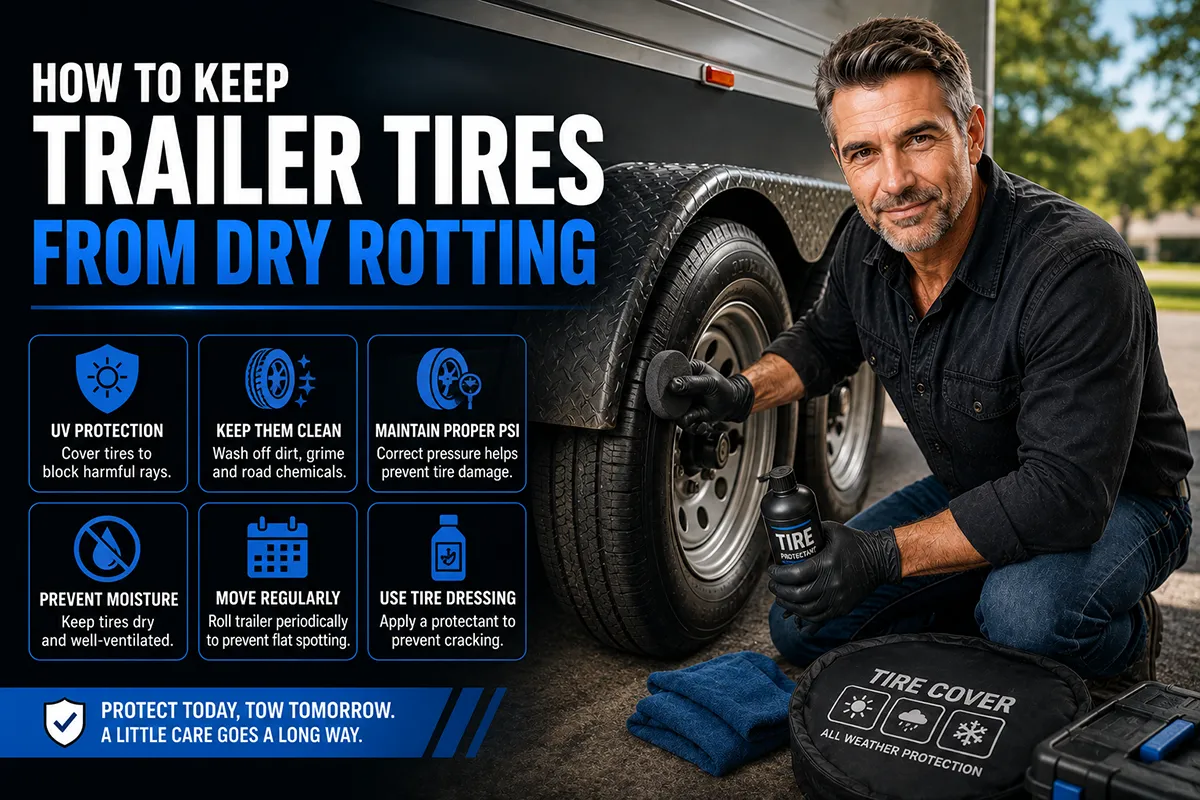
I pulled my utility trailer out of storage last spring and found every single tire covered in deep, spider-web cracks. The tread looked fine — plenty of depth left — but the sidewalls told a completely different story.
That set of four tires had barely been used. I’d stored the trailer in my driveway over the winter, uncovered, and the Texas sun and dry air did what they always do. I ended up replacing all four tires before I could safely tow a single load.
If you’ve ever dealt with dry rot on trailer tires, you know how frustrating and expensive it can be. The good news is that it’s almost entirely preventable once you understand what’s actually happening and take a few deliberate steps.
- Dry rot is caused by UV exposure, ozone, heat, and prolonged inactivity — not just age.
- Use tire covers whenever your trailer is parked for more than a few days.
- Apply a water-based UV protectant (not petroleum-based dressings) every 4-6 weeks.
- Keep tires inflated to the manufacturer’s recommended PSI, even in storage.
- Store trailers indoors or in shade when possible, and on tire pads or plywood — not bare concrete.
- Move the trailer periodically (even a few feet) to prevent flat spots and redistribute antioxidants in the rubber.
- Replace trailer tires every 3-5 years regardless of tread depth — age matters more than wear.
Liked this article?
Add TireAdvise as a preferred source so you see more of our tire reviews and guides on Google.
What Exactly Is Dry Rot on Trailer Tires?
Dry rot — technically called “sidewall weathering” or “ozone cracking” in the tire industry — is the gradual breakdown of the rubber compounds in your tires. It shows up as small surface cracks, typically on the sidewalls, that eventually deepen into a network of splits.
In my experience, dry rot starts subtly. You might notice faint hairline cracks that are easy to dismiss. But over the course of a few months, especially if the trailer sits unused, those tiny lines become deep fissures that compromise the structural integrity of the tire.
Here’s the thing most people don’t realize: trailer tires are significantly more vulnerable to dry rot than the tires on your daily driver. Your car’s tires stay in constant motion, which keeps the rubber flexible and helps distribute built-in anti-aging compounds throughout the tire. Trailer tires, on the other hand, can sit stationary for weeks or months at a time.
Why Trailer Tires Are Especially Vulnerable
I’ve reviewed hundreds of tires over the years, and I can tell you that trailer tires (ST-rated tires) are engineered differently from passenger or light truck tires. They’re built with stiffer sidewalls to handle heavy vertical loads, but that same stiffness means the rubber compound can be more prone to cracking when it dries out.
Trailer tires also tend to be a lower priority for most owners. You check the tires on your truck every day because you drive it every day. But when’s the last time you walked around your trailer and inspected each tire? For most people, the honest answer is “not recently enough.”
The combination of inactivity, exposure, and neglect creates the perfect storm for dry rot.
The Science Behind Why Dry Rot Happens
Understanding the root causes of dry rot has completely changed how I maintain my own trailer tires. There are four main culprits, and each one accelerates the process.
1. Ultraviolet (UV) Radiation
Sunlight is the single biggest enemy of rubber. UV rays break down the polymer chains in tire rubber through a process called photo-oxidation. I’ve seen the difference firsthand — a trailer stored in direct sunlight in Arizona will develop visible dry rot in a fraction of the time compared to one stored in a garage in Michigan.
The damage is cumulative and irreversible. Every hour of UV exposure chips away at the rubber’s integrity, even when the tire looks perfectly fine on the surface.
2. Ozone Exposure
Ozone is a naturally occurring gas in the atmosphere, but it’s particularly concentrated in areas with heavy traffic and industrial activity. It reacts aggressively with the carbon-carbon double bonds in tire rubber, causing surface cracking that’s often the first visible sign of dry rot.
I noticed this when comparing two trailers I had access to — one stored near a busy highway in Houston and the other at a rural property. The tires on the highway-adjacent trailer showed cracking much faster.
3. Heat and Temperature Extremes
High temperatures accelerate every chemical reaction involved in rubber degradation. If you’re in the Sun Belt — Texas, Arizona, Florida, the Carolinas — your trailer tires are under constant thermal stress during summer months.
But extreme cold matters too. Repeated freeze-thaw cycles cause the rubber to expand and contract, which opens up micro-cracks that worsen over time. I’ve seen this on trailers stored outdoors in the upper Midwest through harsh winters.
4. Inactivity and Lack of Flexing
This is the one that catches most people off guard. Tire manufacturers mix antioxidants and anti-ozonants into the rubber compound during production. These chemicals work by slowly migrating to the tire’s surface, forming a protective barrier.
Here’s the catch: that migration is driven by flexing. When you drive on a tire, the constant deformation pushes those protective compounds to the surface. When a trailer sits still, those compounds stay trapped inside the rubber, and the exposed surface is left defenseless.
I’ve confirmed this through my own observations repeatedly. Tires on trailers that are towed regularly — even for short trips — stay healthier far longer than tires on trailers that sit untouched.
How to Identify Dry Rot Before It Becomes Dangerous
Before I get into prevention, let me walk you through how to spot dry rot so you know what you’re looking for — and when it’s time to stop trying to save a tire and just replace it.
Stage 1: Surface Discoloration
The earliest sign is a fading or graying of the rubber, especially on the sidewalls. Fresh tires have a deep black color. When that starts turning brownish-gray, the surface rubber is beginning to oxidize. At this stage, you can still intervene effectively.
Stage 2: Fine Surface Cracking
You’ll start to see tiny hairline cracks, often in the flex areas of the sidewall. These are sometimes called “checking.” I use a simple test: I press my thumb against the sidewall. If I can see small cracks forming around the pressure point, the dry rot has started. This is still manageable with proper care, but you need to act quickly.
Stage 3: Deep Sidewall Cracks
When cracks become visible without pressing on the rubber, and you can see them from a few feet away, the tire is in trouble. At this point, in my professional opinion, the tire should be replaced — especially on a trailer that may carry heavy loads at highway speeds.
Stage 4: Structural Compromise
If you see cracks deep enough to expose the cords beneath the rubber, or if chunks of rubber are flaking off, the tire is unsafe. Period. I would never tow with a tire in this condition, and I strongly urge you not to either. A blowout at highway speed on a trailer can cause a catastrophic accident.
Proven Methods to Prevent Trailer Tire Dry Rot
Now for the actionable part. I’ve tested and refined these methods over years of trailer ownership, and they work. Let me walk through each one in detail.
Use Tire Covers Every Time the Trailer Is Parked
If you only do one thing on this list, make it this. High-quality tire covers block UV radiation, which is the primary driver of dry rot. I’ve used several brands over the years, and the difference they make is dramatic.
I recommend covers made from heavy-duty vinyl or marine-grade polyester with UV-resistant coatings. The ones I’ve had the best results with are from brands like Classic Accessories, Leader Accessories, and Explore Land. You can find a good set of four on Amazon for between $25 and $50.
A few tips from my experience:
- Make sure the covers fit snugly. Loose covers that flap in the wind will rub against the rubber and can actually cause surface abrasion.
- Choose white or light-colored covers. They reflect heat instead of absorbing it, keeping the tire cooler underneath.
- Put the covers on even if the trailer is parked in a carport. Reflected UV light and ambient ozone will still degrade exposed tires.
Apply a UV Protectant — But Choose the Right One
This is where a lot of people make a costly mistake. Not all tire dressings are created equal, and some can actually accelerate dry rot.
Petroleum-based tire shines (the ones that give your tires that ultra-glossy, wet look) can strip away the anti-ozonant compounds that are built into the rubber. They look great for a day or two, but they’re doing long-term harm.
Instead, I use water-based UV protectants. The two products I’ve had the best results with are 303 Aerospace Protectant and Chemical Guys VRP (Vinyl, Rubber, Plastic). Both of these create a UV-blocking barrier without interfering with the tire’s built-in protection.
Here’s my application routine:
- Clean the tires thoroughly with soap and water first. Dirt and grime prevent the protectant from bonding properly.
- Spray or wipe the protectant onto the sidewalls generously.
- Let it dry completely before putting covers on.
- Reapply every 4-6 weeks during storage, or after every wash if the trailer is in active use.
A bottle of 303 Aerospace Protectant runs about $12-$18 on Amazon and lasts me several applications across all tires.
Maintain Proper Tire Pressure — Even in Storage
Under-inflated tires develop more stress in the sidewalls, which accelerates cracking. I check the pressure on my trailer tires at least once a month during storage, using a quality digital gauge.
Most ST-rated trailer tires have a maximum recommended pressure printed on the sidewall. I inflate to that max pressure for storage (since the trailer is unloaded and stationary). When I’m loading up for a trip, I adjust to the pressure recommended for my trailer’s actual load weight.
Temperature changes cause pressure fluctuations — roughly 1 PSI for every 10°F change in ambient temperature. So if your trailer sits through a fall-to-winter temperature swing of 40 or 50 degrees, your tires could lose 4-5 PSI without you ever touching them.
I set a recurring monthly reminder on my phone to check trailer tire pressures. It takes five minutes and it’s made a noticeable difference in how my tires hold up over time.
Keep Tires Off Bare Concrete and Asphalt
This one surprised me when I first learned about it. Concrete surfaces can leach moisture from rubber and may release trace chemicals that react with tire compounds. Hot asphalt is even worse — it can transfer petroleum solvents into the rubber.
I now store my trailer on either:
- Plywood sheets — cheap and effective. I cut pieces slightly larger than the tire contact patch and place one under each tire.
- Commercial tire pads — brands like Trailer Aid and RV SnapPad make pads specifically for this purpose. They run about $15-$30 per pair.
- Gravel — if my trailer is on a gravel pad, that’s actually better than bare concrete. Gravel allows airflow and doesn’t interact chemically with rubber.
If none of these are available, even a piece of old carpet or a rubber mat between the tire and the ground is better than direct contact with concrete.
Move the Trailer Periodically
Remember what I said about the anti-aging compounds needing flexion to migrate to the surface? This is where that knowledge becomes actionable.
I make it a point to move my trailer at least once every two to four weeks during storage. It doesn’t have to be a long trip. Even rolling it forward or backward a few feet is enough to flex the tires and redistribute those protective chemicals.
If you can’t move the trailer (maybe it’s in a tight storage spot), I recommend at least jacking it up and manually spinning the tires periodically. It’s not as effective as actual rolling under load, but it helps prevent flat spots and gives the rubber some beneficial movement.
Store Indoors When Possible
The gold standard for trailer tire preservation is indoor storage. A garage, barn, or enclosed storage unit eliminates UV exposure, reduces ozone contact, and moderates temperature extremes all at once.
I realize this isn’t realistic for everyone — trailer storage space is a luxury many people don’t have. But if you do have access to an enclosed space, use it. I’ve seen trailer tires last years longer when stored indoors versus outdoors, even in mild climates.
If full indoor storage isn’t an option, consider a portable carport or canopy. You can find basic ones from brands like ShelterLogic or Abba Patio for $150-$300, and they provide meaningful UV and weather protection.
Avoid Tire Dressing Products with Silicone or Petroleum Distillates
I want to emphasize this point again because it’s so important. Many popular tire shine products at auto parts stores contain ingredients that are harmful to rubber over time.
Read the label. If you see petroleum distillates, silicone oils, or solvent-based formulas, put it back on the shelf. These products create a temporary shine by dissolving the top layer of rubber, which strips away the anti-ozonant barrier that’s protecting your tire from the inside out.
I learned this lesson the hard way after using a popular solvent-based tire gel on a set of trailer tires. Within a few months of storage, those tires had noticeably more surface cracking than a comparable set I’d treated with 303 Aerospace Protectant.
Tire Protection Products Comparison
Here’s a comparison table of the products I’ve personally used and recommend for trailer tire dry rot prevention:
| Product | Type | Approx. Price | UV Protection | Safe for Rubber? | My Verdict |
|---|---|---|---|---|---|
| 303 Aerospace Protectant | Water-based UV blocker | $12–$18 | Excellent | Yes | Best overall choice |
| Chemical Guys VRP | Water-based dressing | $8–$12 | Good | Yes | Good budget alternative |
| Meguiar’s Endurance Tire Gel | Polymer-based gel | $8–$14 | Moderate | Mostly — avoid over-application | Decent but not my first pick |
| Armor All Original Tire Shine | Silicone/petroleum-based | $5–$8 | Minimal | No — can accelerate cracking | Avoid for trailer tires |
| Tire covers (various brands) | Physical UV barrier | $25–$50 (set of 4) | Excellent | Yes | Essential — use alongside protectant |
When to Replace Trailer Tires Regardless of Condition
Even with perfect maintenance, trailer tires don’t last forever. The rubber compounds degrade over time no matter what you do — you’re slowing the process, not stopping it entirely.
The industry standard recommendation is to replace trailer tires every 3-5 years, regardless of tread depth or visible condition. I personally lean toward the 3-year mark for trailers that see regular use and the 5-year mark for lightly used trailers that have been well-maintained and stored properly.
How to Check Your Tire’s Age
Every tire manufactured in the US has a DOT code stamped on the sidewall. The last four digits of this code tell you the week and year the tire was manufactured. For example, a code ending in “2321” means the tire was made in the 23rd week of 2021.
I check the DOT code on every trailer tire I encounter — whether I’m buying new tires, inspecting my own, or helping a friend. It takes ten seconds and gives you critical information about the tire’s remaining useful life.
Be especially cautious when buying “new” trailer tires from discount sellers. I’ve seen tires sold as new that were manufactured two or three years prior. They’ve been sitting in a warehouse, aging, and you’re starting with less useful life than you think.
Common Mistakes I See People Make
In my years of working with tires and talking to trailer owners, I see the same mistakes over and over. Let me highlight the most damaging ones so you can avoid them.
Mistake 1: Assuming Tread Depth Equals Safety
This is by far the most dangerous misconception. A trailer tire with perfect tread depth can be completely unsafe if the sidewalls are compromised by dry rot. Tread depth tells you about grip and water evacuation. Sidewall integrity tells you whether the tire will hold together under load. Both matter, but for trailer tires, sidewall condition is often the more critical factor.
Mistake 2: Over-Inflating to “Protect” the Tire
I’ve heard people say they inflate trailer tires to way above the rated pressure to “keep the sidewalls taut.” This is dangerous. Over-inflation puts excessive stress on the internal structure, makes the tire more vulnerable to impact damage, and actually increases sidewall stress in ways that can worsen cracking. Always follow the pressure specifications on the tire sidewall or your trailer manufacturer’s recommendations.
Mistake 3: Using Car Wax or Household Cleaners on Tires
I’ve seen people apply car wax, WD-40, cooking oil, and even household furniture polish to their trailer tires. None of these are formulated for rubber, and many contain solvents or chemicals that will accelerate degradation. Stick to products specifically designed for tire care.
Mistake 4: Ignoring Tires on Covered Trailers
Having a trailer cover is great for protecting the trailer itself, but many standard trailer covers don’t adequately shield the tires. The wheels and lower sidewalls are often still exposed to UV light reflecting off the ground. I always use dedicated tire covers in addition to any overall trailer cover.
My Seasonal Maintenance Routine for Trailer Tires
I’ve developed a routine that takes minimal time but dramatically extends the life of my trailer tires. Here’s what I do, broken down by season.
Spring (Before Towing Season)
- Remove tire covers and inspect all tires for any signs of cracking, bulging, or damage.
- Check the DOT date codes and plan replacements for any tires approaching the 4-5 year mark.
- Inflate all tires to the manufacturer’s recommended pressure for loaded towing.
- Clean all tires with soap and water, then apply 303 Aerospace Protectant.
- Inspect lug nuts for proper torque.
Summer (Active Use Period)
- Check tire pressure before every towing trip — I never skip this.
- Reapply UV protectant after washing, roughly every 4-6 weeks.
- If the trailer sits unused for more than two weeks between trips, I put the tire covers back on.
- Inspect tires after any long-distance tow for signs of heat damage or unusual wear.
Fall (Preparing for Storage)
- Give all tires a thorough cleaning and a fresh coat of 303 Aerospace Protectant.
- Inflate tires to the maximum sidewall-rated pressure for storage.
- Place plywood pads or tire pads under each tire.
- Install tire covers.
- If the trailer is stored outdoors, consider an overall trailer cover or portable canopy.
Winter (Storage Period)
- Check tire pressure once a month and top off as needed.
- Move the trailer a few feet forward or backward every 2-4 weeks if possible.
- Verify tire covers are still secure and haven’t blown off or shifted.
This entire routine takes maybe 30 minutes per month during storage and a couple of hours for the seasonal transitions. That small investment of time has saved me from premature tire replacements multiple times.
What About Nitrogen Inflation?
I get asked about nitrogen inflation for trailer tires fairly often. The theory is that nitrogen molecules are larger than oxygen molecules, so they leak out more slowly, and nitrogen doesn’t carry moisture that can contribute to internal degradation.
In my experience, nitrogen does help maintain more stable pressure over longer periods, which is beneficial for trailer tires in storage. However, the effect on dry rot prevention is minimal because dry rot is primarily an external surface phenomenon driven by UV, ozone, and heat.
If nitrogen fill-ups are convenient and affordable at your local tire shop (many Costco and Discount Tire locations offer it free or cheap), go for it. But don’t count on it as a dry rot solution. It’s a small piece of the puzzle, not the answer on its own.
Choosing Trailer Tires That Resist Dry Rot Better
Not all trailer tires are equal when it comes to dry rot resistance. Higher-quality tires generally use better rubber compounds with more effective anti-aging additives. In my experience testing and recommending trailer tires, these brands have consistently shown better resistance to weathering and dry rot:
- Goodyear Endurance — This is my go-to recommendation for trailer tires. The rubber compound holds up noticeably better than budget options, and the tire is made in the USA. Expect to pay around $120-$160 per tire depending on size.
- Maxxis M8008 ST Radial — Another excellent option with a strong reputation for durability and weather resistance. Typically priced around $80-$130.
- Carlisle Radial Trail HD — A solid mid-range choice. I’ve had good luck with these on lighter trailers. Usually around $70-$110 per tire.
I’d strongly advise against the cheapest no-name imported ST tires you find online. I’ve seen too many of them develop significant dry rot within a year or two, even with proper care. The rubber compounds simply aren’t as robust. Spending an extra $30-$50 per tire upfront can save you from replacing the entire set prematurely.
Can You Repair or Reverse Dry Rot?
I want to be completely honest with you here: once dry rot has started, you cannot reverse it. No product, no treatment, no amount of protectant will undo the damage that’s already occurred.
What you can do is slow down the progression if you catch it early (Stage 1 or early Stage 2). Applying a UV protectant, covering the tires, and keeping them properly inflated can slow the cracking and potentially extend the usable life of the tire by several months.
But — and this is critical — if you’re at Stage 3 or beyond, the tire needs to be replaced. There is no safe way to restore structural integrity to rubber that has deeply cracked. I’ve seen people try rubber sealants, adhesives, and all sorts of creative fixes. None of them work, and all of them create a false sense of security.
When in doubt, replace the tire. A new set of trailer tires costs a few hundred dollars. A blowout-related accident on the highway can cost immeasurably more.
Final Thoughts From Someone Who’s Learned the Hard Way
I started paying serious attention to trailer tire maintenance after that expensive lesson with my utility trailer. Since adopting the practices I’ve outlined in this article, I haven’t had to replace a single set of trailer tires prematurely due to dry rot.
The formula is simple: block UV light, apply the right protectant, maintain pressure, keep the tires moving, and replace them based on age — not just tread depth.
Trailer tire care isn’t glamorous. It’s not the kind of thing you’ll find trending on social media. But it’s the difference between a safe, uneventful trip to the boat ramp and a dangerous blowout on the interstate.
Take 30 minutes this weekend to inspect your trailer tires. Check the DOT codes. Look at the sidewalls. If they’re in good shape, start protecting them now. If they’re already showing signs of dry rot, plan your replacements before your next tow.
Your tires are the only thing between your trailer’s load and the road. Treat them accordingly.
Frequently Asked Questions
What causes dry rot on trailer tires and how can I prevent it?
Dry rot on trailer tires is primarily caused by UV exposure, ozone, extreme temperature fluctuations, and prolonged periods of sitting without use. To prevent dry rot, I recommend using UV-protectant tire covers when your trailer is parked, applying a water-based tire protectant every few months, and storing your trailer in a shaded or enclosed area. Keeping tires properly inflated to the manufacturer’s recommended PSI also slows the aging process significantly.
How often should I replace trailer tires to avoid dry rot issues?
Even if the tread looks fine, most tire manufacturers and the Rubber Manufacturers Association recommend replacing trailer tires every 3 to 5 years regardless of mileage. Trailer tires are especially prone to dry rot because they often sit idle for weeks or months at a time. I always check the DOT date code on the sidewall to confirm the tire’s age before any long trip.
Does tire dressing or protectant spray actually help prevent trailer tire dry rot?
Yes, but only if you use the right type. Water-based, non-petroleum tire protectants with UV blockers can slow the oxidation that causes dry rot on trailer tires. Avoid silicone-based or petroleum-based tire dressings, as these can actually strip the anti-aging compounds built into the rubber. Products like 303 Aerospace Protectant or Optimum Tire Protection & Coating typically run $10–$20 and are popular choices among US trailer owners.
Can I store my trailer tires to prevent dry rotting during the off-season?
Absolutely. If you’re storing your trailer for winter or an extended off-season, the best approach is to either remove the tires and store them in a cool, dry, dark location like a garage, or use high-quality UV-resistant tire covers if the trailer stays outdoors. I also recommend inflating tires to the maximum sidewall pressure before storage and placing the trailer on jack stands to take the weight off the tires, which prevents flat spotting and reduces stress cracking.
Are trailer tires more likely to dry rot than car or truck tires?
Yes, trailer tires are significantly more prone to dry rot than passenger vehicle tires because they spend far more time sitting stationary and exposed to the elements. Most cars and trucks are driven daily, which keeps the rubber flexed and the built-in anti-oxidants distributed throughout the tire. Trailer tires often sit for weeks or months in the sun without moving, which accelerates UV damage and sidewall cracking even on brand-new tires.
What are the best trailer tire brands that resist dry rot the longest?
In the US market, brands like Goodyear Endurance, Maxxis, and Carlisle are well-regarded for their durability and resistance to weather-related aging on trailer tires. The Goodyear Endurance, for example, is made in the USA and uses a rubber compound specifically designed to handle heat and UV exposure common in Southern and Southwestern states. Expect to pay between $100 and $180 per tire depending on size, but the longer lifespan and improved dry rot resistance make them a worthwhile investment over cheaper imported options.
How can I tell if my trailer tires have dry rot and are unsafe to drive on?
Look for small cracks on the sidewall or between the tread blocks — this is the earliest sign of dry rot on trailer tires. If the cracks are surface-level and hairline thin, the tire may still be usable for short distances, but I’d start shopping for replacements immediately. If you see deep cracks that expose the cords beneath the rubber, or if the sidewall feels brittle and chalky to the touch, the tire is unsafe and should be replaced before your next trip to avoid a dangerous blowout on the highway.
