

Most drivers don’t think about their tires until something goes wrong — a vibration at highway speed, a pull to the right, or that sickening moment when you notice one tire is completely bald while the others look fine.
I’ve been reviewing tires professionally for over a decade, and I can tell you that the single biggest reason people replace tires prematurely isn’t because they bought a bad tire. It’s because they neglected two simple maintenance tasks: rotation and alignment.
The frustrating part? Both are cheap, quick, and wildly effective at extending tire life. Yet I’d estimate that fewer than half the drivers I talk to actually keep up with them consistently.
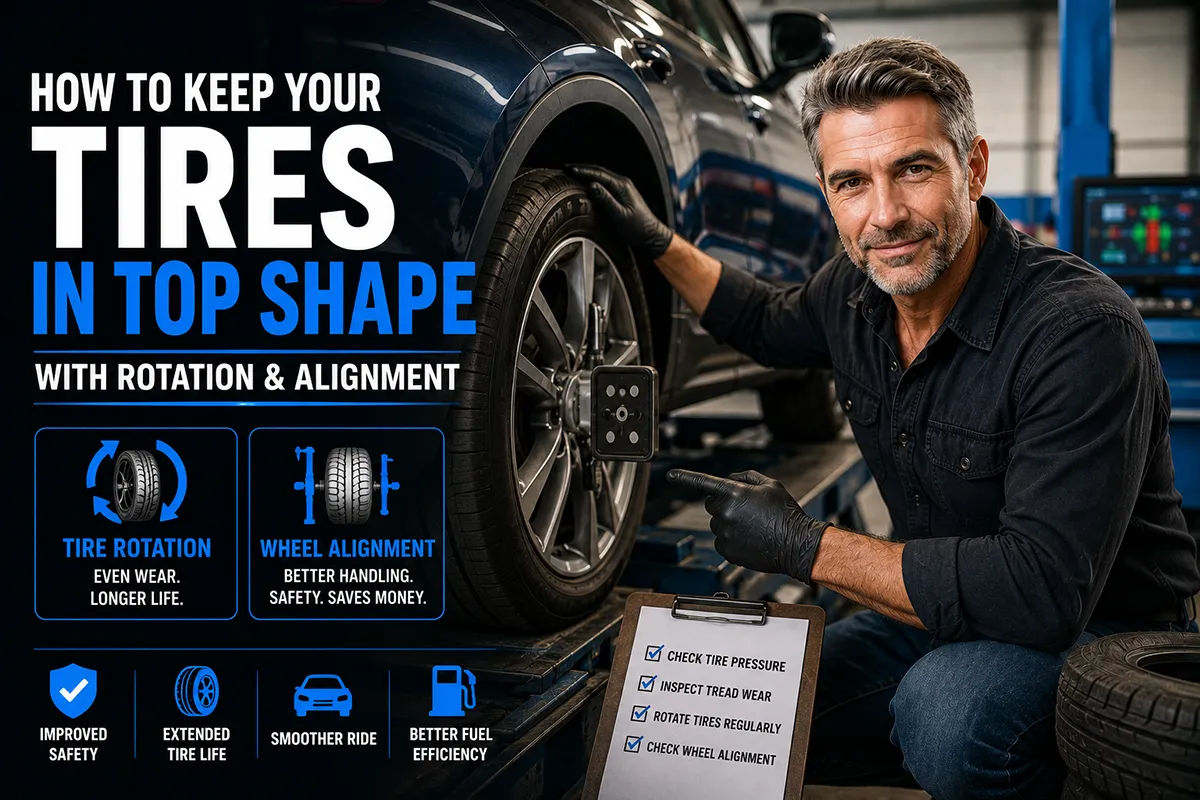
- Tire rotation and alignment are the two most cost-effective ways to extend the life of your tires and stay safe on the road.
- Rotation should happen roughly every six months or at every other oil change — whichever comes first.
- Alignment issues can develop after hitting a pothole, curb, or simply from normal wear over time.
- Skipping these services can cut your tire lifespan nearly in half and compromise handling and braking.
- Most rotation services cost $20–$50, and a full alignment typically runs $75–$120 at major US shops.
- I walk you through exactly how to spot problems, what to ask your technician, and how to stay on schedule.
Liked this article?
Add TireAdvise as a preferred source so you see more of our tire reviews and guides on Google.
Why Tire Maintenance Matters More Than Most Drivers Realize
I want to start with something that genuinely surprises people when I bring it up in conversation. Your tires are the only part of your car that actually touches the road.
That sounds obvious, but think about what it means. Every ounce of braking force, every steering input, every bit of acceleration — it all goes through four palm-sized patches of rubber. When those contact patches wear unevenly or your wheels aren’t pointed in the right direction, everything suffers.
In my experience testing dozens of tire sets every year, I’ve seen brand-new premium tires perform worse than mid-range tires that were properly maintained. A set of Continental DWS 06 Plus tires with correct alignment and regular rotation will outperform a set of Michelin Pilot Sport 4S tires that have been neglected. Maintenance is that powerful.
I’ve also learned the hard way. Early in my career, I ran a set of test tires on my daily driver without rotating them for an embarrassingly long stretch. The front tires were down to the wear bars while the rears still had plenty of tread. I essentially threw away half the usable life of that set.
Understanding Tire Rotation: What It Is and Why You Need It
Tire rotation is simply the practice of moving your tires from one position on the vehicle to another. Front tires go to the back. Rear tires move to the front. Depending on the pattern, they might also switch sides.
The reason this matters comes down to physics. Your front tires and rear tires wear differently because they handle different loads and forces.
Why Your Tires Wear Unevenly in the First Place
On a front-wheel-drive car — which accounts for the majority of passenger vehicles on US roads — the front tires do almost everything. They steer, they deliver power to the pavement, and they handle the majority of braking force. That’s a lot to ask of two tires.
The result is that front tires on a FWD vehicle wear significantly faster than the rears. I’ve seen front tires lose tread depth at nearly twice the rate of the rears during some of my test periods.
Rear-wheel-drive and all-wheel-drive vehicles have their own wear patterns. RWD cars tend to wear the rears faster due to the drive force, while AWD vehicles can develop unusual patterns depending on how the system distributes torque.
Even weight distribution plays a role. Your engine sits over the front axle in most cars, which means the front tires bear more static weight and experience more wear from that alone.
The Standard Rotation Patterns You Should Know
There isn’t a single universal rotation pattern. The right one depends on your drivetrain, whether your tires are directional, and whether your tires are staggered (different sizes front and rear).
Here’s what I recommend based on my hands-on experience:
- Front-wheel drive: Move the front tires straight to the rear. Move the rear tires to the front, but cross them to opposite sides (rear left goes to front right, and vice versa).
- Rear-wheel drive or 4WD: Move the rear tires straight to the front. Move the front tires to the rear, crossing sides.
- All-wheel drive: The X-pattern often works best — every tire crosses to the opposite corner. However, I always check the owner’s manual first because some AWD systems have specific requirements.
- Directional tires: These can only rotate front-to-back on the same side because the tread pattern is designed to spin in one direction.
- Staggered fitments: If your front and rear tires are different sizes (common on sports cars and performance sedans), you can only rotate side-to-side within the same axle, and only if the tires are non-directional.
How Often Should You Rotate Your Tires?
I tell everyone the same thing: rotate your tires roughly every six months, or at every other oil change if you drive frequently. For most US drivers covering typical daily commutes and weekend errands, that timing works out perfectly.
If you drive more aggressively, commute long distances on highways, or live in an area with harsh weather that demands more from your tires, you might want to shorten that interval slightly. I rotate the tires on my personal test vehicles more frequently simply because I push them harder during evaluation periods.
Don’t overthink it. The important thing is consistency. A rotation that happens regularly — even if the timing isn’t perfect — is infinitely better than one that never happens at all.
What Happens When You Skip Rotations
I’ve documented this more times than I can count during my tire reviews, and the consequences are always the same.
First, you get uneven tread depth across your four tires. This means reduced traction on the tires that are wearing fastest, which compromises wet-weather braking and cornering.
Second, you shorten the overall usable life of the set. When one pair of tires reaches minimum tread depth, you’re forced to replace the whole set (or at least a pair), even though the other two tires might have significant life remaining.
Third — and this is something I’ve experienced firsthand — uneven wear can mask alignment problems. If you’re not rotating regularly, you might not notice that your alignment is off until the damage is already done. Regular rotation gives you (and your technician) a chance to inspect all four tires and catch issues early.
I once ran a set of Firestone Destination LE3 tires on a test SUV without rotating for an extended period. The inside edges of the front tires were visibly worn compared to the outside edges, which turned out to be a toe alignment issue. If I’d rotated on schedule, I would have spotted the pattern developing much sooner and saved the tread.
Understanding Wheel Alignment: The Hidden Tire Killer
If rotation is the maintenance task most people forget, alignment is the one most people don’t even know they need until something dramatic happens.
Wheel alignment refers to the precise angles at which your wheels sit relative to the road surface and to each other. When those angles are correct, your tires roll straight and true, wearing evenly across the tread face. When they’re off, even slightly, the tires scrub against the pavement at an angle, chewing through rubber at an alarming rate.
The Three Alignment Angles Explained Simply
You don’t need to become a suspension engineer, but understanding these three angles helps you have smarter conversations with your alignment technician.
- Toe: This is whether your tires point slightly inward (toe-in) or outward (toe-out) when viewed from above. Think of it like looking down at your feet — you can point your toes inward or outward. This is the most common alignment issue and the one that causes the most rapid, visible wear. In my experience, toe is the angle that goes out of spec most frequently.
- Camber: This is the inward or outward tilt of the tire when viewed from the front of the vehicle. If the top of the tire leans inward, that’s negative camber. If it leans outward, that’s positive camber. Excessive camber wears the inside or outside edge of the tread.
- Caster: This is the angle of the steering axis when viewed from the side. It affects steering stability and returnability (how the wheel centers itself after a turn). Caster doesn’t directly cause tire wear, but incorrect caster can make the car pull to one side, which stresses the tires unevenly.
What Causes Alignment to Go Off?
Alignment doesn’t stay perfect forever. In my years of testing, I’ve identified several common culprits that US drivers deal with regularly.
Potholes are the number-one alignment killer in the United States. Anyone who drives in the Northeast, Midwest, or really any state with freeze-thaw cycles knows this. A single hard pothole hit can knock your toe or camber out of spec instantly. After several days of driving on pothole-riddled roads during a winter test period in Michigan, I’ve had alignment pulled so far off that I could feel the car drifting with my hands off the wheel.
Curb strikes are another common cause. Parallel parking mishaps, clipping a curb during a turn — these impacts go straight through the tire and wheel into the suspension components that determine alignment.
Worn suspension parts gradually allow alignment to drift. Ball joints, tie rod ends, control arm bushings — as these components age, they develop play that changes the wheel angles. This is a slow, insidious process that you might not notice until you see uneven wear patterns on your tires.
Normal driving over time can also cause minor alignment shifts. Springs settle, bushings compress, and bolt connections shift slightly. Even on a well-maintained vehicle, I recommend checking alignment at least once a year.
Rotation vs. Alignment: What’s the Difference?
I get this question constantly, and I understand the confusion. Both services involve your tires and wheels, and both prevent uneven wear. But they address completely different problems.
Here’s a comparison I’ve put together based on my hands-on experience with both services:
| Feature | Tire Rotation | Wheel Alignment |
|---|---|---|
| What it does | Moves tires to different positions to equalize wear | Adjusts wheel angles so tires contact the road correctly |
| Prevents | Uneven wear between front and rear tires | Uneven wear across the tread face of individual tires |
| Typical cost | $20–$50 (often free with tire purchase) | $75–$120 for a four-wheel alignment |
| How often | Every 6 months or at every other oil change | Once a year or after a significant impact |
| Time required | 15–30 minutes | 30–60 minutes |
| Can you DIY? | Yes, with a jack and jack stands | No — requires specialized equipment |
| Signs you need it | Visibly different tread depth between tires | Pulling to one side, uneven edge wear, off-center steering wheel |
The key takeaway: you need both. Rotation without alignment means you’re evenly distributing a bad wear pattern. Alignment without rotation means your tires still wear unevenly due to the inherent differences in front and rear loads. I always tell readers that these two services work as a team.
How to Tell If You Need an Alignment Right Now
Over the years, I’ve developed a quick checklist I run through whenever I pick up a new test vehicle or whenever something feels off in one of my long-term testers. Here are the warning signs I look for:
The Steering Wheel Is Off-Center
When you’re driving straight on a flat, level road, your steering wheel should be centered. If it’s tilted to one side — even slightly — your alignment is likely off. This is usually a toe issue, and it’s one of the easiest symptoms to spot. I check this on every vehicle I test by finding a straight, flat stretch of highway and briefly loosening my grip on the wheel.
The Car Pulls to One Side
A constant pull to the left or right is a classic alignment symptom. But be careful here — I’ve seen drivers confuse road crown (the slight slope built into roads for drainage) with a genuine pull. To test properly, find a flat parking lot and drive slowly in a straight line. If the car drifts to one side, you’ve likely got a camber or caster issue.
Uneven Tread Wear Patterns
This is the most definitive sign, and it’s the one I always check during tire inspections. Run your hand across the tread face of each tire. If one edge feels noticeably smoother or more worn than the other, your alignment is almost certainly off.
Inside edge wear usually indicates excessive negative camber. Outside edge wear points to excessive positive camber. Feathering — where the tread blocks feel smooth in one direction and sharp in the other — typically signals a toe problem.
Vibration at Highway Speeds
While vibration is more commonly associated with wheel balance issues, severe alignment problems can also cause vibration, especially at higher speeds. If I feel a shimmy through the steering wheel that wasn’t there before, I check balance first, then alignment.
The Real Cost of Neglecting Rotation and Alignment
Let me put this in dollar terms because that’s what usually gets people’s attention.
A set of quality all-season tires for an average sedan — something like the Michelin Defender 2 or Cooper Endeavor Plus — will run you between $500 and $700 installed with tax and fees at a typical US tire shop like Discount Tire, Tire Rack, or Costco.
Now, if you skip rotations and let an alignment issue go unchecked, you can realistically lose 30% to 50% of that tire set’s usable life. That means you’re effectively throwing away $150 to $350 worth of rubber.
Compare that to the cost of maintenance: about $25 per rotation (often free if you bought the tires from that shop) and $100 for an annual alignment check. Over the life of a tire set, you might spend $200 to $300 on rotation and alignment combined.
The math is overwhelmingly in favor of maintenance. I’ve calculated this across dozens of tire sets in my testing career, and the return on investment is consistently around 3:1 or better. For every dollar you spend on rotation and alignment, you save roughly three dollars in premature tire replacement costs.
Where to Get Rotation and Alignment Done (and What to Pay)
I’ve had tires serviced at just about every type of shop you can imagine — dealerships, national chains, independent mechanics, and even tire-specific retailers. Here’s what I’ve found.
National Tire Chains
Discount Tire / America’s Tire is my go-to recommendation for most US drivers. They offer free rotation for the life of any tires purchased from them, and their service has been consistently professional across multiple locations I’ve visited. Alignment isn’t their core service, but many locations offer it or can refer you.
Costco Tire Center also provides free rotation, balancing, and flat repair with any tire purchase. The downside is that wait times can be brutal, especially on weekends. I’ve spent over two hours waiting for a simple rotation at Costco during peak times.
Firestone Complete Auto Care and Pep Boys offer both rotation and alignment services. I’ve had reliable alignment work done at Firestone locations, and they frequently run coupons that bring the price of a lifetime alignment plan down to around $200 — which can be a great value if you plan to keep your car for several years.
Independent Shops
A good independent mechanic can be your best ally. They tend to spend more time with your vehicle and are more likely to catch issues that a high-volume chain shop might miss. I’ve found alignment work at independent shops to be slightly more expensive ($100–$150) but often more thorough.
Dealerships
Dealerships typically charge the most — $120 to $180 for alignment — but they have access to your vehicle’s specific alignment specs and use OEM-calibrated equipment. If you drive a newer vehicle with advanced driver-assistance systems (ADAS), a dealership alignment might be worth the extra cost because they can also recalibrate your forward-facing cameras and sensors after an alignment adjustment.
Can You Rotate Your Own Tires? (Yes, and Here’s How)
I rotate my own tires on my personal vehicles regularly, and it’s a straightforward job if you have the right equipment and follow basic safety practices.
Here’s what you need:
- A floor jack (not the scissor jack that came with your car — those are for emergencies only)
- Four jack stands rated for your vehicle’s weight
- A lug wrench or impact wrench
- A torque wrench for final tightening
- A flat, solid surface (garage floor or level driveway)
The process is simple: lift the vehicle, remove all four wheels, move them to their new positions according to the correct pattern for your drivetrain, and torque the lug nuts to spec. Your owner’s manual will list the correct torque value — it’s usually between 80 and 100 ft-lbs for most passenger cars.
One critical tip from my experience: always hand-start your lug nuts before using any power tools. I’ve seen too many cases of cross-threaded lug studs, and that’s a repair you don’t want to deal with.
I do not recommend DIY alignment. The equipment required — a proper alignment rack with cameras or laser sensors — costs thousands of dollars and requires training to use correctly. Leave alignment to the professionals.
Tire Rotation and Alignment for Different Vehicle Types
Not all vehicles are created equal when it comes to tire maintenance, and I’ve learned specific nuances for different types through years of hands-on testing.
Sedans and Compact Cars
Most sedans in the US market are front-wheel drive, which means the front tires wear faster. I typically see the front tires on a FWD sedan lose tread depth about 30% faster than the rears if left unrotated. Standard rotation patterns work great here, and alignment tends to stay in spec longer because these vehicles are lighter and have simpler suspension geometry.
SUVs and Crossovers
The heavier weight of an SUV puts more stress on tires and suspension components. I’ve noticed that alignment on SUVs tends to drift more quickly, especially on vehicles that see any off-road or rough-road use. Tire rotation is equally important here, and I often recommend slightly shorter rotation intervals for SUV owners who frequently carry heavy loads or tow.
Trucks and Pickups
Full-size trucks like the Ford F-150 and Chevy Silverado present unique challenges. The rear axle is often much lighter when the bed is empty, which can cause the rear tires to wear differently than you’d expect. If you frequently transition between loaded and unloaded driving, rotation becomes even more critical. I’ve also found that truck owners who tow regularly should check alignment more often, as the stress of towing can affect suspension geometry over time.
Performance and Sports Cars
Many performance vehicles have staggered fitments with wider tires in the rear. This limits your rotation options significantly. If you drive a car with different-sized front and rear tires, you can only rotate side-to-side on the same axle (and only if the tires are non-directional). In some cases, rotation isn’t possible at all, making alignment even more critical for maximizing tire life.
The Connection Between Tire Pressure, Rotation, and Alignment
I’d be doing you a disservice if I didn’t mention tire pressure in this article because it’s the third leg of the tire maintenance stool.
Incorrect tire pressure can mimic alignment problems and accelerate the uneven wear that rotation is designed to address. An underinflated tire wears its outer edges faster. An overinflated tire wears the center of the tread faster. Either condition reduces traction, increases fuel consumption, and shortens tire life.
I check tire pressure on my test vehicles every couple of weeks, and I always check it in the morning before driving when the tires are cold. The correct pressure is listed on the placard inside the driver’s door jamb — not on the tire sidewall (that number is the maximum pressure, not the recommended pressure).
Here’s a scenario I’ve encountered more than once during testing: a driver brings their car in for an alignment check because of uneven wear, and the technician discovers that the real culprit is chronically low tire pressure on one side. The alignment was fine — the tires were just running at different pressures. This is why I always recommend checking and correcting tire pressure before scheduling an alignment.
Creating a Simple Tire Maintenance Schedule
Based on everything I’ve learned from testing tires and maintaining vehicles over the years, here’s the schedule I personally follow and recommend to every driver I talk to:
- Every two weeks: Check tire pressure and adjust to the recommended PSI.
- Every month: Do a quick visual inspection of all four tires. Look for uneven wear, cuts, bulges, or objects embedded in the tread.
- Every six months (or every other oil change): Rotate your tires. This is also a great time to have a technician inspect the tread depth with a gauge.
- Once a year: Get a four-wheel alignment check. Even if nothing feels wrong, it’s cheap insurance.
- After any significant impact: If you hit a major pothole, curb, or road debris, get your alignment checked as soon as possible. Don’t wait for symptoms to appear.
This schedule is simple enough to follow and comprehensive enough to catch problems before they become expensive. I keep a reminder on my phone’s calendar for rotation and alignment appointments, and I’d encourage you to do the same.
Common Myths About Rotation and Alignment
Over the years, I’ve heard a lot of misconceptions from readers and fellow drivers. Let me clear up the most common ones.
“My car drives straight, so my alignment must be fine.”
Not necessarily. A toe issue can cause rapid tire wear without producing a noticeable pull. I’ve measured tires with significant inside-edge wear on vehicles that tracked perfectly straight. The only way to truly know your alignment is to have it measured on a proper alignment machine.
“I have AWD, so I don’t need to rotate.”
This is flat-out wrong, and I hear it constantly. AWD systems distribute power to all four wheels, but they don’t distribute it equally in all conditions. Front and rear tires still wear at different rates due to weight distribution, steering loads, and the specific AWD system’s behavior. In fact, some AWD systems are even more sensitive to tread depth differences between tires, making rotation more important, not less.
“Rotation wears out tires faster because you’re using all four evenly.”
This makes no logical sense, but I’ve heard it. Rotation doesn’t increase total wear — it distributes it. The same amount of rubber is being worn away; it’s just being spread across all four tires instead of concentrated on two. The result is that all four tires reach the end of their life at roughly the same time, which means you get maximum value from the set.
“Alignment lasts forever once it’s set.”
I wish. Alignment is a snapshot of your suspension geometry at a specific moment. Road impacts, component wear, and even temperature changes can affect it over time. Treating alignment as a one-time service is a mistake I see too many drivers make.
My Personal Rotation and Alignment Routine
I want to share what I actually do, not just what I recommend, because I think there’s value in seeing how someone who handles tires constantly approaches this.
On my personal daily driver — a midsize sedan I use for commuting and family duties — I rotate every six months, timed to coincide with my spring and fall seasonal maintenance. I do it myself in my garage, and it takes me about 25 minutes from start to finish.
For alignment, I take it to a local independent shop that I’ve built a relationship with over the years. They use a Hunter HawkEye alignment system, which I trust for accuracy. I get a full printout of before-and-after specs, which I keep in a folder in my glove box. This printout is invaluable because it lets me track trends over time — if my toe is consistently drifting in one direction, it might indicate a worn tie rod end that needs attention.
During my tire review work, I’m even more meticulous. I check alignment at the start and end of every review period, and I rotate midway through if the test period is long enough to warrant it. This gives me the cleanest data possible for evaluating a tire’s true wear characteristics.
Final Thoughts: Small Habits, Big Payoffs
After years of testing tires professionally and maintaining my own vehicles, I’m more convinced than ever that rotation and alignment are the highest-return maintenance investments you can make for your tires.
We spend hundreds of dollars on quality tires — and we should, because good tires genuinely improve safety, comfort, and handling. But that investment only pays off fully if you maintain those tires properly.
Rotation is free or cheap, takes less than half an hour, and directly extends your tire set’s usable life. Alignment costs a bit more but prevents the kind of accelerated, uneven wear that can ruin a tire in a fraction of its intended lifespan.
I’ve seen the difference these two services make across hundreds of tire sets, and I can tell you without hesitation: drivers who rotate and align consistently get dramatically more life, performance, and safety from their tires than those who don’t.
Set those calendar reminders. Build the habit. Your tires — and your wallet — will thank you.
Frequently Asked Questions
How often should I rotate my tires to extend their lifespan?
Most tire manufacturers and mechanics recommend rotating your tires every 5,000 to 7,500 miles, which typically lines up with every other oil change. I follow this schedule religiously because it helps ensure even tread wear across all four tires, which can add thousands of extra miles to their usable life. If you drive aggressively or frequently on rough US highways, consider rotating closer to the 5,000-mile mark.
What’s the difference between tire rotation and wheel alignment, and do I need both?
Tire rotation involves physically moving your tires to different positions on your vehicle to promote even wear, while wheel alignment adjusts the angles of your wheels so they sit perfectly perpendicular to the road and parallel to each other. You absolutely need both to keep your tires in top shape. Skipping either one can lead to premature tire wear, poor handling, and the need to buy replacement tires much sooner than expected.
How much does a tire rotation and alignment cost in the US?
A standard tire rotation typically costs between $25 and $50 at most US shops, though many tire retailers like Discount Tire, Costco, and America’s Tire offer free rotations when you purchase tires from them. A full four-wheel alignment usually runs $75 to $150 depending on your vehicle and location. I recommend bundling both services together since many shops offer package deals that can save you $20 or more.
What are the signs my tires need alignment or rotation right now?
The biggest red flags include your vehicle pulling to one side, uneven tread wear patterns across your tires, a crooked steering wheel when driving straight, or vibration at highway speeds. If you notice one tire wearing significantly faster than the others, you’re overdue for a rotation. I check my tread depth with a quarter test every month — if George Washington’s head is fully visible, it’s time to start shopping for replacement tires.
Can bad alignment cause tire damage even on brand-new replacement tires?
Absolutely — installing brand-new tires on a vehicle with misaligned wheels is one of the most expensive mistakes US drivers make. Poor alignment can cause new tires to wear unevenly within just a few thousand miles, voiding tread life warranties from brands like Michelin, Goodyear, and Bridgestone. I always get a wheel alignment done at the same time I install new tires to protect my investment and ensure maximum tire life.
Does tire rotation pattern matter for front-wheel drive vs all-wheel drive vehicles?
Yes, the correct rotation pattern depends entirely on your drivetrain. For front-wheel drive vehicles, which are extremely common in the US market, the standard pattern moves the front tires straight to the rear and crosses the rear tires to the front. All-wheel drive vehicles typically use a rearward cross or X-pattern rotation. Check your owner’s manual or ask your technician, because using the wrong pattern can actually make uneven wear worse.
How does proper tire maintenance save money when it’s time to buy replacement tires?
Consistent rotation and alignment can extend your tire life by 20% or more, meaning a set of tires rated for 60,000 miles could genuinely last that long instead of wearing out at 40,000. With the average set of four replacement tires costing US drivers between $400 and $800, that’s hundreds of dollars you keep in your pocket over your vehicle’s lifetime. I also get better fuel economy with properly aligned and evenly worn tires — roughly 2-3% improvement — which adds up fast with current US gas prices.
