

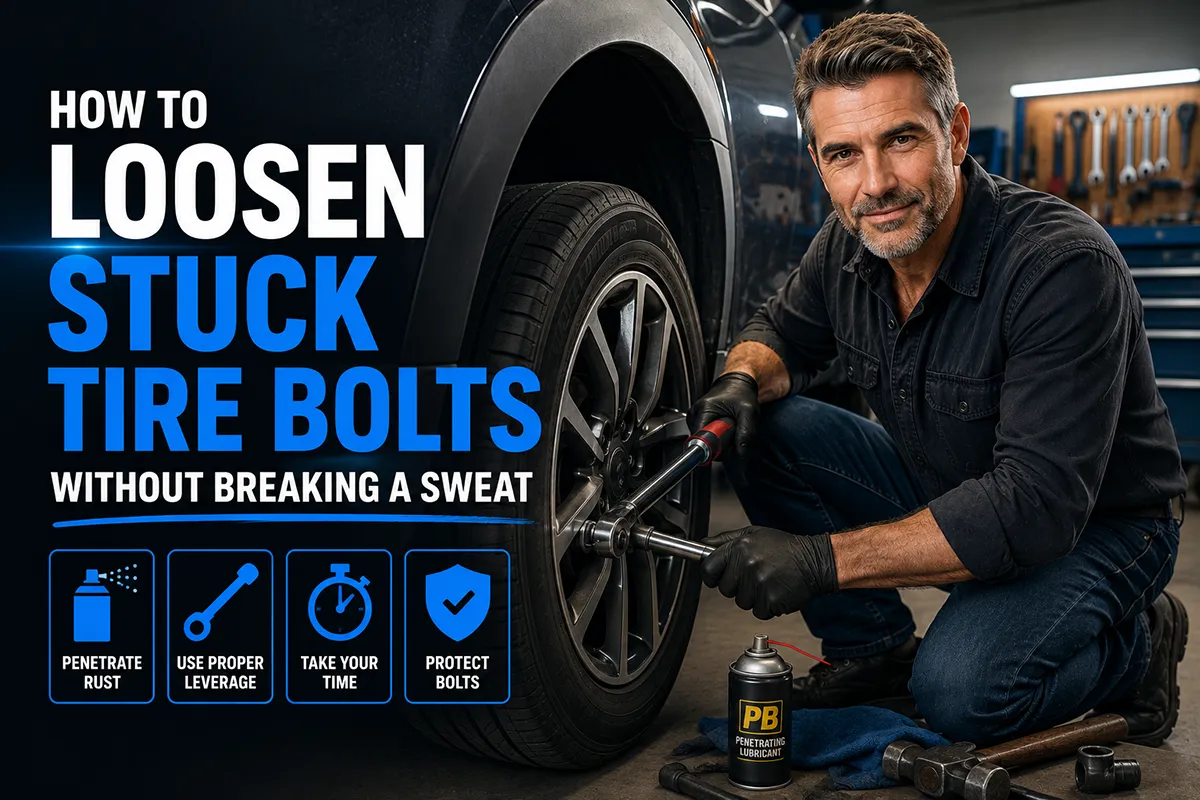
You’re standing in the rain on the shoulder of I-95, spare tire ready, but that last lug nut won’t budge no matter how hard you stomp on the wrench.
I’ve been there — literally. And I’ve watched dozens of otherwise capable drivers nearly throw out their backs fighting a seized bolt on the side of the road.
After years of reviewing tires, rotating sets in my own garage, and swapping wheels across every season, I’ve figured out the tricks that actually work — and the ones that just strip your studs and waste your time. This guide covers everything I know about loosening stuck tire bolts, from simple leverage hacks to advanced penetrating-oil strategies.
- Stuck lug nuts are usually caused by over-torquing, corrosion, or cross-threading — all preventable.
- A breaker bar with a cheater pipe is the safest, most effective first move.
- Penetrating oil (PB Blaster or Liquid Wrench) needs 15–20 minutes to work its way in.
- Never use an impact wrench at full blast on a seized nut without trying manual methods first.
- Apply anti-seize compound during reinstallation to prevent the problem from happening again.
- If the stud or bolt is damaged, replace it — a $3 stud is cheaper than a lost wheel at highway speed.
Liked this article?
Add TireAdvise as a preferred source so you see more of our tire reviews and guides on Google.
Why Do Tire Bolts Get Stuck in the First Place?
Before I walk you through the solutions, it helps to understand why this happens. In my experience, stuck lug nuts almost always come down to one of four causes — and most of them are completely avoidable.
1. Over-Torquing at the Tire Shop
This is the number-one culprit I see. Many tire shops use high-powered impact guns to zip lug nuts on as fast as possible. Speed is money in a busy shop, and the technician cranking your lugs at 150 ft-lbs when the spec is 80 ft-lbs probably isn’t losing sleep over it.
The result? Those nuts are essentially fused to the studs. I’ve personally dealt with over-torqued lugs on vehicles I picked up from national chains, local independents, and even dealerships. It’s shockingly common.
2. Corrosion and Rust
If you live anywhere in the Rust Belt — Ohio, Michigan, Pennsylvania, upstate New York — you already know what road salt does to bare metal. Lug nuts and wheel studs are exposed to moisture, salt spray, and brake dust every time you drive.
Over time, the threads essentially weld themselves together through oxidation. I’ve seen lug nuts on vehicles in the Northeast that looked like they’d been sitting in a saltwater tank for a decade.
3. Cross-Threading
This happens when a lug nut is started at an angle and forced down with an impact gun. The threads on the stud and the nut chew into each other, creating a mechanical lock that no amount of brute force will easily undo.
I always start my lug nuts by hand for the first few turns specifically to avoid this. It takes five extra seconds and saves enormous headaches later.
4. Dissimilar Metal Galvanic Corrosion
This one catches a lot of people off guard. When you put steel lug nuts on aluminum wheels (or vice versa), the two different metals can create a small electrochemical reaction in the presence of moisture. Over several months, this reaction basically glues the nut to the wheel.
I’ve found this is especially common on aftermarket wheels where the owner didn’t use the correct lug nut material or forgot to apply anti-seize during installation.
Tools You’ll Need (and What I Actually Keep in My Trunk)
You don’t need a full mechanic’s tool chest to handle a stuck lug nut. But the flimsy little tire iron that came with your car is almost never enough. Here’s what I recommend keeping on hand, and I’ll tell you what I personally carry in my vehicles.
Essential Tools
- Breaker bar (½-inch drive, 18–24 inches long) — This is your primary weapon. A good breaker bar from Craftsman or Tekton runs $15–$30 and provides dramatically more leverage than a standard lug wrench.
- Correct-size socket (usually 17mm, 19mm, or 21mm for most US passenger vehicles) — Bring the right socket. I keep a small set of impact-rated sockets in my trunk kit. A 4-pack costs about $10–$15.
- Penetrating oil — PB Blaster is my go-to. A can costs under $8 at any auto parts store and lasts forever. Liquid Wrench is a solid alternative.
- Cheater pipe (a 2–3 foot section of steel pipe) — This slides over your breaker bar handle to extend your leverage. I use a $5 piece of galvanized pipe from Home Depot.
- Torque wrench — Not for loosening, but essential for reassembly. A decent one from EPAuto or Tekton costs $25–$40. This prevents the over-torquing problem from happening again.
Nice-to-Have Tools
- Cordless impact wrench — Milwaukee, DeWalt, and Ryobi all make great ½-inch impact wrenches. I use a Milwaukee M18 FUEL and it handles most stuck lugs without issue. Expect to pay $150–$250 with a battery.
- Propane torch — For extreme cases where penetrating oil alone won’t cut it. This is a garage-only tool; don’t use an open flame on the side of the road.
- Lug nut extractor set — If the nut is rounded or stripped, these bite into the outside of the nut and grip as you turn. Irwin makes a great set for about $20.
Step-by-Step: How I Loosen Stuck Tire Bolts
Here’s the exact process I follow every time I encounter a seized lug nut. I’ve refined this over years of tire testing and seasonal swaps, and it works on everything from compact sedans to full-size trucks.
Step 1: Make Sure the Vehicle Is Secure
Before you do anything, make sure the car is on a flat, stable surface with the parking brake fully engaged. If you’re on the road, get as far off the travel lane as possible and turn on your hazards.
This step isn’t optional. I’ve seen a car roll off a jack in a parking lot because someone forgot the parking brake. It took three seconds of carelessness to cause thousands of dollars in damage.
Step 2: Loosen Before You Jack
This is the single most important tip in this entire article. Always break the lug nuts loose while the tire is still on the ground.
When the wheel is on the ground, the weight of the vehicle prevents it from spinning. This gives you something to push against. Once the car is jacked up, the wheel spins freely, and you have almost no leverage — which is exactly when people start hurting themselves.
I crack each nut about a quarter turn while the car is still resting on all four tires. That’s all you need.
Step 3: Apply Penetrating Oil Generously
If a nut doesn’t break free with moderate effort, don’t force it. Grab your can of PB Blaster and spray the base of the lug nut where it meets the wheel. Get the straw nozzle right in there.
Now here’s the part people skip: wait. Penetrating oil needs time to creep into the threads through capillary action. I give it a minimum of 15 minutes. For seriously corroded nuts, I’ll spray them, go grab lunch, and come back after 30–45 minutes.
In my experience, patience at this stage saves you from stripped studs, rounded nuts, and bloody knuckles later.
Step 4: Use a Breaker Bar with Proper Technique
Attach your correctly sized impact socket to your breaker bar and seat it firmly on the lug nut. Make sure the socket is fully engaged — a half-seated socket is how you round off nut corners.
Position the breaker bar handle so it’s roughly parallel to the ground, pointing to the left (since you’re loosening — “lefty loosey”). Now, instead of pulling up on the handle, push down with your foot or step on it with controlled body weight.
This technique is a game-changer. Pushing down uses gravity and your body weight, which is much more controlled than yanking upward. I can break loose most stuck lugs this way without even getting my heart rate up.
Step 5: Add the Cheater Pipe if Needed
If the breaker bar alone isn’t enough, slide your cheater pipe over the end of the handle. This extends your lever arm by two to three feet, which dramatically multiplies the torque you’re applying.
With a 3-foot cheater pipe, even 50 pounds of force at the end of the pipe generates well over 150 ft-lbs of torque at the nut. That’s enough to crack loose almost any over-torqued lug on a passenger vehicle.
A word of caution: with this much leverage, things can break. Apply force slowly and steadily. If you feel a sudden “pop,” that’s usually the nut breaking free — which is exactly what you want. If you hear a snap, you may have broken the stud (more on that below).
Step 6: Try the “Shock” Method
For really stubborn nuts — the kind where penetrating oil and a cheater pipe still aren’t cutting it — I use a controlled shock technique. Position the breaker bar horizontally, then give the end of the handle a sharp strike with a heavy rubber mallet or a dead-blow hammer.
The sudden impact can break the corrosion bond that’s holding the threads together. I’ve freed nuts with this method that I genuinely thought were going to require a professional extraction. It works surprisingly well.
Step 7: Apply Heat (Garage Use Only)
If you’re in your garage and everything else has failed, heat is your nuclear option. Using a propane torch (the small, handheld kind you can buy at any hardware store for about $15), heat the lug nut — not the stud — for 30–60 seconds.
The heat causes the nut to expand slightly, which breaks the corrosion bond. After heating, let it cool for a moment, spray more penetrating oil (it’ll sizzle and wick right in), and then try the breaker bar again.
Important safety note: Do not use a torch anywhere near the brake line, ABS sensor wire, or tire. And never use an open flame on the roadside. This is a controlled, garage-only technique.
Comparison: Methods for Loosening Stuck Lug Nuts
I’ve used every method listed below at some point. Here’s how they stack up in terms of effectiveness, safety, and cost based on my real-world experience.
| Method | Effectiveness | Safety Level | Cost | Roadside Friendly? |
|---|---|---|---|---|
| Breaker bar + cheater pipe | ★★★★★ | ★★★★☆ | $20–$35 | Yes |
| Penetrating oil + wait time | ★★★★☆ | ★★★★★ | $6–$10 | Yes |
| Cordless impact wrench | ★★★★★ | ★★★☆☆ | $150–$250 | Yes (with charged battery) |
| Dead-blow hammer shock method | ★★★★☆ | ★★★☆☆ | $15–$25 | Yes |
| Propane torch + penetrating oil | ★★★★★ | ★★☆☆☆ | $15–$20 | No — garage only |
| Lug nut extractor socket | ★★★★☆ | ★★★★☆ | $15–$25 | Yes |
| OEM tire iron (the one in your trunk) | ★★☆☆☆ | ★★★★☆ | Free (came with car) | Yes |
As you can see, the breaker bar with a cheater pipe is my top recommendation for almost every situation. It’s cheap, portable, and incredibly effective. The cordless impact wrench is a luxury upgrade that I genuinely love, but it’s not worth the investment unless you’re regularly working on cars.
What to Do If You Snap a Wheel Stud
It happens. Even with perfect technique, a corroded stud that’s been weakened by years of salt exposure can snap when you apply torque. Don’t panic — this is a very common and very fixable problem.
Can You Still Drive?
Technically, most passenger vehicles can safely operate with one missing lug nut as a temporary measure to get to a repair shop. Most cars use five lugs per wheel, and four can handle the load for a short, low-speed trip.
That said, I never recommend driving any further than absolutely necessary with a missing stud. The remaining studs are now carrying extra load, and if any of them are also weakened, you have a serious safety issue.
How to Replace a Broken Wheel Stud
Replacing a wheel stud is a straightforward repair that most DIYers can handle in 30–45 minutes. The stud itself costs $2–$5 at AutoZone, O’Reilly, or NAPA. You’ll need to remove the brake caliper and rotor to access the hub, press out the broken stud, and press in the new one.
If you’re not comfortable doing it yourself, any shop will replace a wheel stud for $20–$50 in labor. It’s a quick, inexpensive fix — don’t put it off.
The Reinstallation: How to Prevent Stuck Lug Nuts Forever
Getting the stuck bolt off is only half the battle. If you don’t reinstall correctly, you’ll be fighting the same problem next time. Here’s exactly what I do every time I put a wheel back on.
Clean the Threads
Before the lug nut goes back on, I wipe down the stud with a wire brush or a rag to remove rust, dirt, and old anti-seize. Clean threads are happy threads.
If the studs are heavily corroded, I’ll chase the threads with an inexpensive thread chaser or die (about $8 for the common sizes). This removes corrosion from the thread valleys without removing material.
Apply Anti-Seize Compound (With a Caveat)
I apply a thin film of anti-seize compound to the wheel studs before installing the lug nuts. Permatex and Loctite both make excellent anti-seize products that cost under $10 and last for dozens of applications.
The caveat: When you use anti-seize, it reduces friction on the threads, which means the same torque setting will result in higher clamping force. Many professionals recommend reducing your torque spec by about 10–15% when using anti-seize. For example, if your vehicle specifies 100 ft-lbs, I’ll torque to about 85–90 ft-lbs with anti-seize applied.
Some manufacturers, including Honda and Toyota, specifically advise against anti-seize on their studs in their owner’s manuals. Always check your vehicle’s documentation. For those vehicles, I simply make sure the studs are clean and dry before reinstallation.
Hand-Start Every Lug Nut
I cannot stress this enough: always start lug nuts by hand. Thread them on with your fingers for the first three to four turns. If you feel any resistance or wobble, stop — you may be cross-threading.
Only after the nut is hand-threaded and spinning freely do I bring in a wrench or impact gun to snug it down.
Use a Torque Wrench — Every Single Time
Final tightening should always be done with a calibrated torque wrench set to your vehicle’s specification. You can find the correct torque spec in your owner’s manual, on a sticker inside the glove box or door jamb, or by searching your vehicle’s year, make, and model online.
For reference, here are some common torque specs for popular US vehicles:
- Honda Civic / Accord: 80 ft-lbs
- Toyota Camry / Corolla: 76 ft-lbs
- Ford F-150 (aluminum wheels): 150 ft-lbs
- Chevy Silverado 1500: 140 ft-lbs
- Jeep Wrangler JL: 130 ft-lbs
- Tesla Model 3: 129 ft-lbs
- Subaru Outback: 89 ft-lbs
I always tighten in a star pattern (not a circular pattern) to ensure even clamping pressure across the wheel. This prevents warped brake rotors and uneven seating.
Re-Torque After Driving
After installing new tires or any wheel removal, I re-torque the lug nuts after a few days of driving. Wheels can settle slightly as the components bed in, and a quick re-torque ensures everything stays safe and snug. Most tire shops recommend this at around 50–100 miles, which usually works out to a couple days of normal commuting.
Common Mistakes That Make Stuck Lug Nuts Worse
Over the years, I’ve seen plenty of well-meaning people make the problem worse. Here are the mistakes I see most often — and a couple I’ve made myself.
Using a 12-Point Socket Instead of a 6-Point
Twelve-point sockets have more contact points, but each contact point is smaller. On a corroded or slightly rounded nut, a 12-point socket is far more likely to slip and round off the corners. I exclusively use 6-point impact sockets for lug nut work. The grip is vastly superior.
Hammering on the Lug Wrench at a Bad Angle
If you’re going to use a hammer strike, the force needs to be applied in the direction of rotation. I’ve seen people beat on a wrench handle from the top, driving force straight into the stud and accomplishing nothing except damaging the hub. Controlled, directional force — always.
Jacking Up the Car First
I mentioned this earlier, but it bears repeating because I see it constantly. If the car is jacked up, the wheel spins freely. You have no opposing force. Break the nuts loose on the ground, then jack it up.
Using the Wrong Size Socket
A 19mm socket is not the same as a ¾-inch socket, even though they’re close. Using a slightly oversized socket is a guaranteed way to round off your lug nut. I’ve made this mistake exactly once — early in my career — and I learned fast. Verify the correct metric or SAE size for your specific vehicle.
Ignoring the Wheel Lock Key
If your vehicle has locking lug nuts (many do from the factory or from a dealer add-on), you’ll need the wheel lock key socket to remove at least one nut per wheel. This is typically stored in the glove box, center console, or with the spare tire kit.
If you’ve lost your wheel lock key, don’t try to force the locking nut off with a standard socket — you’ll destroy it. A lug nut extractor set or a trip to the dealership is the correct move. Replacement keys typically cost $20–$40.
What About Roadside Assistance?
Look, there’s no shame in calling for help. If you’re on the side of a highway at night, you don’t have the right tools, or you simply don’t feel safe, calling roadside assistance is the smart move.
AAA membership costs about $60–$140 per year depending on the tier, and it covers tire changes among other services. Many auto insurance policies and credit cards also include roadside assistance at no extra cost — it’s worth checking your policy before you need it.
I carry all my tools and I’m comfortable changing tires in any conditions, but I still maintain my AAA membership. Redundancy in safety systems is never a bad idea.
My Emergency Tire Kit: What I Keep in Every Vehicle
Over the years, I’ve refined my emergency tire kit to a small bag that fits in the spare tire well of any sedan or in the corner of any truck bed. Here’s exactly what’s in it:
- ½-inch drive breaker bar (18 inches)
- Set of 6-point impact sockets: 17mm, 19mm, 21mm, 22mm
- 2-foot steel cheater pipe
- Can of PB Blaster penetrating oil
- A pair of heavy leather work gloves
- LED headlamp (for nighttime changes)
- Reflective safety vest
- Small can of anti-seize compound
- Click-type torque wrench (½-inch drive, 10–150 ft-lb range)
- A laminated card with my vehicle’s torque specs and jack point locations
The total cost of this kit is under $100, and it has saved me — and several strangers on the roadside — more times than I can count. I consider it as essential as the spare tire itself.
When to Call a Professional
There are situations where DIY removal isn’t the right call. In my experience, you should head to a professional mechanic if:
- More than one stud has snapped on the same wheel
- The lug nut is spinning freely but not coming off (the stud is likely spinning inside the hub)
- You’ve rounded the nut to the point where no socket or extractor will grip it
- The wheel itself is seized to the hub (a separate but related problem)
- You’re dealing with a lug bolt system (common on BMW, Mercedes, Volkswagen, and Audi) rather than a stud-and-nut system
European lug bolt systems deserve special mention. Instead of a stud permanently pressed into the hub, these vehicles use a bolt that threads directly into the hub. This makes wheel alignment during installation trickier and creates a different corrosion dynamic. I’ve dealt with seized lug bolts on my Volkswagen test vehicles, and they can be particularly stubborn because you can’t easily apply leverage while also holding the wheel in position.
For lug bolt vehicles, I strongly recommend applying anti-seize (or the manufacturer’s recommended thread treatment) during every wheel removal and reinstallation.
A Quick Word About Impact Wrenches
I own and use cordless impact wrenches regularly. They’re fantastic tools. But I want to be clear about something: an impact wrench is not always the best first move on a stuck lug nut.
Impact wrenches work by delivering rapid rotational hammer blows. On a corroded or cross-threaded nut, those repeated impacts can snap a stud before you realize what’s happening. The tool is so fast and powerful that you lose the “feel” you’d have with a hand tool.
My approach is to always try manual methods first. If a breaker bar and cheater pipe can’t break it loose, then I’ll move to the impact wrench as a second step. And I’ll use it in short bursts, not full-trigger blasts, to give the penetrating oil and the vibration a chance to work together.
If you do invest in a cordless impact wrench for tire work, make sure it produces at least 300 ft-lbs of breakaway torque. The Milwaukee M18 FUEL (2767-20), DeWalt DCF899, and Makita XWT08 are all excellent options in the $180–$280 range that I’ve used and trust.
Final Thoughts: A Little Prevention Goes a Long Way
In all my years of reviewing tires and working on cars, I can confidently say that 90% of stuck lug nut situations are completely preventable. Proper torque during installation, a thin layer of anti-seize on the threads, and periodic maintenance make all the difference.
Every time you have your tires rotated or replaced, ask the shop to use a torque wrench for final tightening. Most reputable shops will do this if you request it. If they look at you funny or refuse, find a different shop — they’re not taking your safety seriously.
And please, build yourself a small emergency tire kit. The $100 investment is nothing compared to the peace of mind of knowing that when you’re kneeling on wet asphalt at 11pm with a flat tire, you have exactly what you need to handle it yourself — and drive away in under 20 minutes.
Frequently Asked Questions
Why are my tire lug nuts so hard to remove?
Lug nuts seize up for a few common reasons: rust and corrosion from road salt and moisture (especially in northern US states), over-torquing during the last tire change, or galvanic corrosion between dissimilar metals like aluminum wheels and steel bolts. If your tires were last mounted at a shop that used an impact gun without a torque stick, there’s a good chance they were tightened well beyond the manufacturer’s recommended spec, sometimes exceeding 150 ft-lbs when your vehicle may only call for 80-100 ft-lbs.
What is the easiest way to loosen stuck tire bolts at home?
The easiest method I recommend is using a breaker bar (typically 18-24 inches long) paired with the correct socket size for your lug nuts—most US passenger vehicles use 17mm, 19mm, or 21mm sockets. Place the socket on the lug nut, position the breaker bar horizontally, and use controlled downward pressure with your foot while the tire is still on the ground and the vehicle is in park. The extra leverage makes even badly stuck bolts manageable without any power tools, and a quality breaker bar costs only $15-$30 at stores like AutoZone or Harbor Freight.
Can I use WD-40 or penetrating oil to loosen stuck lug nuts?
Yes, a penetrating lubricant like PB Blaster or Liquid Wrench works far better than WD-40 for seized lug nuts because they’re specifically designed to creep into corroded threads. Spray the base of each stuck lug nut generously, let it soak for at least 15-20 minutes (overnight is even better for severely rusted bolts), and then attempt removal with your breaker bar. Just make sure to clean the hub and studs thoroughly before reinstalling the wheel, since residual lubricant can cause the nuts to loosen while driving.
How much torque should I use when tightening lug nuts to prevent them from getting stuck?
Always follow your vehicle’s owner manual for the exact torque specification—most US cars and light trucks call for 80-100 ft-lbs, while larger SUVs and trucks may require 120-140 ft-lbs. I strongly recommend investing in a torque wrench ($25-$50 at most auto parts stores) and tightening lug nuts in a star pattern to ensure even pressure across the wheel. Over-torquing is the number one reason lug nuts get stuck, and it can also warp your brake rotors over time.
Is it safe to use an impact wrench to remove stuck tire bolts?
A cordless impact wrench like the Milwaukee M18 or DeWalt 20V can safely remove stuck lug nuts as long as you use the correct impact-rated socket and avoid applying force at an angle that could strip the stud. When putting the nuts back on, however, never use the impact wrench to final-tighten—always finish with a calibrated torque wrench to hit the correct spec. Impact wrenches make roadside tire changes and seasonal tire swaps much faster, and decent corded models start around $40 if you don’t want to invest in a battery platform.
What should I do if a tire bolt snaps while trying to remove it?
If a wheel stud snaps, don’t panic—replacement studs cost $2-$8 each and are available at any auto parts store like O’Reilly, NAPA, or AutoZone for most US vehicle makes and models. You can safely drive short distances to a shop on the remaining bolts as long as at least four out of five are intact, but I wouldn’t recommend highway driving. A mechanic can press in a new stud for roughly $20-$50 per stud in labor, or you can do it yourself with a lug nut stacking method if you’re comfortable with intermediate DIY repairs.
How do I prevent tire lug nuts from getting stuck in the future?
Apply a thin coat of anti-seize compound (nickel-based works best for aluminum wheels) to the wheel stud threads every time you mount a tire—a small $8 tube lasts for years. Always torque your lug nuts to the manufacturer’s specification rather than just hitting them with an impact gun, and re-torque after 50-100 miles of driving on newly mounted wheels. If you live in rust-belt states like Michigan, Ohio, or Pennsylvania, I recommend removing and re-greasing your lug nuts at least once a year to combat road salt corrosion before it bonds the hardware together.
