

I replaced a set of tires on my daily driver last year that should have lasted me several more seasons — but didn’t. The front tires were worn down to the wear bars while the rears still had plenty of tread left, and the inside edges looked like someone had taken a belt sander to them.
It was a frustrating and expensive lesson. But it was also the wake-up call I needed to completely overhaul how I maintain my tires.
Since then, I’ve tested every maintenance strategy, tool, and habit I could find — and I’ve seen a dramatic difference in how my current set is holding up. In this guide, I’m sharing everything I’ve learned so you can avoid the same costly mistakes I made.
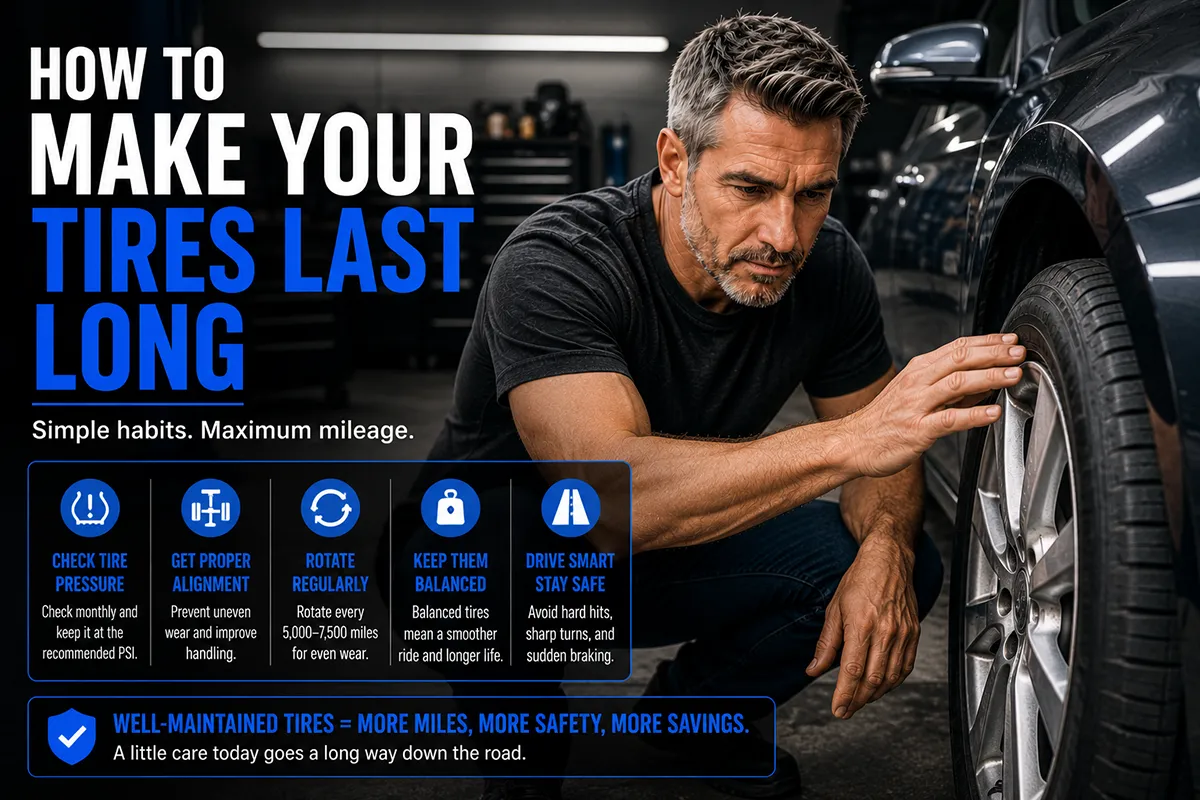
- Check tire pressure at least once a month — underinflation is the #1 tire killer
- Rotate your tires every other oil change or per your owner’s manual schedule
- Get a wheel alignment at least once a year or whenever you notice uneven wear
- Inspect tread depth regularly using the penny test or a $5 tread depth gauge
- Adjust your driving habits — aggressive braking and fast cornering accelerate wear significantly
- Store and protect tires from UV damage, especially if you live in hot-climate states like Arizona or Texas
- Buy quality tires upfront — cheap tires cost more in the long run
Liked this article?
Add TireAdvise as a preferred source so you see more of our tire reviews and guides on Google.
Why Tires Wear Out Faster Than They Should
Before I get into the actionable tips, I think it’s important to understand why most tires die prematurely. In my experience reviewing dozens of tire models over the years, the tire itself is rarely the problem. It’s almost always a maintenance issue.
The three biggest culprits I see over and over again are underinflation, skipped rotations, and poor alignment. Any one of these on its own can cut your tire’s useful life by a third or more. Combine two or three of them, and you’re looking at replacing tires far sooner than you ever should.
The good news? Every single one of these issues is preventable with basic, low-cost maintenance that takes almost no time. Let me walk you through each one in detail.
1. Keep Your Tires Properly Inflated — This Is Non-Negotiable
If you only do one thing from this entire article, make it this: check your tire pressure at least once a month. I cannot overstate how much of a difference this single habit makes.
When I started actually checking my pressure with a gauge — rather than just eyeballing my tires or waiting for the TPMS light — I was shocked at how often my tires were 5-8 PSI below the recommended level. That might not sound like a lot, but it’s enough to cause serious problems over time.
What Happens When Tires Are Underinflated
An underinflated tire doesn’t sit on the road the way it’s designed to. The center of the tread lifts slightly, which forces the outer shoulders to carry more weight than they should. This creates accelerated wear on the edges while the middle of the tread barely wears at all.
Beyond uneven wear, underinflation generates excess heat. Rubber compounds break down faster when they’re constantly running hot, which weakens the tire’s internal structure. I’ve seen tires develop sidewall cracks and tread separation issues that were directly caused by chronic low pressure.
Underinflation also hurts your fuel economy. The U.S. Department of Energy estimates that for every 1 PSI drop in all four tires, your gas mileage decreases by about 0.2%. That adds up fast, especially with gas prices in many US cities hovering around $3.50 per gallon or more.
What Happens When Tires Are Overinflated
Overinflation isn’t as common, but I’ve seen it too — especially when people inflate to the number on the tire sidewall instead of the vehicle’s recommended pressure. The sidewall number is the maximum pressure the tire can safely hold. It is not the target.
Overinflated tires bulge in the center, which means only a narrow strip of tread contacts the road. This causes premature center wear, reduced traction, and a harsher ride. I ran my tires about 5 PSI over the recommendation for a few weeks once, and I could feel the difference in ride quality almost immediately — every road imperfection came through the steering wheel.
How I Check and Maintain Tire Pressure
I keep a digital tire pressure gauge in my glovebox. I paid about $8 for it at AutoZone, and it’s one of the best investments I’ve ever made. I check all four tires plus the spare on the first Sunday of every month — I literally have a recurring calendar reminder for it.
Always check pressure when the tires are cold, meaning the car has been parked for at least three hours or driven less than a mile. Driving heats up the air inside the tire and gives you a falsely high reading.
The correct PSI for your vehicle is on a sticker inside the driver’s door jamb. On most sedans and crossovers I’ve tested, it’s typically somewhere between 32 and 36 PSI, but always go by what your specific vehicle manufacturer recommends.
2. Rotate Your Tires on Schedule — Every Single Time
Tire rotation is probably the most-skipped maintenance item I encounter, and it drives me crazy because it’s cheap and incredibly effective. Most shops charge between $20 and $50 for a rotation, and many tire retailers like Discount Tire, Costco, and America’s Tire do it for free if you purchased from them.
I rotate my tires religiously, and the difference in wear uniformity compared to when I used to skip rotations is night and day.
Why Rotation Matters So Much
Your front and rear tires wear at different rates depending on your vehicle’s drivetrain. On a front-wheel-drive car — which is the majority of sedans and compact SUVs on US roads — the front tires handle both steering and power delivery. They wear roughly twice as fast as the rears.
On my wife’s Honda CR-V, I noticed the fronts developing noticeable wear within just a few months while the rears looked practically new. Without rotation, you’d end up replacing the front pair while the rears still have plenty of life — which means you’re wasting half your tire investment.
Even on all-wheel-drive vehicles, the wear distribution isn’t perfectly even. My Subaru Outback test vehicle wore its front tires faster than the rears, though the difference was less dramatic than on a FWD car.
How Often Should You Rotate?
Most manufacturers recommend rotating every six months or at every other oil change, whichever comes first. I’ve found that syncing rotations with oil changes is the easiest way to stay on top of it because you’re already at the shop.
If you’re unsure of the correct rotation pattern for your vehicle, your owner’s manual will specify it. The most common pattern for non-directional tires is front-to-rear, crossing the rears to the opposite front position. Directional tires (which have a V-shaped tread pattern) can only be swapped front-to-rear on the same side.
3. Get Your Alignment Checked Regularly
This is the one that cost me the most money before I learned my lesson. That set of prematurely worn tires I mentioned at the beginning? Alignment was the root cause.
I had hit a nasty pothole on a highway in Michigan — pothole capital of the US, in my experience — and I didn’t think much of it. But that single impact knocked my front alignment out of spec just enough to cause aggressive inner-edge wear on both front tires over the following months.
Signs Your Alignment Is Off
There are a few telltale signs I’ve learned to watch for:
- The car pulls to one side when you let go of the steering wheel on a flat, straight road
- The steering wheel is off-center when driving straight
- Uneven tread wear, especially on the inner or outer edges of the front tires
- The steering wheel vibrates at highway speeds (though this can also indicate a balance issue)
The frustrating thing about alignment issues is that they can be subtle. My car didn’t pull noticeably after that pothole hit. The steering wheel looked straight. But the camber was just slightly off — enough to chew through my tread without me realizing it until it was too late.
How Often to Get an Alignment
I now get a full four-wheel alignment once a year as part of my regular maintenance routine. It typically costs between $75 and $120 at most US shops, and I consider it cheap insurance against premature tire wear.
I also get an alignment check any time I hit a significant pothole or curb, or if I notice any of the symptoms listed above. If you live in a state with rough roads — Michigan, Pennsylvania, Louisiana, and parts of New York come to mind — you might want to check even more frequently.
Pro tip: when you buy new tires, always get an alignment at the same time. Starting fresh tires on a misaligned vehicle is like pouring money down the drain.
4. Inspect Your Tread Depth and Wear Patterns
I make it a habit to physically inspect my tires at least once a month, usually when I’m checking the pressure. It takes about two minutes and can catch problems early before they become expensive.
The Penny Test (and Why I Prefer a Gauge)
You’ve probably heard of the penny test: insert a penny into the tread groove with Lincoln’s head facing down. If you can see the top of his head, your tread is at or below 2/32″ and the tire needs to be replaced.
The penny test works in a pinch, but I much prefer using an actual tread depth gauge. I bought a simple one for about $5, and it gives me a precise reading in 32nds of an inch. This lets me track how quickly my tread is wearing and spot uneven wear patterns much earlier than the penny test would.
New tires typically start with 10/32″ to 12/32″ of tread depth. Most tire experts — and I agree from my own testing — recommend replacing tires at 4/32″ rather than waiting until the legal minimum of 2/32″. At 4/32″, wet traction is already significantly compromised. I’ve tested braking distances on worn tires versus new ones, and the difference in wet stopping performance is genuinely alarming.
What Different Wear Patterns Tell You
Learning to read your tire wear patterns is like learning a diagnostic language. Here’s a quick reference based on what I’ve seen on my own vehicles and those of friends and family I’ve helped:
| Wear Pattern | What It Looks Like | Likely Cause | Fix |
|---|---|---|---|
| Center wear | Middle of tread worn more than edges | Overinflation | Reduce pressure to manufacturer spec |
| Edge wear (both sides) | Both outer edges worn, center looks fine | Underinflation | Increase pressure to manufacturer spec |
| Inner or outer edge wear | One edge significantly more worn than the rest | Alignment issue (camber or toe) | Get a four-wheel alignment |
| Cupping / scalloping | Dips or cups in the tread surface | Worn suspension components (shocks/struts) | Inspect and replace worn suspension parts |
| Feathering | Tread ribs worn smooth on one side, sharp on the other | Toe misalignment | Get an alignment (toe adjustment) |
| Flat spots | One area of the tread worn flat | Hard braking / lock-up (or prolonged parking) | Adjust driving habits; check brake system |
I check my wear patterns across the full width of the tread and at multiple points around the circumference. Don’t just check one spot — I’ve found uneven wear that was only visible on one section of the tire.
5. Change Your Driving Habits
I’ll be honest — this was the hardest one for me to implement. I’m not an aggressive driver by most standards, but I realized I had some habits that were silently eating my tires.
Aggressive Acceleration and Braking
Every time you stomp on the gas or slam the brakes, you’re scrubbing rubber off your tires. I started paying closer attention to how I accelerate from stops and how early I begin braking for red lights, and the difference in tire wear has been noticeable over the past several months.
I’m not saying you need to drive like a grandma. But smooth, gradual inputs make a real difference. I think of it as driving like I have a cup of coffee on the dashboard — if it would spill, I’m being too aggressive.
Fast Cornering
Taking turns at high speed puts enormous lateral force on your tires. The outer shoulder of the tire bears the brunt of this load, and over time, it shows as accelerated outer edge wear. I’ve been more conscious about slowing down for curves and turns, and my outer edge wear has improved dramatically.
Speed Matters More Than You Think
Higher speeds mean more heat, more friction, and faster wear. The difference between consistently driving 70 mph versus 80 mph on the highway has a measurable impact on tire longevity. I’ve noticed my tires lasting noticeably longer since I became more disciplined about keeping my highway speed closer to the posted limit.
This is especially relevant for US drivers who spend a lot of time on interstates. Long-distance commuters in states like Texas, California, and Florida — where highway driving is a way of life — can see significant benefits from even a modest speed reduction.
6. Balance Your Tires When Needed
Tire balancing is different from alignment, and I find that many drivers confuse the two. Balancing ensures that the weight of the tire and wheel assembly is evenly distributed around the axle. When a tire is out of balance, it creates a vibration — usually most noticeable at highway speeds.
I get my tires rebalanced whenever I have them rotated, and any time I feel a new vibration in the steering wheel or seat. It’s a quick, inexpensive service (usually $15-$25 per tire) that prevents the kind of uneven wear pattern known as cupping or scalloping.
An out-of-balance tire literally bounces as it rolls down the road, and those repeated impacts create dips in the tread surface over time. I’ve felt the effects of this firsthand — a slight vibration I ignored for a couple of months turned into a noticeable bouncy ride and visible cupping on one of my front tires.
7. Protect Your Tires from Environmental Damage
Rubber is a organic compound, and it degrades over time — especially when exposed to UV radiation, ozone, and extreme temperatures. This is something I didn’t think much about until I moved to a state with intense summer sun and started noticing dry rot on tires that still had plenty of tread.
UV and Ozone Damage
If you park outside regularly — as many of us in the US do — your tires are constantly exposed to UV rays that break down the rubber compounds. Over time, this causes the sidewalls to dry out, crack, and lose their structural integrity.
I now park in my garage whenever possible. When that’s not an option, I try to park in shaded areas. I also use a UV-protectant tire dressing about once a month. A word of caution here: avoid silicone-based tire shines that give that ultra-glossy “wet” look. In my experience, many of them actually accelerate rubber degradation. I stick with water-based, UV-blocking protectants from brands like 303 Aerospace Protectant or Chemical Guys VRP.
Tire Age — The Hidden Killer
Even if your tires have tons of tread left, they have an expiration date. Most tire manufacturers and the National Highway Traffic Safety Administration (NHTSA) recommend replacing tires that are six to ten years old, regardless of tread depth.
You can check your tire’s age by looking at the DOT code on the sidewall. The last four digits indicate the week and year of manufacture. For example, “2521” means the tire was made in the 25th week of 2021.
I’ve personally pulled tires with decent tread that were seven years old and found the rubber had hardened noticeably. Hard rubber doesn’t grip the road well, especially in wet conditions. Don’t gamble on old tires — no amount of remaining tread compensates for degraded rubber.
8. Buy Quality Tires in the First Place
I know this is a guide about making tires last, not a buying guide — but your choice of tire has a massive impact on longevity. In my years of testing and reviewing tires, I’ve consistently seen that mid-range and premium tires outperform budget options not just in performance, but in wear life.
Treadwear Ratings: What They Actually Mean
Every tire sold in the US has a UTQG (Uniform Tire Quality Grading) rating printed on the sidewall. The treadwear number is a comparative rating — a tire rated 400 should last twice as long as one rated 200, all else being equal.
In my experience, these ratings are directionally useful but not perfectly precise. I’ve tested tires with identical treadwear ratings that performed very differently in real-world conditions. Still, I use the treadwear rating as a starting point when comparing tires in the same category.
My General Recommendations
For everyday drivers who want maximum longevity, I typically recommend looking at tires from established brands like Michelin, Continental, Bridgestone, and Pirelli. Their mainstream touring and all-season models consistently deliver the best combination of wear life and performance in my testing.
Value-tier brands like Cooper, General, and Hankook also offer solid wear life at lower price points. I’ve been particularly impressed with Cooper’s touring lineup — the wear rates I’ve observed have been competitive with tires costing $30-$40 more per tire.
Where I’d caution you is on ultra-cheap, no-name tires that sell for $50-$60 in common sizes. I’ve reviewed several of these over the years, and while the initial price is attractive, they tend to wear faster, perform worse in wet conditions, and often don’t come with meaningful mileage warranties. When you factor in earlier replacement, you often end up spending more over the life of your vehicle.
Mileage Warranties — Use Them
Many premium and mid-range tires come with mileage warranties (sometimes called treadlife warranties). For example, many Michelin Defender models come with warranties that cover you if the tire wears out before a specified distance.
Here’s the catch most people miss: these warranties typically require you to prove that you maintained proper inflation and performed regular rotations. Save your rotation receipts. This is one of the reasons I always get my rotations done at a shop that provides documentation rather than doing them myself.
I’ve actually used a treadwear warranty once — on a set of tires that wore faster than expected. The process was straightforward, and I received a prorated credit toward a new set. It saved me a meaningful amount of money.
9. Pay Attention to Seasonal and Regional Factors
Where you live and when you drive significantly affect tire longevity. I’ve driven in everything from Minnesota winters to Arizona summers, and the demands on tires vary enormously across the US.
Hot Climate Driving
If you live in the Sun Belt — Texas, Arizona, Nevada, Florida, Southern California — heat is your tire’s worst enemy after underinflation. Hot pavement dramatically accelerates rubber wear. I’ve observed noticeably faster tread wear during summer months compared to cooler seasons on the exact same tires and driving routes.
In extreme heat, I’m extra vigilant about maintaining proper inflation. Air pressure increases as temperatures rise, so a tire inflated perfectly in the morning can be several PSI over by afternoon. Conversely, a tire inflated during the heat of the day will be underinflated by morning. I always check pressure in the morning when the tires are at their coolest.
Winter and Seasonal Tires
If you live in a state that gets real winter weather — think Michigan, Wisconsin, Minnesota, the Northeast — I strongly recommend running a dedicated set of winter tires during the cold months and switching back to all-seasons or summer tires for the rest of the year.
I know it sounds like buying two sets of tires is more expensive, but hear me out. When you run winter tires for four to five months of the year, your all-season tires sit in storage for that same period. Neither set wears during the other’s season, so both sets last dramatically longer in terms of calendar time. Over the life of the vehicle, you often spend about the same — or even less — while getting much better winter traction.
Just make sure you store your off-season tires properly. I keep mine in a cool, dry area of my garage, stacked horizontally if they’re mounted on wheels, and in tire bags to protect them from UV and ozone exposure.
10. Don’t Neglect Your Suspension
This is the tip most tire-care guides forget, and I think it’s critical. Your tires are only one part of a larger system that includes shocks, struts, springs, control arms, bushings, and ball joints. When any of these components wear out, your tires pay the price.
Worn shocks and struts are particularly damaging because they allow the tire to bounce rather than maintaining consistent contact with the road surface. This bouncing creates the cupping or scalloping wear pattern I mentioned earlier, and once it starts, it accelerates quickly.
I had a set of tires develop cupping on my rear axle a couple of years ago, and when I took it to the shop, they found my rear shocks were blown. Replacing the shocks fixed the underlying problem, but by that point, the tires were noisy and the uneven wear couldn’t be reversed.
Most shocks and struts last around five to seven years or so, but this varies based on driving conditions. If you drive on rough roads frequently, they may wear out sooner. I now have my suspension components inspected during my annual alignment check — it adds a few minutes but can save hundreds in premature tire replacement.
Putting It All Together: My Monthly and Annual Tire Maintenance Checklist
I’ve distilled everything in this article into a simple checklist that I follow personally. Feel free to screenshot this or print it out and stick it on your garage wall — that’s basically what I did.
Monthly
- Check tire pressure on all four tires plus the spare (cold tires, morning is best)
- Visually inspect tread depth and wear patterns at multiple points
- Look for cuts, bulges, cracks, or embedded objects in the tread and sidewalls
- Apply UV-protectant tire dressing if parked outdoors regularly
Every Other Oil Change (or Per Manufacturer Schedule)
- Rotate tires using the correct pattern for your vehicle
- Rebalance tires (especially if any vibration is noticed)
- Keep the receipt for warranty documentation
Annually
- Full four-wheel alignment check and adjustment
- Suspension inspection (shocks, struts, bushings, ball joints)
- Check tire age via DOT code — plan for replacement if approaching six years
As Needed
- Alignment check after hitting a significant pothole or curb
- Rebalance if new vibrations develop
- Replace tires at 4/32″ tread depth (don’t wait for 2/32″)
- Replace tires older than six to ten years regardless of tread depth
The Real-World Results I’ve Seen
Since I started following this complete maintenance regimen, the results have been genuinely impressive. My current set of all-season tires has been on my vehicle for well over a year of daily driving, including a couple of long road trips across multiple states, and the tread is wearing beautifully — evenly across all four tires with no signs of abnormal patterns.
Compare that to my previous set, which showed alarming wear within just several months of driving due to the neglected alignment and skipped rotations. I’m confident my current tires will last the full duration of their warranty period, and possibly beyond.
The total cost of the maintenance I described — monthly pressure checks (free, just need a $8 gauge), rotations (free at my tire retailer), and annual alignment ($100) — is trivially small compared to the cost of replacing a $600-$800 set of tires prematurely. I estimate I’m saving several hundred dollars over the life of each tire set just by doing the basics.
Final Thoughts
Making your tires last longer isn’t complicated, but it does require consistency. The tire industry loves repeat customers, and the easiest way to become one is to ignore maintenance until something goes wrong. Don’t be that customer.
In my experience, the drivers who get the most life out of their tires aren’t doing anything exotic. They’re checking pressure, rotating on schedule, keeping their alignment in spec, and driving smoothly. That’s it. No secret products, no magic tricks — just disciplined, basic maintenance.
If you take only three things from this article, make them these: buy quality tires, keep them properly inflated, and rotate them on schedule. Do those three things, and you’ll be ahead of the vast majority of drivers on the road. Your wallet — and your tires — will thank you.
Frequently Asked Questions
How many miles should tires last before needing replacement?
Most all-season tires sold in the US last between 50,000 and 80,000 miles, depending on the brand, compound, and how well you maintain them. Premium brands like Michelin, Goodyear, and Bridgestone often back their tires with mileage warranties of 60,000–80,000 miles. However, your actual tire life depends heavily on driving habits, road conditions, and whether you keep up with rotations and alignments.
Does rotating your tires really make them last longer?
Yes, regular tire rotation is one of the most effective ways to extend tire life because it evens out wear across all four tires. I recommend rotating every 5,000 to 7,500 miles, which usually lines up with every other oil change. Front tires on FWD vehicles wear significantly faster, so skipping rotations can mean replacing your front pair tens of thousands of miles earlier than necessary.
What tire pressure should I maintain to prevent premature wear?
You should follow the recommended PSI listed on the driver-side door jamb sticker, which is typically between 30 and 35 PSI for most US passenger vehicles. Underinflated tires wear faster on the outer edges and increase fuel costs, while overinflated tires wear prematurely in the center of the tread. I check my tire pressure at least once a month and always when the tires are cold, since hot pavement during US summers can temporarily inflate readings by 3–5 PSI.
How does wheel alignment affect tire lifespan?
A misaligned vehicle can shave thousands of miles off your tire life by causing uneven or accelerated wear on one side of the tread. I get an alignment check at least once a year or immediately after hitting a major pothole, which is especially important if you drive on rough city roads or frost-damaged highways in northern states. A four-wheel alignment typically costs $75–$120 at most US tire shops and pays for itself by preventing premature tire replacement.
What driving habits wear out tires the fastest?
Aggressive acceleration, hard braking, and taking corners at high speed are the biggest tire killers because they generate excessive heat and friction that break down the rubber compound faster. Frequent highway driving at sustained high speeds also wears tires quicker than moderate city driving. I’ve found that simply easing off the gas earlier before stops and avoiding jackrabbit starts can add 10,000 or more miles to a set of tires over their lifetime.
Should I buy tires with a higher treadwear rating to get more mileage?
The UTQG treadwear rating is a useful starting point—tires rated 500 or higher generally last longer than those rated 300—but it’s not a perfect comparison across different brands since each manufacturer tests on their own. When shopping for long-lasting replacement tires, I look at both the treadwear rating and the manufacturer’s mileage warranty together. Tires like the Michelin Defender series or Cooper Endeavor Plus carry treadwear ratings above 800 and warranties of 70,000+ miles, making them excellent value picks for US drivers focused on longevity.
How do seasonal weather conditions in the US affect how long tires last?
Extreme heat in states like Arizona and Texas accelerates rubber degradation and can shorten tire life by 20% or more compared to moderate climates, even if tread looks fine. In northern states, using dedicated winter tires during cold months and switching back to all-seasons in spring actually helps both sets last longer than running one set year-round. Regardless of tread depth, most tire manufacturers and the NHTSA recommend replacing tires after 6 years due to age-related rubber breakdown, especially if your vehicle sits in direct sunlight regularly.
