

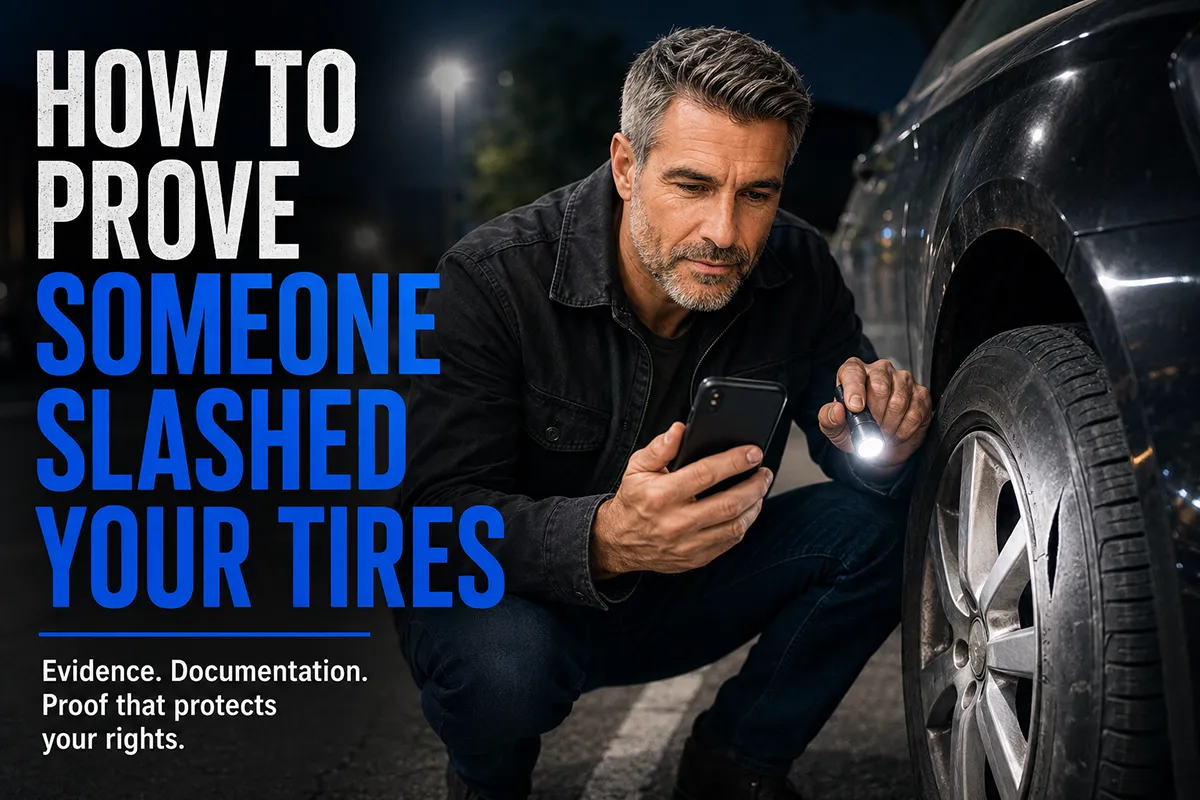
I got a call from my neighbor a couple of years ago — she walked out to her driveway on a Monday morning and found two tires completely flat with clean, straight cuts along the sidewalls. She was furious, but also helpless. She had no idea how to prove it was intentional.
That situation stuck with me because, as someone who’s spent years reviewing tires and advising everyday drivers, I know the difference between a slashed tire and a tire that failed naturally. And I’ve learned that proving vandalism is a very specific process most people get wrong.
- Slashed tires show clean, linear cuts — usually on the sidewall — that look very different from punctures, blowouts, or road damage.
- Document everything immediately: photos, videos, timestamps, and witness statements before touching or moving anything.
- File a police report as soon as possible — it’s critical for insurance claims and legal action.
- Check for security camera footage from your own cameras, neighbors, or nearby businesses within 24-48 hours before it’s overwritten.
- Your comprehensive (not liability-only) auto insurance policy typically covers vandalism, minus your deductible.
- If you need replacement tires after a slashing, budget $100–$300+ per tire depending on size and brand.
Liked this article?
Add TireAdvise as a preferred source so you see more of our tire reviews and guides on Google.
Why Proving Tire Slashing Is Harder Than You Think
Here’s the uncomfortable truth I’ve learned from working in the tire space: most tire slashing cases go unsolved. The act itself takes only a few seconds, it’s usually done at night, and unless you have direct evidence, it becomes your word against nobody.
But “harder” doesn’t mean impossible. I’ve walked several friends and readers through this exact process, and the ones who followed a systematic approach had significantly better outcomes — whether that meant a successful insurance claim, identifying the vandal, or both.
The key is treating it like a crime scene from the very first moment you discover the damage. Every minute you wait, potential evidence degrades or disappears.
Step 1: Learn What a Slashed Tire Actually Looks Like
Before you can prove someone slashed your tires, you need to confirm that slashing is actually what happened. I’ve inspected hundreds of damaged tires over the years, and I can tell you that not every flat tire is the result of vandalism.
Here’s what I look for when I’m trying to distinguish a slashed tire from other types of damage.
Characteristics of a Slashed Tire
- Clean, straight cuts: A knife or box cutter leaves a linear incision, usually between 1 and 3 inches long. The edges of the cut are smooth and deliberate — not jagged or frayed.
- Sidewall location: Vandals almost always target the sidewall because it’s the thinnest, most vulnerable part of the tire. It’s also faster and quieter than trying to puncture the tread.
- Multiple tires affected: In my experience, if someone slashes one tire, they often slash two or more. A single flat is more likely a road hazard or defect.
- No foreign object present: When you run over a nail or screw, it’s usually still embedded in the tread. A slashed tire typically has nothing lodged in the cut.
- Rapid, complete deflation: Sidewall cuts cause almost instant air loss. If your tire went from fine to completely flat overnight with no slow leak, that’s a red flag.
What a Slashed Tire Does NOT Look Like
- Blowouts: These create large, irregular tears — often on the tread face — with shredded rubber and exposed cords. They look violent, not surgical.
- Punctures from road debris: These are small, round holes in the tread area, often with a nail, screw, or piece of metal still stuck in them.
- Sidewall bubbles or cracks: These result from impact damage (hitting a pothole or curb) or age-related deterioration. They look like bulges or spider-web cracking, not cuts.
- Bead leaks: Air escaping from where the tire meets the rim. No visible cut on the rubber itself.
I always tell people: if the cut looks like it was made with a tool, it probably was. Trust your eyes.
Step 2: Document the Damage Immediately — Before You Touch Anything
This is the step most people skip or rush through, and it’s the most important one. The moment you discover slashed tires, your instinct will be to call someone, get angry, or start figuring out how to get to work. Resist all of that for ten minutes.
Here’s exactly what I recommend you do, in order:
Take Photos and Videos
Use your smartphone — the camera you already have in your pocket is good enough.
- Wide shots: Capture your entire vehicle showing where it’s parked, the surroundings, and the overall scene. This establishes context.
- Medium shots: Get each damaged tire in full frame, showing the wheel, sidewall, and tread together.
- Close-ups: Zoom in on each individual cut. Make sure the image is sharp and well-lit. If it’s dark, use your phone’s flashlight or a separate light source.
- Video walkthrough: Record a slow, narrated walkthrough of the damage. Say the date, time, and your location out loud on camera. Walk around the entire car.
- Surrounding area: Photograph anything unusual nearby — footprints, discarded objects, tool marks on the ground, or anything out of place.
I cannot overstate how important timestamps are. Most smartphone cameras embed date and time data (EXIF data) automatically, but verbally stating the time in your video adds another layer of documentation.
Note the Exact Time and Conditions
Write down or type into your phone’s notes app: the date, the time you discovered the damage, the last time you saw the car with tires intact, the weather conditions, and whether the area was lit or dark.
This creates a window of time during which the slashing occurred, which becomes crucial for reviewing camera footage later.
Step 3: Check for Security Camera Footage Right Away
Time is your enemy here. Many security camera systems — especially those at businesses and apartment complexes — overwrite footage every 24 to 72 hours. I’ve seen people lose critical evidence simply because they waited too long.
Sources of Footage to Check
- Your own cameras: If you have a Ring doorbell, Nest cam, Wyze camera, or any other home security system, check it immediately. Even if the camera doesn’t point directly at your car, it might have captured someone walking by or approaching your driveway.
- Neighbor cameras: Knock on doors. Ask politely. Most neighbors are sympathetic to vandalism and willing to let you review or copy footage. I’ve found that neighbors with Ring cameras are especially helpful because Ring stores footage in the cloud for a set period.
- Nearby business cameras: If you were parked on a street or in a commercial area, check with nearby shops, gas stations, restaurants, or banks. Many of these have exterior cameras that may cover the street or parking area.
- Municipal cameras: Some cities have traffic cameras or public safety cameras in certain neighborhoods. You can ask the police to check these as part of their investigation.
- Dashcams from parked cars: Some dashcams have a “sentry mode” or “parking mode” that records when motion is detected. If a neighbor’s car was parked nearby with such a system, that footage could be invaluable.
When I helped my neighbor through her situation, we found that a business two doors down had a camera that caught a figure approaching her car at 2:14 AM. The footage wasn’t high-resolution enough to identify a face, but it established a timeline and confirmed the act was intentional. That alone strengthened her police report significantly.
How to Preserve Footage
Download the footage to your phone or computer. Don’t just view it — save it. If possible, save the raw file rather than re-recording your screen with another phone. Raw files preserve metadata and higher quality, which matters if the case goes to court.
Step 4: File a Police Report
I know some people think filing a police report for slashed tires is pointless because “the police won’t do anything.” And honestly, in many cases, the police aren’t going to launch a full investigation over tire vandalism.
But here’s why you file a report anyway:
- Insurance requirement: Most auto insurance companies require a police report before processing a vandalism claim. No report, no payout.
- Legal documentation: If you later identify the person who did it, the police report serves as your initial documentation. It creates an official record of the incident.
- Pattern recognition: If other people in your neighborhood have also reported tire slashing, police may connect the dots and allocate more resources.
- Restraining orders or harassment claims: If you suspect a specific person (an ex, a neighbor in a dispute, etc.), the police report becomes a critical piece of evidence in a broader legal case.
What to Include in Your Police Report
When I’ve helped people file these reports, I always tell them to come prepared with:
- Your photo and video evidence (bring your phone or a USB drive)
- The exact location of the car when the damage occurred
- The time window during which the slashing happened
- Any security camera footage you’ve already collected
- Names and contact information for any witnesses
- Any suspects you may have, along with your reasoning (be specific and factual — not speculative)
Be calm, be thorough, and be specific. The more organized your evidence is, the more seriously officers will take your report.
Get a copy of the report number. You’ll need it for your insurance claim and potentially for court.
Step 5: Talk to Witnesses
You’d be surprised how often there’s a witness — or at least someone who heard or saw something unusual. I always recommend canvassing your immediate area within the first day.
Who to Ask
- Immediate neighbors on both sides and across the street
- Dog walkers or joggers who may have been out early in the morning
- Delivery drivers (USPS, UPS, FedEx, Amazon) who were in the area during the relevant time window
- Anyone sitting on their porch, in their garage, or who might have been up late
What to Ask
Keep it simple and non-accusatory: “Did you see or hear anything unusual near my car last night between [time] and [time]?” People are more helpful when they don’t feel interrogated.
If someone did see or hear something, ask if they’d be willing to provide a written statement or speak with the police. Even secondhand information — like hearing a loud hissing sound (which a slashed tire absolutely makes) — can support your case.
Step 6: Identify Potential Suspects
This is sensitive territory, and I want to be clear: I’m not suggesting you play detective or confront anyone. But in my experience, most tire slashing cases involve someone the victim knows.
Common Motives for Tire Slashing
- Personal disputes: Arguments with neighbors, ex-partners, coworkers, or acquaintances
- Parking disputes: Someone who felt you took “their” spot, especially in urban areas or apartment complexes
- Road rage follow-through: A driver you had an altercation with who followed you home or tracked your vehicle
- Random vandalism: Occasionally, it really is random — especially if multiple cars on a street were targeted the same night
If you suspect a specific person, gather any corroborating evidence: text messages, prior threats, social media posts, or a history of confrontations. Share this with the police rather than confronting the person yourself.
In one case I’m aware of, a reader discovered their tires were slashed the morning after a heated argument with a neighbor. The neighbor had texted threatening messages the previous evening. Those text messages, combined with the police report and timestamped photos, were enough to establish a strong circumstantial case.
Step 7: File an Insurance Claim
Now let’s talk about money — because replacing slashed tires isn’t cheap. Here’s what you need to know about the insurance side.
What Insurance Covers Tire Slashing?
Comprehensive coverage is what pays for vandalism damage, including slashed tires. This is separate from collision coverage and liability coverage.
If you only carry liability insurance (the minimum required in most US states), vandalism is NOT covered. You’ll be paying out of pocket.
How to File the Claim
- Call your insurance company as soon as possible after filing the police report.
- Provide the police report number.
- Share all your photo and video evidence.
- Get a repair estimate from a tire shop (or multiple shops).
- Your insurance will process the claim minus your deductible.
Is It Worth Filing a Claim?
This is where I encourage people to do the math. Here’s a comparison table to help you decide:
| Scenario | Estimated Cost | Typical Deductible | Insurance Payout | Worth Filing? |
|---|---|---|---|---|
| 1 tire slashed (budget tire) | $80–$150 | $500 | $0 | No |
| 2 tires slashed (mid-range) | $300–$500 | $500 | $0 | Probably not |
| 4 tires slashed (mid-range) | $600–$1,000 | $500 | $100–$500 | Possibly |
| 4 tires slashed (premium/performance) | $800–$1,400+ | $500 | $300–$900+ | Yes |
| 4 tires slashed (truck/SUV all-terrain) | $800–$1,600+ | $500 | $300–$1,100+ | Yes |
Keep in mind that filing a comprehensive claim may affect your future premiums, though the impact is typically less severe than a collision claim. I always recommend asking your insurance agent directly what the premium impact would be before filing.
Step 8: Consider Legal Action
If you’ve identified the person who slashed your tires and you have evidence to support your claim, you have several legal options.
Criminal Charges
Tire slashing is a criminal offense in all 50 US states. Depending on the total dollar amount of the damage, it can be charged as a misdemeanor or felony.
- Misdemeanor vandalism: Typically applies when total damage is under a certain threshold (varies by state — often $500 to $1,000).
- Felony vandalism: Applies when total damage exceeds the state threshold. Four slashed premium tires can easily push past $1,000.
The police and district attorney’s office handle criminal charges. Your role is providing evidence and cooperating with the investigation.
Small Claims Court
Even if criminal charges are filed, you can also pursue the vandal in small claims court for restitution — the cost of your replacement tires, towing, rental car, lost wages, and other related expenses.
Small claims court filing fees in most US states range from $30 to $75, and you don’t need an attorney. I’ve seen people successfully recover the full cost of tire replacement this way when they had solid documentation.
Civil Lawsuit
For larger damages or if the vandalism is part of a broader pattern of harassment, a full civil lawsuit may be appropriate. Consult with a local attorney — many offer free initial consultations for cases like this.
How to Prevent Tire Slashing in the Future
After going through this ordeal, most people want to know how to make sure it never happens again. Here’s what I recommend based on what I’ve seen work.
Install Visible Security Cameras
A visible camera is as much a deterrent as it is a recording device. Ring, Arlo, Wyze, and Blink all offer affordable outdoor cameras ranging from $30 to $200. Mount them to cover your driveway and the street in front of your home.
I personally use a Ring Floodlight Cam over my driveway, and the motion-activated flood light alone has been a powerful deterrent during the several years I’ve had it installed.
Use Motion-Activated Lighting
Vandals prefer darkness. A simple motion-activated floodlight ($20–$50 at Home Depot or Lowe’s) dramatically reduces the likelihood of someone approaching your vehicle undetected.
Park in Well-Lit, Visible Areas
If you don’t have a garage, park under a streetlight or in the most visible spot available. Avoid secluded areas, dead-end streets, or spots that are shielded from view by fences, hedges, or buildings.
Use a Dash Cam with Parking Mode
Several dash cams on the market today offer a parking or sentry mode that activates recording when motion or impact is detected while the car is off. The Viofo A129 Plus and the BlackVue DR900X are two popular options in the US market that I’ve seen recommended repeatedly for this purpose.
Address the Root Cause
If you suspect the tire slashing was motivated by a personal dispute, consider whether it’s possible to resolve the underlying conflict — through direct conversation, mediation, or (if necessary) a restraining order. Repeated vandalism often escalates if the root issue isn’t addressed.
Replacing Slashed Tires: What You Need to Know
Once you’ve handled the evidence, police, and insurance, you still need to actually replace the tires. As a tire reviewer, this is where I can offer the most direct help.
Can a Slashed Tire Be Repaired?
In almost every case, no. Sidewall damage cannot be safely repaired. The sidewall is a structural component of the tire, and any cut, gash, or puncture in this area compromises the tire’s integrity under load and at speed.
I’ve seen shops attempt sidewall repairs, and I strongly advise against it. A repaired sidewall can fail catastrophically at highway speeds. It’s not worth the risk for anyone in your car — or anyone sharing the road with you.
Should You Replace All Four Tires?
This depends on the condition of your remaining tires. If only two tires were slashed and your other two have significant tread life remaining, you can often replace just the damaged tires — as long as the new tires match the same brand, model, and size, and the tread depth difference isn’t excessive.
For all-wheel-drive vehicles, most manufacturers recommend keeping all four tires within a very close tread depth range (often 2/32″ or less difference). If your surviving tires are worn significantly, you may need to replace all four to protect your AWD system.
Budget-Friendly Replacement Tires Worth Considering
If you’re paying out of pocket and need to keep costs down, here are a few reliable, budget-friendly options I’ve tested and reviewed:
- General Altimax RT45: A solid all-season tire from a Continental sub-brand. Typically $80–$120 per tire for common passenger car sizes. I’ve been consistently impressed with its ride comfort and wet traction.
- Cooper CS5 Ultra Touring: Another great value option with a comfortable ride and good tread life. Usually $90–$130 per tire.
- Hankook Kinergy PT (H737): One of the best budget all-season tires I’ve reviewed. Quiet, long-wearing, and priced around $85–$115 for most sizes.
- Falken Sincera SN201 A/S: Affordable and dependable, with better-than-expected wet performance. Typically $75–$110 per tire.
For truck and SUV owners who need all-terrain replacements, the Falken Wildpeak AT3W and the General Grabber ATX are both excellent options that won’t break the bank — usually $140–$200 per tire depending on size.
I always recommend getting quotes from at least two or three tire shops, including Discount Tire, Tire Rack (with local installation), America’s Tire, Costco, and Sam’s Club. Prices can vary by $15–$30 per tire between retailers for the exact same product.
A Complete Checklist: How to Prove Someone Slashed Your Tires
I’ve put together this step-by-step checklist based on everything I’ve covered above. Bookmark this or screenshot it so you have it ready if you ever need it.
- ☐ Confirm the damage is consistent with intentional slashing (clean cuts, sidewall location, no debris)
- ☐ Photograph and video the damage immediately — wide shots, medium shots, and close-ups
- ☐ Verbally state the date, time, and location in your video
- ☐ Document the time window when the slashing likely occurred
- ☐ Note weather conditions and lighting at the scene
- ☐ Check your own security cameras for footage
- ☐ Ask neighbors for security camera footage within 24 hours
- ☐ Contact nearby businesses for exterior camera footage
- ☐ Download and save all footage in original file format
- ☐ Canvass the area for witnesses and collect contact information
- ☐ File a police report with all evidence organized
- ☐ Obtain the police report number
- ☐ Contact your insurance company if you have comprehensive coverage
- ☐ Get repair/replacement estimates from tire shops
- ☐ Decide whether filing a claim is financially worth it
- ☐ Consult with an attorney if you identify a suspect and want to pursue legal action
- ☐ Install security cameras and motion lighting to prevent future incidents
- ☐ Replace damaged tires with properly matched replacements
Final Thoughts from Someone Who’s Seen Too Many Slashed Tires
Discovering that someone slashed your tires is violating. It’s not just about the money — though that stings — it’s the feeling that someone targeted you and your property. I’ve walked enough people through this process to know that the emotional response is just as real as the financial one.
But I’ve also seen that the people who approach the situation methodically — who treat it like a case from minute one — end up in a much better position. They get better insurance outcomes. They give police something actionable to work with. And in some cases, they actually identify the person responsible and get restitution.
The evidence is everything. Start collecting it before you even process how you feel.
And when it comes time to replace those tires, don’t rush the purchase out of frustration. Take a day, compare prices, read reviews, and get the best value for your money. Your next set of tires might end up being better than the ones you lost.
Stay safe out there, and if you have questions about replacement tires after a slashing incident, drop a comment below or reach out — I’m happy to help you find the right fit for your car and your budget.
Frequently Asked Questions
How can I prove someone slashed my tires?
To prove someone slashed your tires, start by documenting the damage with close-up photos and videos that clearly show clean, straight cuts — which differ from blowouts or punctures caused by road debris. Check for nearby security cameras, doorbell cameras, or dash cam footage that may have captured the act. File a police report immediately, as this creates an official record you’ll need for insurance claims and any legal action against the responsible party.
What does a slashed tire look like compared to a tire that blew out?
A slashed tire typically has a clean, linear cut on the sidewall, often 1–3 inches long, with smooth edges that indicate a knife or sharp blade was used. In contrast, a blowout or road hazard puncture usually shows irregular, jagged tearing and is more commonly found on the tread area rather than the sidewall. If you notice multiple tires damaged in the same way, that’s a strong indicator of intentional vandalism rather than normal wear or road debris.
Should I file a police report if someone slashed my tires?
Yes, you should file a police report as soon as you discover the damage, even if you don’t know who did it. A police report creates an official record of the vandalism, which is typically required by your insurance company if you plan to file a comprehensive claim. Officers may also canvas the area for surveillance footage or witnesses, which strengthens your case if a suspect is identified later.
Does car insurance cover slashed tires and how much will replacement cost?
Comprehensive auto insurance generally covers tire slashing since it falls under vandalism, but you’ll need to pay your deductible first — which is often $250–$500. Since a single replacement tire typically costs $100–$300 depending on the brand and size, filing a claim may only make financial sense if multiple tires were slashed. Popular US replacement brands like Goodyear, Cooper, and General Tire offer solid options across price points, so get quotes from local tire shops and weigh them against your deductible before deciding.
Can I use doorbell or security camera footage to catch someone slashing my tires?
Absolutely — doorbell cameras like Ring or Nest and nearby security cameras are some of the strongest evidence you can use to prove someone slashed your tires. Check your own cameras first, then ask neighbors and nearby businesses if their systems captured any footage from the time the damage likely occurred. Act quickly, because many camera systems overwrite footage within 24–72 hours, and provide any recordings directly to the police for your report.
Can I take someone to small claims court for slashing my tires?
Yes, if you can identify the person who slashed your tires, you can sue them in small claims court to recover the cost of replacement tires, installation, and any related expenses like towing. In most US states, small claims court handles cases up to $5,000–$10,000 and doesn’t require an attorney. You’ll need solid evidence such as camera footage, witness statements, the police report, and receipts for your new tires to build a convincing case.
How can I prevent someone from slashing my tires again?
Park in well-lit areas or inside a garage whenever possible, and consider installing a dash cam with parking mode or a motion-activated security camera aimed at your vehicle. Tire pressure monitoring systems (TPMS) won’t prevent slashing, but they’ll alert you immediately if a tire loses air, which helps you address the damage before driving on a flat and ruining the rim. If you suspect a specific person, document every incident and share the pattern with police, as repeat vandalism charges carry stiffer penalties in most US states.
