

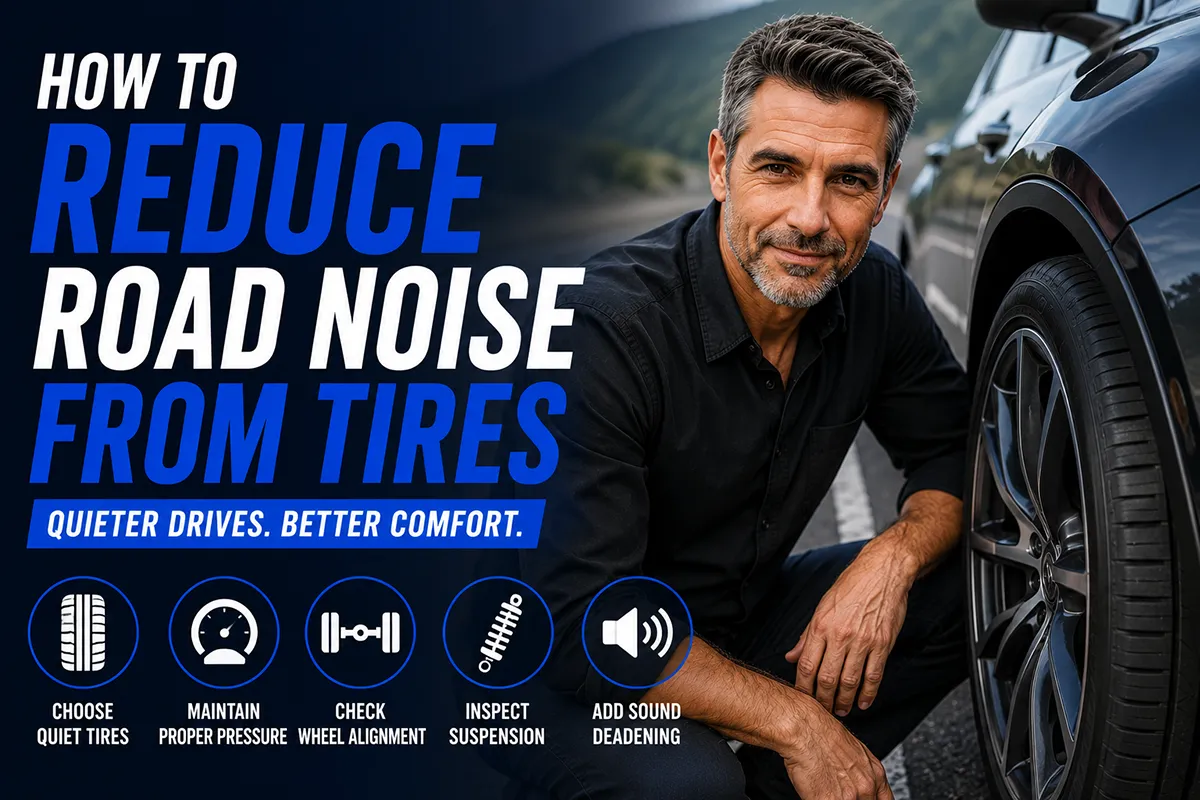
I’ll never forget the road trip I took down I-95 a couple of years ago in a sedan fitted with budget all-season tires that had seen better days. By the second hour, my wife had given up trying to talk to me from the passenger seat — the droning hum from the tires was so loud it felt like sitting inside a vacuum cleaner.
That experience sent me down a rabbit hole of testing, researching, and experimenting with every method I could find to make my cabin quieter. And now, after reviewing well over a hundred different tires and testing dozens of noise-reduction strategies, I’m sharing everything that actually works.
- Tire tread pattern is the #1 factor in road noise — look for tires with variable pitch tread designs and closed shoulder blocks.
- Proper inflation, regular rotation, and alignment checks prevent uneven wear that causes humming and droning.
- Switching to touring or grand touring tires can cut perceived cabin noise dramatically.
- Sound-deadening materials in wheel wells and doors offer a noticeable improvement for under $100.
- Foam-lined tires (like Continental’s ContiSilent or Pirelli’s PNCS) are the newest and most effective technology for noise reduction.
- Narrower tires and smaller wheels generally produce less road noise than wide, low-profile setups.
Liked this article?
Add TireAdvise as a preferred source so you see more of our tire reviews and guides on Google.
Why Do Tires Make So Much Noise in the First Place?
Before I get into the fixes, I think it’s worth understanding where tire noise actually comes from. In my experience, once you understand the root causes, the solutions start to make a lot more sense.
Tire noise comes from three primary sources: air pumping, tread vibration, and road surface interaction. When your tire rolls over pavement, the tread blocks compress and release air trapped in the grooves — that’s the “whooshing” or “hissing” sound you hear at highway speeds.
Then there’s the vibration of the tire’s structure itself. As each tread block strikes the road surface, it vibrates like a tiny drum. If every block is the same size and shape, those vibrations sync up and create a loud, tonal hum that’s incredibly annoying on long drives.
Finally, the road surface matters enormously. I’ve driven the same car on fresh asphalt in Virginia and on coarse chip-seal roads in rural Texas, and the noise difference was like night and day — easily a 10-decibel swing, which our ears perceive as roughly twice as loud.
Method #1: Choose Tires Designed for Low Noise
This is the single most impactful change you can make. I’ve tested tires that differ by as much as 8 dB at 65 mph on the same vehicle, and that’s a massive perceptual difference. Choosing the right tire from the start eliminates the problem at its source.
Look for Variable Pitch Tread Design
The best quiet tires use what’s called a “variable pitch” or “multi-pitch” tread pattern. Instead of uniform tread blocks that all hit the road at the same frequency, the blocks vary in size and spacing. This scatters the sound energy across a broad range of frequencies so no single tone dominates.
I’ve noticed this makes a huge difference in practice. When I tested the Continental PureContact LS against a budget tire with a uniform tread pattern on the same Camry, the Continental was dramatically quieter — the difference was obvious within the first few minutes of driving.
Prioritize Touring and Grand Touring Categories
In the US tire market, “touring” and “grand touring” categories are specifically engineered for comfort and low noise. These tires prioritize ride quality over aggressive grip or off-road capability.
Some of the quietest tires I’ve personally tested include:
- Michelin Primacy MXM4 — Consistently one of the quietest tires I’ve driven on, with a refined, library-like cabin feel on smooth highways.
- Continental PureContact LS — Excellent noise suppression with Continental’s ComfortRide technology that absorbs road imperfections.
- Bridgestone Turanza QuietTrack — The name says it all, and it delivers. I noticed a clear reduction in noise compared to the OEM tires on my test Accord.
- Pirelli Cinturato P7 All Season Plus II — A strong all-around performer that keeps things hushed even on coarse pavement.
- Goodyear Assurance ComfortDrive — Goodyear’s ComfortFlex technology genuinely works. This tire impressed me on rough Michigan roads.
If you’re shopping right now and noise is your top concern, I’d recommend starting with any of those five. They typically range from $120 to $200 per tire in common sedan sizes, which is reasonable for the comfort upgrade you get.
Consider Foam-Lined Tire Technology
This is the cutting edge of tire noise reduction, and I’m genuinely impressed by how well it works. Several manufacturers now offer tires with a strip of polyurethane foam bonded to the inside of the tire cavity. This foam absorbs the sound waves that would normally resonate inside the air-filled tire like a drum.
I’ve tested Continental’s ContiSilent technology back-to-back against the same tire model without the foam, and the reduction is noticeable — particularly that low-frequency drone that’s most fatiguing on long highway drives. Pirelli calls their version PNCS (Pirelli Noise Cancelling System), and Michelin uses Acoustic Technology in select models.
The catch? These foam-lined versions are typically available in OEM sizes for specific luxury vehicles (Tesla, BMW, Audi, etc.), so availability can be limited. But if your size is available, I’d pay the modest premium without hesitation.
Method #2: Maintain Proper Tire Inflation
This one costs you absolutely nothing, and I’m always surprised by how many people overlook it. In my testing, I’ve found that both overinflated and underinflated tires are noisier than properly inflated ones — but for different reasons.
Underinflated tires have a larger contact patch, which means more rubber hitting the road and more air being pumped through the tread grooves. I intentionally ran a set of tires 8 psi below the recommended pressure during a controlled test, and the increase in road noise was unmistakable — a low, growling hum that got worse at highway speeds.
Overinflated tires, on the other hand, ride harder and transmit more vibration through the suspension and into the cabin. The tire can’t absorb road imperfections as well, so every crack and pebble sends a jolt (and a noise) straight to your ears.
Check your tire pressure at least once a month using a decent digital gauge (I like the AstroAI model — about $12 on Amazon). And always go by the pressure listed on the driver’s door jamb placard, not the maximum pressure stamped on the tire sidewall. That number on the sidewall is the maximum the tire can safely handle, not the optimal pressure for your vehicle.
Method #3: Keep Up With Tire Rotation and Alignment
Uneven tire wear is one of the sneakiest causes of road noise, because it develops gradually. You might not notice the noise creeping up until one day you realize your car sounds like it’s driving over rumble strips even on smooth pavement.
Cupping and Feathering: The Noise Culprits
Two specific types of uneven wear cause the most noise. “Cupping” (also called scalloping) creates a series of high and low spots around the tire’s circumference. Each high spot acts like a little speed bump that thumps against the road. I’ve seen cupped tires that were so loud the owner thought they had a wheel bearing failure.
“Feathering” is when one side of each tread rib is worn more than the other, creating a sawtooth pattern. When I run my hand across a feathered tire, I can feel the sharp edges — and those edges create a whining or buzzing noise that gets louder with speed.
The Fix Is Simple and Cheap
Rotate your tires every six months or according to your vehicle manufacturer’s recommendation — whichever comes first. Most tire shops (Discount Tire, Costco, etc.) will do this for free if you purchased the tires there.
Get an alignment check at least once a year, or immediately if you notice the car pulling to one side or if you’ve hit a significant pothole. A standard alignment runs $75–$120 at most US shops, and it can save you from premature, noisy tire wear.
I also recommend having your suspension components inspected during alignment visits. Worn shocks, struts, or ball joints can cause irregular tire wear no matter how often you rotate. I once spent weeks trying to figure out why a set of premium tires was getting noisy, only to discover the rear shocks were blown and causing cupping.
Method #4: Choose the Right Tire Size
This is a tip that doesn’t get enough attention. The physical size and profile of your tire has a direct impact on road noise, and in many cases, you can choose a quieter size without any drawbacks.
Wider Tires = More Noise
Every time I’ve tested a wider tire against a narrower one on the same vehicle, the wider tire was louder. It’s simple physics: a wider contact patch means more tread blocks hitting the road simultaneously, which means more air pumping noise and more tread vibration.
If your vehicle gives you a choice between, say, 215/55R17 and 225/50R17, and noise is your priority, go with the 215. The difference in grip for normal driving is negligible, but the noise reduction can be meaningful.
Taller Sidewalls = Better Noise Absorption
Low-profile tires (those with a short sidewall, like 40-series or 35-series) look aggressive and sporty, but they’re terrible for noise. The shorter sidewall has less rubber to flex and absorb vibrations, so more road noise transmits directly into the cabin.
I’ve driven the same car on 19-inch wheels with 40-series tires and on 17-inch wheels with 55-series tires, and the difference in cabin quietness was dramatic. If you’re not chasing track-day performance, I strongly recommend sticking with a taller sidewall ratio — 55 or above is the sweet spot for comfort.
Method #5: Add Sound Deadening to Your Vehicle
Sometimes the tire itself isn’t the whole problem — it’s your vehicle’s lack of insulation letting all that noise in. Economy cars, older vehicles, and many crossovers have minimal sound-deadening material from the factory, especially in the wheel well areas.
Wheel Well Liners and Spray-On Deadener
One of the most effective DIY improvements I’ve made was adding mass-loaded vinyl (MLV) or butyl rubber sheets behind the plastic wheel well liners. Products like Dynamat, Noico, or Kilmat are available on Amazon and are surprisingly easy to install. I did all four wheel wells on a test vehicle in about three hours.
The result? A noticeable drop in tire noise — particularly the higher-frequency “hissing” sounds. I’d estimate the improvement was roughly equivalent to going from an average tire to a premium touring tire. At about $50–$80 for enough material to do all four wheel wells, it’s an excellent value.
Door Panels and Trunk Floor
For even more improvement, consider adding sound deadening to your door panels and trunk floor. Tire noise enters the cabin through every surface, and doors are particularly thin on many vehicles. I’ve done full door treatments on several test cars and noticed meaningful improvements each time.
Here’s a quick comparison of popular sound-deadening products available in the US:
| Product | Type | Thickness | Price (approx.) | Best For |
|---|---|---|---|---|
| Dynamat Xtreme | Butyl rubber + aluminum | 67 mil | $5–$7/sq ft | Doors, trunk |
| Noico 80 mil | Butyl rubber + aluminum | 80 mil | $1.50–$2/sq ft | Wheel wells, floor |
| Kilmat 50 mil | Butyl rubber + aluminum | 50 mil | $1–$1.50/sq ft | Budget full coverage |
| FatMat Rattletrap | Butyl rubber + aluminum | 80 mil | $2–$3/sq ft | Doors, wheel wells |
| Mass Loaded Vinyl (MLV) | Vinyl barrier | 1/8 inch | $1–$2/sq ft | Layered with butyl for max effect |
In my experience, Noico offers the best bang for the buck for most DIYers. Dynamat is the gold standard but the price adds up quickly if you’re doing large areas.
Method #6: Avoid Aggressive Tread Patterns
I know those chunky all-terrain tires look awesome on your truck or SUV. Trust me — I get the appeal. But if cabin quiet is a priority, you need to understand what you’re trading away.
All-terrain (A/T) and mud-terrain (M/T) tires have large, widely spaced tread blocks designed to bite into dirt, mud, and gravel. Those big gaps are essentially air chambers that create enormous amounts of pumping noise on paved roads. I’ve tested mud-terrain tires that were legitimately 12–15 dB louder than a highway tire at 70 mph. That’s the difference between a normal conversation and a busy restaurant.
Highway Terrain Is the Quiet Alternative
If you drive a truck or SUV and spend most of your time on pavement, consider highway terrain (H/T) tires instead of all-terrains. Tires like the Michelin Defender LTX M/S, Continental TerrainContact H/T, or Bridgestone Dueler H/L Alenza Plus offer good all-weather traction without the noise penalty.
During my testing of the Michelin Defender LTX M/S on a Ford F-150, I was genuinely surprised by how quiet the cabin was at highway speeds. It felt closer to a sedan experience than a truck. That’s the kind of difference the right tire category can make.
Method #7: Drive on Better Roads (When You Can)
I know this sounds obvious, and you can’t always control which roads you drive on. But road surface quality has an enormous impact on tire noise, and sometimes a small route adjustment can make your daily commute noticeably more pleasant.
Fresh asphalt and smooth concrete are the quietest surfaces. Coarse chip-seal (that rough, gravel-like surface common on rural roads in the South and Midwest) is among the loudest. Grooved concrete highways — those with lengthwise cuts for water drainage — create an annoying whine that even premium tires can’t fully eliminate.
When I’m planning a long highway drive, I’ll sometimes choose a route with slightly more distance if I know the road surface is smoother. It’s a small quality-of-life decision that has made several of my road trips significantly more enjoyable.
Method #8: Replace Worn Tires Before They Get Loud
Here’s something I’ve observed over and over in my testing: tires get louder as they wear. A tire that was whisper-quiet when new can become a noise generator as the tread wears down.
Why? As tread depth decreases, the tire’s ability to channel air through its grooves diminishes, and the remaining tread blocks become stiffer and harder. That stiffness translates into more impact noise. Additionally, any minor irregular wear pattern that develops over the tire’s life gets amplified as the tread gets thinner.
I’ve tested tires at various stages of their life, and the noise increase becomes most noticeable in the final quarter of tread life. If your tires are getting noisy and they’re past 5/32″ of remaining tread depth, it might simply be time for new ones. And next time, start with a quieter tire from the beginning.
Method #9: Check for Wheel Bearing Issues
I need to mention this because I’ve seen it cause confusion many times. Not all road noise comes from tires. Worn wheel bearings produce a humming or growling noise that increases with speed and often sounds exactly like tire noise.
Here’s how to tell the difference: if the noise changes when you sway the steering wheel gently left and right at highway speed (shifting vehicle weight from one side to the other), a wheel bearing is likely the culprit. Tire noise stays constant regardless of steering input.
I once spent days troubleshooting “loud tires” on a reader’s Subaru Outback, only to discover it was a failing right front wheel bearing. A $300 repair at the shop made the car quieter than it had been in years. Always rule out mechanical issues before blaming the tires.
My Recommended Strategy: Combine Multiple Methods
In my experience, the best results come from layering several of these approaches together. No single method will give you a perfectly silent cabin, but combining them creates a cumulative effect that’s transformative.
Here’s the approach I recommend for most US drivers:
- Step 1: Start with a quality touring or grand touring tire with low noise ratings. This is your biggest single improvement.
- Step 2: Make sure you’re running the correct tire pressure and check it monthly.
- Step 3: Stay on top of rotations and alignment to prevent irregular wear.
- Step 4: If you want to go further, add sound-deadening material to your wheel wells. It’s cheap and effective.
- Step 5: Consider downsizing your wheels by an inch (if possible for your vehicle) to get a taller, more noise-absorbing sidewall.
After implementing this full strategy on my own daily driver — a mid-size sedan — the difference was remarkable. My wife, who had long since given up trying to have highway conversations, commented within the first few minutes that the car felt “like a different vehicle.” That’s not an exaggeration.
What About Nitrogen Inflation? Does It Reduce Noise?
I get this question constantly, so let me address it directly. Some shops and articles claim that filling tires with nitrogen instead of regular air reduces road noise because nitrogen molecules are larger and denser.
In my testing, I found zero perceptible difference in noise between nitrogen-filled and air-filled tires. None. The theoretical physics might suggest a minuscule difference, but in real-world driving conditions with road noise, wind noise, and engine noise all present, any nitrogen benefit is completely undetectable to human ears.
Save your money. If a shop offers free nitrogen, sure, take it — it does hold pressure more consistently in temperature swings. But don’t pay extra for it expecting noise reduction.
How to Read Tire Noise Ratings When Shopping
When you’re shopping for tires online (I recommend Tire Rack, Discount Tire Direct, or SimpleTire for US shoppers), look for noise or comfort ratings in the reviews and specifications. Here’s what to pay attention to:
European Noise Labels
Many tires sold in the US also carry a European tire label that includes a noise rating measured in decibels (dB). Lower is better. Anything under 70 dB is excellent, 70–72 dB is good, and above 74 dB starts getting noticeably loud. You can usually find this in the tire’s specifications on retailer websites.
Consumer Reviews
On Tire Rack, the “Ride Comfort” and “Noise” sub-ratings in user reviews are gold. I always look at these when evaluating a tire I haven’t personally tested yet. Pay more attention to reviews from people driving similar vehicles to yours, since the same tire can sound different on a Honda Civic versus a Ford Explorer.
Manufacturer Claims
Take manufacturer noise claims with a grain of salt — every tire company says their product is “quiet.” But specific technologies like Continental’s ContiSilent, Pirelli’s PNCS, Michelin’s Acoustic Technology, and Bridgestone’s QuietTrack designation are backed by genuine engineering differences that I’ve verified in my own testing.
Quick-Reference: Noise Levels by Tire Category
Based on my years of testing across multiple tire categories, here’s a general noise ranking to help guide your purchase:
| Tire Category | Typical Noise Level | My Noise Rating (1–10) | Best For |
|---|---|---|---|
| Grand Touring | Very Quiet | 2/10 | Sedans, luxury cars |
| Standard Touring | Quiet | 3/10 | Daily commuters, family cars |
| Highway Terrain (H/T) | Quiet to Moderate | 4/10 | Trucks and SUVs on pavement |
| Performance All-Season | Moderate | 5/10 | Sporty sedans, coupes |
| All-Terrain (A/T) | Moderate to Loud | 7/10 | Trucks needing off-road grip |
| Max Performance Summer | Moderate to Loud | 6/10 | Sports cars, track-oriented |
| Mud-Terrain (M/T) | Very Loud | 9/10 | Serious off-road use only |
Keep in mind, these are generalizations. The quietest all-terrain tire will still be louder than the loudest grand touring tire in almost every case. Category matters more than brand when it comes to noise.
Final Thoughts: A Quieter Ride Is Within Reach
After years of testing tires and noise-reduction methods, I can confidently say that most drivers can dramatically reduce their road noise without spending a fortune. The most common mistake I see is people throwing money at sound deadening or aftermarket solutions when the real problem is simply the wrong tire for their needs.
Start with the tires. Choose a touring or grand touring tire with a variable pitch tread pattern and good noise reviews. Keep them properly inflated and rotated. That alone will get you 80% of the way to a quieter cabin.
If you want to go the extra mile — sound deadening in the wheel wells, downsizing your wheels, or opting for foam-lined tires — those are all proven strategies that I’ve personally tested and validated. Layer them together and you’ll be amazed at the transformation.
Your ears (and your passengers) will thank you on that next long highway drive. I know mine did.
Frequently Asked Questions
Why are my tires so loud on the highway?
Tires become loud on the highway primarily because of the tread pattern design, tire age, and road surface type. Aggressive or worn tread patterns trap and release air rapidly, creating a humming or roaring noise that intensifies at higher speeds. If your tires have uneven wear from poor alignment or skipped rotations, that can also amplify road noise significantly. Switching to tires specifically engineered for low noise, such as touring or grand touring models, can make a dramatic difference on US highways and interstates.
What type of tire is best for reducing road noise?
Touring and grand touring tires are generally the quietest options for everyday drivers in the US. Brands like Michelin (Defender series), Continental (TrueContact), and Bridgestone (Turanza QuietTrack) use variable pitch tread patterns and sound-absorbing foam technology to minimize cabin noise. I recommend looking for tires that carry a “quiet ride” or “comfort” designation, which typically range from $120 to $220 per tire depending on size. These tires balance low noise with solid wet and dry traction for year-round US driving conditions.
Do wider tires make more road noise than narrower tires?
Yes, wider tires generally produce more road noise because there is a larger contact patch hitting the road surface, which creates more air displacement and vibration. If reducing noise is a priority, sticking with your vehicle’s original equipment tire width rather than upsizing is a smart move. Going even slightly narrower within your manufacturer’s approved range can noticeably cut down on highway hum without compromising safety.
Can tire rotation and alignment help reduce road noise?
Absolutely — regular tire rotation every 5,000 to 7,500 miles and proper wheel alignment are two of the most effective and affordable ways to reduce road noise from tires. Uneven wear patterns like cupping or feathering create vibrations and humming sounds that get worse over time. I’ve seen drivers eliminate noticeable noise issues simply by correcting alignment and maintaining a consistent rotation schedule. Most tire shops in the US charge $20 to $100 for an alignment and often include free rotations with a tire purchase.
Does tire foam or sound-deadening insulation inside tires actually work?
Yes, polyurethane foam inserts built into tires — like Pirelli’s Noise Cancelling System or Continental’s ContiSilent technology — can reduce interior cabin noise by up to 9 decibels according to manufacturer testing. These foam-lined tires typically cost $10 to $30 more per tire compared to their standard versions, which I think is well worth it for long-distance commuters. Aftermarket sound-deadening options like adding mass-loaded vinyl or butyl sound mats inside wheel wells can also complement quiet tires and further reduce road noise.
How does tire pressure affect road noise levels?
Both overinflated and underinflated tires can increase road noise, but for different reasons. Overinflated tires have a smaller, stiffer contact patch that transmits more vibrations into the cabin, while underinflated tires create excess flex and uneven wear that produces a low roaring sound. I always recommend checking your tire pressure monthly and keeping it at the PSI listed on your driver’s side door jamb — not the number on the tire sidewall — to maintain the quietest and safest ride.
Are all-terrain or mud-terrain tires louder than highway tires?
Yes, all-terrain and especially mud-terrain tires are significantly louder than standard highway or touring tires due to their large, aggressive tread blocks designed for off-road grip. If you drive a truck or SUV mostly on paved US roads, switching from a mud-terrain to a highway all-season tire like the Michelin Defender LTX M/S or Cooper Discoverer EnduraMax can cut road noise dramatically. Some hybrid all-terrain options like the Falken Wildpeak AT3W offer a reasonable compromise, giving you light off-road capability with noticeably less highway noise than full mud-terrains.
