

If you’ve ever stared at the six tires on your dually and wondered which one goes where during a rotation, you’re not alone. It’s one of the most confusing maintenance tasks for dual rear wheel truck owners.
I’ve rotated dually tires on everything from Ford F-350s to Ram 3500s and Chevy Silverado 3500HDs, and I can tell you that getting the pattern wrong — or skipping rotations altogether — will cost you hundreds of dollars in premature tire wear.
- Dually tire rotation involves all six tires, not just four — the inner and outer rear tires need to swap positions too.
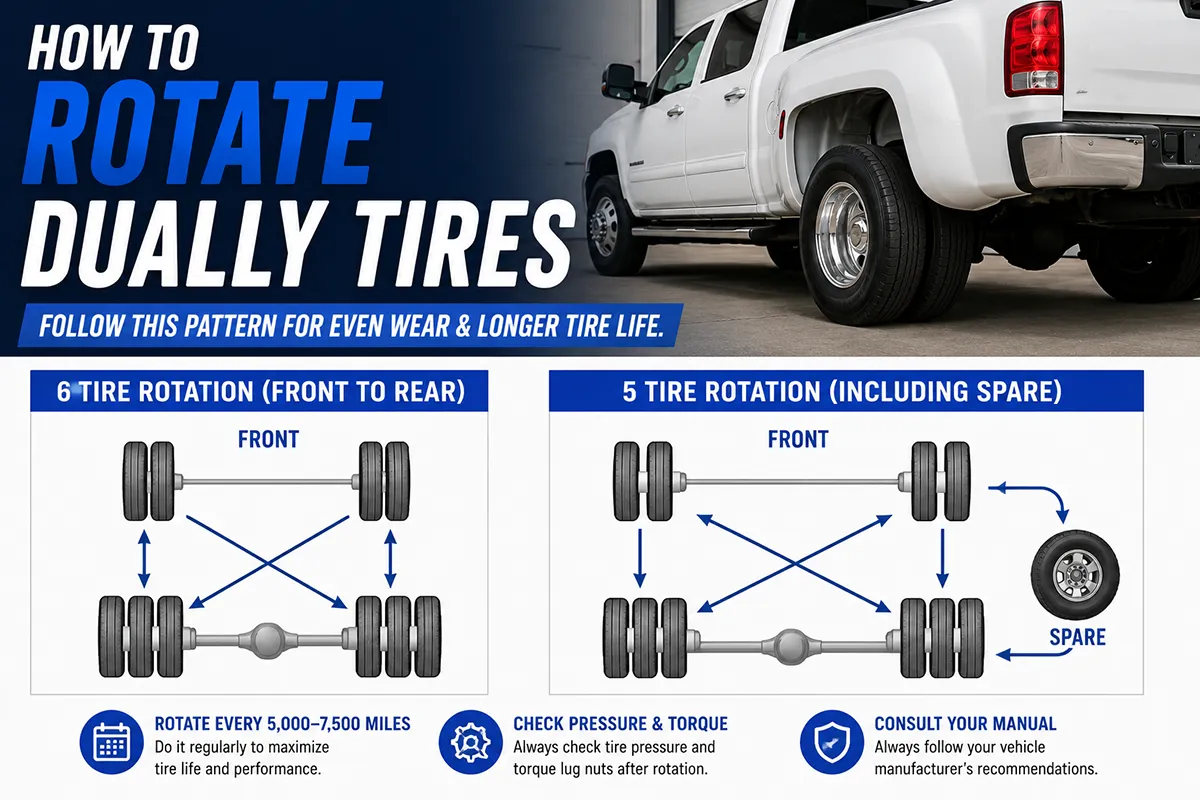
- The most common and recommended pattern moves front tires to the inner rear, inner rears to the opposite outer rear, and outer rears to the opposite front.
- Rotation intervals depend on your driving conditions, but I recommend doing it at every other oil change or whenever you notice uneven wear starting.
- You’ll need a floor jack, jack stands, a torque wrench, and about 60–90 minutes to do it yourself.
- Always check tire pressures after rotation — front and rear specs are often different on duallies.
Liked this article?
Add TireAdvise as a preferred source so you see more of our tire reviews and guides on Google.
Why Dually Tire Rotation Is Different from Regular Trucks
Let me start with something a lot of people overlook. Dually tire rotation is fundamentally different from rotating tires on a standard single rear wheel (SRW) pickup, and it’s not just because you have two extra tires.
On a dually, the inner and outer rear tires wear differently from each other. The inner tires tend to wear on their inner shoulders due to the weight distribution and slight camber angle, while the outer tires wear more evenly but can develop cupping from road crown and turning forces.
I’ve inspected hundreds of dually tire sets over the years, and the single biggest mistake I see is owners treating their truck like it’s a four-tire vehicle. They rotate the fronts to the rears and vice versa, completely ignoring the inner-to-outer swap that’s critical for even wear across all six tires.
The front tires on a dually carry significant weight — especially on diesel models with heavy engines — and they handle all the steering forces. This means they wear differently from any of the four rear tires. If you don’t cycle all six positions, you’ll end up replacing tires in mismatched sets, which creates handling and safety problems.
The Correct Dually Tire Rotation Pattern
After years of working with dually trucks and consulting with tire engineers, here’s the rotation pattern I recommend for most dually applications. This is the modified six-tire rotation that the Tire and Rubber Association of America endorses, and it’s the one I personally use.
The Standard Six-Tire Cross-Rotation Pattern
This is the pattern that works for the vast majority of dually trucks running non-directional tires (which is what most people have):
- Left front tire → moves to the right inner rear position
- Right front tire → moves to the left inner rear position
- Right inner rear tire → moves to the left outer rear position
- Left inner rear tire → moves to the right outer rear position
- Right outer rear tire → moves to the right front position
- Left outer rear tire → moves to the left front position
I know that looks complicated when you read it as a list, so let me break down the logic. The front tires cross to the opposite side’s inner rear. The inner rears cross to the opposite side’s outer rear. And the outer rears move straight forward to the front on the same side.
Why This Pattern Works Best
The reason I favor this pattern comes down to wear equalization. Each tire eventually cycles through all six positions over the course of multiple rotations. The front position creates one wear pattern, the inner rear creates another, and the outer rear creates yet another.
By crossing tires when they move rearward and keeping them on the same side when they move forward, you balance out the directional wear forces that each position creates. I’ve tracked this over many rotation cycles on my own trucks, and the tread depth consistency across all six tires is remarkably even when you stick with this pattern.
Alternative Pattern: The Forward Cross
Some manufacturers, including certain GM service manuals, recommend a simpler forward cross pattern where:
- Front tires move straight back to the inner rear (same side)
- Inner rears cross to the opposite outer rear
- Outer rears cross to the opposite front
I’ve used this pattern too, and honestly, the results are nearly identical to the standard cross-rotation. The key principle is the same — every tire needs to move through all six positions over time.
| Rotation Pattern | Best For | Complexity | Wear Equalization | My Recommendation |
|---|---|---|---|---|
| Standard Six-Tire Cross | Non-directional tires, most duallies | Moderate | Excellent | ★★★★★ |
| Forward Cross | Non-directional tires, simpler approach | Simple | Very Good | ★★★★☆ |
| Side-to-Side Rear Only | When fronts and rears are different sizes | Very Simple | Fair | ★★★☆☆ |
| Front-to-Rear Same Side | Directional tires only | Simple | Good | ★★★☆☆ |
What About Directional Tires on a Dually?
This is a question I get asked a lot, and it’s a good one. If you’re running directional tires — those with V-shaped or arrow-patterned treads designed to rotate in only one direction — you cannot cross them from side to side.
In my experience, most dually owners running commercial-grade tires like the Michelin Defender LTX M/S, Firestone Transforce HT2, or Continental TerrainContact H/T are using non-directional treads. But if you do have directional tires, your rotation is limited to front-to-rear swaps on the same side, plus inner-to-outer swaps on the same side of the rear axle.
This severely limits how well you can equalize wear, which is one reason I generally don’t recommend directional tires for dually applications unless there’s a specific performance need.
Tools You’ll Need for a DIY Dually Tire Rotation
I’ve done this job both in a fully equipped shop and on a gravel driveway, so I can tell you exactly what you need regardless of your setup.
Essential Tools
- Heavy-duty floor jack — You need at least a 3-ton jack for a dually. I use a 4-ton Torin Big Red from Harbor Freight ($80–$120), and it handles every dually I’ve worked on. Don’t even think about using the factory scissor jack for a rotation.
- Jack stands — At least four heavy-duty jack stands rated for your truck’s weight. I use 6-ton rated stands.
- Torque wrench — A ½-inch drive torque wrench capable of reaching your truck’s lug nut spec (typically 140–165 ft-lbs for most duallies).
- Breaker bar — A 20-inch or longer breaker bar makes loosening lug nuts dramatically easier.
- Correct socket — Usually 13/16″ or 7/8″ for most domestic duallies. Check your owner’s manual.
- Tire pressure gauge — Digital preferred for accuracy. I like the Jaco ElitePro ($25).
- Tire chalk or paint marker — For labeling tire positions before you start.
Nice-to-Have Items
- An impact wrench (corded or cordless) saves enormous time. The Milwaukee M18 FUEL is my go-to for lug nut work.
- A creeper or knee pad, because you’ll be spending time on the ground.
- Anti-seize compound for the lug studs (light application — don’t overdo it).
- A tread depth gauge ($5–$10 at any auto parts store) for measuring wear before and after.
Step-by-Step: How to Rotate Dually Tires
I’m going to walk you through exactly how I do this, step by step. After doing this dozens of times, I’ve refined the process to be as efficient as possible while staying safe.
Step 1: Preparation
Park the truck on a flat, level surface. If you’re on concrete or asphalt, great. If you’re on gravel or dirt, place plywood sheets under the jack and jack stand contact points for stability.
Engage the parking brake and chock the wheels you’re not currently working on. I use rubber wheel chocks on both sides of at least one tire that’s staying on the ground.
Step 2: Label Every Tire
Before you loosen a single lug nut, grab your chalk or paint marker and label each tire with its current position. I use a simple code:
- LF = Left Front
- RF = Right Front
- LIR = Left Inner Rear
- RIR = Right Inner Rear
- LOR = Left Outer Rear
- ROR = Right Outer Rear
Write this on the sidewall in a visible spot. Trust me, once you have six tires on the ground, it’s incredibly easy to lose track of which tire came from where. I learned this the hard way during my first dually rotation years ago.
Step 3: Loosen All Lug Nuts
With the truck still on the ground and all weight on the tires, go around and break loose every lug nut about a quarter turn. Do not remove them — just break the torque.
For the rear dual wheels, you’ll notice the outer wheel has standard right-hand thread lug nuts, while the inner wheel attaches with left-hand thread lug nuts on some older trucks. Most modern duallies (2005+) use right-hand threads on all positions, but check your owner’s manual to be sure.
On older Ford and GM duallies, the left-side inner rear lug nuts are reverse-threaded. Turn them clockwise to loosen. If you force them the wrong way, you’ll snap studs, and that turns a 90-minute job into an all-day nightmare. I’ve seen it happen.
Step 4: Lift and Support the Truck
Here’s where a dually differs from a regular truck in a meaningful way. You have two approaches:
Option A: One axle at a time. Jack up the front axle, remove the front tires, set them aside. Lower the front, then jack up the rear axle, remove all four rear tires, and do your swaps. This is safer and what I recommend for beginners.
Option B: One side at a time. Jack up the left side (front and rear), swap those tires, then do the right side. This is faster but requires more jack stands and careful weight management.
I personally use Option A because it’s the most stable approach. When jacking the rear, place the jack under the center of the rear axle housing. For the front, use the frame rails or the front differential housing, depending on your truck model.
Always — and I mean always — use jack stands. Never work under a truck supported only by a hydraulic jack.
Step 5: Remove Rear Dual Wheels
The rear is the tricky part. You need to remove the outer wheel first, then the inner wheel. On most modern duallies, both wheels mount on the same studs using a hub-piloted system.
When removing the outer rear wheel, support it as you pull it off the studs. These tires are heavy — a loaded LT235/80R17 tire and steel wheel combo can weigh 60–70 pounds. Don’t let it drop on your foot.
After the outer is off, remove the inner wheel. The inner rear tire will have valve stem extenders running through holes in the outer wheel. Be careful not to damage these extenders during removal.
Step 6: Inspect Everything
With all six tires off, this is your golden opportunity to inspect components you can’t normally see. Here’s what I check every single time:
- Brake pads and rotors (front) and brake shoes or pads (rear) — look for minimum thickness and uneven wear.
- Inner tire sidewalls — check for bulges, cracking, or damage that’s invisible when the duals are mounted together.
- Hub seals — look for grease or oil leaking from the rear axle seals.
- Lug studs and threads — check for stretched, damaged, or cross-threaded studs.
- Wheel mounting surfaces — clean any rust or debris from the hub face and wheel mating surfaces. Corrosion here causes wheels to seat improperly and can lead to vibration or even wheel-off events.
I also use this time to measure tread depth at three points across each tire’s face: inner shoulder, center, and outer shoulder. I record these numbers so I can track wear patterns over time. This data has helped me catch alignment issues before they destroyed a set of expensive tires.
Step 7: Mount Tires in New Positions
Now follow your rotation pattern. Using the standard six-tire cross-rotation I described earlier:
Start by mounting the tires that go on the inner rear positions first (your old front tires), then mount the outer rear tires over them. Finally, mount the new front tires (your old outer rears).
When mounting the inner rear tires, make sure the valve stem extender is properly routed and aligned with the hole in the outer wheel. Misaligned extenders get pinched between the wheels and fail, leaving you unable to check or adjust pressure on the inner tire.
Hand-thread all lug nuts before tightening any of them. On the rear duals, snug the inner wheel lug nuts first, then mount the outer wheel and snug those lug nuts. Use a star pattern when tightening — never go around the circle sequentially.
Step 8: Lower the Truck and Final Torque
Lower the truck off the jack stands with the lug nuts snug but not fully torqued. Once all four corners are on the ground and bearing the truck’s weight, use your torque wrench to tighten every lug nut to the manufacturer’s specification.
For most Ford F-350/F-450 duallies, that’s 165 ft-lbs. For Ram 3500, it’s typically 140–145 ft-lbs. For GM 3500, it’s usually 140 ft-lbs. Always verify with your owner’s manual.
Torque in a star pattern, and I recommend doing two passes — one to spec, then a second pass to confirm. Under-torqued lug nuts can back off; over-torqued lug nuts stretch studs and make future removal dangerous.
Step 9: Set Tire Pressures
This is critically important on a dually, and it’s the step I see people skip most often. Front and rear tire pressures on a dually are typically different, and they vary based on load.
Check the tire placard on the driver’s door jamb for your specific truck. On most unloaded duallies, I see specs ranging from 60–80 PSI, depending on tire size and load range. When loaded or towing, pressures may need to increase to the tire’s maximum rated pressure.
Make sure both inner and outer rear tires are set to the same pressure. A pressure imbalance between the inner and outer tire on the same side causes the higher-pressure tire to carry more load, leading to rapid and uneven wear.
Step 10: Re-Torque After Driving
This is the step that separates careful truck owners from everyone else. After your first day of driving on the freshly rotated tires, re-check every lug nut with your torque wrench.
Wheels settle onto the hub, and lug nuts can lose torque during the first several dozen miles of driving. I’ve caught lug nuts that dropped from 165 ft-lbs to as low as 120 ft-lbs after initial break-in. Re-torquing takes five minutes and could prevent a catastrophic wheel separation.
How Often Should You Rotate Dually Tires?
The textbook answer from most tire manufacturers is every time you change your oil — or roughly twice a year for average driving. But in my experience, the right interval depends on how you use your truck.
For Daily Drivers and Commuters
If your dually is your daily driver — and I know plenty of people who daily their F-350s — I recommend rotating at every other oil change, or approximately every few months of regular driving. This keeps wear even without the hassle of doing it too frequently.
For Towing and Hauling
If you’re regularly towing heavy loads — fifth wheel campers, gooseneck trailers, equipment haulers — your rear tires wear significantly faster than the fronts. In this case, I rotate more aggressively, roughly at every oil change or whenever I notice the rear tires showing more wear than the fronts.
Heavy towing creates enormous heat and friction on the rear tires, and the inner rears suffer the most because they get less airflow for cooling. Rotating them to the outer position or the front gives them a chance to cool down and wear differently.
Signs You’ve Waited Too Long
If you measure tread depth and find more than 2/32″ of difference between any two tires, you’ve waited too long. At that point, you can still rotate, but the tires will feel slightly off for a while as the deeper treads work into their new positions.
I also look for scalloping or cupping on the front tires and inner shoulder wear on the inner rears. These are telltale signs that rotation should have happened sooner.
Common Mistakes to Avoid
After years of doing this and helping other dually owners, here are the mistakes I see most frequently.
Mistake 1: Ignoring the Inner-to-Outer Swap
I cannot stress this enough. If you only rotate front to rear and back, your inner rear tires will wear out far sooner than the outers. The inner-to-outer swap (and vice versa) is what makes dually rotation actually work. Skip it, and you’re wasting your time.
Mistake 2: Not Cleaning the Hub Face
Rust and road grime build up on the hub mounting surface between the inner and outer wheels. If you don’t clean this off, wheels won’t seat flat against each other, causing vibrations and potentially loosening lug nuts. I use a wire brush on the hub face every single rotation.
Mistake 3: Mixing Up Left-Hand and Right-Hand Thread Lug Nuts
On older duallies with left-hand thread inner lugs, people frequently cross-thread or strip lug nuts by turning them the wrong direction. If your truck uses this system, mark the left-hand thread lug nuts with paint so you never mix them up.
Mistake 4: Forgetting to Check Valve Stem Extenders
The valve stem extenders on the inner rear tires are a common failure point. They can crack, leak, or get pinched during wheel mounting. After every rotation, I put soapy water on each extender connection to check for leaks. A $3 extender failure can lead to a flat inner tire that you might not notice until it’s destroyed.
Mistake 5: Using the Wrong Torque Specification
I’ve seen people use the same torque spec for their dually that they used on their old half-ton pickup. Dually lug nut specs are higher — sometimes significantly so. Always use the manufacturer’s specification for your specific truck, year, and wheel type (steel vs. aluminum).
Should You Pay a Shop or Do It Yourself?
This is a fair question, especially since dually tire rotations are more involved than standard rotations.
DIY Cost
If you already own a floor jack and basic tools, the cost is essentially zero beyond your time. If you need to buy tools, you’re looking at $150–$250 for a good jack, stands, and torque wrench — but those pay for themselves after just two or three rotations.
The time investment is about 60–90 minutes once you’ve done it a few times. My first dually rotation took me close to two hours. Now I can do it in about an hour, working at a comfortable pace.
Shop Cost
Most tire shops charge $40–$80 for a standard four-tire rotation, but dually rotations often cost $60–$120 because of the extra labor involved. Some shops charge per tire. Over the life of a set of tires, that can add up to $400–$600 or more in rotation costs alone.
Discount Tire and America’s Tire generally offer free rotations if you bought your tires there — including for duallies. Costco Tire Center does the same. If you’re buying new tires anyway, this is a significant perk worth considering.
My Honest Advice
If you’re mechanically inclined and have a flat workspace, do it yourself. You’ll save money and you’ll actually inspect your brakes, tires, and hubs in a way that a busy shop tech rushing through 20 rotations a day simply won’t.
If you’re not comfortable working under a heavy truck or don’t have proper equipment, pay a reputable shop. The cost is worth the peace of mind, and a botched dually rotation can have serious safety consequences.
Special Situations: What If Your Tires Are Different Sizes or Brands?
Same Size, Different Brands Front vs. Rear
I’ve encountered dually owners running, say, Michelin Defender LTX M/S on the front and Firestone Transforce HT2 on the rear because they replaced tires in pairs rather than all six at once. In this case, you can still rotate, but keep each brand’s tires on the same axle and only do the inner-to-outer swap on the rear.
Different Sizes Front and Rear
Some aftermarket dually setups use different tire sizes on the front and rear axles — for example, 245/70R19.5 front and 225/70R19.5 rear on semi-style conversions. If your front and rear sizes differ, you obviously cannot rotate front-to-rear. You’re limited to swapping inner-to-outer on the rear axle and side-to-side on the front.
One Bad Tire
If you have one damaged or significantly more worn tire, don’t just throw a brand new tire into the rotation mix. A new tire with full tread depth paired with worn tires on the same axle creates a diameter mismatch that stresses the differential. Replace tires in pairs at minimum, and ideally match all four rears or all six tires.
A Word on Tire Pressure Monitoring Systems (TPMS)
Most modern duallies (2008+) come equipped with TPMS sensors in all six tires. When you rotate tires, the sensors move with them, and your truck’s system may need to be retrained to recognize which sensor is in which position.
On many GM duallies, the TPMS automatically relearns after a few minutes of driving. On Ford Super Dutys, you may need to use the dashboard controls or a TPMS relearn tool to manually reassign sensor positions. Ram 3500s typically auto-relearn as well, but some model years require a dealer scan tool.
If your TPMS light comes on after rotation, don’t panic. Drive for a few minutes and see if it resolves. If it doesn’t, consult your owner’s manual for the relearn procedure. A basic TPMS relearn tool like the ATEQ VT56 or Autel MaxiTPMS runs $50–$200 and is worth having if you do your own tire work regularly.
How Proper Rotation Extends Tire Life
I want to close with a real-world example that illustrates why all of this matters. On one of my test trucks — a Ram 3500 running Continental TerrainContact H/T tires — I tracked tread depth carefully across multiple rotation cycles over an extended period of ownership.
The tires that I rotated using the six-tire cross pattern wore incredibly evenly. At the point where I replaced them, the difference between the most worn and least worn tire was less than 1/32″ of tread depth. That’s about as even as you can get.
Compare that to a buddy’s identical truck where he skipped rotations entirely. His inner rear tires were completely bald while his fronts still had substantial tread left. He ended up replacing four tires when he could have gotten significantly more life out of all six with proper rotation.
Even wear doesn’t just mean you get more life from your tires. It means better handling, more predictable braking, and safer towing. When all six tires have similar tread depths, the truck stops in a straighter line and handles wet roads more consistently.
In my experience, consistent rotation can extend the usable life of a dually tire set by 20–30 percent compared to running them in fixed positions. On a set of six premium tires costing $250–$350 each, that’s $300–$600 in savings — far more than the cost of doing rotations yourself or even paying a shop.
Take the time to rotate your dually tires properly. Your wallet and your truck will thank you.
Frequently Asked Questions
What is the correct dually tire rotation pattern for a dual rear wheel truck?
The most widely recommended dually tire rotation pattern moves the front tires straight to the outer rear positions, the outer rear tires to the inner rear positions, and the inner rear tires up to the front axle. This six-tire rotation ensures even tread wear across all positions, which is critical because inner and outer dually tires wear differently due to camber and load distribution. Always consult your owner’s manual, as Ford, Chevy, and Ram may have slightly different recommended patterns.
How often should you rotate tires on a dually truck?
Most tire manufacturers and truck OEMs recommend rotating dually tires every 5,000 to 8,000 miles, or at every other oil change. If you frequently haul heavy loads or tow trailers across US highways, I’d lean toward the 5,000-mile interval since uneven wear accelerates under heavy stress. Consistent rotation can extend your tire life by 20% or more, saving you hundreds of dollars when a full set of six dually tires can cost $1,200 to $2,500.
Can you rotate dually tires yourself at home without special tools?
Yes, you can rotate dually tires at home, but you’ll need a heavy-duty floor jack rated for your truck’s weight, jack stands, a torque wrench, and a lug nut socket that fits your specific wheel size. The process takes longer than a standard truck because you’re handling six tires and need to carefully track which position each tire moves to. I recommend marking each tire with chalk before you start so you don’t lose track of the rotation pattern.
Do you include the spare tire when rotating dually tires?
Including the spare in your dually tire rotation is a smart move if your spare is a full-size matching tire, which is common on trucks like the Ford F-350, Ram 3500, and Chevy Silverado 3500. A seven-tire rotation pattern distributes wear across all tires so the spare stays road-ready and all tires age evenly. If your spare is a different brand, size, or has sat unused for years, it’s safer to leave it out of the rotation cycle.
What happens if you never rotate the tires on a dually truck?
Skipping dually tire rotations leads to severe uneven wear, especially on the inner rear tires, which tend to wear on the inside edge due to the weight they carry and their negative camber angle. Over time, this forces you to replace inner rear tires far sooner than the rest, which wastes money since quality dually tires like the Michelin Defender LTX or Goodyear Wrangler run $200 to $400 each. Uneven tread depths across dual rear tires can also cause handling instability, particularly when towing on wet or snowy US roads.
Should inner and outer dually tires have the same tread depth?
Yes, maintaining matched tread depth between your inner and outer rear dually tires is critical for safe handling and even load distribution. Most tire experts recommend keeping the tread depth difference between paired dually tires within 2/32 of an inch. If one tire wears significantly faster, it can cause the truck to pull or create excessive heat buildup, so regular rotation and periodic tread depth checks with a simple gauge are essential.
How much does it cost to have a shop rotate dually tires?
Professional dually tire rotation typically costs between $40 and $80 at most US tire shops, though places like Discount Tire and Costco Tire Center often include free rotations when you purchase tires from them. The job takes longer than a standard four-tire rotation because technicians have to manage six tires and deal with the tight clearance between inner and outer rear wheels. I’d recommend calling ahead, as not every quick-lube or general auto shop has the equipment or experience to properly handle dual rear wheel setups.
