

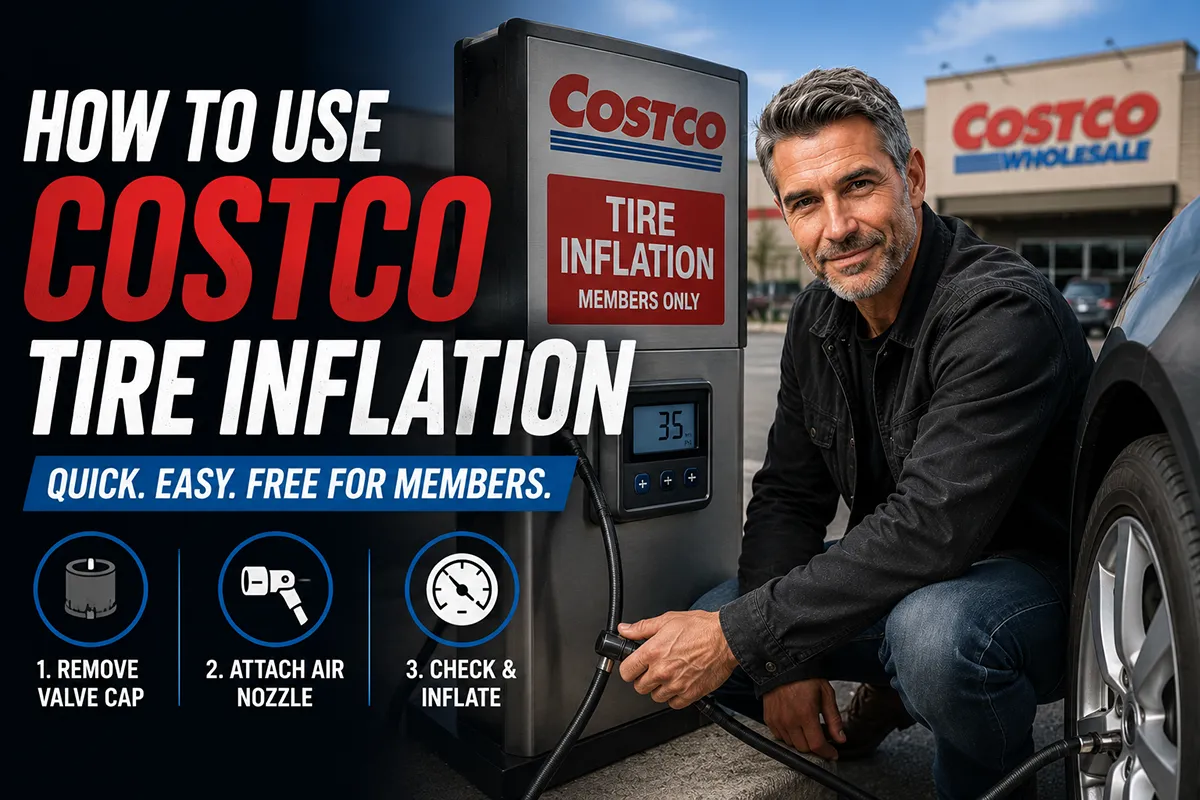
I pulled into a Costco parking lot last winter with my tire pressure warning light glaring at me, and I just sat there staring at the nitrogen inflation station like it was a spaceship control panel.
No instructions were posted. Nobody was around to help. And I felt genuinely embarrassed because I’d been reviewing tires for years but had never actually used one of these machines before.
If you’ve ever felt that same hesitation, this guide is for you — I’m going to walk you through every single step based on my own experience using Costco tire inflation stations across multiple locations.
- Costco offers free nitrogen tire inflation at most warehouse locations — you don’t even need a membership to use it in many cases.
- The stations are typically self-service and located near the Tire Center, often at the side or back of the building.
- You’ll need to know your vehicle’s recommended PSI (found on the driver’s door jamb sticker) before you start.
- The machines usually have a digital gauge, a hose, and a simple fill/release system — most take under 10 minutes to use.
- Nitrogen is better at maintaining consistent pressure over time, but regular air works fine if Costco’s station is unavailable.
Liked this article?
Add TireAdvise as a preferred source so you see more of our tire reviews and guides on Google.
Why Costco Offers Free Tire Inflation (And Why You Should Use It)
Before I get into the how-to, let me quickly explain why Costco even has these stations. Costco’s Tire Center installs tires filled with nitrogen instead of regular compressed air, and they provide free inflation stations so members — and often non-members — can maintain proper tire pressure between visits.
Nitrogen molecules are larger than oxygen molecules, which means they escape through the rubber at a slower rate. In my experience, tires filled with nitrogen hold their pressure noticeably longer than those filled with regular air, especially through seasonal temperature swings.
This isn’t just a Costco gimmick. Nitrogen is used in commercial aviation, NASCAR, and Formula 1 for exactly this reason. For everyday drivers, it means fewer pressure checks and more consistent handling.
Where to Find the Tire Inflation Station at Costco
This was actually my first challenge. The inflation stations aren’t inside the Tire Center — they’re outside, and their placement varies by location.
Typical Locations
At the three Costco warehouses I’ve personally visited for tire inflation (two in Texas and one in Colorado), the stations were located in slightly different spots each time. Here’s where I found them:
- Next to the Tire Center bay doors: This was the most common placement. The machine was mounted on a post or a small concrete island right next to where cars exit the tire installation bays.
- Along the side wall of the building: At one location, it was tucked around the corner from the Tire Center entrance, near the warehouse’s side wall.
- In a dedicated parking area: One Costco had it in a small pull-through lane specifically designed for tire inflation, complete with painted arrows on the pavement.
If you can’t find it, just walk into the Tire Center and ask. The staff has always been helpful when I’ve asked — they’ll point you right to it.
Do You Need a Costco Membership?
Here’s something that surprised me: at two of the three locations I visited, nobody checked for a membership card. The inflation stations are self-service and out in the open. However, Costco’s official policy is that tire services — including inflation — are for members.
In practice, I’ve seen plenty of non-members pull up and use the machines without any issue. That said, I’d recommend having your membership card handy just in case someone asks.
What You Need Before You Start
Don’t make the mistake I made during my first visit — I walked up to the machine without knowing my target tire pressure and had to walk back to my car to check. Here’s what you should have ready:
1. Your Recommended Tire Pressure (PSI)
This is the single most important piece of information you need. Your vehicle’s recommended tire pressure is printed on a sticker located on the driver’s side door jamb. Open the driver’s door and look at the edge of the door frame — you’ll see a white or yellow sticker with tire size and pressure information.
Do not use the number printed on the tire sidewall. That number is the tire’s maximum pressure rating, not the pressure your vehicle needs. I’ve seen so many people make this mistake, and it can lead to overinflation, uneven wear, and a rough ride.
For most passenger cars, the recommended pressure falls between 30 and 35 PSI. Trucks and SUVs sometimes run higher — my test truck called for 38 PSI in the front and 35 PSI in the rear.
2. A General Idea of Your Current Pressure
If your tire pressure monitoring system (TPMS) light is on, at least one tire is significantly under the recommended pressure — usually 25% or more below the target. Some newer vehicles display individual tire pressures on the dashboard, which is incredibly helpful.
If your car doesn’t show individual pressures, don’t worry. The Costco inflation machine has a built-in gauge that will read each tire’s current pressure when you connect the hose.
3. Valve Stem Cap Removal
This sounds obvious, but I want to mention it: unscrew the valve stem caps on all four tires before you start. I like to put them in my pocket so I don’t lose them on the ground. Losing a valve stem cap isn’t catastrophic, but it does let dirt and moisture into the valve over time.
Step-by-Step: How to Use the Costco Tire Inflation Station
Alright, here’s the detailed walkthrough. I’m going to describe the most common type of machine I’ve encountered at Costco locations, which is a nitrogen-dispensing unit with a digital gauge. Your experience may vary slightly depending on the specific machine model at your warehouse.
Step 1: Pull Your Vehicle Up to the Station
Position your car so the inflation hose can reach all four tires. The hoses are typically long enough to reach both sides of your vehicle, but I’ve found it easiest to park with the driver’s side closest to the machine first, inflate those two tires, then reposition if needed.
At some locations, the hose is long enough to walk around the entire car without moving it. At others, I had to pull forward and turn around. Just assess the hose length before you start.
Step 2: Turn On the Machine
Most Costco nitrogen stations have a power button or start button. Some are always on and activate when you pick up the hose nozzle. On the most recent machine I used, there was a green “START” button on the front panel that illuminated the digital display.
If the machine doesn’t seem to respond, check for an “Out of Order” sign — Costco does a decent job of posting these, but sometimes the sign is small or taped to the side of the unit.
Step 3: Set Your Desired Pressure
This is where the Costco machine really shines compared to gas station air pumps. Most Costco nitrogen stations let you pre-set your target PSI using up/down arrow buttons on the control panel.
I set mine to 35 PSI (my vehicle’s recommended pressure), and the machine automatically filled each tire to exactly that number. This is a huge advantage over manual gas station compressors where you have to constantly check the gauge, add air, check again, release air if you overshoot — it’s tedious.
Use the arrow buttons to dial in your target PSI, then confirm by pressing “OK” or “SET” depending on the machine model.
Step 4: Connect the Hose to Your Tire’s Valve Stem
The hose nozzle at Costco is typically a lever-style chuck. Here’s exactly how to connect it:
- Press the open end of the chuck straight onto the valve stem.
- Flip the lever on the chuck to lock it in place.
- You should hear a brief hiss as the machine reads your current pressure, then the filling begins.
If you hear continuous hissing, the chuck isn’t seated properly. Pull it off and try again, making sure you push it on straight and firm before flipping the lever.
Step 5: Wait for the Machine to Fill to Your Target PSI
Once connected, the machine will display your tire’s current pressure and begin filling. On the digital screen, I watched the numbers climb steadily — from 28 PSI up to my target of 35 PSI.
Most machines beep or display a notification when the tire reaches the set pressure. In my experience, each tire took about 30 to 60 seconds to fill, depending on how low it was.
If a tire is significantly underinflated (say, below 20 PSI), it may take a bit longer. I had one tire that was down to about 22 PSI after sitting in cold weather for a while, and it took closer to 90 seconds.
Step 6: Disconnect and Move to the Next Tire
Once the machine signals completion:
- Flip the lever to release the chuck from the valve stem.
- Pull the nozzle straight off.
- You may hear a tiny puff of air — that’s normal and doesn’t mean you’re losing pressure.
- Replace the valve stem cap.
- Move to the next tire and repeat.
Step 7: Verify With Your Car’s TPMS
After filling all four tires, I always start the car and check the TPMS display. On vehicles that show individual tire pressures, you should see all four reading at or very close to your target. If the TPMS warning light was on, it should turn off after driving for a few minutes.
On some vehicles, you may need to drive for a short period before the system updates. I’ve found that after a few minutes of driving, the readings stabilize and the warning light clears.
Costco Tire Inflation vs. Gas Station Air Pumps: A Real Comparison
I’ve used both extensively, and the difference is significant. Here’s a side-by-side comparison based on my personal experience:
| Feature | Costco Nitrogen Station | Gas Station Air Pump |
|---|---|---|
| Cost | Free | $1.50 – $2.00 per use |
| Gas Type | Nitrogen (N₂) | Compressed air (78% nitrogen, 21% oxygen) |
| Pressure Accuracy | Digital, auto-fill to set PSI (±0.5 PSI) | Manual gauge, varies widely (±2-3 PSI) |
| Ease of Use | Set-and-forget; machine stops automatically | Requires constant checking and manual stopping |
| Pressure Retention | Excellent — nitrogen escapes slower | Good, but pressure drops faster in temperature swings |
| Moisture Content | Dry gas — no moisture | Contains moisture that can cause internal corrosion |
| Availability | Costco business hours only | Usually 24/7 |
| Hose Length | Generally long enough for all 4 tires | Often short — may need to reposition car |
The biggest win for Costco’s machine, in my opinion, is the auto-fill feature. I can’t tell you how many times I’ve overinflated a tire at a gas station because the gauge was inaccurate or I got distracted. With Costco’s system, I set 35 PSI and walk away — the machine handles the rest.
Can You Mix Nitrogen and Regular Air?
This is one of the most common questions I get, and the answer is yes, absolutely. Mixing nitrogen and regular air won’t damage your tires, cause a chemical reaction, or void any warranty.
Regular air is already about 78% nitrogen. When you top off a nitrogen-filled tire with regular air at a gas station, you’re slightly diluting the nitrogen concentration, but the tire will still function perfectly.
I’ve done this myself when I was on a road trip and my TPMS light came on far from the nearest Costco. I topped off with regular air from a gas station, and the next time I was near a Costco, I used their nitrogen station to bring the purity back up.
The only thing you lose by mixing is some of the long-term pressure stability benefits of pure nitrogen. It’s not a big deal for everyday driving.
Troubleshooting Common Issues
Over my several visits to Costco inflation stations, I’ve run into a few hiccups. Here’s how I handled them:
The Machine Won’t Turn On
I’ve encountered this twice. Once, the machine was genuinely broken — there was no sign posted, but a Tire Center employee confirmed it was out of service. The second time, I discovered there was a small button on the side of the unit that I hadn’t noticed. Look carefully for any buttons, switches, or motion sensors before assuming it’s broken.
The Hose Won’t Reach My Far-Side Tires
At one location, the hose was shorter than expected. I had to pull forward, turn my car around, and reposition with the other side facing the machine. It added about two minutes to the process. Not a big deal, but worth noting.
The Chuck Keeps Hissing and Won’t Seal
If you can’t get a good seal on the valve stem, try these fixes:
- Make sure you’re pushing the chuck on perfectly straight — even a slight angle will prevent a seal.
- Check the valve stem for debris or corrosion. I’ve used a fingernail to flick away small pieces of grit.
- Try wiggling the chuck slightly while pressing down firmly, then flip the lever.
- If the valve stem itself is damaged or bent, you’ll need a tire shop to replace it — this isn’t a DIY fix at the inflation station.
My Tire Seems to Lose Pressure Right After Filling
If a tire drops pressure within hours of filling, you likely have a slow leak. This could be from a nail or screw in the tread, a cracked valve stem, or a bead leak where the tire meets the rim. Don’t keep re-inflating — drive to Costco’s Tire Center or another tire shop for a proper inspection.
I had this happen with a rear tire after filling it at Costco. It turned out there was a small screw embedded in the tread. The Costco Tire Center patched it for free since I’d purchased the tires there — another reason to buy from Costco if you’re in the market.
When to Check and Inflate Your Tires
Based on my years of tire testing and daily driving, here’s my personal tire pressure check schedule:
Check Pressure Monthly
Even with nitrogen, I check my tire pressure at least once a month. I keep a digital tire pressure gauge in my glove box — I use a simple one that cost about $12 from Amazon. It’s more accurate than the gauges built into gas station pumps, and I can check my tires at home in the morning when they’re cold.
Check Before Long Road Trips
Anytime I’m about to drive more than a couple hundred miles, I check all four tires. Underinflated tires generate more heat at highway speeds, which increases blowout risk. I learned this the hard way during a summer road trip through Arizona — not a place you want a tire failure.
Check After Major Temperature Drops
Tire pressure drops about 1 PSI for every 10°F decrease in ambient temperature. So when that first cold front of fall rolls through and temperatures drop 30 degrees overnight, your tires might be 3 PSI low by morning. This is the number one reason TPMS lights come on in October and November across the US.
I make it a habit to visit the Costco nitrogen station right after the first significant cold snap of the season.
Check When Tires Look Low
If a tire visually looks flatter than the others, don’t wait — check it immediately. By the time a tire looks visibly low, it’s usually significantly underinflated, which is dangerous and causes rapid edge wear.
Pro Tips I’ve Learned From Multiple Visits
After using Costco’s tire inflation stations regularly over the past year, here are some tips that have made the process smoother:
Go Early in the Morning
I’ve found the best time to inflate tires at Costco is right when the Tire Center opens, which is usually 10:00 AM at most locations. The station is free, there’s rarely a line, and your tires are still cold from sitting overnight — which gives you the most accurate pressure reading.
Tire pressure increases as you drive because friction heats the air inside. If you check pressure after a 30-minute drive to Costco, the reading might be 2-3 PSI higher than the true “cold” pressure. This isn’t a huge problem, but for the most accurate fill, cold tires are ideal.
Bring Your Own Gauge as a Backup
I always double-check the machine’s reading with my own digital gauge after filling. The Costco machines I’ve used have been accurate, but I like the peace of mind. It takes 10 seconds per tire and has saved me once when a machine was reading about 2 PSI high.
Don’t Forget the Spare
If your vehicle has a full-size spare (many trucks and SUVs do), inflate it too. I check my spare every few months, and it’s shocking how much pressure it can lose sitting unused under the truck. A flat spare is useless in an emergency.
Some compact spare tires (“donuts”) require 60 PSI, so check your owner’s manual for the correct pressure. The Costco machine’s range should cover this, but verify before you start.
Weekend Afternoons Are the Worst Time
Costco parking lots on Saturday afternoons are chaotic, and I’ve had to wait in line behind two or three cars for the inflation station. If you can go on a weekday morning, you’ll save yourself a lot of frustration.
What If Your Local Costco Doesn’t Have a Station?
While most Costco warehouses with a Tire Center have an external nitrogen inflation station, I’ve heard from readers who say their location doesn’t have one — or that it’s been permanently removed.
If that’s the case, here are your alternatives:
- Ask inside the Tire Center: Even without an external station, the Tire Center itself has nitrogen tanks. If you purchased tires from Costco, they’ll typically check and adjust your pressure for free. You’ll just need to wait in the service queue.
- Use a gas station air pump: As I mentioned earlier, mixing regular air with nitrogen is perfectly fine. Fill to your recommended PSI and move on.
- Buy a portable tire inflator: I’ve been testing portable 12V tire inflators, and some of the newer ones are impressively accurate. They plug into your car’s 12V outlet or run on rechargeable batteries. For about $40-$60, you can inflate your tires anywhere, anytime.
- Visit Discount Tire: Discount Tire locations across the US offer free tire pressure checks and inflation, regardless of where you purchased your tires. I’ve used this service many times and highly recommend it.
Why Proper Tire Inflation Matters More Than You Think
I want to close with a reminder about why all of this matters, because it’s easy to dismiss tire pressure as a minor detail.
Fuel Economy
Underinflated tires increase rolling resistance, which means your engine works harder to maintain speed. The US Department of Energy estimates that properly inflated tires can improve fuel economy by up to 3%. On a vehicle that gets 25 MPG, that’s like getting an extra 0.75 MPG for free. Over a year of driving, that adds up to real money at the pump.
Tire Lifespan
I’ve seen the effects of underinflation firsthand during my tire reviews. Tires that consistently run low develop excessive wear on the outer edges of the tread. Overinflated tires wear excessively in the center. Either way, you’re shortening the life of a tire that might have cost you $150-$200 per unit.
Proper inflation ensures even tread wear across the full contact patch, which maximizes the tire’s usable life.
Safety
This is the big one. Underinflated tires are more prone to blowouts, especially at highway speeds in hot weather. They also compromise handling — braking distances increase, and cornering grip decreases. The National Highway Traffic Safety Administration (NHTSA) reports that tire-related crashes cause hundreds of fatalities in the US every year, and underinflation is a leading contributing factor.
Taking 10 minutes at a Costco nitrogen station once a month is one of the simplest, cheapest things you can do to keep yourself and your passengers safe on the road.
Final Thoughts on Using Costco’s Free Tire Inflation
I’ll be honest — the first time I walked up to a Costco nitrogen station, I felt a little lost. But after using one just once, I realized how straightforward and genuinely useful the service is. It’s free, it’s accurate, and it uses nitrogen that keeps your tires at the right pressure for longer.
If you’re a Costco member — or even if you’re just driving past one — take advantage of this service. Your tires, your wallet, and your safety will thank you.
Here’s my quick checklist to tape on your dashboard or save to your phone:
- ✅ Check your recommended PSI on the driver’s door jamb sticker
- ✅ Remove all four valve stem caps before approaching the machine
- ✅ Set your target PSI on the machine’s digital panel
- ✅ Attach the chuck firmly and straight to each valve stem
- ✅ Wait for the auto-fill to complete (listen for the beep)
- ✅ Verify with your TPMS or a personal gauge after filling
- ✅ Replace all valve stem caps
- ✅ Repeat monthly or after any significant temperature change
I hope this guide takes the mystery out of Costco’s tire inflation stations. If you have questions about tire pressure, nitrogen, or anything tire-related, drop a comment below — I read every single one.
Frequently Asked Questions
Is the Costco tire inflation station free to use for all customers?
Yes, Costco offers free tire inflation at their tire center air stations, but you typically need to be a Costco member or have tires purchased through Costco to access the service. If you bought your tires at Costco, nitrogen inflation and pressure adjustments are included free for the life of your tires as part of their installation package. This is one of the best perks of buying replacement tires through Costco, saving you $3-$5 per fill compared to gas station air machines.
How do I use the Costco tire inflation machine step by step?
Drive up to the Costco Tire Center and locate the nitrogen inflation station, which is usually near the tire service bays. Remove the valve stem cap from your tire, attach the inflation hose nozzle firmly until you hear the seal engage, and use the digital gauge to check your current PSI. Set or inflate to your vehicle’s recommended tire pressure found on the driver’s side door jamb sticker, then repeat for all four tires and your spare.
Does Costco use nitrogen or regular air for tire inflation?
Costco fills tires with nitrogen instead of regular compressed air, which is a significant advantage for US drivers dealing with wide temperature swings between seasons. Nitrogen molecules are larger than oxygen, so they escape through the tire rubber more slowly, helping you maintain proper tire pressure longer. This means fewer pressure checks and more consistent handling whether you’re driving in Arizona heat or Minnesota winter conditions.
What PSI should I inflate my Costco tires to?
You should always inflate your tires to the pressure recommended by your vehicle manufacturer, not the maximum PSI printed on the tire sidewall. Check the tire placard sticker on your driver’s side door jamb or inside your owner’s manual for the correct PSI, which is usually between 30-35 PSI for most passenger cars and 35-42 PSI for SUVs and light trucks. Costco tire technicians will set the correct pressure during installation, but I always double-check it myself after a few days since new tires can settle slightly.
Can I get my tires inflated at Costco if I didn’t buy them there?
Costco Tire Centers primarily serve members who purchased tires through their store, so walk-in inflation service for non-Costco tires isn’t guaranteed at every location. Some Costco locations will accommodate members with tires purchased elsewhere as a courtesy, but it depends on how busy the tire center is. If you need a reliable free option for tires bought elsewhere, many Discount Tire locations across the US offer free air pressure checks and inflation regardless of where you purchased your tires.
How often should I check and adjust tire pressure at Costco’s inflation station?
I recommend checking your tire pressure at least once a month and before any long road trips, even if Costco filled your tires with nitrogen. Tires naturally lose about 1 PSI per month, and for every 10°F drop in outside temperature, your tires can lose another 1 PSI. If you live in a region with dramatic seasonal changes, visiting Costco’s nitrogen fill station during fall and spring transitions is especially important to keep your tires at the correct pressure for safe driving and optimal fuel economy.
What should I do if the Costco tire inflation station is out of service?
If the self-service nitrogen station is down, head inside to the Costco Tire Center counter and ask a technician to check and adjust your tire pressure — they’ll typically handle it quickly at no charge if you’re a member with Costco-purchased tires. As a backup, most gas stations have coin-operated air machines that cost $1-$2 per use with regular compressed air, and stores like Discount Tire and America’s Tire offer free pressure checks. I keep a portable digital tire inflator in my trunk (available for around $30-$50 on Amazon or at Costco itself) so I’m never stuck with dangerously low tire pressure on the road.
