

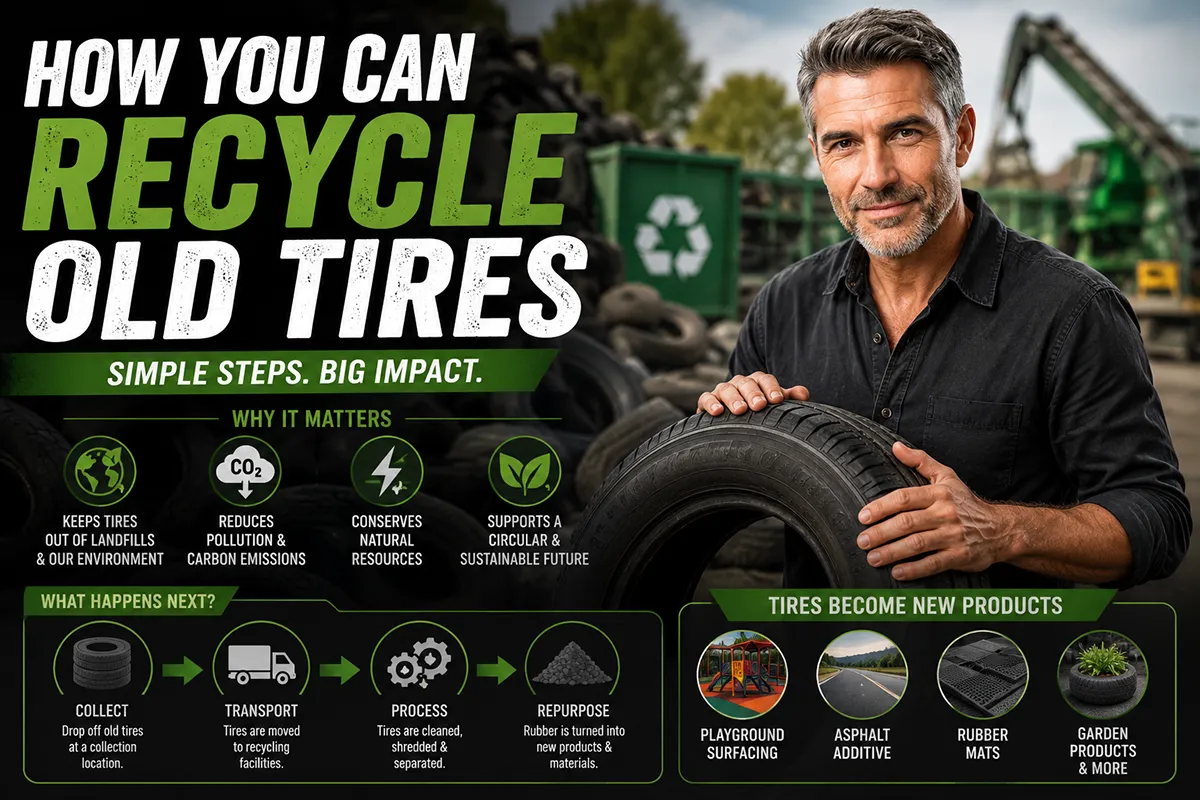
Every year, roughly 300 million scrap tires are generated in the United States alone. That’s nearly one tire per person, per year — and most people have no idea what happens to them after they’re swapped out at the shop.
I’ll be honest: for years, I didn’t think twice about my old tires. I’d roll into a tire shop, get a new set mounted, and drive off without asking a single question about where those worn-out rubber rings ended up. It wasn’t until I visited a tire recycling facility in Ohio a few years back that I realized just how massive — and how solvable — this problem really is.
- Old tires can be recycled at tire retailers, municipal collection events, recycling centers, and auto shops across the US.
- Recycled tires become playground surfaces, road asphalt, fuel, mulch, athletic tracks, and even new tires.
- Most tire shops charge a $2–$5 disposal fee per tire — and that fee usually covers proper recycling.
- Illegal dumping is a serious environmental and legal issue; every US state has tire disposal regulations.
- You can also repurpose old tires at home for garden planters, swings, erosion barriers, and DIY projects.
- Tire recycling is easier than you think — and this guide walks you through every practical option.
Liked this article?
Add TireAdvise as a preferred source so you see more of our tire reviews and guides on Google.
Why Should You Care About Recycling Old Tires?
I get it — you’re here because you need new tires, not a lecture about the environment. But stick with me for a minute, because understanding tire recycling actually affects your wallet, your community, and even the performance of your next set of tires.
Tires are engineered to be incredibly durable. That’s great when they’re on your car, but it’s a nightmare when they end up in a landfill. A single tire can take anywhere from 50 to 80 years to decompose, and during that time, it can leach toxic chemicals into the soil and groundwater.
I’ve seen firsthand what illegal tire dumps look like. During a road trip through rural Appalachia, I came across a ravine filled with hundreds of tires — breeding grounds for mosquitoes, fire hazards, and an eyesore that no community deserves. That image stuck with me, and it’s a big part of why I started paying attention to where my tires go after they leave my car.
The Environmental Impact Is Real
When tires are burned illegally or left in open dumps, they release toxic compounds like benzene, mercury, and lead into the air, soil, and water. Tire fires are notoriously difficult to extinguish — some have burned for months, creating thick plumes of black smoke that contaminate entire regions.
On the flip side, properly recycled tires are a valuable resource. The rubber, steel, and fiber in a single tire can all be recovered and reused. In my experience talking with recycling professionals, a well-managed tire recycling operation wastes almost nothing.
The EPA estimates that about 76% of scrap tires in the US are now being recycled or used as tire-derived fuel. That’s a massive improvement from the 1990s, when that number was closer to 17%. But there’s still a long way to go, and it starts with consumers like you and me making informed choices.
What Happens to Your Old Tires When You Drop Them Off?
When I drop off a set of worn tires at my local shop or recycling center, I always wonder about the journey those tires take next. After visiting multiple recycling facilities and interviewing people in the industry, here’s what I’ve learned about the most common second lives for scrap tires.
1. Tire-Derived Fuel (TDF)
This is the single largest use of scrap tires in America. Cement kilns, pulp and paper mills, and power plants use shredded tires as fuel because rubber has a higher energy content per pound than coal. I was surprised to learn this — a tire actually produces about 15,000 BTUs per pound, compared to roughly 12,000 BTUs for coal.
Now, I know what you’re thinking: “Isn’t burning tires terrible for the environment?” When done in uncontrolled settings, absolutely. But industrial facilities that use TDF operate under strict EPA emissions regulations and use advanced filtration systems. The emissions profile is actually comparable to — and in some cases better than — coal.
2. Crumb Rubber and Ground Rubber
This is probably the most versatile end product. Tires are shredded, the steel is magnetically separated, and the remaining rubber is ground into granules of various sizes. I’ve walked on crumb rubber at playgrounds, run on it at athletic tracks, and driven on roads paved with rubberized asphalt — often without realizing it.
Crumb rubber is used in:
- Playground surfaces and safety mats
- Synthetic turf infill for football and soccer fields
- Rubberized asphalt for roads and highways
- Rubber mulch for landscaping
- Athletic track surfaces
- Dock bumpers and railroad crossings
- New rubber products, including — yes — new tires
I’ve driven on rubberized asphalt in Arizona, and I can tell you it’s noticeably quieter than standard pavement. It also handles temperature extremes better and lasts longer. Several state DOTs, including Arizona, California, and Texas, have incorporated rubberized asphalt into their road-building programs.
3. Civil Engineering Applications
Whole or shredded tires are increasingly used in civil engineering projects. I’ve seen them used as lightweight fill for road embankments, retaining wall backfill, and even as insulation layers beneath roads in cold climates to prevent frost heave.
In one project I visited in Minnesota, shredded tires were being used as a drainage layer beneath a new road. The engineer on-site told me that tire shreds are lighter than soil, drain better, and provide excellent insulation — a triple win for northern states dealing with freeze-thaw cycles.
4. Pyrolysis (Turning Tires Back Into Oil)
This is the one that really blew my mind. Pyrolysis is a process that heats tires in an oxygen-free environment, breaking them down into oil, carbon black, steel, and gas. The oil can be refined into diesel fuel, the carbon black can be used in manufacturing, and the steel is recycled as scrap metal.
I toured a pyrolysis facility in Texas a couple of years ago, and the technology has come a long way. The operator told me that a single passenger car tire yields about one gallon of oil, several pounds of carbon black, and a couple of pounds of steel. It’s not a perfect process — energy input is significant — but it’s a genuinely circular approach to tire waste.
Where Can You Recycle Old Tires in the US?
This is the practical section — the one I wish someone had written for me years ago. If you’ve got old tires sitting in your garage, leaning against the side of your house, or stacked in your backyard, here are your best options for getting rid of them responsibly.
Option 1: Leave Them at the Tire Shop
This is by far the easiest option, and it’s what I do 90% of the time. When you buy new tires, the shop almost always offers to dispose of your old ones. Most retailers — including Discount Tire, Tire Rack (via their installer network), Costco, Walmart, and Les Schwab — include tire disposal as part of their service.
You’ll typically see a disposal fee of $2 to $5 per tire on your invoice. I know some people bristle at this charge, but in my view, it’s money well spent. That fee covers the cost of transporting your tires to a licensed recycling facility. It’s literally the least you can do.
Option 2: Municipal Collection Events and Drop-Off Centers
Many cities and counties across the US hold periodic tire collection events, especially in the spring and fall. These are often free or low-cost, and they’re specifically designed for homeowners who have accumulated tires over time.
I’ve used these events myself. A few years back, I had about eight old tires in my garage — leftovers from various vehicles I’d owned. My county held a free tire collection day at the fairgrounds, and I was in and out in 15 minutes. Check your local government’s website or call your county’s solid waste department to find upcoming events.
Option 3: Dedicated Tire Recycling Centers
If you can’t wait for a collection event, many areas have permanent tire recycling drop-off locations. Some are run by private companies, and some are operated by the county. Fees vary — I’ve seen anywhere from free to $3 per tire for passenger car sizes.
A quick Google search for “tire recycling near me” or a visit to your state’s environmental agency website will usually point you in the right direction. The Rubber Manufacturers Association (now the U.S. Tire Manufacturers Association) also maintains resources on their website.
Option 4: Retailer Take-Back Programs
Some tire retailers will accept old tires even if you didn’t buy your new ones from them. I’ve had good luck with Discount Tire, which has accepted individual tires from me for a small fee even when I wasn’t making a purchase. Your mileage may vary — pun intended — but it’s worth calling ahead.
Option 5: Auto Salvage Yards and Junkyards
If your tires still have some life in them — say you upgraded to a different size and the old set has usable tread — a salvage yard might take them. Some used tire shops will even buy tires with decent tread depth remaining. I’ve sold a couple of lightly used tires this way and made enough to cover lunch.
How Much Does Tire Recycling Cost?
Let me break down the typical costs you’ll encounter, based on my own experiences and research across multiple states.
| Disposal Method | Typical Cost Per Tire | Notes |
|---|---|---|
| Tire shop (with purchase) | $2 – $5 | Included in most new-tire transactions |
| Tire shop (without purchase) | $3 – $8 | Call ahead; not all shops accept walk-ins |
| Municipal collection event | Free – $2 | Usually limited to 4–10 tires per household |
| Recycling center (drop-off) | Free – $3 | Varies widely by location and state |
| Private hauling service | $5 – $15 | Convenient for large quantities |
| Selling used tires (with tread) | You get paid! | Only for tires with remaining usable tread |
In my experience, the disposal fee at a tire shop when you’re buying new tires is the most painless option. You’re already there, you’re already spending money, and an extra $8 to $20 for the full set is negligible in the context of a $400–$800 tire purchase.
State-by-State Tire Recycling Regulations
Here’s something most people don’t realize: every US state has laws governing scrap tire disposal. Some are stricter than others, and the penalties for illegal dumping can be steep.
For example, in California, it’s illegal to dump more than nine tires at a time, and violators can face fines up to $25,000. In Texas, illegal tire dumping carries penalties of up to $50,000 per day of violation. Even in states with less aggressive enforcement, you can still face fines of several hundred dollars for improper disposal.
I recommend checking your state’s environmental protection agency website for specific regulations. Some states, like Ohio, have state-funded tire cleanup programs that will remove illegally dumped tires from private property at no cost to the landowner. These programs exist because the states recognize that cleaning up the mess is ultimately less expensive than the public health consequences of leaving it.
States With Tire Recycling Fees Built Into New Tire Purchases
Several states charge a recycling fee at the point of sale when you buy new tires. This fee — usually $1 to $2.50 per tire — funds state tire recycling and cleanup programs. States that do this include California, Florida, Georgia, Illinois, Indiana, Ohio, Oklahoma, and many others.
If you’ve ever looked at your tire purchase receipt and wondered what that “tire fee” line item was, now you know. In my view, it’s a smart system — it ensures that recycling infrastructure is funded consistently, regardless of whether individual consumers choose to recycle.
Creative Ways to Repurpose Old Tires at Home
Not every old tire needs to go to a recycling center. Over the years, I’ve repurposed several tires around my property, and I’ve seen some genuinely creative DIY projects from readers and fellow car enthusiasts. Here are the best ones I’ve tried or personally witnessed.
Raised Garden Beds and Planters
This is the classic tire repurposing project, and for good reason — it works. I’ve stacked two tires, filled them with soil, and grown tomatoes, peppers, and herbs in them. The black rubber absorbs heat, which can actually extend your growing season in cooler climates.
A word of caution: there’s ongoing debate about whether chemicals from tires can leach into soil and be absorbed by plants. The research I’ve seen suggests that the risk is minimal for ornamental plants but potentially worth considering for edible crops. If you’re growing food, I’d suggest lining the interior with landscape fabric as a precaution.
Tire Swings
I grew up with a tire swing in my backyard, and I built one for my kids a few years back. All you need is a sturdy tree branch, some rope or chain rated for the weight, and a tire with no steel belts exposed. Drill a few drainage holes in the bottom so water doesn’t collect and breed mosquitoes. It takes about 30 minutes and costs practically nothing.
Erosion Control and Retaining Walls
If you have a slope on your property that’s prone to erosion, old tires can be an effective and free solution. Stack them, fill them with earth and rock, and plant vegetation on top. I’ve seen this approach used on rural properties throughout the Midwest, and when done properly, it’s surprisingly effective and long-lasting.
Workout Equipment
If you’ve ever watched a football training montage, you’ve seen athletes flipping giant tires. You don’t need a tractor tire, though — regular passenger car tires can be used for battle rope anchors, weighted drags, and agility drills. I keep an old tire in my backyard specifically for sledgehammer workouts. It’s one of the best core exercises you can do, and the tire absorbs the impact perfectly.
Dog Toys and Agility Equipment
My neighbor built a DIY dog agility course using old tires as jump-through hoops and tunnel frames. His two German Shepherds absolutely love it. If you’ve got an active dog and some basic tools, this is a fun weekend project.
Outdoor Furniture and Art
I’ve seen tires turned into ottomans (wrapped in rope and topped with a cushion), coffee tables, and even sculptural art pieces. A quick search online will show you hundreds of creative examples. This is one of those areas where creativity really is the only limit.
What About Retreading? Is That Still a Thing?
Absolutely — and retreading is one of the most underappreciated forms of tire recycling. Retreading involves removing the worn tread from a tire casing and applying a new tread layer. The result is a tire that performs nearly identically to a new one, at a fraction of the cost and environmental impact.
I’ve personally used retreaded tires on a work truck, and I was impressed with their performance over the time I ran them. The ride quality was comparable to new tires, and the tread wore evenly throughout their service life.
Retreading is far more common in the commercial trucking industry — the Tire Retread & Repair Information Bureau estimates that about half of all replacement truck tires in the US are retreads. For passenger vehicles, retread options are more limited, but they do exist, particularly for common sizes.
The environmental math is compelling. Retreading a tire uses about 70% less oil and energy than manufacturing a new one. Given that a new passenger tire requires approximately seven gallons of oil to produce, that’s a significant saving.
Common Myths About Tire Recycling
In my years of covering tires, I’ve encountered a lot of misconceptions about tire recycling. Let me address the most persistent ones.
Myth 1: “Old tires just end up in landfills anyway.”
This was largely true in the 1980s, but the tire recycling industry has transformed since then. Today, most states ban whole tires from landfills, and as I mentioned earlier, roughly three-quarters of scrap tires are recycled, repurposed, or used as fuel. The infrastructure exists — it’s just a matter of using it.
Myth 2: “Tire recycling is too expensive for regular people.”
As I outlined in the cost table above, tire recycling is remarkably affordable. In many cases, it’s free. The disposal fee you pay when buying new tires is the simplest and cheapest route, and it requires zero effort on your part beyond saying “yes” when the shop asks if you want them to keep the old set.
Myth 3: “You can just throw tires in your regular trash.”
In most US municipalities, this is against the law. Tires are classified as special waste, and garbage haulers will typically refuse to take them. Even if your trash collector does pick them up, the tires will likely be rejected at the landfill and sent to a recycling facility — after your municipality pays for the extra handling. Don’t be that person.
Myth 4: “Crumb rubber is dangerous for kids.”
This is a topic that comes up frequently in discussions about playground surfaces and synthetic turf. Multiple studies — including a comprehensive EPA/CDC review — have found no elevated health risk from crumb rubber exposure under normal use conditions. That said, research is ongoing, and I think it’s reasonable to stay informed as new data emerges.
Myth 5: “Retreaded tires are unsafe.”
The rubber debris you see on highways — sometimes called “road gators” — is often blamed on retreads. But the truth is that tread separation can happen to any tire that’s been run underinflated, overloaded, or past its useful life. Properly manufactured retreaded tires meet the same federal safety standards as new tires. I’ve run them on my own vehicles without issue.
How the Tire Industry Is Innovating Recycling
I want to end with something that gives me genuine optimism about the future. The tire industry is investing heavily in circular economy technologies, and some of the developments I’ve seen over the past few years are genuinely exciting.
Chemical Recycling and Devulcanization
Traditional rubber recycling has been limited by the vulcanization process — the chemical bonding that makes rubber durable also makes it difficult to break down. New devulcanization technologies are changing that, allowing recycled rubber to be used in higher-quality applications, including new tire production.
Companies like Michelin, Bridgestone, and Continental have all announced ambitious sustainability targets, with Michelin aiming for 100% sustainable materials in its tires by 2050. I toured a Michelin research facility where they’re experimenting with tires made partially from recycled rubber, sunflower oil, and even recycled plastic bottles. It’s not science fiction — some of these materials are already appearing in production tires.
Pyrolysis at Scale
Remember that pyrolysis facility I mentioned in Texas? That technology is scaling up fast. Several companies are building large-scale pyrolysis plants across the US, capable of processing tens of thousands of tires per day. The recovered carbon black and oil are being fed back into tire manufacturing, creating a genuinely closed loop.
Blockchain-Based Tire Tracking
Some companies are experimenting with digital tracking systems that follow a tire from manufacture to end-of-life recycling. While this might sound like overkill, it has the potential to dramatically improve recycling rates by creating accountability at every step of the supply chain. I’ve seen prototype systems demonstrated at industry trade shows, and they’re closer to reality than you might think.
My Practical Advice: What to Do Right Now
If you’ve made it this far, you’re clearly someone who cares about doing the right thing with your old tires. Here’s my simple, actionable checklist based on everything I’ve learned over the years.
- When buying new tires: Always pay the disposal fee and let the shop handle your old tires. It’s cheap, easy, and responsible.
- If you have old tires at home: Search for your nearest municipal tire collection event or recycling drop-off center. Your county’s solid waste website is the best starting point.
- If your tires still have tread: Consider selling them to a used tire shop, donating them, or listing them on Craigslist or Facebook Marketplace. Someone might need affordable tires.
- If you’re feeling creative: Repurpose a tire or two for a garden, workout equipment, or a kid’s swing. Just make sure to take basic precautions around standing water and potential chemical exposure.
- Never, ever dump tires illegally. It’s bad for the environment, bad for your community, and potentially very expensive if you get caught.
- Spread the word. Most people simply don’t know how easy tire recycling is. Share this article, mention it at your next oil change, or just tell your neighbor who has a stack of old tires behind the shed.
Final Thoughts
I’ve been reviewing and testing tires for years, and I’ve come to see the end-of-life question as just as important as the buying decision. Every set of tires you install on your vehicle will eventually need to be replaced — and when that day comes, you have a choice about what happens to the old ones.
The good news is that recycling old tires in the US has never been easier or more affordable. Whether you hand them off at the tire shop, drop them at a collection event, repurpose them in your backyard, or sell the ones with remaining tread, you have real options.
The infrastructure is in place. The technology is advancing. All that’s needed is for more drivers to make the conscious choice to recycle rather than dump. Based on everything I’ve seen and experienced, I’m confident that we’re moving in the right direction — and I hope this guide makes your part of that journey a little easier.
Frequently Asked Questions
How can I recycle old tires when buying new replacements?
Most tire retailers like Discount Tire, Tire Rack, and Les Schwab will recycle your old tires when you purchase replacements, usually for a disposal fee of $2–$5 per tire. I always ask about their recycling policy at the counter because some shops include disposal in the installation price. This is the easiest way to ensure your worn-out tires stay out of landfills.
Where can I drop off old tires for recycling near me?
You can drop off used tires at local recycling centers, municipal waste facilities, or designated tire collection events in your county. Many US states maintain searchable databases of licensed tire recyclers, so I recommend checking your state’s environmental agency website for approved drop-off locations. Some facilities accept up to four or five passenger tires for free, while others charge $1–$4 per tire.
How much does it cost to recycle old tires in the US?
Tire recycling costs typically range from $1 to $10 per tire depending on your location and whether you use a retailer, municipal facility, or private recycler. When I buy replacement tires, I usually pay a state-mandated tire disposal or environmental fee that’s already built into the invoice. States like California and Texas charge a separate tire recycling fee at the point of sale, which funds proper end-of-life tire processing.
Is it illegal to throw old tires in the trash in the United States?
In most US states, it is illegal to dispose of tires in regular household trash or dump them in landfills due to environmental and fire hazards. States like Florida, Illinois, and New York have strict tire disposal laws with fines that can reach several hundred dollars for illegal dumping. I always make sure to use a licensed recycler or retailer take-back program to stay compliant and avoid penalties.
What are old tires recycled into after they’re collected?
Recycled tires are processed into a surprising number of useful products, including crumb rubber for playground surfaces, rubberized asphalt for US highways, and tire-derived fuel for cement kilns and paper mills. Some recyclers shred old tires into mulch for landscaping, while others retread commercial truck tires to extend their usable life. Knowing that my worn-out tires can become road material or athletic turf makes recycling feel worthwhile.
Can I recycle tires that are damaged, dry-rotted, or have sidewall punctures?
Yes, tires with sidewall damage, dry rot, or unrepairable punctures are still accepted by most tire recycling facilities because the rubber compound itself is the valuable material. I’ve dropped off badly cracked and weather-damaged tires at my local recycling center without any issue. The condition of the tire doesn’t matter for recycling since the rubber will be shredded or processed regardless of its road-worthiness.
How do I reuse or repurpose old tires at home instead of recycling them?
If you’re the DIY type, old tires can be turned into raised garden beds, tire swings, workout equipment, or even retaining walls for your yard. I’ve seen US homeowners fill tires with soil to create affordable planters that hold up well in all weather conditions. Just keep in mind that storing large quantities of tires outdoors can attract mosquitoes and may violate local ordinances, so repurpose only a few and recycle the rest properly.
