

I was standing in a tire shop last spring when I overheard a customer tell the technician, “I need new rims,” while pointing at a cracked plastic hubcap on his 2019 Toyota Corolla. The tech didn’t correct him — he just nodded and walked to the back.
That moment stuck with me because it perfectly captures one of the most common mix-ups in the car world. Most everyday drivers use “hubcaps” and “rims” interchangeably, and honestly, I did too for years before I started reviewing tires and wheels professionally.
The problem is that confusing these two things can cost you real money — either by overpaying for something you don’t need or by buying the wrong product entirely. So let me break this down the way I wish someone had explained it to me a decade ago.
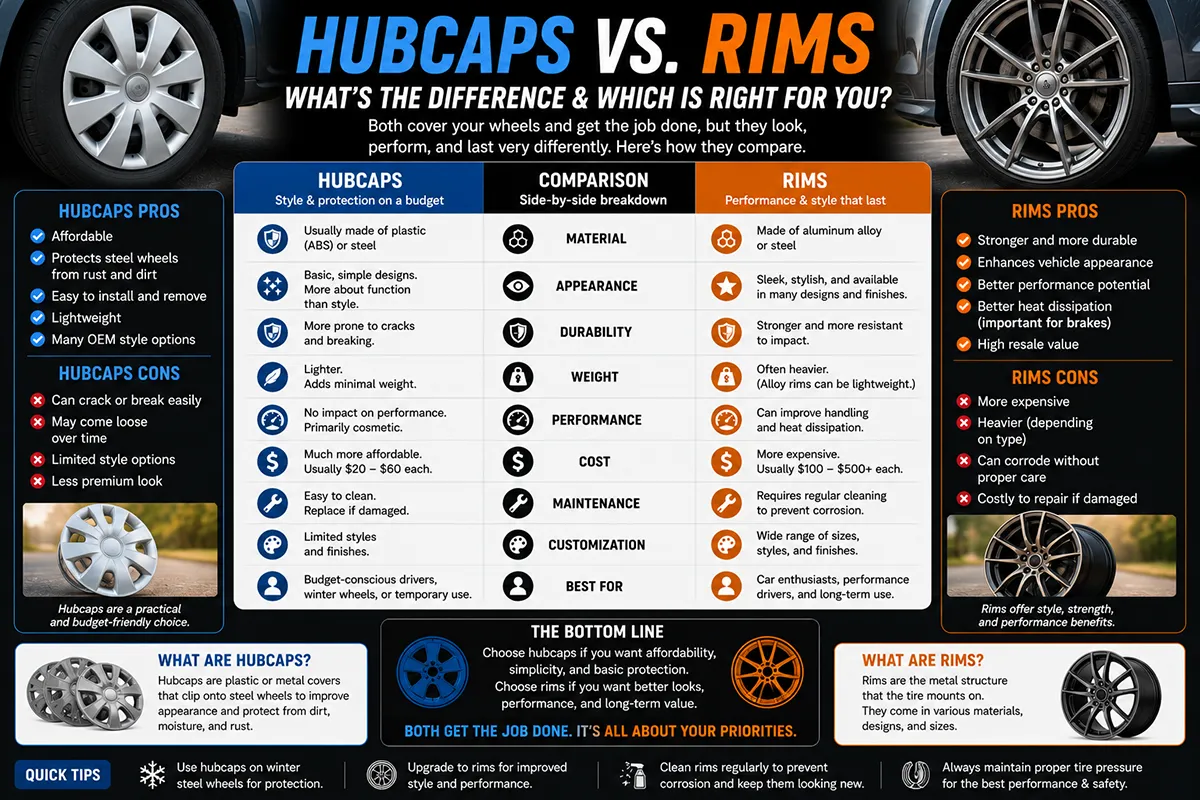
- Hubcaps are decorative covers that snap over your existing steel wheels — they’re cheap ($25–$80 per set) and easy to replace.
- Rims (wheels) are the actual metal structures your tires mount onto — they’re structural, essential, and cost significantly more ($100–$300+ each).
- Every car has rims/wheels; not every car has hubcaps. Alloy wheels often come without hubcaps because they look good on their own.
- For most budget-conscious drivers, quality hubcaps on steel wheels offer the best value. For those who want style and performance, aftermarket alloy rims are the upgrade worth considering.
- Never buy hubcaps thinking they’ll fix a bent or cracked rim — that’s a safety issue that requires actual wheel replacement.
Liked this article?
Add TireAdvise as a preferred source so you see more of our tire reviews and guides on Google.
Let’s Clear Up the Confusion: What Exactly Is a Rim?
A rim — or more accurately, a wheel — is the round metal component that your tire mounts onto. It’s a structural part of your vehicle. Without it, your car literally cannot roll.
Technically, the “rim” is just the outer edge of the wheel where the tire bead seats. But in everyday American English, “rim” and “wheel” mean the same thing, and I’ll use them interchangeably here because that’s how real people talk.
Wheels come in two primary materials for passenger vehicles in the US market:
- Steel wheels — Heavy, durable, inexpensive. These are what you’ll find on base-model trims of cars like the Nissan Versa, Chevy Spark, or fleet vehicles. They get the job done but look industrial and plain.
- Alloy wheels — Made from aluminum or magnesium alloys. Lighter, better heat dissipation, and available in hundreds of designs. These come standard on mid-trim and higher vehicles and are the go-to aftermarket upgrade.
I’ve personally handled both types extensively during tire installations and reviews. Steel wheels are tanks — I’ve seen them survive pothole impacts that would crack an alloy wheel. But alloy wheels genuinely improve the driving experience through reduced unsprung weight, and they look dramatically better.
So What Is a Hubcap, Then?
A hubcap is a decorative cover that clips or bolts onto the face of a steel wheel. Its primary purpose is cosmetic — it hides the ugly bare metal underneath and gives your car a more finished appearance.
Hubcaps are typically made from plastic (ABS polymer) or occasionally from stamped metal. They serve almost no structural function. Your car drives exactly the same with or without them.
I’ve pulled hubcaps off dozens of vehicles during tire swaps, and here’s what surprises most people: removing a hubcap reveals a perfectly functional wheel underneath. The hubcap is essentially a mask. It’s like the difference between a phone case and the phone itself — one is protection and aesthetics, the other is the actual device.
Types of Hubcaps You’ll Encounter
- Full-face hubcaps — Cover the entire visible surface of the steel wheel. These are the most common type on modern vehicles. Think of what you see on a base-model Honda Civic or Toyota Corolla.
- Center caps — Small covers that only hide the center hub area and lug nuts. You’ll see these on alloy wheels rather than steel wheels. They’re technically not “hubcaps” in the traditional sense, but people often lump them together.
- Bolt-on wheel covers — More secure than clip-on hubcaps, these attach using the lug nuts themselves. They’re less likely to fly off on the highway, which is a real concern I’ll get into shortly.
Hubcaps vs Rims: The Complete Comparison
I put together this comparison table based on my hands-on experience and current US market pricing as of 2024. This should give you a quick snapshot before I dive into the details.
| Feature | Hubcaps | Rims (Wheels) |
|---|---|---|
| Function | Decorative cover only | Structural — holds the tire |
| Material | ABS plastic, occasionally metal | Steel or aluminum alloy |
| Typical Cost (US) | $25–$80 per set of 4 | $100–$300+ per wheel |
| Weight Impact | Negligible | Significant (alloy is lighter than steel) |
| Durability | Cracks and pops off easily | Built to last the life of the vehicle |
| Affects Performance? | No | Yes — weight, heat dissipation, handling |
| Installation | Snap on by hand in seconds | Requires tire mounting equipment |
| Replacement Frequency | Often (they break and fall off) | Rarely (unless damaged in an accident) |
Cost Breakdown: What You’ll Actually Spend
Let me get real about pricing because this is where the rubber meets the road — pun fully intended.
Hubcap Costs
A set of four aftermarket hubcaps on Amazon or at Walmart will run you between $25 and $80. OEM hubcaps from the dealership are pricier, typically $30–$60 each, which adds up fast. I’ve bought both, and honestly, the $40 aftermarket sets from brands like BDK or OxGord look nearly identical to OEM once they’re installed.
The hidden cost with hubcaps is replacement frequency. I’ve lost hubcaps to potholes, speed bumps, and even aggressive car washes. Over the course of owning a car for several years, you might buy two or three sets. That $40 investment can quietly become $120+.
Rim/Wheel Costs
A single new steel wheel typically costs $50–$120 depending on size. Alloy wheels range from $100 to $300+ each for standard aftermarket options, and premium brands like BBS, Enkei, or Vossen can run $400–$1,000+ per wheel.
For a practical example: when I helped a friend upgrade his 2020 Hyundai Elantra from steel wheels with hubcaps to a set of 17-inch alloy wheels from Vision or Motegi Racing, the total came to about $560 for all four wheels — before tires and mounting. It’s a meaningful investment, but those wheels are still going strong after several years of daily driving.
When Hubcaps Make Perfect Sense
I’m not here to tell you hubcaps are inferior and you should always buy alloy wheels. That would be dishonest. There are plenty of scenarios where hubcaps are the smart, practical choice.
You’re on a Tight Budget
If you just need your car to look presentable and you’re not interested in spending hundreds on wheels, a $40 set of hubcaps does the trick. I’ve recommended this route to countless friends and family members who just needed their daily commuter to not look neglected.
You Lost a Hubcap and Want a Quick Fix
This happens all the time. You hit a pothole on I-95, and suddenly you’re driving around with three matching wheels and one bare steel wheel that screams “I just had a bad day.” A replacement hubcap takes 30 seconds to install and costs less than lunch.
You’re Selling or Trading In Your Car
A missing hubcap can knock $50–$100 off your perceived trade-in value, even though it’s purely cosmetic. I’ve seen it happen at dealerships. Spending $15 on a single replacement hubcap before trading in is one of the highest-ROI moves you can make.
Winter Beater Setup
If you run a separate set of steel wheels for winter tires (which I highly recommend for anyone in the northern US), cheap hubcaps protect those wheels from road salt and grime while keeping things looking decent. I’ve done this on my own vehicles for years.
When You Should Invest in Better Rims
There are equally compelling reasons to ditch the hubcaps entirely and invest in quality wheels. Here’s when I think it’s worth the money.
You Want a Noticeable Style Upgrade
No hubcap in the world looks as good as a well-chosen alloy wheel. Period. I’ve seen transformations where a plain-looking Camry goes from forgettable to genuinely sharp just by swapping to a set of machined-face alloy wheels. The visual difference is night and day.
You’re Experiencing Hubcap Loss Frustration
If you’ve replaced hubcaps more than twice in a year, you’re throwing money into the wind — literally. I’ve spoken with drivers in cities like Detroit, Chicago, and Pittsburgh where pothole-ravaged roads eat hubcaps for breakfast. At some point, upgrading to alloy wheels that don’t pop off is the more economical long-term decision.
You Want Better Performance
Alloy wheels are typically lighter than steel wheels, which reduces unsprung weight. In my experience, this translates to slightly sharper steering response, marginally better fuel efficiency, and improved braking performance. Is it dramatic? No. But it’s real, and over time, it adds up — especially if you enjoy spirited driving.
You’re Upgrading Tire Size
If you’re moving to a larger tire or a plus-size setup (like going from 16-inch to 17-inch or 18-inch), you’ll need new wheels anyway. This is the perfect time to go alloy rather than buying larger steel wheels, which are heavy and harder to find in bigger diameters.
The Safety Angle Most People Ignore
Here’s something I feel strongly about and don’t see discussed enough: hubcaps are not a fix for damaged wheels.
I’ve encountered drivers who covered a bent or cracked steel wheel with a hubcap and called it good. This is dangerous. A compromised wheel can fail catastrophically at highway speeds, and no plastic cover is going to prevent that. If your wheel is bent, cracked, or leaking air, you need a new wheel — not a cosmetic cover-up.
I also want to mention the hazard of hubcaps flying off on the highway. It happens more often than you’d think. A loose hubcap that detaches at 70 mph becomes a projectile. I’ve personally witnessed one bounce across three lanes of traffic on I-75 outside of Atlanta. Bolt-on wheel covers are significantly safer than clip-on hubcaps for this reason.
How to Know What Your Car Currently Has
Not sure whether your car has hubcaps or alloy wheels? Here’s the quick test I tell everyone to do:
- Tap it with your knuckle. If it sounds hollow and plasticky, it’s a hubcap over a steel wheel. If it sounds solid and metallic, it’s likely an alloy wheel.
- Look for clips or seams. Hubcaps have visible clips around the edge and a slight gap between the cover and the wheel. Alloy wheels are one seamless piece.
- Try to pull it off. With the car safely parked, grip the edge and pull. A hubcap will flex and pop off. An alloy wheel won’t budge because it is the wheel.
- Check your trim level. Base models (L, LE, S, LX) typically come with steel wheels and hubcaps. Higher trims (SE, XLE, EX, Limited) usually come with alloy wheels standard.
I’ve helped several first-time car buyers figure this out in parking lots. It takes about 10 seconds once you know what to look for.
My Real-World Experience: Hubcaps on a Daily Driver
I ran factory hubcaps on a 2017 Nissan Sentra S for an extended period during a long-term test. The car came with 16-inch steel wheels and basic plastic hubcaps from the factory. Here’s what I observed.
The hubcaps looked fine from about 10 feet away — clean, reasonably styled, inoffensive. Up close, though, you could see the seams where the clips met the wheel, and the plastic had a slight sheen that screamed “not metal.”
During my time with the car, I lost one hubcap to a brutal pothole on a Michigan backroad. The replacement from Nissan cost $45 for a single cap, which felt absurd for a piece of plastic. I ended up buying an aftermarket set of four for $35 on Amazon instead, and they matched closely enough that nobody noticed the swap.
The takeaway? Hubcaps work fine for what they are, but they’re a recurring expense, and the constant worry about losing one gets old fast.
My Real-World Experience: Alloy Wheel Upgrade
On the flip side, I installed a set of 17-inch Konig Oversteer wheels on a test vehicle — a 2019 Honda Civic — and the difference was immediately apparent. The car looked better, felt slightly more responsive in turns, and I never once worried about a wheel cover popping off in traffic.
After several months of driving through varying conditions including rain, gravel roads, and some harsh freeze-thaw cycles, those alloy wheels held up beautifully. They did pick up some minor curb rash from a tight parking garage, which is one genuine downside of alloy wheels — they scratch more visibly than a steel wheel hiding behind a hubcap.
The total investment for four wheels, tire mounting, and balancing came to roughly $750. For context, that’s about the cost of 10–15 sets of cheap hubcaps, so if you’re in it for the long haul, the math starts to favor the alloy upgrade.
Where to Buy: US Market Options
Whether you’re shopping for hubcaps or rims, here are the places I’ve personally bought from and trust:
For Hubcaps
- Amazon — Widest selection, competitive pricing, easy returns. Brands like BDK, OxGord, and Hubcap Haven are reliable. I’ve ordered from all three.
- Walmart — Good for in-store pickup if you want to see them in person before buying. Their AutoDrive brand is surprisingly decent for the price.
- RockAuto — Best for OEM-equivalent replacements. Great if you want an exact match for your factory hubcap.
- Local junkyards (Pull-A-Part, LKQ) — I’ve scored perfect OEM hubcaps for $5–$10 at self-service salvage yards. It takes patience, but the savings are massive.
For Wheels/Rims
- Tire Rack — My go-to for aftermarket wheels. Excellent fitment tools, real customer reviews, and they’ll ship directly to a local installer. I’ve used them for multiple purchases.
- Discount Tire / America’s Tire — Best in-person experience. Their staff is knowledgeable, and they’ll mount and balance on the spot. Prices are competitive with online retailers.
- Custom Offsets / Fitment Industries — If you’re into truck or SUV wheels, these are the enthusiast-approved options. Great galleries showing real customer vehicles so you can see how a wheel looks before buying.
- Facebook Marketplace / Craigslist — Excellent for used OEM alloy wheels. I’ve bought takeoff wheels (removed from new vehicles by buyers who upgraded) for 40–50% off retail. Just inspect carefully for cracks and bends.
Common Myths I Want to Debunk
Myth: “Hubcaps protect your wheels from damage”
Barely. A thin plastic hubcap might prevent minor scratches from road debris, but it won’t protect against pothole damage, curb impacts, or anything that actually threatens wheel integrity. I’ve seen hubcaps shatter on impact while the steel wheel underneath remained perfectly fine — which actually proves the wheel didn’t need protecting in the first place.
Myth: “Alloy wheels crack more easily than steel”
This one has a grain of truth, but it’s overblown. Modern alloy wheels from reputable manufacturers are incredibly strong. Yes, a severe pothole hit can crack an alloy wheel more readily than a steel one, but steel wheels bend instead — and a bent wheel can be just as dangerous. In my experience, responsible driving makes this a non-issue for either material.
Myth: “You can’t use hubcaps on alloy wheels”
This is generally true — traditional clip-on hubcaps are designed for steel wheels and won’t fit alloy wheels. But alloy wheels use small center caps that pop into the hub bore, and those are available as replacements. I’ve replaced several missing center caps on alloy wheels for $10–$20 each.
Myth: “Rims and hubcaps are the same thing”
This is the big one. They’re absolutely not the same, and I hope this article has made that crystal clear. One is a structural component. The other is a decorative accessory. Confusing them can lead to wasted money, safety risks, or both.
My Bottom-Line Recommendation
After years of testing, reviewing, and swapping more tires and wheels than I can count, here’s my honest advice for different types of drivers:
If you drive a budget commuter car and want to keep costs low: Stick with your steel wheels and buy a quality set of aftermarket hubcaps. Bolt-on covers are better than clip-on if you can find them for your vehicle. Budget about $40–$60 per set and keep a spare in the trunk.
If you’re tired of replacing hubcaps and want a permanent upgrade: Look at mid-range alloy wheels from brands like Konig, Motegi Racing, Vision, or RTX. You can outfit most sedans for $400–$700 (wheels only), and you’ll never buy another hubcap again.
If you’re a truck or SUV owner: The steel wheel + hubcap combo is rare in this segment these days, but if you have it, brands like Fuel, Method Race Wheels, or Pro Comp offer aftermarket alloy and steel wheels that transform the look of your vehicle while handling off-road abuse.
If you’re buying new tires right now: This is the ideal time to make the switch to alloy wheels if you’ve been considering it. You’ll save on mounting costs by doing everything at once rather than paying for labor twice.
Whatever you choose, the most important thing is understanding what you’re buying and why. Hubcaps serve a real purpose for a lot of drivers. Alloy wheels are a meaningful upgrade for others. There’s no wrong answer — only uninformed ones.
And please, if your actual wheel is damaged, don’t slap a hubcap on it and call it a day. Get it inspected and replaced if necessary. Your safety is worth more than the cost of a new rim.
Frequently Asked Questions
What is the difference between hubcaps and rims on a car?
Rims are the actual metal part of the wheel that your tire mounts onto, and every vehicle has them as a structural component. Hubcaps are decorative plastic or metal covers that snap or bolt over the rim to improve its appearance. If you remove a hubcap, you’ll still see a fully functional steel rim underneath, but if you remove a rim, there’s nothing left to mount a tire on.
Can I replace hubcaps with aftermarket rims, and is it worth the upgrade?
Yes, many US drivers replace their factory steel wheels and hubcaps with aftermarket alloy rims from brands like American Racing, Fuel, or Motegi for both aesthetic and performance benefits. Alloy rims are lighter, improve heat dissipation for your brakes, and can enhance handling. The trade-off is cost — a set of quality alloy rims typically runs $400–$1,200+, while replacement hubcaps cost as little as $25–$80 for a full set of four.
Do hubcaps affect tire performance or fuel economy?
Hubcaps have a minimal but measurable effect on aerodynamics, and some studies suggest removing them can slightly reduce fuel economy at highway speeds due to increased drag around exposed steel rims. However, they add almost no meaningful weight, so they won’t impact acceleration, braking, or handling in any noticeable way. For everyday US driving conditions, the performance difference between hubcaps and no hubcaps is negligible.
How do I know if my car has hubcaps or alloy rims?
The easiest test is to tap the wheel cover with your knuckle — a plastic hubcap will sound hollow and feel lightweight, while an alloy or steel rim will produce a solid metallic sound. You can also look for clips or fasteners around the edge; hubcaps typically snap onto the rim and can be pried off by hand or with a flat tool. If the spokes and design are integral to the wheel itself and nothing pops off, you have rims, likely alloy wheels that came as a factory or aftermarket upgrade.
Will switching from hubcaps to rims affect my tire size or replacement tire options?
It depends on whether you change the rim diameter during the switch. If you go from a 16-inch steel wheel with a hubcap to a 16-inch alloy rim, your tire size stays the same and you can use the exact same replacement tires. However, many drivers upsize to 17- or 18-inch rims for a sportier look, which requires a different tire size with a lower profile — something to factor in since larger tires often cost $20–$50 more per tire.
Why do hubcaps fall off, and should I just switch to rims instead?
Hubcaps fall off due to broken or weakened retention clips, hitting potholes, or improper installation — it’s one of the most common complaints from drivers in states with rough roads like Michigan or Pennsylvania. If you’re tired of replacing lost hubcaps at $15–$40 each, upgrading to a set of steel or alloy rims eliminates the problem entirely since rims are bolted directly to the hub. For budget-conscious drivers, you can also buy hubcaps with bolt-on retention systems that are far more secure than clip-on models.
Are hubcaps or rims better for winter driving in the US?
Many drivers in northern US states like Minnesota, Wisconsin, and New York keep a dedicated set of inexpensive steel rims with hubcaps for their winter tires, saving their nicer alloy rims from road salt, potholes, and curb damage. Steel rims with hubcaps are cheaper to replace if they get corroded or damaged, and the hubcap provides a small barrier against salt and debris. I’d recommend this two-set approach if you swap between summer and winter tires — it protects your investment in alloy rims and makes seasonal tire changes faster and more affordable.
