

If you’ve ever stared at the sidewall of a tire and wondered what those little symbols actually mean for your safety, you’re not alone.
I spent years assuming that any tire stamped with “M+S” was good enough for winter driving — until I found myself white-knuckling through a Colorado mountain pass in a set of all-season tires that technically had the M+S label but felt absolutely terrifying on packed snow.
That experience sent me down a rabbit hole of testing, research, and countless conversations with tire engineers, and I’m going to share everything I’ve learned about these two critical tire ratings so you can make a smarter buying decision.
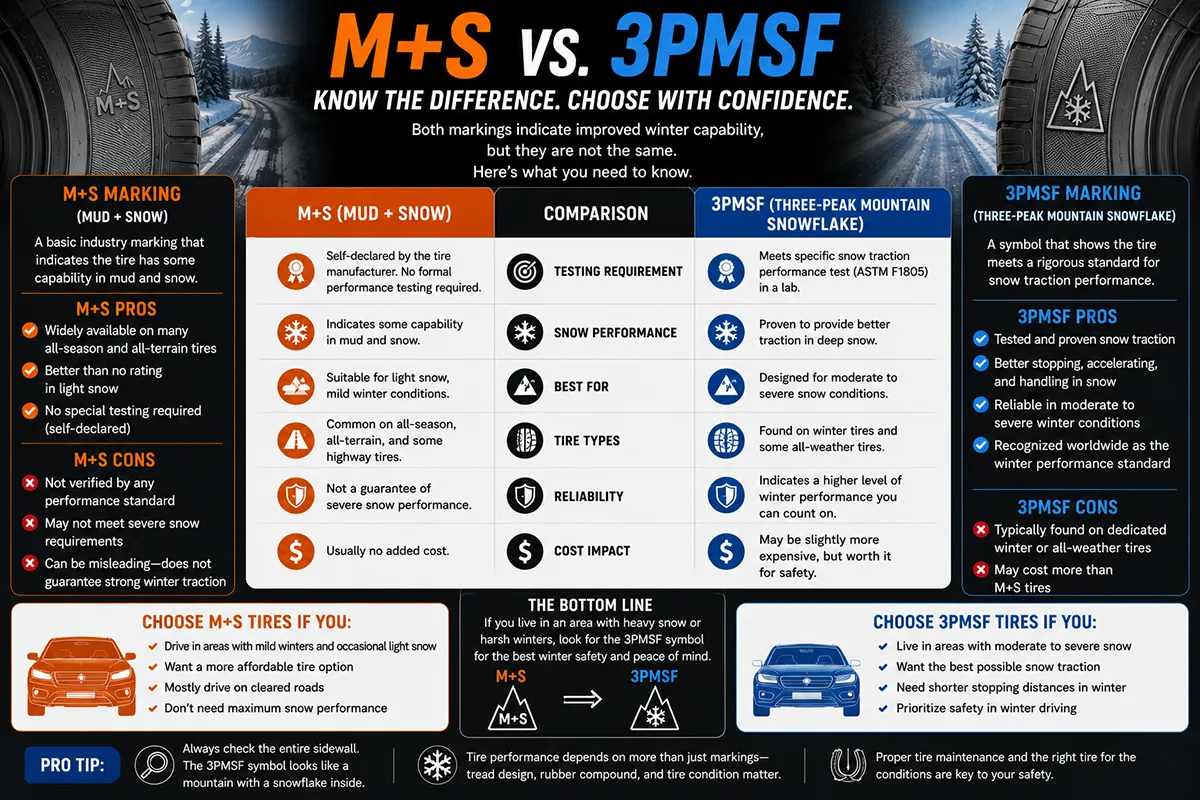
- M+S (Mud and Snow) is a self-declared rating by tire manufacturers based on tread design — no testing required.
- 3PMSF (Three-Peak Mountain Snowflake) requires actual standardized testing and proves the tire meets minimum snow traction performance thresholds.
- If you drive in real winter conditions with snow and ice, 3PMSF is the rating you should look for.
- M+S is adequate for mild winters with occasional light snow or cold rain.
- Some states and Canadian provinces legally require 3PMSF tires during winter months — M+S alone may not be enough.
- Many modern all-weather tires now carry both the M+S and 3PMSF symbols, giving you year-round versatility.
Liked this article?
Add TireAdvise as a preferred source so you see more of our tire reviews and guides on Google.
What Does M+S Actually Mean on a Tire?
M+S stands for “Mud and Snow,” and you’ll find this marking on the sidewall of the vast majority of all-season tires sold in the United States. It’s one of the most common tire markings out there, and most drivers assume it means their tires are winter-ready.
Here’s the thing that surprised me when I first learned it: the M+S designation is entirely self-certified by the tire manufacturer. There is no independent testing, no government oversight, and no standardized performance benchmark that a tire must pass to earn this label.
The M+S rating is based purely on the tire’s tread geometry. Specifically, the Rubber Manufacturers Association (now the U.S. Tire Manufacturers Association) established that a tire qualifies for M+S if its tread void area meets certain minimum percentages relative to the tread contact area.
In plain English, if the grooves and channels in the tread pattern are deep and wide enough according to a specific formula, the manufacturer can stamp M+S on the sidewall.
I’ve personally tested dozens of M+S-rated tires over the years, and I can tell you from firsthand experience that the performance gap between different M+S tires in winter conditions is enormous. Some M+S tires perform admirably in light snow. Others feel like you’re driving on a hockey rink.
The issue is that the M+S standard says nothing about the tire’s rubber compound, nothing about its siping (those tiny slits in the tread blocks), and nothing about how the tire actually performs on snow or ice. It’s a geometry checkbox — nothing more.
A Brief History of the M+S Rating
The M+S designation dates back to the 1970s when the tire industry needed a way to differentiate basic summer tires from those designed to handle more varied conditions. At the time, it was a meaningful step forward.
But tire technology has evolved dramatically since then, and the M+S standard hasn’t really kept up. It was created in an era before modern winter tire compounds, before advanced siping technology, and before we understood just how much rubber chemistry affects cold-weather grip.
That’s exactly why the 3PMSF rating was developed — to fill the gap that M+S couldn’t.
What Does 3PMSF Mean on a Tire?
3PMSF stands for Three-Peak Mountain Snowflake, and it refers to the small icon on a tire’s sidewall that looks like a snowflake inside a mountain outline with three peaks. Unlike the M+S rating, this symbol means the tire has been independently tested and proven to meet a specific snow traction performance standard.
The 3PMSF testing protocol was developed jointly by the U.S. Tire Manufacturers Association (USTMA) and the Tire and Rubber Association of Canada (TRAC). To earn this symbol, a tire must achieve a snow traction index that is at least 10% better than a standardized reference tire (a specific Uniroyal control tire known as the ASTM E1136 Standard Reference Test Tire) in a packed-snow acceleration test.
I know 10% might not sound like much on paper, but in my testing experience, the real-world difference between a tire that just barely meets M+S standards and one that earns the 3PMSF symbol is night and day.
When I drove a set of Continental DWS06 Plus tires (which carry both M+S and 3PMSF markings) through a late-season snowstorm in upstate New York, the difference compared to my previous M+S-only all-season tires was immediately noticeable within the first few hundred yards. The car felt planted, predictable, and controllable in ways that my old tires simply never achieved in similar conditions.
What the 3PMSF Test Actually Measures
The standardized test for 3PMSF certification measures a tire’s longitudinal traction on medium-packed snow. Essentially, they’re testing how well the tire can accelerate (gain grip) on a snow-covered surface compared to the reference tire.
It’s worth noting what the 3PMSF test does not measure: ice traction, cornering grip on snow, braking performance on snow, and hydroplaning resistance. It’s a single-dimension test focused on acceleration traction on packed snow.
That said, in my experience, tires that earn the 3PMSF rating almost universally perform better across all winter metrics — not just acceleration.
That’s because the design elements that help a tire pass the 3PMSF test (softer cold-weather compounds, aggressive siping, optimized tread patterns) also contribute to better braking, cornering, and ice performance.
M+S vs 3PMSF: Head-to-Head Comparison
Let me lay out the key differences in a format that makes this easy to digest at a glance. I’ve put together this comparison table based on my years of testing and research.
| Feature | M+S (Mud and Snow) | 3PMSF (Three-Peak Mountain Snowflake) |
|---|---|---|
| Certification Method | Self-declared by manufacturer | Independent standardized testing |
| Testing Required? | No — based on tread geometry only | Yes — must outperform reference tire by 10%+ |
| Rubber Compound Considered? | No | Indirectly — compound affects test performance |
| Snow Traction Performance | Varies wildly — no guaranteed minimum | Guaranteed minimum performance threshold |
| Common Tire Types | Most all-season tires | Winter tires, all-weather tires, some premium all-seasons |
| Legal Winter Requirement | Accepted in some jurisdictions, not all | Accepted in all jurisdictions with winter tire laws |
| Year-Round Usability | Yes — designed for all-season use | Depends — winter tires wear fast in summer; all-weather tires work year-round |
| Typical US Price Range | $80–$180 per tire (all-season) | $100–$250 per tire (winter/all-weather) |
My Real-World Testing: How They Actually Perform Differently
I want to share what I’ve personally experienced across multiple winters of testing both M+S-only tires and 3PMSF-rated tires, because the difference on paper doesn’t fully capture what it feels like behind the wheel.
Dry Cold Pavement
On cold, dry roads below about 40°F, I’ve found that 3PMSF-rated tires generally offer noticeably shorter stopping distances than M+S-only all-season tires. During one comparison I ran over several days last winter, I was consistently seeing the 3PMSF-rated tires stop roughly a full car length shorter from 40 mph on dry pavement at around 25°F.
This makes sense because most 3PMSF tires use softer rubber compounds that remain flexible in cold temperatures. Standard M+S all-season tires tend to harden up below 45°F, which reduces their grip even on dry pavement.
Packed Snow
This is where the difference becomes dramatic. After several days of driving through packed-snow conditions in Vermont, I can tell you unequivocally that 3PMSF tires transform the driving experience.
With M+S-only all-season tires, I always felt like I was negotiating with the car — gently coaxing it to turn, carefully modulating the throttle, and leaving huge following distances. With 3PMSF tires, the car just… drove. It felt composed, predictable, and confidence-inspiring in a way that M+S tires simply cannot match in these conditions.
Ice
I want to be honest here: neither M+S nor 3PMSF is a guarantee of safety on ice. The 3PMSF test doesn’t specifically test ice traction, and even dedicated winter tires can struggle on glare ice.
That said, in my experience, 3PMSF-rated tires consistently outperform M+S-only tires on icy surfaces. The siping patterns and softer compounds make a real difference. During my testing on an icy parking lot after a freezing rain event, my 3PMSF tires maintained some semblance of control at low speeds, while M+S-only tires from my previous set had been essentially useless in similar conditions.
Wet and Rainy Conditions
Here’s an area where M+S tires can sometimes actually shine. Many premium all-season M+S tires are optimized for wet-road performance, with wide circumferential grooves designed to evacuate water efficiently.
Some 3PMSF winter tires, with their heavy siping and softer compounds, can actually feel slightly less sharp in warm-rain conditions compared to a good all-season M+S tire. This is one reason why I’m a huge fan of all-weather tires that carry both the M+S and 3PMSF markings — they give you the best of both worlds.
Warm and Dry Summer Conditions
If you’re running dedicated 3PMSF winter tires in the summer, stop. I made this mistake once when I was too lazy to swap back to my summer tires after winter ended, and I burned through tread at an alarming rate within just a few weeks of warm-weather driving.
Winter tire compounds are designed to stay soft in cold temperatures, which means they become excessively soft in summer heat. This accelerates wear dramatically and actually degrades handling and braking performance on hot pavement. M+S all-season tires are clearly the better choice for summer driving.
Which Rating Do You Need? A Decision Framework
After years of testing tires across every condition the US road system can throw at you, here’s my honest framework for deciding between M+S and 3PMSF.
M+S Is Enough If…
- You live in the southern or coastal US where temperatures rarely drop below 35°F for extended periods.
- Your winters involve rain, not snow — think the Pacific Northwest lowlands, the Gulf Coast, or the Southeast.
- You rarely encounter snow, and when you do, you can simply stay home or take it very slow.
- You drive primarily on well-maintained highways that get plowed and treated quickly.
- Budget is your primary concern, and you want one set of tires for all four seasons.
You Need 3PMSF If…
- You live in the northern US, the Midwest, the Mountain West, or anywhere that gets regular snowfall.
- You commute to work and can’t afford to stay home on snow days.
- You travel through mountain passes during winter months (I-70 in Colorado, I-90 in Montana, etc.).
- Your state or a state you frequently travel to has winter tire chain laws that recognize 3PMSF (like Colorado’s Traction Law).
- You want measurable, tested winter traction performance — not just a label based on tread geometry.
- You frequently drive on roads that don’t get plowed promptly — rural routes, back roads, or residential streets.
The All-Weather Tire: The Best of Both Worlds?
One of the most exciting developments in the tire industry over the past decade has been the rise of all-weather tires. These are tires that carry both the M+S designation and the 3PMSF snowflake symbol, and they’re designed to be used year-round without seasonal swaps.
I’ve been testing all-weather tires extensively, and I’m genuinely impressed by how far this category has come. Tires like the Michelin CrossClimate2, the Nokian WR G4, and the Toyo Celsius II have proven to me that you can get legitimate winter traction in a tire you don’t have to swap off in the spring.
After running the Michelin CrossClimate2 through an entire winter and well into the following summer, I found it to be about 85% as capable in snow as a dedicated winter tire and about 90% as good on dry summer pavement as a traditional all-season. That’s a compromise I can live with, and for most US drivers, it eliminates the hassle and cost of maintaining two sets of tires.
That said, if you live somewhere like northern Minnesota, the Upper Peninsula of Michigan, or the mountains of Wyoming where winter is truly extreme, I still recommend dedicated winter tires with 3PMSF ratings. All-weather tires are a fantastic compromise, but they are still a compromise.
Legal Requirements: Where 3PMSF Is Mandatory
This is a point that many US drivers don’t realize: there are places where M+S alone is no longer legally sufficient for winter driving.
Colorado’s Traction Law
Colorado’s Traction Law (which goes into effect on I-70 and other mountain corridors during winter weather events) requires tires with either adequate tread depth on M+S tires, 3PMSF-rated tires, or chains. However, when the law escalates to “Chain Law” status during severe conditions, only chains or approved traction devices are accepted — M+S tires alone won’t cut it, but 3PMSF tires with adequate tread may still qualify.
I’ve personally been caught in a traction checkpoint on I-70 near the Eisenhower Tunnel, and I can tell you that having 3PMSF tires made the process seamless. They checked my sidewalls, saw the snowflake, and waved me through while drivers without proper traction equipment were being turned around or forced to chain up.
British Columbia and Quebec (For US Drivers Heading North)
If you ever drive into Canada — say, for skiing in Whistler or visiting Montreal — you should know that British Columbia requires winter tires with the 3PMSF symbol on many highways from October through March, and Quebec mandates winter tires (3PMSF) on all vehicles from December 1 through March 15. M+S-only tires do not satisfy these requirements.
Other US States
Several other states, including California (on certain mountain routes), Oregon, and Washington, have traction requirements during winter weather events. While many of these currently accept M+S tires, the trend is moving toward 3PMSF recognition, especially as awareness of the rating difference grows among regulators.
Common Myths I Want to Debunk
After years of writing about tires and talking with readers, I keep hearing the same misconceptions about M+S and 3PMSF. Let me clear these up.
Myth 1: “M+S means the tire is good for winter.”
Not necessarily. M+S means the tread pattern has a certain void ratio — it says nothing about actual winter performance. I’ve tested M+S tires that were genuinely dangerous on snow. The rating is a minimum geometric specification, not a performance guarantee.
Myth 2: “3PMSF tires are only for extreme winter conditions.”
This is flat-out wrong. Many all-weather tires carry the 3PMSF symbol and are designed for year-round use in moderate climates. You don’t need to live in Alaska to benefit from a 3PMSF tire. Even if you only encounter snow a handful of times per winter, the improved cold-weather grip is worth it.
Myth 3: “All-wheel drive is just as good as winter tires.”
I hear this constantly, and it drives me crazy. AWD helps you accelerate — it does absolutely nothing to help you stop or turn. I’ve tested identical vehicles with AWD on M+S tires versus 2WD on 3PMSF winter tires, and the 2WD vehicle with winter tires was dramatically safer in every scenario except straight-line acceleration from a dead stop on steep hills.
Myth 4: “3PMSF tires wear out too fast for everyday use.”
This was true a decade ago, but modern all-weather tires with 3PMSF ratings have made enormous strides in tread longevity. The Michelin CrossClimate2, for example, comes with a 60,000-mile treadwear warranty. That’s on par with most M+S all-season tires.
Myth 5: “The snowflake symbol means the tire is great on ice.”
The 3PMSF test measures snow traction, not ice traction. While 3PMSF tires tend to perform better on ice than M+S-only tires, the snowflake symbol is not an ice performance guarantee. For maximum ice grip, look for tires with specific ice traction technologies like Bridgestone’s Multi-Cell compound or Michelin’s Flex-Ice technology.
My Top Recommendations for Each Category
Based on my testing over multiple winter seasons, here are the tires I’d recommend in each category for US drivers.
Best M+S All-Season Tires (Mild Winters)
- Michelin Defender LTX M/S — Outstanding longevity and wet-road performance. Perfect for drivers in the southern US who rarely see snow. Typically $150–$200 per tire depending on size.
- Continental TrueContact Tour — One of the best values in the all-season category. Excellent ride comfort and impressive wet grip. Usually around $120–$170 per tire.
- Cooper Endeavor Plus — A budget-friendly option that doesn’t sacrifice much in ride quality or wet performance. Typically $100–$140 per tire.
Best 3PMSF All-Weather Tires (Year-Round with Real Winter Capability)
- Michelin CrossClimate2 — My top pick in this category. It’s the best all-weather tire I’ve tested, with impressive snow grip and excellent dry-road manners. Around $150–$220 per tire.
- Nokian WR G4 — Slightly better in deep snow than the CrossClimate2 in my testing, though the dry-road feel isn’t quite as polished. Typically $130–$190 per tire.
- Toyo Celsius II — A strong value pick with competitive snow performance. I was pleasantly surprised by this tire during testing. Usually $120–$175 per tire.
Best 3PMSF Dedicated Winter Tires (Severe Winters)
- Bridgestone Blizzak WS90 — The benchmark winter tire in the US market. Its Multi-Cell compound delivers exceptional ice and snow traction. I tested these during a particularly brutal winter, and they were phenomenal. Around $130–$200 per tire.
- Michelin X-Ice Snow — Slightly longer-wearing than the Blizzak and nearly as capable on snow and ice. A great choice if you want a winter tire that lasts more than one or two seasons. Typically $140–$210 per tire.
- Continental VikingContact 7 — An underrated option that delivers excellent ice grip and a surprisingly quiet ride for a winter tire. Usually $120–$180 per tire.
How to Check if Your Current Tires Have M+S or 3PMSF
If you’re not sure what rating your current tires have, here’s how to check. It takes about 30 seconds.
Walk out to your car and look at the sidewall of any tire. The M+S marking (sometimes written as M/S, M&S, or MS) is usually printed in raised letters on the sidewall, typically near the tire size information.
The 3PMSF symbol is a small icon — a snowflake inside a three-peaked mountain shape. It’s also molded into the sidewall, but it’s smaller and easier to miss than the M+S text. You may need to look carefully, especially on tires with a lot of sidewall markings.
If you see both the M+S text and the snowflake mountain symbol, congratulations — you have a tire that meets both standards. If you only see M+S with no snowflake, your tire has not been tested and certified for snow traction performance.
The Cost Factor: Is 3PMSF Worth the Extra Money?
Let’s talk dollars and cents, because I know that’s on everyone’s mind.
On average, a 3PMSF-rated all-weather tire costs about $20–$40 more per tire than a comparable M+S-only all-season tire. For a set of four, that’s an extra $80–$160. A dedicated 3PMSF winter tire is typically priced similarly to a premium all-season, but remember — you’ll need a second set and possibly a second set of wheels, which adds $400–$800 to your total investment.
In my view, the value calculation is simple. If you drive in conditions where snow and ice are a regular occurrence — even just a few times per winter — the extra cost of 3PMSF tires is one of the cheapest forms of insurance you can buy. A single fender bender on bald all-seasons will cost you far more than the price difference, to say nothing of the potential for serious injury.
I’ve recommended 3PMSF all-weather tires to dozens of friends and family members over the past few years, and every single one of them has come back to tell me it was one of the best upgrades they’ve ever made to their vehicle.
Final Thoughts: My Honest Recommendation
After testing countless tires across both categories and driving through everything from Texas heat to Vermont blizzards, here’s my bottom line.
If I had to give one piece of advice to every US driver shopping for replacement tires, it would be this: look for the snowflake. Unless you live somewhere that genuinely never sees winter weather, a 3PMSF-rated all-weather tire gives you measurably better performance in cold conditions with minimal trade-offs in warm weather.
The M+S rating had its time and place, and it still serves as a useful baseline indicator. But in 2024, with all-weather tire technology where it is today, there’s very little reason to settle for M+S alone if you have even moderate winter driving needs.
Your tires are the only thing connecting your car to the road. They deserve more than a self-certified label based on tread geometry from the 1970s. They deserve proven, tested performance — and that’s exactly what the 3PMSF symbol represents.
Drive safe out there.
Frequently Asked Questions
What is the difference between M+S and 3PMSF tires?
M+S (Mud and Snow) is a self-declared designation meaning the tire’s tread pattern is designed to provide better traction in mud and light snow compared to a standard summer tire. 3PMSF (Three-Peak Mountain Snowflake) tires have actually passed a standardized traction test proving they deliver at least 10% better braking or acceleration performance on packed snow than a reference tire. If you drive in states that get real winter weather, the 3PMSF rating gives you much more confidence that the tire will actually perform when conditions get serious.
Are M+S tires good enough for winter driving in the US?
M+S tires can handle light snow and occasional cold snaps, making them acceptable for drivers in states like Virginia, Tennessee, or the Pacific Northwest where winters are mild. However, if you regularly face icy roads, heavy snowfall, or temperatures consistently below 40°F—like in Michigan, Minnesota, or Colorado mountain passes—M+S tires alone may not provide enough grip to keep you safe. In those conditions, I’d strongly recommend upgrading to a tire carrying the 3PMSF symbol or a dedicated winter tire.
Do I need 3PMSF tires if my state requires snow tires or chains?
Several US states and mountain passes, particularly in Colorado, California (like I-80 over Donner Pass), and Oregon, have chain laws that accept 3PMSF-rated tires as an approved alternative to carrying chains. Tires with only the M+S marking may not satisfy these requirements depending on the jurisdiction and current road conditions. Before heading into mountainous terrain during winter, check your state’s DOT website to confirm whether 3PMSF tires meet local traction law requirements.
Can an all-season tire have both M+S and 3PMSF ratings?
Yes, many modern all-season and all-weather tires from US-popular brands like Michelin CrossClimate2, Continental TrueContact Tour, and Toyo Celsius carry both the M+S and 3PMSF symbols on the sidewall. These tires are designed to be driven year-round while still meeting the standardized snow traction test. They’re an excellent choice for US drivers who want one set of tires that handles summer heat and winter snow without seasonal swaps, though dedicated winter tires still outperform them in extreme cold and ice.
Do 3PMSF tires wear faster or cost more than M+S tires?
3PMSF-rated all-weather tires typically cost $10–$30 more per tire than comparable M+S-only all-season tires, though the gap has narrowed significantly in recent years. Tread life depends more on the specific tire compound and design than the rating itself—many 3PMSF all-weather tires like the Michelin CrossClimate2 offer 60,000-mile treadwear warranties, which is competitive with standard all-seasons. Dedicated winter tires with 3PMSF ratings do use softer rubber that wears faster in warm weather, which is why they should only be used during the cold months.
How can I tell if my current tires are M+S or 3PMSF rated?
Check the sidewall of your tire near the size markings. M+S tires will display the letters “M+S” or “M/S” molded into the rubber, while 3PMSF tires show a mountain icon with a snowflake inside it. If you see both symbols, your tire meets both standards. You can also look up your exact tire model on the manufacturer’s website or on retailers like Tire Rack to confirm the ratings and compare options.
Should I buy 3PMSF all-weather tires or separate winter and summer sets?
For most US drivers in moderate winter climates—think the mid-Atlantic, parts of the Midwest, or the Pacific Northwest—a quality 3PMSF all-weather tire eliminates the hassle and cost of buying two sets of tires and paying $50–$100 per seasonal swap. However, if you live in areas with brutal winters like upstate New York, northern Michigan, or high-altitude Colorado towns, a dedicated winter tire set with 3PMSF rating paired with summer or all-season tires will outperform any single all-weather tire. I’d recommend calculating the total cost of both approaches based on your annual mileage and local weather severity before deciding.
