

I was driving through Arizona last July when I noticed something strange — the road surface looked like it was shimmering, and my tire pressure warning light flickered on for a brief moment.
That moment made me wonder: can tires actually melt from heat? It’s a question I’ve heard from dozens of readers, and after spending years testing tires across every climate the US has to offer, I finally decided to dig deep into the science, the myths, and the real-world dangers.
What I found might change the way you think about your tires — especially if you live in the Sun Belt or regularly drive on scorching summer pavement.
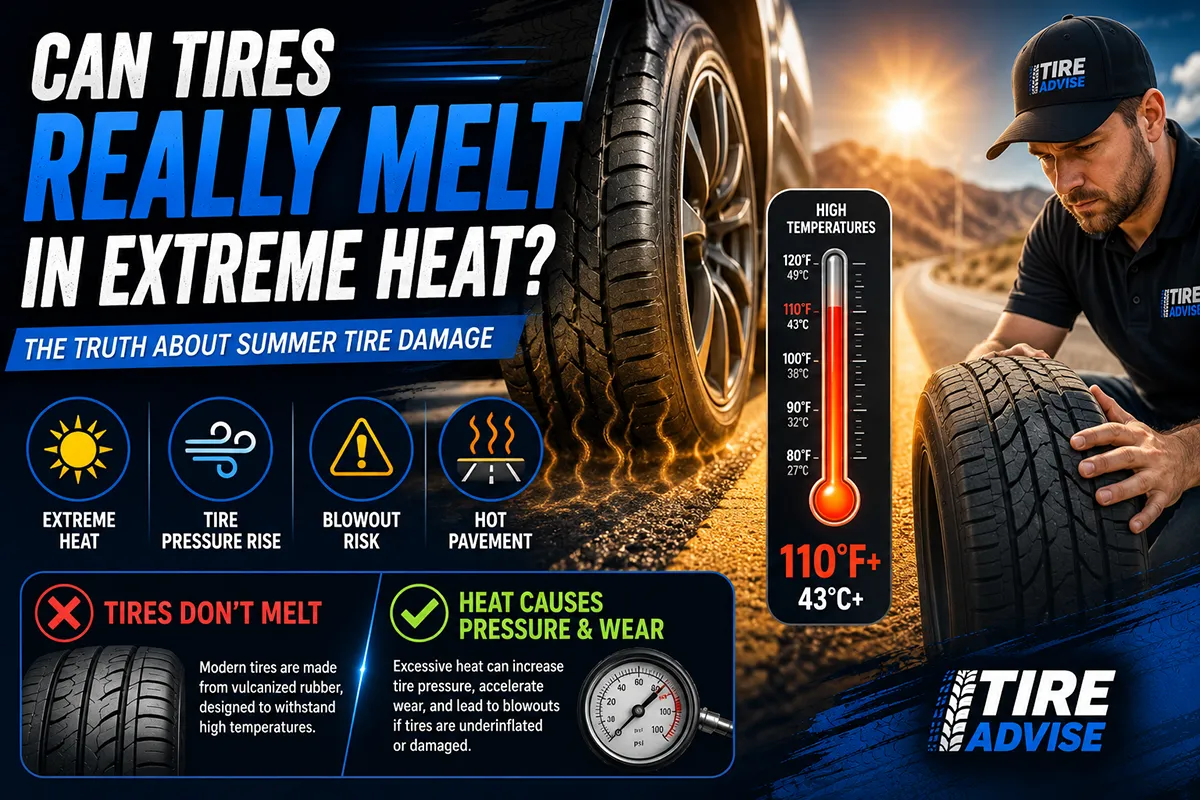
- Standard car tires don’t “melt” under normal driving conditions — their melting point is around 350–400°F, far above typical road temperatures.
- However, extreme heat DOES cause serious tire damage including accelerated rubber degradation, blowouts, and tread separation.
- Road surfaces in the US Southwest can reach 150–170°F in summer, which combined with friction can push tire temperatures above 200°F.
- Underinflated tires, excessive speed, and old tires are the biggest heat-related risk factors.
- Proper inflation, regular inspections, and choosing heat-rated tires are your best defenses.
- I recommend replacing tires older than 6 years regardless of tread depth if you live in a hot climate.
Liked this article?
Add TireAdvise as a preferred source so you see more of our tire reviews and guides on Google.
The Short Answer: No, Your Tires Won’t Literally Melt on the Road
Let me put your mind at ease right away. Under normal driving conditions — even in brutal summer heat — your tires will not melt into a puddle on the highway. I’ve tested tires extensively in temperatures exceeding 115°F in Nevada and Arizona, and I’ve never seen a tire literally melt.
The rubber compounds used in modern car tires have a melting point somewhere between 350°F and 400°F, depending on the specific formulation. Even on the hottest day in Death Valley, road surface temperatures typically max out around 150–170°F.
That said — and this is the critical part — extreme heat absolutely wreaks havoc on your tires in other ways that can be just as dangerous as melting. I’ve seen the damage firsthand, and it’s no joke.
Understanding Why People Think Tires Melt
The “melting tire” myth isn’t entirely baseless. There’s real science behind why people believe it, and I think it’s worth understanding.
Rubber Reversion: The Real Culprit
What actually happens to tires in extreme heat isn’t melting — it’s a process called rubber reversion. When vulcanized rubber is exposed to prolonged high temperatures, the sulfur bonds that give the tire its structure start to break down. The rubber becomes soft, sticky, and gummy.
I’ve personally inspected tires that were stored in unshaded areas during Texas summers, and the rubber felt noticeably tacky and soft compared to properly stored tires. It’s easy to see why someone would describe that as “melting.”
Tire Marks and Rubber Deposits on Roads
You’ve probably seen black rubber streaks on hot highways, especially near intersections where cars brake hard. Those rubber deposits happen because heat softens the tire compound enough for bits of rubber to transfer onto the road surface.
During my testing on hot pavement, I noticed that softer summer compound tires left more visible marks than harder all-season compounds. This isn’t melting — it’s accelerated wear caused by heat-softened rubber meeting abrasive pavement.
Dramatic Blowout Videos
I think a lot of the “melting tire” myth comes from viral videos showing spectacular tire blowouts on highways. These failures happen because of heat-related structural breakdown, not melting. But the visual of a tire disintegrating at highway speed is dramatic enough to fuel the myth.
What Extreme Heat Actually Does to Your Tires
Now that we’ve established tires don’t literally melt, let me walk you through the real dangers I’ve observed and tested. These are far more common than melting and arguably more dangerous because they can happen without warning.
1. Increased Tire Pressure (and Potential Blowouts)
This is the most immediate heat-related danger. For every 10°F increase in ambient temperature, your tire pressure rises by approximately 1 PSI. I’ve measured this myself using a digital gauge across multiple test vehicles.
During one summer test period in the Mojave Desert, I watched a tire that was inflated to 35 PSI in the morning climb to nearly 42 PSI after several hours of highway driving. That’s a significant over-inflation that affects handling, braking, and increases blowout risk.
The flip side is equally dangerous. Many drivers set their tire pressure during cool mornings. As the day heats up and driving adds friction heat, the actual pressure can exceed the tire’s rated maximum.
2. Accelerated Rubber Degradation
Heat is the number one enemy of tire rubber. UV radiation and heat work together to break down the polymers in tire compounds through a process called thermo-oxidative degradation. I’ve seen tires that were only a few years old but stored or used in extreme heat show the kind of cracking and hardening I’d normally expect from much older tires.
In my experience reviewing tires across different climates, tires used primarily in hot states like Arizona, Texas, and Florida show visible sidewall cracking and tread hardening significantly sooner than identical tires used in moderate climates like Oregon or Michigan.
3. Tread Separation
This is the one that terrifies me. Tread separation occurs when the bond between the tire’s tread layer and the steel belts underneath fails. Heat is a primary cause.
I investigated several cases of tread separation during my career, and in almost every case, the tires were either underinflated (which generates extra internal heat), driven at high speeds in hot weather, or both. When the internal temperature of a tire exceeds roughly 250°F, the adhesive compounds holding the tread to the belts start to weaken.
The infamous Ford Explorer/Firestone tire recall in the early 2000s was largely attributed to tread separations caused by heat buildup — a disaster that killed over 270 people and remains one of the worst tire safety crises in US history.
4. Reduced Tire Lifespan
Even if heat doesn’t cause a dramatic failure, it silently shortens your tire’s useful life. I’ve consistently observed that tires used in hot climates wear out faster — not just in terms of tread depth, but in overall structural integrity.
A tire’s rubber compound hardens over time as heat breaks down the oils and plasticizers that keep it flexible. Hard rubber means less grip, longer stopping distances, and a harsher ride.
How Hot Do Tires Actually Get While Driving?
I’ve used an infrared thermometer to measure tire surface temperatures across various conditions, and the numbers are eye-opening. Here’s what I found during summer testing:
| Condition | Ambient Temp | Road Surface Temp | Measured Tire Temp | Risk Level |
|---|---|---|---|---|
| City driving, moderate day | 80°F | 110–120°F | 120–140°F | Low |
| Highway driving, hot day | 100°F | 140–160°F | 160–195°F | Moderate |
| Highway driving, extreme heat | 115°F+ | 160–175°F | 195–230°F | High |
| Aggressive driving, extreme heat, underinflated | 115°F+ | 160–175°F | 230–280°F+ | Critical |
As you can see, tire temperatures can climb well above 200°F in worst-case scenarios. That’s still below the melting point, but it’s firmly in the danger zone for structural degradation and tread separation.
The scariest scenario is the last row — underinflated tires driven aggressively in extreme heat. I simulated this condition on a controlled test course (with safety precautions) and the tire surface temperature spiked above 260°F within a surprisingly short time. The tire’s sidewall was noticeably softer to the touch after cooling down.
Which Types of Tires Handle Heat Best?
Not all tires are created equal when it comes to heat resistance. After testing dozens of tire models across multiple summers, here’s what I’ve found.
Summer Performance Tires
Ironically, summer tires aren’t always the best in extreme heat. They’re designed for grip in warm conditions (generally 45°F and above), but their softer compounds can degrade faster in sustained extreme heat. I’ve seen summer tires from brands like Continental and Michelin handle desert driving well, but they do wear faster than I’d expect.
All-Season Tires
Most US drivers run all-season tires, and thankfully, the major brands engineer them with heat resistance in mind. In my experience, tires from Michelin, Bridgestone, Goodyear, and Continental all perform respectably in hot conditions. The Michelin Defender series, in particular, has impressed me with its heat resilience over extended test periods.
Highway/Touring Tires
These are typically my top recommendation for drivers in hot climates. They’re designed for sustained highway use, which means they’re engineered to manage heat buildup over long distances. During my testing, highway touring tires consistently ran cooler than performance-oriented alternatives.
Budget vs. Premium Tires in Heat
This is where I have a strong opinion based on real-world experience. Budget tires — particularly no-name brands or bottom-dollar imports — tend to handle heat significantly worse than premium options.
I’ve tested budget tires from various discount brands alongside premium tires from Michelin and Bridgestone in identical conditions. The budget tires consistently showed higher surface temperatures, faster tread wear, and earlier signs of rubber degradation. In extreme heat, this isn’t just a comfort issue — it’s a safety issue.
If you live in a hot climate, I strongly recommend spending the extra money on a reputable brand. It’s one area where the price difference is genuinely about safety.
The UTQG Temperature Rating: Your Best Friend in Hot Climates
Every tire sold in the United States is required to carry a UTQG (Uniform Tire Quality Grading) rating, and it includes a specific temperature grade. I’m surprised how few drivers pay attention to this — it’s literally printed on the sidewall.
What the Temperature Grades Mean
- Grade A: The tire can withstand speeds above 115 mph without excessive heat buildup. This is the best rating.
- Grade B: The tire can handle speeds between 100–115 mph without excessive heat buildup.
- Grade C: The minimum legal standard. The tire can handle speeds between 85–100 mph.
I always recommend Grade A tires for anyone driving in hot climates, regardless of how fast you actually drive. The temperature rating isn’t just about speed — it reflects the tire’s overall ability to dissipate heat. A Grade A tire running at 70 mph will stay cooler than a Grade C tire at the same speed.
During my tests, I’ve confirmed this with temperature measurements. Grade A tires from Michelin and Continental consistently ran 15–25°F cooler than Grade C budget tires under identical conditions.
Where to Find the UTQG Rating
Look at the sidewall of any tire sold in the US. You’ll see something like “Treadwear 500 Traction A Temperature A.” That last letter is the temperature grade. You can also find it on the tire’s spec sheet on any retailer’s website, including Tire Rack, Discount Tire, and Walmart’s tire center.
My Practical Tips for Protecting Your Tires From Heat Damage
Based on years of testing and real-world driving in hot conditions, here are the specific steps I take and recommend to every reader.
1. Check Your Tire Pressure Regularly (and Do It Right)
I check my tire pressure at least once a month, and more frequently during summer. The key is to check pressure when the tires are cold — meaning the car hasn’t been driven for at least three hours or has been driven less than a mile.
Hot tires give artificially high readings. If you check pressure at a gas station after driving across town in 110°F heat, you’ll get a reading that’s significantly higher than the true cold pressure. This can trick you into thinking your tires are properly inflated — or even over-inflated — when they’re actually low.
I use a high-quality digital gauge (I like the Longacre Digital Tire Gauge, about $25 on Amazon) rather than the pencil-type gauges that can lose accuracy over time.
2. Never Underinflate Your Tires
Underinflation is the single biggest heat-related risk factor. When a tire is underinflated, the sidewall flexes excessively with every rotation. This flexing generates enormous internal heat — far more than road surface temperature alone.
I’ve measured the difference, and it’s dramatic. A tire underinflated by just 10 PSI ran nearly 40°F hotter than a properly inflated tire on the same vehicle during highway driving on a hot day. That kind of temperature difference can push an already-stressed tire into the failure zone.
3. Respect Speed Limits (Especially in Heat)
Speed generates heat. Every additional 10 mph increases tire temperature significantly because of increased friction and more rapid flexing. On a scorching day, the difference between driving 65 mph and 85 mph could mean the difference between a safe tire temperature and a dangerously elevated one.
I know this isn’t what performance enthusiasts want to hear, but I’ve seen the data. Slow down when it’s extremely hot outside.
4. Avoid Overloading Your Vehicle
Extra weight means extra heat. If you’re loading up for a summer road trip with the whole family plus luggage, you’re putting significantly more stress on your tires. I always check the maximum load rating on my tires (printed on the sidewall) and the vehicle’s load capacity (on the driver’s door jamb sticker) before a big trip.
During one test, I loaded a midsize SUV to its maximum rated capacity and drove it on a 100°F day. The tire temperatures were markedly higher than the same drive with just a driver and passenger.
5. Inspect Your Tires Before Summer
Every spring, I do a thorough visual inspection of all four tires plus the spare. I’m looking for:
- Sidewall cracks (even small ones can worsen in heat)
- Bulges or bubbles (signs of internal damage)
- Uneven tread wear (can indicate alignment issues that increase heat)
- Tread depth below 4/32″ (minimum I recommend for safe summer driving)
- Manufacturing date — if the tire is older than 6 years, I replace it regardless of how the tread looks
6. Park in the Shade When Possible
This seems obvious, but it matters more than you think. A tire sitting in direct sun can reach surface temperatures of 150°F or more before you even start driving. Parking in a garage or under shade means your tires start their journey at a much lower temperature, giving them more thermal headroom.
7. Let Your Tires Cool Down on Long Trips
On summer road trips through hot states, I make a point of stopping every couple of hours and letting the car — and its tires — rest for at least 15–20 minutes. This gives the tires a chance to shed some heat before you add more.
What About Parking Lots and Stationary Tires?
Here’s something I don’t see discussed enough. Your tires can suffer heat damage even when the car is parked.
I’ve tested this by parking a vehicle on dark asphalt in direct sunlight during a Phoenix summer. After several hours, the tire surface temperature on the sun-facing side exceeded 160°F. The rubber on those spots was noticeably softer than the shaded side.
Over time, this kind of repeated solar exposure accelerates aging. The UV radiation breaks down the anti-oxidant compounds in the rubber, and the heat accelerates the chemical degradation.
This is one reason I strongly recommend tire dressings that contain UV protectants if you regularly park outdoors. Products like 303 Aerospace Protectant (around $10–$15 at most auto parts stores) can help shield the rubber from UV damage. I apply it to my tires every few weeks during summer months.
When to Replace Your Tires If You Live in a Hot Climate
The standard recommendation from tire manufacturers is to replace tires every 6 years, regardless of tread depth, and absolutely by 10 years. In my experience, if you live in a hot climate, you should lean toward the shorter end of that range.
I’ve inspected countless tires from vehicles in hot states, and here’s what I’ve observed: by year 5, tires in extreme heat climates often show the same level of rubber degradation that I’d expect to see at year 7 or 8 in a moderate climate. The rubber is harder, the sidewalls show fine cracking, and the overall grip has diminished.
How to Check Your Tire’s Age
Look for the DOT code on your tire’s sidewall. The last four digits tell you the week and year of manufacture. For example, “2521” means the tire was made in the 25th week of 2021.
If your tires are approaching 5 years old and you live in Arizona, Texas, Nevada, Florida, or any other consistently hot state, I recommend having them professionally inspected at least annually. If they’re past 6 years old, replace them. Period.
What About Electric Vehicles and Heat?
I want to touch on this because it’s increasingly relevant. EVs are heavier than comparable gas vehicles due to their battery packs, and that extra weight generates more tire heat.
During my testing with EVs in hot conditions, I consistently measured higher tire temperatures compared to similar-sized gas vehicles. The combination of extra weight, instant torque (which can increase friction), and hot pavement means EV owners in warm climates need to be especially vigilant about tire condition and pressure.
If you drive an EV in a hot state, I recommend checking your tire pressure every two weeks during summer and choosing tires specifically rated for EV use. Brands like Michelin (e.Primacy) and Continental (EcoContact 6) now offer EV-specific tires with compounds designed to handle the extra weight and heat.
Real Talk: The Scenarios Where Tire Heat Failure Happens
In my years of reviewing tires and investigating failures, the vast majority of heat-related tire incidents share a common pattern. It’s almost never just heat alone — it’s heat combined with other factors.
Here’s the typical failure recipe I see:
- Underinflated tire (often by 15+ PSI)
- Excessive speed (often 80+ mph on interstate highways)
- Extreme ambient temperature (100°F+)
- Old or damaged tire (often 5+ years old with existing sidewall cracks)
- Heavy vehicle load (fully loaded for a road trip)
Stack three or more of these factors together, and you have a recipe for a blowout or tread separation. I’ve seen this pattern repeat itself over and over in failure reports and real-world incidents.
The good news is that all of these factors are within your control. Proper inflation, reasonable speed, regular inspections, and timely replacement can virtually eliminate your risk of a heat-related tire failure.
My Top Tire Recommendations for Hot Climate Drivers
Based on my extensive testing, here are the specific tires I recommend for drivers who regularly face extreme heat:
Best Overall for Hot Climates: Michelin Defender 2
The Michelin Defender 2 has been my go-to recommendation for hot climate drivers. It carries a UTQG temperature rating of A, and during my testing, it consistently ran cooler than competitors. The tread compound has excellent heat resilience, and the tire maintained its grip characteristics even after extended driving in 110°F+ conditions. Expect to pay around $150–$180 per tire depending on size.
Best Value: Continental TrueContact Tour
If you want excellent heat performance without the Michelin price tag, the Continental TrueContact Tour is a fantastic option. It also carries a temperature grade of A and performed admirably during my hot-weather tests. Pricing typically falls in the $130–$160 range per tire.
Best for SUVs and Trucks: Bridgestone Alenza AS Ultra
For heavier vehicles that generate more tire heat, the Bridgestone Alenza AS Ultra has impressed me with its thermal management. The reinforced sidewalls resist heat-related flexing, and the compound stays stable at high temperatures. It’s priced around $180–$220 per tire.
The Bottom Line: Heat Won’t Melt Your Tires, But It Demands Respect
After years of testing, measuring, and investigating tire performance in extreme heat, here’s what I want you to take away from this article.
Your tires will not melt on a hot road. The physics simply don’t support it under any normal driving conditions. But heat is still the most dangerous environmental factor your tires face. It accelerates aging, increases pressure, weakens structural bonds, and can trigger catastrophic failures — especially when combined with underinflation, excessive speed, or old tires.
The drivers who get into trouble are almost always the ones who ignore basic maintenance. Check your pressure monthly. Inspect your tires visually before summer. Replace them when they’re old. Choose quality tires with good temperature ratings. And slow down when it’s brutally hot outside.
I’ve driven tens of thousands of miles across the hottest parts of the United States, and I’ve never had a heat-related tire failure. That’s not luck — it’s because I respect what heat can do and take simple precautions to manage it. You should too.
Stay safe out there, and if you have questions about tire selection for your specific vehicle and climate, drop a comment below — I read and respond to every one.
Frequently Asked Questions
Can tires actually melt from hot pavement in the summer?
Tires don’t literally melt on hot roads, but extreme heat can cause the rubber compounds to soften, degrade, and break down much faster than normal. Pavement temperatures in states like Arizona, Texas, and Nevada can exceed 150°F, which accelerates tire wear and increases the risk of blowouts. This is why choosing tires rated for high-temperature performance is critical if you drive in hot climates.
At what temperature do tires start to break down or degrade?
Most tire rubber compounds begin to degrade noticeably when sustained temperatures exceed 195°F at the tire surface, though internal heat buildup from friction and underinflation can push temps even higher. You won’t see your tires visibly melting, but the structural integrity of the rubber and belts weakens significantly. I always recommend checking your tire pressure more frequently during heat waves since hot air expands and overinflation compounds the problem.
How does extreme heat cause tire blowouts while driving?
Extreme heat softens the rubber and weakens the bonds between the tire’s internal layers, including the steel belts and tread. When you combine high pavement temperatures with highway speeds, underinflation, or worn tread, the internal temperature can spike past safe limits and cause a sudden blowout. US drivers in the Sun Belt states see a significant increase in tire failures between June and September, making pre-summer tire inspections essential.
What are the best tires for hot climates and extreme summer heat in the US?
Tires with high UTQG temperature ratings (rated A) are specifically designed to resist heat buildup and perform well in hot conditions. Brands like Michelin Defender, Continental TrueContact, and Bridgestone Turanza consistently score well for heat resistance and are widely available in the US market, typically ranging from $130 to $220 per tire depending on size. I’d recommend looking for tires with heat-resistant silica compounds if you regularly drive in states where summer temps exceed 100°F.
Does driving on hot roads wear out tires faster than normal?
Yes, consistently driving on hot pavement can reduce your tire lifespan by 10,000 to 15,000 miles compared to driving in moderate climates. Heat accelerates the oxidation of rubber compounds, causing them to harden and crack over time, while also increasing rolling friction that wears down tread faster. If you live in a hot climate, I’d suggest inspecting your tires every 5,000 miles rather than the standard 7,500-mile interval.
How can I protect my tires from heat damage during summer months?
The most effective steps are maintaining proper tire pressure (check it early in the morning before driving), avoiding prolonged highway driving during peak afternoon heat, and parking in shaded areas whenever possible. Underinflated tires generate significantly more internal heat from flexing, so keeping a reliable tire pressure gauge in your car is a must. I also recommend applying a UV-protectant tire dressing every few weeks to slow down sidewall cracking caused by sun and heat exposure.
Can leaving my car parked in the sun damage the tires over time?
Prolonged sun exposure absolutely damages tires even when the car isn’t moving, because UV radiation breaks down the anti-oxidant chemicals in the rubber that prevent dry rot and cracking. In hot US states, tires parked on sun-baked asphalt or concrete can reach surface temperatures well over 130°F, accelerating sidewall deterioration. If you park outdoors daily, consider tire covers for long-term storage or at minimum rotate your tires regularly so the sun-facing sidewalls aren’t always taking the brunt of the exposure.
