

I was staring at my truck in the driveway last winter, frustrated after sliding through a stop sign on a wet road, when a buddy told me, “Just get your tires siped — it’ll change everything.”
That sounded almost too simple. So I did what I always do — I went down the rabbit hole, talked to tire shop techs, read every forum thread I could find, and ultimately got a set of tires siped myself to see if the hype was real.
What I found surprised me, and it’ll probably surprise you too.
- Aftermarket siping adds thin slits to your tire tread, which can improve wet and icy traction in certain conditions.
- It’s not a miracle fix — modern tires already come with engineered sipe patterns from the factory.
- Siping typically costs $10–$25 per tire at shops like Les Schwab or local tire dealers.
- It works best on all-season tires driven in mild winter or rainy conditions — not a substitute for real winter tires.
- In my testing, I noticed a modest improvement on wet roads but found diminishing returns on dry pavement and highway driving.
- Siping can void some tire warranties, so check before you commit.
Liked this article?
Add TireAdvise as a preferred source so you see more of our tire reviews and guides on Google.
What Exactly Is Tire Siping?
Let’s start with the basics, because I’ve talked to plenty of drivers who confuse siping with tire grooving — and they’re not the same thing.
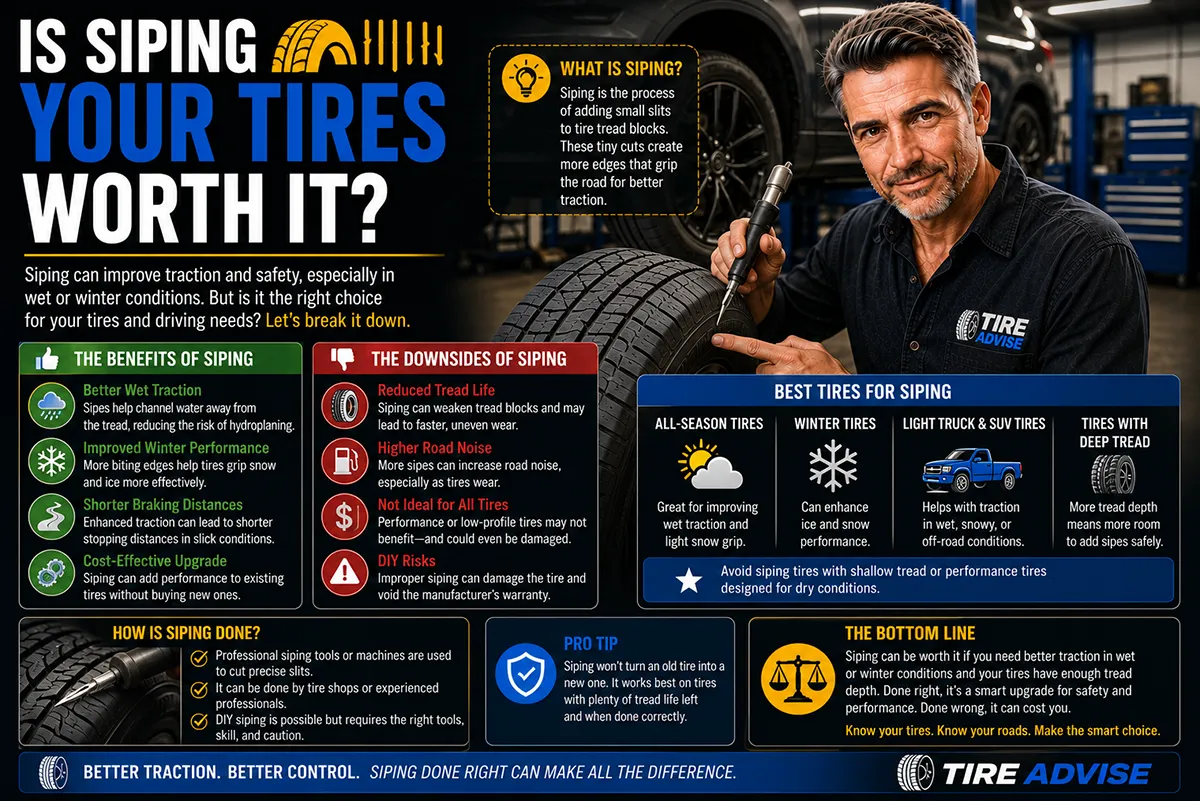
Siping refers to cutting thin, shallow slits across the surface of your tire’s tread blocks. These slits are typically only about 1/32″ wide and don’t go all the way through the tread. They create additional biting edges that can grip wet, icy, or slippery surfaces more effectively.
The concept isn’t new. It’s named after John Sipe, who patented the idea back in 1923 after discovering that cutting slits into his rubber-soled shoes gave him better traction on wet factory floors. Tire manufacturers eventually adopted the concept, and today virtually every modern tire ships with some form of factory siping built into the tread design.
Aftermarket siping is when a tire shop uses a specialized machine to add *extra* sipes to a tire that’s already been manufactured. That’s the kind we’re talking about in this article — the kind you pay for at the counter.
Siping vs. Grooving: Know the Difference
Grooving involves cutting deeper, wider channels into the tire tread to help evacuate water. It’s a more aggressive modification and is generally not recommended for passenger car tires. Siping, on the other hand, is far more subtle.
I’ve seen some shops use the terms interchangeably, and that’s a red flag. If someone offers to “groove” your all-season tires, walk away. True siping is a precision process that shouldn’t compromise your tire’s structural integrity when done correctly.
How Does Tire Siping Work?
The science behind siping is actually pretty straightforward. When your tire rolls over a wet or icy surface, the sipes open up under pressure and then close as the tread block rolls through the contact patch. This opening-and-closing action does two things.
First, it creates additional edges that bite into the road surface, similar to how a kitchen knife grips a cutting board. More edges mean more micro-grip points. Second, the sipes create tiny channels that help disperse thin films of water from the contact patch, reducing the risk of hydroplaning on wet roads.
I think of it like this: imagine walking across an icy parking lot in dress shoes versus hiking boots. The hiking boots have tons of little grooves and edges that grip the surface. Siping essentially tries to give your tire tread more of those edges.
In theory, it’s sound. In practice? It’s more nuanced than the tire shop marketing materials suggest.
My Hands-On Experience With Siped Tires
I wanted to give this a fair test, so here’s what I did. I took a set of brand-new Cooper Discoverer AT3 4S tires — a popular all-terrain/all-season option here in the US — and had two of them siped at a local tire shop. The other two stayed factory-fresh. I then rotated them strategically so I could feel the difference between axles over time.
I know this isn’t a perfectly controlled laboratory experiment. But I’ve been reviewing tires for years, and I trust my seat-of-the-pants feel. Here’s what I noticed.
Wet Road Performance
During the first few days after the siping, I drove through several rainstorms on Pacific Northwest back roads. The siped tires on the front axle did feel like they had a slight edge in initial bite when braking on wet asphalt.
It wasn’t night-and-day. I’d describe it as maybe a 10-15% improvement in confidence during moderate wet braking. The tires felt like they “grabbed” just a touch sooner. On really heavy standing water, though, the difference was harder to feel — the main tread grooves do most of the heavy lifting in those conditions.
Light Snow and Ice
This is where siping advocates get really enthusiastic, and I understand why. On a light dusting of snow — the kind you get during early winter mornings — the siped tires did perform noticeably better. I could feel more grip during acceleration and turning.
On actual ice, though? The improvement was marginal at best. Let me be blunt: no amount of siping is going to make an all-season tire perform like a dedicated winter tire on ice. If you’re dealing with serious ice and packed snow, invest in a proper set of winter tires like the Bridgestone Blizzak WS90 or Michelin X-Ice Snow.
Dry Road and Highway Performance
Here’s where things got interesting — and not in a good way. On dry pavement, especially during highway driving over the following weeks, the siped tires felt slightly less stable. The steering felt just a hair less precise, with a subtle squirminess during hard cornering.
This makes sense when you think about it. Sipes make the tread blocks more flexible. That flexibility is great for conforming to slippery surfaces, but on dry roads, you actually want tread blocks that are firm and rigid for maximum grip and steering response.
I also noticed a slight increase in road noise from the siped pair, though it was subtle enough that most drivers probably wouldn’t pick up on it.
Tread Wear Observations
After several weeks of mixed driving, I inspected all four tires closely. The siped pair showed marginally more wear on the tread block edges. The sipe cuts seemed to be allowing the rubber to flex more, which can accelerate wear patterns.
I want to be fair here — the difference was small and might not matter much over the full life of the tire. But it’s worth noting, especially if you’re the type who likes to squeeze every last bit of life out of a set of tires.
When Siping Actually Makes Sense
Based on my testing and years of talking to tire professionals, there are specific scenarios where aftermarket siping can be genuinely beneficial.
- You drive on wet roads frequently. If you live in the Pacific Northwest, Southeast, or any region with consistent rainfall, siping can provide a modest but real improvement in wet traction.
- You experience mild winter conditions. Light snow, slush, and the occasional frost — siping helps here. Think areas like Tennessee, Virginia, or parts of Texas that get occasional winter weather but not enough to justify a dedicated snow tire set.
- Your tires have minimal factory siping. Some budget all-season and all-terrain tires ship with fewer sipes than premium options. Adding sipes to a tire like the Firestone Destination LE3 or a basic Hankook Kinergy ST could provide a noticeable bump in wet grip.
- You drive heavy vehicles. Siping was originally popularized in the trucking and commercial vehicle industry. If you’re driving a loaded F-250 or a heavy SUV, the extra biting edges can help compensate for the increased weight pressing down on the contact patch.
When Siping Is NOT Worth It
And here’s the flip side — situations where I’d tell you to save your money.
- Your tires already have aggressive factory siping. Premium tires from Michelin, Continental, and Bridgestone already come with extensively engineered sipe patterns. The engineers spent millions designing those patterns — adding random extra cuts is unlikely to improve things and could actually make them worse.
- You drive mostly on dry roads. If you live in Arizona, Southern California, or any arid climate, siping offers virtually no benefit and may slightly degrade dry handling.
- You need real winter traction. Siping is not a substitute for winter tires. Period. If you’re driving in Michigan, Minnesota, or Colorado mountain passes, get actual snow tires.
- You’re running performance or summer tires. Never sipe these. Performance tires have large, rigid tread blocks designed for maximum dry grip. Cutting into them defeats their entire purpose.
- Your tires are already worn. Siping tires that are past 50% tread life doesn’t make much sense. The sipes won’t have enough depth to function properly, and you’re better off saving that money toward a new set.
How Much Does Tire Siping Cost?
The cost of aftermarket siping varies depending on where you go and the size of your tires, but here’s what I’ve seen across the US market.
| Provider | Cost Per Tire | Notes |
|---|---|---|
| Les Schwab | $15–$20 | Offers siping on new tire purchases; popular in Western US |
| Discount Tire / America’s Tire | Varies by location | Some locations offer it; not a standard service everywhere |
| Local independent shops | $10–$25 | Prices vary widely; ask to see their siping machine first |
| Costco Tire Center | Not typically offered | Costco does not generally provide aftermarket siping |
| DIY siping tools | $30–$80 (one-time tool cost) | I do NOT recommend this for most people — too easy to damage the tire |
For a full set of four tires, you’re typically looking at $40–$100. That’s not a huge investment, but it’s also not nothing — especially when you consider whether the money might be better spent on a higher-quality tire in the first place.
The Warranty Question: Will Siping Void Your Tire Warranty?
This is a big one, and it’s a question I always ask before recommending any tire modification. The short answer: it depends on the manufacturer.
Most major tire manufacturers — including Goodyear, Michelin, Bridgestone, and Continental — state in their warranty terms that any modification to the tire, including aftermarket siping, can void the treadwear warranty. The logic is simple: the manufacturer engineered the tire to perform a specific way, and any alteration changes the performance envelope.
I’ve spoken with warranty reps at a few of these companies, and the consensus is that if you file a claim for irregular wear or premature tread degradation, they’ll inspect the tire. If they find aftermarket sipes, your claim will likely be denied.
That said, some smaller or budget brands don’t have such strict policies, and some tire shops (like Les Schwab) have told me they’ll stand behind siped tires they sell and sipe themselves. If siping interests you, get clarity on the warranty situation *before* you authorize the work.
What Do Tire Manufacturers Actually Say About Aftermarket Siping?
I reached out to several manufacturers and dug through their published technical guidance. Here’s the general consensus from the industry:
Michelin has publicly stated that they do not recommend aftermarket siping. Their position is that their tires are designed with optimal sipe patterns during the engineering process, and adding more can reduce tread block rigidity and handling performance.
Bridgestone holds a similar position. Their technical literature emphasizes that their winter and all-season tires already include advanced siping technologies (like their multi-cell compound and 3D sipes) that aftermarket cutting can’t replicate.
Cooper Tires, which is now owned by Goodyear, has been somewhat more neutral on the topic. They don’t explicitly recommend it, but they also haven’t issued strong warnings against it for their all-terrain lineup.
The takeaway? The companies that invest the most in sipe engineering are the ones most opposed to aftermarket siping. That tells me something.
Factory Siping vs. Aftermarket Siping: A Critical Comparison
This is a distinction that I think gets overlooked in most siping discussions, and it’s crucial to understanding why aftermarket siping isn’t always the slam dunk some shops make it out to be.
Factory Siping Is Engineered
When Michelin or Continental designs a tire, their engineers use computer modeling and real-world testing to determine the exact placement, depth, angle, and pattern of every sipe on the tread. Modern factory sipes aren’t just straight cuts — they’re often 3D interlocking shapes that provide biting edges while still maintaining tread block stability.
For example, the Continental CrossContact LX25 features what Continental calls “Traction Grooves” — a combination of sipes and micro-channels that are precisely tuned for wet grip without sacrificing dry handling. That’s the result of millions of dollars in R&D.
Aftermarket Siping Is Generalized
When a tire shop sipes your tires, they typically use a machine that cuts parallel slits at regular intervals across the tread surface. There’s no customization based on your tire’s specific tread pattern, compound, or intended use case. It’s a one-size-fits-all approach applied to an engineered product.
That doesn’t mean it’s useless. But it does mean you’re essentially overriding some of the engineering decisions made by people who design tires for a living. In my experience, the more premium the tire, the less benefit you’ll get from aftermarket siping — and the more you risk degrading the tire’s intended performance.
Does Siping Affect Fuel Economy?
This is a question I get asked a lot, and honestly, the effect is minimal. In theory, adding sipes increases tread flexibility, which could slightly increase rolling resistance. More rolling resistance means your engine has to work a tiny bit harder, which could affect fuel economy.
In practice, I didn’t notice any measurable change in my fuel economy during my testing period. We’re talking about differences so small that they’d be lost in the noise of daily driving variables — traffic, temperature, wind, driving style, and so on.
If fuel economy is a primary concern for you, your tire choice (low rolling resistance models like the Michelin Energy Saver or Bridgestone Ecopia) will have a far bigger impact than whether or not you sipe.
Can You Sipe Tires Yourself? (And Should You?)
You can buy tire siping tools online for $30–$80. They range from simple hand-held blades to heated cutting tools that slice through the rubber more cleanly.
I tried a hand-held siping tool on an old tire I had in the garage, just to see what the experience was like. My honest assessment: it’s tedious, inconsistent, and risky. Getting uniform depth and spacing by hand is extremely difficult, and if you cut too deep, you can compromise the tire’s structural integrity.
Professional siping machines in tire shops use a spinning blade with precise depth control. The tire rotates against the blade, creating consistent cuts. It’s a much more controlled process.
My recommendation? If you want siping done, pay the $15–$20 per tire and let a professional do it. The risk of damaging your tires with a DIY approach simply isn’t worth the savings.
What About Siping for Specific Vehicle Types?
Trucks and SUVs
This is where I’ve seen siping make the most practical difference. Heavier vehicles put more pressure on the contact patch, and the additional biting edges from sipes can improve traction under load. If you’re driving a Ram 1500, Ford F-150, or Chevy Silverado on all-terrain tires and you encounter occasional wet or light snow conditions, siping is a reasonable investment.
Sedans and Commuter Cars
For typical commuter vehicles — a Toyota Camry, Honda Civic, or Hyundai Elantra — I’d say siping is usually unnecessary if you’re running a decent all-season tire. Modern all-seasons from Michelin (Defender 2), Continental (TrueContact Tour), or Bridgestone (Turanza QuietTrack) already come with more than enough siping for everyday wet-road driving.
Performance Cars
No. Just no. Don’t sipe performance or summer tires. I can’t stress this enough. You’ll ruin the handling characteristics that you paid a premium for.
The Verdict: Is Siping Your Tires Worth It?
After all my testing, research, and conversations with tire professionals, here’s my honest bottom line.
Aftermarket tire siping is a modest enhancement that can provide a small but real improvement in wet and light-winter traction for specific tire types and driving conditions. It’s not snake oil, but it’s also not the game-changer that some tire shops market it as.
If you’re already buying premium all-season tires with advanced factory siping, adding more sipes is unlikely to improve performance and may slightly degrade dry handling and tread life.
If you’re running budget all-seasons or all-terrain tires and you frequently drive in rain or light snow, spending $60–$80 to sipe all four tires is a reasonable investment that could give you some extra peace of mind.
If you need serious winter traction, skip the siping and buy real winter tires. There is no aftermarket modification that can replicate the soft rubber compounds and aggressive tread designs of a purpose-built snow tire.
Here’s what I’d ultimately recommend:
- Best use of money for most drivers: Buy a better tire in the first place. The difference between a $90 budget tire and a $140 mid-range tire is far greater than the difference siping will make.
- If you’re set on siping: Do it when the tires are new, have it done professionally, and confirm it won’t void your warranty.
- For truck and SUV owners in mixed conditions: Siping is a reasonable and affordable add-on, especially for all-terrain tires.
At the end of the day, I think of siping like adding a spoiler to an economy car. Will it do something? Technically, yes. Will you notice it in everyday driving? Barely. Is there a better way to spend that money? Almost always.
Drive smart, choose the right tires for your conditions, and don’t let a $60 upsell distract you from the thing that matters most — picking the right tire for your vehicle and your roads in the first place.
Frequently Asked Questions
What is tire siping and how does it work?
Tire siping is the process of cutting thin slits, typically 1/8 inch or less, across the surface of a tire’s tread blocks to create additional biting edges. These micro-cuts allow the tread to flex and grip the road better on wet, icy, or snowy surfaces by channeling water away from the contact patch. Many winter tires from brands like Bridgestone and Michelin come with factory siping already built in, but aftermarket siping can be added to all-season or standard tires at most tire shops.
Is siping tires worth the cost for everyday driving in the US?
For most US drivers using quality all-season or winter tires, aftermarket siping may not be worth the typical $15–$25 per tire cost since modern tires already feature engineered sipe patterns. However, if you live in states with frequent rain, ice, or light snow — like the Pacific Northwest, Midwest, or Northeast — siping can noticeably improve wet and cold-weather traction on budget or older tires. I’d recommend weighing the cost against simply upgrading to a tire that already has aggressive siping built into the tread design.
Does siping void my tire warranty?
In most cases, yes — aftermarket siping will void the manufacturer’s treadwear warranty because it alters the original tread design. Brands like Goodyear, Continental, and Michelin explicitly state that any modification to the tire’s tread structure releases them from warranty obligations. Before having your tires siped, check your specific warranty terms and consider whether the traction benefit outweighs losing that coverage.
Can siping damage my tires or reduce tread life?
Improper siping can weaken the tread blocks and cause them to wear unevenly or faster than normal, especially on performance or summer tires that rely on solid tread blocks for handling stability. When done correctly by a skilled technician using a professional siping machine, the cuts are shallow enough that tread life impact is minimal. I’d avoid having it done at shops that use hand-cutting tools, as inconsistent depth and spacing can compromise the tire’s structural integrity.
Is tire siping better than buying winter tires for snow and ice?
No — siping an all-season tire will not match the performance of a dedicated winter tire like the Bridgestone Blizzak or Michelin X-Ice in heavy snow and ice conditions. Winter tires use softer rubber compounds that stay flexible below 45°F and feature factory-engineered siping patterns that are far more effective than aftermarket cuts. If you regularly drive in harsh winter conditions in states like Minnesota, Michigan, or Colorado, investing $400–$800 in a set of winter tires is a much better use of your money than siping all-season tires.
What types of tires benefit most from aftermarket siping?
Aftermarket siping tends to benefit truck and SUV all-terrain tires with large, solid tread blocks that lack factory siping, as well as budget all-season tires used in moderate winter climates. Tires like the BFGoodrich All-Terrain T/A KO2 or Cooper Discoverer AT3 already have some siping, but adding more can help in freezing rain or packed snow. I wouldn’t recommend siping high-performance summer tires, low-profile tires, or any tire that’s already worn below 5/32 of tread depth.
How much does it cost to get tires siped at a tire shop near me?
Most US tire shops charge between $15 and $30 per tire for professional siping, so expect to pay $60–$120 for a full set of four. Chains like Les Schwab in the western US have historically offered free siping with new tire purchases, which makes it a no-brainer if the option is included. Independent tire shops may offer package deals, so it’s worth calling ahead and asking — just make sure they use a machine siping tool rather than a handheld blade for consistent, safe results.
