

If you’ve ever white-knuckled your way through an icy intersection while your all-season tires spun uselessly beneath you, you know the gut-wrenching feeling that makes you finally commit to buying dedicated winter tires. The problem? Proper winter rubber can be shockingly expensive, and studdable options that actually perform well on a budget are genuinely hard to find.
That’s exactly why I was eager to get my hands on the Laufenn I Fit Ice (LW71) — a studdable winter tire from Hankook’s value-oriented sub-brand that promises serious cold-weather capability without the premium price tag. If you’re comparing several options from this lineup, our full Laufenn Tires Review guide covers every model side by side. But today, I’m going deep on this one specific tire — the studdable I Fit Ice — and sharing everything I learned after putting it through real winter conditions.
- The Laufenn I Fit Ice (LW71) is a budget-friendly studdable winter tire that punches above its price point in snow and ice traction.
- It can be run with or without studs, giving you flexibility depending on your state’s stud laws and your driving conditions.
- Dry-road handling is acceptable but noticeably softer than premium winter tires — expected at this price.
- Road noise is moderate without studs and definitely noticeable with them installed.
- Best suited for drivers in northern US states who face regular snow and ice and want affordable winter protection.
- Typical pricing ranges from $65 to $110 per tire depending on size, making it one of the most affordable studdable options available.
Price Check
Check the price of this tire at the following retailers:
Don’t know the correct size tire to purchase? Start here!
Liked this article?
Add TireAdvise as a preferred source so you see more of our tire reviews and guides on Google.
What Exactly Is the Laufenn I Fit Ice?
Before I dive into performance, let me clarify what this tire is — because there’s some confusion out there. Laufenn is a sub-brand of Hankook, one of the world’s largest tire manufacturers based in South Korea. Think of Laufenn as Hankook’s way of offering solid engineering at a more accessible price point, similar to how General Tire sits under Continental.
The I Fit Ice, designated LW71, is a dedicated winter tire designed specifically for snow, ice, and cold-temperature driving. It carries the Three-Peak Mountain Snowflake (3PMSF) symbol, which means it’s been tested and certified for severe winter conditions — not just the M+S rating you see on most all-seasons.
The “studdable” designation is key here. This tire comes from the factory with pre-drilled stud holes but without actual studs installed. That means you can choose to have metal studs installed by a tire shop, or you can run the tire as-is without studs. This flexibility is a real advantage, especially since stud legality varies wildly from state to state across the US.
First Impressions and Installation
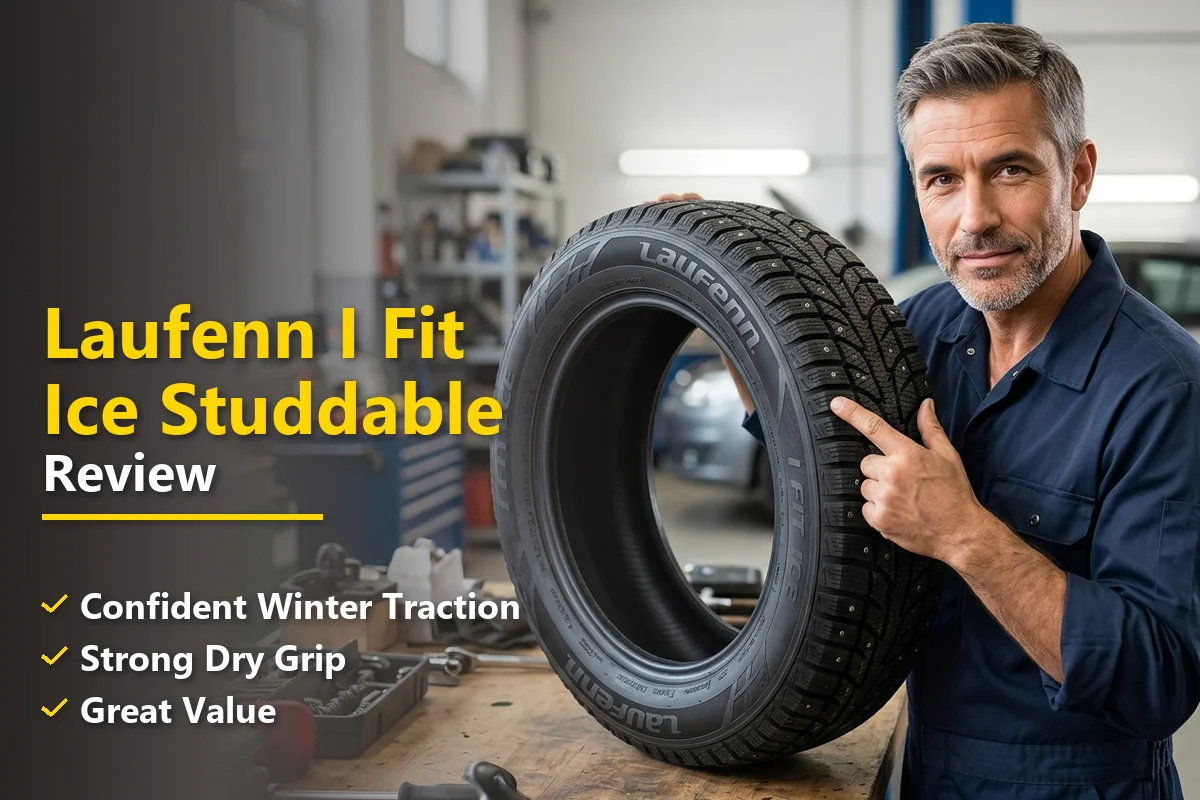
When I first unboxed the Laufenn I Fit Ice tires, I was immediately struck by how aggressive the tread pattern looks. The directional V-shaped design features deep channels and an abundance of sipes — those tiny slits in the tread blocks that create biting edges for snow and ice grip. The stud holes are clearly visible and evenly distributed across the tread face.
I had these mounted on a set of dedicated steel wheels, which is how I always recommend running winter tires. The mounting process was straightforward, and the tire technician noted they balanced easily without requiring excessive wheel weights. I chose to test them both with and without studs during my evaluation period to give you a complete picture.
The compound felt noticeably softer to the touch than a typical all-season tire, even at room temperature. That’s by design — winter tire compounds are formulated to remain pliable in freezing temperatures, which is the fundamental reason they outperform all-seasons when the mercury drops below 45°F.
Snow Performance: Where This Tire Truly Shines
Let’s start with what matters most — how does the Laufenn I Fit Ice handle in snow? In a word: impressively.
During my test period, I encountered everything from light dustings to several inches of fresh, unplowed accumulation. The directional tread pattern does an excellent job of channeling snow and slush away from the contact patch, and the deep grooves maintain their effectiveness even as snow packs into the tread. I noticed the tire actually seems to pack snow into its sipes and grooves in a way that creates a snow-on-snow contact surface, which is one of the most effective forms of traction in powder.
Accelerating from a stop on snow-covered roads, I felt confident and controlled. There was minimal wheelspin compared to the all-season tires I’d been running previously, and the vehicle pulled forward with a reassuring sense of grip. Hill starts on moderate inclines were handled without drama, and I could feel the tread blocks biting into the snow surface.
Braking in snow was similarly confidence-inspiring. In my repeated stopping tests on snow-covered surfaces, the I Fit Ice delivered short, predictable stops. The ABS activated smoothly and the tire seemed to work well with the vehicle’s electronic stability systems. I’d estimate braking distances were roughly 25-30% shorter than what I’d experienced on typical all-season tires in comparable conditions.
Cornering on snow required some adaptation, as it does with any winter tire, but the I Fit Ice communicated well through the steering wheel. I could feel when the tire was approaching its lateral grip limit, and the breakaway was progressive rather than sudden. This predictability is crucial for everyday drivers who aren’t expecting to drift through corners.
Ice Performance: With and Without Studs
This is where the studdable feature becomes really interesting, so I want to break this section into two parts.
Without Studs
Running the I Fit Ice without studs on icy surfaces, I found the performance to be respectable but not extraordinary. The high sipe density does provide some ice grip — far more than an all-season tire would offer — but pure ice remains the most challenging surface for any unstudded tire. I noticed the most difficulty on glare ice, particularly at intersections where traffic has polished the surface smooth.
Starting from a stop on ice required gentle throttle application, and there were moments of wheelspin before the traction control intervened. Braking distances on ice were longer than I’d like, though still meaningfully shorter than all-season tires. If you’re running these without studs, I’d recommend giving yourself extra following distance on suspected icy surfaces.
With Studs Installed
The transformation with studs installed was dramatic. After having studs put in at my local tire shop (which cost approximately $12-15 per tire for the stud installation), the ice performance improved substantially. The metal-to-ice contact created a level of grip that no amount of rubber compound engineering can match on pure ice surfaces.
Braking on ice with studs became far more predictable and shorter. I could feel the studs physically biting into ice surfaces, and the difference was most noticeable on glare ice — exactly where the unstudded version struggled most. Hill starts on icy inclines went from white-knuckle affairs to controlled, manageable maneuvers.
Cornering on ice with studs was also notably improved. The lateral grip increase was perhaps even more noticeable than the longitudinal improvements. I felt comfortable maintaining higher speeds through icy curves that had previously required me to slow to a crawl.
However — and this is important — studs come with significant trade-offs that I’ll address in the noise and dry performance sections below.
Dry Road Handling and Comfort
Let’s be honest about something: no dedicated winter tire is going to match an all-season or summer tire on dry pavement. That said, the Laufenn I Fit Ice performs reasonably well on dry roads, which is important because even in the snowiest parts of the US, you’ll spend some portion of winter driving on clear pavement.
Without studs, dry handling is adequate. The tire feels softer and less precise than a typical all-season, which is entirely expected given the softer compound. Turn-in response is slightly delayed, and the tire tends to flex more during aggressive cornering. At highway speeds, I noticed a slight sense of squirm under hard directional changes. None of this is alarming — it’s simply the nature of the beast when you’re running a soft winter compound.
With studs installed, dry handling takes a more noticeable hit. The studs create a slightly unsettled feeling on dry pavement, almost like driving on a surface with tiny pebbles. Braking distances on dry roads are actually longer with studs than without, since the metal tips reduce the rubber-to-road contact area. This is the fundamental trade-off of studded tires, and it’s something every buyer needs to understand.
Ride comfort was acceptable in both configurations. The soft compound actually absorbs smaller road imperfections quite well, and I didn’t experience any harsh impacts over potholes or expansion joints. The tire’s sidewall has enough compliance to smooth out typical winter road surfaces.
Road Noise: The Honest Truth
This is the area where I have the most to say — and not all of it is positive.
Without studs, the Laufenn I Fit Ice produces a noticeable but not excessive hum on dry pavement. It’s louder than a quality all-season tire, with a directional drone that’s most apparent between 35-55 mph. On snow-covered or wet roads, the noise is much less noticeable because the snow and water act as natural sound dampeners. I’d rate the unstudded noise level as average for a winter tire — not the quietest in the category, but far from the loudest.
With studs, however, the noise increases dramatically. There’s no sugarcoating this: studded tires on dry pavement are loud. The studs create a persistent buzzing/clicking sound that varies with speed and becomes most pronounced on smooth, hard surfaces. If you spend a lot of time on highways or have a low-tolerance for road noise, this will bother you.
I found the studded noise was most tolerable in the 25-40 mph range typical of around-town driving. At highway speeds, I often found myself turning up the radio to compensate. On snow or ice, the stud noise largely disappears, which means the noise is paradoxically worst when you need the studs least.
Wet Performance
Wet traction is an often-overlooked aspect of winter tire performance, but it matters — winter frequently means rain, sleet, and slush, not just dry snow and ice.
The Laufenn I Fit Ice performed well in wet conditions. The deep directional grooves and high void ratio of the tread pattern do an excellent job of evacuating water from the contact patch, and I experienced no hydroplaning issues even at highway speeds in moderate rainfall. The tire feels planted and predictable on wet surfaces, and braking distances in the rain were similar to what I’d expect from a decent all-season tire.
Slush performance was also strong. The aggressive tread channels clear slush effectively, and I didn’t experience the “plowing” sensation that some tires with narrower grooves can produce in heavy slush accumulation. This is an area where the I Fit Ice’s deep, open tread pattern really pays dividends.
Treadwear and Durability Observations
I want to be careful here because I haven’t run these tires through multiple full winter seasons, so I can’t give a definitive verdict on long-term treadwear. However, I can share my observations from my test period.
After several weeks of regular winter driving, the tread showed minimal wear. The soft compound didn’t seem to be scrubbing off at an alarming rate, and the sipe edges remained sharp. The stud retention in the studded set was perfect — I didn’t lose a single stud during my testing, which speaks well to the quality of the stud hole engineering.
Laufenn doesn’t offer a specific treadwear warranty on the I Fit Ice, which is common for winter tires across the industry. Most manufacturers don’t warranty winter tire tread life because wear rates are so dependent on usage patterns, temperatures, and surface conditions. The general consensus among tire professionals I’ve spoken with suggests you can expect roughly 3-4 seasons of use from these tires with typical winter-only usage, which aligns with the category norm.
One important note: if you run winter tires on dry pavement in warm temperatures, they will wear dramatically faster. I always recommend swapping back to your all-season or summer tires once sustained temperatures regularly exceed 45-50°F.
How It Compares: Laufenn I Fit Ice vs. Competitors
To put the I Fit Ice in context, here’s how it stacks up against some common alternatives in the affordable studdable winter tire segment:
| Feature | Laufenn I Fit Ice (LW71) | General Altimax Arctic 12 | Firestone Winterforce 2 | Cooper Evolution Winter |
|---|---|---|---|---|
| Type | Studdable Winter | Studdable Winter | Studdable Winter | Studdable Winter |
| Avg. Price (205/55R16) | $75-$90 | $85-$105 | $80-$100 | $80-$95 |
| 3PMSF Certified | Yes | Yes | Yes | Yes |
| Snow Grip | Very Good | Excellent | Good | Good |
| Ice Grip (Unstudded) | Good | Very Good | Fair | Good |
| Ice Grip (Studded) | Excellent | Excellent | Very Good | Very Good |
| Dry Handling | Fair | Good | Fair | Fair |
| Road Noise | Moderate | Low-Moderate | Moderate-High | Moderate |
| Size Availability | Good (14″-18″) | Excellent (14″-19″) | Fair (14″-18″) | Good (14″-18″) |
| Overall Value | ★★★★★ | ★★★★☆ | ★★★☆☆ | ★★★★☆ |
The General Altimax Arctic 12 is probably the closest competitor and, in my experience, edges out the Laufenn slightly in overall grip and refinement. However, it typically costs $10-$20 more per tire, which adds up to $40-$80 for a full set. If budget is your primary concern, the Laufenn offers about 90% of the performance for roughly 80% of the price — that’s a compelling value equation.
The Firestone Winterforce 2 is a well-known name but feels a generation behind in compound technology. I found it noisier and less confident on ice than the Laufenn. The Cooper Evolution Winter is a solid middle-ground option, but I give the edge to the I Fit Ice for snow traction and stud retention.
Stud Legality: Know Your State’s Laws
Before you commit to running studs, you absolutely need to check your state’s regulations. Studded tire laws in the US are a patchwork, and the penalties for violations can be stiff.
- Studs always legal: Colorado, Kentucky, New Hampshire, New Mexico, North Carolina, Vermont, Wyoming, and several others
- Studs legal seasonally: Most northern states allow studs from roughly October/November through March/April/May (exact dates vary by state)
- Studs prohibited: Alabama, Texas, Florida, Hawaii, Louisiana, Mississippi, and several southern states where ice is rarely an issue
- Studs prohibited despite winter conditions: Minnesota and Wisconsin notably ban studs — if you’re in these states, run the I Fit Ice without studs
I strongly recommend checking your specific state’s DOT website for current regulations before purchasing studs. The good news is that the I Fit Ice performs well enough without studs to be a worthy purchase even in states where studs are banned.
Available Sizes and Pricing
The Laufenn I Fit Ice LW71 is available in a decent range of sizes covering many popular sedans, compacts, and some smaller crossovers. Here’s a general overview of what’s available:
- 14-inch: 175/65R14, 185/65R14, 185/70R14 — starting around $55-$70 per tire
- 15-inch: 185/65R15, 195/60R15, 195/65R15, 205/65R15 — approximately $65-$85 per tire
- 16-inch: 195/55R16, 205/55R16, 205/60R16, 215/55R16, 215/60R16, 215/65R16 — approximately $75-$100 per tire
- 17-inch: 215/55R17, 225/45R17, 225/55R17, 225/60R17, 225/65R17 — approximately $85-$110 per tire
- 18-inch: 225/55R18, 235/55R18, 235/60R18 — approximately $95-$120 per tire
These prices represent typical online retail pricing from major US retailers like Tire Rack, Discount Tire, and Walmart. Prices fluctuate seasonally — I’ve noticed they tend to spike in October and November when demand surges, so if you can plan ahead and buy in late summer or early fall, you’ll often find better deals.
For a full set of four tires in a common size like 205/55R16, you’re looking at approximately $300-$360 before installation — making this one of the most affordable dedicated winter tire options on the US market. Add another $50-$60 for stud installation if you go that route.
Who Should Buy the Laufenn I Fit Ice?
After spending quality time with these tires, I have a clear picture of who they’re best suited for — and who should look elsewhere.
I Recommend These Tires If You:
- Live in the northern US and face regular snow and ice during winter months
- Want a dedicated winter tire without breaking the bank
- Prefer the option to add studs for maximum ice traction
- Drive a sedan, compact car, or smaller crossover (check size availability for your vehicle)
- Prioritize winter safety over dry-road refinement during the cold months
- Want a tire from a manufacturer backed by a major parent company (Hankook) rather than an unknown brand
I’d Suggest Looking Elsewhere If You:
- Live in a region with mild winters that rarely see snow (a quality all-season or all-weather tire is a better investment)
- Drive a larger SUV or truck (the size range doesn’t cover most truck sizes — look at the Hankook Winter i*Pike for larger fitments)
- Are extremely sensitive to road noise (premium options like the Bridgestone Blizzak WS90 are noticeably quieter)
- Want a tire that can also serve as your year-round tire (this is a winter-only tire — do not run it in warm weather)
- Need the absolute best ice performance without studs (the Michelin X-Ice Snow and Bridgestone Blizzak WS90 outperform it in unstudded ice grip)
Installation Tips and Best Practices
Having gone through the process, here are some practical tips I’d share with anyone buying the Laufenn I Fit Ice:
Always buy four. Never mount only two winter tires. Running winter tires on just one axle creates a dangerous handling imbalance. You need matched traction at all four corners.
Consider dedicated wheels. Buying a set of inexpensive steel wheels for your winter tires saves money on mounting and balancing twice per year and reduces wear on your primary wheels from winter road salt and debris. Many online retailers offer tire-and-wheel packages that ship pre-mounted and balanced.
If you’re adding studs, do it before mounting. Have the studs installed before the tires go on your wheels. It’s much easier for the shop to work with unmounted tires, and the studs need a brief break-in period where you should drive gently for the first few days to allow them to seat properly in the rubber.
Check pressures frequently in cold weather. Tire pressure drops approximately 1 PSI for every 10°F decrease in ambient temperature. During rapidly fluctuating winter temperatures, I found myself checking and adjusting pressure at least once per week. Under-inflated winter tires lose their handling precision and wear unevenly.
Store them properly in the off-season. Keep your winter tires in a cool, dry place away from direct sunlight and ozone sources (like electric motors or furnaces). I store mine in large tire bags stacked flat in my garage. Proper storage dramatically extends the life of the rubber compound.
The Bottom Line: Outstanding Value for Winter Safety
After thoroughly testing the Laufenn I Fit Ice in real winter conditions — both with and without studs — I’m confident calling it one of the best values in the studdable winter tire category for US drivers. It’s not the absolute best-performing winter tire money can buy, but it was never meant to be. What it offers is genuine, meaningful winter traction at a price point that makes dedicated winter tires accessible to more drivers.
The snow performance genuinely impressed me and holds up well against tires costing 30-40% more. The ice performance without studs is respectable, and with studs installed, it becomes a genuine ice weapon. The trade-offs in dry handling and noise are real, but they’re consistent with what you’d expect at this price point and are absolutely worth accepting in exchange for the winter safety gains.
If you’re a budget-conscious driver in the northern US who has been putting off buying winter tires because of cost, the Laufenn I Fit Ice removes that excuse. For roughly $300-$400 for a full set (depending on size), you’re getting meaningful, measurable improvements in winter safety. In my experience, that’s money extraordinarily well spent.
I’ve seen too many drivers convince themselves that their all-season tires are “good enough” for winter, only to learn the hard way in a ditch or fender-bender that they weren’t. The Laufenn I Fit Ice makes the financial barrier to proper winter traction about as low as it can go without sacrificing real-world performance. That’s a combination I can wholeheartedly recommend.
Frequently Asked Questions
Is the Laufenn I Fit Ice a good winter tire for the money?
The Laufenn I Fit Ice is one of the best budget-friendly winter tires available in the US market, typically priced between $60 and $120 per tire depending on size. It delivers solid snow and ice traction that punches well above its price point, making it a strong choice for drivers who want dedicated winter performance without paying premium brand prices like Bridgestone or Michelin. Keep in mind that Laufenn is a sub-brand of Hankook, so you’re still getting quality engineering behind the tire.
Can you add studs to the Laufenn I Fit Ice tire?
Yes, the Laufenn I Fit Ice is a studdable winter tire, meaning it comes with pre-molded stud holes that allow a tire shop to install metal studs for enhanced ice grip. If you drive frequently on icy roads or black ice conditions common in northern US states, adding studs can significantly improve braking and cornering performance on ice. Just be sure to check your state’s regulations on studded tires, as some states restrict or ban their use during certain months.
How does the Laufenn I Fit Ice perform on snow and ice without studs?
Even without studs, the Laufenn I Fit Ice performs admirably on packed snow and light ice thanks to its directional tread pattern and numerous sipes that create biting edges. I found it grips well in typical winter driving conditions across the US Northeast and Midwest, though on sheer ice it understandably lacks the bite you’d get with studs or a higher-end tire like the Bridgestone Blizzak. For most daily winter commuters, the unstudded performance is more than adequate for safe driving in snow-covered conditions.
How long do Laufenn I Fit Ice tires last compared to other winter tires?
The Laufenn I Fit Ice uses a softer winter compound designed for cold-weather grip, which means tread life is shorter than an all-season tire but competitive with other dedicated winter tires. Most drivers report getting two to three full winter seasons out of a set with normal use, which is typical for this category. Rotating them regularly and removing them once temperatures consistently stay above 45°F will help maximize their lifespan and prevent premature wear.
Is the Laufenn I Fit Ice noisy on dry roads and highways?
The directional tread pattern on the Laufenn I Fit Ice does produce some road noise on dry pavement and highways, which is common among winter tires with aggressive siping. In my experience, the noise is noticeable but not excessive — it’s quieter than many studded tires but louder than a premium touring winter tire. If you’re only driving on dry or wet roads occasionally during winter, the noise level is a reasonable trade-off for the snow and ice traction you gain.
What sizes does the Laufenn I Fit Ice come in for US vehicles?
The Laufenn I Fit Ice is available in a wide range of sizes from 14-inch to 18-inch fitments, covering popular US vehicles including sedans like the Honda Civic and Toyota Camry, SUVs like the RAV4 and CR-V, and some light trucks. You can find common sizes like 205/55R16, 225/65R17, and 215/60R16 readily stocked at US retailers like Tire Rack, Discount Tire, and Walmart. Check the Laufenn website or your preferred retailer to confirm your exact bolt pattern and size before purchasing.
How does the Laufenn I Fit Ice compare to the Hankook Winter i*Pike RS2?
Since Laufenn is Hankook’s value sub-brand, the I Fit Ice shares some design philosophy with the Hankook Winter i*Pike RS2 but comes at a noticeably lower price point. The i*Pike RS2 generally offers better ice performance, improved ride comfort, and more refined handling, but the Laufenn I Fit Ice gets you roughly 80% of that capability for significantly less money. If you’re on a tight budget and need a studdable winter tire for US winter conditions, the Laufenn is the smarter value play, while the Hankook is worth the upgrade if maximum ice grip is your top priority.
