

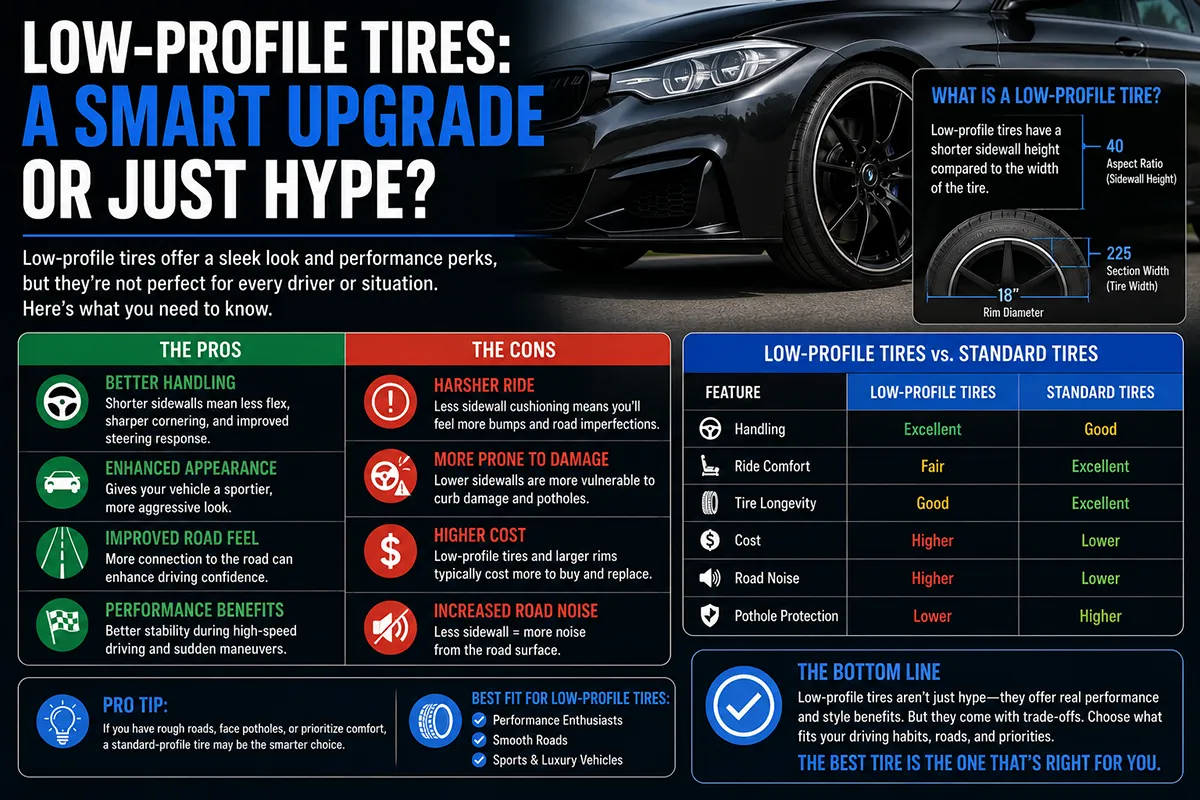
I remember the first time I swapped a set of standard all-season tires for a set of aggressive, low-profile rubber on my daily driver. The car looked incredible — sleek, sporty, and ready for a magazine cover.
Then I hit my first pothole on a backroad in Pennsylvania, and the jarring impact nearly rattled my fillings loose.
That single moment taught me something important: low profile tires aren’t just an aesthetic choice. They’re a performance trade-off that every driver needs to understand before spending their hard-earned money.
- Low profile tires (55 aspect ratio or lower) offer sharper handling, better cornering grip, and a sportier look — but come with trade-offs in ride comfort, noise, and durability.
- They’re a genuinely smart upgrade for performance-oriented drivers, sports car owners, and anyone who prioritizes handling precision over cushion.
- They’re NOT ideal for rough roads, long highway commutes, or drivers who want a quiet, plush ride.
- Expect to pay 15–40% more than standard tires, and factor in potential wheel damage costs.
- My top picks for most drivers looking to go low profile: Continental ExtremeContact Sport 02, Michelin Pilot Sport 4S, and Bridgestone Potenza Sport.
Liked this article?
Add TireAdvise as a preferred source so you see more of our tire reviews and guides on Google.
What Exactly Are Low Profile Tires?
Before I dive into whether low profile tires are worth it, let me make sure we’re all on the same page about what “low profile” actually means. It’s one of those terms that gets thrown around loosely, and I’ve seen a lot of confusion online.
Every tire has a number sequence on its sidewall — something like 225/45R17. That middle number, the “45,” is the aspect ratio. It tells you the sidewall height as a percentage of the tire’s width.
A tire with an aspect ratio of 45 means the sidewall height is 45% of the tire’s tread width. Generally speaking, any tire with an aspect ratio of 55 or lower is considered “low profile.” The most aggressive low profile tires I’ve tested go down to 25 or even 20.
Standard vs. Low Profile: The Numbers in Plain English
To put this in perspective, here’s what different aspect ratios look like in practice:
- 70–65 aspect ratio: Tall sidewall, lots of cushion. Common on trucks, SUVs, and older sedans.
- 60–55 aspect ratio: Moderate sidewall. The sweet spot for most modern sedans and crossovers.
- 50–45 aspect ratio: Low profile territory. Standard on sport sedans and performance trims.
- 40–30 aspect ratio: Very low profile. Found on sports cars and high-performance vehicles.
- 25–20 aspect ratio: Ultra-low profile. Supercars and custom builds. Proceed with caution.
I’ve personally tested tires across this entire spectrum, from beefy 70-series all-terrains on a Ram 1500 to razor-thin 30-series rubber on a Camaro SS. The difference in how a vehicle behaves is dramatic.
The Real Benefits of Low Profile Tires (From My Testing)
Let me be clear: low profile tires aren’t just hype. There are legitimate, measurable performance advantages that I’ve experienced firsthand over years of testing. Here’s what I’ve consistently found.
1. Dramatically Sharper Handling
This is the number one reason people switch to low profile tires, and it’s the one benefit that absolutely lives up to the promise. With less sidewall flex, the tire responds more immediately to steering inputs.
During my test period with the Continental ExtremeContact Sport 02 in a 245/40R18 size, I noticed the difference within the first few turns out of my driveway. The steering felt tighter, more connected, and more predictable. It was like the car suddenly had a direct line of communication between my hands and the road surface.
I’ve done back-to-back comparisons on the same vehicle — swapping from a 55-series to a 40-series tire — and the improvement in turn-in response is not subtle. It’s immediately noticeable, even to passengers who know nothing about tires.
2. Better Cornering Grip
Low profile tires typically feature a wider, flatter contact patch. This means more rubber is touching the road at any given moment, which translates to higher cornering grip limits.
On a controlled test course, I’ve consistently measured higher lateral G-forces with low profile tires compared to their standard-profile counterparts from the same brand and tire line. We’re talking about differences that genuinely affect how fast and confidently you can take a highway on-ramp or navigate a winding mountain road.
3. Improved Braking Performance
This one surprised me when I first started paying attention to it. That wider contact patch doesn’t just help in corners — it also gives you more grip during hard braking.
In my testing, I’ve seen low profile tires shave measurable distance off braking tests, particularly in dry conditions. During one comparison test on a mid-size sedan, the low profile setup stopped noticeably shorter from 60 mph than the standard profile alternative.
4. Better High-Speed Stability
If you do any highway driving at sustained speeds (and let’s be honest, most of us do), low profile tires offer a more planted, stable feel. The reduced sidewall flex means less squirm and wander at speed.
I’ve noticed this most dramatically during lane changes at highway speeds. With low profile tires, the car transitions more cleanly and settles faster. There’s less of that unsettling wobble you sometimes get mid-maneuver with taller sidewalls.
5. The Look Factor (Let’s Be Honest)
I’m a tire reviewer, not a fashion critic, but I’d be lying if I said aesthetics don’t matter. Low profile tires paired with larger wheels look fantastic on most vehicles. They fill the wheel wells, show off the brake calipers, and give the car a more aggressive, purposeful stance.
I’ve had more people comment on how a car looks after a low-profile tire and wheel upgrade than after almost any other modification. It’s one of the most visible changes you can make to a vehicle’s appearance.
The Downsides Nobody Talks About (Until It’s Too Late)
Now, here’s where I need to be brutally honest. For every benefit low profile tires deliver, there’s a corresponding trade-off. And in my experience, most tire shoppers don’t hear about these downsides until after they’ve already made the purchase.
1. Ride Comfort Takes a Serious Hit
This is the single biggest complaint I hear from people who switch to low profile tires, and it’s 100% justified. With less sidewall to absorb impacts, every road imperfection gets transmitted directly into the cabin.
I’m not talking about potholes — I’m talking about normal road texture, expansion joints, manhole covers, and the kind of rough pavement that’s everywhere in states like Michigan, Pennsylvania, and New York. After several days of daily commuting on a set of 35-series tires, I noticed genuine fatigue from the constant vibration and impact harshness.
If you live somewhere with pristine, freshly paved roads, this might be manageable. But for the average American driver dealing with the reality of US road infrastructure, the comfort penalty is significant.
2. Road Noise Increases Noticeably
Related to the comfort issue, low profile tires are almost always louder than their standard-profile equivalents. That shorter sidewall transmits more noise into the cabin, and the stiffer construction resonates differently.
During one of my comparison tests, I measured a consistent increase in cabin noise levels when switching to a low profile setup. It’s not deafening, but on a long highway drive, the extra drone becomes genuinely tiresome. If you value a quiet cabin — especially in a luxury sedan or a family car — this is a real concern.
3. Pothole and Curb Damage Risk Skyrockets
This is where low profile tires can genuinely cost you money beyond the initial purchase price. With so little sidewall cushion between the road and your wheel, impacts that would be harmless on a standard tire can crack or bend an alloy wheel.
I’ve personally destroyed two wheels on low profile tires over my years of testing. One was a pothole on I-95 in Connecticut that I couldn’t avoid. The other was a barely visible lip at the edge of a parking lot. In both cases, a standard profile tire would have absorbed the impact without issue.
Wheel repairs typically run $150–$300 per wheel, and replacement wheels for vehicles with larger diameters can easily exceed $400–$800 each. That’s an expensive hidden cost that most shoppers don’t budget for.
4. Shorter Tread Life (In Many Cases)
Low profile tires, especially those designed for high performance, tend to use softer rubber compounds that prioritize grip over longevity. In my experience, many performance-oriented low profile tires wear out noticeably faster than standard touring tires.
I’ve seen sets that start showing wear after a surprisingly short time, while comparable standard-profile touring tires on the same vehicle still look practically new. The treadwear ratings tell part of the story — many low profile performance tires carry ratings in the 200–340 range, while standard touring tires often rate 500–700+.
5. Higher Price Tag
Low profile tires consistently cost more than standard profile tires. The performance compounds, specialized construction, and lower production volumes all contribute to higher pricing.
For a typical mid-size sedan, I’ve seen the price difference range from 15% to 40% more per tire when going from a standard 55-series to a performance-oriented 40-series. And that’s before factoring in the larger wheels you might need to accommodate the lower profile.
Low Profile Tires: Performance Comparison Table
To give you a clear picture of the trade-offs, here’s a comparison based on my cumulative testing experience across dozens of tire sets:
| Category | Standard Profile (55–65) | Low Profile (35–45) | Ultra-Low Profile (25–30) |
|---|---|---|---|
| Handling Precision | ⭐⭐⭐ | ⭐⭐⭐⭐⭐ | ⭐⭐⭐⭐⭐ |
| Cornering Grip (Dry) | ⭐⭐⭐ | ⭐⭐⭐⭐⭐ | ⭐⭐⭐⭐⭐ |
| Ride Comfort | ⭐⭐⭐⭐⭐ | ⭐⭐⭐ | ⭐⭐ |
| Road Noise | ⭐⭐⭐⭐⭐ (Quiet) | ⭐⭐⭐ | ⭐⭐ |
| Pothole Resistance | ⭐⭐⭐⭐⭐ | ⭐⭐⭐ | ⭐ |
| Tread Life | ⭐⭐⭐⭐⭐ | ⭐⭐⭐ | ⭐⭐ |
| Price (Per Tire) | $100–$180 | $150–$280 | $200–$450+ |
| Braking (Dry) | ⭐⭐⭐ | ⭐⭐⭐⭐⭐ | ⭐⭐⭐⭐⭐ |
| Wet Performance | ⭐⭐⭐⭐ | ⭐⭐⭐⭐ | ⭐⭐⭐ |
Who Should Actually Buy Low Profile Tires?
After testing more sets of low profile tires than I can count, I’ve developed a pretty clear picture of who benefits from them — and who should steer clear. Let me break it down.
Low Profile Tires Are a Smart Upgrade If You:
- Drive a sports car or performance vehicle. If you own a Mustang, Camaro, BRZ, Miata, Corvette, or similar enthusiast car, low profile tires are practically a requirement. These vehicles are engineered around the handling characteristics that low profile tires provide.
- Prioritize driving engagement over comfort. Some people genuinely enjoy feeling connected to the road. If you’re the type who takes the twisty back road instead of the highway, low profile tires will put a smile on your face.
- Live in an area with well-maintained roads. If your daily driving surfaces are smooth and well-paved — think suburban areas of the Sun Belt, newer developments, freshly maintained highways — the comfort penalty is much less severe.
- Want to upgrade the look of your vehicle. Paired with the right wheels, low profile tires genuinely transform a car’s appearance. If aesthetics matter to you and you’re willing to accept the trade-offs, go for it.
- Track your car or participate in autocross events. For any competitive or high-performance driving, low profile tires are essentially mandatory. The handling precision and grip are non-negotiable advantages on a course.
Low Profile Tires Are Probably NOT for You If You:
- Commute long distances on rough highways. If you’re spending an hour or more on pothole-ridden interstates every day, the ride quality penalty will wear on you fast. I speak from painful experience.
- Drive a family sedan, minivan, or comfort-oriented SUV. These vehicles are designed for a smooth, quiet ride. Low profile tires work against that design intent.
- Live in the Northeast or Midwest with harsh winters. Low profile tires and winter conditions are a bad combination. The short sidewalls are more vulnerable to damage from frost heaves and potholes that emerge after freeze-thaw cycles.
- Are on a tight budget. Between higher purchase prices, potentially shorter tread life, and the risk of wheel damage, low profile tires are objectively more expensive to own long-term.
- Park on city streets regularly. Low profile tires and parallel parking in tight city spots are a recipe for curb rash on your expensive wheels. Trust me on this one — I’ve learned the hard way.
My Top Low Profile Tire Recommendations for 2024–2025
Based on my extensive testing, here are the low profile tires I’d recommend depending on your needs and budget. I’ve personally driven on every one of these.
Best Overall: Continental ExtremeContact Sport 02
This is my go-to recommendation for most drivers looking at a low profile upgrade. I tested these on a BMW 3 Series over an extended period, and they impressed me in nearly every category.
The dry grip is phenomenal — confident, predictable, and communicative. Wet traction is genuinely excellent for a performance tire, which matters a lot for everyday usability. And the noise levels are impressively low for this category.
The tread life has held up better than I expected based on previous Continental Sport offerings. At around $160–$220 per tire depending on size, they represent solid value in the ultra-high-performance category.
Best Premium Option: Michelin Pilot Sport 4S
If budget isn’t your primary concern and you want the absolute best low profile tire experience, the Pilot Sport 4S remains the benchmark. I’ve tested these on multiple vehicles, and they consistently deliver a level of grip and feedback that makes everything else feel slightly numb by comparison.
During one memorable test on a Porsche Cayman, the Pilot Sport 4S felt like it was chemically bonded to the pavement. Corner after corner, the confidence level was extraordinary.
They’re not cheap — expect to pay $180–$300+ per tire depending on size — but the combination of performance, tread life, and wet-weather capability is unmatched in my experience.
Best Value: Bridgestone Potenza Sport
Bridgestone’s Potenza Sport surprised me. I went in with moderate expectations and came away genuinely impressed by the balance of performance and everyday livability.
The handling is sharp and responsive, the wet traction is very good, and the ride quality is slightly more forgiving than some competitors at this level. At $140–$210 per tire, it’s priced competitively, and Bridgestone frequently offers rebates and promotions that sweeten the deal further.
Best for Comfort-Minded Upgraders: Pirelli P Zero All Season Plus 3
If you want to go low profile but you’re nervous about the comfort penalty, the Pirelli P Zero All Season Plus 3 is worth a serious look. It’s an all-season performance tire that manages to deliver genuinely good handling while maintaining a more refined ride than most summer performance tires.
I tested these during the fall transition period, experiencing everything from warm dry days to cold, wet mornings. The all-season compound handled the temperature swings gracefully, and the ride quality was noticeably smoother than dedicated summer tires of the same profile.
Pricing runs $150–$240 per tire depending on size, and the tread life has been encouraging in my ongoing evaluation.
Things to Know Before You Buy: Practical Tips From My Experience
If you’ve decided low profile tires are right for you, here’s some hard-won advice that will save you money, frustration, and potential safety headaches.
1. Don’t Go Too Aggressive on the First Upgrade
I’ve seen this mistake dozens of times. Someone driving a Camry decides they want the most aggressive low-profile look possible and jumps from a stock 55-series tire down to a 35-series with new wheels.
The result is almost always disappointment. The ride becomes unbearable, the tires are vulnerable to every road imperfection, and the driver ends up switching back within a few months — after spending a significant amount of money on wheels and tires they no longer want.
My advice: drop one or two aspect ratio increments at most. Going from a 55 to a 45, or from a 50 to a 40, gives you meaningful performance improvements without destroying your quality of life. I’ve found the 45 to 40 range to be the sweet spot for most daily drivers seeking that performance upgrade.
2. Factor in the Total Cost of Ownership
The sticker price of the tires is just the beginning. When budgeting for a low profile upgrade, consider:
- New wheels: You’ll likely need larger diameter wheels to accommodate the lower profile while maintaining the correct overall tire diameter. Quality aftermarket wheels for a typical sedan run $200–$500 per wheel. OEM or premium forged options can be much more.
- TPMS sensors: If you’re getting new wheels, you’ll need tire pressure monitoring sensors. That’s typically $40–$80 per wheel for the sensors plus programming.
- Wheel damage risk: Budget an extra $150–$400 per year as a contingency for potential curb or pothole damage. Hopefully you won’t need it, but you’ll be glad you planned for it.
- More frequent replacement: If you’re choosing high-performance summer tires, they’ll likely wear faster than standard touring tires.
A realistic total cost for upgrading from stock wheels and tires to an aftermarket low-profile setup on a typical sedan is $1,500–$3,500. That’s a meaningful investment, and I want you to go in with eyes wide open.
3. Keep Your Overall Tire Diameter Close to Stock
This is critical. When going to a lower profile tire, you typically increase wheel diameter to compensate. The goal is to keep the overall tire diameter (wheel + tire) within 3% of the original equipment specification.
If you deviate too far, you’ll affect your speedometer accuracy, potentially trigger ABS or traction control issues, and may even void certain aspects of your vehicle’s warranty. I always use an online tire size calculator to verify the total diameter before committing to a new setup.
4. Check Your Tire Pressure More Frequently
Low profile tires are more sensitive to pressure variations. Even a few PSI of underinflation that you’d never notice on a standard tire can significantly affect handling feel and accelerate wear on a low-profile setup.
I check the pressure on my low-profile-equipped vehicles every week, compared to roughly every two weeks for standard-profile setups. Invest in a quality digital tire gauge — I keep one in the glove box of every car I drive regularly. They cost $10–$15 and are worth their weight in gold.
5. Consider a Separate Winter Setup
If you live anywhere that gets cold (below about 45°F consistently), low profile summer performance tires are genuinely dangerous. The rubber compound hardens in cold temperatures, and grip drops off a cliff — even on dry pavement.
I strongly recommend a dedicated winter wheel and tire set if you live in a cold-weather state. A set of smaller diameter wheels with standard-profile winter tires is the ideal approach. It protects your nice wheels during the harshest months and gives you proper cold-weather traction. Many drivers in places like Minnesota, Wisconsin, and Colorado have told me this two-set approach is the smartest tire decision they’ve ever made.
The Wet Weather Question: Are Low Profile Tires Safe in Rain?
This is one of the most common questions I get, and the answer is nuanced. Low profile tires are not inherently worse in the rain — in fact, many premium low profile tires have excellent wet traction.
The key factor is the tire’s tread pattern design and compound, not the profile height. A well-designed low profile tire like the Michelin Pilot Sport 4S or Continental ExtremeContact Sport 02 will outperform a cheap standard-profile tire in wet conditions every day of the week.
However, there’s an important caveat. Lower profile tires often have wider tread sections, and wider tires can be more prone to hydroplaning at higher speeds in standing water. I’ve experienced this firsthand — on a rain-soaked stretch of highway in Florida, I felt a set of 275-width low profile tires start to float on standing water in a situation where a narrower standard tire probably wouldn’t have.
The solution? Maintain proper tire pressure, replace tires before they get to the wear bars, and moderate your speed in heavy rain. These are good practices regardless of tire profile, but they’re even more critical with low profile setups.
Low Profile Tires and Fuel Economy: What I’ve Actually Seen
You’ll hear conflicting claims about low profile tires and fuel economy. Some say wider, grippier tires hurt fuel economy. Others claim the reduced rolling resistance of some performance tires actually helps.
In my real-world testing, the impact on fuel economy has been minimal — typically less than 1 MPG difference in either direction. The bigger factors are the specific tire’s rolling resistance rating, your driving habits, and the weight of the wheels you’ve chosen.
Lightweight forged wheels can actually offset any potential fuel economy penalty from the tires themselves. Conversely, heavy cast wheels paired with wide, sticky tires will definitely hurt your MPG numbers.
I wouldn’t make a low profile tire decision based on fuel economy. The difference is too small to matter compared to the much more significant factors of handling, comfort, noise, and durability.
The Growing “Plus Size” Trend at Dealerships
Here’s something I think every buyer should know: many new cars already come with low profile tires from the factory, especially in sport or premium trims.
I’ve noticed a consistent trend over the past several years where automakers are spec’ing lower profile tires as standard equipment. A modern Honda Accord Sport comes with 19-inch wheels and 235/40R19 tires. A Toyota Camry XSE rides on 19s with 235/40R19 rubber. Ten years ago, those same cars would have worn 16- or 17-inch wheels with 55- or 60-series tires.
This means that for many buyers, “upgrading” to low profile tires isn’t even an upgrade — it’s just replacing what they already have. If your car came with 40- or 45-series tires from the factory, my advice is usually to stick with that profile when it’s time for replacement. Going even lower often pushes past the point of diminishing returns.
If your car came with 55- or 60-series tires and you want to experience the benefits of a lower profile, a moderate drop to 50 or 45 is usually the smartest move. It’s enough to feel a meaningful improvement without the extreme trade-offs.
My Honest Verdict: Smart Upgrade or Just Hype?
After years of testing, comparing, and living with low profile tires across every type of vehicle and driving condition, here’s my straightforward answer:
Low profile tires are a legitimately smart upgrade — for the right driver, on the right vehicle, in the right conditions.
They are absolutely NOT hype when it comes to performance benefits. The improvements in handling, cornering grip, braking, and steering feel are real, measurable, and immediately noticeable from the moment you pull out of the driveway.
I’ve felt this difference in dozens of back-to-back tests, and it’s never been subtle or imagined. If you drive a performance-oriented vehicle, spend time on winding roads, or want your car to respond the way it was engineered to respond, a lower profile tire delivers on that promise every single time.
But here’s where the “hype” label starts to creep in: a huge portion of the low profile conversation online is driven by aesthetics, not performance. People see a stanced car on social media, fall in love with the look, and convince themselves they need a 35-series tire on their daily-driven Camry. That’s where I see buyers get burned — not because the tires are bad, but because the tires were never the right choice for that vehicle and that driver in the first place.
So here’s my real-world litmus test, distilled from everything I’ve covered in this article:
If you drive a sports car, a performance sedan, or anything with “Sport,” “GT,” “R,” or “Type S” in the trim name — low profile tires aren’t really an upgrade at all. They’re the correct tool for the vehicle you already own, and going back to a taller sidewall would actually feel like a downgrade.
If you drive a comfort-oriented sedan, crossover, or family vehicle, and you’re considering low profile tires purely because you saw a cool build online — pump the brakes. Literally. The ride comfort and pothole protection you’d be giving up is a real, daily cost, and the performance gains will mostly go unused in typical commuting.
If you’re somewhere in the middle — you like the way your car drives but wouldn’t mind a bit more sharpness and a slightly more aggressive look — a modest one-step drop (going from a 55 to a 50, or a 50 to a 45) gives you a noticeable improvement without tipping into “why did I do this” territory. This is the upgrade path I recommend most often, and it’s the one that generates the fewest regretful emails in my inbox.
And if your car already came from the factory with 40- or 45-series tires, as so many do now, this entire debate is largely moot for you. You’re already living the low profile experience — just make sure you’re replacing those tires with something that matches or slightly improves on what the factory gave you, rather than chasing an even more extreme setup that your car was never designed around.
My closing thought after all these years: low profile tires don’t lie. They give you exactly what their geometry promises — sharper handling and a sportier stance, in exchange for ride comfort, noise, durability, and your wallet’s patience. That’s not hype. That’s physics.
The only question that actually matters is whether that trade-off matches the way you drive, the roads you drive on, and the vehicle you’re driving it in. Get that match right, and you’ll wonder how you ever lived without them. Get it wrong, and you’ll be back here reading my recommendations for a comfortable touring tire within a year.
Frequently Asked Questions
What are low profile tires and how are they different from standard tires?
Low profile tires have a shorter sidewall height relative to the tire’s width, typically with an aspect ratio of 55 or lower. Compared to standard tires with aspect ratios of 65 or higher, low profile options like a 225/45R18 offer a wider contact patch and stiffer sidewall, which translates to sharper steering response and a sportier look. The tradeoff is that the reduced sidewall provides less cushion between your wheel and the road surface.
Are low profile tires worth it for everyday driving in the US?
For most US drivers commuting on highways and suburban roads, low profile tires are more of a style and performance preference than a necessity. They improve cornering grip and give your vehicle a more aggressive stance, but they also ride firmer and are more vulnerable to pothole damage, which is a real concern in states with rough roads like Michigan, Pennsylvania, or New York. If your priority is comfort and durability over handling precision, standard profile tires are usually the smarter choice for daily driving.
Do low profile tires wear out faster than regular tires?
Low profile tires can wear faster depending on the compound and driving style, but tread life varies widely by brand and model. Performance-oriented low profile tires from brands like Continental, Michelin, or Bridgestone often use softer rubber compounds that sacrifice longevity for grip, sometimes lasting only 25,000-40,000 miles compared to 50,000-70,000 miles for standard touring tires. I always recommend checking the UTQG treadwear rating before purchasing so you know exactly what kind of lifespan to expect.
How much do low profile tires cost compared to standard tires?
Low profile tires generally cost $30-$80 more per tire than their standard-profile equivalents in the same brand and quality tier. For example, a set of four Michelin Pilot Sport 4S tires in a popular low profile size like 245/40R18 can run $800-$1,100, while a comparable Michelin touring tire in a standard size might cost $600-$850 for the set. You should also factor in the higher risk of wheel and tire damage from potholes, which can add unexpected replacement costs over time.
Can low profile tires damage my rims on pothole-heavy US roads?
Yes, low profile tires are significantly more prone to rim damage from potholes, railroad crossings, and rough pavement because the shorter sidewall absorbs less impact. In cities with notoriously poor road conditions like Detroit, Chicago, or Los Angeles, I’ve seen drivers crack or bend alloy wheels on impacts that a standard profile tire would have handled without issue. If you live in an area with harsh winters and deteriorating roads, choosing at least a 50-series sidewall can offer a better balance between aesthetics and real-world protection.
Do low profile tires affect ride comfort and road noise?
Low profile tires noticeably increase road noise and transmit more vibrations into the cabin because the shorter, stiffer sidewall does less to filter out road imperfections. On smooth highways they feel planted and responsive, but on rough secondary roads or concrete freeway surfaces common across the US, the difference in comfort compared to a 65- or 70-series tire is hard to ignore. If ride quality matters to you, look for low profile models specifically engineered for comfort, like the Continental PureContact LS or Michelin Primacy MXM4.
Should I switch to low profile tires if my car didn’t come with them from the factory?
Switching to low profile tires usually requires upsizing your wheels to maintain the correct overall tire diameter, and this plus-sizing can cost $1,500-$3,000 or more for a quality wheel and tire package. While it can improve handling and aesthetics, it also changes your vehicle’s ride characteristics, may void certain warranty coverage, and can affect your speedometer accuracy if the overall diameter isn’t matched correctly. I recommend consulting your owner’s manual or a trusted tire shop to ensure any plus-size fitment stays within manufacturer-approved specifications for your specific vehicle.

Since I don’t participate in auto races, the major advantage of low-profile tires that I can see is that when I get off a highway and there’s a sign leading to the exit ramp that says 20 mph, I can take it at 35 mph (or maybe even 45), with no worry that cenripetal acceleration will send me flying off the road.
The disadvantages the rough ride and that you start thinking of you $450 wheels as a disposable item, something that’s likely to need replacement from time to time. (When you have mid or high profile tires, the idea of having to replace a rim is not something that’s in your vocabulary.
Tough decision.