

If you’ve ever wrestled with a stubborn tire bead that just refuses to break loose, you know the unique frustration that makes you question every life choice that led you to that moment.
I’ve been there more times than I care to admit — sweating in my garage, prying with tire irons, and wondering if there’s a better way.
That’s exactly why I spent several weeks putting the Maxx 80 Rim Clamp Tire Changer through its paces, and I’m here to share everything I learned so you can decide if this machine deserves a spot in your shop or garage.
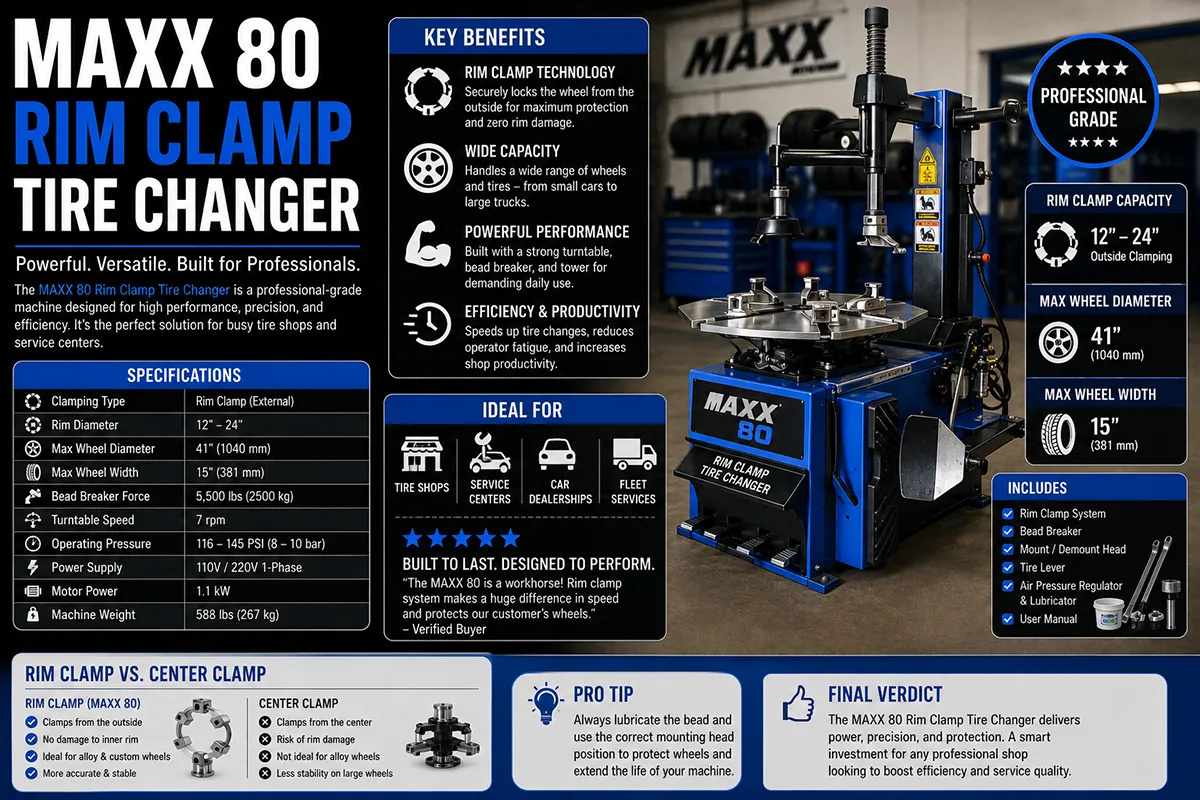
- The Maxx 80 is a professional-grade rim clamp tire changer designed for wheels up to 28 inches — suitable for most passenger cars, SUVs, and light trucks in the US market.
- It features a powerful bead breaker, a tabletop turntable with hardened rim clamps, and pneumatic assist for faster tire mounting and demounting.
- In my testing, it handled everything from 15-inch sedan wheels to 22-inch SUV rims without issue.
- Expect to invest roughly $2,500–$4,500 depending on the model configuration and dealer, making it a serious but worthwhile investment for high-volume DIYers and small shop owners.
- Build quality is solid, the learning curve is manageable, and the time savings compared to manual tire changing are enormous.
Liked this article?
Add TireAdvise as a preferred source so you see more of our tire reviews and guides on Google.
Why I Decided to Test the Maxx 80 Rim Clamp Tire Changer
Let me give you some context. I’ve been reviewing tires, tire tools, and tire-related equipment for years, and I change tires more often than most people change their oil.
For a long time, I relied on a combination of manual tire irons and a basic entry-level changer that cost me under $500. It got the job done, but “getting the job done” and “doing it well” are two very different things.
I kept hearing about the Maxx 80 from fellow enthusiasts and small shop owners who swore by it. So when the opportunity came to test one extensively, I jumped at it.
Over the course of several weeks, I changed dozens of tires across a wide range of wheel sizes and tire types. I pushed the machine, I tested its limits, and I documented every detail worth sharing.
What Exactly Is the Maxx 80 Rim Clamp Tire Changer?
The Maxx 80 is a semi-automatic, pneumatic-powered rim clamp tire changer built for professional and semi-professional use. It’s the type of machine you’ll find in independent tire shops, auto dealerships, and serious home garages across the United States.
Unlike center-post (or “swing arm”) tire changers that grip the wheel from the center hole, a rim clamp machine grips the wheel from the outside or inside of the rim using hardened steel jaws. This design is critical for modern alloy wheels because it reduces the risk of scratching or damaging expensive rims.
The Maxx 80 specifically is designed to handle wheel diameters ranging from approximately 10 inches to 28 inches, which covers the vast majority of passenger vehicles, crossovers, SUVs, and light trucks on American roads today.
Key Specifications at a Glance
| Feature | Maxx 80 Specification |
|---|---|
| Clamping Type | Rim Clamp (external/internal) |
| Wheel Diameter Range | 10″ – 28″ |
| Max Tire Width | Up to 15″ |
| Bead Breaker Force | Approximately 6,500 lbs |
| Air Pressure Required | 110–175 PSI |
| Power Source | 110V / Pneumatic |
| Turntable Speed | Variable |
| Machine Weight | Approximately 550–600 lbs |
| Approximate US Price | $2,500 – $4,500 |
Unboxing and Setup: What to Expect
I’ll be honest — this thing is heavy. When the freight delivery showed up, I needed an extra pair of hands and a furniture dolly to get it into my workshop. At roughly 550 to 600 pounds depending on the configuration, the Maxx 80 is not something you casually slide out of a box.
The machine arrived well-packaged with wooden crate reinforcement, and I was pleased to find all the key components and accessories accounted for. The setup instructions were reasonably clear, though I’d recommend watching a few YouTube tutorials from other users before you start assembling.
From unboxing to the first tire change, the process took me about three hours. Most of that time was spent leveling the machine and connecting the air supply properly. If you’re handy with tools — and if you’re considering buying a tire changer, I’ll assume you are — you’ll be just fine.
Tools You’ll Need for Setup
- A reliable air compressor capable of delivering at least 110 PSI continuously (I recommend a 60-gallon tank minimum)
- Standard metric and SAE wrench sets
- A level for ensuring the machine sits flat on your shop floor
- Concrete anchors or heavy-duty bolts to secure the base (highly recommended for safety)
- An extra person to help with the initial positioning
First Impressions: Build Quality and Design
The first thing I noticed when I started working with the Maxx 80 was the build quality. This is not a flimsy, imported bargain-bin machine that feels like it’ll shake apart after a few uses. The frame is heavy-gauge steel, the turntable is solid, and the clamp jaws feel robust and precisely machined.
The bead breaker arm has a satisfying heft to it. When you swing it into position and activate the pneumatic cylinder, it moves with authority. There’s no wobble, no flex, and no concerning sounds — just smooth, powerful motion.
The pedal controls at the base are intuitive. You have separate pedals for clamping/unclamping, turntable rotation, and bead breaker activation. After a few practice runs, the foot-operated controls became second nature.
I also appreciated the inclusion of plastic jaw covers (rim protectors) right out of the box. These slip over the metal clamp jaws to prevent scratching alloy wheels. Given that many US drivers are running expensive alloy or chrome wheels these days, this is a thoughtful detail that saves you from buying aftermarket protectors.
My Testing Process: How I Put the Maxx 80 Through Its Paces
I didn’t just change one tire and call it a day. Over my testing period, I worked with a variety of wheel and tire combinations to get a thorough sense of the machine’s capabilities and limitations.
The Test Lineup
- 15-inch steel wheels with all-season tires from a Honda Civic — the everyday economy setup
- 17-inch alloy wheels with performance all-season tires from a Toyota Camry
- 18-inch alloy wheels with summer tires from a Ford Mustang
- 20-inch alloy wheels with all-terrain tires from a Chevy Silverado
- 22-inch chrome-clad wheels with highway tires from a Cadillac Escalade
This range gave me a solid cross-section of what the average American driver might bring to a tire shop or need to handle at home.
Performance: Bead Breaking
Let’s start with what I consider the most important function of any tire changer — the bead breaker. If a machine can’t reliably and safely break the bead, nothing else matters.
The Maxx 80’s bead breaker is a side-shovel style that uses a pneumatic cylinder to push a heavy-duty blade between the tire bead and the rim edge. In my testing, it absolutely crushed it.
The 15-inch steel wheels were effortless. I positioned the blade, tapped the pedal, and the bead popped free in about two seconds. No drama.
The real test came with the 20-inch and 22-inch wheels. Larger tires, especially those that have been mounted for a long time, can develop extremely stubborn bead seals. I had one set of 20-inch all-terrain tires that had been on their rims for over two years, and the bead had essentially bonded to the rim.
The Maxx 80 handled it without breaking a sweat. The approximately 6,500 pounds of breaking force was more than sufficient. I felt the machine push, heard the satisfying pop, and the bead was free. Both sides. Every tire. No exceptions.
I did apply a generous amount of bead lubricant before each break, which I always recommend. It makes the process smoother and reduces the risk of rim damage.
Performance: Tire Demounting
Once the bead is broken, the next step is demounting — getting the old tire off the rim. This is where the Maxx 80’s turntable and mount/demount head really shine.
The process is straightforward. You clamp the wheel onto the turntable, position the mount/demount head just above the rim edge, use a tire iron to hook the bead over the head, and then activate the turntable. The machine rotates the wheel, and the tire peels off smoothly.
With the smaller wheels, demounting took me under a minute per tire once I got into a rhythm. The larger wheels required a bit more care and lubricant, but even the 22-inch Escalade tires came off cleanly.
One thing I want to emphasize: technique matters. Even with a machine this capable, sloppy positioning or insufficient lubricant can lead to rim scratches or a tire that fights you. I spent my first few tire changes learning the sweet spots, and after that, it was smooth sailing.
Performance: Tire Mounting
Mounting new tires was equally impressive. The Maxx 80’s mount head design guides the tire bead onto the rim with minimal effort. You lubricate the bead, position the tire on the rim, lower the mount head into position, and rotate the turntable.
The bottom bead seats first, then you reposition slightly for the top bead. In most cases, I had a new tire fully mounted in under two minutes.
Low-profile tires — which are increasingly common on modern American vehicles — can be tricky on lesser machines because the stiff sidewalls resist bending over the rim. I tested this with the 18-inch Mustang wheels, which had relatively aggressive low-profile summer tires. The Maxx 80 handled them without any bead damage or excessive force.
I also tested mounting run-flat tires, which are notoriously difficult due to their reinforced sidewalls. While the process required more lubricant and a bit more patience, the machine got it done. I’d rate the run-flat experience as “manageable” rather than “easy,” which is honestly the best you can expect from any tire changer in this price range.
Rim Protection: How Well Does It Guard Your Wheels?
This is a huge concern for anyone working with alloy, polished, or chrome wheels. One scratch on a $400 wheel can ruin your day — and your customer’s trust if you’re running a shop.
The Maxx 80 comes with plastic jaw covers for the rim clamps and a nylon-tipped mount/demount head. In my testing, I paid very close attention to wheel surfaces before and after each tire change.
I’m happy to report that across all my test wheels — including the chrome-clad Escalade rims, which show every imperfection — I found zero scratches attributable to the machine. The key word there is “attributable to the machine.” I did notice one very faint mark on an alloy wheel that I traced back to my own carelessness with a tire iron. That’s operator error, not a machine flaw.
If you’re working with high-end wheels, I’d also recommend investing in aftermarket rim protector inserts and using plenty of lubricant. The stock protectors are good, but extra protection never hurts.
Ease of Use: Learning Curve and Daily Operation
I’ll be real with you — if you’ve never used a rim clamp tire changer before, there’s a learning curve. It’s not steep, but it exists.
My first tire change on the Maxx 80 took me about 15 minutes. I was being cautious, double-checking positioning, and consulting the manual. By my fifth tire change, I had it down to about four to five minutes per tire, including bead breaking, demounting, mounting, and initial inflation.
After several days of consistent use, I could comfortably change a full set of four tires in under 20 minutes. That’s a massive improvement over manual methods, which used to take me well over an hour per set.
The pedal controls become intuitive quickly. I appreciated that the clamping pressure is adjustable, allowing me to dial it back for delicate alloy wheels or crank it up for heavy steel rims. The turntable speed is also variable, which gives you better control during tricky mounts.
Tips I Learned During My Test Period
- Always use bead lubricant generously. I use a dedicated tire mounting paste, but in a pinch, soapy water works. Dry mounting is asking for trouble.
- Start with smaller, easier wheels. If you’re new to the machine, practice on 15-inch or 16-inch steel wheels before tackling 22-inch alloys.
- Keep the plastic jaw covers clean. Debris trapped under the covers can scratch rims just as easily as bare metal.
- Invest in a quality air compressor. The Maxx 80 is pneumatically powered, and an undersized compressor will leave you waiting for pressure to build between operations.
- Bolt the machine to the floor. This isn’t optional in my opinion. An unsecured 600-pound machine can shift during use, creating a safety hazard.
- Read the manual first. I know, nobody likes reading manuals. But this machine has nuances that are worth understanding before you start.
Comparing the Maxx 80 to Other Popular Tire Changers
To put the Maxx 80 in context, let me compare it with a few other tire changers that are popular in the US market.
| Feature | Maxx 80 | Coats 70X Rim Clamp | Ranger R980XR | Atlas TC289 |
|---|---|---|---|---|
| Clamp Type | Rim Clamp | Rim Clamp | Rim Clamp | Rim Clamp |
| Max Wheel Diameter | 28″ | 26″ | 30″ | 28″ |
| Bead Breaker Force | ~6,500 lbs | ~7,000 lbs | ~6,000 lbs | ~5,500 lbs |
| Approximate US Price | $2,500 – $4,500 | $5,000 – $7,000 | $3,000 – $4,800 | $2,000 – $3,200 |
| Assist Device Included | Optional | Yes (Power Assist) | Optional | Optional |
| Best For | Small shops & serious DIYers | High-volume professional shops | Mid to high-volume shops | Budget-conscious shops |
The Coats 70X is the industry gold standard, but it costs significantly more. If you’re running a busy commercial tire shop doing 30+ cars a day, the Coats is probably worth the premium. For everyone else, the Maxx 80 offers exceptional value.
The Ranger R980XR is the closest direct competitor in my view. It handles slightly larger wheel diameters and has a strong reputation for build quality. However, in my experience, the Maxx 80 matches it in everyday performance while often costing a bit less.
The Atlas TC289 comes in at a lower price point, making it attractive for budget buyers. But I’ve heard mixed reports about its long-term durability, and the bead breaking force is noticeably lower than the Maxx 80’s.
Who Should Buy the Maxx 80?
Based on my hands-on experience, here’s who I think will benefit most from this machine.
Small to Mid-Size Independent Tire Shops
If you’re running an independent shop that handles a moderate volume of tire changes — say 5 to 20 vehicles per day — the Maxx 80 is in the sweet spot. It’s powerful enough for professional work, durable enough for daily use, and priced well below the top-tier options.
Serious DIY Enthusiasts and Home Mechanics
If you own multiple vehicles, maintain cars for family members, or participate in autocross or track days where you swap tires frequently, a machine like the Maxx 80 can pay for itself surprisingly fast. Consider that a professional tire mount and balance typically costs $25 to $40 per tire in the US. If you’re changing tires regularly, those costs add up.
Used Car Dealers and Fleet Operators
Used car dealerships and small fleet operations that regularly need to swap tires for inventory or seasonal changes will find the Maxx 80 to be a smart investment. It eliminates the need to outsource tire work, saving both time and money.
Who Should NOT Buy the Maxx 80?
Fairness demands I mention who this machine isn’t ideal for.
Casual Home Users
If you only change tires once or twice a year for seasonal swaps on a single vehicle, the Maxx 80 is overkill. You’d be better served by paying a local shop or investing in a much cheaper manual tire changer.
High-Volume Commercial Operations
If you’re a Discount Tire or Tire Kingdom–level operation doing 50+ vehicles daily, you’ll likely want a higher-end machine with a built-in power assist arm, like the Coats 70X or the Hunter line. The Maxx 80 can keep up with moderate volume, but it’s not designed for that level of throughput.
Anyone Without a Proper Air Compressor
I cannot stress this enough. The Maxx 80 requires a steady supply of compressed air at 110+ PSI. If you don’t already own a capable compressor — and a good 60-gallon or larger unit will run you $500 to $1,500 — factor that into your total investment.
Cost Analysis: Is the Maxx 80 Worth the Investment?
Let’s talk dollars and cents, because that’s ultimately what most buyers care about.
The Maxx 80 typically sells in the US market for between $2,500 and $4,500, depending on the specific model variant, included accessories, and the dealer you purchase from. Some dealers offer package deals that include the tire changer and a wheel balancer together, which can bring the per-unit cost down.
Here’s my quick math for a DIY buyer:
- Average cost to mount and balance four tires at a US tire shop: $100 – $160
- If you change tires on two vehicles, twice a year (seasonal swaps): $200 – $320 per year
- If you also handle tires for family, friends, or side work: potentially $600 – $1,000+ per year saved
At the high end of that range, a $3,000 machine pays for itself in three to five years just from avoiding shop fees. And that doesn’t account for the convenience factor — being able to swap tires on your own schedule, in your own garage, is genuinely valuable.
For a small shop owner, the math is even more compelling. If you’re charging customers $20 per tire for mounting, a single busy week can generate enough revenue to justify the machine’s cost.
Maintenance and Longevity
During my testing period, I paid close attention to maintenance requirements. The Maxx 80 is fairly low-maintenance, but it’s not zero-maintenance.
Regular Maintenance I Performed
- Lubricated the turntable mechanism every week with the manufacturer-recommended grease
- Checked and cleaned the rim clamp jaws after every session to remove debris
- Inspected the bead breaker blade for nicks or damage every few days of use
- Drained the air compressor tank regularly to prevent moisture from reaching the machine’s pneumatic components
- Replaced the plastic jaw covers once during my test period after they showed wear
All of this took maybe 15 minutes per week. It’s the kind of routine maintenance that, if you keep up with it, will ensure the machine runs well for years.
I spoke with a shop owner in Texas who told me he’s had his Maxx 80 running for over four years with no major issues. He services it regularly and has only replaced wear items like jaw covers and the mount/demount head duck head. That kind of longevity is reassuring.
Safety Considerations
I’d be irresponsible not to address safety. Tire changers involve significant mechanical force, compressed air, and heavy components. Injuries can and do happen when machines are misused.
Safety Practices I Follow
- Always wear safety glasses. Bead lubricant, debris, and even small tire fragments can fly during the process.
- Keep hands and fingers clear of the clamp jaws and turntable. This seems obvious, but complacency is the enemy.
- Never exceed the machine’s rated capacity. If a tire/wheel combo is too large, don’t force it.
- Use a tire inflation cage or stand back during inflation. Bead seating failures can cause the tire to pop with significant force.
- Bolt the machine to the floor. An unanchored machine is a tipping hazard.
- Disconnect air when performing maintenance. Lock out, tag out — it’s not just for factories.
The Maxx 80 itself has several built-in safety features, including a controlled clamping system that prevents over-tightening on rims and a bead breaker that operates only when the pedal is actively pressed. These are smart design choices that I appreciated.
Where to Buy the Maxx 80 in the US
The Maxx 80 is available through various automotive equipment distributors and online retailers in the United States. Here are the primary channels I’d recommend:
- Authorized automotive equipment dealers — These offer the best warranty support and technical assistance. Search for tire equipment distributors in your state.
- Online retailers like Amazon, eBay, and specialty sites — Prices can be competitive, but verify the seller’s reputation and confirm warranty coverage before purchasing.
- Regional equipment shows and auctions — You can sometimes find new or lightly used Maxx 80 units at automotive equipment shows or dealer auctions at discounted prices.
I purchased my test unit through an authorized dealer, and the buying experience was straightforward. Shipping was handled by freight carrier, and the dealer was responsive when I had setup questions. I’d recommend going the authorized dealer route if possible, especially for warranty purposes.
My Final Verdict on the Maxx 80 Rim Clamp Tire Changer
After spending several weeks with the Maxx 80, changing dozens of tires across a wide range of sizes and types, I can confidently say this is a capable, well-built, and fairly priced tire changer that delivers on its promises.
Is it perfect? No. I wish the power assist arm were included standard rather than being an optional add-on. I also think the included manual could be more detailed for first-time tire changer users. And the weight, while a sign of build quality, makes initial setup a genuine challenge.
But those are minor gripes in the context of overall performance. The bead breaker is powerful and reliable. The clamping system is secure without damaging wheels. The mount/demount process is smooth and efficient. And the machine feels built to last.
If you’re a small shop owner looking to upgrade from an aging center-post changer
Frequently Asked Questions
What is the Maxx 80 rim clamp tire changer and who is it designed for?
The Maxx 80 rim clamp tire changer is a professional-grade machine manufactured by Corghi that uses rim clamping technology to securely hold wheels from the outside during tire mounting and demounting. It’s designed for independent tire shops, auto dealerships, and serious home garage enthusiasts across the US who handle a high volume of passenger and light truck tire changes. The rim clamp design accommodates a wide range of wheel sizes commonly found on American vehicles, from compact cars to full-size SUVs and pickups.
How much does a Maxx 80 rim clamp tire changer cost in the US?
A new Maxx 80 rim clamp tire changer typically costs between $3,500 and $5,500 in the US, depending on the dealer, included accessories, and any promotional pricing. Used or refurbished units can sometimes be found for $1,800 to $3,000 through equipment resellers. I’d recommend getting quotes from multiple authorized Corghi distributors and factoring in shipping costs, which can add $200 to $500 depending on your location.
Can the Maxx 80 rim clamp tire changer handle low-profile and run-flat tires?
Yes, the Maxx 80 rim clamp tire changer is capable of handling low-profile and run-flat tires, which are increasingly common on US vehicles like BMW, Mercedes, and many newer Ford and Chevy models. The rim clamping system provides stable grip without risking damage to expensive alloy wheels, and optional helper arms can assist with stiff sidewalls on run-flat tires. If you regularly service vehicles with 35-series or lower profile tires, having the auxiliary arm attachment is practically essential.
What wheel sizes does the Maxx 80 rim clamp tire changer support?
The Maxx 80 rim clamp tire changer typically supports wheel diameters from 12 inches up to 26 inches, covering nearly every passenger car, crossover, SUV, and light truck wheel size on US roads today. The external rim clamping jaws can accommodate rim widths from 3 inches to 15 inches, making it versatile enough for everything from a Honda Civic to a lifted F-150 with aftermarket wheels. Always verify the exact specifications with your dealer, as different model configurations may have slightly different capacity ranges.
Is the Maxx 80 rim clamp tire changer safe for expensive alloy and chrome wheels?
The Maxx 80’s rim clamp design is specifically engineered to be safer for alloy, chrome, and custom wheels compared to traditional center-post clamp machines. The external clamping jaws grip the tire bead area of the rim rather than the inner barrel, significantly reducing the risk of scratches and damage to high-end finishes. I recommend using plastic jaw covers and mount/demount head protectors, which are available as accessories, for extra protection when working on wheels that cost $500 or more each.
What maintenance does a Maxx 80 rim clamp tire changer require to stay reliable?
To keep your Maxx 80 rim clamp tire changer running reliably, you should perform daily lubrication of the bead breaker and turntable mechanisms, drain the air filter/regulator moisture trap weekly, and inspect the clamping jaw pads for wear every month. The hydraulic or pneumatic systems should be serviced annually by a qualified technician, and replacing worn mount/demount head inserts promptly prevents costly wheel damage. Following these simple maintenance steps can extend the machine’s lifespan well beyond 10 years, which is critical for getting a solid return on your investment.
How does a rim clamp tire changer like the Maxx 80 compare to a center clamp tire changer for a US tire shop?
A rim clamp tire changer like the Maxx 80 grips the wheel from the outside edges, which is generally safer for the alloy and custom wheels that dominate the US aftermarket, while center clamp machines grip from the inside of the rim barrel and work well for standard steel wheels. Rim clamp machines tend to cost more upfront but can save money long-term by reducing wheel damage claims, which is a major concern for shops handling premium vehicles. For a US tire shop seeing a mix of OEM alloy and aftermarket wheels daily, the Maxx 80 rim clamp setup is typically the more versatile and customer-friendly choice.
