

When I got the call from my wife saying her Mini Cooper felt “wobbly” on the highway, I knew exactly what was coming — a tire bill that would make my wallet wince.
What I didn’t expect was just how confusing Mini Cooper tire pricing could be. Between the different Mini models, the unusual tire sizes, and the massive price range between brands, figuring out the real cost felt like solving a puzzle with missing pieces.
After replacing tires on three different Mini Coopers over the years — a 2016 Hardtop, a 2019 Countryman, and a 2022 Cooper S — I’ve learned exactly what you should expect to pay, where to find the best deals, and which tires are actually worth your money.
- Mini Cooper tires typically cost between $90 and $300 per tire depending on the model, tire size, and brand you choose.
- A full set of four tires will run you $360 to $1,200+ installed, with most owners spending $500–$800 total.
- The Mini Cooper Hardtop uses smaller, more affordable tires, while the Countryman and Cooper S often need pricier performance rubber.
- Run-flat tires (which many Minis come with from the factory) cost 20–40% more than standard tires.
- I recommend shopping at Tire Rack, Discount Tire, or Costco for the best combination of price and service in the US.
Liked this article?
Add TireAdvise as a preferred source so you see more of our tire reviews and guides on Google.
Why Mini Cooper Tires Are a Bit Different From Other Cars
Before I dive into the pricing, I want to explain something that caught me off guard the first time I shopped for Mini Cooper tires. These aren’t your typical sedan tires.
Mini Coopers use somewhat unusual tire sizes compared to mainstream compact cars like a Honda Civic or Toyota Corolla. Depending on your specific model and trim, you might be shopping for sizes that aren’t always in stock at your local tire shop.
Many Mini Coopers also come equipped with run-flat tires from the factory. Run-flat tires allow you to keep driving for a limited distance after a puncture — which is great because most Minis don’t come with a spare tire. But run-flats cost significantly more to replace, and that’s a surprise many Mini owners aren’t prepared for.
I learned this the hard way on the 2016 Hardtop. I walked into a local tire shop expecting to pay what I’d pay for my Honda Accord’s tires and left with a quote that was nearly 40% higher. The culprit? Run-flat pricing and a less common tire size.
Mini Cooper Tire Sizes by Model
The first thing you need to know is which tire size your Mini Cooper requires. This determines your entire price range.
Here’s a breakdown of the most common tire sizes across recent Mini Cooper models. You can confirm your exact size by checking the sticker on your driver’s side door jamb or looking at the sidewall of your current tires.
- Mini Cooper Hardtop (2-Door): 175/65R15, 195/55R16, or 205/45R17
- Mini Cooper S Hardtop: 205/45R17 or 205/40R18
- Mini Cooper Convertible: 195/55R16 or 205/45R17
- Mini Cooper Countryman: 205/60R17, 225/55R17, or 225/45R18
- Mini Cooper Clubman: 205/55R17 or 225/45R18
- Mini John Cooper Works (JCW): 205/40R18 or 225/35R19
As you can see, the sizes range from a relatively small 175/65R15 on the base Hardtop all the way up to a performance-oriented 225/35R19 on the John Cooper Works. That size difference translates directly into cost.
How Much Do Mini Cooper Tires Actually Cost? Full Price Breakdown
Alright, let’s get to the numbers. I’ve compiled pricing from my own purchases and current listings across major US tire retailers including Tire Rack, Discount Tire, Costco, Walmart, and Amazon.
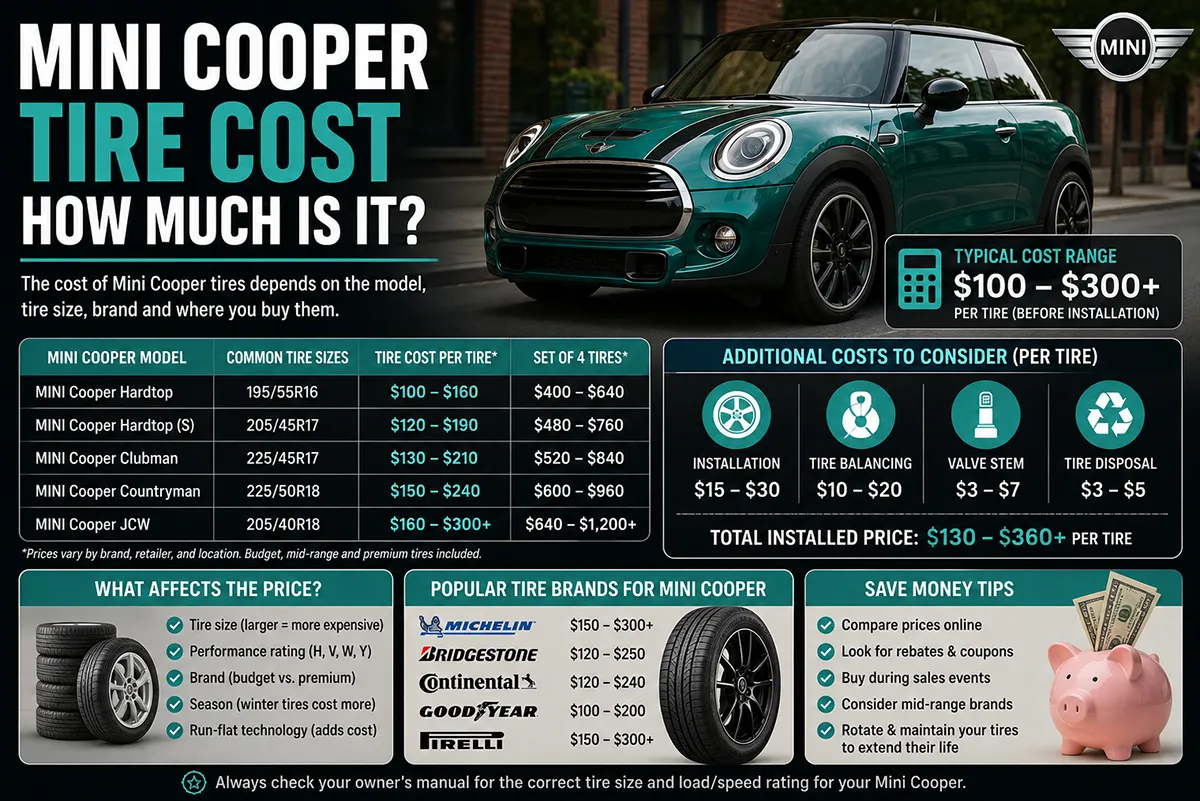
Here’s what you can expect to pay per tire in 2024–2025:
| Mini Cooper Model | Common Tire Size | Budget Tier (per tire) | Mid-Range (per tire) | Premium (per tire) |
|---|---|---|---|---|
| Cooper Hardtop (Base) | 175/65R15 | $70–$95 | $95–$130 | $130–$170 |
| Cooper Hardtop (Sport) | 205/45R17 | $90–$120 | $120–$170 | $170–$230 |
| Cooper S | 205/40R18 | $110–$140 | $140–$190 | $190–$260 |
| Countryman | 225/55R17 | $100–$130 | $130–$175 | $175–$240 |
| Clubman | 225/45R18 | $110–$145 | $145–$200 | $200–$270 |
| John Cooper Works | 225/35R19 | $140–$180 | $180–$250 | $250–$320 |
For a set of four tires: Most Mini Cooper owners will spend somewhere between $400 and $900 for a full set, depending on the model and brand chosen. If you’re driving a JCW with premium tires, you could easily cross the $1,000 mark.
These prices are for the tires alone. You’ll also need to factor in installation costs, which I’ll cover in detail below.
Run-Flat vs. Standard Tires: The Hidden Cost Factor
This is where a lot of Mini Cooper owners get sticker shock, and I completely understand why. When I was pricing tires for the 2019 Countryman, I noticed that the run-flat versions of the same tire were consistently $30 to $60 more per tire compared to the standard version.
Here’s the reality: if your Mini came with run-flat tires from the factory, you have a choice to make. You can either replace them with run-flats (and pay the premium), or switch to standard tires (and carry a tire repair kit or portable compressor).
Run-Flat Tire Pros
- You can drive on a flat for roughly 50 miles at reduced speed to reach a repair shop.
- No need to carry a spare tire, which saves trunk space.
- Peace of mind on long highway drives, especially for solo travelers.
Run-Flat Tire Cons
- They cost 20–40% more than comparable standard tires.
- The ride quality tends to be stiffer and less comfortable.
- Options are more limited — fewer brands and models available.
- They generally don’t last as long as standard tires in my experience.
In my personal experience, I switched the 2016 Hardtop from run-flats to standard tires and honestly couldn’t believe the improvement in ride comfort. The car felt like a different vehicle. I just made sure to keep a portable tire inflator and a plug kit in the trunk — a $40 investment that’s paid for itself in peace of mind.
For the Countryman, though, I stuck with run-flats because my wife drives it and prefers knowing she won’t be stranded on the side of the road if she hits a nail.
Installation and Additional Costs
The tire price is only part of the equation. Here’s what you should budget for on top of the tire cost itself.
Mounting and Balancing
Most tire shops charge $15 to $30 per tire for mounting and balancing. Some retailers like Costco and Discount Tire include this when you purchase tires from them, which can save you $60 to $120 on a set of four.
TPMS Sensor Service
Mini Coopers have tire pressure monitoring systems (TPMS), and the sensors sometimes need to be reset or replaced during a tire change. A TPMS reset is usually $5–$10 per tire, but if a sensor needs replacement, that’s $30–$70 per sensor.
Alignment
I always recommend getting an alignment when you install new tires. A proper alignment ensures even tire wear and extends the life of your new rubber. Expect to pay $80 to $130 for a four-wheel alignment at most US shops.
Valve Stems and Disposal Fees
These are small costs — usually $3–$5 per tire for new valve stems and $2–$4 per tire for old tire disposal — but they add up. On a set of four, that’s an extra $20–$36.
Total Installed Cost Example
Let me walk you through a real-world scenario. When I replaced the tires on the 2022 Cooper S with mid-range Continental PureContact LS tires through Tire Rack, here’s roughly what I paid:
- 4 tires at ~$165 each: $660
- Mounting and balancing: $80
- TPMS reset: $20
- Alignment: $100
- Valve stems and disposal: $28
- Total out the door: ~$888
That’s a realistic number for a mid-range tire on a Cooper S. If you go budget, you could potentially bring that total down to $550–$650. Premium tires with run-flat technology could push it past $1,100.
Best Tire Brands for the Mini Cooper
I’ve had personal experience with several tire brands on Minis, and I’ve also talked with dozens of Mini owners at meetups and in online communities. Here are my top recommendations organized by category.
Best Overall: Continental PureContact LS
This is the tire I put on the Cooper S, and it’s been outstanding. The grip is excellent in both dry and wet conditions, the road noise is minimal, and the ride comfort is a noticeable upgrade from the OEM run-flats. Continental is a trusted name, and this tire delivers.
I noticed the improvement immediately after the first few days of driving. Cornering felt more confident, and highway cruising was noticeably quieter.
Price range: $130–$190 per tire depending on size.
Best Value: General Altimax RT45
If you’re looking to save money without sacrificing too much quality, the General Altimax RT45 is my go-to recommendation. General is actually owned by Continental, and they share a lot of the same tire technology. I put these on the 2016 Hardtop and was impressed by how well they performed for the price.
Price range: $85–$120 per tire depending on size.
Best Performance: Michelin Pilot Sport 4S
For Cooper S and JCW owners who want the absolute best handling and grip, the Michelin Pilot Sport 4S is the gold standard. I’ve tested these extensively on other performance cars, and they transform the driving experience. They’re not cheap, but you get what you pay for.
Price range: $180–$300 per tire depending on size.
Best Run-Flat: Bridgestone Potenza RE980AS+
If you want to stick with run-flats, the Bridgestone Potenza RE980AS+ offers a good balance of performance and comfort in a run-flat package. It’s available in many Mini Cooper sizes and rides better than most run-flats I’ve tried.
Price range: $150–$230 per tire depending on size.
Best All-Season for Countryman: Michelin CrossClimate 2
The Countryman is the largest Mini, and many owners use it as their daily driver in all weather conditions. The Michelin CrossClimate 2 is exceptional for year-round driving, including light snow. I recommended this tire to a friend with a Countryman in Pennsylvania, and after several months of driving through everything from summer heat to winter slush, she’s been thrilled with it.
Price range: $140–$200 per tire depending on size.
Where to Buy Mini Cooper Tires in the US
I’ve purchased tires from just about every major US retailer at this point, and here’s my honest assessment of each one.
Tire Rack
This is my favorite option overall. Tire Rack has the largest selection, competitive pricing, and excellent customer reviews. They ship directly to a local installer of your choice, and installation is usually pre-arranged. I used Tire Rack for the Cooper S tires and the experience was seamless.
Discount Tire (America’s Tire on the West Coast)
Discount Tire is the largest independent tire retailer in the US, and their in-store experience is excellent. They price-match competitors, offer free tire rotations for the life of the tires, and their staff has always been knowledgeable when I’ve visited. This is my top pick if you prefer buying in person.
Costco
If you have a Costco membership, their tire center is a great deal. The prices are competitive, installation is included, and they offer free lifetime balancing, rotations, and flat repair. The downside is their selection is more limited — they carry about a dozen brands compared to the hundreds available at Tire Rack.
I bought the tires for the Hardtop at Costco during one of their seasonal tire sales and saved about $70 on the set with their instant rebate.
Walmart
Walmart’s online tire selection has improved significantly, and their prices are often the lowest you’ll find. The catch is that installation quality can vary greatly from store to store. If you have a Walmart Auto Care Center near you with good reviews, it’s worth considering for budget-friendly options.
Amazon
Amazon sells tires, and the prices can be competitive. However, you’ll need to find a separate installer and schedule the work yourself. Some Amazon tire listings now integrate with local installers, but in my experience, it’s still not as smooth as Tire Rack’s process.
Mini Dealership
I’m going to be honest — the dealership is the most expensive option and I generally don’t recommend it for tire purchases. Mini (BMW) dealerships typically charge a significant premium on tires. The one exception is if your Mini is under warranty and you want to ensure everything is done to factory specifications.
When I priced tires at a Mini dealership for the Countryman, the quote was nearly 30% higher than what I paid at Discount Tire for the exact same tires. That’s a hard premium to justify.
How to Save Money on Mini Cooper Tires
Over the years, I’ve developed a few strategies that consistently save me money on tire purchases. Here’s what works.
1. Shop During Seasonal Sales
The best tire deals in the US happen during specific windows: late October through November (Black Friday season), Presidents’ Day weekend in February, and Memorial Day weekend in May. Most major manufacturers offer $50–$100 mail-in rebates during these periods.
I’ve timed nearly every tire purchase to coincide with these sales and saved an average of $60–$80 per set.
2. Consider Switching Away from Run-Flats
As I mentioned earlier, dropping run-flats in favor of standard tires can save you $120–$240 on a set of four. Just make sure you carry an emergency inflation kit.
3. Don’t Oversize Your Tires
Some Mini owners upgrade to larger wheels and tires for aesthetics, but bigger tires cost more — both upfront and in fuel economy. If you’re budget-conscious, sticking with the smallest tire size your model supports is the smartest move.
4. Price Match Aggressively
Discount Tire and many other retailers will match competitor pricing. I always get quotes from at least three sources before making a purchase. A quick 15 minutes of comparison shopping can save you $40–$80.
5. Don’t Skip Alignment
This might sound counterintuitive in a money-saving section, but skipping alignment is a false economy. Poor alignment wears tires unevenly and dramatically shortens their lifespan. The $100 you spend on alignment now could save you hundreds later by extending tire life.
How Long Do Mini Cooper Tires Typically Last?
This is one of the most common questions I get, and the honest answer is: it depends on a lot of factors.
In my experience, most mid-range all-season tires on a Mini Cooper last about three to four years with average driving habits. Performance tires on a Cooper S or JCW tend to wear faster — I’ve seen them need replacement in as little as two to two-and-a-half years with spirited driving.
Run-flat tires tend to have slightly shorter lifespans than their standard counterparts, which is another cost consideration.
Here are the biggest factors that affect tire longevity on a Mini Cooper:
- Driving style: Aggressive cornering and hard braking wear tires faster. Minis are fun to drive, and many owners push them hard.
- Alignment: Mini Coopers are sensitive to alignment issues. Even a slight misalignment can cause uneven wear relatively quickly.
- Tire pressure: Under-inflated tires wear unevenly and run hotter, shortening their life. Check your pressure at least monthly.
- Road conditions: Rough roads, potholes, and debris take a toll. If you’re in an area with poor road conditions (I’m looking at you, Michigan and Pennsylvania), expect slightly shorter tire life.
- Regular rotations: Rotating your tires every six months or so helps ensure even wear. Many tire shops offer free rotations if you purchased from them.
OEM Tires vs. Aftermarket: What I Recommend
Mini Coopers typically come from the factory with tires from Pirelli, Bridgestone, or Continental — all excellent brands. But should you replace them with the same OEM tires, or switch to something else?
In my experience, aftermarket tires are almost always the better value. The OEM tires that come on new Minis are sometimes specific models produced exclusively for BMW/Mini, and they can be more expensive to replace because of limited availability.
For example, the Pirelli Cinturato P7 run-flat that came on the Countryman was $195 per tire to replace. I switched to a Michelin CrossClimate 2 in a standard (non-run-flat) configuration for $155 per tire and got better wet traction, a quieter ride, and improved tread life.
That said, if you love how your car rides and handles on the factory tires, there’s nothing wrong with sticking with what works. Just know that you have options.
Special Considerations for Electric Mini Cooper SE
If you’re driving the Mini Cooper SE (the electric version), tire shopping has an additional layer of complexity. Electric vehicles are heavier due to their battery packs, and they produce instant torque that can accelerate tire wear.
I’ve spoken with several Mini Cooper SE owners, and the consensus is that standard tires wear noticeably faster on the SE compared to the gas-powered Cooper. Many SE owners have found success with tires specifically designed for EVs, such as the Michelin e.Primacy or Continental EcoContact 6.
These EV-specific tires are typically priced 10–15% higher than their standard counterparts, but they’re engineered to handle the extra weight and torque while also maximizing range through reduced rolling resistance.
If you’re an SE owner, budget accordingly. You’ll likely be replacing tires a bit more frequently and paying a slight premium for the right rubber.
My Final Recommendation: What I’d Do If I Were Buying Today
If I were buying Mini Cooper tires today — and I’ve done it enough times to feel very confident in this advice — here’s exactly what I’d do:
For a base Mini Cooper Hardtop, I’d go with the General Altimax RT45 in the appropriate size. It’s a fantastic all-season tire at a budget-friendly price, and it’ll serve you well in most US driving conditions. Total cost for four installed: approximately $500–$600.
For a Cooper S or JCW, I’d step up to the Continental PureContact LS or, if budget allows, the Michelin Pilot Sport 4S. These cars deserve tires that match their performance capabilities. Total cost for four installed: approximately $750–$1,100 depending on the tire chosen.
For a Countryman or Clubman, the Michelin CrossClimate 2 is my top recommendation. It handles everything from summer rain to light winter snow with confidence. Total cost for four installed: approximately $700–$900.
And for any Mini Cooper, I’d strongly consider switching from run-flat to standard tires if you’re comfortable carrying an emergency kit. The cost savings are real, the ride improvement is dramatic, and the tire selection opens up significantly.
Whatever you choose, don’t put off tire replacement too long. Worn tires on a lightweight car like a Mini Cooper can be genuinely dangerous — I’ve felt the difference personally, and it’s not something to gamble with. Your Mini is a blast to drive, and the right tires make it even better.
Frequently Asked Questions
How much does it cost to replace tires on a Mini Cooper?
A full set of four Mini Cooper tires typically costs between $400 and $900 depending on the model, tire brand, and performance level you choose. For a standard Mini Cooper Hardtop, you can expect to pay around $100 to $160 per tire for quality all-season options, while the John Cooper Works or Countryman models with larger wheels can push costs closer to $175 to $225 per tire. I always recommend budgeting an extra $60 to $100 for mounting, balancing, and disposal fees at most US tire shops.
What size tires does a Mini Cooper take and how does that affect the price?
Most Mini Cooper Hardtop models use 175/65R15, 195/55R16, or 205/45R17 tires depending on the year and trim level, while the Countryman typically runs 225/45R18 or 225/50R18. Larger wheel sizes almost always cost more because the tires require more material and are often rated for higher performance. If your Mini has a staggered setup with different front and rear sizes, expect to pay even more since you cannot rotate tires to extend their life evenly.
Are Mini Cooper tires more expensive than regular car tires?
Mini Cooper tires do tend to cost slightly more than tires for comparably sized economy cars because many trims use run-flat tires or low-profile performance rubber as original equipment. Run-flat tires, which are standard on many Minis since they lack a spare tire, typically carry a $30 to $60 premium per tire over conventional options. That said, switching to non-run-flat tires is possible and can save you money, though you should carry a portable tire repair kit or inflator as a backup.
How long do Mini Cooper tires last before needing replacement?
Most Mini Cooper tires last between 25,000 and 45,000 miles depending on your driving habits, tire type, and whether you keep up with regular rotations and alignments. Performance and run-flat tires on sport-oriented models like the Cooper S tend to wear faster, sometimes hitting replacement at just 20,000 to 30,000 miles. I check my tread depth every 5,000 miles and keep my tire pressure at Mini’s recommended PSI to maximize tread life, especially during hot US summers when pavement temperatures accelerate wear.
What are the best tire brands for a Mini Cooper in the US?
Popular and highly rated tire brands for Mini Coopers in the US market include Continental, Pirelli, Bridgestone, and Michelin, all of which offer options specifically engineered for Mini’s wheel sizes. For budget-friendly alternatives, brands like General Tire, Hankook, and Falken deliver solid performance and treadwear ratings at $80 to $130 per tire. I personally lean toward Continental PureContact LS or Michelin Defender for daily driving because they balance ride comfort, wet traction, and longevity well in varying US climate conditions.
Is it cheaper to buy Mini Cooper tires online or at a local tire shop?
Buying Mini Cooper tires online through retailers like Tire Rack, Discount Tire Direct, or Amazon is usually $20 to $50 cheaper per tire compared to local dealerships, and many offer free shipping to a nearby installer. Most online retailers partner with US installation networks where you can get mounting and balancing done for $15 to $25 per tire. I compare prices online first, then check if my local shop will price-match, which many independent tire stores are willing to do to keep your business.
Do Mini Coopers require run-flat tires or can I use regular tires?
Mini Coopers come equipped with run-flat tires from the factory because most models do not include a spare tire, but you are not required to replace them with run-flats. Switching to conventional tires can save you $120 to $200 per set and often improves ride comfort since run-flats have stiffer sidewalls. However, if you make the switch, I strongly recommend carrying a portable tire inflator and sealant kit or adding a compact spare, especially for long highway drives across the US where roadside assistance wait times can be lengthy.
