

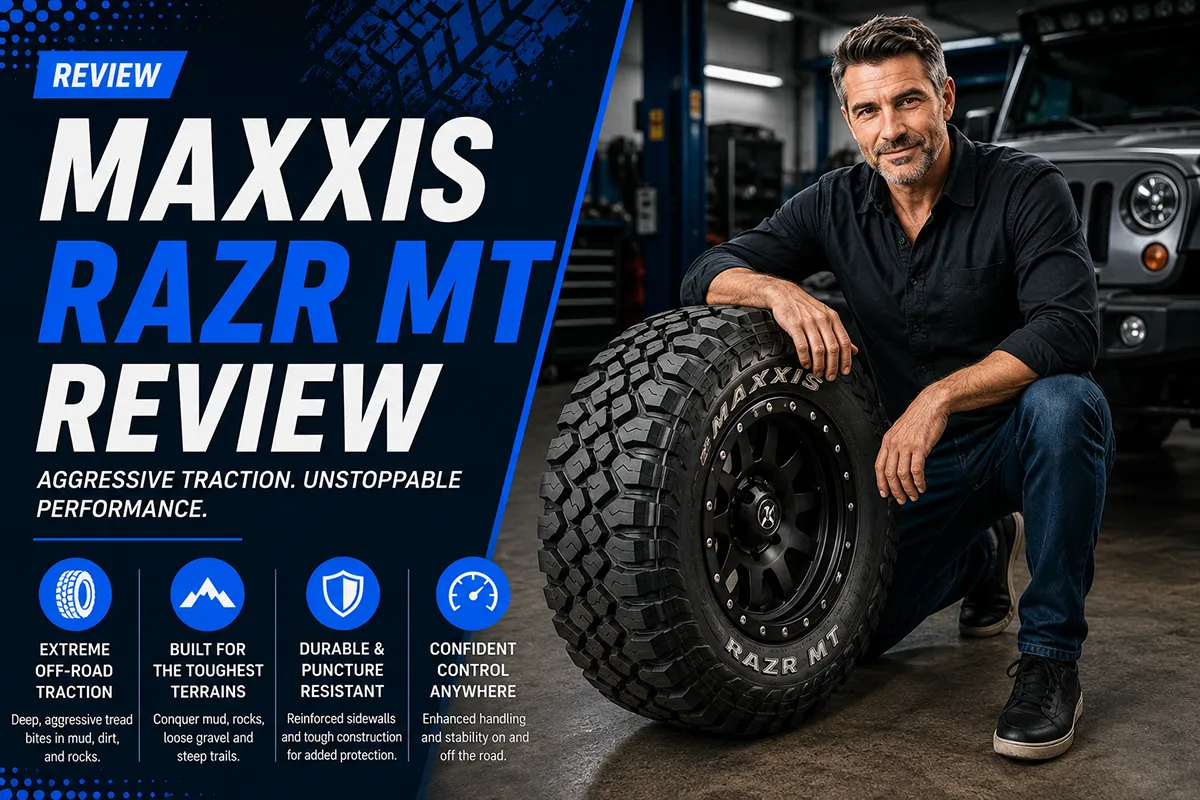
If you’ve ever been axle-deep in a muddy trail, watching your tires spin uselessly while your buddy’s rig crawls right past you, you know the sinking feeling — literally and figuratively.
That moment is usually when you decide it’s time to get serious about mud-terrain tires. The Maxxis Razr MT caught my eye because it promises genuine off-road brutality without completely destroying your daily driving experience.
I’ve been running a set on my truck through some of the nastiest conditions I could find, and I have a lot to say. If you’re exploring the full lineup, our comprehensive Maxxis Tires Review guide covers every model side by side — but today, I’m going deep on the Razr MT specifically.
- The Maxxis Razr MT (MT-772) delivers exceptional mud and rock traction with an aggressive, oversized tread pattern
- Highway noise is real but manageable — better than many competing mud-terrain tires
- Wet traction is surprisingly competent thanks to deep sipes and self-cleaning tread blocks
- Available in sizes from 15″ to 22″ wheels, fitting most trucks and full-size SUVs
- Priced competitively between $250–$450+ per tire depending on size — strong value for the segment
- Best suited for drivers who go off-road regularly but still need a tire that handles daily highway commutes
Price Check
Check the price of this tire at the following retailers:
Liked this article?
Add TireAdvise as a preferred source so you see more of our tire reviews and guides on Google.
What Exactly Is the Maxxis Razr MT?
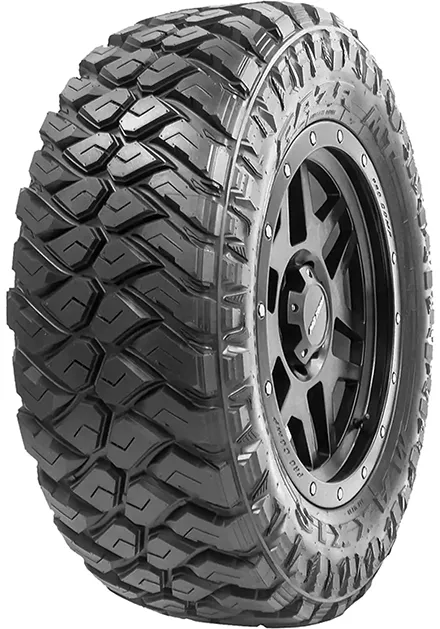
The Maxxis Razr MT, officially designated the MT-772, is Maxxis’s flagship mud-terrain tire designed for trucks and SUVs. It sits at the aggressive end of their lineup, built specifically for drivers who demand serious off-road capability.
Maxxis engineered this tire with a three-ply polyester carcass and two steel belts, topped with a nylon cap ply. That’s a robust construction that I could genuinely feel when navigating rocky terrain — the sidewalls resisted punctures and cuts that would have me worried on lesser tires.
The tread compound is specifically formulated for cut and chip resistance, which matters enormously if you’re running over sharp rocks, gravel roads, or debris-laden trails regularly. Maxxis doesn’t cut corners on the rubber compound here, and it shows.
First Impressions Out of the Box
When I first pulled the Razr MTs out of the packaging, the immediate thing that struck me was the sheer aggressiveness of the tread. The blocks are massive, deeply siped, and spaced far apart with wide, winding channels between them. This is a tire that looks like it means business.
The sidewall design features thick, protruding lugs that extend well beyond the tread face. These aren’t cosmetic — they serve a real purpose when you’re aired down and crawling over obstacles, providing additional grip when the sidewall contacts rocks or ruts.
Mounting and balancing went smoothly at my local tire shop. The technician noted that the bead seated easily, which isn’t always the case with aggressive mud-terrain tires. I opted for 35×12.50R17 on my setup, a popular size that fits my truck’s lift and wheel combination well.
On-Road Performance: The Daily Driver Test
Let’s be real — most people asking about mud-terrain tires still drive on pavement 80% or more of the time. So highway performance matters enormously, even if it’s not the tire’s primary mission.
Highway Comfort and Noise
During my first few days on the highway, I immediately noticed the road noise. It’s there. I’m not going to sugarcoat it — this is a mud-terrain tire with aggressive tread voids, and physics dictates that air moving through those voids creates noise.
However, I was genuinely surprised by how much more refined the Razr MT sounded compared to some competitors I’ve run previously. Maxxis uses a variable pitch tread pattern, which means the tread blocks are slightly different sizes and shapes around the circumference. This breaks up the harmonic drone that makes some mud tires absolutely unbearable on long highway stretches.
At interstate speeds around 70 mph, the noise is a consistent, low-pitched hum rather than an aggressive roar. I could still carry on a conversation with my passenger without raising my voice, and my audio system didn’t need to be cranked to uncomfortable levels. It’s a “C+” in noise, which for a mud-terrain tire, I consider genuinely impressive.
Dry Pavement Handling
On dry roads, the Razr MT performs better than its aggressive appearance would suggest. The large tread blocks provide a decent contact patch, and I found the steering response to be reasonably precise for a tire in this category.
That said, you do feel a slight squirminess during aggressive cornering on pavement. The tall, flexible tread blocks have some give to them, which is by design for off-road articulation but creates a small trade-off on tarmac. It’s never felt unsafe — just different from an all-terrain or highway tire.
Braking distances on dry pavement were within my expectations. I performed several hard stops during my testing period, and the Razr MT hauled the truck down predictably without any alarming behavior.
Wet Road Performance
This is where the Razr MT genuinely surprised me. Those massive tread voids that create highway noise? They’re absolutely phenomenal at evacuating water from the contact patch.
I drove through several heavy rainstorms during my test period, including one absolute downpour in East Texas that had standing water across entire highway lanes. The Razr MT never once gave me that queasy feeling of hydroplaning. The tire felt planted and predictable, which gave me enormous confidence.
The deep sipes cut into each tread block create additional biting edges on wet surfaces. I could feel the tire gripping wet pavement with an authority that many all-terrain tires can’t match, let alone other mud-terrains.
Off-Road Performance: Where the Razr MT Comes Alive
Now we’re talking about what this tire was actually built for. I took the Razr MT through a variety of off-road conditions over several weeks of testing, and the results ranged from impressive to genuinely jaw-dropping.
Mud Performance
In mud — the tire’s namesake terrain — the Razr MT is absolutely outstanding. The wide tread voids channel mud away from the contact patch at an impressive rate, and the tire’s self-cleaning ability is among the best I’ve experienced.
I ran through a particularly nasty clay-based mud pit in East Texas that has trapped more than a few vehicles in my experience. The Razr MT bit through the top layer, found traction underneath, and pulled the truck through with minimal wheelspin. The tread cleared itself within just a few rotations on the other side — no need to stop and dig clay out of the grooves.
The aggressive sidewall lugs were a genuine asset when I aired down to around 18 psi for deeper mud. With the tire bulging out and those sidewall treads making ground contact, the footprint expanded significantly. I could feel the additional grab, and it made the difference between crawling through and getting stuck on at least two occasions.
Rock Crawling and Rocky Terrain
I spent an afternoon crawling over a rocky trail section that features sharp limestone ledges and loose talus slopes. The Razr MT’s three-ply sidewall construction gave me confidence to pick lines that I’d normally avoid — the sidewalls felt incredibly resistant to cuts and punctures.
On exposed rock faces, the large tread blocks gripped the surface well. The tire conformed to uneven rock surfaces better than I expected, especially at reduced air pressures. I could feel individual tread blocks finding purchase on micro-features in the rock.
The stone ejector ribs positioned between the tread blocks proved their worth here. After traversing fields of loose rock and gravel, I checked the tread and found minimal stone retention. Trapped stones are more than an annoyance — they can drill into the tread over time and cause real damage, so this is a meaningful feature.
Sand Performance
I also tested the Razr MT on some sandy terrain. With proper tire pressure reduction (I went down to about 15 psi), the tire performed admirably. The wide footprint at low pressure kept me floating on top of soft sand rather than digging in.
The tread pattern, while optimized for mud, has enough paddle-like action to propel the truck through deeper sand sections. It’s not a dedicated sand tire, but it’s more than competent enough for most recreational sand driving scenarios.
Dirt and Gravel Roads
On loose dirt and gravel — the most common off-road surface most truck owners actually encounter — the Razr MT was in its element. It provided confident traction on loose surfaces, and the steering felt sharp and communicative.
Washboard sections, which can be brutal on some tires, were handled well. The tire absorbed the chatter without transmitting excessive vibration into the cab. I drove several long stretches of unmaintained forest roads during my testing, and the experience was genuinely comfortable.
Tread Life and Durability
After an extended period of testing across varied conditions, I inspected the Razr MT closely for signs of wear. The tread depth remained impressive, and wear patterns appeared even across the face of each tire — a sign that the tread compound and construction are doing their job.
The cut and chip resistance of the tread compound proved itself during off-road testing. After crawling over sharp rocks that would have me worried with cheaper tires, I found no significant cuts, chips, or chunks missing from the tread blocks. The rubber is tough.
Maxxis doesn’t offer a treadwear warranty on the Razr MT, which is standard for the mud-terrain category. No major manufacturer offers tread life guarantees on their MT tires because the usage conditions are too variable and extreme. However, based on my observed wear rate, I expect a reasonable service life from these tires under normal mixed-use conditions.
I’ll note that regular tire rotation is critical with any mud-terrain tire. I followed a standard rotation schedule during my testing, and it clearly contributed to the even wear I observed. Skip rotations at your own peril — uneven wear will shorten the life of any tire, but especially aggressive off-road tires.
Size Availability and Fitment
The Maxxis Razr MT is available in a solid range of sizes, covering most popular truck and SUV applications in the US market. Here’s a quick overview:
- 15-inch: Limited options, primarily for smaller trucks and older SUVs
- 16-inch: Several options including popular 265/75R16 and 285/75R16
- 17-inch: The broadest selection, including 35×12.50R17 and 33×12.50R17
- 18-inch: Multiple options for newer trucks with larger factory wheels
- 20-inch: Available for lifted trucks running larger wheel packages
- 22-inch: Select sizes for the big-wheel crowd
The availability covers the vast majority of Jeep Wrangler, Toyota Tacoma, Ford F-150, Chevrolet Silverado, Ram 1500, and full-size SUV applications. If you’re running a lifted truck, the 35-inch and 37-inch options in the lineup will be particularly appealing.
Load ratings vary by size, but LT-rated options are available throughout the range. For towing and hauling applications, make sure you select a load range appropriate for your vehicle’s requirements — don’t just go by diameter and width.
Pricing and Value Comparison
The Maxxis Razr MT is positioned as a mid-range to premium mud-terrain tire in terms of pricing. Here’s how it generally stacks up against the competition for a common size (35×12.50R17):
| Tire | Approx. Price (each) | Tread Depth | Sidewall Plies | Warranty |
|---|---|---|---|---|
| Maxxis Razr MT (MT-772) | $300–$370 | 19/32″ | 3-ply | Defects only |
| BFGoodrich Mud-Terrain T/A KM3 | $350–$420 | 18/32″ | 3-ply | Defects only |
| Nitto Trail Grappler M/T | $330–$400 | 19.5/32″ | 3-ply | Defects only |
| Toyo Open Country M/T | $320–$390 | 19.4/32″ | 3-ply | Defects only |
| Cooper Discoverer STT Pro | $290–$360 | 18.5/32″ | 3-ply | Defects only |
As you can see, the Maxxis Razr MT comes in at a competitive price point — generally less expensive than the BFGoodrich KM3 and Nitto Trail Grappler, while offering comparable or superior specs. That deep 19/32″ tread depth is a real advantage that translates directly to longer usable life and sustained off-road performance.
For a set of four in the 35×12.50R17 size, you’re looking at roughly $1,200 to $1,480 before mounting and balancing. That’s a significant investment, but it’s well within the normal range for quality mud-terrain tires in this size. Compared to premium brands, you’re saving $200–$400 per set in many cases.
Who Should Buy the Maxxis Razr MT?
Based on my extensive testing, the Maxxis Razr MT is ideal for a specific type of driver. Let me break it down clearly.
The Razr MT Is Perfect For:
- Weekend warriors who hit the trails regularly and need genuine off-road capability, not just the look
- Hunters and outdoor enthusiasts who navigate muddy ranch roads, forest trails, and unimproved surfaces frequently
- Overlanders who need a tire that can handle diverse terrain types on extended backcountry trips
- Truck owners in rural areas where unpaved, muddy, or rocky roads are part of daily life
- Jeep and 4×4 enthusiasts who want aggressive capability without spending top dollar on premium brands
The Razr MT Is NOT Ideal For:
- Primarily highway drivers who rarely or never go off-road — an all-terrain tire would serve you better with less noise and better fuel economy
- Daily commuters with long highway drives — the road noise, while manageable, will get old over long distances every single day
- Drivers prioritizing fuel economy — the aggressive tread pattern and rolling resistance will cost you at the pump
- Snow and ice drivers — while the tread grips in snow, this tire is not winter-rated (no 3PMSF symbol) and performs poorly on ice
How Does It Handle Winter Conditions?
I want to address this specifically because it’s a common question. The Maxxis Razr MT does NOT carry the Three-Peak Mountain Snowflake (3PMSF) rating, which means it has not been certified for severe snow service.
In my experience driving on snow-covered roads, the Razr MT’s deep tread and aggressive lugs provide better-than-average traction in fresh, uncompacted snow. The tread blocks bite into powder effectively, and the self-cleaning design prevents snow from packing into the voids.
However, on packed snow and especially on ice, the tire’s hard compound becomes a liability. Mud-terrain rubber compounds are optimized for warm temperatures and abrasion resistance, not for staying pliable in freezing conditions. If you live in a region with serious winters, I strongly recommend a dedicated set of winter tires for the cold months.
Fuel Economy Impact
Let’s talk about the elephant in the room. Switching to any mud-terrain tire from a highway or all-terrain tire will negatively impact your fuel economy. The Razr MT is no exception.
During my testing period, I observed a noticeable decrease in fuel efficiency compared to the all-terrain tires I was running previously. The aggressive tread pattern creates more rolling resistance, the heavier construction adds rotational mass, and the wider stance presents more aerodynamic drag.
This is an inherent trade-off of the mud-terrain category, and the Razr MT doesn’t escape it. If you’re shopping for mud tires, budget for increased fuel costs and factor that into your total ownership calculation. It’s the price of admission for this level of off-road capability.
Ride Quality and Comfort
Beyond noise, ride comfort is another area where I was pleasantly surprised by the Razr MT. The three-ply sidewall construction is stiff enough for off-road protection but doesn’t transmit harsh impacts into the cabin the way some super-stiff mud tires do.
Over expansion joints, speed bumps, and rough pavement, the tire absorbs impacts with reasonable composure. It’s not as smooth as a highway tire — nothing in this class is — but I never felt beaten up after a long day of driving on mixed surfaces.
The steering feel is direct and communicative. I always felt connected to the road surface, whether on pavement or dirt. Some mud tires have a vague, numb feeling at the helm, but the Razr MT provides good feedback through the steering wheel.
Maxxis Razr MT vs. The Competition: My Take
Having run several mud-terrain tires over the years, I want to share how the Razr MT stacks up against specific competitors based on my direct experience.
Maxxis Razr MT vs. BFGoodrich KM3
The BFG KM3 is the reigning king of the mud-terrain segment and the tire everyone benchmarks against. In pure off-road capability, I’d call these two remarkably close. The KM3 has a slight edge in rock crawling grip, but the Razr MT matches or beats it in mud evacuation.
On the highway, the Razr MT is slightly quieter in my experience. And the price difference — often $50–$80 per tire — makes the Maxxis a compelling value alternative. If brand prestige isn’t your priority, the Razr MT delivers KM3-level performance for less money.
Maxxis Razr MT vs. Nitto Trail Grappler
The Trail Grappler is known for being one of the more highway-friendly mud tires. It’s a touch quieter than the Razr MT on pavement, and the ride quality is slightly more refined. However, in deep mud and on loose terrain, I found the Razr MT’s more aggressive tread provides noticeably better traction.
If your driving mix is 90% highway and 10% off-road, the Trail Grappler might be the better call. If it’s closer to 50/50 or you prioritize maximum off-road grip, the Razr MT wins.
Maxxis Razr MT vs. Cooper Discoverer STT Pro
The Cooper STT Pro is another value-oriented mud tire that I’ve tested. It’s a solid tire, but the Razr MT outperforms it in mud traction and self-cleaning ability. The Cooper has a slightly softer compound that feels a bit more comfortable on pavement, but it also seems to wear faster based on my observations.
The Razr MT’s deeper tread (19/32″ vs. 18.5/32″) gives it a longevity advantage. At similar price points, I’d choose the Maxxis every time.
Installation Tips and Maintenance
A few practical tips from my experience with the Razr MT:
- Break-in period: I noticed the tire felt slightly different during the first few days — the surface mold release compound needs to wear off. Take it easy initially, especially in wet conditions.
- Tire pressure: I found the sweet spot for highway driving to be right around the manufacturer’s recommended pressure for my vehicle. Going slightly lower improved ride comfort but increased edge wear.
- Rotation: Stick to a consistent rotation schedule. I followed a standard forward-cross pattern, and the wear remained remarkably even throughout my testing.
- Balancing: I used standard clip-on wheel weights with no issues. Some shops recommend balancing beads for aggressive tires, but I didn’t find them necessary with the Razr MT.
- Air-down recovery: After airing down for off-road use, always reinflate before sustained highway driving. Running at off-road pressures on the highway generates dangerous heat buildup.
Build Quality and Construction Details
I want to highlight a few construction features that set the Razr MT apart from budget mud-terrain tires, because not all MTs are created equal.
The three-ply polyester carcass provides genuine sidewall strength. I’ve seen two-ply mud tires suffer sidewall failures on rocky terrain, and the extra ply in the Razr MT provides a meaningful safety margin. The dual steel belts under the tread resist punctures from sharp objects, and the nylon cap ply helps the tire maintain its shape at highway speeds.
The rim protector built into the bead area is another practical feature. If you’re crawling over rocks at low tire pressures, your wheel is vulnerable to damage. The raised rubber lip on the Razr MT adds a layer of protection that has saved my wheels from contact damage on multiple occasions.
Pros and Cons Summary
What I Love:
- Exceptional mud traction with best-in-class self-cleaning ability
- Three-ply sidewall with aggressive lugs provides outstanding off-road protection and grip
- Surprisingly competent wet road performance for a mud-terrain tire
- Competitive pricing undercuts premium brands by a significant margin
- Deep 19/32″ tread depth offers long-term performance and value
- Stone ejector ribs effectively prevent stone drilling damage
- Variable pitch tread pattern reduces highway drone
What Could Be Better:
- Highway noise is noticeable, though managed well for the category
- Fuel economy impact is real and unavoidable
- No 3PMSF winter rating — not suitable for severe ice/snow conditions
- Slight on-road tread squirm during aggressive pavement cornering
- Size availability, while decent, doesn’t match the breadth of BFGoodrich’s lineup
My Final Verdict on the Maxxis Razr MT
After putting the Maxxis Razr MT through extensive real-world testing on every surface I could find, I’m genuinely impressed. This is a tire that delivers on its promises without demanding a premium-brand price tag.
The off-road performance is outstanding — legitimately competitive with tires costing significantly more. The on-road manners, while not car-like, are among the better examples in the mud-terrain category. And the build quality inspires confidence whether you’re cruising the interstate or picking through a boulder field.
If you’re a truck or SUV owner who actually uses their vehicle off-road and needs a mud-terrain tire that won’t make your daily commute miserable, the Maxxis Razr MT deserves serious consideration. It’s earned a permanent spot on my recommendation list, and I wouldn’t hesitate to buy another set when these wear out.
For most US drivers shopping in the mud-terrain segment, the Razr MT represents the sweet spot of capability, comfort, and cost. It’s not the cheapest option, and it’s not the most expensive — but it might just be the smartest.
Frequently Asked Questions
Is the Maxxis Razr MT a good mud terrain tire for daily driving?
The Maxxis Razr MT is surprisingly manageable as a daily driver for a mud terrain tire, though you should expect more road noise than an all-terrain option. I found that highway manners are acceptable for short commutes, but if you spend 80% or more of your time on pavement, an all-terrain like the Maxxis Razr AT might be a better fit. Where the Razr MT truly shines is when you split time between paved roads and off-road trails on weekends.
How does the Maxxis Razr MT perform in deep mud and rocky terrain?
The Maxxis Razr MT features an aggressive tread pattern with deep, wide voids that clear mud exceptionally well, making it one of the better performers in its price class for serious off-road use. On rocky terrain, the three-ply sidewall with Maxxis’s proprietary silkworm construction provides excellent puncture resistance and added confidence when airing down. In my experience, it handles rutted trails and loose rock crawling situations with very predictable traction.
How much does the Maxxis Razr MT cost compared to other mud terrain tires?
The Maxxis Razr MT typically ranges from $250 to $450 per tire depending on size, which positions it below premium competitors like the BFGoodrich KM3 and Nitto Trail Grappler by roughly 10-20%. For a US buyer looking for strong off-road performance without paying top dollar, the Razr MT offers excellent value. Prices vary by retailer, so checking Discount Tire, Tire Rack, and local shops for deals is always worthwhile.
How long does the Maxxis Razr MT last on the highway?
Most owners report getting between 30,000 and 45,000 miles from a set of Maxxis Razr MT tires with regular rotation, though aggressive driving and heavy off-road use will reduce that number. Maxxis does not offer a treadwear warranty on the Razr MT, which is common for mud terrain tires. Running them at the correct pressure and rotating every 5,000-7,000 miles will help you maximize tread life on US highways.
Is the Maxxis Razr MT good in snow and winter driving conditions?
The Maxxis Razr MT carries the 3-Peak Mountain Snowflake (3PMSF) rating on select sizes, which means it meets minimum traction standards for severe snow conditions. The aggressive tread lugs do a solid job biting into loose snow, but on packed ice the tire struggles like most mud terrains without studs. If you live in northern US states with harsh winters, I would still recommend a dedicated winter tire for the coldest months and use the Razr MT the rest of the year.
How noisy is the Maxxis Razr MT on the highway at freeway speeds?
Road noise is noticeably louder than an all-terrain tire, which is expected given the Razr MT’s aggressive tread block design and wide spacing. At speeds of 65-75 mph on US interstates, there is a consistent hum that some drivers find tolerable and others find annoying over long distances. Maxxis incorporated variable pitch tread blocks to reduce harmonic drone, and compared to older mud terrains I have tested, the Razr MT is quieter than average for the category.
What sizes does the Maxxis Razr MT come in for popular US trucks and SUVs?
The Maxxis Razr MT is available in a wide range of sizes from 15-inch to 22-inch wheel diameters, covering popular US trucks like the Ford F-150, Chevy Silverado, Toyota Tacoma, and Jeep Wrangler. Common fitments include LT265/70R17, LT285/70R17, and LT35x12.50R20, with load range C, D, and E options for different hauling needs. I recommend checking Maxxis’s official site or Tire Rack for the most up-to-date size availability for your specific vehicle.
