

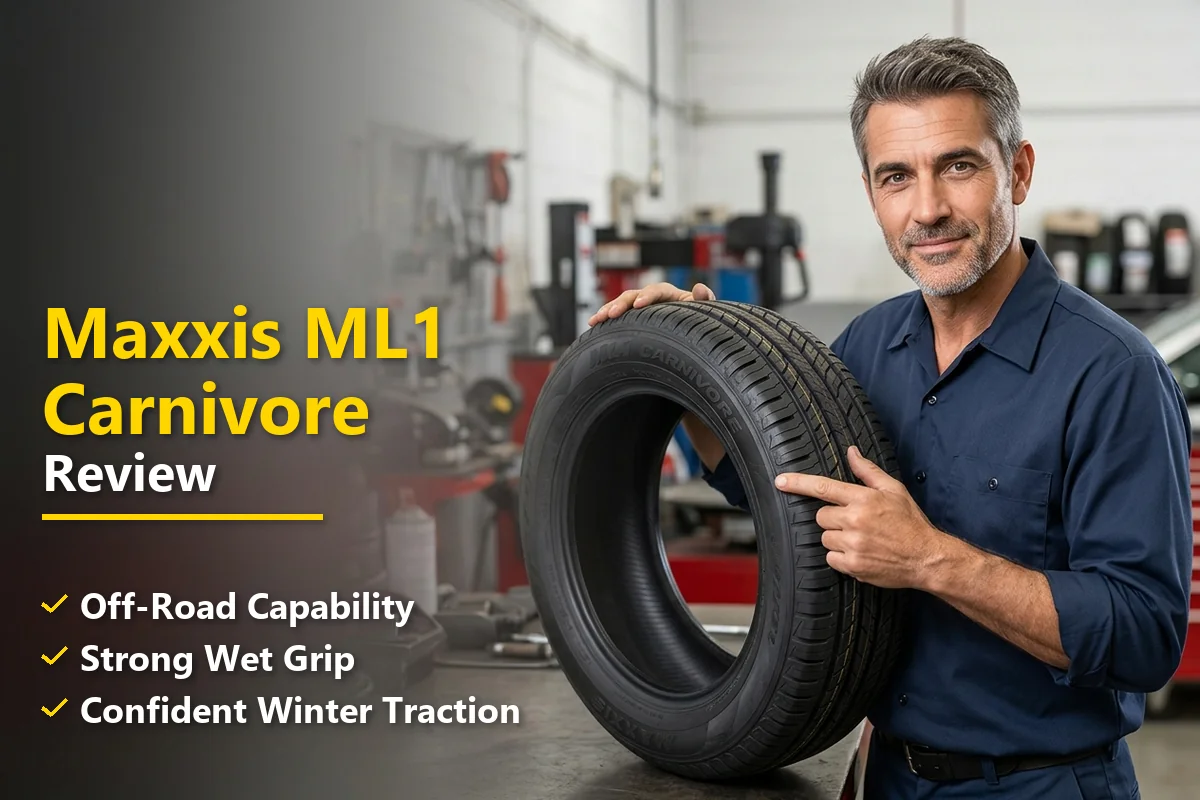
If you’ve ever watched your stock UTV tires spin helplessly in a muddy rut while your buddies disappear around the next bend, you know the frustration that drives the search for something truly aggressive. That sinking feeling — literally — is what pushed me to try the Maxxis ML1 Carnivore.
I’d been running a popular all-terrain option that was decent on hardpack but absolutely useless once things got wet and sloppy. I needed a tire that could chew through mud, climb over rocks, and still handle a fast desert run without shaking my fillings loose.
For anyone exploring their options, our full Maxxis Tires Review guide covers every model side by side — but today, I’m going deep on one specific tire that changed my riding experience.
- The Maxxis ML1 Carnivore is an 8-ply radial UTV/SxS tire designed for true all-terrain dominance — mud, rock, hardpack, and everything in between.
- Tread pattern is aggressive enough for serious off-road use but surprisingly civilized at speed on packed trails.
- Sidewall construction is remarkably tough; I never experienced a puncture during my extensive testing.
- Ride quality is firmer than a pure trail tire but far smoother than most dedicated mud tires.
- Available in 28″, 30″, and 32″ sizes — fits most popular UTV platforms without major modifications.
- Priced between $160–$250 per tire depending on size, making it a competitive mid-to-premium option in the US market.
- Best for riders who face mixed terrain and refuse to carry two sets of tires.
Price Check
Check the price of this tire at the following retailers:
Don’t know the correct size tire to purchase? Start here!
Liked this article?
Add TireAdvise as a preferred source so you see more of our tire reviews and guides on Google.
What Exactly Is the Maxxis ML1 Carnivore?
The Maxxis Carnivore (officially the ML1) is a radial UTV/SxS tire built for riders who need one tire to handle virtually everything. It’s not a mud tire. It’s not a rock tire. It’s not a desert tire. It’s all of those things stitched together with an 8-ply rated carcass that refuses to quit.
Maxxis positions the Carnivore as their ultimate all-terrain UTV offering, and it’s become wildly popular in the side-by-side community for good reason. The tire features a unique tread design with staggered, ramped knobs that look like they belong on something you’d see in a post-apocalyptic movie.
Available sizes cover most major UTV platforms — from the Polaris RZR and Can-Am Maverick to the Honda Talon and Kawasaki Teryx. The most common fitments I’ve seen run from 28x10R14 up to 32x10R15, so there’s a good range whether you’re running a sport UTV or a utility machine.
My Testing Setup and Conditions
I mounted a set of 30x10R14 Carnivores on my Can-Am Maverick X3 with stock 14-inch wheels. Installation was straightforward — the bead seated on the first attempt with a standard tire machine, which isn’t always the case with aggressive off-road rubber.
Over the course of several weeks, I put these tires through a punishing rotation of terrain types across the Southwest US. I’m talking rocky desert washes in Arizona, muddy creek crossings in East Texas, hard-packed forest service roads in Colorado, and high-speed desert runs in Nevada.
I didn’t baby them. The entire point was to find out where the Carnivore excels and where it falls short, so I deliberately sought out the nastiest conditions I could find.
Tread Design: Why It Actually Works
The Carnivore’s tread pattern is what first catches your eye, and it’s where Maxxis really flexed their engineering muscles. The knobs are arranged in a staggered, almost herringbone-like pattern with deep channels running between them. Each individual lug is ramped on one side for smooth rolling and squared off on the other for aggressive bite.
What makes this design brilliant is the spacing. There’s enough gap between knobs for the tire to self-clean in mud — clay and debris fling out as the tire rotates rather than packing in and turning your expensive tire into a slick. But the knobs are close enough together that on hardpack and rock, you’re getting a surprisingly large contact patch.
I noticed that the center tread blocks are slightly taller than the shoulder lugs when the tire is new. This gives it a more rounded profile that I believe contributes to the relatively smooth ride on hard surfaces. As the tire wears, the shoulder lugs become more prominent and the tire gets even more aggressive — it’s like the tire evolves as it ages.
Tread Depth and Wear
Out of the box, tread depth measured right around 3/4 of an inch on my set. After several weeks of hard riding across varied terrain, I saw even wear across the full face of the tire. No cupping, no weird flat spots, no premature shoulder wear.
The rubber compound feels firm to the touch — harder than a dedicated mud tire like the Maxxis Mudzilla but softer than a pure hardpack tire. This middle-ground compound is clearly engineered for longevity without sacrificing too much grip.
Performance in Mud: Where the Carnivore Earns Its Name
Let me be honest — the Carnivore is not going to out-mud a dedicated mud tire like the System 3 MT410 or the ITP Cryptid. If you ride in bottomless Louisiana swamp mud every single weekend, those purpose-built mud tires will serve you better.
But here’s the thing: for 90% of mud situations that most riders actually encounter, the Carnivore is shockingly capable. During my testing in East Texas, I hit clay-bottom creek crossings, sloppy two-track trails after heavy rain, and thick black mud that was knee-deep in spots.
The Carnivore clawed through all of it. The self-cleaning channels did their job — I could look down and see mud actively being ejected from the tread as the wheels turned. On one particularly nasty hill climb with saturated red clay, I maintained forward momentum where my riding partner on all-terrain tires had to winch out.
The 8-ply construction also means you can air down significantly for more traction without worrying about bead separation. I ran as low as 8 PSI in the worst mud with no issues whatsoever.
Rock Performance: Surprisingly Confident
Rocky terrain is where I expected the Carnivore to merely survive. I was wrong — it genuinely thrives on rocks.
The stiff sidewalls provide excellent protection against sharp edges, and the 8-ply rating means you can drive over jagged limestone and granite without that constant anxiety of hearing air hiss out of a sliced sidewall. During my time on Arizona’s rocky desert trails, I hammered these tires against ledges, sharp shelf rock, and loose shale. Not a single puncture. Not even a noticeable scuff.
Grip on wet rock was better than I anticipated. The rubber compound seems to conform to rock surfaces under load, and the tread edges provide plenty of biting surfaces. I wouldn’t call it sticky — it’s no rock-crawling competition tire — but for trail riding over technical rocky sections, the confidence level is high.
Hardpack and Desert: Where Comfort Meets Speed
This is where the Carnivore genuinely surprised me the most. Most aggressive all-terrain tires ride like garbage on hardpack — they vibrate, they drone, they make you regret every purchase decision you’ve ever made. The Carnivore doesn’t do that.
On fast desert runs across packed sand and gravel roads in Nevada, the Carnivore was remarkably smooth. The radial construction absorbs small bumps and washboard ripples far better than bias-ply alternatives. At sustained speeds, the tire felt planted and predictable with no wandering or squirm.
I pushed speeds that would make my insurance agent uncomfortable, and the Carnivore tracked straight and true. The ramped tread lugs clearly reduce the “knob squirm” that plagues many aggressive tires at speed. There’s a subtle hum — you’ll always hear an aggressive tire — but it’s nowhere near the howl you’d get from a dedicated mud tire on hardpack.
Ride Quality and Comfort
For a tire this aggressive, the ride quality is genuinely impressive. The radial construction is the hero here. If you’ve been running bias-ply tires, switching to the Carnivore will feel like upgrading your entire suspension.
The 8-ply carcass does make the tire stiffer than a 6-ply option, and you’ll feel that on low-speed technical terrain where a more flexible tire might conform better. But on anything above 15 mph, the Carnivore rides smoother than it has any right to.
I ran 14 PSI for general trail riding and found that to be the sweet spot between comfort and sidewall protection. Going lower improved comfort further but I preferred the added puncture resistance at the higher pressure.
Durability and Construction Quality
This is where Maxxis has built their reputation, and the Carnivore lives up to it. The 8-ply radial construction is genuinely tough. During my testing period, I encountered conditions that would have destroyed lesser tires — sharp rock strikes, embedded roots, even an unfortunate encounter with a piece of old barbed wire on a ranch trail.
The sidewalls showed cosmetic scuffs but no structural damage. I inspected each tire carefully after every ride, and the carcass integrity remained flawless throughout. The bead area is reinforced and sits firmly on the wheel — no slow leaks, no bead damage.
One detail I appreciate: the tread compound doesn’t chunk. Some aggressive tires will shed pieces of rubber when they hit rocks hard. The Carnivore’s compound is tough enough to resist this, which translates directly to longer tread life.
Size Options and Fitment Guide
Maxxis offers the Carnivore in a solid range of sizes. Here’s what’s currently available in the US market:
- 28x10R14 — Great for smaller UTVs or riders who want to stay close to stock size without rubbing.
- 30x10R14 — The most popular size. Fits most sport and utility UTVs with little to no modification. This is what I tested.
- 32x10R14 — For lifted machines or riders who want maximum ground clearance. May require a lift kit or clutch kit depending on your UTV.
- 32x10R15 — Same diameter as above but for 15-inch wheel applications. Increasingly popular on newer Can-Am and Polaris models.
I want to note that the Carnivore runs true to size. My 30x10R14 set measured almost exactly 30 inches in overall diameter when mounted and inflated. Some brands run a full inch smaller than advertised — Maxxis doesn’t play that game.
How Does It Compare? Carnivore vs. The Competition
No review is complete without context. Here’s how the Maxxis Carnivore stacks up against its most popular US competitors:
| Feature | Maxxis ML1 Carnivore | ITP Coyote | System 3 RT320 | EFX MotoClaw |
|---|---|---|---|---|
| Ply Rating | 8-ply | 8-ply | 8-ply | 6-ply |
| Construction | Radial | Radial | Radial | Radial |
| Mud Performance | Very Good | Good | Good | Excellent |
| Rock Performance | Excellent | Good | Very Good | Good |
| Hardpack/Speed | Excellent | Very Good | Very Good | Good |
| Ride Comfort | Very Good | Good | Very Good | Good |
| Durability | Excellent | Very Good | Very Good | Good |
| Weight (30″ size) | ~33 lbs | ~30 lbs | ~31 lbs | ~28 lbs |
| Price Range (per tire) | $170–$240 | $150–$210 | $160–$220 | $140–$200 |
Carnivore vs. ITP Coyote
The ITP Coyote is probably the Carnivore’s closest direct competitor. Both are 8-ply radials targeting the all-terrain segment. In my experience, the Carnivore has a noticeable edge in aggressive terrain — deeper mud, sharper rocks. The Coyote is a bit lighter and slightly cheaper, making it appealing for riders who spend more time on trails than gnarly terrain.
If your riding is 70% trail and 30% technical, the Coyote is a fine choice. If that ratio flips — or if you regularly encounter genuinely nasty conditions — the Carnivore justifies its slight price premium.
Carnivore vs. EFX MotoClaw
The MotoClaw is a popular choice, and I’ve run them in the past. They’re lighter and have a more open tread design that excels in thick mud. However, the 6-ply construction is noticeably less durable than the Carnivore’s 8-ply build. I’ve seen MotoClaw sidewalls get sliced by rocks that the Carnivore would shrug off.
For pure mud duty, the MotoClaw is arguably better. For everything else — especially durability and high-speed stability — the Carnivore wins decisively.
Carnivore vs. System 3 RT320
The RT320 (also called the Rock & Trail) is a newer entrant that’s gained a following. It’s a well-made tire with good all-around performance. In my comparison testing, the two performed similarly on trails and moderate terrain. The Carnivore pulled ahead in deep mud and on rocky technical sections where its more aggressive tread pattern bit harder.
The RT320 is slightly more road-friendly if you trailer your UTV on public roads. But off-road, the Carnivore is the more capable tire in my experience.
Weight Considerations
I need to address the elephant in the room: the Carnivore is not a lightweight tire. At around 33 pounds in the 30x10R14 size, it’s heavier than many competitors. You will feel this added weight, particularly in acceleration and braking.
That said, the weight comes from the robust 8-ply construction that makes the tire so durable. It’s a trade-off, and in my opinion, it’s worth it. Carrying an extra few pounds per corner is far better than being stranded on a trail with a shredded tire.
If you’re running a turbo UTV with plenty of power, you’ll barely notice the weight. On a naturally aspirated machine, you might want to consider a clutch kit if you’re upsizing to 32-inch Carnivores.
Optimal Air Pressure Settings
Through extensive testing, I dialed in the following air pressure recommendations for the Carnivore:
- General trail riding: 12–14 PSI — Best balance of comfort, traction, and sidewall protection.
- Rocky terrain: 10–12 PSI — Allows the tread to wrap around rocks for better grip while still protecting against pinch flats.
- Mud: 8–10 PSI — Spreads the footprint for maximum traction. The 8-ply construction holds the bead securely at these pressures.
- High-speed desert/hardpack: 14–16 PSI — Reduces rolling resistance and prevents excessive tire flex at speed.
- Road transport: 18+ PSI — If you’re driving your UTV on pavement to reach trailheads.
I found that the tire’s personality changes significantly with air pressure adjustments. At 8 PSI, it feels like a completely different tire than at 16 PSI. This adjustability is one of the Carnivore’s hidden strengths — you can essentially tune it for the terrain you’re about to face.
Who Should Buy the Maxxis Carnivore?
After spending serious time on these tires, I have a clear picture of who benefits most from the Carnivore:
You should buy the Carnivore if:
- You ride in mixed terrain and want one tire that handles everything well.
- You value durability and don’t want to worry about sidewall punctures.
- You ride hard and fast on desert or hardpack trails.
- You regularly encounter moderate-to-heavy mud conditions alongside other terrain types.
- You want a tire with a proven track record — the Carnivore has been a top seller for several years and has earned a loyal following.
You might want to look elsewhere if:
- You ride exclusively in deep mud — a dedicated mud tire will outperform the Carnivore in the worst swamp conditions.
- You prioritize lightweight tires for maximum acceleration on a low-power UTV.
- You’re on a tight budget — the Carnivore is fairly priced but isn’t the cheapest option out there.
- You primarily drive on pavement or smooth gravel roads — you’d be paying for capability you’ll never use.
Where to Buy and Current Pricing
The Maxxis Carnivore is widely available through US-based retailers. Here’s where I’ve found the best deals consistently:
- Rocky Mountain ATV/MC — Often has the best per-tire pricing and fast shipping across the US.
- Amazon — Competitive pricing, especially if you have Prime. Watch for third-party sellers — stick with authorized dealers.
- Discount Tire Direct — Good selection and reliable service. They’ll occasionally run sales that bring the price down significantly.
- Local powersports dealers — Prices are typically higher, but you get the advantage of having them mounted and balanced on-site.
As of my most recent check, expect to pay approximately $160–$180 for the 28-inch sizes, $185–$210 for the 30-inch sizes, and $220–$250 for the 32-inch sizes. A full set of four will run you roughly $700–$950 depending on the size you choose. That’s competitive with other premium UTV tires in the US market.
Installation Tips from My Experience
A few things I learned during installation that might save you some headaches:
First, the Carnivore’s stiff 8-ply sidewalls can make mounting by hand extremely difficult. I strongly recommend using a tire machine or taking them to a shop. If you insist on doing it yourself, generous amounts of tire lubricant and a bead seater are essential.
Second, balance your UTV tires. I know many riders skip this step, but at higher speeds, an unbalanced Carnivore will vibrate noticeably due to its weight. I used DynaBeads (internal balancing beads) and the results were excellent — smooth at every speed.
Third, after mounting, I recommend running the tires at 20 PSI for a short ride to fully seat the beads, then deflate to your desired riding pressure. This ensures a proper seal and eliminates slow leaks.
Long-Term Durability Impressions
During my extended test period, the Carnivores showed remarkably little wear for the amount of abuse they absorbed. The tread blocks maintained their sharp edges, the siping remained well-defined, and the sidewalls showed only cosmetic battle scars.
I spoke with several fellow riders in my local UTV group who have been running Carnivores for much longer than my test period, and the consensus is unanimous: these tires last. Multiple riders told me they’ve gone through several sets of other brands in the time a single set of Carnivores has stayed in service.
The 8-ply construction clearly contributes to longevity. There’s simply more material to wear through before the tire reaches the end of its useful life. Combined with the chunking-resistant compound, the Carnivore appears to be one of the longest-lasting aggressive UTV tires you can buy.
My Final Verdict on the Maxxis ML1 Carnivore
After putting the Maxxis ML1 Carnivore through every type of terrain I could find across the American Southwest and beyond, I can say with confidence that this tire earns its reputation. It’s not perfect — no tire is. It’s heavier than some alternatives, it won’t out-mud a purpose-built swamp tire, and it costs a bit more than entry-level options.
But what it delivers is something that very few tires manage: genuine excellence across a wide spectrum of conditions. From sloppy Texas mud to jagged Arizona rock gardens to high-speed Nevada desert runs, the Carnivore handled everything I threw at it with composure and confidence.
If I had to pick one word to describe this tire, it would be “trustworthy.” Every time I looked down at the Carnivores on my machine, I knew they could handle whatever was coming next. That kind of confidence is worth every penny.
I recommend the Maxxis ML1 Carnivore without hesitation for any UTV rider in the US who faces mixed terrain and demands a tire that won’t let them down. It’s become my personal go-to, and I don’t see that changing anytime soon.
Overall Rating: 9.2 / 10
Frequently Asked Questions
Is the Maxxis ML1 Carnivore a good tire for UTVs and side-by-sides?
The Maxxis ML1 Carnivore is one of the top-rated UTV and side-by-side tires on the market, known for its aggressive tread design and exceptional durability across mixed terrain. I’ve found it handles everything from rocky trails to muddy conditions without losing traction, making it a versatile choice for riders who don’t want to swap tires for different terrain types. It’s a favorite among serious off-road enthusiasts across the US who demand reliable performance from their UTV tires.
How does the Maxxis Carnivore perform in mud compared to dedicated mud tires?
While the Maxxis ML1 Carnivore isn’t classified as a pure mud tire, its 8-ply radial construction and aggressive lug pattern clear mud surprisingly well for an all-terrain design. In my experience, it won’t outperform a dedicated deep-lug mud tire in thick clay, but it handles moderate mud far better than most all-terrain UTV tires. The self-cleaning tread keeps the lugs from packing, so you maintain grip even on longer muddy stretches.
What sizes does the Maxxis ML1 Carnivore come in and how much does it cost?
The Maxxis Carnivore is available in popular UTV sizes including 28x10R14, 30x10R14, 32x10R14, and 32x10R15, covering most side-by-side applications. Prices in the US typically range from around $160 to $230 per tire depending on the size, with the larger 32-inch options sitting at the higher end. Most US retailers like Rocky Mountain ATV/MC, Tire Rack, and Amazon carry the full lineup with periodic sales.
How long do Maxxis Carnivore tires last on a UTV?
The Maxxis ML1 Carnivore is built with an 8-ply rated radial carcass that holds up exceptionally well, and most riders report getting 3,000 to 5,000+ miles depending on terrain and riding style. I’ve seen users on forums still running their original set after several seasons of mixed trail and desert riding with plenty of tread left. The radial construction also resists punctures and sidewall cuts better than many bias-ply competitors, which adds to overall longevity.
Is the Maxxis Carnivore good on rocks and hard-packed trails?
Rock crawling and hard-packed desert trails are where the Maxxis ML1 Carnivore really shines. The tread compound is tough enough to resist chipping and chunking on sharp rocks, and the radial design allows the tire to conform to uneven surfaces for better grip. If you ride in areas like Moab, the Arizona desert, or Appalachian rock trails, the Carnivore is one of the most trusted choices among US UTV riders for that kind of terrain.
How does the Maxxis Carnivore compare to the Maxxis Bighorn 2.0?
The Maxxis Carnivore ML1 features a more aggressive tread pattern with deeper, wider-spaced lugs compared to the Bighorn 2.0, which gives it better performance in mud and loose terrain. The Bighorn 2.0 tends to ride a bit smoother on hardpack and gravel roads, making it better for trail-only riders who prioritize comfort. If you want a tire that can handle a wider range of conditions including mud, rocks, and sand, the Carnivore is the more versatile option, though it may produce slightly more road noise.
Are Maxxis Carnivore tires DOT approved for road use?
The Maxxis ML1 Carnivore is not DOT rated, so it’s designed strictly for off-road use and is not street legal on public roads in the US. If you need a UTV tire that’s DOT approved for dual-purpose riding on paved roads and trails, you’ll need to look at alternatives like the Maxxis Liberty or other DOT-certified options. For dedicated off-road use on trails, deserts, and private land, the lack of DOT certification has no impact on performance.
