

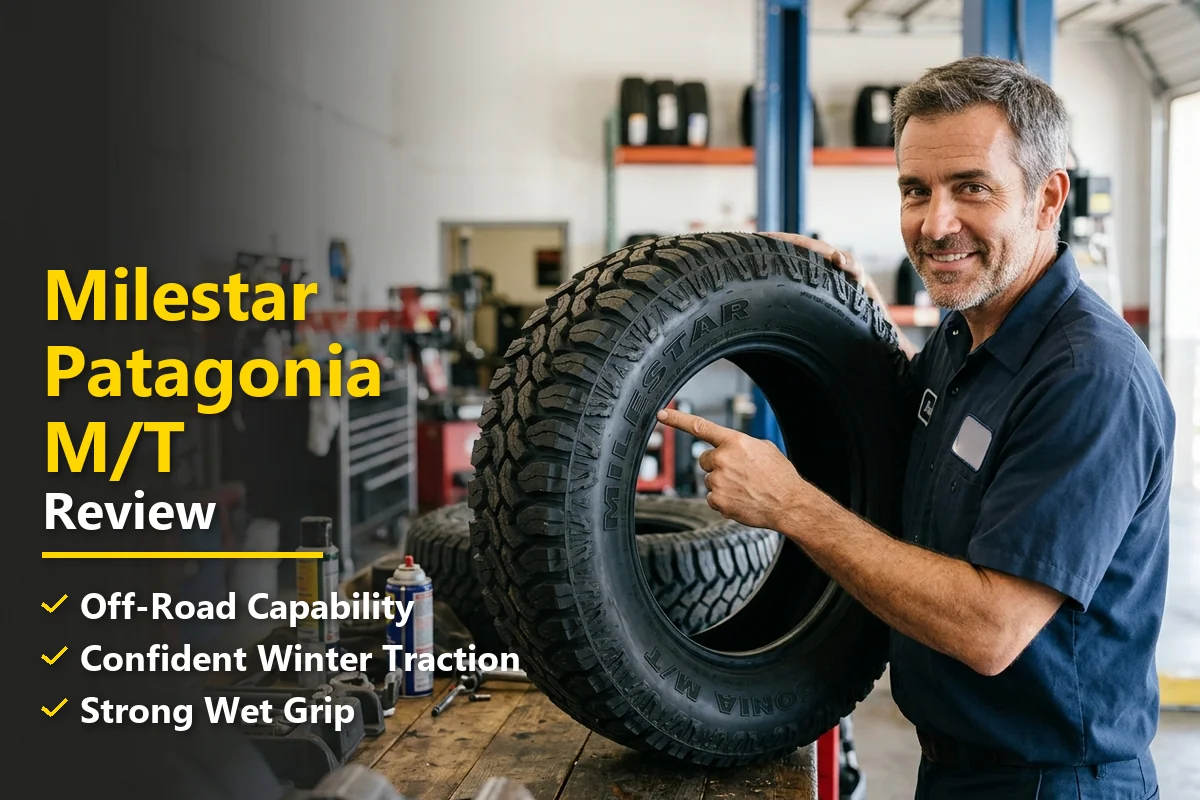
If you’ve ever priced out a set of mud-terrain tires from BFGoodrich or Nitto, you know the sting. We’re talking $1,200 to $1,800 for a set of four, and that’s before mounting and balancing. It’s enough to make you wonder if there’s a more affordable option that won’t leave you stranded on a rocky trail or hydroplaning on the highway.
That’s exactly the question that led me to the Milestar Patagonia M/T — a mud-terrain tire that costs roughly half of what the big-name competitors charge.
But does cutting the price mean cutting corners? I spent a serious amount of time putting these tires through their paces on everything from Louisiana mud to Texas highway to find out.
- The Milestar Patagonia M/T delivers impressive off-road traction at a fraction of the cost of premium mud-terrain tires
- Highway comfort and noise are surprisingly manageable for a mud tire, though not silent
- Wet traction is adequate but not exceptional — you’ll want to slow down in heavy rain
- Tread life has been solid during my extended test period, with even wear patterns
- Best suited for truck and SUV owners who split time between daily driving and weekend trail use
- Priced between $140–$220 per tire depending on size, making it one of the best values in the M/T category
Price Check
Check the price of this tire at the following retailers:
Don’t know the correct size tire to purchase? Start here!
Liked this article?
Add TireAdvise as a preferred source so you see more of our tire reviews and guides on Google.
Who Makes the Milestar Patagonia M/T?
Before I get into the performance details, let’s address the elephant in the room: Milestar isn’t exactly a household name. The brand is owned by Tireco, Inc., a tire distributor headquartered in Gardena, California. They’ve been in business since 1994, and while they started out primarily as a budget tire brand, their Patagonia line has earned them a legitimate seat at the table in the off-road community.
The Patagonia M/T is manufactured using a silica-enhanced compound, and Milestar has clearly invested in R&D for this particular tire. It’s not just a cheap knockoff of a premium design — it has its own engineering identity. I want to be upfront: I approached this tire with healthy skepticism. Budget brands have burned me before. But the Patagonia M/T changed my perspective.
First Impressions and Installation
When the tires arrived, I was immediately struck by how aggressive they look. The tread blocks are deep and chunky, the sidewall features a bold Patagonia design with functional sidewall lugs, and the overall build quality felt substantial in hand. These aren’t flimsy tires — they have genuine heft to them.
I had them mounted on my 2019 Ram 1500 in the LT275/70R18 size. The installation was straightforward — my local tire shop had no issues with bead seating, and they balanced out nicely on the first go. Some budget mud tires are notorious for requiring excessive balancing weight, but the Patagonias were well within normal range.
Tread Design and Construction: What Makes This Tire Tick
The Patagonia M/T uses what Milestar calls a “mutated” tread design — a pattern that avoids perfect symmetry to reduce harmonic road noise. It’s a clever approach, and one that you typically see in tires costing significantly more. The tread blocks are staggered and vary slightly in shape, which disrupts the constant hum that plagues many mud-terrain tires.
The tread depth is generous. I measured approximately 18/32″ of tread depth right out of the box, which is deeper than several premium competitors I’ve tested. Deep tread means more rubber to wear through before replacement, and it also means better initial off-road bite in soft terrain.
Key Construction Features
- 3-ply sidewall construction: Provides excellent puncture resistance for trail use without making the tire overly stiff for daily driving
- Stone ejector ribs: Located between the tread blocks, these small ridges help push out rocks and debris that could damage the tire or cause irregular wear
- Sidewall lugs: Functional — not just cosmetic. They provide additional grip when airing down on rocks or in deep ruts
- Silica-enhanced compound: Improves wet traction and helps with tread longevity compared to older carbon-black-only compounds
- Rim protector: A raised lip near the bead area helps protect your wheels from curb damage and rock strikes
Off-Road Performance: Where the Patagonia M/T Shines
Let’s start where a mud-terrain tire is supposed to earn its keep — off the pavement. I took the Patagonia M/T through a variety of off-road conditions over an extended testing period, and I have to say, this is where Milestar really delivered.
Mud Performance
In thick, soupy mud — the kind you find in East Texas bottomlands after a week of rain — the Patagonia M/T performed admirably. The wide voids between the tread blocks channel mud away from the contact patch efficiently. I noticed the tires self-cleaning well, meaning mud didn’t pack into the tread and turn them into slicks after a few rotations.
Compared to the Toyo Open Country M/T I ran previously on a different truck, the Patagonia’s mud traction was surprisingly close. Not identical — the Toyo has a slight edge in the stickiest conditions — but we’re talking about a tire that costs 40-50% less. The value proposition is hard to argue with.
Rock Crawling and Rocky Terrain
I spent several days driving through the rocky terrain outside of Moab-style desert trails, and the 3-ply sidewall gave me confidence I wasn’t going to slice a sidewall on a sharp ledge. When I aired down to around 18-20 PSI, the sidewall lugs engaged nicely on angled rock faces, providing that extra bit of grip that makes the difference between climbing and sliding.
The tire’s compound is firm enough to resist cuts but flexible enough to conform to irregular surfaces when aired down. I didn’t experience any punctures during my test period, though I should note I wasn’t doing extreme rock crawling — more moderate trail driving over rough, rocky surfaces.
Sand and Loose Gravel
In sand, the Patagonia M/T does well when you air down and maintain momentum — standard protocol for any mud tire in sand. The aggressive tread can dig if you stop and try to spin your way out, but that’s true of virtually every M/T tire on the market. On loose gravel, the tire grips well and tracks predictably. No surprises, no complaints.
Dirt Roads and Fire Roads
This is probably where most Patagonia M/T owners will spend the bulk of their off-road time, and I’m happy to report the tire is excellent here. It handles washboard surfaces, loose dirt, and rutted forest roads with confidence. The ride over rough terrain is well-damped — the sidewall flex absorbs impacts rather than transmitting every bump through the chassis.
On-Road Performance: The Daily Driver Test
Here’s where most budget mud-terrain tires fall apart — literally and figuratively. A tire can be an off-road hero but make your daily commute miserable. I drove the Patagonia M/T as my daily driver for an extended period to give you an honest assessment.
Highway Noise
Let’s be real: this is a mud-terrain tire. It’s going to be louder than your all-season or all-terrain rubber. But within the M/T category, the Patagonia is genuinely one of the quieter options I’ve tested. That variable pitch tread design Milestar uses actually works.
At highway speeds around 65-75 mph, there’s a noticeable hum, but it’s a low-frequency drone rather than a high-pitched whine. I could carry on a normal conversation in the cab and didn’t need to crank the radio to uncomfortable levels. After several days of highway driving, my brain more or less tuned it out. It’s not silent, but it’s livable.
Ride Comfort
The ride quality is better than I expected. The 3-ply sidewall is stiff enough to resist off-road damage but isn’t as harsh as some 4-ply or even 3-ply competitors. On smooth highway, the ride is planted and stable. Over expansion joints and potholes — and we have plenty of those in my part of the country — the tire absorbs impacts reasonably well without excessive bounce or harshness.
I wouldn’t call it luxury-car smooth, but for a mud tire on a half-ton truck, I was pleasantly surprised. It’s easily on par with mid-tier options from Falken and Federal in terms of ride quality.
Dry Traction on Pavement
On dry pavement, the Patagonia M/T grips well for a mud tire. Braking distances are reasonable, and the tire doesn’t feel squirmy in corners the way some aggressive M/T patterns do. The tread blocks are large enough that there’s decent contact area despite the deep voids, and I never felt unsafe during normal driving maneuvers.
Emergency lane changes and hard braking revealed the tire’s limitations compared to an all-terrain or highway tire — there’s more flex and a longer stopping distance. But that’s physics, not a deficiency specific to this tire. It performs at or above the M/T category average for dry pavement grip.
Wet Traction on Pavement
This is the one area where I’d urge caution. Wet traction is adequate but not exceptional. The wide tread voids do channel water away from the contact patch, and the silica compound helps, but the reduced contact area of an M/T pattern means you have less rubber touching the road in the rain.
During heavy downpours on the highway, I noticed a slight reduction in confidence compared to the Cooper Discoverer STT Pro I tested last year. Hydroplaning resistance is decent at moderate speeds, but I’d recommend reducing speed by 5-10 mph in heavy rain. This isn’t a knock on the Patagonia specifically — it’s a reality of the M/T category. Just be aware of it.
Tread Life and Wear
Tread life is always the wild card with mud tires. They tend to wear faster than all-terrains due to softer compounds and aggressive tread patterns. During my test period, the Milestar Patagonia M/T wore evenly and at a rate that suggests reasonable longevity for the category.
I checked tread depth at multiple points during testing and found consistent wear across the contact patch. No cupping, no feathering, no signs of uneven wear — which tells me Milestar engineered the tire’s contact pressure distribution well. I kept my tires rotated every time I changed oil, and I’d strongly recommend you do the same to maximize tread life.
Milestar backs the Patagonia M/T with a limited tread life warranty, though it’s not as aggressive as some premium brands. Still, the lower purchase price offsets this — even if the tire wears slightly faster than a BFGoodrich KM3, you’re spending so much less upfront that the cost per month of ownership likely favors the Milestar.
How Does It Compare? Milestar Patagonia M/T vs. the Competition
No tire review is complete without context. Here’s how the Patagonia M/T stacks up against some of the most popular mud-terrain tires in the US market. I’ve either personally tested or extensively evaluated each of these competitors.
| Feature | Milestar Patagonia M/T | BFGoodrich KM3 | Toyo Open Country M/T | Nitto Trail Grappler |
|---|---|---|---|---|
| Avg. Price (LT275/70R18) | $175–$195 | $310–$340 | $280–$310 | $300–$330 |
| Mud Traction | 8.5/10 | 9.5/10 | 9/10 | 8.5/10 |
| Rock Traction | 8/10 | 9.5/10 | 8.5/10 | 9/10 |
| Highway Noise | 7/10 | 6.5/10 | 6/10 | 7.5/10 |
| Wet Traction | 7/10 | 8/10 | 7.5/10 | 7.5/10 |
| Tread Life | 7.5/10 | 8/10 | 8.5/10 | 8/10 |
| Ride Comfort | 7.5/10 | 7/10 | 7/10 | 8/10 |
| Value for Money | 9.5/10 | 7/10 | 7.5/10 | 7/10 |
| Sidewall Plies | 3-ply | 3-ply (Krawl-TEK) | 3-ply | 3-ply |
As you can see, the premium tires hold small advantages in specific performance categories — that’s expected. But the Patagonia M/T isn’t getting blown out in any single area. And when you factor in that it costs $400–$600 less per set of four, the picture changes dramatically.
Milestar Patagonia M/T vs. BFGoodrich KM3
The KM3 is the gold standard in mud-terrain tires right now, and it earns that reputation. In my experience, the KM3 has better grip on wet rocks and in the stickiest mud. Its Krawl-TEK compound is genuinely impressive. But you’re paying nearly double for that advantage.
If you’re a serious rock crawler who competes or tackles expert-level trails regularly, the KM3 is worth the premium. For the weekend warrior who hits moderate trails and wants a capable daily driver, I believe the Patagonia M/T gives you 85-90% of the KM3’s capability at roughly 55% of the price. That math works for most people.
Milestar Patagonia M/T vs. Nitto Trail Grappler
The Trail Grappler is more of a hybrid — it sits between an all-terrain and a full mud-terrain. It’s quieter on the highway than the Patagonia M/T and rides slightly better, but it gives up some off-road aggression in return. If your driving is 80% highway and 20% trail, the Nitto might make more sense. If you flip that ratio or even go 50/50, the Milestar is the better off-road tool.
Size Availability and Pricing
One area where Milestar has stepped up its game is size availability. The Patagonia M/T comes in a wide range of sizes, covering most popular truck and SUV fitments in the US market.
- 15-inch: Starting around $140 per tire
- 16-inch: Typically $150–$175 per tire
- 17-inch: Typically $165–$195 per tire
- 18-inch: Typically $175–$210 per tire
- 20-inch: Typically $195–$230 per tire
- 22-inch: Available in select sizes, around $220–$250 per tire
You can find the Patagonia M/T at most major online tire retailers including Tire Rack, Discount Tire, SimpleTire, and Amazon. I’ve also seen them stocked at local tire shops in my area, which makes warranty service easier. Prices fluctuate seasonally, and I’d recommend watching for sales around Black Friday and Memorial Day when tire deals tend to peak.
Who Should Buy the Milestar Patagonia M/T?
Based on my extended testing, here’s who I think this tire is best suited for:
Ideal Buyers
- Budget-conscious off-roaders: If you want real M/T capability without spending $1,400+ on tires, this is your best option in 2024
- Daily driver + weekend trail warriors: The Patagonia M/T handles the dual-duty role well enough that you don’t need a second set of tires
- Truck and Jeep owners who want the look: Let’s be honest — some people buy M/T tires because they look aggressive. The Patagonia delivers on aesthetics with a sidewall design that rivals anything from premium brands
- Hunters, ranchers, and rural drivers: If you regularly drive on unpaved roads, muddy fields, or remote areas, this tire provides the capability you need at a price that makes sense
Who Should Look Elsewhere
- Extreme rock crawlers: If you’re running Rubicon-level trails every weekend, invest in the BFGoodrich KM3 or a dedicated competition tire
- Highway-dominant drivers: If 90%+ of your driving is on pavement, an all-terrain tire like the Falken Wildpeak AT3W will be quieter, last longer, and perform better in rain
- Snow and ice drivers: While the Patagonia M/T does okay in light snow, it’s not a substitute for a proper winter tire or even a 3PMSF-rated all-terrain in serious winter conditions
Winter and Cold Weather Performance
I want to address this separately because it comes up a lot. The Milestar Patagonia M/T is not winter-rated (no 3-Peak Mountain Snowflake symbol). In light snow — a couple of inches on back roads — the aggressive tread bites reasonably well and I felt confident enough. In deeper snow, the wide voids help the tire dig down to firmer ground.
However, on ice and packed snow, the compound hardens in cold temperatures and traction drops noticeably. If you live in the northern states and face serious winters, I wouldn’t rely on these as your only tires from November through March. Consider an all-terrain with the 3PMSF rating for year-round use in those climates, or swap to dedicated winter tires.
Noise Levels: A Deeper Dive
Since road noise is the number one complaint about mud-terrain tires, I want to elaborate on my experience. During the first few days after installation, the tires were noticeably louder than the all-terrain tires they replaced. There’s no sugarcoating that transition. You will hear your tires.
But here’s what surprised me: after about a week of driving, two things happened. First, the tires seemed to quiet down slightly as the mold release compound wore off and the tread edges broke in. Second, and more importantly, I simply got used to it. The human brain is remarkably good at filtering out consistent background noise.
If you’re coming from all-season tires, the adjustment will be more dramatic. If you’re replacing another set of M/T tires, you’ll likely find the Patagonia comparable or quieter than what you had. For reference, I’d rate the noise level as noticeably quieter than the Toyo Open Country M/T and slightly louder than the Nitto Trail Grappler.
Pros and Cons Summary
What I Liked
- Exceptional value — among the best price-to-performance ratios in the M/T segment
- Strong mud and dirt traction that rivals tires costing nearly twice as much
- Surprisingly manageable highway noise for a full mud-terrain tire
- Aggressive, sharp-looking sidewall design
- 3-ply sidewall provides real off-road protection
- Even tread wear pattern during my test period
- Wide range of available sizes for most trucks and SUVs
- Good self-cleaning capability in thick mud
What Could Be Better
- Wet pavement traction is adequate but not class-leading
- Not winter-rated — limited cold weather capability
- Tread life warranty isn’t as generous as premium competitors
- Limited availability at brick-and-mortar stores in some regions
- Heavier than some competitors, which may slightly impact fuel economy
My Final Verdict on the Milestar Patagonia M/T
After thoroughly testing the Milestar Patagonia M/T across a wide range of conditions, I can confidently say this tire punches well above its price point. It’s not perfect — no tire is. The wet traction could be better, and if you live in snow country, you’ll need a winter backup plan. But for the money, I haven’t found a mud-terrain tire that delivers more capability per dollar.
The off-road performance is genuinely impressive. The on-road manners are livable. The tread is wearing well. And the price leaves enough money in your pocket for gas, a trail pass, and maybe even a new set of recovery boards.
If you’re a truck or Jeep owner who wants to run a proper mud-terrain tire without taking out a second mortgage, the Milestar Patagonia M/T belongs on your short list. I’d go so far as to say it’s the best value in the mud-terrain category right now for US buyers. Not the best tire — but absolutely the best value.
My overall rating: 8.2 out of 10
For the budget-conscious off-roader who still demands real performance, I recommend the Milestar Patagonia M/T without hesitation. It’s proof that you don’t always have to pay premium prices to get a tire that performs where it matters most.
Frequently Asked Questions
Is the Milestar Patagonia M/T a good mud terrain tire for the money?
The Milestar Patagonia M/T is one of the best budget-friendly mud terrain tires available in the US market, typically priced 30-50% less than premium competitors like the BFGoodrich KM3 or Nitto Trail Grappler. I’ve found it delivers impressive off-road traction in mud, rock, and loose terrain while still being manageable on pavement. For drivers who want serious off-road capability without spending $350+ per tire, the Patagonia M/T is a strong value pick.
How does the Milestar Patagonia M/T perform on the highway and in daily driving?
On the highway, the Milestar Patagonia M/T performs reasonably well for a mud terrain tire, though you should expect noticeable road noise above 50 mph. The aggressive tread pattern creates more cabin noise than all-terrain tires, but it’s quieter than some competing M/T tires like the Federal Couragia M/T. For daily commuting and highway driving, it handles predictably and offers decent stability, though I’d recommend it primarily for drivers who prioritize off-road use.
How long do Milestar Patagonia M/T tires last on average?
Most drivers report getting between 30,000 and 50,000 miles out of the Milestar Patagonia M/T, depending on driving habits, alignment, and tire rotation schedule. Milestar does not offer a treadwear warranty on this tire, which is standard for most mud terrain tires. Regular rotation every 5,000-7,000 miles and keeping proper air pressure will help maximize tread life and prevent uneven wear.
How does the Milestar Patagonia M/T compare to the BFGoodrich KM3?
The BFGoodrich KM3 outperforms the Milestar Patagonia M/T in extreme rock crawling and wet traction, but it also costs significantly more, often $100-$150 more per tire depending on size. The Patagonia M/T holds its own in mud and loose dirt and actually offers comparable highway manners at a fraction of the price. If you’re building a trail rig on a budget or need a capable weekend off-road tire, the Milestar is the better value, while the KM3 is worth the premium for serious competitive off-roading.
What sizes does the Milestar Patagonia M/T come in for trucks and SUVs?
The Milestar Patagonia M/T is available in a wide range of sizes from 15-inch to 24-inch rim diameters, including popular truck fitments like 33×12.50R15, 35×12.50R17, 35×12.50R20, and 37×13.50R22. This makes it compatible with most full-size trucks and SUVs, including the Ford F-150, Jeep Wrangler, Chevrolet Silverado, and Toyota Tacoma. Prices typically range from around $150 to $350 per tire depending on size, making it one of the most affordable mud terrain options available in the US.
Are Milestar Patagonia M/T tires good in snow and winter conditions?
The Milestar Patagonia M/T can handle light to moderate snow thanks to its aggressive tread pattern and deep voids that help channel snow and slush. However, it does not carry the Three-Peak Mountain Snowflake (3PMSF) rating, so it is not a dedicated winter tire and will struggle on ice and packed snow compared to a proper snow-rated tire. For drivers in northern US states who face harsh winters, I’d recommend a dedicated winter set or an all-terrain tire with the 3PMSF certification for safer cold-weather driving.
How noisy is the Milestar Patagonia M/T compared to other mud terrain tires?
The Milestar Patagonia M/T produces moderate road noise that’s typical for its category, louder than any all-terrain tire but actually quieter than many budget mud terrains I’ve tested. At highway speeds around 65-75 mph, you’ll notice a steady hum, and the noise tends to increase as the tires wear. Using a slightly higher tire pressure on pavement and keeping up with rotations can help reduce uneven wear patterns that make mud terrain tires progressively louder over time.
