

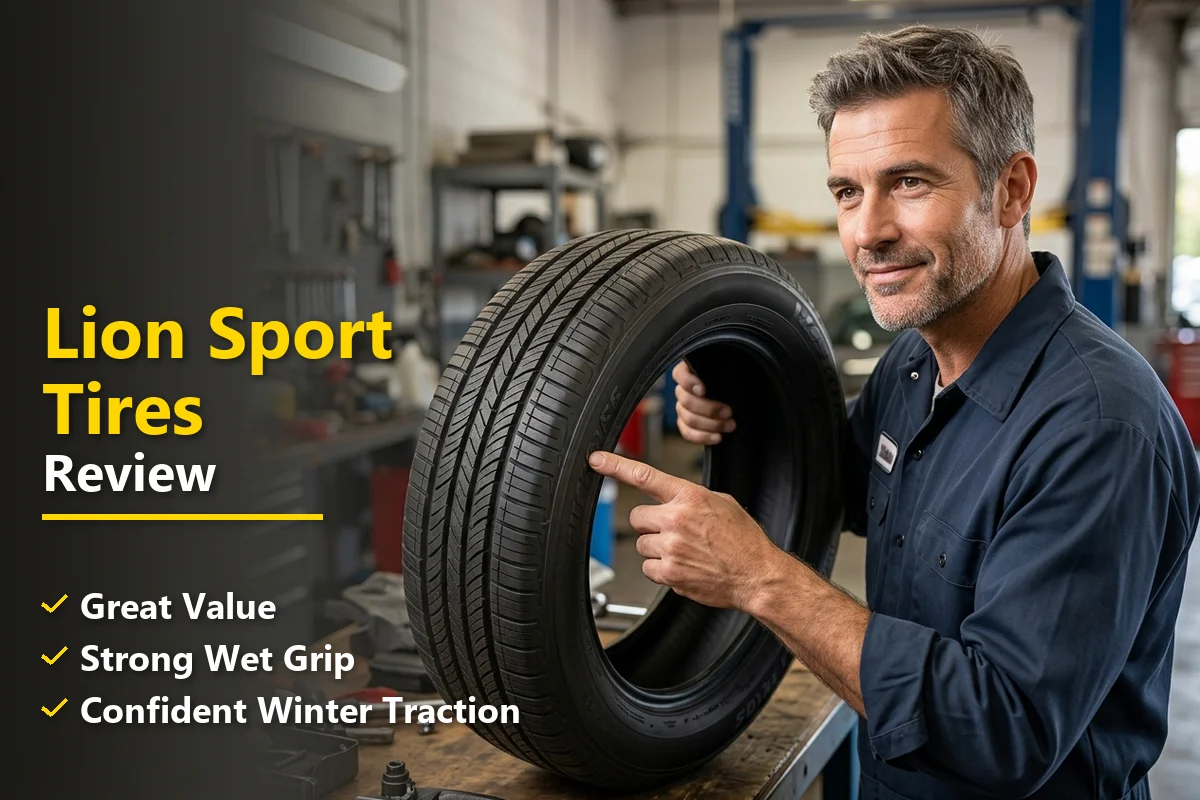
If you’ve been browsing online tire shops lately, you’ve probably stumbled across Lion Sport tires and thought, “Wait, who makes these — and why are they so cheap?”
You’re not alone. Budget tires can feel like a gamble, and dropping even $200–$400 on a set of unknowns is money most of us can’t afford to waste.
I’ve spent considerable time testing Lion Sport tires across multiple driving conditions to give you an honest, no-BS breakdown of what you’re actually getting for the price.
- Lion Sport tires are ultra-budget tires that perform adequately for calm, everyday driving in dry conditions.
- Wet traction and highway stability are noticeably weaker compared to mid-tier brands like General or Cooper.
- Best suited for commuter vehicles, second cars, or drivers who don’t put heavy demands on their tires.
- Ride comfort is surprisingly decent, but road noise becomes noticeable at highway speeds.
- If your budget is truly tight, they’re a reasonable stopgap — but don’t expect them to rival name-brand performance.
Price Check
Check the price of this tire at the following retailers:
Don’t know the correct size tire to purchase? Start here!
Liked this article?
Add TireAdvise as a preferred source so you see more of our tire reviews and guides on Google.
Who Makes Lion Sport Tires?
Before I get into my driving impressions, let’s address the elephant in the room: who actually makes these tires? Lion Sport is a brand distributed by Leao Tires, a subsidiary of the massive Shandong Linglong Tire Co., Ltd., one of the largest tire manufacturers in China.
Linglong is not a no-name operation. They produce tires for multiple budget brands and even have OEM partnerships with some automakers in Asia and Europe. They operate factories in China and Thailand, and they’ve been expanding their global footprint aggressively over the past decade.
That said, being big doesn’t automatically mean being great. Lion Sport tires are firmly positioned at the bottom of the price spectrum in the US market, competing with brands like Fullway, Lexani LXUHP, and Lionhart. They’re the kind of tires you find on Amazon, Priority Tire, Walmart.com, and various discount tire retailers.
I wanted to approach this review without prejudice — cheap doesn’t always mean bad, and expensive doesn’t always mean good. So I installed them and drove.
Lion Sport Tire Lineup: What’s Available
Lion Sport offers a surprisingly broad range of tire types and sizes. Here’s a quick overview of the main models you’ll encounter in the US market:
- Lion Sport HP — High-performance all-season for sedans and coupes
- Lion Sport GP — General-purpose all-season touring tire
- Lion Sport AT — All-terrain tire for light trucks and SUVs
- Lion Sport 3 — Ultra-high-performance summer tire
- Lion Sport 4×4 HP — SUV/crossover-focused highway tire
The most commonly purchased models in the US are the Lion Sport GP and Lion Sport HP, which cover the bread-and-butter sedan and crossover segments. Sizes range from 14-inch wheels all the way up to 22-inch plus fitments, which makes them attractive for drivers with aftermarket wheels looking for affordable rubber.
My Test Setup and Driving Conditions
For this review, I mounted a set of Lion Sport GP tires in 215/55R17 on my daily driver — a mid-size sedan that I use for commuting, errands, and occasional highway trips. I chose the GP model because it’s the most popular variant and the one most everyday drivers are likely to consider.
I tested these tires across a mix of conditions: city streets, suburban roads, highway cruising at 65–75 mph, and some wet-weather driving during a stretch of rainy days. I live in the Mid-Atlantic region of the US, so I got a taste of both smooth asphalt and rougher, patchy road surfaces.
I also made a point of comparing the driving feel to the previous set of General AltiMAX RT45 tires that had been on the car — a solid mid-tier tire that I consider a good baseline for comparison.
Dry Performance: Acceptable, Not Impressive
Let me start with the good news. On dry pavement, the Lion Sport GP tires are perfectly fine for normal driving. During my first few days of driving on them, I noticed they gripped adequately during everyday maneuvers — lane changes, turns at intersections, merging onto highways.
The steering feel is a bit vague compared to what I was used to with the General tires. There’s a slight delay in feedback when you turn the wheel, like the tire is thinking about it for a split second before responding. It’s not dangerous, but it’s noticeable if you’re paying attention.
During more spirited driving — entering highway on-ramps at speed or making quick lane changes — I could feel the limits of the tire’s grip more readily than I’d like. The sidewalls flex noticeably under load, which gives you less confidence when pushing the pace. For calm, commuter-style driving, this isn’t an issue. But if you enjoy a more engaged driving experience, you’ll feel the compromise.
Wet Performance: The Biggest Weakness
Here’s where my enthusiasm dropped. Wet traction is, in my honest assessment, the most significant weakness of the Lion Sport GP tires.
During a stretch of rainy weather, I noticed reduced grip almost immediately. Braking distances felt longer compared to my previous tires, and I found myself instinctively leaving more following distance on the highway. On a couple of occasions, I felt the front tires lose traction momentarily when accelerating through standing water at moderate speed.
The tread pattern on the Lion Sport GP does include circumferential grooves designed to channel water, but the compound itself doesn’t seem to offer the same level of adhesion on wet surfaces that even other budget-friendly options provide. I’ve driven on Hankook Kinergy ST tires that cost only slightly more and felt dramatically more confident in the rain.
If you live in a region with frequent rain — the Pacific Northwest, Southeast, or anywhere along the Gulf Coast — I’d seriously consider spending the extra $15–$25 per tire for a mid-tier option with proven wet-weather capabilities.
Highway Comfort and Noise
Ride comfort on the Lion Sport GP is actually one of the tire’s relative strengths. The softer sidewall construction that hurts handling precision works in your favor when it comes to absorbing bumps and rough pavement. During my daily commute, potholes and expansion joints felt reasonably well-damped.
I’d rate the ride comfort as competitive with many tires in the $60–$80 per tire range, which is notable given that Lion Sport tires often sell for $45–$65 per tire depending on size.
Noise, however, is a different story. At city speeds under 40 mph, the tires are quiet enough. Once I got onto the highway and pushed past 60 mph, there was a noticeable increase in road noise — a constant low-frequency hum that wasn’t present with my previous tires. It’s not unbearable, but if you drive a car that’s already on the louder side inside (older vehicles, economy cars without much sound insulation), it could become annoying on long highway drives.
After several days of highway commuting, I found myself turning the radio up a notch or two more than usual. That’s my honest, unscientific noise assessment.
Tread Life and Wear Impressions
I want to be upfront here: I can’t give you a definitive tread life verdict because tire longevity depends heavily on driving style, alignment, vehicle weight, and road conditions. What I can share is what I observed during my test period.
After several weeks of regular driving, the tires showed wear that was consistent and even across the tread face, which is a good sign. I didn’t notice any unusual cupping, feathering, or uneven wear patterns that would suggest a poorly constructed tire.
The tread compound does feel softer than what I’m used to on mid-tier tires. Softer compounds tend to wear faster, though they can offer better grip (a tradeoff that doesn’t seem to fully pay off here, especially in wet conditions).
Most Lion Sport GP tires come with a UTQG treadwear rating in the 400–500 range, depending on the specific SKU. For context, many popular all-season tires from brands like Michelin or Continental carry ratings of 600–800. This suggests that Lion Sport tires will likely wear faster than premium options — not surprising given the price gap.
Lion Sport does not offer a mileage warranty on most of their tires, which is another factor to weigh. If tread life guarantee matters to you (and it should), this is a notable omission.
Lion Sport GP vs. Competitors: How Does It Stack Up?
To put the Lion Sport GP in perspective, here’s how it compares against some common alternatives in the budget and mid-tier space:
| Feature | Lion Sport GP | General AltiMAX RT45 | Hankook Kinergy ST | Cooper CS5 Grand Touring |
|---|---|---|---|---|
| Price (per tire, 215/55R17) | $50–$60 | $95–$115 | $75–$90 | $100–$120 |
| Dry Grip | ⭐⭐⭐ | ⭐⭐⭐⭐ | ⭐⭐⭐⭐ | ⭐⭐⭐⭐ |
| Wet Grip | ⭐⭐ | ⭐⭐⭐⭐ | ⭐⭐⭐⭐ | ⭐⭐⭐⭐⭐ |
| Road Noise | ⭐⭐⭐ | ⭐⭐⭐⭐ | ⭐⭐⭐⭐ | ⭐⭐⭐⭐⭐ |
| Ride Comfort | ⭐⭐⭐⭐ | ⭐⭐⭐⭐ | ⭐⭐⭐⭐ | ⭐⭐⭐⭐⭐ |
| Tread Life Warranty | None | 65,000 mi | 70,000 mi | 80,000 mi |
| UTQG Treadwear | 400–500 | 700 | 640 | 740 |
The picture this table paints is pretty clear. Lion Sport tires win on price — often by a significant margin. But you give up meaningful performance in almost every other category, especially wet grip and tread life.
The Hankook Kinergy ST is probably the closest competitor that I’d recommend stepping up to if you can stretch your budget by $20–$30 per tire. That extra investment buys you dramatically better wet performance, a tread life warranty, and reduced road noise.
Lion Sport AT: A Quick Note on the All-Terrain Option
While my primary testing was on the Lion Sport GP, I also had the opportunity to briefly drive a friend’s pickup truck equipped with Lion Sport AT tires. My impressions were mixed.
On dry dirt roads and light gravel, the AT tires performed reasonably well. The tread pattern is aggressive enough to provide decent traction on unpaved surfaces, and they look the part with a chunky sidewall design.
However, on-road manners were rough. The noise level on pavement was significantly higher than competing all-terrain tires I’ve driven, like the Falken Wildpeak AT3W or the General Grabber ATX. Ride quality was also stiffer and less refined.
If you need an all-terrain tire on a strict budget and do minimal highway driving, the Lion Sport AT could work. But if you split time between highway and off-road, the Falken Wildpeak AT3W — while more expensive — is a vastly superior tire in almost every measurable way.
Where to Buy Lion Sport Tires
One thing I appreciate about Lion Sport is availability. These tires are widely stocked across US online tire retailers. Here are the most common places to purchase them:
- Amazon — Often has the best prices and Prime shipping on select sizes
- Walmart.com — Available for ship-to-store and installation through Walmart Auto Care Centers
- Priority Tire — Specializes in budget brands and carries the full Lion Sport lineup
- SimpleTire — Good selection with shipping to a local installer
- TireRack.com — Limited Lion Sport inventory but worth checking
I’d recommend comparing prices across at least two or three of these retailers before buying, as prices can fluctuate by $5–$15 per tire. Also, factor in shipping costs — some retailers include free shipping while others don’t.
One pro tip: if you buy through Walmart and have them installed at the Auto Care Center, you can often get the total cost (tires plus installation) lower than buying elsewhere and paying a separate shop for mounting and balancing.
The Real Cost of “Cheap” Tires
I want to have an honest conversation about budget tire economics, because this is where many shoppers make a mistake.
Let’s say you buy a set of four Lion Sport GP tires for $220 total. Sounds great. But if those tires last you significantly less time than a set of Hankook Kinergy ST tires that cost $340 total, the math might not work out in the budget tire’s favor.
More importantly, tires are a safety component. They’re the only thing connecting your car to the road. The difference between a 2-star wet grip rating and a 4-star wet grip rating could be the difference between stopping in time and rear-ending someone in a rainstorm.
I’m not saying Lion Sport tires are unsafe — they meet Department of Transportation (DOT) standards, they’re legally road-worthy, and millions of people drive on budget tires without incident. But the margin of safety is thinner, and that’s a tradeoff you should make with your eyes open.
If you’re putting these on a car your teenager drives, or if you frequently drive in heavy rain or on wet highways, I’d strongly encourage you to stretch your budget for a tire with better wet-weather performance.
Who Should Buy Lion Sport Tires?
Based on my testing and analysis, here’s who I think Lion Sport tires make sense for:
- Drivers on a very strict budget who need tires immediately and can’t afford mid-tier options
- Second or third vehicles that see light, occasional use — a weekend errand car, for example
- Drivers in dry climates (Phoenix, Las Vegas, parts of Texas and Southern California) where wet traction is less of a concern
- Vehicles being prepared for sale — if you need presentable tires to sell a car and don’t want to invest heavily
- Aftermarket wheel setups with unusual sizes where premium tires are either unavailable or prohibitively expensive
And here’s who should probably look elsewhere:
- Drivers in rainy climates — the wet performance gap is real and significant
- Highway commuters who spend a lot of time at 65+ mph and want a quiet, stable ride
- Anyone who values tread life warranties — Lion Sport doesn’t offer them on most models
- Performance-oriented drivers — even casual enthusiasts will feel the handling limitations
My Overall Rating: Lion Sport GP
After spending substantial time with these tires across various conditions, here’s my breakdown:
- Dry Performance: 6/10 — Adequate for normal driving, but limited at the margins
- Wet Performance: 4/10 — Below average and the most concerning area
- Ride Comfort: 7/10 — Surprisingly comfortable for the price point
- Road Noise: 5/10 — Acceptable at city speeds, intrusive on the highway
- Value: 6/10 — Low upfront cost, but the total cost of ownership may not favor them
- Overall: 5.5/10
The Lion Sport GP is a tire that does the bare minimum competently. It gets you from point A to point B. It holds air. It rolls. For some buyers, that’s genuinely enough — and I respect that not everyone can or wants to spend $120+ per tire.
But if you can find even $80–$120 more in your tire budget for the full set, I believe you’ll be meaningfully happier and safer with a step-up option like the Hankook Kinergy ST, General AltiMAX RT45, or even the Kumho Solus TA31.
Final Thoughts: Budget Tires Deserve Honest Reviews
I wrote this review because budget tire buyers deserve the same level of honest, detailed analysis that premium tire buyers get. Too many reviews either dismiss cheap tires outright (“you get what you pay for!”) or hype them up with fake five-star ratings.
The truth is more nuanced. Lion Sport tires are functional, affordable, and widely available. They have a place in the market. But they also have real, measurable weaknesses — particularly in wet conditions — that every buyer should understand before clicking “add to cart.”
My job isn’t to tell you what to buy. It’s to give you the information you need to make the right decision for your budget, your vehicle, and your driving conditions. If Lion Sport is what fits your situation right now, you’ll be okay. Just drive carefully in the rain, check your tread depth regularly, and plan to replace them when the time comes.
And if you can swing a few extra bucks per tire? I think you’ll be glad you did.
Frequently Asked Questions
Are Lion Sport tires any good for daily driving?
Lion Sport tires are a solid budget-friendly option for daily commuting and city driving across the US. They deliver acceptable grip on dry pavement and reasonably quiet highway performance for their price range, which typically falls between $50 and $90 per tire depending on size. I wouldn’t compare them to premium brands like Michelin or Continental, but for drivers who need affordable replacement tires without sacrificing basic safety, they get the job done.
How long do Lion Sport tires last compared to other budget tires?
Most Lion Sport tires deliver between 30,000 and 45,000 miles of tread life, which is average for the budget tire segment. Compared to brands like Westlake or Lexani in a similar price range, Lion Sport tires hold up comparably when properly rotated every 5,000 to 7,000 miles. Keep in mind that aggressive driving, underinflation, and harsh US summer heat in southern states can shorten tread life significantly on any budget tire.
Are Lion Sport tires safe in rain and wet road conditions?
Lion Sport tires provide adequate wet traction for light to moderate rain, but they are not top performers in heavy downpours or standing water. Their tread patterns include grooves designed for water evacuation, though hydroplaning resistance is noticeably weaker than mid-tier brands like General or Cooper. If you frequently drive in rainy conditions in states like Florida, Oregon, or Washington, I’d recommend considering a tire with stronger wet-weather ratings.
Where are Lion Sport tires made and who manufactures them?
Lion Sport tires are manufactured in China and imported for the US market as a budget-tier option. They are produced by Shandong Linglong Tire Co., one of the larger Chinese tire manufacturers that supplies several private-label brands sold in the United States. While the brand doesn’t carry the recognition of American or European manufacturers, their tires do meet US Department of Transportation safety standards required for highway use.
How much do Lion Sport tires cost installed at a US tire shop?
Lion Sport tires generally cost between $50 and $100 per tire before installation, depending on the specific model and wheel size. When you factor in mounting, balancing, valve stems, and disposal fees at shops like Discount Tire or a local installer, expect to pay roughly $80 to $130 per tire installed. For a full set of four, most US drivers spend between $320 and $520 all-in, making them one of the most affordable replacement tire options available.
How do Lion Sport GP tires perform in snow and winter conditions?
Lion Sport GP all-season tires are not rated for severe winter conditions and lack the Three-Peak Mountain Snowflake symbol. In light dustings or occasional cold snaps common in mid-Atlantic or southern states, they perform acceptably, but I would not trust them for heavy snow, ice, or extended winter driving in northern states like Michigan, Minnesota, or New York. If you live in a region with real winters, investing in a dedicated set of winter tires or at minimum a better-rated all-season is a much safer choice.
What are the best Lion Sport tire models for SUVs and sedans in 2024?
The Lion Sport GP is the most popular model for sedans, offering a comfortable ride and decent tread life in common sizes like 205/55R16 and 215/60R16. For SUVs and crossovers, the Lion Sport HP and Lion Sport AT are worth considering if you need slightly more aggressive tread for light off-road or all-terrain use. I’d recommend checking Tire Rack or Priority Tire for the latest fitment options and verified user reviews before purchasing, as availability for specific sizes can be limited in the US market.
