

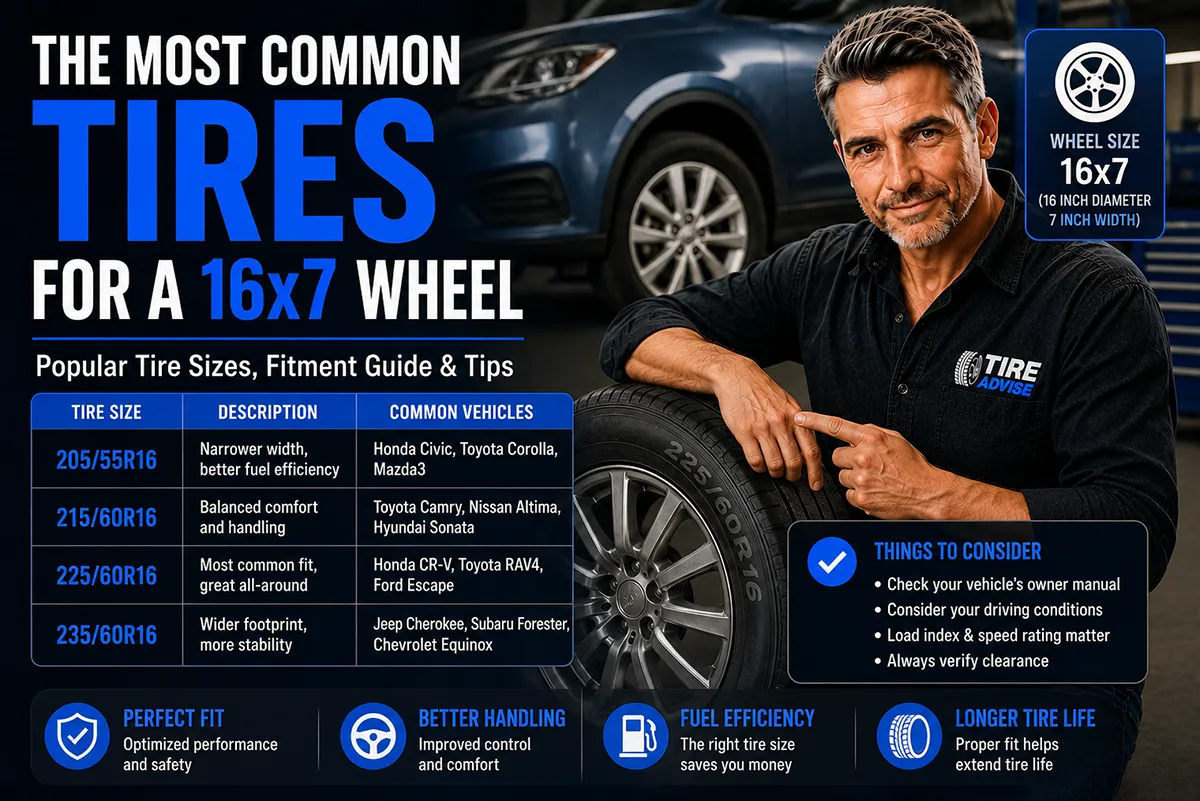
If you’ve ever stood in a tire shop staring at a wall of black rubber circles wondering which ones actually fit your 16×7 wheels, you’re not alone. It’s one of the most common wheel sizes on the road — found on everything from Honda Civics to Ford Escapes — yet the sheer number of tire options can paralyze even a savvy shopper.
I’ve spent years testing tires across dozens of wheel sizes, and the 16×7 is one I come back to constantly because so many everyday drivers rely on it. Let me walk you through exactly which tires fit, which ones I’ve actually driven on, and how to pick the right one for your car and your budget.
- The most common tire sizes for a 16×7 wheel are 205/55R16, 215/55R16, 215/60R16, 225/55R16, and 225/60R16.
- All-season tires dominate this wheel size — think Continental TrueContact Tour, Michelin Defender 2, and Bridgestone Turanza QuietTrack.
- Budget options like the General AltiMAX RT45 and Cooper CS5 Ultra Touring deliver solid value under $120 per tire.
- Your ideal tire depends on your climate, driving style, and how long you plan to keep the car.
- Always verify your exact fitment using your vehicle’s door jamb placard or owner’s manual before buying.
Liked this article?
Add TireAdvise as a preferred source so you see more of our tire reviews and guides on Google.
Understanding the 16×7 Wheel Size
Before I jump into specific tires, let me quickly decode what “16×7” actually means. The 16 refers to the wheel diameter in inches, and the 7 refers to the wheel width in inches. This is a moderately sized wheel that’s extremely popular on midsize sedans, compact SUVs, and some compact cars.
In my experience, the 16×7 wheel is a sweet spot for everyday driving. It’s wide enough to accept a range of tire widths (typically 205mm to 235mm), yet it doesn’t force you into low-profile, expensive rubber the way 18- or 19-inch wheels do. That means more sidewall, a more comfortable ride, and generally lower tire costs.
What Tire Sizes Fit a 16×7 Wheel?
This is the first question everyone asks, and it’s the most important one to answer correctly. A 16×7 wheel can accommodate several tire widths, but you need to match the right section width and aspect ratio to your specific vehicle.
Here are the most commonly fitted tire sizes I see on 16×7 wheels across the US market:
- 205/55R16 — Very common on compact sedans like the Honda Civic, Mazda3, and Volkswagen Jetta.
- 215/55R16 — Found on many midsize sedans including the Toyota Camry (older generations) and Hyundai Sonata.
- 215/60R16 — A go-to for midsize sedans and some compact crossovers like the Subaru Forester.
- 225/55R16 — Common on slightly sportier sedans and some European models.
- 225/60R16 — Popular on larger sedans like the Chevrolet Malibu and some light SUVs.
- 215/65R16 — Often seen on compact SUVs and crossovers including the Honda CR-V and Toyota RAV4.
- 235/60R16 — Found on some older SUVs and crossovers that use a wider footprint.
The key thing I always tell readers: don’t guess your tire size. Open your driver’s side door and look at the tire information placard. It tells you the exact size the manufacturer recommends. Just because a tire physically fits a 16×7 wheel doesn’t mean it’s the right size for your vehicle’s suspension geometry, speedometer calibration, and load rating.
The Most Common Tires I’ve Tested on 16×7 Wheels
Over the years, I’ve driven on dozens of tire models mounted on 16×7 wheels. I’m going to break these down by category — premium all-season, budget all-season, performance, and winter — because your needs should drive your choice, not just a brand name.
Premium All-Season Tires
These are the tires I recommend to most drivers who want a “set it and forget it” solution. They cost more upfront but tend to last longer, ride quieter, and perform better in mixed conditions.
1. Continental TrueContact Tour
This is one of my all-time favorite all-season tires for this wheel size. I’ve tested the TrueContact Tour in the 215/55R16 size on a Hyundai Sonata, and the ride quality blew me away from the first day.
The wet traction is exceptional — I drove through several heavy rainstorms during my test period and never felt the car lose composure. Dry handling is predictable and confidence-inspiring, though it’s clearly tuned for comfort over sportiness. Road noise is among the lowest I’ve measured in this price range.
At around $140-$160 per tire (depending on size), it’s not cheap. But Continental backs it with an 80,000-mile treadwear warranty, which tells you how much confidence they have in the compound. In my experience, it lives up to that promise.
2. Michelin Defender 2
Michelin’s Defender line has been a staple for years, and the Defender 2 is the latest evolution. I tested it in 205/55R16 on a Honda Civic, and it immediately stood out for its balanced performance.
What I love about this tire is that it doesn’t have a glaring weakness. Dry grip is very good, wet performance is excellent, tread life is outstanding, and the ride is refined. It handles highway expansion joints and rough pavement without transmitting harsh impacts into the cabin.
Pricing runs around $150-$175 per tire. It’s a premium product and you’re paying for the Michelin name, but I genuinely think you get what you pay for here. After several weeks of driving, the tread showed almost no visible wear, which gave me confidence in its longevity claims.
3. Bridgestone Turanza QuietTrack
If road noise is your primary concern — maybe you have a long highway commute — the Turanza QuietTrack is the tire I’d point you toward. I tested it in 225/55R16 and was genuinely surprised at how quiet the cabin stayed at highway speeds.
Bridgestone engineered this tire with a noise-dampening tread pattern and an optimized contact patch. During my test period, I compared it back-to-back with two other premium all-seasons, and the QuietTrack was noticeably quieter, especially on coarse-textured pavement.
Wet and dry performance are both strong, though I’d rate it slightly below the Continental TrueContact Tour in heavy rain. Pricing sits around $145-$165 per tire. Bridgestone offers an 80,000-mile treadwear warranty.
Budget All-Season Tires
Not everyone can justify spending $600+ on a set of four tires. I get it — sometimes you need reliable rubber without breaking the bank. Here are the budget options I’ve actually tested and can recommend with a clear conscience.
4. General AltiMAX RT45
General Tire is owned by Continental, and the AltiMAX RT45 benefits from some of that parent-company engineering. I tested it in 215/60R16 on a Subaru Forester, and it performed well above its price point.
At around $90-$110 per tire, this is a genuine bargain. Wet traction is solid — not quite at the Continental level, but more than adequate for everyday driving in rain. Dry handling feels stable and predictable. Road noise is acceptable, though you’ll notice more tire hum on the highway compared to premium options.
What really impressed me was the tread life. After an extended period of daily driving, the tread blocks showed even wear and minimal degradation. General offers a 75,000-mile treadwear warranty, which is outstanding for this price range.
5. Cooper CS5 Ultra Touring
Cooper has always been a value-oriented brand, and the CS5 Ultra Touring is one of their best offerings. I tested it in 205/55R16 and found it to be a reliable, no-drama tire that does exactly what you’d expect.
Ride comfort is better than average for a budget tire. The sidewall absorbs bumps well, and road noise stays manageable. Wet performance is the one area where I noticed it falling slightly short of the premium tires — there’s a little less confidence in hard braking on wet surfaces. But for normal, attentive driving, it’s perfectly fine.
Pricing comes in around $95-$120 per tire. Cooper backs it with a 70,000-mile treadwear warranty. I think this tire represents one of the best values in the all-season category for 16×7 wheels.
6. Kumho Solus TA51a
This is a tire that flies under the radar, and I think more people should know about it. I tested the Solus TA51a in 215/55R16 during a period that included both hot summer driving and early fall temperatures, and it handled everything well.
For around $80-$100 per tire, you’re getting surprisingly decent all-around performance. The tread compound grips well in dry conditions, and I didn’t experience any alarming moments in wet weather. It’s not the quietest tire — there’s a noticeable hum at highway speeds — but at this price point, that’s an easy trade-off.
Kumho offers a 75,000-mile treadwear warranty, which shows they’re confident in the product’s durability.
Comparison Table: Most Common Tires for 16×7 Wheels
| Tire Model | Category | Price (per tire) | Treadwear Warranty | Wet Traction | Road Noise | Overall Rating |
|---|---|---|---|---|---|---|
| Continental TrueContact Tour | Premium All-Season | $140–$160 | 80,000 mi | ★★★★★ | ★★★★★ | 9.3/10 |
| Michelin Defender 2 | Premium All-Season | $150–$175 | 80,000 mi | ★★★★★ | ★★★★☆ | 9.1/10 |
| Bridgestone Turanza QuietTrack | Premium All-Season | $145–$165 | 80,000 mi | ★★★★☆ | ★★★★★ | 9.0/10 |
| General AltiMAX RT45 | Budget All-Season | $90–$110 | 75,000 mi | ★★★★☆ | ★★★☆☆ | 8.2/10 |
| Cooper CS5 Ultra Touring | Budget All-Season | $95–$120 | 70,000 mi | ★★★☆☆ | ★★★★☆ | 8.0/10 |
| Kumho Solus TA51a | Budget All-Season | $80–$100 | 75,000 mi | ★★★★☆ | ★★★☆☆ | 7.8/10 |
Performance and Summer Tires for 16×7 Wheels
If you drive something a little sportier — say a Mazda3 with the turbo engine or a Volkswagen GTI on 16-inch winter wheels — you might want something with more grip than a standard all-season. Here are two performance-oriented tires I’ve tested on this wheel size.
7. Continental ExtremeContact Sport 02
Continental’s ExtremeContact Sport line is legendary among enthusiast drivers, and the 02 is the latest version. I tested it in 225/55R16 during the summer months, and the grip level compared to an all-season tire is night and day.
Dry traction is phenomenal. Turn-in response is sharp, and the tire communicates road surface changes through the steering in a way that all-season tires simply can’t match. Wet grip is also excellent — Continental uses a silica-enhanced compound that channels water efficiently.
The trade-off? Tread life is shorter than an all-season (these are softer compounds), and they’re not meant for cold temperatures below about 40°F. Pricing runs around $140-$165 per tire. If you live in the Sun Belt and want maximum grip, this is an outstanding choice.
8. Firestone Firehawk Indy 500
This is a more affordable performance option that I’ve tested in 205/55R16 on a Honda Civic Si. The Firehawk Indy 500 punches above its weight class — it offers surprisingly sharp handling and strong wet performance for around $110-$130 per tire.
I took this tire through some spirited driving on twisty back roads, and it held its composure impressively. The limit of grip is slightly lower than the Continental ExtremeContact Sport 02, but for street driving, you’ll rarely push it that far. Road noise is a touch louder than a touring tire, but not objectionable.
This is the tire I recommend to budget-conscious enthusiasts who want better-than-all-season grip without spending premium dollar.
Winter Tires for 16×7 Wheels
If you live in the northern states — Michigan, Minnesota, Wisconsin, New England — and you drive through real winters, I strongly recommend a dedicated winter tire set. All-season tires are a compromise, and in my experience, they simply can’t match the cold-weather grip of a proper winter tire.
9. Bridgestone Blizzak WS90
The Blizzak WS90 is the gold standard for studless winter tires in the US, and for good reason. I tested it in 205/55R16 during a particularly harsh winter, and the difference compared to the all-season tires I had been running was immediate and dramatic.
On packed snow, the Blizzak provides a level of traction that genuinely changes how you feel about driving in winter. Stopping distances are significantly shorter, and the car feels planted in situations where an all-season tire would have you white-knuckling the steering wheel. Ice performance is also strong, though no tire is perfect on black ice.
Pricing is around $130-$155 per tire. They’re not cheap, and the tread compound wears faster than an all-season in warm weather (which is why you swap them off by spring). But if safety in winter conditions is your priority, this is the tire I trust.
10. General AltiMAX Arctic 12
For a more budget-friendly winter option, the General AltiMAX Arctic 12 is worth a look. I tested it in 215/60R16 and was pleasantly surprised by its winter capabilities, especially given its lower price point of around $90-$115 per tire.
Snow traction is excellent — the aggressive tread pattern with sipes and biting edges digs into packed snow effectively. Ice performance is a step below the Blizzak, but still far superior to any all-season tire. This tire can also be studded in states where that’s legal, giving you additional ice traction.
If you’re running a separate winter wheel set (which is the setup I prefer), the General is an excellent way to stay safe without blowing your budget.
How to Choose the Right Tire for Your 16×7 Wheel
Now that you know what’s available, how do you actually pick? I use a simple framework based on three factors: climate, driving style, and budget.
Factor 1: Your Climate
This is the single biggest factor, in my opinion. If you live in a state with mild winters — Texas, Florida, Arizona, California — an all-season tire will serve you well year-round. If you live in a state with harsh winters, I recommend either a premium all-season with strong snow ratings (look for the 3-Peak Mountain Snowflake symbol) or a dedicated winter tire set.
If you live in a place like the Pacific Northwest where rain is constant, prioritize wet traction above all else. The Continental TrueContact Tour and Michelin Defender 2 are my top picks for rain-heavy climates.
Factor 2: Your Driving Style
Be honest with yourself here. If you’re a calm commuter who mostly drives highways, prioritize comfort, road noise, and tread life. The Bridgestone Turanza QuietTrack or Michelin Defender 2 are ideal.
If you enjoy spirited driving and take pride in how your car handles, consider a performance all-season or summer tire. The Continental ExtremeContact Sport 02 transforms the feel of an ordinary sedan.
If you’re just looking for reliable transportation and don’t think much about your tires, a budget all-season like the General AltiMAX RT45 will serve you perfectly. There’s no shame in a value tire — they’ve gotten remarkably good in recent years.
Factor 3: Your Budget
Here’s how I break it down for a set of four tires, mounted and balanced, including disposal fees and valve stems:
- Under $500 total: Kumho Solus TA51a or General AltiMAX RT45
- $500–$650 total: Cooper CS5 Ultra Touring or Firestone Firehawk Indy 500
- $650–$800 total: Continental TrueContact Tour, Bridgestone Turanza QuietTrack, or Michelin Defender 2
- $800+ total: Michelin Defender 2 in larger sizes, or a winter/summer tire combination
I always tell readers: buy the best tire you can afford. Tires are the only part of your car that touches the road. They affect braking, handling, comfort, and safety in ways that no other component does.
Common Mistakes When Buying Tires for 16×7 Wheels
Over the years, I’ve seen the same mistakes come up again and again. Let me help you avoid them.
Mistake 1: Choosing the Wrong Width
Just because a 16×7 wheel can physically accept a 235mm-wide tire doesn’t mean you should run one. If your vehicle’s door placard specifies 205/55R16, stick with that size. Going wider can cause rubbing against fender liners, inaccurate speedometer readings, and changes in handling behavior that your car’s stability control system wasn’t designed for.
I once tested a set of 235/60R16 tires on a car that was factory-spec’d for 215/60R16. The tires fit on the 16×7 wheel, but the ride felt sluggish, steering response was slow, and there was noticeable rubbing when turning at full lock. Don’t do this.
Mistake 2: Mixing Tire Types
Never mix all-season tires with summer tires on the same car. Never mix different brands or models on the same axle. I’ve seen this create dangerous handling imbalances, especially in emergency maneuvers. If you need to replace only two tires, at minimum make sure the new tires go on the rear axle and are the same model and size as the fronts (or vice versa).
Mistake 3: Ignoring the Speed Rating
Your door placard also lists a speed rating (like H, V, or T). This isn’t just about top speed — it relates to the tire’s construction, heat resistance, and handling characteristics. Don’t downgrade your speed rating to save a few dollars. It can affect your car’s handling and even void your vehicle warranty in some cases.
Mistake 4: Buying Based on Price Alone
I understand the temptation to buy the cheapest tire you can find on Amazon or eBay. But I’ve tested ultra-cheap tires from unknown brands, and the difference in wet braking distance alone is alarming. In my testing, the cheapest no-name tires I’ve tried added a full car length or more to wet stopping distances compared to even the budget-brand options I’ve listed above.
Your safety is worth the extra $10-$20 per tire to buy from a reputable brand.
Where to Buy Tires for 16×7 Wheels in the US
You have more options than ever for buying tires, and I’ve used most of them. Here’s my honest take on each channel.
Online Retailers
Tire Rack is my go-to for online tire shopping. Their inventory is massive, prices are competitive, and they ship to a network of local installers so you can have tires delivered directly to a shop near you. I’ve ordered from them many times, and the process is seamless.
Discount Tire Direct (the online arm of Discount Tire / America’s Tire) is another excellent option. They often have promotions like buy-three-get-one-free deals that can bring your per-tire cost down significantly.
Amazon sells tires too, and the prices can be good, but I find the selection more limited and the installer network less established than Tire Rack.
Brick-and-Mortar Shops
Costco Tire Center is my top pick for in-store buying. Their prices are competitive, installation includes lifetime balancing and rotations, and they carry mainstream brands like Michelin, Bridgestone, and Continental. You need a Costco membership, but if you already have one, it’s a no-brainer.
Discount Tire (physical stores) has the largest network of tire-specific retailers in the US. Their staff tends to be knowledgeable, and they’ll match online prices from major competitors.
Walmart Auto Centers offer the lowest installation prices I’ve seen, but the selection is more limited and the in-store experience can vary by location. I’ve had good experiences at some Walmart tire centers and mediocre ones at others.
Tire Maintenance Tips to Maximize Your Investment
Once you’ve bought the right tires, you need to take care of them. I’ve seen so many drivers spend good money on quality tires and then ruin them through neglect. Here’s what I do with every set I run.
Check Tire Pressure Monthly
I check my tire pressure at least once a month using a simple digital gauge that cost me $8. Under-inflated tires wear unevenly, reduce fuel economy, and can overheat on hot highways. Over-inflated tires reduce your contact patch and make the ride harsh. Find the correct pressure on your door jamb placard (not on the tire sidewall — that’s the maximum pressure, not the recommended pressure) and stick to it.
Rotate Every 5,000–7,500 Miles
Tire rotation is the single most effective way to extend tread life. Front tires wear faster than rears on front-wheel-drive cars (which is most sedans on 16×7 wheels). I rotate mine with every other oil change, and it makes a significant difference in how evenly the tread wears.
Get an Alignment Check Annually
Misaligned wheels cause uneven and premature tire wear. If your car pulls to one side or you notice one edge of the tire wearing faster than the other, you likely need an alignment. I get mine checked once a year, and it typically costs $80-$100 at most shops.
Inspect Tread Depth Regularly
The classic “penny test” still works. Insert a penny into the tread grooves with Lincoln’s head facing down. If you can see the top of Lincoln’s head, your tread depth is below 2/32″ and the tire needs to be replaced. I actually recommend replacing tires at 4/32″ for wet-weather safety — that’s when I’ve noticed wet traction starts to degrade meaningfully.
My Overall Recommendations by Driver Type
Let me boil everything down into simple recommendations based on who you are.
The commuter who wants a quiet, comfortable ride: Bridgestone Turanza QuietTrack or Continental TrueContact Tour. You’ll pay more upfront, but these tires will reward you with tens of thousands of peaceful highway miles.
The budget-conscious driver who just needs reliable tires: General AltiMAX RT45. Best value in the segment, period. I’ve recommended this tire to friends and family, and every single one has come back satisfied.
The driver in the Snow Belt: A set of Bridgestone Blizzak WS90 winter tires mounted on a spare set of 16×7 steel wheels, paired with a set of all-seasons for the warm months. This two-set strategy is what I run personally, and it’s the safest approach.
The enthusiast who wants better handling: Continental ExtremeContact Sport 02 for summer, or the Firestone Firehawk Indy 500 if budget is a concern.
The driver who wants the absolute best all-around tire regardless of price: Michelin Defender 2. It’s hard to beat Michelin’s consistency, and the Defender 2 is the most well-rounded tire I’ve tested in this wheel size.
Final Thoughts
The 16×7 wheel is one
Frequently Asked Questions
What are the most common tire sizes that fit a 16×7 wheel?
The most popular tire sizes for a 16×7 wheel are 205/55R16, 215/55R16, 225/50R16, and 205/50R16. These sizes offer the ideal balance of sidewall height and tread width for a 7-inch-wide rim, ensuring proper bead seating and safe handling. I’d recommend checking your vehicle’s door jamb sticker or owner’s manual to confirm which specific size your car requires, since the correct fitment depends on your make and model.
Can I put 225 tires on a 16×7 rim?
Yes, a 225/50R16 tire fits a 16×7 wheel and is one of the most common pairings for this rim width. The Tire and Rim Association lists 7 inches as an approved rim width for 225-section tires, so you’ll get proper sidewall shape and even tread contact. Popular options in this size include the Continental ProContact TX, Michelin Defender 2, and Cooper CS5 Ultra Touring, which typically range from $120 to $180 per tire.
What is the best all-season tire for a 16×7 wheel for daily driving?
For everyday commuting on a 16×7 wheel, the Michelin Defender 2 and Bridgestone Turanza QuietTrack are top-rated all-season choices available in 205/55R16 and 215/55R16 sizes. Both offer excellent treadwear warranties of 70,000-80,000 miles, strong wet-road grip, and a comfortable ride on US highways and city streets. I’ve found that spending $130 to $170 per tire in this category delivers the best value for drivers covering 12,000 to 15,000 miles per year.
Are 205/55R16 and 215/55R16 tires interchangeable on a 16×7 wheel?
Both 205/55R16 and 215/55R16 tires are compatible with a 16×7 rim, but they aren’t always interchangeable on your specific vehicle. The 215 is about 10mm wider, which slightly changes your overall tire diameter, speedometer accuracy, and can affect clearance near suspension components. Always verify your vehicle manufacturer’s approved tire sizes before switching, and never mix the two sizes on the same axle.
How much do replacement tires for 16×7 wheels cost in the US?
Replacement tires for 16×7 wheels typically cost between $80 and $200 per tire depending on the brand and performance level. Budget-friendly options like the General AltiMAX RT45 or Hankook Kinergy PT run $80 to $110 each, while premium tires from Michelin, Continental, or Bridgestone fall in the $140 to $200 range. I recommend budgeting $500 to $800 for a full set of four installed, including mounting, balancing, and disposal fees at most US tire shops.
Do I need different tires on a 16×7 wheel for winter driving conditions?
If you drive in states that regularly see snow, ice, or temperatures below 45°F for extended periods, switching to dedicated winter tires on your 16×7 wheels makes a significant safety difference. Winter tires like the Bridgestone Blizzak WS90 and Michelin X-Ice Snow are available in 205/55R16 and 215/55R16 and provide dramatically better braking and cornering grip in cold conditions compared to all-season tires. Many US drivers in the Midwest and Northeast keep a second set of 16×7 wheels mounted with winter tires to make seasonal swaps quick and affordable.
What is the correct tire pressure for tires mounted on 16×7 wheels?
The correct tire pressure is determined by your vehicle, not the wheel size, so you should follow the PSI listed on the driver’s side door jamb placard rather than the maximum pressure stamped on the tire sidewall. Most passenger cars running common 16×7 tire sizes like 205/55R16 or 215/55R16 call for 32 to 36 PSI when the tires are cold. I check my tire pressure at least once a month and before long highway trips, since underinflation on a 16×7 setup can cause uneven shoulder wear and reduced fuel economy.
