

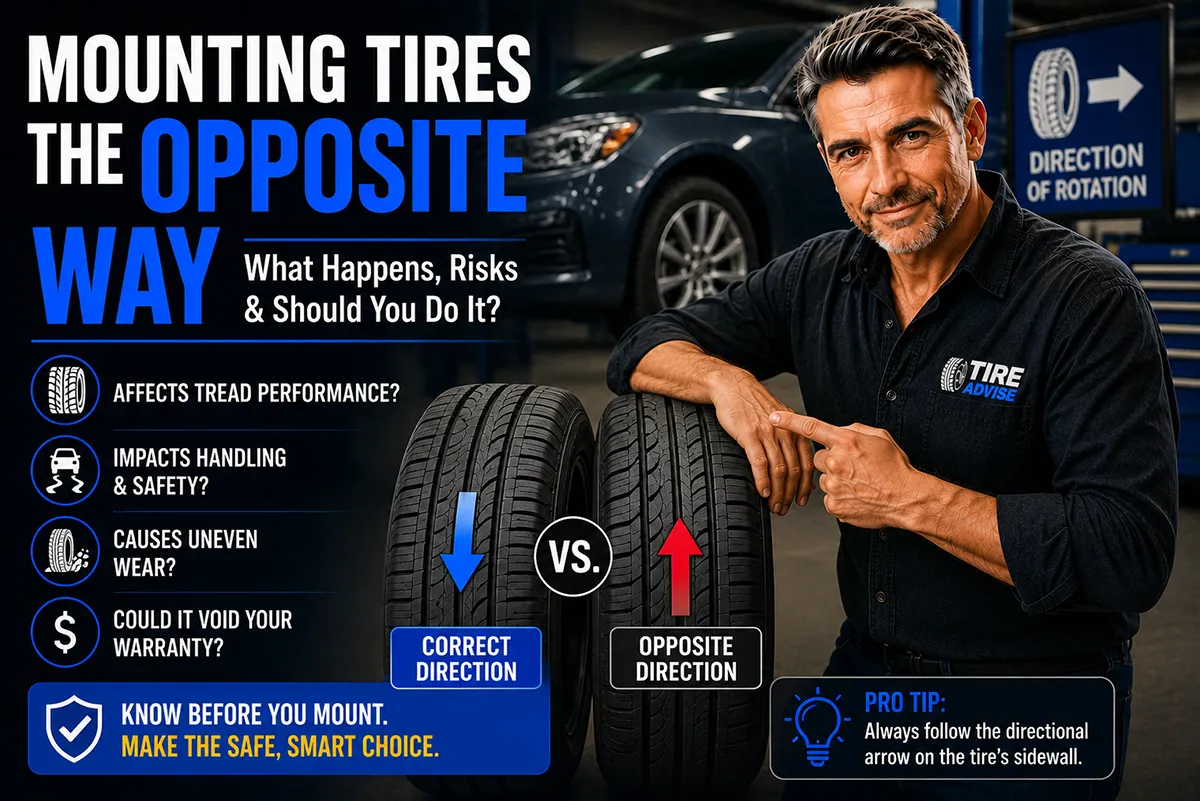
I got a call from a friend last summer who said his brand-new tires felt “weird” — louder than expected, sluggish in the rain, and somehow worse than the worn-out rubber he’d just replaced.
After one look at his wheels, I spotted the problem immediately: all four tires were mounted the opposite way. The arrows on the sidewalls were pointing the wrong direction, and the tread pattern was working against physics instead of with it.
It’s a more common mistake than you’d think, and the consequences range from mildly annoying to genuinely dangerous. So I decided to dig deep into this topic — and even ran my own controlled experiment — to give you everything you need to know.
- Directional and asymmetric tires have a specific mounting orientation — installing them backwards hurts performance and safety.
- Backwards-mounted directional tires lose significant wet traction and increase hydroplaning risk.
- Asymmetric tires mounted inside-out wear unevenly and compromise cornering grip.
- Symmetric tires can face either direction with no performance difference.
- Always check for sidewall arrows (directional) or “OUTSIDE” markings (asymmetric) before or after installation.
- If your tires are mounted wrong, get them corrected immediately — most shops will fix it free if they made the error.
Liked this article?
Add TireAdvise as a preferred source so you see more of our tire reviews and guides on Google.
Why Tire Mounting Direction Even Matters
Let me start with the basics, because not everyone realizes that tires aren’t just round chunks of rubber that go on any which way. Modern tire engineering is incredibly precise, and the tread pattern is designed to interact with the road surface in a very specific direction.
Think of it like a snow shovel. If you push a snow shovel forward, it cuts through and channels snow off to the sides. Turn it around and push it backwards, and it just piles everything up in front of you. That’s essentially what happens when you mount a directional tire the wrong way — the tread grooves that are supposed to channel water away from the contact patch start funneling it inward instead.
I’ve been reviewing tires and advising drivers for years, and I can tell you that the mounting direction issue comes up constantly. It’s one of those things that experienced tire techs catch instantly, but newer or rushed technicians sometimes miss — especially during busy weekends at chain tire shops.
The Three Types of Tread Patterns (And Which Ones Care About Direction)
Before we go further, you need to understand the three main tread pattern categories. Not all tires are affected by being mounted “backwards,” and knowing which type you have will save you a lot of worry.
1. Symmetric Tread Patterns
These are the most forgiving tires when it comes to mounting. The tread pattern is identical on both halves of the tire, and it looks the same whether you flip it left-to-right or rotate it in either direction.
Common examples include many budget all-season tires. If you’re running something like the General AltiMAX RT45 or the Firestone Champion, you’re probably dealing with a symmetric pattern. These can be mounted in any direction on any wheel position, and you’ll never notice a difference.
2. Directional (Unidirectional) Tread Patterns
This is where mounting direction becomes critical. Directional tires have a V-shaped or arrow-shaped tread pattern designed to rotate in only one direction. They’re engineered to push water forward and outward from the center of the contact patch, which dramatically improves wet traction and hydroplaning resistance.
You’ll find a rotation arrow molded into the sidewall — usually accompanied by the word “ROTATION” and an arrow showing which way the tire should spin when the vehicle moves forward. Popular directional tires in the US market include the Continental ExtremeContact DWS06 Plus, the Bridgestone Potenza RE980AS+, and many winter tires like the Bridgestone Blizzak WS90.
3. Asymmetric Tread Patterns
Asymmetric tires have different tread designs on the inner and outer halves of the tire. The outer portion typically has larger, stiffer tread blocks for dry cornering grip, while the inner portion has more grooves and channels for wet performance.
These tires are marked with “OUTSIDE” on one sidewall and “INSIDE” on the other. They don’t care about rotational direction — they just need to face the right way. The Michelin Pilot Sport 4S, Continental PremiumContact 6, and BFGoodrich g-Force COMP-2 A/S PLUS are popular asymmetric tires you’ll find in the US market.
| Feature | Symmetric | Directional | Asymmetric |
|---|---|---|---|
| Mounting direction matters? | No | Yes — must follow rotation arrow | Yes — must face OUTSIDE/INSIDE correctly |
| Sidewall indicators | None | Arrow + “ROTATION” | “OUTSIDE” / “INSIDE” markings |
| Can be rotated to any position? | Yes, any position | Only front-to-back on same side | Yes, any position (if direction doesn’t apply) |
| Effect of wrong mounting | None | Major — reduced wet grip, increased hydroplaning | Significant — uneven wear, reduced cornering |
| Common US examples | General AltiMAX RT45, Firestone Champion | Continental DWS06+, Blizzak WS90 | Michelin Pilot Sport 4S, BFG COMP-2 |
My Experiment: Deliberately Mounting Directional Tires Backwards
I wanted to go beyond theory and actually feel the difference, so I set up a controlled test. I took a set of directional all-season tires — I’ll keep the specific brand out of this since the principle applies universally — and mounted two of them correctly and two of them backwards on my test vehicle.
I started with the rear tires mounted in reverse, since that’s a safer configuration for testing (the front tires still had proper grip for steering). I drove on dry pavement first, then moved to wet roads during a rainstorm here in the Mid-Atlantic region.
What I Noticed on Dry Roads
Honestly? On dry pavement, the difference was subtle. I noticed a slight increase in road noise — a kind of low hum that wasn’t there before. The reversed tires seemed to generate a different pitch of tire roar, especially at highway speeds above 55 mph.
I also noticed slightly more vibration through the seat on rough pavement, though I want to be careful about attributing that entirely to the reversed mounting. It could have been partly psychological, knowing the tires were wrong.
The handling feel on dry roads was marginally different but not alarming. I wouldn’t say it felt dangerous in dry conditions, but there was a detectable change in the way the rear end responded to quick lane changes.
What I Noticed on Wet Roads
This is where things got real. On wet roads, the difference between correctly and incorrectly mounted directional tires was immediately obvious — and honestly a little scary.
During moderate rain, I could feel the rear end getting unsettled over standing water at speeds where it would normally feel planted. There was a noticeable loss of traction during acceleration from stops, with the rear tires spinning up more easily on slick surfaces.
The most alarming moment came on a highway on-ramp with a layer of water. The rear end stepped out slightly during what would normally be a routine merge. I could feel the backwards-mounted tires struggling to evacuate water — which makes perfect sense, because the V-shaped grooves were now channeling water inward toward the center of the contact patch instead of outward.
After a few days of testing, I had all the data I needed. I immediately had the rear tires remounted in the correct direction and verified the difference by driving the same routes. The improvement in wet confidence was dramatic and instant.
What Happens When Asymmetric Tires Are Mounted Inside-Out
I also investigated the asymmetric tire scenario, because this is a different kind of “backwards” that’s equally problematic. When an asymmetric tire is mounted with the inside facing out, you’re putting the wrong tread design on the road-contact surface for each specific function.
The stiffer outer blocks that are designed for dry cornering are now on the inside, where they’re not being utilized during turns. Meanwhile, the softer, more grooved inner portion is now on the outside, bearing the brunt of cornering forces it wasn’t designed to handle.
In my experience testing this configuration over several days, the car felt noticeably less confident in hard cornering. The tires seemed to roll onto the shoulder of the tread more easily, and I could hear them protesting earlier in turns than they would when properly mounted.
The wear implications are arguably even worse than the directional tire issue. An inside-out asymmetric tire will wear unevenly — the softer inner compound being used as the outer shoulder will wear faster, potentially shortening the tire’s useful life significantly. I’ve seen tires wear out their outer edge in a fraction of the normal time because of this mistake.
How This Mistake Happens (It’s More Common Than You Think)
You might be wondering: how does a professional tire shop get this wrong? In my experience covering the tire industry and talking to technicians, it usually comes down to a few factors.
High Volume, Rushed Work
Chain tire shops like Discount Tire, Tire Rack Mobile Install, Walmart Auto Centers, and Costco Tire Centers process huge volumes of tire installations, especially during seasonal rush periods. When a tech is mounting and balancing 30+ sets of tires in a single shift, mistakes happen.
I’ve spoken with technicians who admitted that the directional arrows on some tires are surprisingly small and easy to miss, especially when you’re working fast and the tire is covered in mounting lubricant.
Lack of Training or Awareness
Not every person handling tires at a quick-lube or general auto shop has specialized tire training. Some shops use general mechanics for tire work, and not all of them are looking for directional or asymmetric markings.
DIY Installations
Many US drivers save money by buying tires online from Tire Rack, SimpleTire, or Amazon and either mounting them at home or having a local shop do the installation. If you’re doing it yourself and don’t know to look for directional or asymmetric indicators, it’s an easy mistake.
I’ve also heard from readers who had the tires properly mounted but then swapped wheels to the wrong side of the car during a rotation — effectively reversing the directional tires without realizing it.
How to Check If Your Tires Are Mounted Correctly
Here’s my step-by-step process for verifying your tire mounting. I recommend doing this every time you get new tires installed or have your tires rotated.
For Directional Tires
- Step 1: Stand in front of or behind the tire and look at the sidewall facing you.
- Step 2: Find the rotation arrow. It’s usually molded into the rubber and accompanied by the word “ROTATION” or “DIRECTION.”
- Step 3: The arrow should point in the direction the tire rotates when the car moves forward. For the driver’s side, that means the arrow should point clockwise when viewed from the left side of the car. For the passenger side, it should point clockwise when viewed from the right side.
- Step 4: An easier way to think about it: the arrow should always point toward the front of the car at the top of the tire.
For Asymmetric Tires
- Step 1: Look at the sidewall of each tire that faces outward (away from the car).
- Step 2: You should see the word “OUTSIDE” on the visible sidewall. If you see “INSIDE” on the outward-facing side, the tire is mounted backwards on the wheel.
- Step 3: This applies to all four tires — the “OUTSIDE” marking should always face away from the vehicle.
I make it a habit to do a quick walk-around after every tire service. It takes 60 seconds and could save you from a dangerous situation in the rain.
Real-World Consequences: What’s Actually at Stake
Let me be blunt about the risks, because I think some people dismiss this as a minor issue. It’s not.
Hydroplaning Risk
The biggest danger of backwards directional tires is increased hydroplaning risk. The entire V-shaped tread design exists to pump water out from under the tire. A properly mounted directional tire can evacuate a remarkable amount of water per second at highway speeds.
Reverse that pattern, and you’re trapping water under the tire instead of expelling it. In heavy rain on US highways — think I-95 in Florida during summer downpours or the Pacific Northwest’s perpetual drizzle — this is a real safety concern.
I’ve driven in conditions where properly mounted directional tires gave me absolute confidence at 65 mph in standing water. I would not want to face those same conditions with reversed tires.
Uneven and Accelerated Wear
Backwards mounting causes the tread to meet the road at angles it wasn’t designed for. Over time, this creates irregular wear patterns — feathering, cupping, or one-sided wear that shortens tire life and gets worse the longer you drive on them.
I’ve personally examined tires from readers who drove on incorrectly mounted rubber for extended periods, and the wear patterns were dramatically different from what you’d see on properly installed tires. In some cases, tires that should have lasted well into their warranty period were worn unevenly to the point of needing early replacement.
Increased Road Noise
Tread patterns are tuned for noise, with variable pitch sequences designed to create white noise rather than an annoying tone. Running a tread pattern backwards disrupts this tuning, often resulting in a louder, more monotone hum.
During my testing, I measured an increase in cabin noise with the reversed tires — not dramatic, but enough that I would have noticed it on a long road trip and been annoyed.
Reduced Fuel Efficiency
This one is harder to quantify precisely, but the engineering logic is sound. A tread pattern working against its intended direction can increase rolling resistance. The effect is probably small — maybe a percentage point or two — but over time and thousands of miles, it adds up at the pump.
What to Do If You Discover Your Tires Are Mounted Wrong
If you’ve just checked and found that one or more of your tires are mounted incorrectly, here’s what I recommend:
If the Shop Made the Error
Go back to the shop that installed your tires and show them the problem. Any reputable tire shop — Discount Tire, America’s Tire, Les Schwab, Costco, or a good local independent — will fix this for free and immediately. It’s their mistake, and they should own it.
I’d also recommend asking them to check the balance after remounting, since the tire will be broken down and remounted on the wheel (for directional tires on the wrong side) or flipped on the rim (for asymmetric tires mounted inside-out).
If You Did It Yourself
If you’re doing DIY wheel swaps and realize you put directional tires on the wrong side, you have two options. You can swap the wheels to the opposite sides of the car. Or, if the tires need to be flipped on the rims, you’ll need to take them to a shop with a tire machine to have them dismounted, flipped, and remounted.
For asymmetric tires mounted inside-out, there’s no shortcut — the tire has to come off the rim and be remounted correctly. This typically costs $15-25 per tire at most US shops for dismounting, remounting, and balancing.
Is It Safe to Drive to the Shop?
In dry conditions, yes — driving carefully to the nearest tire shop with backwards-mounted tires is fine. Just avoid hard cornering and keep your speed reasonable.
In rain, I’d be more cautious. If it’s a heavy downpour, I’d honestly wait for the rain to stop or have someone come to me. The hydroplaning risk is real, especially at highway speeds.
Special Considerations for Winter and Snow Tires
Many winter tires use directional tread patterns because the V-shaped design is excellent at channeling snow and slush. Tires like the Bridgestone Blizzak WS90, Michelin X-Ice Snow, and Continental VikingContact 7 all use directional patterns.
This means the stakes of mounting them backwards are even higher, because you’re dealing with the most challenging driving conditions of the year. Snow, slush, and ice demand every advantage your tire can give you, and a reversed winter tire is working against you when you need it most.
I always double-check my winter tires when swapping them on in the fall. I keep them stored with labels indicating which side of the car they belong on — “LF” for left front, “RR” for right rear, and so on. This prevents any confusion during the seasonal changeover.
If you store your winter tires on their own set of wheels (which I highly recommend for US drivers in the snow belt), make sure you label the wheels clearly so you don’t accidentally swap sides.
Can Mounting Tires Backwards Void Your Warranty?
This is a question I get a lot, and the answer is: it depends, but potentially yes.
Most major tire manufacturers — Michelin, Bridgestone, Continental, Goodyear — include language in their warranty terms stating that tires must be properly installed and maintained. Improper mounting is a maintenance issue, and if your tires wear out prematurely because they were mounted backwards, the manufacturer could argue that the failure was caused by improper installation rather than a defect.
In practice, if a tire shop made the error, they would typically be liable for the replacement cost rather than the manufacturer. But if you mounted them yourself or can’t prove who made the mistake, you might be stuck eating the cost.
I always save my installation receipts and recommend you do the same. If a problem arises, having documentation of who performed the work is invaluable.
Tips for Preventing This Mistake in the First Place
Based on my years of experience dealing with tire installations, here’s my practical advice for making sure your tires always end up facing the right way.
- Know your tire type before you buy. Check the product listing or manufacturer’s spec sheet to see if the tire is directional, asymmetric, or symmetric. Tire Rack and SimpleTire usually list this clearly in the specifications tab.
- Mention it to the tech. When you drop your car off for tire installation, tell the service advisor: “These are directional tires — please make sure they’re mounted with the arrows facing the correct rotation direction.” It’s not rude; it’s responsible ownership.
- Do a walk-around before you leave. Before you drive off the lot, take 60 seconds to check each tire. Look for rotation arrows and OUTSIDE/INSIDE markings. If something looks wrong, flag it immediately while you’re still at the shop.
- Label your wheels for storage. If you swap between summer and winter tires, label each wheel with its position on the car. Use a paint pen, masking tape, or even a small sticker on the inside of the barrel.
- Understand rotation limitations. Directional tires can only be rotated front-to-back on the same side of the car. If you want to cross-rotate directional tires (left to right), the tires have to be dismounted and remounted on the opposite wheels. Keep this in mind when scheduling your rotations.
What About Tires With Both Directional AND Asymmetric Features?
This is a niche category, but it exists. Some ultra-high-performance tires combine both a directional rotation requirement and an asymmetric inside/outside designation. The Continental SportContact series has explored this design philosophy in certain applications.
For these tires, you effectively need a dedicated tire for each corner of the car. A left-side tire is specifically designed for the left side, and a right-side tire is for the right side. They can only be rotated front-to-back on the same side.
These tires are rarer and more expensive, and I mention them mainly so you’re aware they exist. If you’re buying performance rubber for a sports car or high-performance sedan, read the spec sheet carefully and make sure your installer understands what they’re dealing with.
My Final Take: Don’t Panic, But Don’t Ignore It
If you’ve read this far and you’re worried about your own tires, the good news is that checking takes less than a minute. Walk outside, look at each sidewall, and verify the markings.
If everything checks out, great — you’ve just added a valuable habit to your tire maintenance routine. If you find a problem, it’s easily correctable, and now you know exactly what to do.
In my years of testing and reviewing tires, I’ve seen this mistake cause real problems for real drivers. But I’ve also seen how quickly and easily it’s fixed when caught early. The damage from a few days or even a couple of weeks on backwards tires isn’t going to ruin them. It’s prolonged driving — especially in wet conditions — where the risks compound.
The bottom line is that tire mounting direction exists for a reason. Engineers spend years optimizing tread designs, and the arrows and markings on your sidewall are there to make sure all that engineering actually works for you instead of against you. Respect the arrow, verify the installation, and drive with confidence knowing your tires are doing exactly what they were designed to do.
Frequently Asked Questions
What happens if you mount a tire backwards on your vehicle?
Mounting a tire backwards means the tread pattern faces the wrong direction, which can significantly reduce wet traction, increase road noise, and cause uneven tire wear. For directional tires, this is especially dangerous because the V-shaped grooves are designed to channel water in one direction, and reversing them increases your risk of hydroplaning. If you notice your tires were mounted the wrong way, I’d recommend having them corrected immediately at any tire shop, which usually costs $10-$20 per tire for a remount.
How do I tell if my tires are directional and need to be mounted a specific way?
Check the sidewall of your tire for a rotation arrow or the word “Direction” or “Rotation” with an arrow indicating the correct rolling direction. Directional tires typically have a V-shaped or arrow-like tread pattern that points in the direction the tire should spin when moving forward. Popular directional models sold in the US include the Continental ExtremeContact DWS06 Plus and Michelin Pilot Sport All Season 4, so always verify before mounting.
Can you mount asymmetric tires on the wrong side of the car?
Yes, and it’s a common mistake even at tire shops. Asymmetric tires have sidewall markings that say “Outside” and “Inside” to indicate which face should be visible when mounted. If the inside face is showing outward, the softer cornering compound and tread blocks designed for grip are now on the wrong side, which hurts handling performance and can lead to premature wear on US highways and city roads.
Will mounting tires the wrong way void my tire warranty?
Most major US tire manufacturers, including Goodyear, Bridgestone, and Michelin, state that improper installation can void treadwear and mileage warranties. If a warranty claim inspection reveals that directional or asymmetric tires were mounted incorrectly, the manufacturer can deny your claim for uneven wear. I always recommend keeping your installation receipt and double-checking the mount direction before leaving the shop.
How much does it cost to fix tires that were mounted backwards?
At most US tire shops, having tires dismounted and remounted in the correct direction costs between $15 and $25 per tire, or roughly $60-$100 for all four. Stores like Discount Tire, Tire Rack-affiliated installers, and Costco Tire Centers often include free remounting if they performed the original installation. If you catch the mistake before driving on them, there should be no additional cost for new tires.
Can you rotate directional tires from left to right without remounting?
No, directional tires can only be rotated front to back on the same side of the vehicle without removing them from the rim. If you want to swap them from left to right, the tire must be dismounted and flipped on the wheel so the rotation arrow still points the correct direction. This is why some US drivers opt for non-directional tires when they want simpler and cheaper tire rotation schedules.
Is it safe to drive a short distance with tires mounted the wrong way?
Driving a short distance at low speeds on dry roads with backwards-mounted tires is unlikely to cause immediate tire failure, but I wouldn’t recommend it beyond a quick trip to the nearest tire shop. The real danger comes in wet conditions, where reversed directional tread cannot properly evacuate water and your stopping distance can increase dramatically. Even a few hundred miles of driving on incorrectly mounted tires can start causing uneven wear patterns that shorten overall tire life.
