

I bought a set of tires from Walmart a while back that turned out to be completely wrong for my vehicle. Standing at the automotive counter trying to figure out my options, I realized most drivers have no idea how Walmart’s tire return policy actually works.
And honestly, neither did I — until I had to learn the hard way.
After going through the return process myself (twice, actually) and spending hours talking with Walmart automotive associates and customer service reps, I’ve put together everything you need to know so you don’t end up stuck with tires you can’t use.
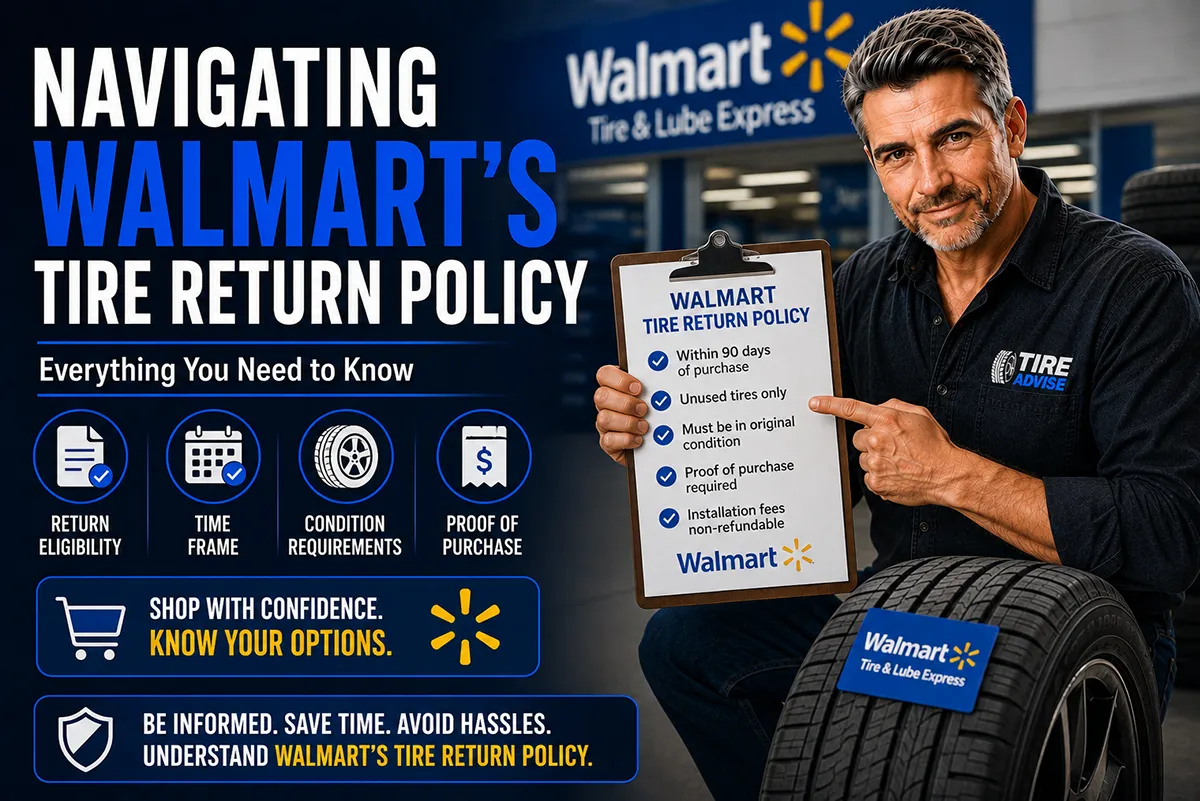
- Walmart accepts tire returns within 90 days of purchase with a receipt — unmounted tires are straightforward; mounted tires are trickier.
- Tires installed by Walmart’s auto center may be eligible for a Road Hazard Warranty, which covers replacement under specific conditions.
- No receipt? You can still attempt a return, but expect store credit at the lowest recent sale price.
- Walmart.com tire orders follow the same 90-day window, and you can return them in-store or by shipping them back.
- Always keep your receipt, your installation paperwork, and your Road Hazard Warranty documentation — it makes everything dramatically easier.
Liked this article?
Add TireAdvise as a preferred source so you see more of our tire reviews and guides on Google.
Why Understanding Walmart’s Tire Return Policy Matters
Tires aren’t cheap. Even at Walmart, where prices tend to be lower than dedicated tire shops, you’re still looking at anywhere from $60 to $200+ per tire depending on the brand and size. A full set of four can easily cost $400 to $800 out the door.
So when something goes wrong — you ordered the wrong size, the tires don’t perform like you expected, or you find a defect after a few days — you need to know exactly what your options are. I’ve seen too many drivers just accept a bad purchase because they assumed tires were “non-returnable.”
They’re not. But there are rules you need to follow.
Walmart’s General Return Policy and How It Applies to Tires
Walmart’s standard return policy gives you 90 days from the date of purchase to return most items. Tires fall under this general umbrella, but the details depend heavily on whether the tires have been mounted and driven on.
In my experience, Walmart breaks tire returns into two main categories: unmounted (never installed) tires and mounted (installed and used) tires. These two scenarios play out very differently at the return counter.
Returning Unmounted Tires
If you bought tires but never had them installed — maybe you realized you grabbed the wrong size or you changed your mind — returning them is relatively painless. I did this myself when I accidentally ordered a set of all-terrain tires in the wrong load rating.
I walked into the Walmart where I’d made the purchase, brought my receipt, and the return was processed at the customer service desk in about 15 minutes. Full refund to my original payment method. No drama whatsoever.
The key here is that the tires need to be in their original, sellable condition. If you’ve scuffed them up, removed labels, or damaged the packaging, you might run into pushback.
Returning Mounted or Used Tires
This is where things get more complicated, and this is where most drivers run into frustration. Once tires have been mounted on your wheels and driven on, Walmart’s willingness to accept a return drops significantly.
In general, Walmart doesn’t accept returns on mounted and used tires unless there’s a defect or the tire is covered under warranty. I learned this firsthand when I tried to return a set of tires after driving on them for several days because they were noisier than I expected on the highway.
The associate was sympathetic but explained that “not liking the tire” isn’t a valid return reason once they’ve been installed. This is pretty standard across the tire industry, to be fair — most tire shops operate the same way.
The 90-Day Return Window: What Counts and What Doesn’t
The 90-day clock starts ticking from the day you purchase the tires, not the day they’re installed. This matters more than you might think, especially if you buy tires online and don’t get them mounted right away.
I once ordered a set of tires from Walmart.com during a holiday sale but didn’t schedule the installation appointment until about three weeks later. That ate into my return window without me even realizing it.
What Qualifies for a Return Within 90 Days
- Wrong size purchased: If you or Walmart made a sizing error, they’ll typically make it right.
- Unmounted, unused tires: Straightforward return with receipt.
- Defective tires: Manufacturing defects visible before or shortly after installation are covered.
- Order errors: If Walmart sent the wrong tires (online orders), they’ll process the return and ship the correct ones.
What Typically Doesn’t Qualify
- Buyer’s remorse on mounted tires: You installed them, drove on them, and just don’t like them.
- Normal wear: Tread wearing down from regular driving isn’t a defect.
- Damage from road hazards: Nails, potholes, and curb damage aren’t covered by the return policy (but may be covered by the Road Hazard Warranty — more on that below).
- Tires purchased past the 90-day window: After 90 days, the standard return policy no longer applies.
Walmart’s Road Hazard Warranty: Your Safety Net After Installation
Here’s something I wish I’d paid more attention to during my first tire purchase at Walmart: the Road Hazard Warranty. This is a separate protection plan offered through Walmart’s Auto Care Centers, and it’s genuinely one of the better values in the tire world.
What the Road Hazard Warranty Covers
When you buy tires and have them installed at Walmart, they’ll offer you a Road Hazard Warranty for a relatively small additional fee — usually around $10 to $15 per tire when I last purchased. This warranty covers tire damage caused by common road hazards like:
- Nails and screws
- Glass and metal debris
- Potholes
- Blowouts from road conditions
If a covered event happens and the tire can’t be repaired, Walmart will replace it. The replacement cost is prorated based on the remaining tread depth, so the earlier the damage occurs in the tire’s life, the more of the cost Walmart covers.
My Experience With the Road Hazard Warranty
I picked up a nail in a construction zone after just a few days of driving on a brand-new set of tires. The nail went in at an angle near the sidewall, making it unrepairable. Because I’d purchased the Road Hazard Warranty, Walmart replaced the tire and I only paid a small prorated amount.
Without that warranty, I would have been on the hook for the full price of a new tire. That $10 investment saved me well over $100. I now recommend the Road Hazard Warranty to anyone buying tires at Walmart — it’s one of the rare add-on purchases that actually makes financial sense.
How to File a Road Hazard Claim
The process is pretty simple. Bring your vehicle to any Walmart Auto Care Center (doesn’t have to be the one where you originally purchased the tires). Bring your receipt and warranty documentation if you have them.
The technician will inspect the tire, determine if the damage is covered under the warranty, and if so, they’ll replace the tire. In my case, the whole process from arrival to driving out took about two hours, which included some wait time since I didn’t have an appointment.
Returning Tires Bought on Walmart.com
Buying tires online from Walmart.com has become incredibly popular, and for good reason — the selection is wider, you can compare prices easily, and they frequently run online-only promotions. But returning online tire purchases has its own quirks.
Ship-to-Store vs. Ship-to-Home
When you order tires on Walmart.com, you typically have two options: ship them to a Walmart store for installation, or ship them to your home. The return process differs slightly depending on which you chose.
Ship-to-Store: If the tires were shipped to a Walmart store and haven’t been installed, you can return them right there at the store’s customer service desk. This is the simplest scenario and mirrors an in-store purchase return.
Ship-to-Home: If the tires were shipped to your house and are still unmounted, you can either bring them to a Walmart store to return in person, or initiate a return through your Walmart.com account and ship them back. Fair warning — shipping tires is expensive and heavy, so I strongly recommend the in-store return option if one is available near you.
Marketplace Seller Tires on Walmart.com
This is a trap that catches a lot of people. Not every tire listed on Walmart.com is sold directly by Walmart. Some are sold by third-party marketplace sellers, and those sellers have their own return policies.
I almost made this mistake myself. I found what looked like a great deal on a set of Cooper tires, but when I read the fine print, the seller was a third-party marketplace retailer. The return policy was only 30 days, not 90, and the seller required the buyer to pay return shipping.
Always check who the seller is before purchasing. Look for “Sold and shipped by Walmart.com” to ensure you’re covered by Walmart’s standard return policy.
What If You Don’t Have Your Receipt?
We’ve all been there. You can’t find the receipt, you accidentally threw it away, or the ink faded to nothing. Walmart is actually more accommodating than many retailers when it comes to no-receipt returns, but there are limitations.
Walmart can often look up your purchase using the credit or debit card you used at checkout. If you’re a Walmart+ member or have a Walmart.com account, your purchase history may also be stored digitally. I’ve successfully processed a return using my debit card lookup when I couldn’t find the physical receipt.
If none of these options work, Walmart may still accept the return, but you’ll likely receive store credit at the lowest advertised price for that item in recent weeks. This means you might get significantly less than what you actually paid.
Pro Tip: Always Store Your Tire Receipt Digitally
After my receipt-misplacement scare, I started taking a photo of every tire-related receipt and warranty document immediately after purchase. I keep them in a dedicated folder on my phone and backed up to cloud storage. It takes 30 seconds and can save you hundreds of dollars.
Comparison: Walmart vs. Other Major Tire Retailers’ Return Policies
To put Walmart’s policy in context, here’s how it stacks up against other popular tire retailers in the US:
| Retailer | Return Window | Mounted Tire Returns? | Road Hazard Warranty | Receipt Required? |
|---|---|---|---|---|
| Walmart | 90 days | Only for defects/warranty | ~$10–$15/tire | Preferred (card lookup available) |
| Costco | Satisfaction-based (flexible) | Yes, case-by-case | Included with installation | No (member history tracked) |
| Discount Tire | 30 days (unmounted) | Only for defects/warranty | Available (certificate-based) | Yes |
| Sam’s Club | Satisfaction-based | Yes, case-by-case | Included with installation | No (member history tracked) |
| Tire Rack | 30 days (unmounted only) | No | Available for purchase | Yes (online order history) |
As you can see, Walmart’s 90-day window is actually one of the most generous in the industry for unmounted tires. Costco and Sam’s Club technically have more flexible policies for mounted tires, but they require a membership. Discount Tire and Tire Rack both have shorter return windows.
Step-by-Step: How to Return Tires at Walmart
Based on my own experiences, here’s the exact process I recommend:
Step 1: Gather Your Documentation
Before you drive to Walmart, collect everything related to your tire purchase. This includes your receipt, any warranty paperwork, the credit or debit card you used for the purchase, and your vehicle’s information (year, make, model).
If you bought the tires online, pull up your Walmart.com order confirmation email or log into your account to access your order history.
Step 2: Determine If the Tires Are Mounted or Unmounted
This determines where you go in the store. Unmounted tires can be returned at the main customer service desk at the front of the store. Mounted tires or warranty claims typically need to go through the Auto Care Center.
When I returned my unmounted tires, I went straight to customer service. When I filed my Road Hazard Warranty claim on the mounted tire, I went to the auto center. Going to the right place first saves you time.
Step 3: Explain the Situation Clearly
Be honest and specific about why you’re returning the tires. “I ordered the wrong size” or “there’s a visible defect in the sidewall” are clear, valid reasons. The associate will inspect the tires and process the return accordingly.
In my experience, Walmart associates are generally helpful when you’re straightforward. Getting defensive or combative doesn’t help anyone.
Step 4: Choose Your Refund Method
With a receipt, you’ll get your refund to the original payment method. Cash purchases get cash back. Credit or debit card purchases go back to the card. Without a receipt, expect a Walmart gift card at a potentially reduced amount.
Step 5: Get a Refund Confirmation
Before you leave, make sure you get a printed confirmation of the return. If the refund is going back to a card, it can take several business days to appear. I always ask for the return receipt and take a photo of it on the spot.
Common Issues and How to Handle Them
In all the conversations I’ve had with other drivers and in my own experiences, these are the most common problems people encounter when trying to return tires at Walmart:
“The Manager Says They Can’t Accept the Return”
Individual store managers do have some discretion when it comes to returns. If you feel your return is legitimate and the store is refusing, stay calm and ask to speak with a higher-level manager. You can also call Walmart’s corporate customer service line at 1-800-925-6278.
I’ve heard from several drivers who had their returns initially denied at the store level but approved after contacting corporate customer service. Having documentation and being polite goes a long way.
“The Tires Were Installed by Walmart and They Put On the Wrong Size”
This is 100% on Walmart, and they should make it right at no cost to you. If Walmart’s own technicians installed the wrong tire size on your vehicle, they are responsible for correcting the error. This includes removing the incorrect tires, installing the correct ones, and refunding any price difference.
I’ve seen this happen to a friend who brought in his truck for new tires. The tech grabbed the wrong set from the back. It was caught during the test drive and corrected immediately with a full apology.
“My Tires Are Wearing Unevenly After Just a Few Days”
Uneven wear in a very short period could indicate a defective tire, but it could also point to a vehicle alignment issue. Walmart’s Auto Care Center can inspect the tires and help determine the cause.
If it’s a manufacturing defect, the tire manufacturer’s warranty typically covers it — and Walmart can facilitate that claim since they’re an authorized retailer for most major brands like Goodyear, Michelin, BFGoodrich, Cooper, and Hankook.
“I Bought Tires During a Sale and Now They’re Cheaper”
Walmart doesn’t have a formal price adjustment policy for tires. However, if you purchased tires within the last few days and the price dropped, it’s worth asking at customer service. Some associates will process a price adjustment, especially if the tires are still within the return window — the logic being you could just return and rebuy them anyway.
Manufacturer Warranties vs. Walmart’s Return Policy
It’s important to understand that the tire manufacturer’s warranty is separate from Walmart’s return policy. These are two different forms of protection, and knowing the distinction can save you a headache.
Walmart’s Return Policy
This covers your right to return the product to Walmart for a refund. It’s time-limited (90 days) and condition-dependent (unmounted vs. mounted).
Manufacturer’s Warranty
Most major tire manufacturers offer a treadwear warranty (often called a mileage warranty) and a workmanship/materials warranty. These extend far beyond 90 days — sometimes covering the tire for years or for the life of the tread.
If your tires develop a defect after the 90-day Walmart return window closes, you’d file a claim through the manufacturer’s warranty. Walmart’s Auto Care Center can often help you initiate this process since they have direct relationships with the major tire brands they sell.
I dealt with a manufacturer warranty claim on a set of tires that started showing sidewall bubbles well after the 90-day Walmart return window. The claim went through the manufacturer, but the Walmart auto center handled all the paperwork and the tire swap. It was surprisingly seamless.
Tips for a Smooth Tire Return at Walmart
After going through this process multiple times and talking to other drivers who’ve done the same, here are my best tips for making a Walmart tire return as painless as possible:
- Keep everything. Receipt, warranty papers, installation invoice — keep it all in one place, ideally with a digital backup.
- Act quickly. The sooner you identify an issue and bring it to Walmart’s attention, the smoother the process will be. Don’t wait until day 89 of the return window.
- Be polite but firm. Associates deal with returns all day. Being respectful gets you further than being aggressive.
- Know what you want. Do you want a refund, an exchange for a different tire, or a warranty replacement? Knowing your desired outcome helps the associate help you.
- Call ahead. Before loading four tires into your car and driving across town, call the store to confirm they can process your specific type of return. This is especially important for warranty claims.
- Buy the Road Hazard Warranty. I can’t stress this enough. For $10–$15 per tire, you get peace of mind that extends well beyond the 90-day return window.
- Check the seller on Walmart.com. Make sure you’re buying from Walmart directly, not a third-party marketplace seller, unless you’ve reviewed their specific return policy.
When Walmart Isn’t the Best Place to Buy Tires
I want to be honest here because I think it serves you better than blindly recommending Walmart for every situation. There are times when buying tires elsewhere might be the smarter move.
If you’re the kind of driver who values a generous return policy on mounted tires — meaning you want the ability to try a set and return them if you’re not satisfied — Costco is probably a better fit. Their satisfaction guarantee is genuinely more flexible, and the road hazard warranty is included in the installation package price.
If you’re looking for expert guidance and a wider selection of performance or specialty tires, Discount Tire or Tire Rack may offer a better experience, even if their return windows are shorter.
But for the average driver looking for solid value on mainstream tire brands with a reasonable return policy, Walmart remains a strong option. Their prices are competitive, the 90-day return window for unmounted tires is generous, and the Road Hazard Warranty is affordable and actually useful.
Final Thoughts From Someone Who’s Been Through It
Navigating Walmart’s tire return policy isn’t complicated once you understand the ground rules. Unmounted tires within 90 days with a receipt? Easy return. Mounted tires with a defect or covered by the Road Hazard Warranty? Manageable, especially with proper documentation. Mounted tires you just don’t like? That’s going to be a tough sell at any retailer, not just Walmart.
The biggest lesson I’ve learned through my own experiences is that preparation is everything. Keep your receipts, buy the Road Hazard Warranty, and don’t wait to address an issue. The faster you act, the more options you have.
I hope this guide saves you the confusion and frustration I felt during my first tire return at Walmart. If you have a specific situation that isn’t covered here, I’d recommend calling Walmart’s customer service line directly — they can give you a definitive answer for your unique circumstances before you make the trip.
Drive safe, and keep those receipts.
Frequently Asked Questions
What is Walmart’s tire return policy for new tires?
Walmart allows you to return new, unused tires within 90 days of purchase with a valid receipt for a full refund. The tires must be in their original condition and not mounted or driven on. If you purchased tires online through Walmart.com, you can also return them to a local store or ship them back, though I’d recommend the in-store option to avoid hefty return shipping costs on heavy tires.
Can you return tires to Walmart after they’ve been installed?
Returning mounted and driven-on tires to Walmart is significantly harder and generally not covered under the standard return policy. However, if the tires were installed at a Walmart Auto Care Center and you experience a defect or installation-related issue, you may be eligible for a warranty claim or adjustment. I’d recommend speaking directly with the Auto Care Center manager and bringing your original receipt, as they handle these situations on a case-by-case basis.
Does Walmart offer a road hazard warranty on tires, and how does it work?
Yes, Walmart offers an optional Road Hazard Protection plan that you can purchase at the time of tire installation, typically costing around $10-$15 per tire. This warranty covers damage from potholes, nails, glass, and other common US road hazards that cause flats or blowouts. If your tire is deemed non-repairable, Walmart will replace it on a prorated basis depending on remaining tread depth, which has saved me from paying full price for a replacement after hitting a nasty pothole.
How do I return tires bought on Walmart.com to a Walmart store?
To return tires purchased on Walmart.com to a physical store, bring the tires along with your order confirmation email or packing slip to the customer service desk. The tires must be unused, unmounted, and within the 90-day return window. I’ve found it helpful to pull up the order in your Walmart app beforehand, as it speeds up the process and ensures the associate can quickly locate your purchase details for the refund.
Will Walmart take back tires without a receipt?
Walmart may process a tire return without a physical receipt by looking up the purchase through your debit or credit card, Walmart Pay, or your Walmart.com account. If the purchase can be verified, you’ll typically receive a refund to the original payment method or a store gift card. Without any form of purchase verification, the store manager has discretion but will likely offer only a store credit at the tire’s current selling price, so I always recommend keeping digital records of big-ticket purchases like tires.
What’s the difference between Walmart’s tire return policy and the manufacturer’s tire warranty?
Walmart’s 90-day return policy covers your right to return unused tires for a refund if you change your mind or ordered the wrong size, while the manufacturer’s warranty covers defects in materials and workmanship for a set mileage or time period. Brands like Goodyear, Michelin, and Cooper sold at Walmart carry their own treadwear warranties ranging from 40,000 to 80,000 miles. If your tires wear out prematurely due to a defect, you’d file a claim through the manufacturer, but Walmart’s Auto Care Center can often help facilitate that process for tires they installed.
Can I exchange tires at Walmart if I bought the wrong size?
Yes, Walmart allows exchanges for wrong-size tires as long as they are unmounted, undamaged, and returned within 90 days with proof of purchase. If the replacement tires are a different price, you’ll pay the difference or receive a partial refund. I’d suggest double-checking your vehicle’s correct tire size on the driver’s side door jamb sticker or your owner’s manual before heading to the store, as this avoids the hassle of a second trip and ensures you drive away with the right fit for US road conditions.
