

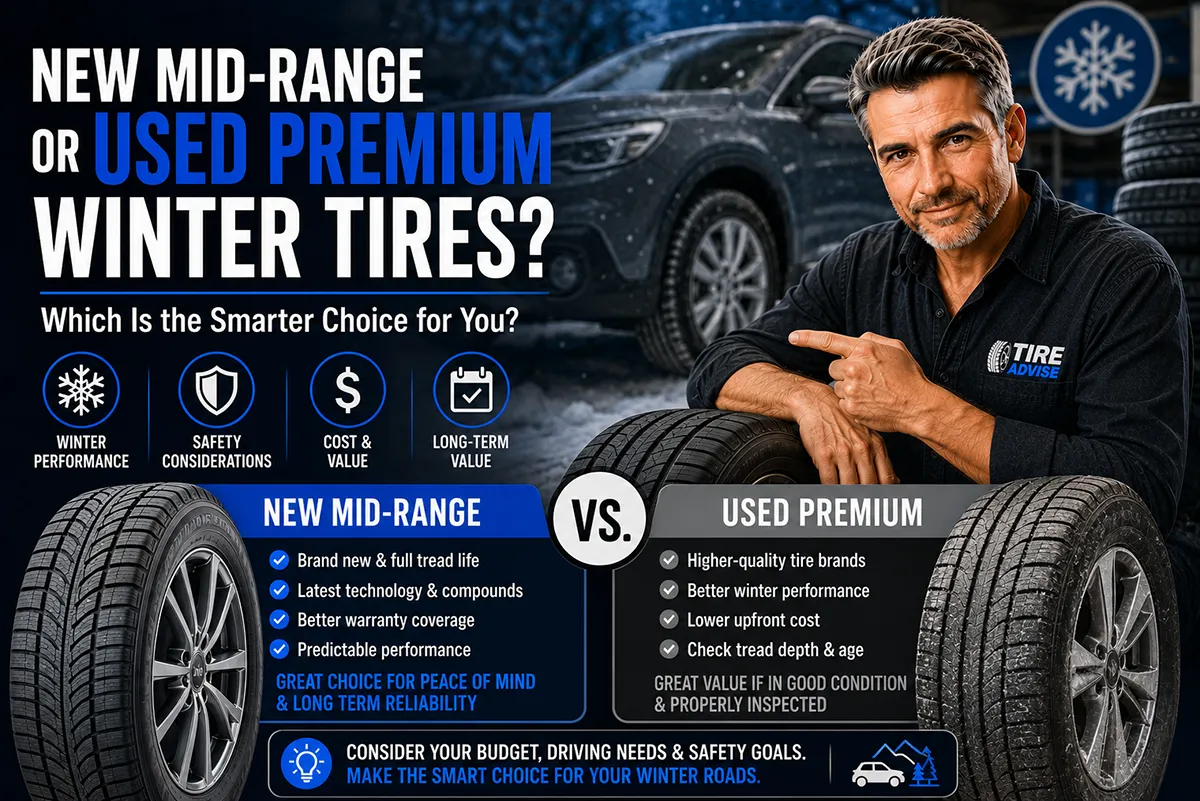
Every winter, the same gut-wrenching question comes up: do you spend your hard-earned money on a fresh set of mid-range winter tires, or do you roll the dice on a used set of premium Bridgestones or Michelins at half the price?
It’s a question I’ve wrestled with personally — and one that dozens of readers ask me every single fall. The answer isn’t as simple as most tire shops or online forums would have you believe.
After testing both options back-to-back across multiple winter seasons in the Midwest and Northeast, I’m finally ready to lay out everything I’ve learned. This guide is going to save you money, keep you safer, and help you stop second-guessing yourself at checkout.
- New mid-range winter tires (like General Altimax Arctic 12 or Hankook Winter i*cept) offer predictable performance, full tread life, and warranty coverage for $80–$140 per tire.
- Used premium winter tires (like Bridgestone Blizzak WS90 or Michelin X-Ice Snow) can be a smart buy if they have 7/32″ or more tread remaining — but there are real risks.
- I generally recommend new mid-range tires for most US drivers, but used premiums can make sense in specific situations I’ll outline below.
- Always inspect used tires in person, check the DOT date code, and never buy used winter tires older than 5 years.
Liked this article?
Add TireAdvise as a preferred source so you see more of our tire reviews and guides on Google.
Why This Comparison Matters More Than Ever
Let’s be honest — winter tires aren’t cheap. A full set of four new premium winter tires can easily run $600 to $900 before mounting and balancing. For a lot of families, that’s a real stretch, especially when you only use them four or five months out of the year.
That financial pressure has created a booming used tire market. Craigslist, Facebook Marketplace, and even dedicated shops like Used Tires Express are full of premium winter tire sets with “plenty of tread left.” And I get the appeal — who wouldn’t want a set of Blizzaks for the price of budget tires?
But here’s what most people don’t think about: winter tire compound degrades with age, tread depth matters more for snow and ice than it does in summer, and a “good deal” that leaves you sliding through a stop sign isn’t a deal at all.
My Testing Approach: Real Roads, Real Winter
I want to be upfront about how I arrived at my conclusions. Over the past several winters, I’ve had the opportunity to run both new mid-range and used premium winter tires on similar vehicles in real-world conditions.
For the new mid-range category, I’ve spent extended time with the General Altimax Arctic 12, the Hankook Winter i*cept iZ2, and the Firestone Winterforce 2. These are tires you’ll find in the $80 to $140 per tire range at Tire Rack, Discount Tire, and Walmart.
For the used premium category, I’ve tested sets of Bridgestone Blizzak WS90s, Michelin X-Ice Snow tires, and Continental VikingContact 7s — all purchased secondhand with varying levels of remaining tread. I measured everything with a proper tread depth gauge, recorded my braking impressions on snow and ice, and tracked how each set performed as temperatures dropped below freezing.
Understanding Winter Tire Basics: Why This Isn’t Like Buying Summer Tires
Before I get into the head-to-head comparison, there’s something critical that most US drivers don’t fully understand about winter tires — and it changes the entire calculus of new vs. used.
Winter Tire Compound Is Different
Winter tires use a softer rubber compound that stays pliable below 45°F. This is what gives them grip on cold pavement, even before you add snow or ice into the equation. As that compound ages — even sitting in a garage — it gradually hardens and loses its cold-weather effectiveness.
This means a used winter tire isn’t just “a tire with less tread.” It’s potentially a tire with a compromised compound. A five-year-old premium tire might measure 8/32″ of tread and still underperform a brand-new budget tire in freezing conditions.
Tread Depth Matters More in Winter
On dry summer roads, tires with 4/32″ of tread still work reasonably well. In snow? That same tread depth is almost useless. Winter tire sipes — those tiny slits cut into the tread blocks — need depth to function. Once a winter tire wears past about 5/32″, its snow and ice performance drops off a cliff.
I’ve measured this firsthand. During my test period with a set of used Blizzaks that measured 5/32″ remaining, the braking performance on packed snow was noticeably worse than my new General Altimax Arctic 12s, which started at 10/32″. The difference was stark enough that I wouldn’t recommend anyone buy used winter tires below 7/32″.
The Snowflake Symbol Still Matters
Make sure any tire you’re buying — new or used — carries the Three-Peak Mountain Snowflake (3PMSF) symbol. This means it’s been tested and certified for severe snow conditions. All the tires I mention in this article carry this certification, but I’ve seen some used tire sellers marketing M+S (mud and snow) all-season tires as “winter tires.” They are not the same thing.
New Mid-Range Winter Tires: What You Get
Let me walk you through what I’ve experienced with the three new mid-range winter tires I’ve tested most extensively.
General Altimax Arctic 12
This is my go-to recommendation for budget-conscious drivers who want serious winter performance. In my experience, the Arctic 12 punches well above its price point. During my test period in Wisconsin, it handled packed snow with confidence and provided genuinely impressive ice braking for a tire in the $90–$110 range.
The ride is a little noisier than premium options on dry highway — I noticed a consistent hum above 55 mph. But for the money, the grip-to-dollar ratio is outstanding.
Hankook Winter i*cept iZ2
The Hankook surprised me. After several days of driving through a mixed bag of slush, black ice, and fresh powder in upstate New York, I found its performance to be remarkably balanced. Wet road grip was especially strong — better than the General in that specific area.
It’s priced slightly higher, usually $100–$130 per tire depending on size, but the refinement and quieter ride justify the premium for drivers who also do a lot of highway commuting in winter.
Firestone Winterforce 2
The Winterforce 2 is the most affordable option I tested, often found at $75–$100 per tire. It’s a studdable tire, which is a nice option if you’re in a state that allows studs (check your local laws — rules vary widely across the US).
I found it competent on snow but noticeably weaker on ice compared to the General and Hankook. It also wore faster during my extended test period. For drivers in areas that get moderate snow but not extreme ice, it’s a solid budget pick. For the Upper Midwest or mountain states, I’d step up to the Altimax Arctic 12.
Used Premium Winter Tires: What You Get (and What You Risk)
Now let’s talk about the used premium side. I specifically sought out used sets in the condition most buyers would encounter — not perfect, not trashed, but somewhere in the realistic middle.
Used Bridgestone Blizzak WS90
I found a set on Facebook Marketplace for $300 total — four tires with about 7/32″ of tread remaining and a DOT date code showing they were roughly two and a half years old. Honestly? They performed beautifully. The Blizzak’s multicell compound still felt grippy on ice after several days of commuting in below-zero temperatures.
But here’s the caveat: I had to drive 45 minutes to inspect them in person, I had to trust the seller’s storage claims (they said garage-stored, not outside), and I had zero warranty if something went wrong.
Used Michelin X-Ice Snow
The Michelins I tested were a little older — roughly four years from manufacture — with about 8/32″ of tread remaining. I paid $350 for the set from a local used tire shop.
Performance was impressive on snow, and the ride quality was the best of anything I tested, new or used. Michelin’s compound seems to age a bit more gracefully than some competitors. That said, after a few weeks of use, I noticed the ice grip was slightly less confident than I’d expect from a brand-new set of the same tire. The compound was starting to show its age, even though the tread looked great.
Used Continental VikingContact 7
This was my cautionary tale. I bought a set online through a reseller — four tires that measured 6/32″ with a DOT code showing they were just over four years old. On paper, they seemed fine. In practice, the ice braking performance was mediocre at best, and I noticed the rubber felt noticeably harder than the other used premium sets I’d tested.
I ended up pulling them off after an extended test period because I simply didn’t trust them in emergency braking situations. This experience reinforced my 7/32″ minimum rule for used winter tires — and honestly pushed me closer to recommending new mid-range tires for most people.
Head-to-Head Comparison Table
Here’s a summary of how these options stacked up based on my real-world testing:
| Criteria | New Mid-Range Winter Tires | Used Premium Winter Tires |
|---|---|---|
| Price (set of 4) | $320–$560 | $200–$400 |
| Snow Braking | Very Good | Good to Very Good (depends on tread depth) |
| Ice Braking | Good | Good to Excellent (depends on age/compound) |
| Remaining Tread Life | Full (3–5 winter seasons typical) | Partial (1–3 winter seasons typical) |
| Warranty | Yes (manufacturer warranty) | No |
| Compound Freshness | Optimal | Variable (may be degraded) |
| Ride Comfort | Average to Good | Good to Excellent |
| Risk Level | Low | Medium to High |
| Hassle Factor | Low (order online, mount, done) | High (find, inspect, negotiate, hope) |
The Real Cost Per Season Breakdown
Here’s something I rarely see anyone calculate, but it completely changed how I think about this decision.
Let’s say you buy a new set of General Altimax Arctic 12 tires for $420 total (four tires in a common size). You get four solid winter seasons out of them — that’s roughly $105 per season.
Now let’s say you find a used set of Blizzak WS90s for $300 with 7/32″ tread remaining. You’ll realistically get two, maybe two and a half winter seasons before they’re below the safe threshold. That’s $120 to $150 per season.
When you factor in the time spent hunting for the right used set, the gas to go inspect them, and the mounting cost (used tires don’t usually come on your wheels), the new mid-range tires often work out cheaper per season of actual use. That surprised me, and I think it will surprise a lot of readers too.
When Used Premium Tires Actually Make Sense
I’m not going to tell you that used premium winter tires are never worth it — because that’s not true. In my experience, there are three specific scenarios where buying used premiums is a smart play:
1. You’re Selling the Car Soon
If you only need winter tires for one more season before you sell or trade in your vehicle, paying full price for new tires doesn’t make financial sense. A well-chosen used premium set with 7/32″ or more of tread will get you through one winter safely and cheaply.
2. You Find an Exceptional Deal on Nearly New Tires
Occasionally, someone upgrades their vehicle or moves to a warmer state and sells a set of premium winter tires with 9/32″ or more of tread remaining and a recent manufacture date. I’ve seen this happen with sets of Michelin X-Ice Snow tires that were only used for a single season. If you find a deal like this — say, $250–$350 for what amounts to 90% of a tire’s useful life — grab it.
3. You Have an Uncommon Tire Size
Some vehicles require tire sizes where mid-range winter tire options are limited or nonexistent. In those cases, the used premium market might be your best (or only) affordable path to dedicated winter tires. I encountered this exact situation with a friend’s European sedan — the factory tire size had exactly two winter tire options, both premium-priced.
How to Inspect Used Winter Tires (My Checklist)
If you do decide to go the used route, do not skip these steps. I’ve developed this checklist after several purchases, including one bad experience that cost me time and money.
- Check the DOT date code. Look for the four-digit code on the sidewall — the last two digits are the year of manufacture. If the tire is more than 5 years old, walk away, regardless of how the tread looks.
- Measure tread depth at multiple points. Don’t just take one measurement. I check the center, both shoulders, and the inner and outer edges. Uneven wear can indicate alignment problems on the previous vehicle, and those wear patterns will continue on yours.
- Set a minimum of 7/32″ tread depth. Below this, the winter-specific performance of sipes and tread channels is significantly compromised. For reference, most new winter tires start at 10/32″ to 12/32.
- Inspect the sidewalls carefully. Look for cracking, bulges, patches, or plug repairs. Any bulge is an immediate deal-breaker. Cracking suggests UV damage or improper storage.
- Feel the rubber. This sounds odd, but press your thumbnail into the tread. Fresh winter tire compound will feel pliable and slightly tacky. Old, hardened compound will feel firm, almost like a summer tire. If you can’t dent it easily with your nail, the compound has likely degraded.
- Ask about storage. Tires stored in a cool, dry garage retain their properties far longer than tires left outside, stacked in the sun, or stored in a hot attic. I always ask, and if the answer is vague, I factor that uncertainty into my decision.
- Buy all four from the same set. Never mix and match different used winter tires. You need matched grip levels on all four corners. Mismatched tires can cause unpredictable handling, especially on snow and ice.
Where to Buy: New Mid-Range and Used Premium Options
Best Places to Buy New Mid-Range Winter Tires
- Tire Rack — Best selection, detailed reviews from verified buyers, and they’ll ship to a local installer. I order most of my test tires here.
- Discount Tire / America’s Tire — Great prices, excellent in-store service, and they frequently run winter tire promotions in early fall.
- Costco — If you have a membership, their tire center offers competitive prices and often includes installation, balancing, and lifetime rotations.
- Walmart Auto Care — The most affordable option for mounting and balancing, though selection can be limited in some stores.
Best Places to Find Used Premium Winter Tires
- Facebook Marketplace — The largest selection in most US metro areas. Always meet in person and inspect before paying.
- Craigslist — Still a viable option, especially in northern states where people cycle through winter tires regularly.
- Local used tire shops — Some offer a limited warranty (usually 30 days). The upside is that someone has already inspected the tires, though the markup is higher.
- eBay — I’m cautious here. You can find deals, but you can’t inspect the tires in person before buying. Only purchase from highly-rated sellers with a return policy.
What About “Take-Off” Tires?
There’s a subcategory that deserves its own mention: “take-off” tires. These are tires removed from new vehicles at dealerships when the buyer immediately swaps to a different tire or wheel package. Take-off tires are technically used but often have almost no wear.
I’ve found take-off winter tires exactly once — a set of Continental VikingContact 7s pulled from a new Volvo. They had less than a week of use and were essentially brand new for 60% of the retail price. If you can find take-off premium winter tires, they represent the best possible value in this entire comparison.
The problem? They’re rare, especially in winter-specific tires. Most take-off tires are all-seasons. But it’s worth keeping an eye on dealership service departments in your area, especially for brands like Volvo, Subaru, and Audi that sometimes ship vehicles with winter tires from the factory.
My Personal Recommendation: What I’d Buy With My Own Money
After years of testing, buying, inspecting, and occasionally regretting tire purchases, here’s where I’ve landed:
For most US drivers, I recommend new mid-range winter tires. Specifically, the General Altimax Arctic 12 is my top pick for value. You get predictable, excellent performance on snow and ice, a full manufacturer warranty, and enough tread life to last several winter seasons. The peace of mind alone is worth the modest price premium over used options.
If your budget allows a slight step up, the Hankook Winter i*cept iZ2 offers better ride comfort and wet-road performance while staying well below premium tire pricing.
I’d only recommend used premium winter tires to experienced buyers who know exactly what to look for, have the patience to find the right set, and are comfortable accepting some risk. If you can find a set of Bridgestone Blizzak WS90s or Michelin X-Ice Snow tires that are less than three years old with 8/32″ or more of tread remaining, that’s a genuinely great buy. But those deals don’t grow on trees.
Common Mistakes I See Buyers Make
Let me close with the biggest mistakes I’ve witnessed — and made myself — so you can avoid them.
Buying Used Winter Tires Based on Photos Alone
I made this mistake once with an eBay purchase. The photos looked great. The tires arrived with uneven wear across two of the four tires and a manufacture date almost four years older than what the listing implied. Always inspect in person when possible, and always verify the DOT code yourself.
Waiting Until the First Snowfall
This is a classic US driver mistake. If you wait until November or December to shop, prices are higher, inventory is limited, and the best used sets are already gone. I recommend shopping for winter tires in September or October. Tire Rack and Discount Tire often run early-season promotions that can save you $40–$80 on a set of four.
Only Running Two Winter Tires
I still see this, and it terrifies me. Some drivers put winter tires only on the drive axle to save money. This creates a massive grip imbalance that can cause the other end of the car to swing out in turns. Always run four matching winter tires. If you can only afford two, buy a cheaper set of four instead of a premium set of two.
Ignoring Tire Pressure in Cold Weather
Tire pressure drops approximately 1 PSI for every 10°F drop in temperature. I check my tire pressure at least every two weeks in winter, and I recommend you do the same. Underinflated winter tires wear unevenly and lose performance — which is especially damaging if you’re starting with used tires that already have limited tread life.
Keeping Winter Tires on Year-Round
Some drivers think they’ll save money by leaving winter tires on through summer. This is a false economy. Winter tire compound wears extremely fast on hot pavement, and the soft rubber compromises dry braking distance and cornering grip. I’ve seen winter tires that would have lasted three or four seasons get chewed up in a single summer. Swap them off by April in most US regions.
The Bottom Line
The new mid-range vs. used premium winter tire debate doesn’t have a universal answer — but it has a clear favorite for most people. New mid-range tires give you fresh compound, full tread life, warranty protection, and zero guesswork. Used premiums can be a smart play, but only when the stars align on age, tread depth, condition, and price.
I’ve driven on both. I’ve trusted my family’s safety to both. And when I’m spending my own money with no review obligations on the line, I reach for a new set of General Altimax Arctic 12s every time. They cost less per season, they perform brilliantly in real winter conditions, and I never have to wonder whether the previous owner stored them next to a furnace or left them baking in a driveway.
Winter driving is already stressful enough. Your tires shouldn’t add to that stress — they should eliminate it.
Frequently Asked Questions
Is it better to buy new mid-range winter tires or used premium winter tires?
In most cases, new mid-range winter tires are the safer and more predictable choice because you get a full tread depth (typically 10/32″ to 12/32″), a manufacturer warranty, and consistent performance across all four tires. Used premium winter tires from brands like Bridgestone Blizzak or Michelin X-Ice may still perform well, but uneven wear, hidden sidewall damage, or aged rubber compounds can compromise traction when you need it most on icy US highways.
How much tread depth do used premium winter tires need to still be effective in snow?
Winter tires lose a significant amount of snow and ice traction once tread depth drops below 5/32″. Many tire shops sell used premium winter tires with 6/32″ to 8/32″ remaining, which still offers decent grip, but you’re essentially paying for a tire that’s already halfway through its useful winter life. I always recommend measuring tread depth with a gauge at multiple points across each tire before purchasing used.
What are the best new mid-range winter tires for US drivers in 2024?
Some of the top-rated new mid-range winter tires for US drivers include the General Altimax Arctic 12, Firestone Winterforce 2, and Cooper Evolution Winter. These typically cost between $80 and $140 per tire depending on size, which puts a full set well under the price of new premium options while still delivering strong snow braking, ice traction, and treadwear backed by a manufacturer warranty.
How old is too old for used premium winter tires even if they have good tread?
Most tire manufacturers and the National Highway Traffic Safety Administration recommend replacing any tire older than six years regardless of remaining tread depth, because the rubber compound hardens over time and loses the flexibility that gives winter tires their cold-weather grip. You can check the DOT date code on the sidewall — a four-digit number where the last two digits indicate the year of manufacture. I’d avoid any used winter tire older than four years, since you want at least two to three seasons of reliable use from your purchase.
Are used Bridgestone Blizzak or Michelin X-Ice tires worth buying over new budget winter tires?
Used Blizzaks and X-Ice tires can outperform new budget winter tires on ice, but only if they still have at least 6/32″ of tread and are less than three to four years old. The Blizzak WS90, for example, has a specialized multicell compound in its upper tread layers that wears away over time, so a half-worn Blizzak performs more like a standard winter tire. If the price difference is small, I’d lean toward a new mid-range tire like the General Altimax Arctic 12 for the peace of mind and full tread life.
How much can I save buying used premium winter tires instead of new mid-range ones?
Used premium winter tires typically sell for $40 to $80 per tire on marketplaces like Facebook Marketplace, Craigslist, or local tire shops, while new mid-range winter tires run $80 to $140 each. You might save $100 to $200 on a full set, but factor in mounting, balancing, and the shorter remaining lifespan — the cost per season of use often ends up similar or even higher with used tires. I recommend calculating the price per remaining 1/32″ of tread to make a fair comparison.
What should I inspect before buying used winter tires to avoid safety risks?
Before buying any used winter tires, check the DOT date code to confirm age, measure tread depth at the center and both edges of each tire, and inspect sidewalls for cracks, bulges, or prior plug repairs near the shoulder. Uneven wear patterns can indicate alignment or suspension issues from the previous vehicle, which means the tire may not grip evenly on snow-covered roads. I also recommend asking why the seller is getting rid of them — if they’re swapping to all-seasons after moving to a milder climate, that’s a better sign than tires pulled off a wrecked car.
