

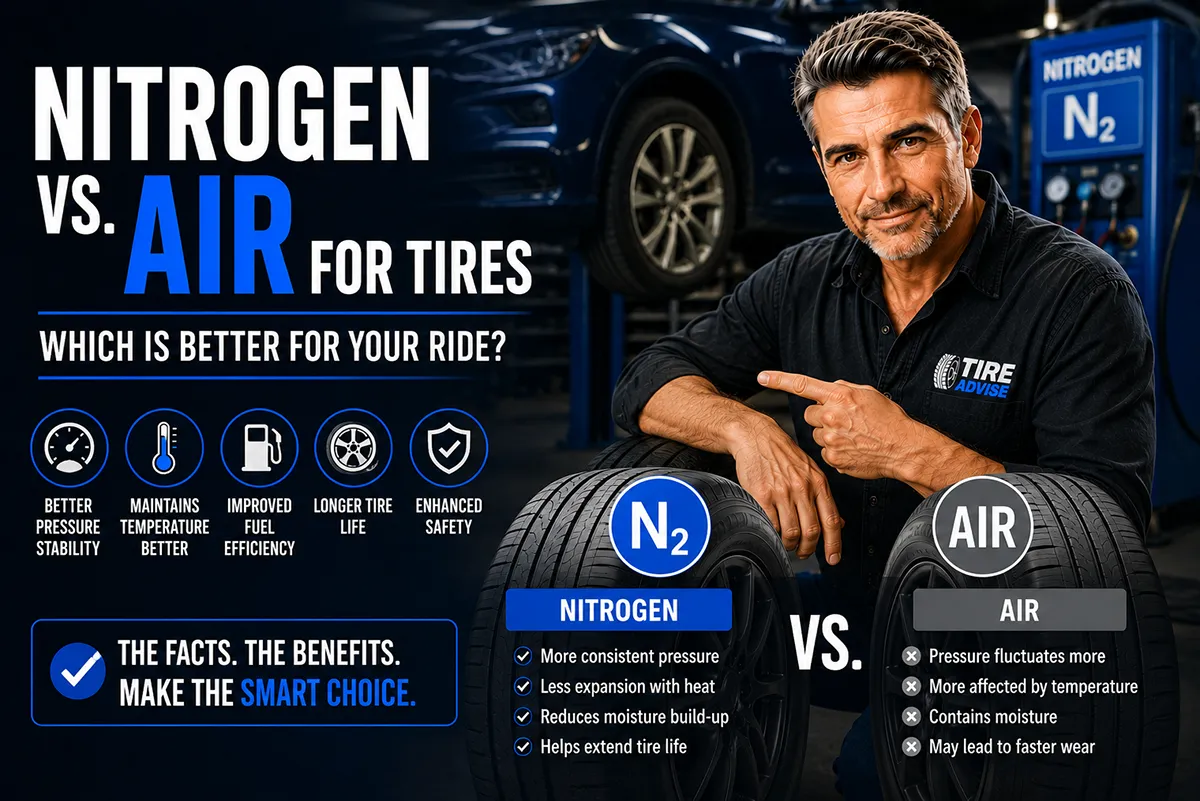
I was standing at a tire shop last year when the technician casually asked, “Do you want nitrogen for an extra $10 per tire?” I froze. I’d heard the green valve caps looked cool and that race cars use nitrogen — but was it actually worth paying for on my daily driver?
That question sent me down a rabbit hole. I spent months testing nitrogen-filled tires against regular compressed air on two of my own vehicles, tracking pressure, temperature response, and real-world performance. What I found might surprise you — or it might save you some money.
- Nitrogen holds pressure slightly longer than regular air, but the difference is minimal for most drivers.
- Regular air is free at most gas stations; nitrogen costs $5–$10 per tire for initial fills and $3–$7 for top-offs.
- Nitrogen reduces moisture inside the tire, which can slow internal corrosion on steel wheels.
- For most everyday US drivers, regular air with monthly pressure checks is perfectly fine.
- Nitrogen makes the most sense for drivers who rarely check tire pressure or live in extreme temperature climates.
- No matter which you choose, maintaining correct PSI is far more important than what gas fills your tires.
Liked this article?
Add TireAdvise as a preferred source so you see more of our tire reviews and guides on Google.
What’s Actually Inside Your Tires Right Now?
Here’s something most people don’t realize: the air you pump into your tires at the gas station is already about 78% nitrogen. The remaining 22% is mostly oxygen, with trace amounts of water vapor, carbon dioxide, and other gases.
So when a shop offers to “fill your tires with nitrogen,” they’re really talking about increasing that nitrogen concentration to somewhere between 93% and 99%. It’s not some exotic chemical — it’s just a purer version of what’s already in there.
This distinction matters because it frames the entire debate. We’re not comparing two completely different substances. We’re comparing regular atmospheric air against a higher-purity version of its dominant component.
Why Nitrogen Is Used in Tires (The Science)
The case for nitrogen comes down to three basic properties that differ from regular compressed air.
1. Nitrogen Molecules Are Larger
Nitrogen molecules (N₂) are slightly larger than oxygen molecules (O₂). Because of this size difference, nitrogen permeates through the rubber of your tire walls more slowly. In theory, this means a nitrogen-filled tire will hold its pressure longer than one filled with regular air.
I want to be honest here — “slightly larger” is the key phrase. We’re talking about a molecular difference that’s measurable in a lab but relatively subtle in real-world driving conditions.
2. Nitrogen Contains Less Moisture
This is actually the more compelling argument. Compressed air from a gas station pump contains water vapor. That moisture can cause several issues inside your tire over time.
Water vapor expands and contracts more dramatically with temperature changes than dry nitrogen does. This means your tire pressure can fluctuate more on hot days or cold mornings if there’s moisture inside. Moisture can also contribute to corrosion on steel wheels and valve stems from the inside out.
Nitrogen used for tire inflation is typically processed to remove nearly all moisture, resulting in a dry fill. In my experience, this is where the real advantage lies — not so much in the nitrogen itself, but in the dryness of the gas.
3. More Stable Pressure Under Temperature Swings
Because nitrogen is drier and permeates more slowly, tires filled with it tend to show more stable pressure readings across temperature changes. If you live somewhere like Arizona where summer pavement temperatures can exceed 150°F, or Minnesota where winter mornings drop well below zero, this stability can be a genuine benefit.
My Real-World Testing Setup
I wanted to go beyond theory, so I set up a straightforward comparison test on my own vehicles.
I had one car running nitrogen in all four tires and another running regular compressed air. Both vehicles had the same brand of all-season tires in comparable sizes. I used a calibrated digital tire pressure gauge — the same one each time — to eliminate measurement inconsistency.
I started both sets of tires at their manufacturer-recommended PSI and then tracked pressure readings over the following weeks and months. I tested in the morning before driving (cold pressure) to get consistent readings. I also documented how each set responded during a stretch of summer heat and the transition into cooler fall weather.
Here’s what I actually observed.
Pressure Retention: Nitrogen vs. Air (My Results)
Over my test period, the nitrogen-filled tires did hold pressure better. But the margin was smaller than I expected.
After several weeks of normal driving, the air-filled tires had lost about 1.5–2 PSI. The nitrogen-filled tires had lost about 0.5–1 PSI over the same period. Both sets started at 35 PSI.
That’s a real, measurable difference. But here’s the thing — if you’re checking your tire pressure even once a month (which every driver should be doing), you’d catch and correct that 1–2 PSI loss in the air-filled tires with a free top-off at any gas station.
The advantage of nitrogen is most meaningful for drivers who simply never check their tire pressure. And I get it — surveys consistently show that most Americans don’t check their tires monthly. If that sounds like you, nitrogen might provide a slightly longer cushion before your tires become noticeably underinflated.
Temperature Stability: Did I Notice a Difference?
This is where things got interesting. During a summer hot spell when temperatures were hitting the upper 90s, I measured the pressure in both sets of tires after the cars sat in the sun for several hours.
The air-filled tires showed pressure increases of about 3–4 PSI above their cold baseline. The nitrogen-filled tires showed increases of about 2–3 PSI. So yes, nitrogen was more stable — but we’re talking about a 1 PSI difference in thermal response.
During the transition from summer to fall, when morning temperatures dropped by 20–30 degrees over a few weeks, the air-filled tires showed slightly more dramatic pressure drops in cold morning readings. Again, the nitrogen tires were a bit more consistent.
Would I have noticed either of these differences in my driving? Honestly, no. The car felt the same either way. The differences were only apparent because I was obsessively measuring with a gauge.
Nitrogen vs. Air: Full Comparison Table
| Factor | Nitrogen | Regular Air |
|---|---|---|
| Cost (initial fill) | $5–$10 per tire | Free at most gas stations |
| Cost (top-off) | $3–$7 per tire (or free at Costco) | Free or $1–$2 at gas stations |
| Pressure retention | Slightly better (loses ~1 PSI/month) | Good (loses ~1.5–2 PSI/month) |
| Temperature stability | Marginally more stable | Slightly more reactive to heat/cold |
| Moisture content | Virtually zero (dry fill) | Contains water vapor |
| Wheel corrosion risk | Lower (no internal moisture) | Slightly higher over time |
| Fuel economy impact | Negligible (tied to PSI maintenance) | Negligible (tied to PSI maintenance) |
| Availability | Select tire shops, Costco, some dealers | Everywhere |
| Can you mix nitrogen and air? | Yes — no safety issue | N/A |
| Best for | Low-maintenance drivers, extreme climates | Budget-conscious drivers, most daily drivers |
The Fuel Economy Question: Is Nitrogen Worth It for MPG?
I’ve seen some nitrogen advocates claim it can improve fuel economy by 3–5%. In my testing, I found this claim to be misleading at best.
Here’s the truth: properly inflated tires improve fuel economy regardless of what’s inside them. The U.S. Department of Energy estimates that for every 1 PSI drop in all four tires, you lose about 0.2% in gas mileage. So if nitrogen helps your tires stay at the correct PSI longer, then yes — it could indirectly help your fuel economy.
But here’s the catch. If you simply check your air-filled tires once a month and top them off as needed, you’ll get the same fuel economy benefit. The gas inside the tire isn’t what saves you money at the pump — the correct pressure is.
During my test period, I noticed no measurable difference in fuel economy between my two vehicles when both were maintained at their recommended PSI. Zero.
What About Tire Lifespan and Tread Wear?
Another claim I wanted to investigate was whether nitrogen could extend the life of your tires. The argument goes like this: because nitrogen reduces internal moisture, it slows oxidation of the rubber from the inside, which could theoretically extend tire life.
I spoke with a tire engineer at a regional tire distributor who told me this: “The oxidation benefit is real but practically insignificant for passenger car tires that are replaced every few years. It matters more for tires that sit in storage for long periods, like spare tires or RV tires.
That made sense to me. If you’re running a set of all-season tires and replacing them on a normal cycle, the internal oxidation difference between nitrogen and air is unlikely to be the thing that determines when you need new tires. Your driving habits, alignment, rotation schedule, and road conditions will have a far bigger impact.
That said, I did find one scenario where nitrogen made a noticeable difference in tire condition. On my older vehicle with steel wheels, I pulled the tires during a seasonal swap and noticed visibly less corrosion on the inside of the wheels that had been running nitrogen. It wasn’t dramatic, but it was there.
Where Can You Get Nitrogen for Your Tires in the US?
If you decide nitrogen is right for you, here’s where to find it:
- Costco Tire Centers: This is probably the best deal in the US. Costco fills your tires with nitrogen for free when you purchase tires from them, and they’ll top off nitrogen for free at any Costco tire center, even years later. If you’re already a Costco member, this is a no-brainer.
- Discount Tire / America’s Tire: Many locations offer nitrogen fills, sometimes included with a tire purchase or available as an add-on service.
- Car dealerships: Some dealerships offer nitrogen as an upsell during service visits. In my experience, dealer pricing tends to be higher — I’ve seen $8–$12 per tire at dealerships versus $5–$7 at independent tire shops.
- Independent tire shops: Availability varies, but many shops in larger metro areas now have nitrogen generators. Call ahead before assuming your local shop offers it.
- Les Schwab, Firestone, Pep Boys: Some national chains offer nitrogen, though policies vary by location. It’s always worth asking.
One important note: if your tires are currently filled with regular air and you want to switch to nitrogen, the shop will need to purge and refill your tires multiple times to get the nitrogen concentration high enough (above 93%). This process costs more than a simple top-off and is why initial nitrogen fills are pricier.
Can You Mix Nitrogen and Regular Air?
Yes, and this is a critical point that I wish more people understood.
If you’re running nitrogen and your tire pressure drops while you’re on a road trip in rural Kansas, you absolutely should pull into that gas station and add regular air. Do not drive on underinflated tires just because you’re worried about “contaminating” your nitrogen fill.
Mixing air and nitrogen is completely safe. There’s no chemical reaction, no risk of damage, and no safety concern whatsoever. You’ll simply dilute the nitrogen concentration, which reduces the benefits slightly but causes zero harm.
The worst thing you can do is drive on low tires because you’re waiting to find a nitrogen source. Underinflation causes uneven tread wear, reduces fuel economy, increases blowout risk, and compromises your handling. None of those problems care whether your tire has nitrogen or air inside it.
After my nitrogen tires needed a top-off during a weekend trip, I added regular air at a gas station. When I got home, I had my tire shop purge and refill with nitrogen. Simple.
The Real Cost Over Time
Let me break down the actual dollars-and-cents comparison, because this is where the decision gets practical.
Scenario 1: Regular Air (The Free Option)
You buy a new set of four tires. The shop fills them with compressed air at no charge. Over the life of those tires, you check your pressure monthly and add air as needed at a gas station. In some states, air is free by law (like Connecticut and California). In others, it costs $1–$2 per fill.
Total cost for inflation over the life of the tires: $0–$24.
Scenario 2: Nitrogen (The Premium Option)
You buy the same four tires. The shop charges $7 per tire for nitrogen fills — that’s $28 upfront. Over the life of those tires, you need occasional top-offs. If you’re a Costco member, those are free. If not, figure $5 per tire a few times per year.
Total cost for inflation over the life of the tires: $28–$100+.
Is the difference in pressure retention and temperature stability worth an extra $28 to $100 over the life of a set of tires? For most people I talk to, the honest answer is no. But if you’re already buying tires at Costco and the nitrogen is free, there’s absolutely no reason not to take it.
When Nitrogen Actually Makes Sense
After all my testing and research, I’ve identified specific scenarios where I’d genuinely recommend nitrogen over regular air:
- You rarely check your tire pressure. If you’re the type of driver who only thinks about tires when the TPMS light comes on, nitrogen’s slower pressure loss gives you a better safety margin.
- You live in extreme temperature zones. If you deal with Phoenix summers or North Dakota winters, nitrogen’s better temperature stability can mean fewer pressure fluctuations and fewer TPMS warnings.
- You’re storing tires or vehicles long-term. If you have a seasonal set of tires, a classic car, or an RV that sits for months, nitrogen’s lack of moisture helps prevent internal corrosion and rubber degradation during storage.
- You buy tires at Costco. It’s free. Take it.
- You have expensive alloy or custom wheels. If you’re running $500+ wheels, the reduced internal corrosion from a dry nitrogen fill could help protect your investment.
- You tow heavy loads regularly. When you’re towing near your vehicle’s GVWR, consistent tire pressure is critical for safety. Nitrogen gives you slightly more predictable pressure behavior under heavy load and heat.
When Regular Air Is Perfectly Fine
For the majority of US drivers, regular air remains the sensible choice. Here’s when I’d tell you to save your money:
- You check your tires monthly. If you already have a routine, the pressure retention advantage of nitrogen is nearly irrelevant.
- You drive a typical commuter car. For standard sedans, crossovers, and SUVs driven in moderate climates, regular air performs just fine.
- You don’t want the hassle of finding nitrogen. Regular air is available at virtually every gas station in America. Nitrogen is not. Convenience matters.
- You’re on a tight budget. If you’re already stretching to afford new tires, spend that extra $28–$40 on a quality tire pressure gauge and check your tires regularly instead.
The Myths I Want to Debunk
In the course of my testing and research, I encountered several nitrogen claims that range from exaggerated to flat-out false. Let me set the record straight.
Myth: Nitrogen-filled tires never lose pressure
False. Nitrogen-filled tires absolutely lose pressure over time. They just lose it slightly more slowly than air-filled tires. If you have a nail in your tire or a leaky valve stem, nitrogen won’t help you any more than air would. You’ll still get a flat.
Myth: Nitrogen improves handling and ride quality
I noticed zero difference in ride quality or handling between my nitrogen-filled and air-filled tires at the same pressure. Your suspension, tire compound, tread design, and inflation level determine ride quality — not whether the gas inside is 78% or 95% nitrogen.
Myth: Nitrogen makes your tires run cooler
This one has a tiny grain of truth but is wildly overstated. Dry nitrogen does result in slightly less pressure variation under heat because there’s no water vapor to expand. But the actual temperature of the tire itself doesn’t change based on the inflation gas. Your tire’s heat generation comes from road friction, load, speed, and inflation pressure — not the molecular composition of the gas inside.
Myth: You can never add regular air to nitrogen tires
As I covered above, this is completely false and potentially dangerous misinformation. Always top off with whatever’s available rather than driving on low pressure.
Myth: The green valve caps mean the tire has nitrogen
Green caps are supposed to indicate a nitrogen fill, but they’re just caps. I’ve seen shops put green caps on tires filled with regular air, and I’ve seen nitrogen-filled tires with standard black caps. The cap color is a courtesy indicator, not a guarantee.
What Professional Race Teams and Airlines Actually Do
Nitrogen advocates love to point out that NASCAR, Formula 1, and commercial airlines use nitrogen. This is true — but context matters enormously.
Race teams use nitrogen because they need absolutely consistent tire pressures during races where even a 0.5 PSI change can affect lap times by tenths of a second. They’re operating at the extreme edge of tire performance, where every variable must be controlled.
Airlines use nitrogen in aircraft tires because those tires experience extreme temperature swings (from tarmac heat to -60°F at cruising altitude) and because moisture inside a tire could freeze at high altitude and cause dangerous imbalances during landing.
Your Honda Accord driving to the grocery store in suburban Ohio is not operating under these conditions. The fact that professional applications benefit from nitrogen doesn’t mean your daily driver will experience meaningful improvements.
I respect the science behind these professional use cases, but I think it’s misleading to use them as selling points for passenger car tires.
My Practical Recommendation
After months of testing, measuring, and researching, here’s my honest recommendation for most US drivers:
Don’t pay extra for nitrogen unless it’s free or nearly free.
Instead, invest $15–$25 in a quality digital tire pressure gauge — I like the Accutire MS-4021B and the AstroAI digital gauge, both available on Amazon — and check your tires once a month. Do it in the morning before you drive, when the tires are cold.
Keeping your tires at the correct PSI (found on the driver’s door jamb sticker, not the tire sidewall) will deliver every benefit that nitrogen promises: better fuel economy, longer tread life, improved handling, and reduced blowout risk. It doesn’t matter if that correct PSI is maintained with nitrogen, regular air, or a mix of both.
If you happen to buy tires at Costco, absolutely take the free nitrogen. If a tire shop throws in nitrogen for free with your purchase, great. But if someone is trying to upsell you $40–$50 for nitrogen on top of your tire purchase, I’d politely decline and spend that money on a proper alignment instead.
The Bottom Line: It’s About Pressure, Not the Gas
The entire nitrogen vs. air debate, in my opinion, distracts from the far more important message: keep your tires properly inflated.
Underinflated tires are one of the leading causes of tire failures in the US. The National Highway Traffic Safety Administration (NHTSA) estimates that about one in four cars on US roads has at least one significantly underinflated tire. That’s a safety problem that no amount of nitrogen can solve if drivers still aren’t paying attention to their tire pressure.
Whether you fill your tires with nitrogen, air, or some mix of both, the single best thing you can do for your tires — and your safety — is check the pressure regularly and keep it where the manufacturer says it should be.
I’ve driven on both, tested both extensively, and lived with both. Nitrogen is fine. Air is fine. What’s not fine is driving around on tires that are 8 PSI low because you haven’t checked them since last summer.
Be the driver who checks. That matters infinitely more than what’s inside the tire.
Frequently Asked Questions
Is filling tires with nitrogen worth the extra cost?
For most everyday US drivers, nitrogen inflation offers marginal benefits that may not justify the typical $5–$10 per tire fill-up cost. Nitrogen does hold pressure slightly longer than regular air and reduces moisture inside the tire, but if you already check your tire pressure monthly, you’ll get similar performance and tread life with free compressed air at most gas stations. I’d recommend saving the money and putting it toward higher-quality replacement tires instead.
What is the real difference between nitrogen and air in tires?
Regular compressed air is about 78% nitrogen already, so the difference comes down to removing most of the oxygen and water vapor. Pure nitrogen molecules are slightly larger and permeate through the tire rubber more slowly, which means your tires lose pressure at a marginally slower rate—roughly 1–2 psi less per month compared to standard air. The absence of moisture also reduces internal corrosion on steel wheels, though this is rarely a significant issue for passenger vehicles driven in normal US conditions.
Does nitrogen in tires improve gas mileage and fuel economy?
Nitrogen can help maintain more consistent tire pressure, which indirectly supports optimal fuel economy since underinflated tires increase rolling resistance and reduce MPG. However, the fuel savings are negligible—typically less than 1%—because regular air works just as well if you simply check and adjust your tire pressure every few weeks. The best way to improve gas mileage through your tires is to keep them properly inflated to the manufacturer’s recommended PSI, regardless of whether you use nitrogen or air.
Can you mix nitrogen and regular air in your tires?
Yes, you can safely mix nitrogen and regular air without damaging your tires, wheels, or TPMS sensors. If your tires are filled with nitrogen and you notice low pressure on a road trip, topping off with regular air at any gas station is perfectly fine. You’ll dilute the nitrogen concentration, but the tire will still perform normally. Many Costco and Discount Tire locations that offer nitrogen fills will simply top off with nitrogen again at your next visit.
Do new tires from Costco, Discount Tire, or Walmart come filled with nitrogen?
Costco fills all new tire purchases with nitrogen at no additional charge and will provide free nitrogen refills for the life of the tires. Discount Tire and America’s Tire generally use standard compressed air but may offer nitrogen at select locations. Walmart’s auto centers typically fill with regular air. If nitrogen is important to you, it’s worth asking about fill policies when comparing tire installation prices between retailers.
How often do you need to refill nitrogen tires compared to regular air?
Nitrogen-filled tires still lose pressure over time—just about 30–40% more slowly than air-filled tires. You can expect to check and top off nitrogen tires every 2–3 months versus roughly once a month with regular air. I still recommend checking all tire pressures at least monthly regardless of the fill gas, especially before long highway drives or during major seasonal temperature swings that are common across much of the US.
Is nitrogen better for tires in extreme heat or cold weather driving?
Nitrogen is slightly more stable than regular air when temperatures fluctuate because it contains less moisture and expands or contracts more predictably. In extreme US climates—whether it’s Arizona summers hitting 115°F or Minnesota winters dropping below zero—nitrogen-filled tires may hold a more consistent PSI. That said, the real-world difference is typically just 1–2 psi, so checking your pressure with a quality gauge when seasons change matters far more than which gas is inside the tire.
