

I was halfway through a routine oil change on my daily driver when I realized the replacement oil filter I’d grabbed off the shelf simply wouldn’t thread onto the engine block. It looked right, it felt close, but the threads were just slightly off — cross-threading it would have been a disaster.
That experience sent me down a rabbit hole of oil filter thread sizes, and what I learned genuinely surprised me. Most drivers never think about the threads on their oil filter until something goes wrong, and by then, the damage can range from a slow leak to a catastrophic engine failure.
- Oil filter thread size refers to the diameter and pitch of the threads on the filter’s mounting base that connect to your engine’s oil filter adapter.
- The most common thread sizes for US vehicles are 3/4″-16 UNF, 13/16″-16 UNF, M20x1.5, and M22x1.5.
- Using the wrong thread size can cause cross-threading, oil leaks, and severe engine damage.
- Always verify your vehicle’s required thread size in the owner’s manual or by checking the OEM filter specifications before purchasing a replacement.
- This guide covers how to identify, measure, and match oil filter thread sizes for virtually every US-market car and truck.
Liked this article?
Add TireAdvise as a preferred source so you see more of our tire reviews and guides on Google.
Why Should a Tire Blog Talk About Oil Filters?
I know what you’re thinking — this is a tire advice site, so why am I writing about oil filter thread sizes? Here’s the thing: at TireAdvise, we talk to everyday car owners, and most of you are handling basic maintenance yourselves. If you’re shopping for tires, there’s a good chance you’re also the kind of hands-on driver who does your own oil changes.
I’ve been reviewing tires and maintaining my own fleet of test vehicles for years, and I can tell you that oil changes and tire rotations go hand-in-hand as the two most common DIY maintenance tasks. Getting either one wrong can be expensive and dangerous.
So consider this your complete guide to oil filter thread sizes — written from real experience in the garage, not from a spec sheet.
What Exactly Is Oil Filter Thread Size?
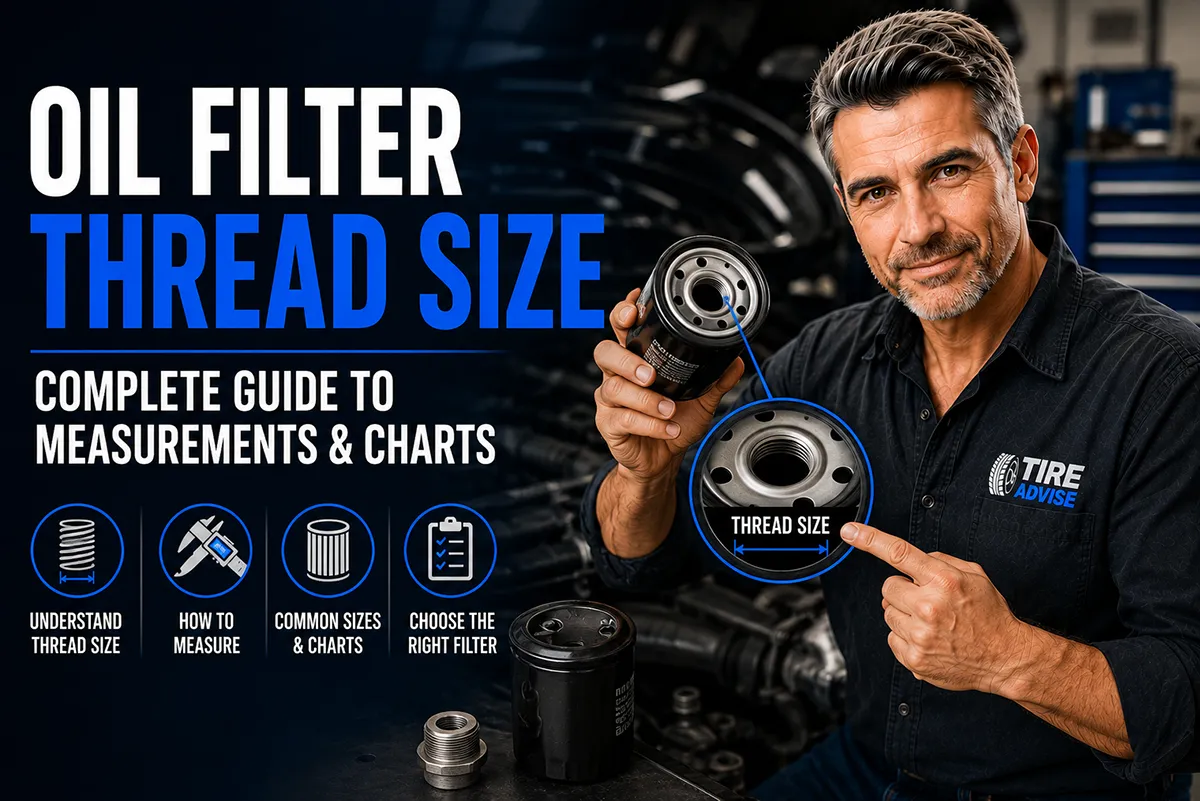
The oil filter thread size is the measurement of the threaded fitting on the base of your spin-on oil filter. This threaded portion screws onto a corresponding threaded nipple or adapter on your engine block.
Thread size is defined by two measurements: the diameter of the threads and the pitch (the distance between each thread). In US standard (SAE) measurements, this is expressed as diameter-threads per inch, like 3/4″-16. In metric, it’s diameter x pitch in millimeters, like M20x1.5.
Getting these numbers wrong — even by a fraction — means your oil filter either won’t mount properly or will appear to fit while actually creating a dangerous seal failure.
The Anatomy of an Oil Filter Thread
Let me break down what you’re actually looking at when you examine the base of a spin-on oil filter:
- Threaded center hole: This is the female threaded opening in the center of the filter’s baseplate. It screws onto the male-threaded post on your engine.
- Gasket/O-ring surface: The flat area surrounding the threaded hole where a rubber gasket sits to create an oil-tight seal against the engine’s mounting surface.
- Anti-drain back valve: Located just inside the threaded hole, this rubber flap prevents oil from draining out of the filter when the engine is off.
- Thread diameter: The inner diameter of the threaded hole, measured across the widest point of the threads.
- Thread pitch: The number of threads per inch (SAE) or the distance between threads in millimeters (metric).
The Most Common Oil Filter Thread Sizes in the US
After working on dozens of vehicles over the years — everything from compact sedans to full-size trucks — I’ve found that the vast majority of US-market vehicles use one of a handful of standard thread sizes. Here’s what I encounter most frequently:
| Thread Size | Standard | Common Vehicles | Notes |
|---|---|---|---|
| 3/4″-16 UNF | SAE | Many GM, Ford, Chrysler vehicles; most US-made small to mid-size cars | The single most common thread size I encounter in US vehicles |
| 13/16″-16 UNF | SAE | Larger GM engines, some Ford trucks, Dodge trucks | Common on larger displacement V8 engines |
| M20x1.5 | Metric | Toyota, Honda, Mazda, Subaru, many Japanese imports | Extremely common; close to 3/4″-16 but NOT interchangeable |
| M22x1.5 | Metric | Some Honda, Hyundai, Kia models; select European vehicles sold in the US | Less common but important to identify correctly |
| 1″-12 UNF | SAE | Heavy-duty Ford and GM trucks, some diesel applications | Larger size for high-flow applications |
| M24x1.5 | Metric | Select European vehicles (BMW, VW, Audi models sold in US) | Found on some German-engineered engines |
| 1″-16 UN | SAE | Some Ford modular V8 engines | Finer pitch variant for specific Ford applications |
In my experience, if you drive a domestic vehicle made in the last 20 years, you’re most likely looking at 3/4″-16 or 13/16″-16. If you drive a Japanese import, M20x1.5 is the thread size I see more than any other.
How to Identify Your Vehicle’s Oil Filter Thread Size
This is where the rubber meets the road — or in this case, where the threads meet the adapter. Here are the methods I use and recommend, ranked from easiest to most involved.
Method 1: Check Your Owner’s Manual
I always start here. Your owner’s manual will specify the OEM oil filter part number. From that part number, you can easily look up the thread size on the filter manufacturer’s website or any auto parts retailer.
This is the fastest and most reliable method. If you don’t have a physical manual, most manufacturers offer digital versions for free on their websites.
Method 2: Look Up the OEM Filter Part Number
If you still have the old filter, the part number is printed right on the canister. Type that number into any auto parts website — AutoZone, O’Reilly, NAPA, or Amazon — and the product specifications will list the thread size.
I keep a small notebook in my garage where I record the OEM filter numbers for every vehicle I work on. It saves me from making repeat trips to the parts store.
Method 3: Use an Online Cross-Reference Tool
Brands like Wix, FRAM, Purolator, and Mobil 1 all offer online filter lookup tools. You punch in your year, make, model, and engine, and they’ll tell you exactly which filter you need — including thread size specifications.
I’ve found the Wix filter lookup to be particularly detailed, as it includes full dimensional specs alongside the part numbers.
Method 4: Measure the Threads Yourself
If all else fails, you can physically measure the threads. Here’s how I do it:
- For the engine adapter (male threads): Use a caliper to measure the outside diameter of the threaded post. Then use a thread pitch gauge to determine the pitch.
- For the oil filter (female threads): Measure the inside diameter of the threaded hole on the filter base using a caliper. Use a thread pitch gauge inside the hole to confirm pitch.
A decent set of calipers costs about $15-$25 at Harbor Freight, and a thread pitch gauge set runs about $8-$12. These are tools that pay for themselves many times over if you do any DIY automotive work.
SAE vs. Metric: Why This Distinction Matters
Here’s something that tripped me up early in my DIY career: SAE and metric thread sizes can be frustratingly close to each other without being compatible. The most notorious example is 3/4″-16 UNF (SAE) versus M20x1.5 (metric).
Let me put this in perspective. A 3/4″ diameter is 19.05mm. An M20 thread is 20mm. That’s less than 1mm difference in diameter. To make things worse, 16 threads per inch (UNF) works out to approximately 1.587mm pitch — pretty close to the 1.5mm metric pitch.
This means a metric M20x1.5 filter can sometimes appear to start threading onto a 3/4″-16 adapter. It might even go on a turn or two before binding. If you force it, you’ll strip the threads on the engine adapter, and that’s a repair bill that can easily run $200-$500 or more at a shop.
I’ve personally watched someone at a quick-lube shop nearly cross-thread a metric filter onto an SAE adapter on my truck. I caught it in time, but it reinforced why I prefer doing my own oil changes whenever possible.
How to Tell SAE from Metric at a Glance
Here are some quick rules of thumb that have served me well:
- Domestic US brands (GM, Ford, Chrysler/Stellantis): Usually SAE threads, but modern models with global platforms may use metric.
- Japanese brands (Toyota, Honda, Nissan, Subaru, Mazda): Almost always metric threads.
- Korean brands (Hyundai, Kia): Typically metric.
- German brands (BMW, VW, Audi, Mercedes): Metric, though many modern German cars use cartridge-style filters instead of spin-on, making this a moot point.
When in doubt, I always cross-reference against the OEM filter specification. It takes 30 seconds and eliminates all guesswork.
What Happens When You Use the Wrong Thread Size
I want to be very clear about the stakes here because I’ve seen the aftermath firsthand. Using an oil filter with the wrong thread size can lead to several outcomes, none of them good.
Cross-Threading
This is the most immediate risk. When you force a filter with mismatched threads onto the adapter, the threads cut into each other, creating a sloppy, unreliable connection. In some cases, the filter may not seal properly and will leak immediately. In other cases, it might hold for a while before vibrating loose.
I’ve seen an engine adapter that was cross-threaded so badly it needed to be drilled out and re-tapped. That job alone cost the car owner over $300 in labor at a local shop.
Oil Leaks
Even if the filter appears to thread on, wrong-sized threads won’t create the proper clamping force against the gasket. This means the gasket doesn’t seal correctly, and oil slowly (or not so slowly) leaks out.
An oil leak might seem like a minor inconvenience, but if you lose enough oil without noticing, your engine runs without lubrication. That leads to bearing failure, scored cylinder walls, and potentially a seized engine — a repair that can total an older vehicle.
Filter Blowoff
In the worst-case scenario, a poorly threaded filter can actually blow off the engine entirely under oil pressure. Modern engines run oil pressure between 25-65 PSI, and that’s more than enough force to launch a loosely threaded filter off the adapter.
When this happens, the engine loses all its oil in seconds. If you’re driving at highway speed, you might not realize what happened until the oil pressure light comes on — and by then, the damage is often already done.
Oil Filter Thread Size by Popular US Vehicles
To save you some research time, I’ve compiled the most common thread sizes for popular vehicles I see on US roads every day. I’ve verified these against OEM specifications and my own garage experience.
Trucks and SUVs
- Ford F-150 (EcoBoost 2.7L, 3.5L): 3/4″-16 UNF
- Ford F-150 (5.0L Coyote V8): 3/4″-16 UNF
- Chevy Silverado 1500 (5.3L, 6.2L V8): 13/16″-16 UNF
- RAM 1500 (5.7L Hemi V8): 13/16″-16 UNF (earlier models) or uses cartridge filter (newer eTorque models)
- Toyota Tacoma (3.5L V6): M20x1.5
- Toyota Tundra (5.7L V8): M20x1.5
- Jeep Wrangler (3.6L Pentastar V6): 3/4″-16 UNF
- Chevy Tahoe / Suburban (5.3L V8): 13/16″-16 UNF
Sedans and Compact Cars
- Toyota Camry (2.5L 4-cyl): M20x1.5
- Honda Civic (1.5L Turbo, 2.0L): M20x1.5
- Honda Accord (1.5T, 2.0T): M20x1.5
- Hyundai Sonata (2.5L): M20x1.5
- Nissan Altima (2.5L): M20x1.5
- Chevy Malibu (1.5T): 3/4″-16 UNF
- Ford Fusion (2.5L, EcoBoost): 3/4″-16 UNF
- Subaru Outback (2.5L Boxer): M20x1.5
European Models Sold in the US
- BMW 3 Series (B48 2.0T): Cartridge-style filter (no thread size applicable)
- VW Jetta/Golf (2.0T): Cartridge-style filter (most newer models)
- Mercedes C-Class: Cartridge-style filter
A noticeable trend I’ve observed over recent years is that many European manufacturers — and increasingly some domestic and Japanese brands — are moving to cartridge-style oil filters housed inside a reusable canister. These don’t have thread sizes in the traditional sense, as you’re simply replacing a paper filter element rather than spinning on a metal canister.
Cartridge Filters vs. Spin-On Filters: The Thread Size Question
Since we’re talking about thread sizes, it’s worth addressing the growing trend of cartridge-style oil filters. I’ve noticed that about one-third of the newer vehicles I work on now use a cartridge-style filter instead of the traditional spin-on design.
With a cartridge filter, the housing is permanently attached to the engine and has a removable cap (usually plastic or aluminum). You unscrew the cap, pull out the old paper filter element, drop in a new one, and screw the cap back on.
The thread size question still exists, but it applies to the cap-to-housing connection rather than a filter-to-engine connection. And since you’re reusing the same cap every time, there’s no thread compatibility issue to worry about during a filter change.
If your vehicle uses a cartridge filter, you simply need to match the filter element dimensions — height, outer diameter, and inner diameter — rather than worrying about thread size.
How to Properly Install an Oil Filter (Thread Size Best Practices)
Even when you have the correct thread size, improper installation can cause problems. Here’s the process I follow every single time, and it hasn’t failed me yet.
Step 1: Verify the Thread Match Before Installation
Before applying any oil to the gasket, I hand-thread the new filter onto the adapter just a turn or two to confirm it goes on smoothly. The filter should spin easily with just finger pressure. If it feels tight, gritty, or resistant, stop immediately — something is wrong.
Step 2: Lubricate the Gasket
I always apply a thin film of fresh motor oil to the rubber gasket on the filter base. This ensures the gasket seats properly and doesn’t bind or tear during installation. It also makes removal much easier at the next oil change.
Step 3: Hand-Tighten, Then Snug
Thread the filter on by hand until the gasket makes contact with the mounting surface. From that point, I tighten an additional 3/4 to 1 full turn by hand. Most filter manufacturers specify this range, and it’s printed right on the filter or the box.
I never use an oil filter wrench to tighten a new filter. Over-tightening compresses the gasket excessively, which makes it harder to remove next time and can actually cause leaks by distorting the gasket.
Step 4: Check for Leaks
After filling the engine with fresh oil and running it for a minute, I shut it off and visually inspect around the filter base for any signs of oil seepage. If everything is dry, you’re good to go.
Common Mistakes I’ve Seen (And Made)
In the spirit of honesty, let me share some real mistakes I’ve witnessed — and a couple I’ve made myself.
Mistake #1: Assuming All Filters of the Same Brand Are the Same Thread
Just because you used a FRAM PH3614 on your old car doesn’t mean a FRAM PH3614 fits your new car. Different part numbers within the same brand have different thread sizes. I learned this the hard way during my first year of doing my own oil changes. Always look up the specific part number for your specific vehicle.
Mistake #2: Buying by Filter Size Instead of Part Number
I’ve seen people at auto parts stores grab a filter because it “looks about the same size” as their old one. Physical canister dimensions and thread size are independent specifications. Two filters can have identical canister heights and diameters but completely different thread sizes.
Mistake #3: Not Checking for a Stuck Gasket
Before installing a new filter, always inspect the engine’s mounting surface to make sure the old filter’s gasket didn’t stay behind. If you install a new filter on top of a stuck old gasket, you’ll have a double-gasket situation that almost always causes a catastrophic leak. I check this every single time — it takes two seconds and can save you thousands.
Mistake #4: Using Thread Sealant on Oil Filters
I’ve seen people apply Teflon tape or thread sealant to oil filter threads. Don’t do this. The gasket is designed to create the seal — the threads are purely for clamping force. Adding sealant to the threads serves no purpose and can actually prevent the filter from achieving proper gasket compression.
Recommended Oil Filter Brands and Where to Buy
Since I’ve been doing my own oil changes for years, I’ve developed strong preferences for certain filter brands. Here are my go-to choices, all widely available in the US:
- Wix (about $6-$12): This is my everyday workhorse filter. Great construction, excellent filtration media, and their thread machining is consistently clean and precise. Available at most auto parts stores and Amazon.
- Purolator Boss / PureOne ($8-$15): A step up in filtration performance. I use PureOne filters on vehicles where I want the best protection. The thread quality has always been excellent in my experience.
- Mobil 1 Extended Performance ($10-$15): If you’re running synthetic oil and want a filter designed to match extended drain intervals, this is a great option. I’ve used these on several long-term test vehicles with zero issues.
- FRAM Ultra Synthetic ($8-$14): FRAM gets a bad reputation from their cheapest orange-can filters, but the Ultra Synthetic line is genuinely excellent. Good thread quality, strong construction, and a grippy textured canister that makes installation easy.
- OEM Filters ($7-$20): For vehicles like Toyota (using genuine Toyota filters) or Honda, OEM filters are reasonably priced and guaranteed to have the correct thread size. I use OEM filters on my Toyota specifically because they’re affordable and I never have to second-guess compatibility.
What About Universal or “Fits All” Oil Filters?
Let me be blunt: there is no such thing as a universal oil filter. Any product marketed as “fits all” or “universal” should be treated with extreme skepticism. Oil filters vary in thread size, gasket diameter, bypass valve pressure rating, anti-drain back valve design, and filtration capacity.
I’ve seen no-name “universal” filters at flea markets and discount tool shops priced at $2-$3 each. In my opinion, your engine deserves better than a gamble on an unknown filter. A quality, application-specific oil filter costs $6-$15 — that’s a trivial expense compared to the engine it’s protecting.
Special Situations: Adapters and Thread Size Conversion
There are legitimate scenarios where you might need an oil filter thread adapter. Common reasons include:
- Engine swaps: If you’ve installed a different engine in your vehicle, the oil filter adapter thread size may not match the filters you want to use.
- Remote oil filter relocation kits: These kits move the oil filter to a more accessible location and often involve an adapter plate with specific thread sizes on each side.
- Oil cooler or oil analysis port additions: Sandwich-style adapters that go between the engine and oil filter may require thread size matching on both sides.
Thread adapters are available from companies like Mishimoto, Earl’s, and various racing parts suppliers. Prices range from $15-$50 depending on the configuration. I’ve used Mishimoto sandwich plates on two builds with no issues — just make sure you verify thread sizes on both the engine side and filter side before ordering.
A Quick Thread Size Reference Chart for DIYers
I keep a simplified version of this chart taped to my toolbox. Here it is for your reference:
| Thread Size | Diameter (inches) | Diameter (mm) | Pitch |
|---|---|---|---|
| 3/4″-16 UNF | 0.750″ | 19.05mm | 16 TPI (1.587mm) |
| 13/16″-16 UNF | 0.8125″ | 20.64mm | 16 TPI (1.587mm) |
| M20x1.5 | 0.787″ | 20.00mm | 1.5mm |
| M22x1.5 | 0.866″ | 22.00mm | 1.5mm |
| 1″-12 UNF | 1.000″ | 25.40mm | 12 TPI (2.117mm) |
| M24x1.5 | 0.945″ | 24.00mm | 1.5mm |
| 1″-16 UN | 1.000″ | 25.40mm | 16 TPI (1.587mm) |
Final Thoughts: It’s a Small Detail With Big Consequences
After years of wrenching on my own cars and trucks, I’ve come to appreciate that the small details are often the most important ones. Oil filter thread size is exactly that kind of detail — easy to overlook, easy to get wrong, and potentially devastating when it goes bad.
My best advice? Spend two minutes ver
Frequently Asked Questions
What is oil filter thread size and why does it matter for my vehicle?
Oil filter thread size refers to the diameter and pitch of the threads on your engine’s oil filter mounting post, which must match your replacement oil filter exactly. Using the wrong thread size can cause cross-threading, oil leaks, or even catastrophic engine failure while driving. Common US vehicle thread sizes include 3/4″-16, 13/16″-16, and M20x1.5, depending on whether your engine uses SAE or metric fittings. Always verify your specific thread size in your owner’s manual before purchasing a filter.
How do I find the correct oil filter thread size for my car?
The easiest way to find your oil filter thread size is to check your vehicle’s owner’s manual or look up the OEM part number and cross-reference it with filter manufacturers like Fram, Mobil 1, or Wix. You can also remove the existing filter and measure the thread diameter and pitch using a thread gauge, which costs around $10-$15 at most US auto parts stores. Online filter lookup tools from brands like K&N and Purolator let you enter your year, make, and model to find the exact thread specification.
What are the most common oil filter thread sizes for US cars and trucks?
The most common oil filter thread sizes for US-market vehicles are 3/4″-16 UNF (found on many GM, Ford, and Chrysler engines) and 13/16″-16 UNF (common on larger V8 engines and trucks). Many newer vehicles and imports use metric thread sizes like M20x1.5 or M22x1.5. If you drive a popular model like a Toyota Camry, Honda Civic, or Ford F-150, aftermarket filter brands typically stock multiple options that match your specific thread size.
Can I use an oil filter with a different thread size than what’s recommended?
No, you should never use an oil filter with a thread size that differs from your manufacturer’s specification. Even a slight mismatch can strip the threads on your engine block’s oil filter adapter, leading to expensive repairs that can cost $200-$500 or more. A poorly seated filter can also blow off under oil pressure while driving, causing sudden oil loss and potential engine seizure. Always match the exact thread size, gasket diameter, and filter height to your vehicle’s requirements.
What is the difference between SAE and metric oil filter thread sizes?
SAE (Society of Automotive Engineers) thread sizes are measured in inches with threads per inch, like 3/4″-16, and are standard on most American-made engines from Ford, GM, and Stellantis. Metric thread sizes use millimeters for diameter and pitch, such as M20x1.5, and are common on Japanese, Korean, and European vehicles sold in the US. The two systems are not interchangeable, so I always recommend confirming whether your engine uses SAE or metric threads before ordering a replacement oil filter online or at stores like AutoZone or O’Reilly.
Does oil filter thread size affect oil pressure or engine performance?
The thread size itself doesn’t directly affect oil pressure, but installing a filter with the wrong thread size can result in an improper seal that causes low oil pressure warnings and dangerous leaks. A correctly threaded filter ensures the bypass valve and anti-drain back valve function properly, maintaining consistent oil flow in all US driving conditions from Arizona heat to Minnesota winters. If you notice oil pressure fluctuations after a filter change, the thread engagement may be insufficient and you should inspect the fitment immediately.
How much does it cost to fix a stripped oil filter thread on an engine block?
Repairing a stripped oil filter thread on your engine block typically costs between $150 and $500 at most US repair shops, depending on whether the mechanic can install a thread repair insert like a HeliCoil or TimeSert, or if the oil filter adapter housing needs full replacement. In severe cases where the block itself is damaged, costs can exceed $1,000. This is why I always stress using the correct oil filter thread size and hand-tightening the filter according to the manufacturer’s torque specification, usually 3/4 to one full turn past gasket contact.
