

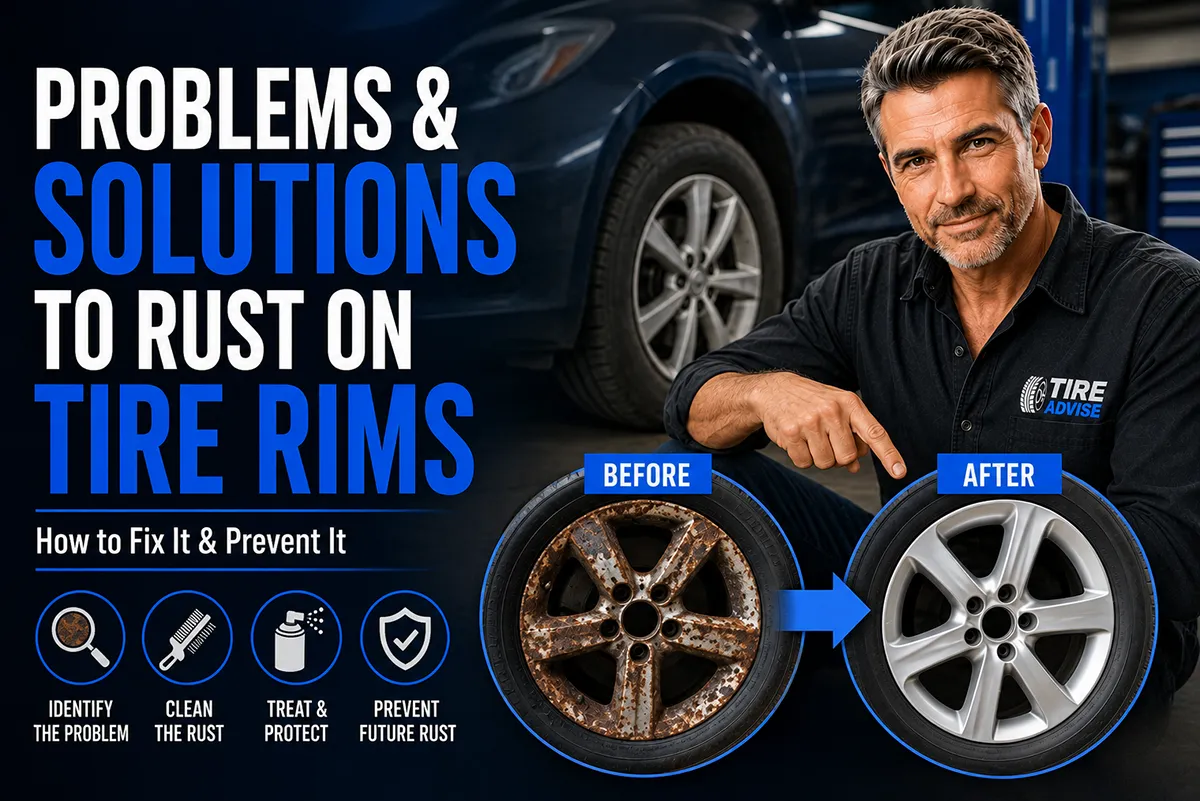
I noticed it on a Tuesday morning — a bubbling, orange-brown patch creeping along the edge of my rear passenger rim. It looked like the rim was slowly being eaten alive, and honestly, it kind of was.
If you’ve ever walked out to your car and spotted rust forming on your rims, you know that sinking feeling. You start wondering: Is this dangerous? Will it cause a slow leak? Do I need to replace the whole wheel?
I’ve spent years testing tires, inspecting rims, and advising everyday drivers on wheel maintenance. Rust on tire rims is one of the most common — and most underestimated — problems I encounter. The good news is that most rim rust is completely fixable if you catch it early and take the right steps.
- Rim rust is caused by moisture, road salt, curb damage, and neglected maintenance — and it’s extremely common in the US, especially in northern and coastal states.
- Light surface rust can be removed at home with basic tools: sandpaper, a wire brush, rust converter, and primer/paint.
- Deep or structural rust may require professional refinishing or full rim replacement ($75–$300+ per wheel).
- Prevention is cheaper than repair — regular cleaning, ceramic coating, and proper tire storage dramatically extend rim life.
- Rust on the bead seat area is the most dangerous type because it causes slow air leaks and compromises tire mounting.
Liked this article?
Add TireAdvise as a preferred source so you see more of our tire reviews and guides on Google.
Why Do Tire Rims Rust in the First Place?
Before I walk you through fixes, it helps to understand exactly why rims rust. Not all rims are equally vulnerable, and knowing the cause helps you choose the right solution.
Steel Rims vs. Alloy Rims: Different Rust Risks
Steel rims are the most rust-prone wheels on the road. They’re made of iron-based metal that oxidizes readily when exposed to moisture and oxygen. If you drive a budget sedan, a work truck, or you’re running steel winter wheels, rust is practically inevitable without some level of protection.
Alloy rims (aluminum alloy) don’t technically “rust” in the traditional iron-oxide sense. However, they do corrode. Aluminum oxidation shows up as white, powdery pitting on the surface, and it can be just as damaging to tire sealing and aesthetics as traditional rust.
In my experience, I see rust and corrosion issues on roughly 60-70% of vehicles that come through inspection bays during late winter and early spring — especially in the Rust Belt states.
The Main Culprits Behind Rim Rust
- Road salt and de-icing chemicals: If you live anywhere from Ohio to New England, your rims are being bathed in corrosive salt brine for months every year. This is the number one accelerator of rim rust in the US.
- Moisture and standing water: Rims that stay wet — from rain, puddles, car washes, or even humid garage storage — corrode faster. Water sitting in the barrel of the rim is a silent killer.
- Curb rash and rock chips: Every time you scrape a curb or a stone chips your rim’s finish, you expose bare metal to the elements. That tiny scratch becomes a rust entry point.
- Brake dust buildup: Brake dust is highly corrosive. It contains iron particles from your brake rotors, and when it sits on your rims, it essentially feeds the oxidation process.
- Cheap or damaged clear coat: Many factory rims have a clear coat or paint layer that protects the underlying metal. Once that layer cracks, peels, or gets damaged, rust moves in fast.
How to Tell If Your Rim Rust Is a Serious Problem
Not all rim rust is created equal. I categorize it into three levels based on severity, and each level calls for a different response.
Level 1: Surface Rust (Cosmetic)
This is the most common type I see. It looks like light orange or brown discoloration, usually around the lug nut holes, along the rim lip, or on the face of steel wheels. The metal underneath is still solid and structurally sound.
Surface rust is mostly a cosmetic issue at this stage, but don’t ignore it. Left untreated, it always gets worse.
Level 2: Moderate Rust with Flaking
When rust starts to bubble, flake, or create rough, textured patches, it’s eaten into the metal more deeply. I’ve seen this stage cause slow tire leaks, especially when the corrosion reaches the bead seat — the area where the tire’s inner edge seals against the rim.
If you’re adding air to a tire every week or two and can’t find a nail or puncture, bead seat corrosion is often the culprit. This is the stage where I tell drivers: fix it now or pay more later.
Level 3: Severe Structural Corrosion
At this point, the metal is visibly pitted, thinned, or compromised. You might see holes, deep grooves, or sections where the rim has lost significant material. I’ve encountered rims where the corrosion was so advanced that the tire couldn’t hold air at all, even after remounting.
Severe corrosion is a safety issue. A structurally weakened rim can crack under load, especially when hitting a pothole at highway speed. If your rim is at this stage, replacement is the only responsible recommendation I can make.
DIY Solutions: How to Remove Rust from Tire Rims at Home
I’ve personally restored dozens of rusty rims over the years, and for Level 1 and most Level 2 cases, a DIY approach works beautifully. Here’s my step-by-step process.
What You’ll Need
- Wire brush or wire wheel attachment for a drill
- Sandpaper (80-grit, 220-grit, and 400-grit)
- Rust converter/neutralizer (I like Rust-Oleum Rust Reformer — about $6-$10 at Home Depot or Walmart)
- Automotive primer spray
- Rim paint or metallic spray paint matched to your wheel color
- Clear coat spray
- Masking tape and plastic sheeting
- Degreaser or brake cleaner
- Microfiber cloths
- Safety glasses and a dust mask
Step 1: Clean the Rim Thoroughly
Start by washing the entire rim with soap and water to remove dirt, brake dust, and road grime. I follow up with a dedicated degreaser or brake cleaner to strip any oily residue. You need a completely clean surface for rust treatment to work properly.
If the tire is still mounted, I recommend masking off the tire sidewall with painter’s tape and plastic sheeting to protect the rubber.
Step 2: Remove Loose Rust Mechanically
Using your wire brush or a wire wheel on a cordless drill, scrub away all the loose, flaking rust. Work in small sections and be thorough. The goal is to get down to either clean metal or tightly adhered rust that won’t flake off.
For stubborn areas, I start with 80-grit sandpaper to knock down the rough spots, then move to 220-grit for smoother blending. In my experience, spending extra time on this step makes the biggest difference in the final result.
Step 3: Apply Rust Converter
This is the secret weapon most people skip. Rust converter is a chemical treatment that reacts with remaining iron oxide and converts it into a stable, paintable surface — usually a dark black compound that stops further oxidation.
I spray or brush on the rust converter according to the product directions (usually two coats with drying time in between). After it cures, you’ll see the treated areas turn black. That’s the chemical doing its job.
Step 4: Sand Smooth and Prime
Once the rust converter has fully dried (I usually wait overnight), I lightly sand the treated areas with 400-grit sandpaper to create a smooth surface. Wipe away dust with a tack cloth or damp microfiber.
Apply two to three light coats of automotive primer, allowing each coat to dry before the next. Don’t rush this. Thin, even coats prevent drips and ensure good adhesion.
Step 5: Paint and Clear Coat
Match your rim color as closely as possible. For steel wheels, a silver or charcoal metallic spray paint usually works well. For alloy wheels, color matching can be trickier — I recommend checking your vehicle manufacturer’s wheel color code.
Apply three to four thin coats of paint, followed by two to three coats of clear coat for UV protection and durability. Let everything cure for at least 24-48 hours before driving on the rims.
Step 6: Final Inspection
After everything cures, I do a close inspection. Run your fingers over the repaired areas — they should feel smooth and blended with the surrounding surface. If there are rough spots, a light wet-sand with 800-grit and another clear coat pass will fix it.
Professional Solutions: When to Call in the Experts
Not every rusty rim is a DIY candidate. Here’s when I recommend professional help.
Professional Rim Refinishing
If your alloy wheels have widespread corrosion, deep pitting, or damaged clear coat across the entire surface, a professional wheel refinishing shop can strip the wheel down to bare metal, repair damage, and apply a factory-quality finish.
In my experience, professional refinishing typically costs $75 to $200 per wheel depending on the size and level of damage. Shops like Alloy Wheel Repair Specialists and Rimblades have locations across the US, and many mobile wheel repair services will come to your home.
Powder Coating
For the most durable finish possible, I’m a big fan of powder coating. It’s an electrostatically applied dry coating that gets baked onto the rim in an oven. The result is an incredibly tough, chip-resistant finish that far outlasts conventional spray paint.
Powder coating runs $100 to $250 per wheel at most US shops, and you can choose from a huge range of colors and finishes — gloss black, bronze, gunmetal, you name it. I had a set of winter steel wheels powder coated in matte black a few years ago, and they still look great after multiple harsh seasons.
Full Rim Replacement
If the rim is structurally compromised, cracked, or so heavily corroded that refinishing would only be a temporary fix, replacement is the way to go. New steel wheels start around $50-$80 each for common sizes. Aftermarket alloy wheels range from $100 to $400+ per wheel depending on brand and style.
I’ve had good luck sourcing quality replacement rims from Tire Rack, Discount Tire, and even used options from LKQ or local junkyards for older vehicles.
Cost Comparison: DIY vs. Professional vs. Replacement
| Solution | Cost Per Wheel | Best For | Durability | Skill Level |
|---|---|---|---|---|
| DIY Rust Removal & Paint | $15–$40 | Surface to moderate rust on steel rims | 1–3 years with proper prep | Beginner to intermediate |
| Professional Refinishing | $75–$200 | Alloy wheels with corrosion or cosmetic damage | 3–5 years | N/A (professional) |
| Powder Coating | $100–$250 | Any rim needing maximum protection | 5–10+ years | N/A (professional) |
| New Steel Wheel | $50–$80 | Severely corroded steel rims | Full new lifespan | Basic (bolt-on) |
| New Alloy Wheel | $100–$400+ | Severely corroded or damaged alloy rims | Full new lifespan | Basic (bolt-on) |
The Bead Seat Problem: Rust That Causes Slow Tire Leaks
This deserves its own section because it’s the issue I get asked about most. The bead seat is the flat surface on the rim where the tire’s bead (the reinforced inner edge) presses against the metal to create an airtight seal.
When corrosion builds up on the bead seat, it creates tiny gaps between the tire and the rim. Air slowly escapes through these gaps, and you end up with a tire that loses a few PSI every week. It’s maddening because there’s no visible puncture.
How I Fix Bead Seat Corrosion
This fix requires demounting the tire from the rim. If you don’t have a tire machine, any tire shop will break the bead for you — usually for $10-$20.
Once the tire is off, I scrub the bead seat area with a wire brush and sandpaper until it’s smooth and clean. I apply a thin layer of rust converter, let it dry, then lightly sand again. Before remounting, I apply a bead sealer (like Tech Bead Sealer or similar product) to the bead seat area.
When the tire is remounted and inflated, the sealer fills any remaining micro-imperfections and creates a solid, leak-free seal. I’ve fixed dozens of mysterious slow leaks this way, and the results are consistently excellent.
Prevention: How to Keep Rim Rust from Coming Back
Fixing rust is satisfying, but preventing it from returning is where the real value lies. Here are the preventive measures I personally use and recommend.
1. Wash Your Rims Regularly
I can’t stress this enough. A simple wash with soap and water every two weeks — or weekly during winter salt season — dramatically reduces rust risk. Focus on the inner barrel of the rim where brake dust and road grime accumulate.
I use a dedicated wheel brush (the Mothers Wheel Brush is my go-to, about $8 at any auto parts store) to reach behind the spokes and into the barrel.
2. Apply a Ceramic Coating or Wheel Sealant
After cleaning or restoring a rim, I apply a ceramic coating specifically designed for wheels. Products like CarPro DLux, Gtechniq C5 Wheel Armor, or Adam’s Polishes Wheel Coating create a hydrophobic barrier that repels water, brake dust, and road chemicals.
A good ceramic wheel coating lasts anywhere from six months to two years depending on the product and driving conditions. In my experience, it’s the single best investment for long-term rim protection.
3. Use Wheel Wax as a Budget Alternative
If ceramic coating feels like overkill for your budget, a quality paste wax works surprisingly well. I’ve used Collinite 845 Insulator Wax on rims with great results. It’s about $20 a can and lasts forever since you only need a thin layer.
Apply it after every thorough wash during the fall, and it’ll create a sacrificial barrier against salt and moisture all winter.
4. Rinse After Driving on Salted Roads
During winter, I make it a habit to spray down my wheels (and the undercarriage) at a self-serve car wash at least once a week. You don’t even need soap — just a strong rinse to wash away the brine before it has a chance to eat into the metal.
This alone has saved my winter wheels from noticeable corrosion over several harsh seasons.
5. Inspect and Touch Up Curb Damage Immediately
Whenever I notice a curb scrape or rock chip on a rim, I treat it like a wound. Clean it, apply a dab of rust converter if it’s steel, and hit it with touch-up paint or clear coat. Sealing exposed metal within a few days prevents rust from ever gaining a foothold.
6. Store Seasonal Wheels Properly
If you swap between summer and winter wheels, how you store the off-season set matters. I keep mine in tire totes (the Kurgo Seasonal Tire Tote bags work well) in a dry, climate-controlled space. Before storage, I clean each wheel thoroughly and apply a light coat of wax or corrosion inhibitor.
Never store rims on a bare concrete floor in a damp garage. Concrete wicks moisture, and I’ve seen perfectly good rims develop rust spots after just one off-season stored this way.
Special Considerations for Different US Regions
Where you live in the US has a massive impact on rim rust risk. Here’s what I’ve observed across different driving environments.
Rust Belt and Northeast (Ohio, Michigan, Pennsylvania, New York, New England)
This is ground zero for rim corrosion. Between heavy road salt use, wet conditions, and freeze-thaw cycles, rims in these states take a beating. I recommend dedicated winter steel wheels (which are cheap to replace) and saving your nice alloy wheels for the warmer months.
If you only run one set of wheels year-round, ceramic coating and aggressive wash schedules are non-negotiable.
Coastal Areas (Florida, Carolinas, Texas Gulf Coast, Pacific Coast)
Salt air and humidity create a surprisingly corrosive environment even without road salt. I’ve seen alloy wheels on Florida cars develop white oxidation pitting within just a couple of seasons. Regular washing and sealant application are essential in these regions too.
Dry and Arid States (Arizona, Nevada, New Mexico, Utah)
You have it the easiest when it comes to rim rust. Low humidity means much less oxidation risk. However, desert roads kick up a lot of abrasive debris that can chip rim finishes, so damage-prevention awareness is still important.
Pacific Northwest (Washington, Oregon)
Constant rain and damp conditions keep rims wet for long periods. I’ve seen more bead seat corrosion issues from the PNW than you might expect. The key here is ensuring your rims dry out periodically and keeping protective coatings maintained.
Common Myths About Rim Rust (That I Want to Clear Up)
Over the years, I’ve heard a lot of bad advice about rim rust. Let me set the record straight on a few things.
Myth: “Alloy wheels don’t corrode.”
Wrong. They don’t rust like steel does, but aluminum corrosion is real and can be just as problematic. White pitting, flaking clear coat, and bead seat corrosion happen on alloy wheels all the time.
Myth: “A little rust is just cosmetic — it’s fine.”
Maybe today it’s cosmetic. But rust never stops on its own. Without intervention, surface rust progresses to flaking, then pitting, then structural compromise. I’ve never once seen a rusty rim “stabilize” without treatment.
Myth: “You can just paint over rust.”
Painting directly over active rust is like putting a band-aid on a leaky pipe. The rust continues eating the metal underneath, and your paint will bubble and peel within weeks. Proper rust removal and conversion before painting is essential.
Myth: “WD-40 stops rim rust.”
WD-40 is a water displacer, not a long-term corrosion inhibitor. It might help temporarily after washing, but it’s not a substitute for proper sealant, wax, or ceramic coating. I’ve tested this specifically, and WD-40 washes off far too quickly to provide meaningful ongoing protection.
When Rusty Rims Become a Safety Issue
I want to be direct about this because your safety matters more than saving a few dollars on a wheel.
Rusty rims become a genuine safety concern when corrosion compromises the structural integrity of the wheel. A weakened rim can crack when you hit a pothole, creating a sudden blowout at highway speed. I’ve seen this happen, and it’s terrifying.
Rusty rims also become a safety issue when bead seat corrosion causes chronic underinflation. If you don’t check your tire pressure regularly and a slow leak drops a tire down to dangerously low PSI, you’re at risk for tire overheating, tread separation, and loss of vehicle control.
My rule of thumb: if you can push a screwdriver into the rim and feel soft, crumbly metal rather than solid resistance, that rim needs to be retired. No amount of rust treatment will restore structural integrity once the metal is that far gone.
My Recommended Products for Rim Rust Prevention and Repair
These are products I’ve personally used and trust. I’m not sponsored by any of these brands — these are genuine recommendations based on my experience.
- Rust-Oleum Rust Reformer Spray ($6-$10): The best affordable rust converter I’ve found. Available at Home Depot, Lowe’s, Walmart, and Amazon.
- 3M Sandpaper Assortment Pack ($8-$12): Get a multi-grit pack for convenience. 80, 220, 400, and 800 grits cover all the stages.
- Dupli-Color Wheel Coating ($7-$12): Great color match for common factory wheel finishes. Available at AutoZone and O’Reilly Auto Parts.
- CarPro DLux Ceramic Wheel Coating ($20-$25): My top pick for long-lasting wheel protection. Available online through detailing suppliers.
- Collinite 845 Insulator Wax ($18-$22): The budget king of durable wheel protection. One can lasts years.
- Tech Bead Sealer ($15-$20): Essential for fixing bead seat leak issues. Available at tire supply shops and Amazon.
- Mothers Wheel Brush ($8): Simple, effective, and gentle enough for all rim finishes.
Final Thoughts: Don’t Let Rust Win
After years of inspecting, cleaning, restoring, and replacing rusty rims, the biggest lesson I’ve learned is that procrastination is rust’s best friend. That small orange spot you noticed today will be a flaking, air-leaking mess in a few months if you ignore it.
The fix for surface rust takes an afternoon and costs less than $40 in supplies. Compare that to $200+ for professional refinishing or $300+ for a new alloy wheel, and the math is obvious.
Take 30 minutes this weekend to walk around your car and really look at your rims. Check the faces, the lug nut areas, the lip edges, and — if you can see them — the inner barrels. If you spot any rust or corrosion, grab some supplies and deal with it now while it’s easy and cheap.
Your rims carry the entire weight of your vehicle. They deserve a little attention, and your wallet (and your safety) will thank you for it.
Frequently Asked Questions
What causes rust to form on tire rims and wheel wells?
Rust forms on tire rims when the protective coating wears away and bare metal is exposed to moisture, road salt, and oxygen. If you drive in states that use heavy road salt during winter—like Ohio, Michigan, or Pennsylvania—your rims are especially vulnerable. Curb damage, brake dust buildup, and chipped paint can all accelerate corrosion by creating entry points for moisture to reach the metal underneath.
Can rust on tire rims cause dangerous driving problems?
Yes, rust on your rims can lead to serious issues including slow air leaks where the tire bead meets the rim, which causes chronic low tire pressure and uneven tire wear. In severe cases, corroded rims can weaken structurally and compromise your ability to maintain a proper seal, leading to sudden pressure loss at highway speeds. If you notice you’re constantly refilling a tire, rim corrosion along the bead seat is one of the first things to check.
How do I remove rust from my steel or alloy tire rims at home?
For light surface rust on steel rims, I recommend using a wire brush or fine-grit sandpaper (around 220-grit) to remove the corrosion, then applying a rust-converting primer like Rust-Oleum before repainting. For alloy wheels, use a non-acidic wheel cleaner and a soft bristle brush to avoid damaging the finish. A DIY rust removal kit typically costs $15–$40 at AutoZone or O’Reilly, making it a budget-friendly fix compared to rim replacement.
Should I repair rusted rims or buy replacement wheels?
If the rust is only on the surface and hasn’t caused pitting or structural damage, repair is usually the more cost-effective option at around $50–$150 per wheel for professional refinishing. However, if you see deep pitting along the bead seat area or cracks in the metal, replacement is the safer choice—new steel rims typically run $50–$120 each, while alloy replacements range from $150–$400 per wheel. When shopping for replacement tires, it’s worth having a tire shop inspect your rims so you can address both at once and avoid premature wear on your new tires.
How do I prevent rust from coming back on my tire rims?
The best prevention strategy is applying a quality wheel sealant or ceramic coating after cleaning, which creates a barrier against moisture and road salt. During winter months, wash your wheels every two weeks with a pH-neutral wheel cleaner to remove salt and brake dust buildup. I also recommend applying a thin coat of clear wheel paint or anti-corrosion spray to any chips or scratches as soon as they appear, especially if you live in the salt belt states.
Can rusted rims cause tire bead leaks and do I need new tires if my rims are corroded?
Corroded rims are one of the most common causes of slow tire bead leaks because rust creates an uneven sealing surface between the rim and the tire. A tire shop can often fix this by dismounting the tire, sanding down the corrosion on the bead seat, applying bead sealer, and remounting—typically costing $20–$50 per tire. You usually don’t need new tires unless the slow leak caused prolonged underinflation that damaged the tire’s sidewall or caused uneven tread wear beyond safe limits.
Does rust on rims affect wheel balancing and tire alignment?
Heavy rust and flaking corrosion can absolutely throw off your wheel balance by creating an uneven weight distribution on the rim, leading to vibrations at highway speeds. Rust buildup on the hub mounting surface can also cause the wheel to sit slightly off-center, mimicking alignment problems and causing uneven tire wear. If you’re getting new tires mounted, ask the technician to clean the hub contact area and inspect for corrosion—this simple step can save you from premature tire replacement down the road.
