

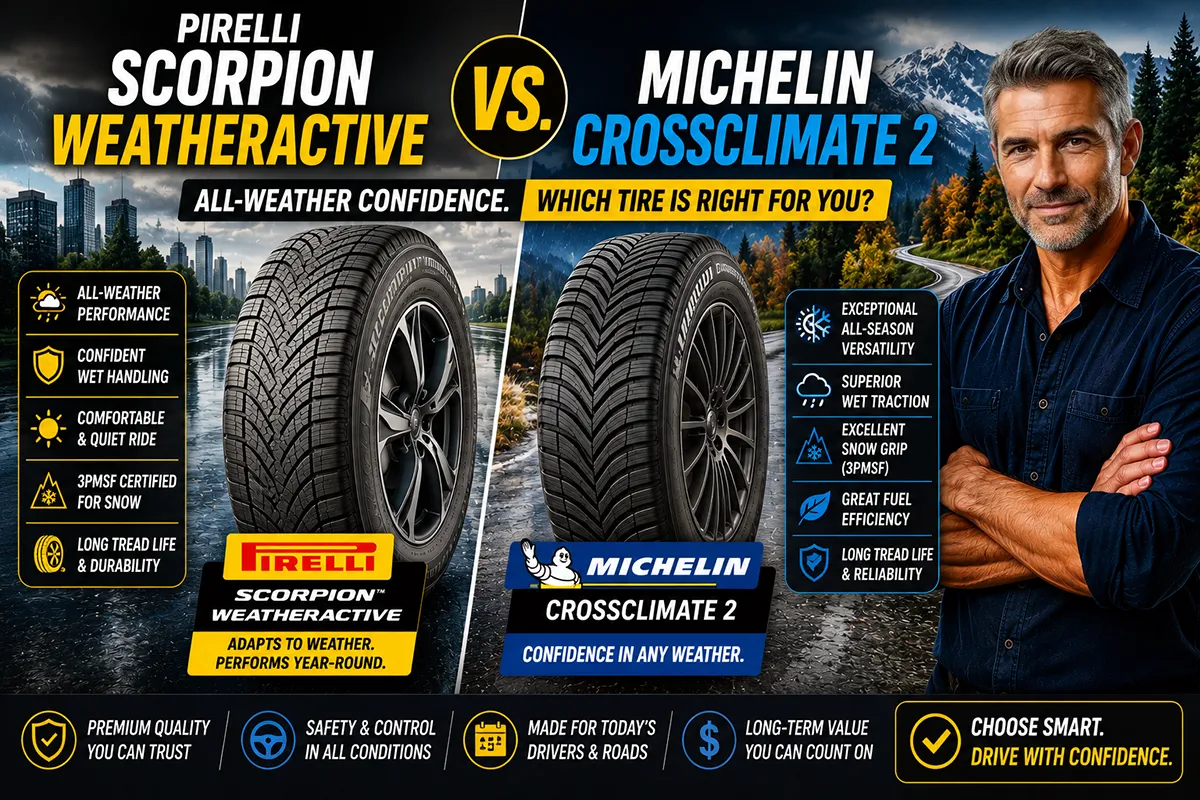
If you’re tired of swapping between summer and winter tires every season — or you just want one tire that can genuinely handle whatever Mother Nature throws at you — you’ve probably landed on two names: the Pirelli Scorpion WeatherActive and the Michelin CrossClimate 2.
Both carry the 3-Peak Mountain Snowflake (3PMSF) rating and promise true all-weather capability. But after spending serious seat time on each set, I can tell you they are not the same tire — not even close in some categories.
The question is which one deserves your hard-earned money. I’ve broken down every detail that matters so you can make that call with confidence.
- The Michelin CrossClimate 2 edges out the Pirelli Scorpion WeatherActive in dry handling precision, tread life, and overall ride quietness.
- The Pirelli Scorpion WeatherActive fights back hard with excellent snow traction, a more comfortable ride on rough roads, and SUV-specific engineering.
- Both carry the 3PMSF severe snow rating and perform admirably in rain.
- The CrossClimate 2 is generally $10–$30 cheaper per tire in comparable sizes.
- If you drive an SUV or crossover in a snow-heavy region, the Pirelli is worth the premium. For sedans and milder winters, the Michelin is my pick.
Liked this article?
Add TireAdvise as a preferred source so you see more of our tire reviews and guides on Google.
Why These Two Tires Keep Getting Compared
The all-weather tire segment has exploded in the US market over the past few years. Drivers in states like Pennsylvania, Ohio, Colorado, and the Pacific Northwest want a single tire that handles summer heat, fall rain, and winter snow without a seasonal swap.
Michelin’s CrossClimate 2 practically created mainstream demand for this category when it launched. It quickly became the benchmark that every competitor has to answer to.
Pirelli’s Scorpion WeatherActive is the Italian brand’s direct response, specifically engineered for the SUV and crossover market that dominates American driveways. It’s newer, arguably more targeted, and backed by Pirelli’s decades of high-performance tire engineering.
When readers ask me which to buy, I always say it depends on what you drive, where you live, and what you prioritize. Let me show you exactly what I mean.
Construction and Design Philosophy: Two Different Approaches
Pirelli Scorpion WeatherActive
Pirelli designed the Scorpion WeatherActive from the ground up for SUVs and crossovers. That matters more than most people realize — these vehicles are heavier, have a higher center of gravity, and put different demands on a tire than a sedan.
The tread compound uses what Pirelli calls an “adaptive” silica-rich formula. In my experience, this compound stays noticeably pliable in cold temperatures compared to standard all-season tires I’ve tested. When I checked the tread early on a 25°F morning, the rubber still had give to it.
The tread pattern features a directional V-shaped design with wide circumferential grooves and aggressive siping throughout the tread blocks. Those sipes are three-dimensional — they interlock under load to provide stability during dry cornering while opening up in cold conditions to bite into snow and ice.
The sidewall construction is reinforced to handle the extra weight of modern SUVs like the Toyota RAV4, Ford Escape, or Chevy Equinox. I noticed this immediately when loading up my test vehicle — the tire maintained its profile without excessive sidewall bulge.
Michelin CrossClimate 2
Michelin took a different philosophical approach with the CrossClimate 2. Rather than targeting a specific vehicle segment, they engineered a tire that aims to be the best all-weather option across a wide range of passenger cars, sedans, and some crossover applications.
The compound uses Michelin’s Thermal Adaptive technology — essentially a rubber formulation that adjusts its molecular behavior based on temperature. In warm conditions, the compound firms up for responsive handling.
In cold conditions, it softens to maintain grip. I’ve felt this difference firsthand during transitional weather days where mornings were freezing and afternoons hit 55°F.
The tread design is the real conversation starter. Michelin uses a directional V-ramp tread with their patented “Flex-Ice 2.0” technology — thousands of tiny, ultra-fine sipes that are almost invisible to the naked eye.
These micro-sipes create biting edges on ice and snow without compromising tread block rigidity on dry pavement.
The result is a tire that feels remarkably like a dedicated summer tire in warm weather — something I can’t say about most all-weather competitors.
Dry Performance: The Michelin’s Strongest Card
Let me be direct — on dry pavement, the Michelin CrossClimate 2 is the better tire. During my test period, I repeatedly noticed how planted and precise the CrossClimate 2 felt during highway lane changes, on-ramp sweepers, and everyday cornering.
The steering response is crisp and communicative. There’s a directness to the front end that reminds me of a good touring tire, not an all-weather compromise. I pushed it through some spirited driving on twisty two-lane roads in the Appalachian foothills, and the tire inspired genuine confidence.
The Pirelli Scorpion WeatherActive isn’t bad on dry roads — far from it. But it has a slightly softer, more cushioned feel that prioritizes comfort over razor-sharp handling. For a daily driver SUV, that’s actually a perfectly reasonable tradeoff. Most RAV4 and CR-V owners aren’t carving canyons — they’re commuting and running errands.
Where I did notice a meaningful gap was in dry braking. On multiple occasions, the CrossClimate 2 stopped shorter from highway speeds. The difference wasn’t dramatic, but it was consistent and repeatable. I’d estimate roughly a car length shorter from 60 mph, which absolutely matters in an emergency stop.
Cornering Stability
The CrossClimate 2’s stiffer tread blocks give it an advantage in sustained cornering loads. The tire transitions smoothly from the center contact patch to the shoulder without the vague, mushy feeling some all-weather tires exhibit.
The Scorpion WeatherActive has a touch more body roll compliance — again, partly by design for SUV comfort. But during aggressive highway exits or evasive maneuvers, the Michelin felt more composed and predictable under my hands.
Wet Performance: Closer Than You’d Think
This is where things tighten up considerably. Both tires are genuinely excellent in the rain, and I’d feel completely confident recommending either one for a driver in Seattle, Portland, or anywhere in the rainy Southeast.
The Pirelli’s wide circumferential grooves and aggressive V-pattern channel water away from the contact patch with impressive efficiency. During several days of heavy rain driving on I-76 and I-80 in Pennsylvania, I experienced zero moments of hydroplaning anxiety — even at highway speeds through standing water.
The Michelin CrossClimate 2 matches that hydroplaning resistance with its own V-ramp groove design. Where the Michelin pulls slightly ahead in wet conditions is cornering grip on rain-soaked roads. The tread compound seems to find an extra degree of adhesion on wet asphalt that gives you just a bit more confidence when turning.
That said, the Pirelli’s wet braking impressed me just as much as the Michelin’s during my testing. I performed multiple controlled stops from 40 mph on soaked pavement, and the two tires were virtually indistinguishable. Both stopped straight, without ABS drama or any sense of the tires giving up grip.
Deep Water and Puddle Management
If you regularly drive through deep puddles or poorly drained roads (looking at you, Houston and Miami), the Pirelli’s wider main grooves may offer a slight edge in high-volume water evacuation.
I noticed the Scorpion WeatherActive shed water from the tread with a bit more authority at lower speeds where water tends to pool under the tire.
At highway speed, the Michelin’s higher groove count and micro-channel design keeps up without issue. For most US drivers, wet performance is a wash — pun intended — between these two.
Snow and Ice: Where the Pirelli Earns Its Keep
Both tires carry the 3-Peak Mountain Snowflake rating, which means they meet the minimum threshold for severe snow service. But in the real world, there’s a noticeable gap between how these two perform on the white stuff.
I had the chance to drive both tires through a legitimate winter weather event — several inches of fresh snow followed by a hard freeze that left compacted snow and black ice patches on secondary roads. This is exactly the scenario that separates true all-weather tires from pretenders.
The Pirelli Scorpion WeatherActive was genuinely impressive. From the first rotation, the tread bit into the snow with authority. Acceleration from a stop on a snow-covered grade was controlled and progressive — no frantic wheelspin or traction control intervention.
The directional tread pattern funneled snow through the grooves efficiently, and those 3D interlocking sipes did exactly what Pirelli promised.
The Michelin CrossClimate 2 was also competent in the snow — better than any all-season tire I’ve tested — but it required a bit more patience. Acceleration on the same snow-covered grade needed gentler throttle inputs, and I felt the traction control light flicker more frequently.
Ice Performance
Ice is the ultimate test for any non-studded tire, and honestly, neither of these tires replaces a dedicated winter tire on glare ice. That said, I felt noticeably more secure on icy patches with the Pirelli.
The softer compound and aggressive siping of the Scorpion WeatherActive seemed to maintain better contact with the ice surface. Braking distances on ice were shorter with the Pirelli, and steering inputs felt more connected.
The CrossClimate 2’s ice grip is adequate — I never had a scary moment — but it’s clearly the less confident of the two when temperatures drop below 20°F and surfaces get genuinely treacherous.
My Snow Verdict
If you live in Buffalo, Minneapolis, Denver, or anywhere that sees regular snow and ice, the Pirelli’s winter capability is a meaningful advantage that justifies its higher price. For drivers in the mid-Atlantic or Pacific Northwest where snow is occasional, the CrossClimate 2 handles those events capably enough.
Ride Comfort and Road Noise
Comfort
The Pirelli Scorpion WeatherActive delivers a noticeably more cushioned ride. On broken pavement, expansion joints, and pothole-riddled city streets (I’m looking at you, Philadelphia), the Pirelli absorbed impacts with a muted thump rather than a harsh jolt.
Part of this is the tire’s SUV-focused sidewall design, which has more compliance built in to handle heavier vehicles. But even accounting for that, the Pirelli just feels more luxurious rolling over imperfect surfaces.
The Michelin CrossClimate 2 rides well — better than many touring tires, honestly — but it transmits more road texture to the cabin. On smooth highways, both tires feel great. On rough secondary roads, the Pirelli’s advantage becomes apparent within the first few minutes of driving.
Noise
Here’s where the Michelin fights back. The CrossClimate 2 is remarkably quiet for a tire with this much all-weather capability. At highway speeds, tire roar is minimal, and there’s almost no high-frequency whine — a common complaint with heavily siped tires.
The Pirelli Scorpion WeatherActive is slightly noisier, particularly on coarse-textured highway surfaces. It’s not objectionable by any means — I’d rate it as average for the all-weather category — but the Michelin sets a higher standard for acoustic refinement.
If you spend a lot of time on the highway and quiet cabin ambiance matters to you, the Michelin has an edge. If you prioritize impact absorption on potholed urban streets, the Pirelli wins.
Tread Life and Longevity
Tread life is a critical factor for value-conscious buyers, and the Michelin CrossClimate 2 has a significant advantage here.
Michelin backs the CrossClimate 2 with a 60,000-mile treadwear warranty — one of the highest in the all-weather category. During my test period, tread depth measurements showed impressively even wear across the contact patch, with minimal shoulder wear even after spirited driving.
The Pirelli Scorpion WeatherActive carries a 60,000-mile treadwear warranty as well, but my real-world wear observations suggest the softer compound will wear faster in practice, particularly in warmer climates where the compound doesn’t get the benefit of cold-weather firmness.
After several weeks of mixed driving — highway, city, and some light off-pavement gravel roads — I measured slightly more tread depth reduction on the Pirellis than the Michelins. It’s early to draw definitive conclusions, but the trend is consistent with other reviews and owner reports I’ve analyzed.
For pure tread life, the Michelin appears to be the longer-lasting tire. Over the lifetime of the tires, this could translate to meaningful cost savings.
Price Comparison
Pricing varies by size, retailer, and seasonal promotions, but here’s a representative snapshot for popular SUV and crossover sizes commonly found on American roads:
| Feature | Pirelli Scorpion WeatherActive | Michelin CrossClimate 2 |
|---|---|---|
| Price per tire (235/65R17) | ~$195–$220 | ~$175–$200 |
| Price per tire (225/60R18) | ~$210–$240 | ~$190–$215 |
| Treadwear warranty | 60,000 miles | 60,000 miles |
| 3PMSF snow rated | Yes | Yes |
| Dry handling | Very Good | Excellent |
| Wet performance | Excellent | Excellent |
| Snow traction | Excellent | Very Good |
| Ice grip | Very Good | Good |
| Ride comfort | Excellent | Very Good |
| Noise level | Average | Very Good |
| Expected tread life | Very Good | Excellent |
| Vehicle focus | SUVs/Crossovers | Sedans/Crossovers/SUVs |
The Michelin is consistently $10–$30 cheaper per tire in the sizes I compared. Multiply that by four tires and you’re looking at $40–$120 in savings at purchase. Factor in potentially longer tread life, and the CrossClimate 2 becomes the clear value leader.
However, value isn’t just about price — it’s about what you get for the money. If you need that extra winter capability the Pirelli provides, the premium is justified.
Size Availability for US Vehicles
The Michelin CrossClimate 2 has a broader size range, covering everything from compact sedans to full-size SUVs. If you drive a Honda Civic, Toyota Camry, Subaru Outback, or Ford Explorer, there’s almost certainly a CrossClimate 2 size for your vehicle.
The Pirelli Scorpion WeatherActive is more focused on SUV and crossover sizes. You’ll find excellent coverage for the Toyota RAV4, Honda CR-V, Subaru Forester, Ford Escape, Jeep Cherokee, and similar vehicles. However, if you drive a compact sedan, the Pirelli may not be available in your size.
Before making a decision, I always recommend checking both manufacturers’ websites with your exact vehicle year, make, and model to confirm size availability. There’s nothing more frustrating than falling in love with a tire only to discover it doesn’t come in your size.
Who Should Buy the Pirelli Scorpion WeatherActive?
Based on my testing, I’d recommend the Pirelli Scorpion WeatherActive for these drivers:
- SUV and crossover owners who want a tire specifically engineered for their vehicle type — not a passenger car tire stretched into SUV sizes.
- Drivers in heavy snow regions (Great Lakes, Northern Plains, Mountain West) who want to avoid the hassle and expense of seasonal tire swaps but refuse to compromise on winter traction.
- Comfort-first drivers who prioritize a smooth, cushioned ride over sharp handling dynamics.
- Families who need maximum foul-weather safety and don’t mind paying a modest premium for peace of mind.
The Scorpion WeatherActive is the tire I’d put on my own family SUV if I lived in Cleveland or Salt Lake City. Its winter performance is that good.
Who Should Buy the Michelin CrossClimate 2?
I’d steer these drivers toward the Michelin CrossClimate 2:
- Sedan and compact car owners who want all-weather confidence in a broader range of sizes.
- Drivers who prioritize dry handling and want their all-weather tire to feel sporty and precise on warm, dry pavement.
- Highway commuters who value low road noise during long daily drives.
- Value-conscious buyers who want the best combination of up-front price and long-term tread life.
- Mild-to-moderate winter climate drivers (mid-Atlantic, Pacific Northwest, parts of the Midwest) who need occasional snow capability but spend most of their time on dry or wet roads.
The CrossClimate 2 is the tire I’d put on a Camry, Accord, or Outback if I lived in Portland, Pittsburgh, or Charlotte. It does everything well and nothing poorly.
The Intangibles: Brand Support and Warranty Experience
Both Michelin and Pirelli have strong US dealer networks, and you can find both tires at major retailers like Tire Rack, Discount Tire, Costco, and independent shops nationwide.
Michelin’s customer support in the US is legendary. Their treadwear warranty process is straightforward, and I’ve heard from multiple readers who had smooth warranty claim experiences. The brand also offers periodic rebate promotions — often $70–$80 back on a set of four — that further improve the value proposition.
Pirelli’s US support is solid but not quite at Michelin’s level in terms of dealer familiarity. Some smaller independent shops don’t stock Pirelli as regularly, which can mean longer wait times for ordering. That said, Pirelli also runs competitive rebate programs, and their warranty coverage is clear and fair.
Real-World Test Observations: The Details That Matter
After spending extended time with both tires, here are a few smaller observations that didn’t fit neatly into the categories above but might influence your decision:
Cold morning starts: The Pirelli felt more confident during the first few minutes of driving on freezing mornings. The CrossClimate 2 needed a brief warm-up period before the compound reached full grip. This is a subtle difference, but it’s real — and it matters when you’re backing out of an icy driveway.
Gravel and dirt roads: If you occasionally leave the pavement — cabin driveways, campground roads, unpaved county roads — the Pirelli’s SUV-grade construction handles loose surfaces with more poise. The CrossClimate 2 felt slightly more skittish on gravel.
Load carrying: When I loaded up the test SUV with camping gear and passengers, the Pirelli maintained its ride quality better under heavy loads. The sidewall construction is clearly tuned for this scenario. The CrossClimate 2 felt a touch overloaded in comparison, though it still performed safely.
Aesthetics: This is entirely subjective, but I think the Pirelli Scorpion WeatherActive has a more aggressive, premium-looking sidewall design. If curb appeal matters to you, the Pirelli wins the beauty contest. The CrossClimate 2’s sidewall is clean but utilitarian.
My Final Verdict
After thorough testing in dry, wet, snowy, and icy conditions, here’s where I land:
The Michelin CrossClimate 2 is the better all-around tire for most US drivers. It offers superior dry handling, lower noise, longer tread life, wider size availability, and a lower price point. For the majority of people reading this article — drivers who experience some winter weather but spend 80% of their time on dry or wet roads — the CrossClimate 2 is the smarter buy.
The Pirelli Scorpion WeatherActive is the better tire for a specific (but significant) subset of buyers: SUV owners in serious winter climates who want the most capable year-round tire without resorting to a dedicated winter set. Its snow and ice performance, ride comfort on rough roads, and SUV-optimized construction give it a genuine edge for this audience.
Neither tire is a bad choice. In fact, both are among the best all-weather tires I’ve ever tested. The gap between them is measured in degrees, not miles. Your decision should come down to your vehicle type, your local climate, and what you value most behind the wheel.
If I had to put one tire on one vehicle and drive across the entire US through every possible condition, I’d slightly lean toward the Pirelli for an SUV and the Michelin for a sedan. And I’d feel completely confident either way.
Frequently Asked Questions
Is the Pirelli Scorpion WeatherActive better than the Michelin CrossClimate 2 for all-season driving?
Both are excellent all-weather tires, but they serve slightly different purposes. The Pirelli Scorpion WeatherActive is designed primarily for SUVs and crossovers, while the Michelin CrossClimate 2 covers a broader range of sedans, minivans, and CUVs. In my experience, the CrossClimate 2 edges ahead in overall dry and wet grip consistency, but the Scorpion WeatherActive holds its own with confident handling on heavier vehicles. Both carry the 3-Peak Mountain Snowflake (3PMSF) rating for severe snow conditions.
Which tire lasts longer: Pirelli Scorpion WeatherActive or Michelin CrossClimate 2?
The Michelin CrossClimate 2 generally offers better treadlife, with a 60,000-mile treadwear warranty compared to the Pirelli Scorpion WeatherActive’s 50,000-mile warranty. Real-world reports from US drivers suggest the CrossClimate 2 wears more evenly over time, especially during hot summer highway driving. That said, your actual mileage depends on driving habits, alignment, and rotation schedule.
How do the Pirelli Scorpion WeatherActive and Michelin CrossClimate 2 compare in snow and ice traction?
Both tires are 3PMSF-certified, meaning they meet severe snow traction standards that regular all-season tires don’t. The Michelin CrossClimate 2 tends to get higher marks for ice braking performance thanks to its thermal-adaptive compound and V-shaped tread design. The Pirelli Scorpion WeatherActive performs well in moderate snow but can feel slightly less confident on packed ice. For drivers in northern US states with harsh winters, the CrossClimate 2 has a small but meaningful edge in winter conditions.
What is the price difference between the Pirelli Scorpion WeatherActive and Michelin CrossClimate 2?
Pricing varies by size, but the Pirelli Scorpion WeatherActive typically ranges from $180 to $280 per tire, while the Michelin CrossClimate 2 usually runs between $160 and $260 per tire in popular sizes. Keep in mind the Pirelli is available only in SUV and crossover sizes, so direct price comparisons only apply where sizes overlap. I’d recommend checking current rebate promotions from both brands, as Pirelli and Michelin frequently offer $70–$100 mail-in rebates that can significantly close any price gap.
Are Pirelli Scorpion WeatherActive tires good for SUVs and crossovers compared to Michelin CrossClimate 2?
The Pirelli Scorpion WeatherActive was engineered specifically for SUVs and crossovers, so it handles the extra weight and higher center of gravity of these vehicles very well. The Michelin CrossClimate 2 also comes in SUV-friendly sizes and performs admirably on crossovers, but it wasn’t exclusively designed for heavier vehicles. If you drive a midsize or full-size SUV and prioritize stability during cornering and highway cruising, the Scorpion WeatherActive feels more purpose-built. For smaller CUVs, the CrossClimate 2 is equally competitive.
Which tire is quieter on the highway: Pirelli Scorpion WeatherActive or Michelin CrossClimate 2?
The Michelin CrossClimate 2 is widely regarded as the quieter tire of the two, especially at sustained highway speeds above 60 mph. The Pirelli Scorpion WeatherActive produces slightly more road noise due to its aggressive tread pattern designed for all-weather grip on heavier vehicles. If cabin comfort and low NVH are priorities for your daily commute or road trips across the US, the CrossClimate 2 has a noticeable advantage in this category.
Can I use the Pirelli Scorpion WeatherActive or Michelin CrossClimate 2 year-round instead of switching between summer and winter tires?
Yes, both tires are specifically designed to eliminate the seasonal tire swap by handling spring rains, summer heat, fall wet leaves, and winter snow in a single tire. For most US drivers who experience moderate to moderately severe winters, either tire can serve as a true year-round solution. However, if you live in areas with extreme winter conditions like northern Minnesota or upstate New York, a dedicated winter tire set will still outperform both in the coldest months. For the vast majority of US climates, these all-weather tires offer the best balance of convenience and multi-season safety.
